From our webinar, Turning POCs into Revenue, produced with RevGenius and featuring John Care, author of Mastering Technical Sales, and Gilad Komorov, three-time CRO and GTM advisor. Watch the recording
Your proof of concept is the most expensive stage of your sales cycle. It's also the one most likely to quietly kill your deal.
Enterprise SaaS teams optimize the top of the funnel relentlessly. Then a deal that took 12 to 18 months and tens of thousands of dollars to nurture reaches the POC stage and stalls. It doesn't lose to a competitor or fail on product-market fit. It dies in a “no decision.”
The good news: POC failure is a system problem, and you can fix a system. Below are the six failure modes that sink enterprise evaluations, and the alignment framework that beats them.
First, put a price tag on your POC
The numbers make the case:
- The average enterprise sales cycle runs 10+ months, and the POC, typically 4 to 8 weeks, is the single longest stage inside it.
- For six-figure ACV deals, you spend nearly $2 for every $1 of revenue you eventually book.
- 40 to 60% of pipeline deals end in no decision, so they don't lose so much as evaporate.
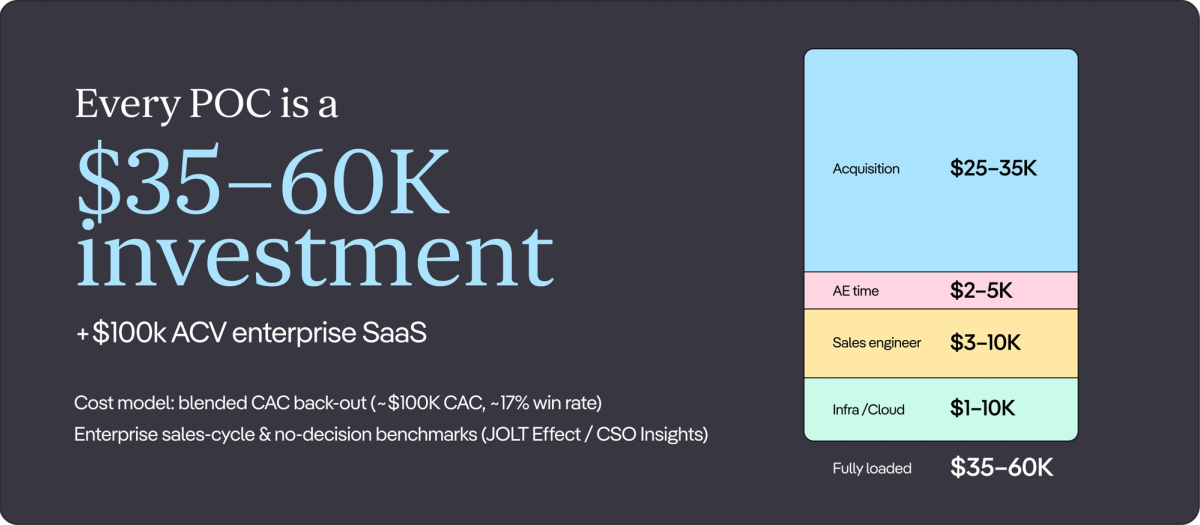
- A single POC costs roughly $35,000 to $60,000+ once you add acquisition cost, AE and SE time, enablement, customer success, and the infrastructure to show value.
Put a dollar figure on it. Once you treat every POC as a $50K to $70K investment, your whole approach changes. You walk away from evaluations you can't win, and you run the ones you do enter with far more intent.
The mistake almost everyone makes
The biggest misconception is treating the POC as a technical validation exercise.
The technical win matters, and it's table stakes. If your product can't solve the problem, nothing else counts. But plenty of teams land the technical win and still lose to no decision. The POC turns on alignment around value and impact. Proving the tech runs is only the entry ticket.
A technical win means the customer agrees you're uniquely qualified to run in their environment and solve their business problems. It's a precursor to the business win, usually by five or six weeks. Any SE who thinks “my job is to make this POC work, then I'm done” has misread the job. The technology and the business are intertwined, and you have to complete both.
The alignment framework
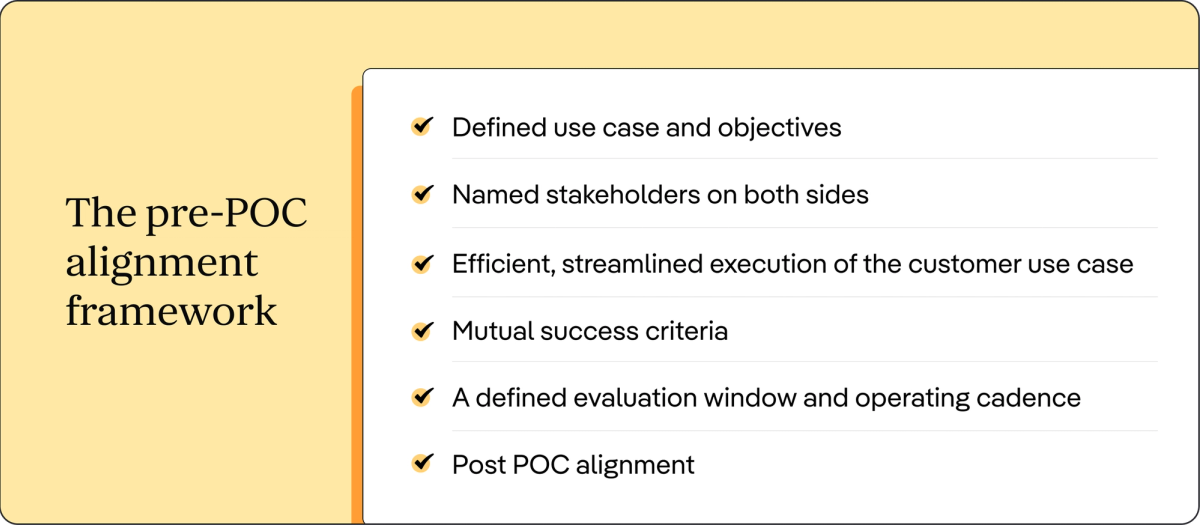
Invert the six killers and the framework writes itself.
Before the POC.
Align on use cases and objectives. Send a short pre-POC questionnaire so the customer supplies the context you need to run something focused and intentional.
Build a POC kickoff deck. The deck is the artifact that forces the conversation. It should cover objectives, measurable success criteria (the decision can't come down to a gut feeling, it has to be a clean yes/no), stakeholders, and process. On stakeholders, aim for 3x3 alignment: AE, SE, and executive sponsor on your side; business champion, technical champion, and executive sponsor on theirs. More alignment there means less risk in the deal.
On timeline, there's no magic number. Forget the reflexive 30-day POC. The right length is however fast you can prove value. Some teams close a one-day POC when that's all it takes to show impact.
During the POC.
Streamlined execution, confined to the agreed use cases. Tempting as it is to show off adjacent features, hold the line and stay inside the scope tied to your objectives and success criteria.
After the POC.
Treat the wrap-up with real respect. Dry run with your champion, testimonials in hand, success criteria demonstrated, and a tight plan to convert the POC into a signed deal.
Ownership is a tag team. The AE kicks off the POC properly, hands the baton to the SE to lead execution (with the AE still navigating from the passenger seat), then climbs back into the driver's seat to bring it home. The SE is the most trusted voice in the room, the person buyers consistently rank as providing the most value in a deal. Few teams use that advantage.
What sharper discovery surfaces
Discovery is the multiplier under all of this. In one competitive evaluation, three vendors ran week-long POCs with about half a million dollars on the line. One team did far deeper discovery and surfaced the real stakes: a delayed product launch would cost the customer $8 million and eight weeks. Same product, same week, very different framing, and the deal followed the vendor who understood what the POC was actually protecting.
Where Demostack fits
Most of this framework is process. One part is tooling: the lighter-weight alternative to a full POC.
A Demostack sandbox gives your buyer a hands-on, trial-like environment tailored to their world, with no engineering setup and no production risk. Rather than spending weeks provisioning a custom POC, an SE sends a sandbox leave-behind the buyer and their committee can explore on their own time.
It answers three of the six killers directly:
- The generic environment: sandboxes reflect the customer's reality instead of abstract sample data, and they set up instantly.
- The management gap: usage tracking runs automatically, so you know whether the committee is running the agreed use cases.
- The visibility gap: engagement analytics show exactly which features landed, and that data flows into your CRM so the evaluation never goes dark.
Hunters proved the model. By replacing their traditional POC motion with a sandbox-led “Express POC,” they cut many sales cycles in half, freed their SEs from weeks of environment setup, trimmed the cloud cost of standing up POC environments, and gave channel partners a controlled environment to demo in on the first call. Their VP of Sales Engineering has closed deals with no POC at all, at a higher ACV, off the strength of the sandbox alone.
The bottom line
The framework is how you win the POCs you run. The sandbox is how you run fewer of them, and win more of the deals underneath. Price the POC like the investment it is, refuse to enter without alignment, and give the buyer a hands-on path to value that doesn't cost you six weeks of engineering time.