# Demostack.com
> Demostack is the demo experience platform that lets you accelerate revenue with better product storytelling. Spin up a sales demo environment in minutes, tailor the story, and win more deals faster.
## Demostack for Sales
Source: https://www.demostack.com/demo-for-sales
Equip frontline GTM teams with the independence to deliver expert-level product experiences from day one, eliminating technical bottlenecks and accelerating your path to revenue.
Get a Demo
Enable market-facing teams to guide and pivot their narrative on the fly. Provide access to high-fidelity product simulations, your team can customize to show specific product value without waiting for a technical resources or support.
- **Unmatched Demo Agility:** Switch between product variants or user personas seamlessly during a live meeting with “Chrome tab” navigation.
- **Eliminate the "SE Bottleneck":** Empower reps to handle early-stage demos independently while maintaining a high technical standard and narrative consistency.
Ensure every rep demos like an expert. In-context guidance allows sellers to navigate complex product use cases with institutional knowledge embedded directly into the experience.
- **Presenter-Pro:** View "invisible" talking points and ROI callouts that guide the narrative without distracting the prospect.
- **Navigation Guardrails:** Prevent reps from getting lost in the UI with interaction blockers that keep the demo on the "golden path."
- Deploy functional, hands-on POC sandbox environments for prospects to explore and share internally to build consensus.
- **Customized Journeys:** Create customized product journeys and data that bring customer use cases to life.
Transform your Sandbox leave-behinds into actionable intelligence. Provide buyers with functional, hands-on simulations and track exactly how the entire buying committee interacts with your solution.
- **Identify Intent Signals and Deal Blockers:** See exactly which features stakeholders spend the most time on. Get real-time engagement alerts pushed directly to your CRM or Slack.
- **Trigger Intent-Based Follow-ups:** Automatically trigger followup communication based on the hands-on evaluation that takes place outside of the sales presentation.
Get the guide
## Sales enablement demo platform
Source: https://www.demostack.com/your-sales-enablement-demo-platform
Accelerate deals with demo assets at sales’ fingertips.
Sales enablement starts at demos.
Let us show you how you can move the revenue needle.
Get a demo
See it live


















Equip AEs’, Partners & Solutions’ fingertips with demo templates for every situation. Accelerate deals by empowering sales to show the product early and often. Go-to-market quickly with demo assets that you can easily create and customize.
Give sales a stable, custom & consistent demo. Create demo template for every persona, industry and segment that stay up to date. Ensure sales is free from demo surprises, with a demo instance independent of your production environment.
Train your sales team with interactive product tours and add speaker notes to live demo assets for seamless presentations. Use analytics to track to see what is being shown and by who, even if the demo asset is stored off Demostack in your LMS.
David Greene

Sr. Manager, SC Enterprise at Gainsight
"Gainsight’s sales team has achieved an impressive 8% increase in close-win rates by leveraging Demostack-powered demos. Demostack demos closely replicate the look and feel of our actual products and are easy to customize."
Tim Nordvedt

Solution Architect at Synack
Synack cut demo build time from 100+ hours to under 10 with Demostack. Before, we spend on average 20% of our week on demo building & maintenance . That's 1 working day per week on just demo hygiene!
Rob De Marco

Vice President of Solutions Consulting at Xactly Corp
“With Demostack, our Solution Consultants (SCs) have become significantly more efficient, as Account Executives (AEs) now have access to customized, ready-to-use demos at their disposal.”
Hanan Levin

VP Sales at Hunters.Security
Demostack's Sandbox helped us cut the sales cycle by 50%. Now, both Enterprise and SMBs now buy us in just 4 months, compared to 9 months.
Sarah Goldstein

Head of Product Marketing + GTM at Cyrebro
"With Demostack, over 200 partner users can independently demo our product without concerns about accidentally breaking our demo environment. Demostack allowed us to easily create a demo environment that is 99% indistinguishable from our actual platform, the only solution on the market that could do that."
Sudipto Kar

Senior Solutions Consultant at Gloat
“The platform experience is very intuitive and allows us to manage different versions of the demo environment well. It helps drive a consistent experience for all stakeholders, driving better business outcomes.”
Bryan Rowland

Director of Solutions Architecture at BlueVoyant
“We used Demostack for a multi-million dollar RFP and it allowed us to showcase the value of our product with a much stronger story in the demo. That was all the ROI we needed in one call."
Joe Buchanan

VP of Sales Engineering at Hunters
“I was sold on Demostack within the first 20 minutes of walking through it just knowing all the pain points I’ve had over the years of standing up a demo environment. You’re constantly having to chase down other teams to keep it updated with fresh data and content, and the maintenance becomes just as time consuming as setting it up in the first place. I haven’t seen any other tools that come close to the value that Demostack provides.”
Matthew Bigelow

Director of Global Revenue Enablement at WalkMe
“Demostack is our dream demo environment. Before customizing our dashboards and analytics to tell a story of WalkMe's impact was impossible. With Demostack we can easily edit graphs and showcase data-driven product stories for any deal. It's a total game changer for us.”
## Demostack MCP: Integrate, without making it a project
Your AI tool can now answer questions like "which demo converts best" or "which SE showed what" straight from your Demostack data.
## Demostack for GTM Teams
Source: https://www.demostack.com/teams
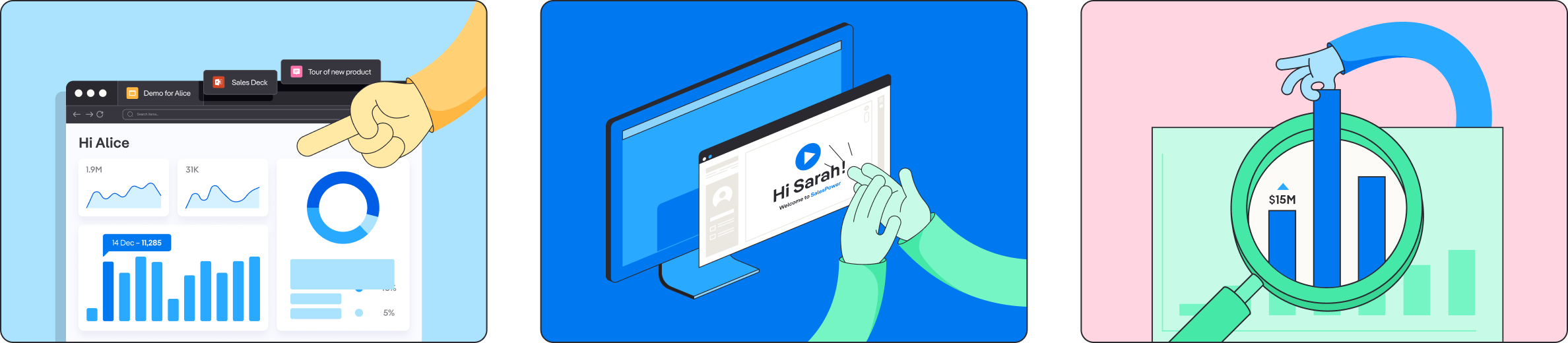


Create and personalize sales demos without having to rely on R&D or waiting on SE support.

Track engagement, see which features resonate, and refine your demo approach.

Share interactive sandboxes as a leave-behind so prospects can explore and build internal buy-in.
Talk to us
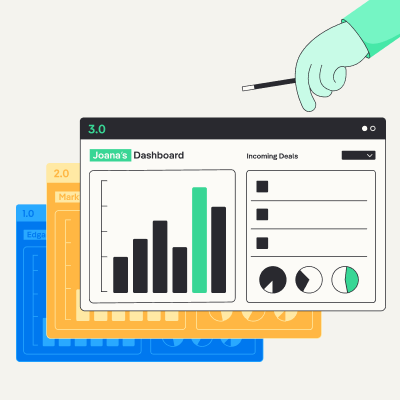

Enable AEs to run first-call demos while SEs focus on later stage or strategic deals.

Prebuilt demo templates by persona, industry, or use case.

Share hands-on sandboxes post-demo as a leave-behind so buyers can explore and validate faster.
Talk to us


Interactive tours and sandbox environments help partners learn your product quickly.

Provide a controlled demo environment that partners can personalize for prospects—without straying off course.

See how partners use demos and which ones lead to closed deals.
Talk to us


Let buyers explore your product with interactive, self-guided product tours on their own.

ncrease conversions with pre-qualified leads who have already experienced your product and understand its value.

Quickly create highly targeted, self-guided tours specific to each target or campaign.
Talk to us


Enable new employees with interactive product tours that guide them through user flows by use case, vertical, or persona.

Sandbox environments provide a risk-free way to practice and refine demo skills.

Keep product knowledge fresh with always-on demo resources and playbooks.
Talk to us
## Let every team demo - Their Way
From live sales calls to self-serve experiences, Demostack gives your GTM teams full control over how they showcase your product.
## Presales Insights
Source: https://www.demostack.com/presales-insights
We spoke with 6 senior leaders about the challenges and opportunities of using data and analytics to inform decisions for presales departments.

Learn more
- **Activity metrics:** How many demos are we doing?
- **Outcome metrics:** What is our win-rate?
- **Customer metrics: **What did the customer care about on the call?
- There is a lot of data presales teams need to track. Are you tracking the right data?
- The most impactful data is presales’ revenue relationship and win rate impact. Or “outcome metrics.”
- Activity data helps make sure presales are spending their time on the right activities. But tracking activity data is hard.
- Demo Software provides presales teams with new buyer engagement data.
- With non-traditional pre-sales KPIs, presales leaders are transforming how they speak with sales leadership.
- Demostack’s Salesforce Integration makes it easier to marry sales and presales data.
- The more data you collect with purpose, the more you can slice and dice into valuable insights later.
- Harbor tour demos are boring, but are they worth the investment of customization?
- Deirdre was able to measure the impact of customizing demos.
- She showed that they increased win rate by more than 10% for her product.






Unlock the power of demo data to optimize your sales performance. This guide provides the tools to turn your demos into actionable insights and deal-winning strategies.
## Demostack MCP: Integrate, without making it a project
Your AI tool can now answer questions like "which demo converts best" or "which SE showed what" straight from your Demostack data.
## Demostack for Partner Marketing & Certification
Source: https://www.demostack.com/partner-marketing-and-certification
Scale technical expertise to your entire partner ecosystem. Provision thousands of concurrent, stable training labs without the overhead of expensive cloud server instances or manual engineering support.
Get a Demo
Eliminate the high spend associated with traditional Virtual IT Labs by deploying a lightweight simulation layer that supports thousands of concurrent sessions without the need for dedicated VM server instances.
- **Zero-Service Provisioning:** Deploy technical training labs instantly without DevOps or engineering involvement.
- **Massive Server ROI:** Replace heavy server tenants with efficient, pixel-perfect and fully functional product simulations
Ensure your resellers and partners are demoing your product correctly with high-fidelity and secure labs protected by interaction guardrails that guarantee they're aligned with your approved narrative.
- **Stateful Training Labs:** Break complex product clones into manageable, certifying lab pieces for partner training.
- **Compliance Control:** Grant external access to product simulations without ever exposing live production backends or data.
Help partners tell a cohesive "Platform" story. Connect simulations from multiple products into a single navigation experience, allowing for seamless cross-product discovery without technical friction.
- **Multi-App Playbooks:** Seamlessly jump between different products or users without the lag of multiple logins.
- **Platform Storytelling:** Create a smoother, more professional "Suite" story for multi-product enterprise deals.
Get the guide
## Demostack for Solutions Engineering
Source: https://www.demostack.com/solution-engineering
10X your SE team's velocity and quality, and reduce hours spent on environment hygiene, by deploying a scalable product simulation infrastructure. Build, manage, and customize high-fidelity simulations that embed your expert knowledge in the demo experience.
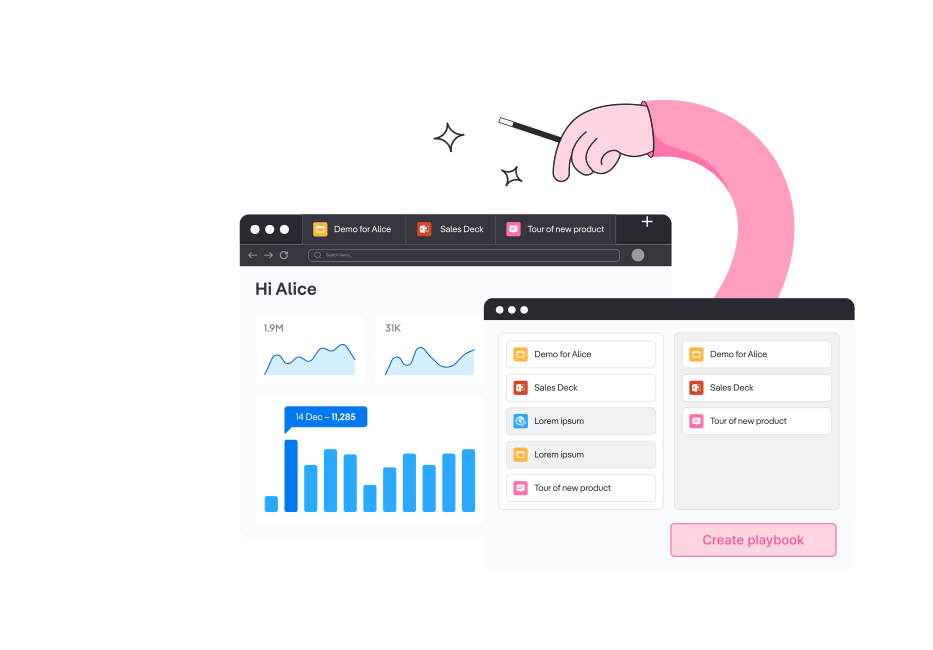
Get a Demo
Automate the repetitive grunt work of demo staging. Replace manual data resets and hard-coding with environments that are perfectly setup every single time.
- **Automated Stateful Resets:** Ensure every session starts with a clean slate without manual database intervention.
- **One-Click Mass Personalization:** Use AI power-tools to swap logos, names, and data points across hundreds of assets in seconds.
Simulate complex product use cases that linear and rigid demos can't handle. Manipulate network and API data to show stateful outcomes and business-critical logic.
- **Hybrid Flexible Playbooks:** Combine stable cloned flows with live app overlays to handle unpredictable prospect questions.
- **Deep Data Manipulation:** Implement JS/CSS overrides, intercept and edit network/API transactions, to show dynamic data states without backend changes.
Remove the risk of production data exposure. Provision high-fidelity sandboxes for external evaluations that are entirely decoupled from production and easily scrub sensitive information.
- **Native PII Masking:** Replace personally identifiable information with safe, realistic data using our AI-powered data generator and data variable editing.
- **Isolated Infrastructure:** Run fully functional POCs in independent environments that meet enterprise security standards.
Get the guide
## Product tour
Source: https://www.demostack.com/product-tour
Demostack
Platform Tour
See how Demostack helps you build, analyze and share demos
Watch a complete product tour of Demostack top features: Cloner, sandbox, analytics, playbooks, AI data editor and more.
See the platform
## Demostack for Product Marketing & Enablement
Source: https://www.demostack.com/product-marketing-enablement
Close the gap between product innovation and field execution.
Demostack ensures that your "Expert Story" stays consistent across every region and every launch, providing a safe environment for your team to master the product.
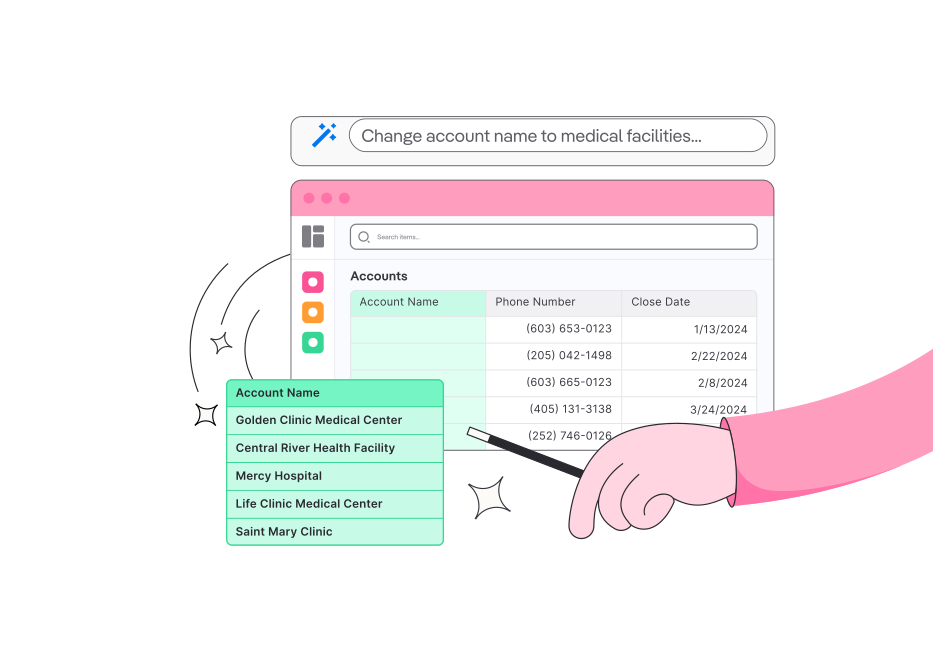
Get a Demo
Equip your field with demo-ready assets before production is stable. By decoupling GTM speed from R&D staging cycles, you can train your team and show value to the market on launch day.
- **Pre-Launch Clones:** Capture high-fidelity simulations of new features while they are still in the development phase to prep internal teams for launch day.
- **Global Translation:** Localize your entire demo library into 10 languages with a single click to ensure regional consistency.
- Reduce AE ramp times by moving training from passive shadowing to active mastery. Provide new hires with hands-on practice environments where they can learn to demo in a consequence-free space.
- **Enablement "Flight Simulation":** Build active practice playbooks where reps practice talking and clicking simultaneously alongside technical explanations and expert guidance
Lower the friction for top-of-funnel prospects. Embed interactive website simulations that allow buyers to experience value immediately, capturing high-intent leads directly into your CRM.
- **Guided Website Tours:** Guide visitors through high-value features with compelling product experiences.
- **High-Intent Lead Capture:** Gate interactive experiences with CRM-integrated forms and password protected simulations to identify buyers who are actively engaged.
Get the guide
## Platform Overview: The Product Simulation Layer
Source: https://www.demostack.com/platform/demo-hq
With demo assets, tools, and analytics in one place, you can scale your demo operation and win more deals faster. No code needed.
Get a demo
Enable buyers to self-educate with guided product walk-throughs.
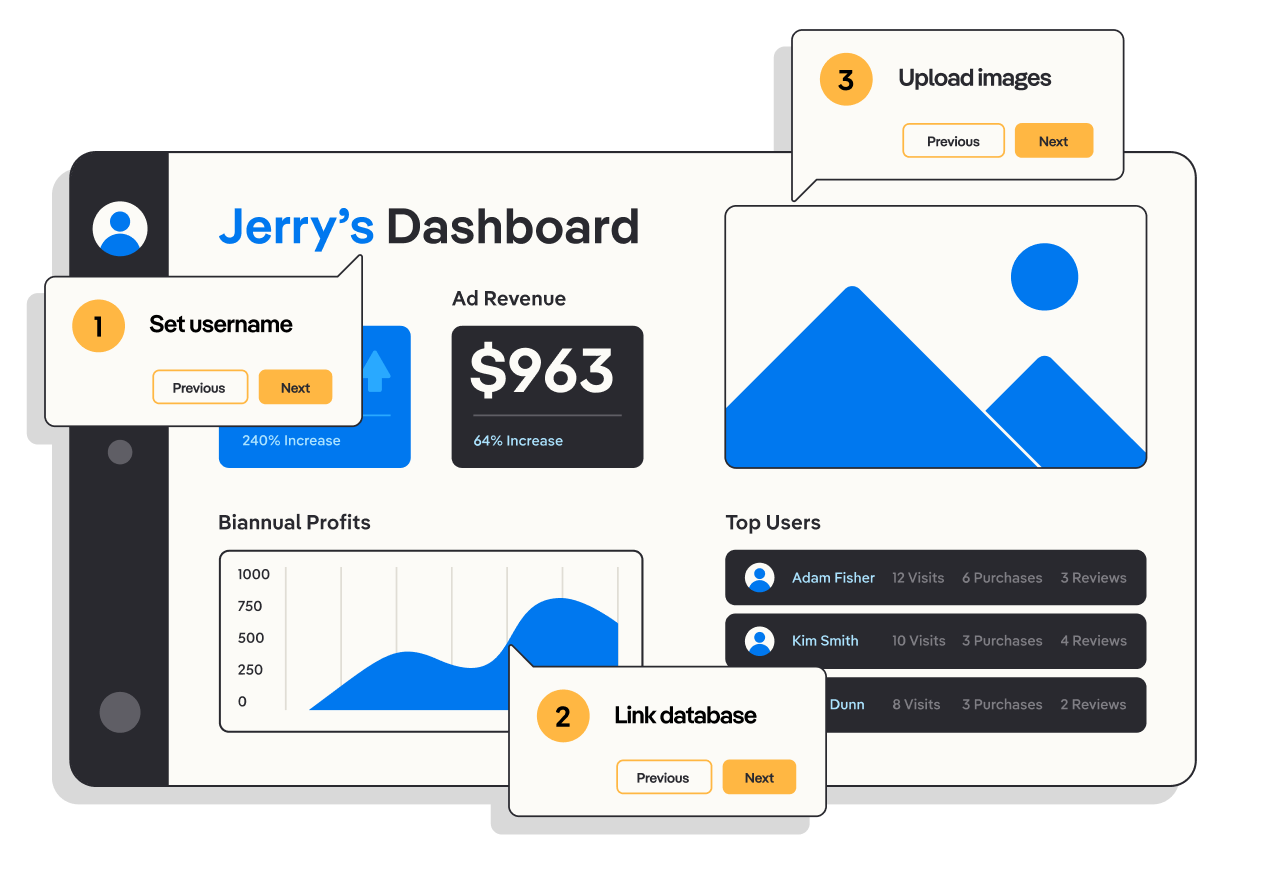

Mask your existing environment with a story that resonates on every live demo.
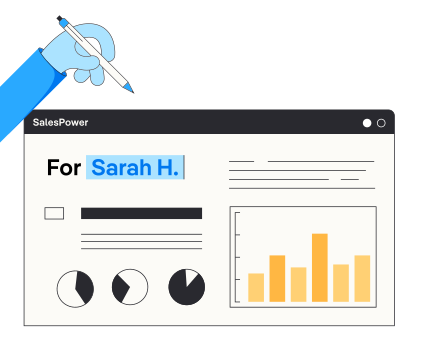

Scale your demo operation with an independent demo environment, built for showcasing.
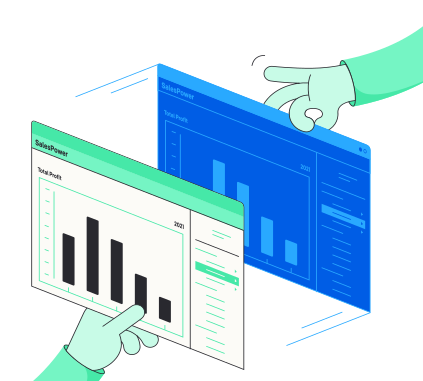

Say goodbye to unreliable demos, SEs required on every call, and demo admin overload. Demostack makes it easy to showcase your product in the best light, without the hassle.
Get a demo
Fill your demo environment with relevant content and data, so value is a no brainer. Edit with a point and click.


Immerse your prospects in a tailored product story, whether that’s in a self-guided tour, first-call micro demo, or fully customized technical walk-through.
Get product into your customer’s hands faster with a trial-like environment, tailored to their business. They can explore the product and share with other internal stakeholders, while you gather insights on who’s viewing what, when.
Your demo operation was a black box - until now. Understand your most effective demo flows, how many demos it takes to close a deal by segment, which features your buyers care about, and more.
Get a demo
We give revenue teams complete control over the demo environment, so engineers can focus on building a great product.
|
Requires engineering resources, or even a team focused solely on managing the demo environment.
|
Puts revenue teams in control of the demo, so engineering can focus on building a great product.
|
|
Default to ACME, Inc. story or spend weeks building out a tailored version.
|
Customize every demo in minutes with a few clicks.
|
|
Data quickly becomes outdated, requiring constant updates to dummy data to showcase relevant product stories.
|
Replace data throughout your demo with a few clicks.
|
|
Risk of product surprises and bugs.
|
Deliver flawless demos that are independent from hiccups in your live product.
|
David Greene

Sr. Manager, SC Enterprise at Gainsight
"Gainsight’s sales team has achieved an impressive 8% increase in close-win rates by leveraging Demostack-powered demos. Demostack demos closely replicate the look and feel of our actual products and are easy to customize."
Tim Nordvedt

Architect Solution at Synack
"Synack cut demo build time from 100+ hours to under 10 with Demostack. Before, we spend on average 20% of our week on demo building & maintenance . That's 1 working day per week on just demo hygiene!"
Rob De Marco

Vice President of Solutions Consulting at Xactly Corp
“With Demostack, our Solution Consultants (SCs) have become significantly more efficient, as Account Executives (AEs) now have access to customized, ready-to-use demos at their disposal.”
Sarah Goldstein

Head of Product Marketing + GTM at Cyrebro
"With Demostack, over 200 partner users can independently demo our product without concerns about accidentally breaking our demo environment. Demostack allowed us to easily create a demo environment that is 99% indistinguishable from our actual platform, the only solution on the market that could do that."
Sudipto Kar

Senior Solutions Consultant at Gloat
“The platform experience is very intuitive and allows us to manage different versions of the demo environment well. It helps drive a consistent experience for all stakeholders, driving better business outcomes.”
Bryan Rowland

Director of Solutions Architecture at BlueVoyant
“We used Demostack for a multi-million dollar RFP and it allowed us to showcase the value of our product with a much stronger story in the demo. That was all the ROI we needed in one call."
Joe Buchanan

VP of Sales Engineering at Hunters
“We’ve already closed 3 deals without a POC thanks to our Demostack Sandbox. It’s accelerating our deals through the funnel - and at a higher ACV.”
Matthew Bigelow

Director of Global Revenue Enablement at WalkMe
“Demostack is our dream demo environment. Before customizing our dashboards and analytics to tell a story of WalkMe's impact was impossible. With Demostack we can easily edit graphs and showcase data-driven product stories for any deal. It's a total game changer for us.”
Tsvika Vishnievsky

VP of Operations, GTM at Yotpo
"Enabling sellers to design tailored product demos promotes confidence and showcases Yotpo's value utilizing realistic examples. In doing so, our prospects are able to visualize precisely how they will be interacting with Yotpo on a daily basis. This helps accelerate deals through the sales funnel."
Javier Ortega Estrada

VP of Sales at Hopin
"Having led multiple teams of sellers of SaaS companies, I realized how complicated it is to find the perfect balance in a demo; having it be both relevant to the customer but that doesn't take a lot of time of the AE away from the phone. The vision of Demostack intersects perfectly between this need and revenue efficiency."
Des Traynor

Co-Founder and Chief Strategy Officer at Intercom
"A great demo is the difference between a product you have to sell, and a product that can sell itself. Demostack solves the Acme problem, the idea that the data in demos never resonates with the customer receiving them."
Nir Zohar

COO & President at Wix
"Empowering businesses to craft a professional digital presence with no coding or design skills needed is core to our mission at Wix. I invested in Demostack, because we share this mission in common and I am impressed with how they are achieving it for creating sales demos."
Leyla Seka

Chief Operating Officer at Ironclad
“The hand off demo is going to have a huge impact on organizations getting deals done faster. Demostack offers the best solution I've seen to get product in the hands of prospects and gain deal-winning insights in exchange.”
Tomer London

Co-Founder and CPO at Gusto
“Demostack will be a productivity boost to any SaaS engineering team. I wish we had something like this when we started.”
Scale your demo operation and focus SE time on the most valuable activities.

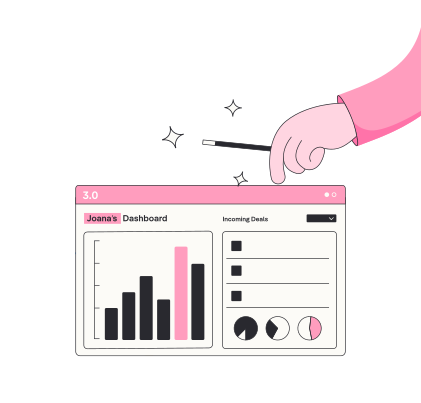
Make the live demo count, and win more deals faster.

Enable buyers to self-educate with tours.

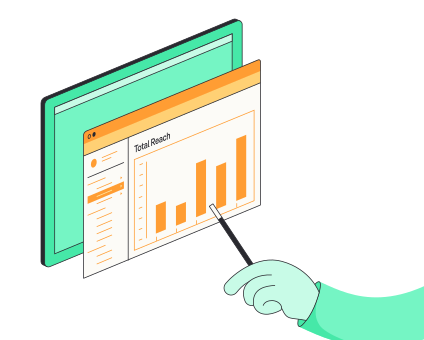
Drive adoption with tailored demos that showcase what success looks like.

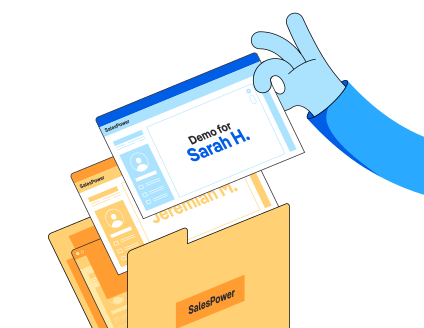
Let partners promote your product with on-the-rails demos.


Enable employees with a demo sandbox to get them ramped and ready.


## Demostack MCP: Integrate, without making it a project
Your AI tool can now answer questions like "which demo converts best" or "which SE showed what" straight from your Demostack data.
## Careers: Build Product Simulation With Us
Source: https://www.demostack.com/careers
We’re always excited to hear from talented individuals who are passionate about improving the demo operation. If you’re interested in exploring opportunities with Demostack please reach out to recruiting@demostack.com






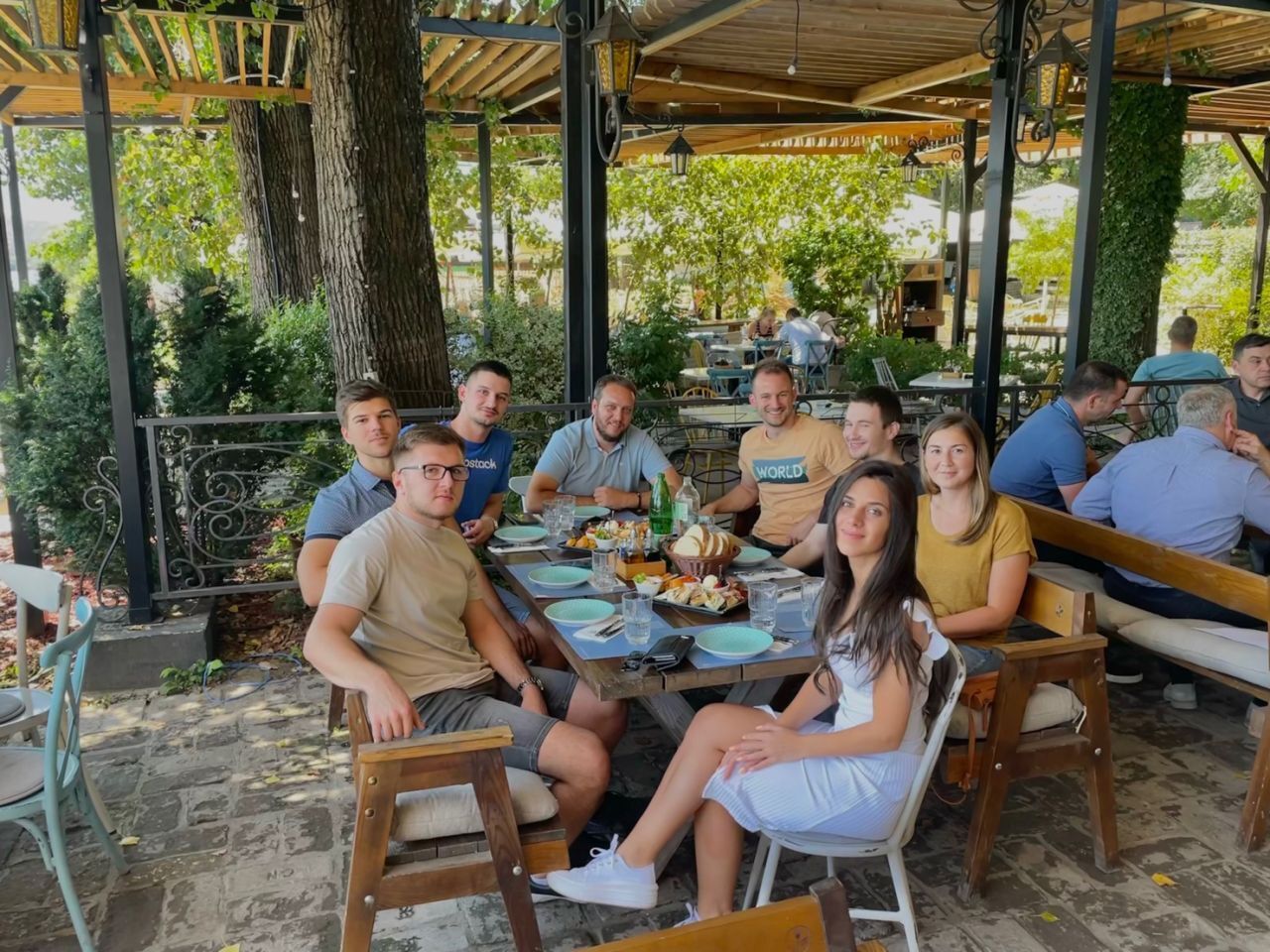



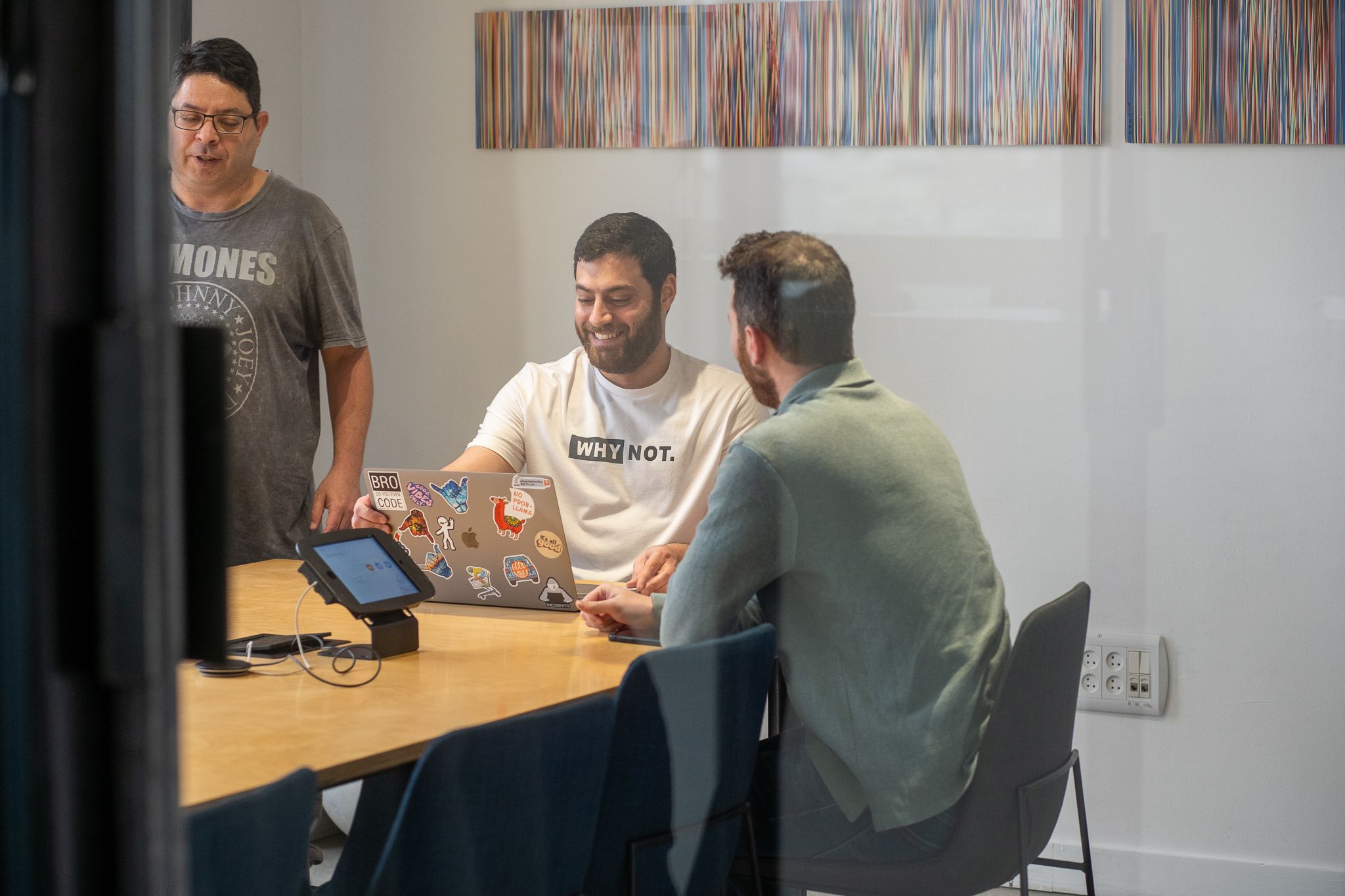
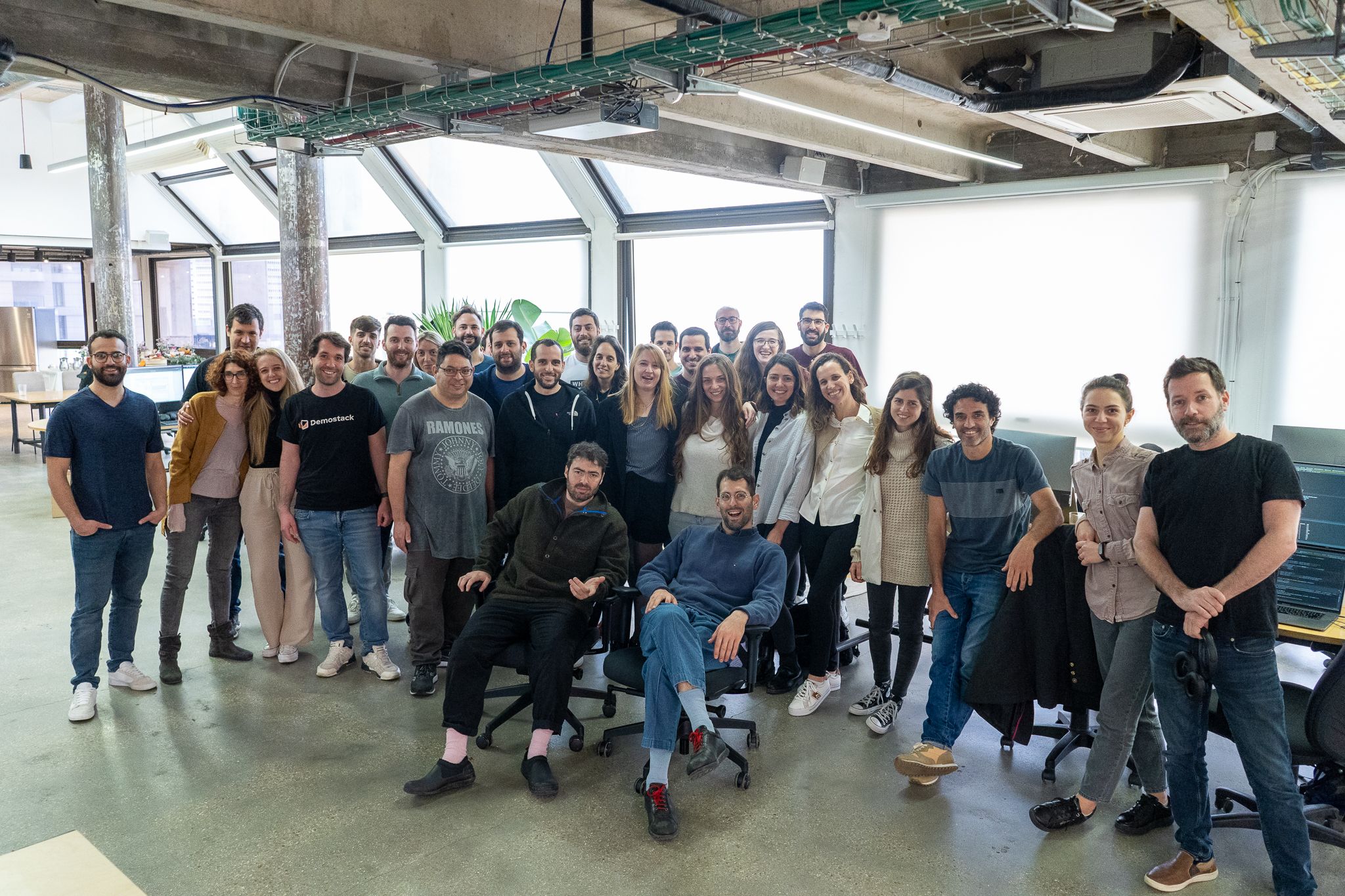
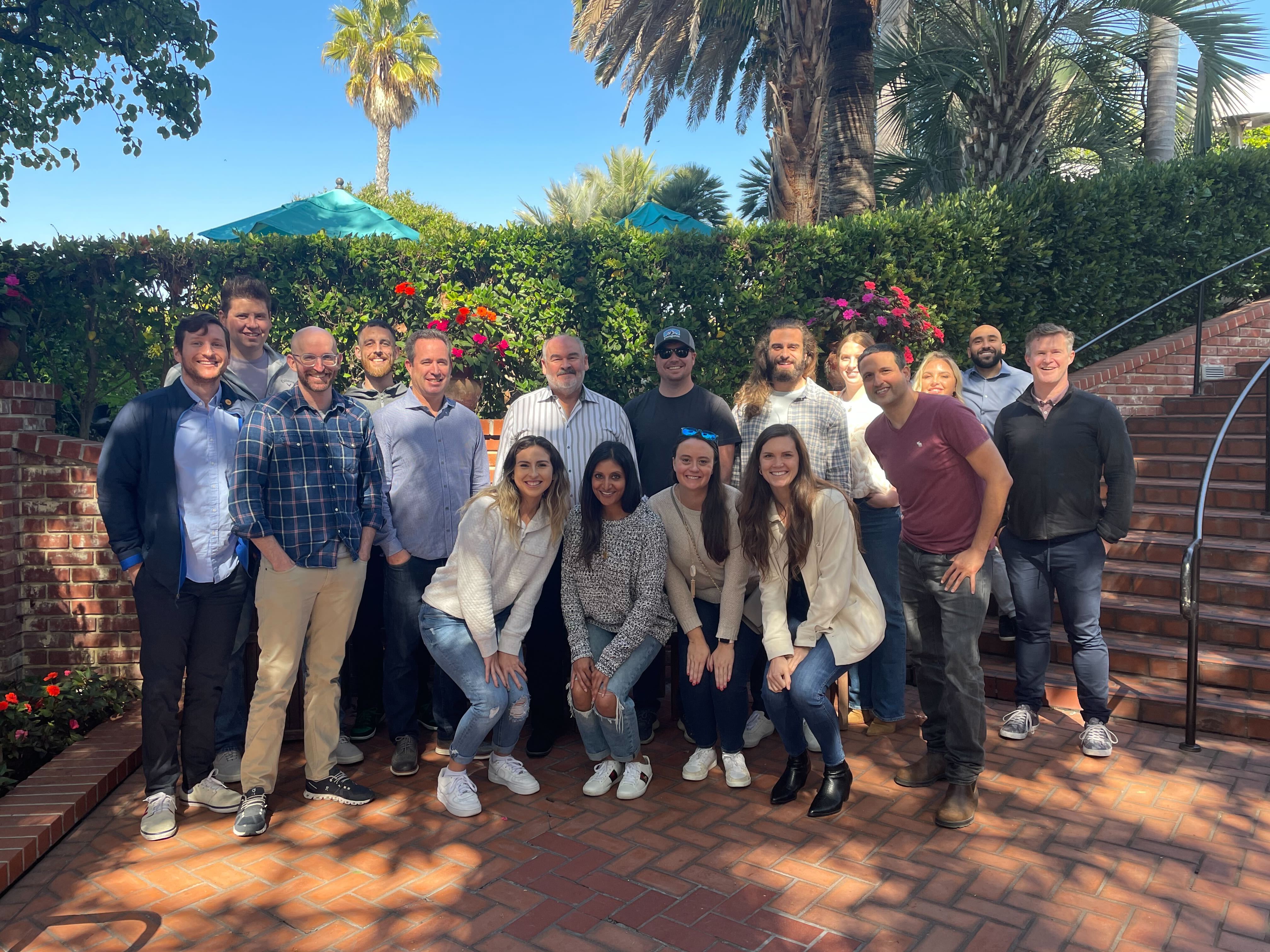


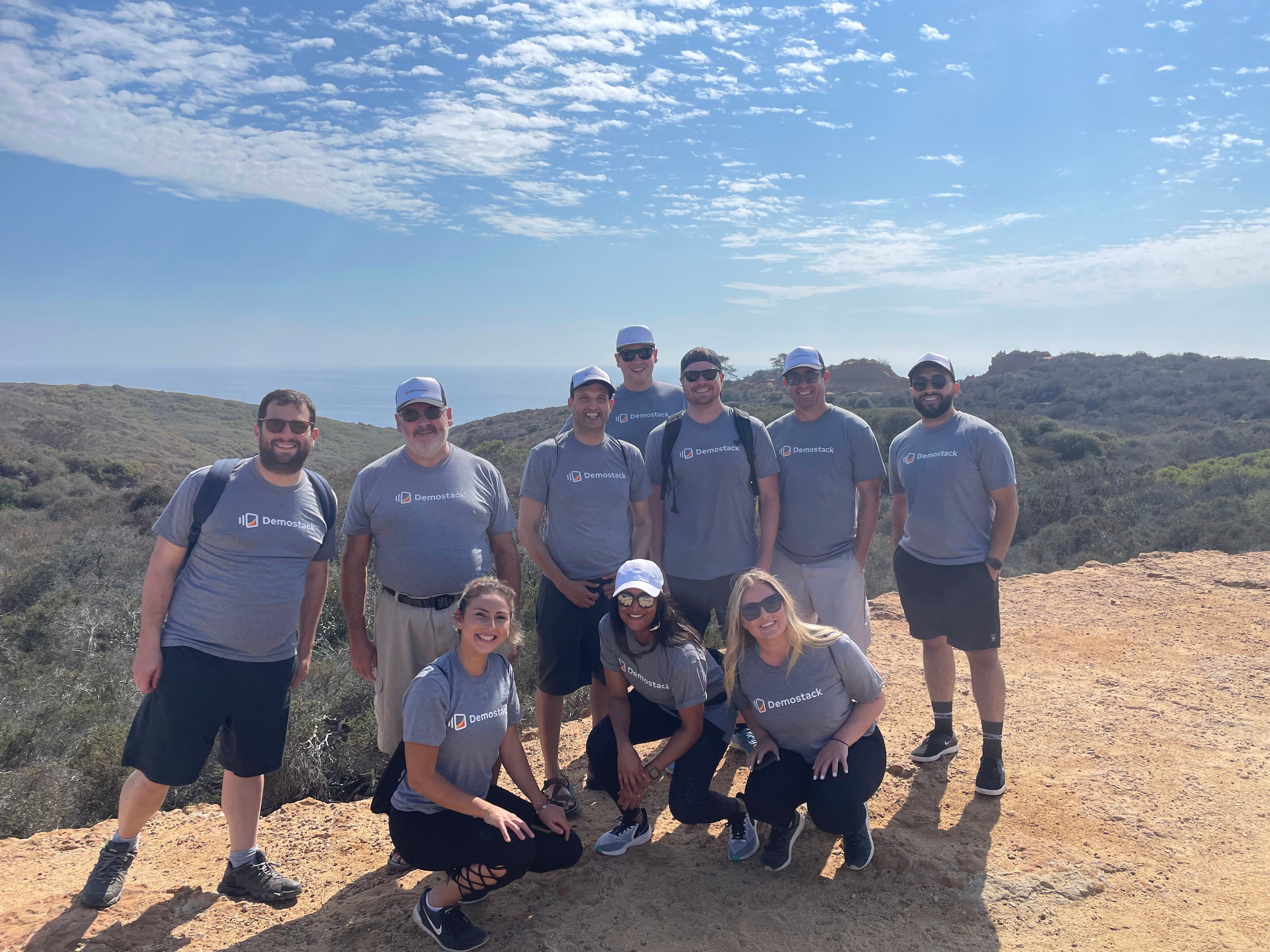



Competitive pay, great benefits, and equity options
We offer every full-time employee competitive salary, health benefits, meaningful equity, and a retirement plan.

Impact
We move quickly and encourage every employee to push the envelope. Our best ideas come from out-of-the-box thinking and innovation! We want to hear your ideas.

Inclusive and supportive environment
You don't have to have the perfect background or credentials. We look for the right energy, ambition, and all around culture fit.

Generous vacation policy
We believe a good work-life balance is crucial to our happiness and productivity, which is why we take vacation very seriously.

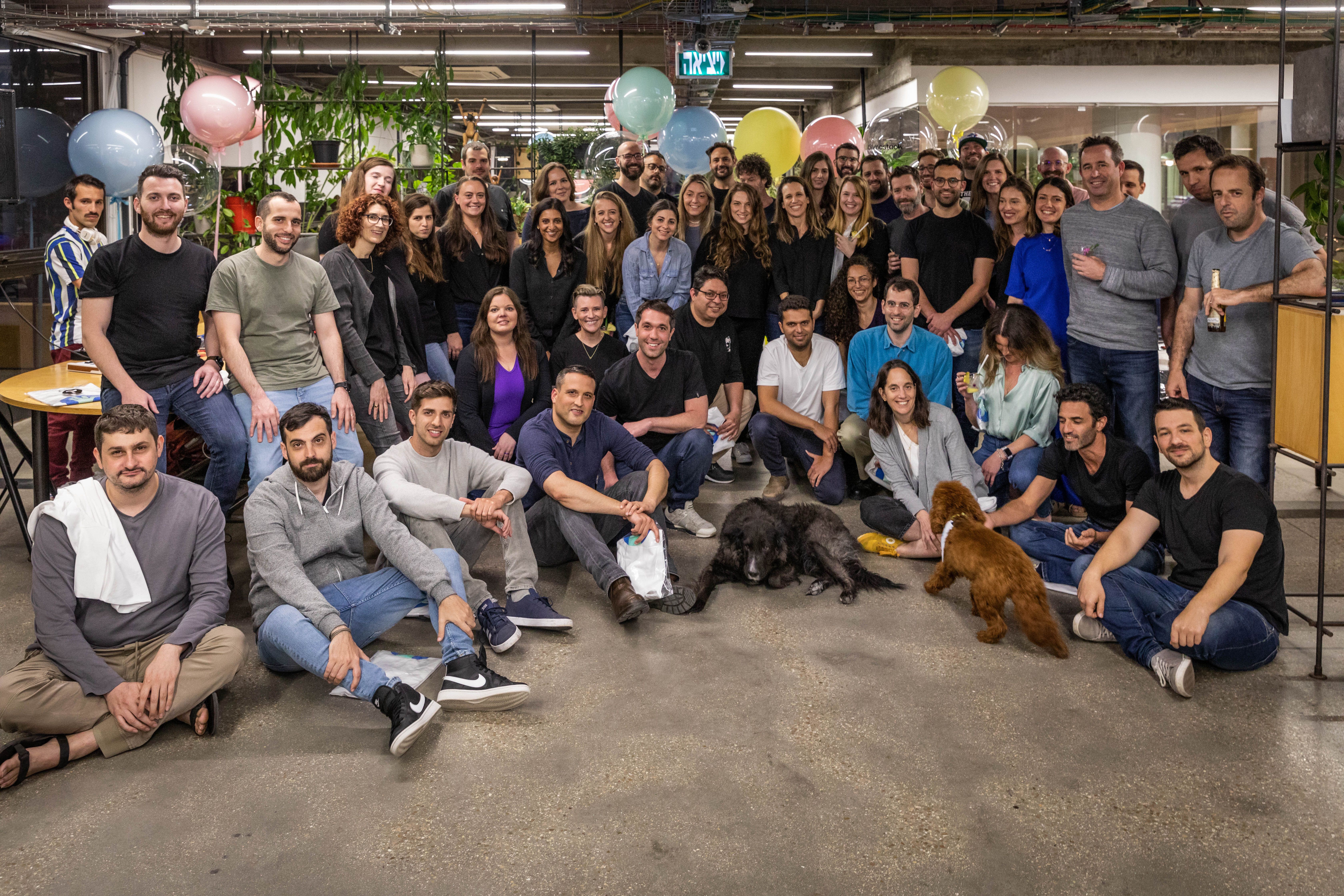
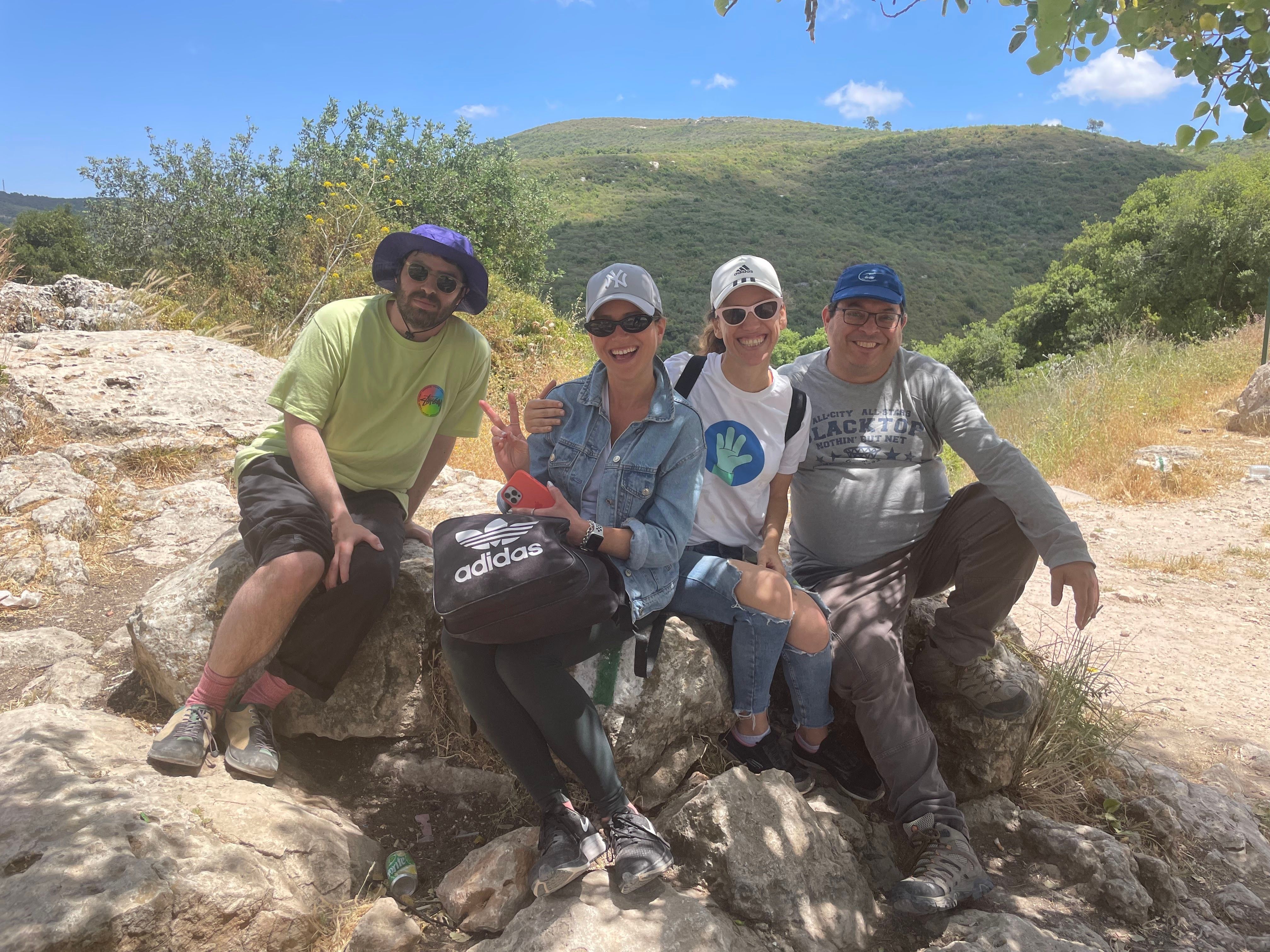
Team building
We believe in getting to know your coworkers outside of work - so you can strengthen connections, gain new perspectives, and foster creativity.




Interested in getting to know Demostack without applying for a specific role? Reach out at recruiting@demostack.com
Contact us
## Demo Analytics: See What Buyers Engage With
Source: https://www.demostack.com/features/analytics
Leverage demo data to optimize your demo operation and drive outsized returns.
Get a demo
Demos are everywhere, and your data is just as scattered. But what if you could open the black box and get insights like… What’s our magic moment? Where do we miss the mark? Who’s delivering the best demos, and how can we scale that to the entire team?
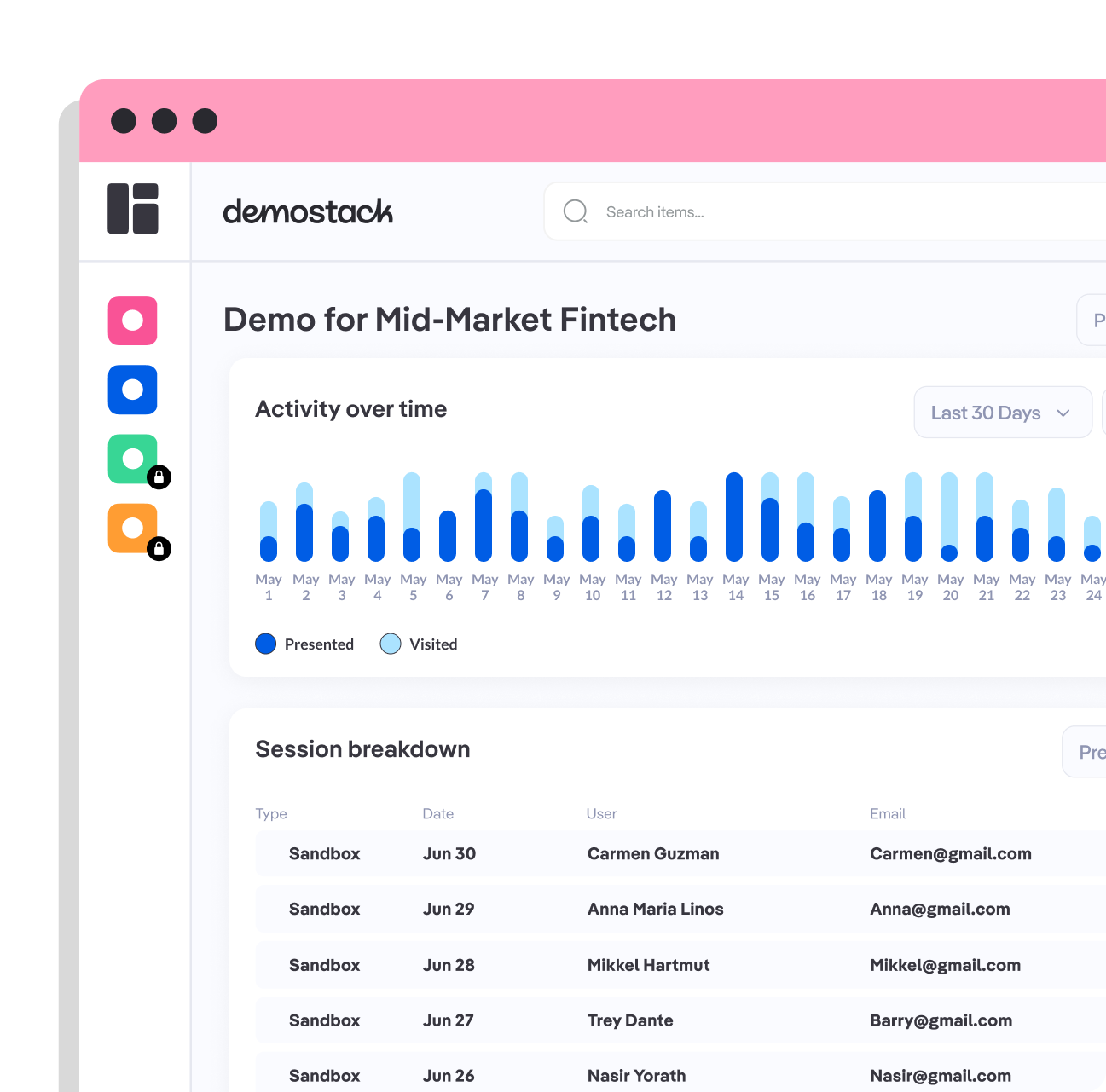
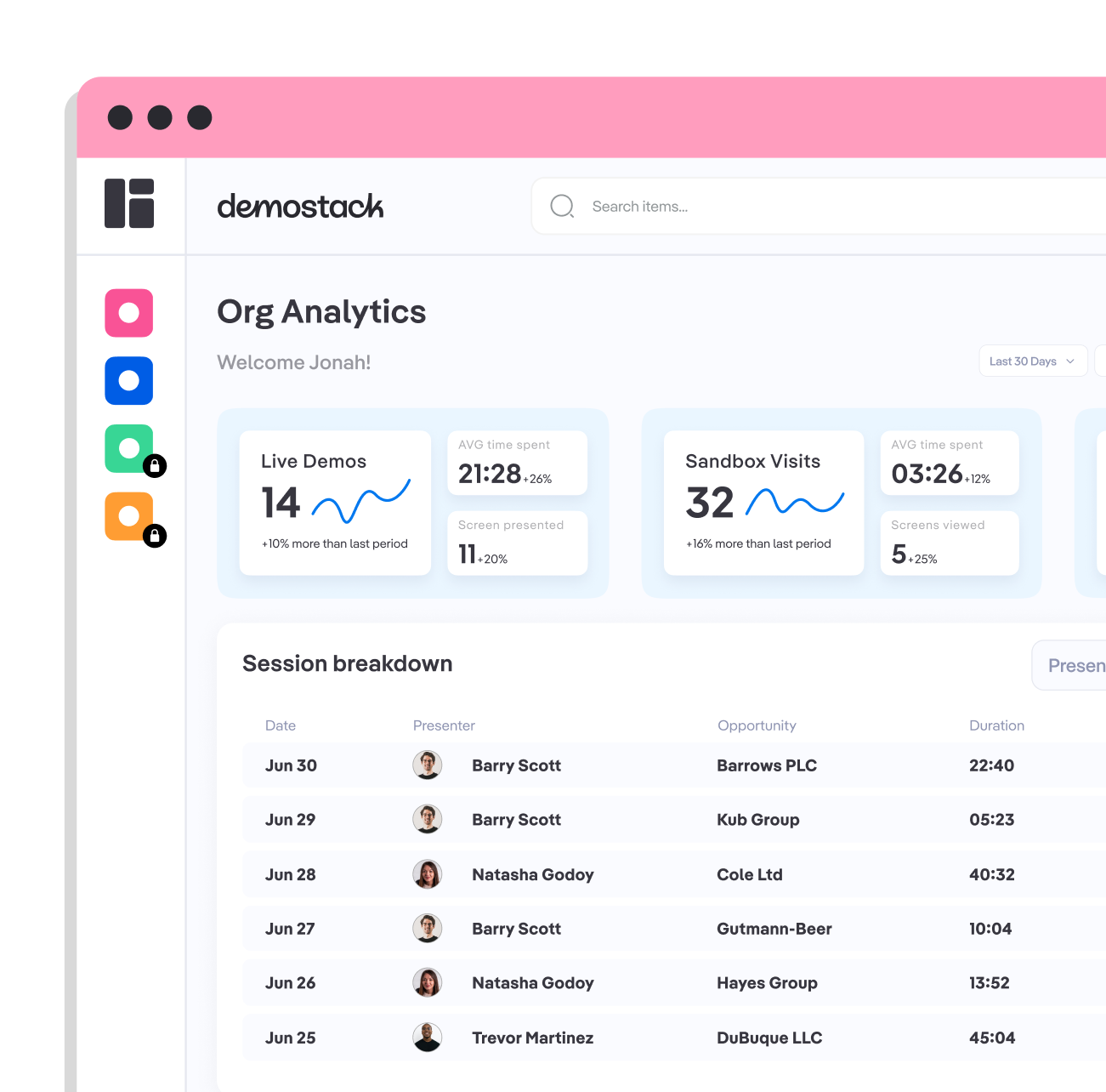
Our Salesforce integration allows you to sync all your Demostack data into your CRM, so you can see how your demos are impacting deals, get notified when a prospect views your leave-behind, or prioritize accounts based on demo engagement.
Get a demo
## Demostack MCP: Integrate, without making it a project
Your AI tool can now answer questions like "which demo converts best" or "which SE showed what" straight from your Demostack data.
## Security, Compliance and Privacy
Source: https://www.demostack.com/security
Stay informed about the security, compliance, and privacy of our products and services.
Privacy Policy
Customer Subscription Terms
Terms of Use
Security Overview
Privacy Notice to End Users
Notice of Demostack IP Rights
## Privacy & Security Overview
Download the Demostack Privacy & Security Informational PDF. [Click Here!](https://20453961.fs1.hubspotusercontent-na1.net/hubfs/20453961/%5BEXTERNAL%5D%20Demostack%20Privacy%20and%20Security%20-%20Website%20-%20Jan%202024.pdf)
## Demo Technology for Enterprise
Source: https://www.demostack.com/demo-technology-for-enterprise
## Demostack MCP: Integrate, without making it a project
Your AI tool can now answer questions like "which demo converts best" or "which SE showed what" straight from your Demostack data.
## About Us: Product Simulation for Enterprise
Source: https://www.demostack.com/about
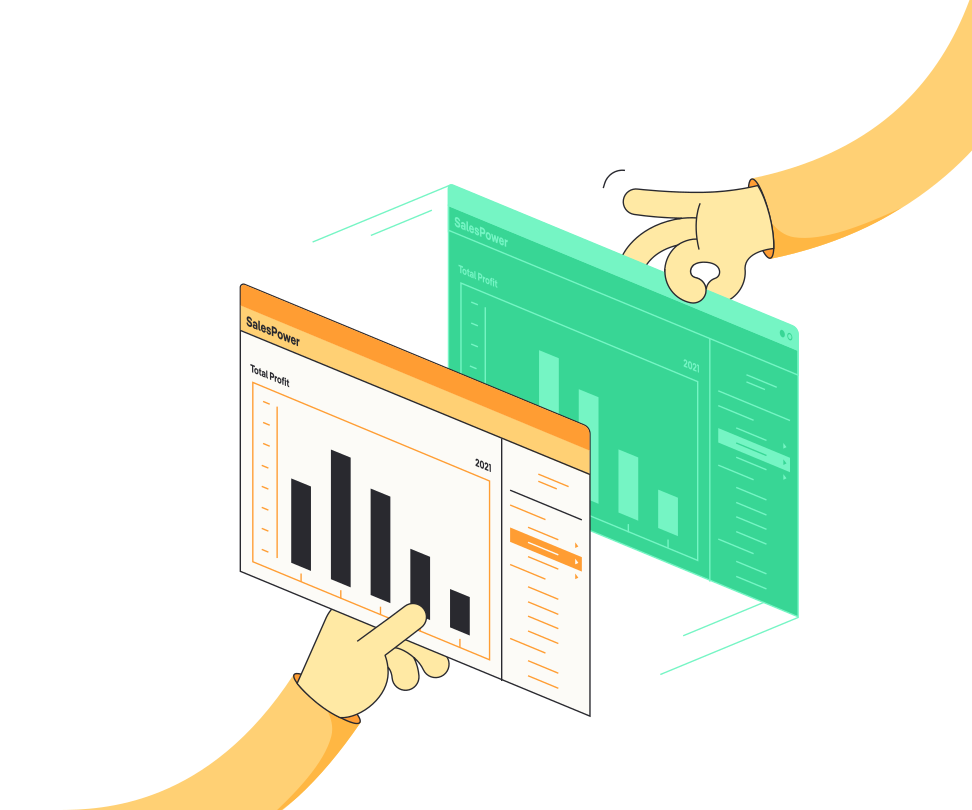
Demostack helps software companies create, deliver, and analyze great demos.
Get a demo
A great product isn’t enough. People need to see themselves using and gaining value from your product to become a customer. They need to connect with it.
We believe great demos build connection between people and products. They make it easy for people to envision themselves successfully using your product and working with your company. Great demos are controlled, tailored to the prospect, flawlessly delivered, and continually improved based on data. Easier said than done, we know. We're building Demostack to make delivering great demos possible every time.
We believe a great demo experiences build connections between people and products.
Learn more

Demo to prospects earlier to build trust, qualify, and gain insight faster

Break free from presentation mode and use demos to facilitate discussion

Customize every demo with content that will resonate

Track demo performance and continually improve based on data

Deliver tailored demo experiences at every step of the customer journey

Hand off demos for prospects to explore without requiring an account










## Demostack MCP: Integrate, without making it a project
Your AI tool can now answer questions like "which demo converts best" or "which SE showed what" straight from your Demostack data.
## Demo Browser that keeps your teams professional
Source: https://www.demostack.com/features/demo-browser
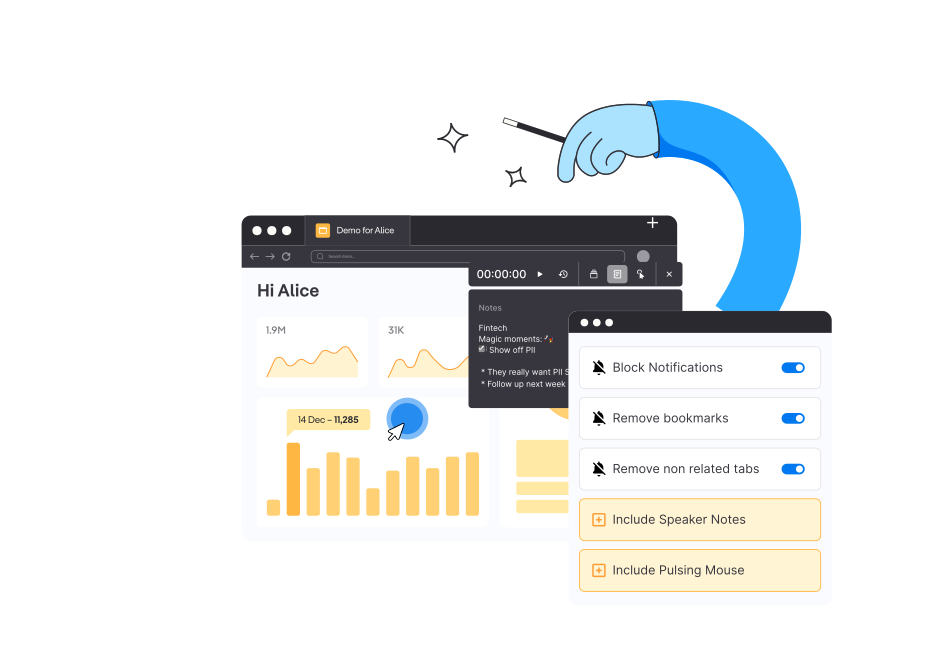
Create a calmer and more professional demo experience in a patented-browser designed for sales demo presentations.
Get a demo
Avoid unwanted distractions and enhance the professionalism of your team's demo presentations.
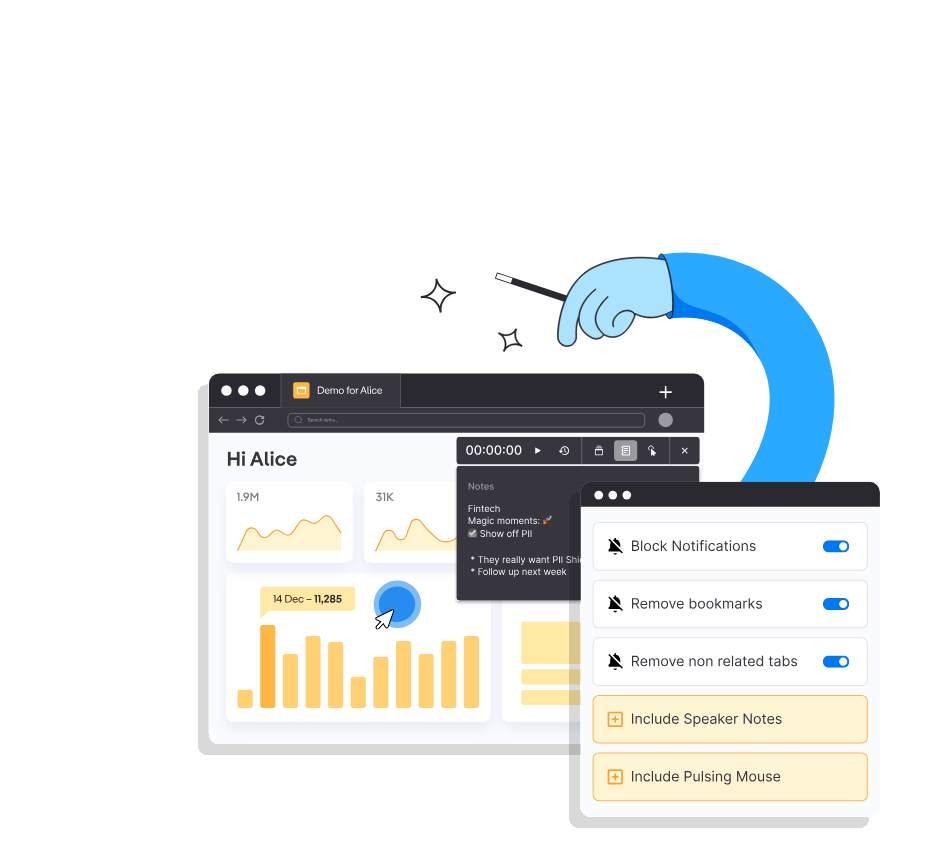
With our demo browser, you can automatically mute distracting Slack messages, texts, and Teams notifications. This ensures your presentations proceed without those awkward pop-up interruptions.
All this money is spent on getting prospects to a demo and then all of sudden a screen sharing mistake made this demo go from a deal-maker to a deal-breaker.
Make sure your team demos with confidence by bundling all demo presentation assets together - including sales decks and your mobile app.
Sales teams can effortlessly launch tailored demos, sales decks, integration demonstrations, and mobile demos with **one-click**
Enablement teams can equip each demo playbook with speaker notes and organize the products in the right flow so sales can stay on track.
**Bonus:** Sales can use our pulsing mouse feature to grab the prospect's attention.
Launching cable-free, phone-free mobile app demonstrations is now seamless and professional. Traditional challenges, such as unreliable cable connections, distracting third-party apps, and unprofessional home screens, are a thing of the past. There is no more need for signing into Zoom twice.
With Demostack, prepare your mobile app demo once for your entire team, enabling consistent, distraction-free presentations alongside your web app demos. This unified platform ensures a smooth, professional experience free from pop-ups and interruptions, empowering your sales team to focus on what truly matters - showcasing your product's value.
## Demostack MCP: Integrate, without making it a project
Your AI tool can now answer questions like "which demo converts best" or "which SE showed what" straight from your Demostack data.
## Product Demos
Source: https://www.demostack.com/product-demos
Deliver tailored, consistent demos that show the best version of your product - every single time.
Get a demo
Show buyers exactly what your product can do—no scheduling delays, no technical glitches, just results.
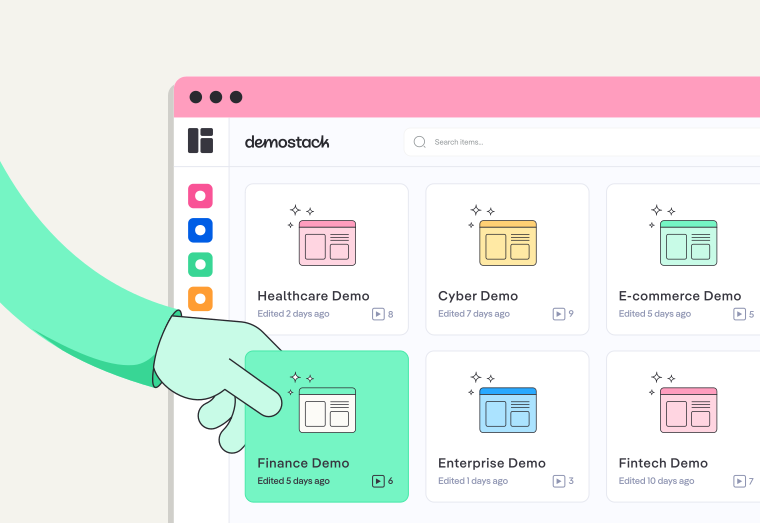
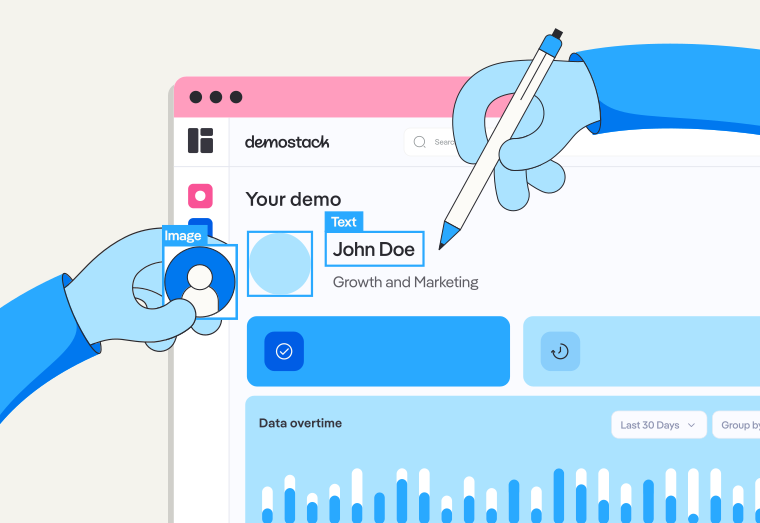
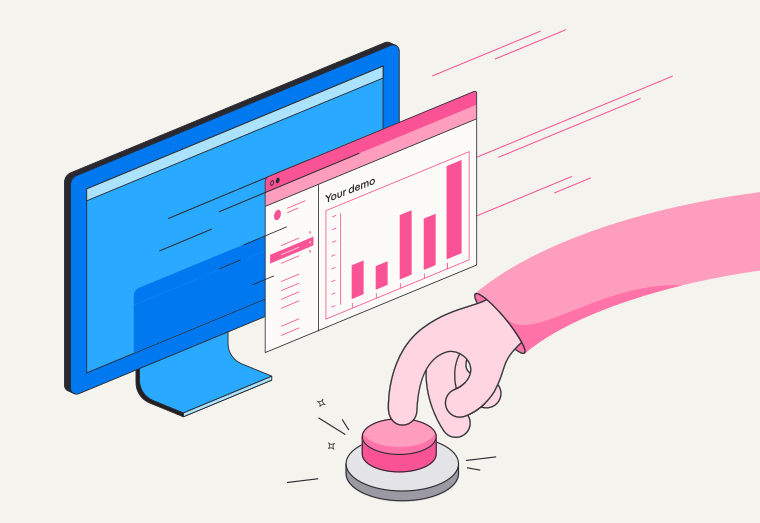
Demos that look, feel, and perform just like your real product—free from PII leakage, bad data, and product issues.

Select the demo setup that works best for your needs—cloned environments for a standalone, tailored experience or overlays to customize directly on top of your live product.


Have a mobile app to go with your product? No sweat. Demostack lets you demo that straight from your laptop.

Provide your partners with demos they can easily customize and deliver, helping them showcase your product’s value to prospects.

Built-in analytics track top performers, showcase essential demo highlights, and measure deal impact. Seamlessly integrate with your CRM to monitor pipeline progress and sharpen performance.

See the platform
David Greene

Sr. Manager, SC Enterprise at Gainsight at Gainsight
"Gainsight’s sales team has achieved an impressive 8% increase in close-win rates by leveraging Demostack-powered demos. Demostack demos closely replicate the look and feel of our actual products and are easy to customize."


## Demostack MCP: Integrate, without making it a project
Your AI tool can now answer questions like "which demo converts best" or "which SE showed what" straight from your Demostack data.
## Privacy Policy
Source: https://www.demostack.com/privacy
Stay informed about the security, compliance, and privacy of our products and services.
Privacy Policy
Customer Subscription Terms
Terms of Use
Security Overview
Privacy Notice to End Users
Notice of Demostack IP Rights
# Privacy Policy
**Last updated April 6, 2026**
Demostack and its affiliates (“Demostack”, “we”, “our” or “us”) put great efforts into making sure that the data relating to identifiable individuals (“personal data”) processed by us is safe and used properly, and that our data practices are properly communicated to our customers, users and prospects.
This Privacy Policy describes how we collect, process, store and use the following types of personal data:
1. Demostack User Data: such as contact, contractual and billing details concerning our customers, which may also contain the details of their internal focal persons who directly engage with Demostack concerning their organizational account, and users of our demo environment solution or any part thereof (the “Platform”) on behalf of such customers, e.g., the account administrators and users, billing contacts and authorized signatories on behalf of the customer; as well as the customer’s needs and preferences, as identified to us or recognized through our engagement with them (“Users” and “User Data” respectively);
2. Customer Data: personal data which we collect, process and manage on our customers’ behalf, as part of the usage of the Platform (“Customer Data”). The Customer Data relates to individuals who register as end-users, or otherwise interact with our customers’ demos via our Platform (“End-Users”);
3. Demostack Website, CRM, and Prospects Data: data relating to customers, potential customers and visitors of our websites (Demostack.com or any other website in our control, on which this policy is presented), online ads and content, emails or communications under our control (“Websites” and “Visitors” respectively);
4. Other Types of Data: Participant Information (as defined below) or any other data or information collected while otherwise interacting with us.
The Website together with the Platform shall be referred to as “the Services”.Specifically, this Privacy Policy describes our practices regarding –
1. Data Collection and Processing
2. Data Uses
3. Data Location
4. Data Sharing
5. Data Location
6. Cookies and Tracking Technologies
7. Communications
8. Data Security
9. Data Subject Rights
10. Data Controller/Processor
11. Additional Notice and Contact Details
Please read this Privacy Policy carefully and make sure that you fully **understand and agree to it.**You are not legally required to provide us with any personal data, and may do so (or avoid doing so) at your own free will. If you do not wish to provide us with your personal data, or to have it processed by us or any of our Service Providers (as defined below), please avoid any interaction with us or use of our Services. If you are a User of the Platform on behalf of any of our customers, we suggest that you contact your account administrator with any questions.
## 1. Data Collection and Processing
(i) Customer Data: Our Platform enables Users to create tailored demos for their software and applications and deliver such demos to End-Users who can access the demo through a link provided to them by a customer (the “Demo”). When an End-User follows the link to the Demo and interacts with the Demo, we collect data on such End-User for the purpose of providing our Services (such as analytics or insights on engagement/interaction with a Demo) and we process such data only per the instructions and on behalf of our customer.
Certain privacy and data protection laws require that prior to processing personal data, a legal basis for such processing is established. Accordingly, whilst Demostack supports these laws by providing our customers with features and options for how they use our Services – our customer is solely responsible for determining whether and how they wish to use our Services and such features, and to ensure that the appropriate legal basis and all necessary notices for the processing of Customer Data have been established and provided, by the customer, prior to our processing it through the Platform.
Demostack processes personal data contained in the Customer Data strictly on our customer’s behalf, in accordance with their reasonable instructions and as further stipulated in our Data Processing Agreement or other applicable commercial agreements with such customer.Accordingly, to the extent applicable by law, our customer will be deemed the ‘data controller’ (e.g. under the EU GDPR, UK GDPR and similar laws) or ‘business’ (under the CCPA or similar laws) of Customer Data; and Demostack will be deemed the ‘data processor’ or ‘service provider’ when processing such data.
Our services are not intended to collect or process sensitive personal data such as health information, biometric data or information related to racial or ethnic origin, religious beliefs, or political opinions. Users should not submit such data through the services unless specifically requested.
(iI) User Data: We also collect and generate the following Personal Data concerning Users of our Platform:
- User account and contact information (e-mail address and, when applicable - hashed password, name, title, team, company, e-mail and phone number (as provided), and additional information and media submitted by Users, their team members or their organization);
- Platform usage information – (connectivity, technical and aggregated usage data, such as user agent, IP addresses, device data (like type, OS, device id, browser version, locale and language settings used), activity logs, session recordings, and the cookies installed or utilized on their device);
- Direct interactions and communications with us (including, in some cases, recordings of your calls and emails with us, e.g., for user enablement, support and training purposes).
- Phone numbers may also be used for business communications, including phone calls and SMS messages, as further described in Section 7 (Communications) below.
(iIi) Demostack Website, CRM and Prospect Data: We collect and generate the following types of Personal Data concerning our Visitors, Participants, customers and prospects:
- Website usage information: (connectivity, technical and aggregated usage data, such as user agent, IP addresses, device data (like type, OS, device id, browser version, locale and language settings used), activity logs, session recordings, and the cookies and pixels installed or utilized on the device);
- Data obtained through Analytics Tools: We use analytics tools to collect data about the use of our Website and Services. Analytics tools collect data such as how often Users and Visitors visit or use the Website or Services, which pages they visit and when, and which website, ad or e-mail message brought them there.
- Information concerning our customers and prospects: (contact and business details, including phone numbers, our communications with such customers and prospects, as well as any needs, preferences, attributes and insights relevant to our potential engagement).
We collect the above categories of data either automatically, through the data subject’s interaction with us or through our Services; or through third party services, social media, analytics tools, events we organize or participate in, and other business initiatives.
(iv) Job Candidates Participants: We also collect and generate the following Personal Data concerning Users of our Platform:
(A) We may collect information provided to us by job candidates (“Candidates”) when they apply to a position in our super awesome company (directly, through head hunters or through other service providers). Demostack welcomes all qualified Candidates to apply to any of the open positions by sending us their contact details and CV (“Candidates Information”). Personal data contained in Candidates Information will be subject to our Candidate Privacy Notice. If you wish to review the notice, please contact us at [privacy@demostack.com](mailto:privacy@demostack.com). (B) If you participate in an event or webinar that we sponsor or participate in (“Participant”), we may receive your personal data from you or from the event organizers. We may also receive your contact and professional details (e.g., your name, company, position, contact details and professional experience, preferences and interests) from our business partners or service provides, and through the use of tools and channels commonly used for connecting between companies and individuals in order to explore potential business and employment opportunities, such as LinkedIn™ and other data services and sources (“Participants Information”).
## 2. Data Uses
Demostack processes Customer Data, and any personal data contained in it, strictly on the customer’s behalf, in accordance with their reasonable instructions and as further stipulated in our Data Processing Agreement or other applicable commercial agreements with such customer. Demostack is not aware of any data collected (if any) through a customer’s Demo directly by such customer . Please refer to the privacy policy of the relevant customer for more information on their privacy practices.
We process personal data contained in User Data, Demostack Website, CRM and Prospect Data, Candidates Information and Participants Information, as necessary for the following purposes and in reliance on the lawful basis as further detailed in the chart below:
|
To provide, facilitate, operate, and enhance our Services
|
Performance of Contract; Legitimate Interests
|
|
To personalize our Services, including by recognizing individuals and remembering their information when they return to our Services, and to provide further localization and personalization capabilities
|
Performance of Contract; Legitimate Interests
|
|
To further develop, customize and improve the Services and your user experience, based on common or personal preferences, experiences and difficulties.
|
Performance of Contract; Legitimate Interests
|
|
To contact you with general or personalized service-related messages, as well as promotional messages that may be of a specific interest to you
|
(Performance of Contract; Legitimate Interests; Consent)
|
|
To support and enhance our data security measures, including for the purposes of preventing and mitigating the risks of fraud, error or any illegal, criminal or prohibited activity
|
(Performance of Contract; Legitimate Interests; Legal Obligation)
|
|
To enforce our Terms of Service, to resolve disputes, to carry out our obligations and enforce our rights, and to protect our business interests and the interests and rights of third parties
|
(Legitimate Interests, Legal Obligation)
|
|
To comply with our contractual and legal obligations and requirements, and maintain our compliance with applicable laws, regulations and standards
|
(Performance of Contract; Legitimate Interests; Legal Obligation)
|
|
For any other lawful purpose, or other purpose that you consent to
|
(Legal Obligation; Consent)
|
|
To communicate via SMS or phone regarding our services, meetings or business opportunities
|
Legitimate Interests, Consent
|
|
For any other lawful purpose, or other purpose that you consent to
|
Legal Obligation; Consent
|
|
To facilitate and optimize our marketing campaigns, ad management and sales operations, and to manage and deliver advertisements for our products and services more effectively, including on other websites and applications. Such activities allow us to highlight the benefits of using our Services, and thereby increase your engagement and overall satisfaction with our Services. This includes contextual, behavioral and interests-based advertising based on your activity, preferences or other data available to us or to our business partners
|
(Legitimate Interests; Consent)
|
|
To gain a better understanding on how individuals use and interact with our Services, and how we could improve their and others’ user experience and the value they can generate from using our Services, so we could continue improving our products, offerings and the overall performance of our Services
|
(Legitimate Interests)
|
|
To contact you with general or personalized service-related messages, as well as promotional messages that may be of a specific interest to you
|
(Performance of Contract; Legitimate Interests; Consent)
|
|
To support and enhance our data security measures, including for the purposes of preventing and mitigating the risks of fraud, error or any illegal, criminal or prohibited activity
|
(Performance of Contract; Legitimate Interests; Legal Obligation)
|
|
To create aggregated statistical data, inferred non-personal data, or anonymized or pseudonymized data (rendered non-personal and non-identifiable), which we or our business partners may use to provide and improve our respective services, or for any other purpose
|
(Legitimate Interests)
|
|
To enforce our Terms of Service, to resolve disputes, to carry out our obligations and enforce our rights, and to protect our business interests and the interests and rights of third parties
|
(Legitimate Interests, Legal Obligation)
|
|
To comply with our contractual and legal obligations and requirements, and maintain our compliance with applicable laws, regulations and standards
|
(Performance of Contract; Legitimate Interests; Legal Obligation)
|
|
For any other lawful purpose, or other purpose that you consent to
|
(Legal Obligation; Consent)
|
|
To communicate via SMS or phone regarding our services, meetings or business opportunities
|
Legitimate Interests, Consent
|
|
For any other lawful purpose, or other purpose that you consent to
|
Legal Obligation; Consent
|
## 3. Data Location
We and our authorized Service Providers (as defined below) maintain, store and process Personal Data in Google servers in the United States of America. We may also retain your Personal Data in Israel, a jurisdiction which is considered by the European Commission as offering an adequate level of protection for the personal data of EU Member State residents, and in other locations as reasonably necessary for the proper performance and delivery of our Services, or as may be required by law; provided that Customer Data may only be processed in such locations as permitted in commercial agreements with the applicable customer.
While privacy laws may vary between jurisdictions, Demostack and its affiliates are each committed to protect personal data in accordance with this Privacy Policy and customary industry standards, and such appropriate lawful mechanisms and contractual terms requiring adequate data protection, regardless of any lesser legal requirements that may apply in their jurisdiction.
For data transfers from the EEA, UK or Switzerland to countries which are not considered to be offering an adequate level of data protection, we and the relevant data exporters and importers have entered into Standard Contractual Clauses as approved by the European Commission (or other applicable authority) or other transfer mechanism recognized by applicable laws such as Binding Corporate Rules.
## 4. Data Retention
**Use and Customer Data**
We retain Customer Data strictly on our customer’s behalf, in accordance with their reasonable instructions as further stipulated in our Data Processing Agreement or other applicable commercial agreements with our customer, and applicable laws.
Please note that, except as required by applicable law or our specific agreements with you, we will not be obligated to retain personal data for any particular period, and we are free to securely delete it or restrict access to it for any reason and at any time, with or without notice to you. If you have any questions about our data retention policy, please contact us by e-mail at [privacy@demostack.com](mailto:%20privacy@demostack.com).
Other Types of DataWe retain User Data, Demostack Website, CRM & Prospect Data, and Participant Information for as long as reasonably necessary in order to maintain and expand our relationship and to provide them with our Services, for as long as is required in order to comply with our legal and contractual obligations, or to protect ourselves from any potential disputes (i.e. as required by laws applicable to log-keeping, records and bookkeeping, and in order to have proof and evidence concerning our relationship, should any legal issues arise following your discontinuance of use), in accordance with our data retention policy.
For example, business contact information used for marketing or outreach purposes may be retained until the individual opts out of communications or for a reasonable period of business inactivity, unless a longer retention period is required by law.
Please note that except as required by applicable law or our specific agreements with you, we will not be obligated to retain your Personal Data for any particular period, and we are free to securely delete it or restrict access to it for any reason and at any time, with or without notice to you. If you have any questions about our data retention policy, please contact us by e-mail at [privacy@demostack.com](mailto:%20privacy@demostack.com).
## 5. Data Sharing
**Legal Compliance
**
In exceptional circumstances, and except as stipulated otherwise in the commercial agreements with you, we may disclose or allow government and law enforcement officials access to your Personal Data, in response to a subpoena, search warrant or court order (or similar requirement), or in compliance with applicable laws and regulations. Such disclosure or access may occur if we believe in good faith that: (a) we are legally compelled to do so; (b) disclosure is appropriate in connection with efforts to investigate, prevent, or take action regarding actual or suspected illegal activity, fraud, or other wrongdoing; or (c) such disclosure is required to protect our legitimate business interests, including the security or integrity of our products and services.
Service Providers:We may engage with selected third-party companies and individuals to perform services complementary to our own. Such service providers include hosting and server co-location services, communications and content delivery networks (CDNs), data and cyber security services, billing and payment processing services, fraud detection and prevention services, web analytics, e-mail distribution and monitoring services, session or activity recording services, remote access services, performance measurement, data optimization and marketing services, social and advertising networks, content providers, e-mail, voicemails, support and customer relation management systems, and our legal, financial and compliance advisors (collectively, “Service Providers“). For a full list of third parties, please contact us at [privacy@demostack.com](mailto:%20privacy@demostack.com).
These Service Providers may have access to your personal data, depending on each of their specific roles and purposes in facilitating and enhancing our Services, and may only use it for such limited purposes as determined in our agreements with them.
Third Party Websites and Platform:Our Website may include links to third party websites, and integrations with third party services. Such websites and third-party services, and any information you process, submit, transmit or otherwise use with such websites and third-party services, are governed by such third party’s terms and privacy practices and policies, and not by this Privacy Policy. We encourage you to carefully read the terms and privacy policies of such website and third-party services. Sharing Personal Data with End-Users: User Data is shared and available to the End-Users as part of the Demo created by the applicable customer. This means that the End-Users of such customer may access the User Data that was uploaded and used in the Demo (if any), and will be able to monitor, and possibly process and analyse the Personal Data contained therein.
Please note that Demostack is not responsible for and does not control any disclosure, use or monitoring by or on behalf of the customers, that itself acts as the ‘data controller’ of such data (as further described in Section 10 below).
Protecting Rights and Safety: We may share Personal Data with others if we believe in good faith that this will help protect the rights, property or personal safety of Demostack, any of our Users or customers, or any members of the general public.
Demostack Subsidiaries and Affiliated Companies:We may share Personal Data internally within our group, for the purposes described in this Privacy Policy. In addition, should Demostack or any of its subsidiaries or affiliates undergo any change in control or ownership, including by means of merger, acquisition or purchase of substantially all or part of its assets, Personal Data may be shared with or transferred to the parties involved in such an event. If we believe that such change in control might materially affect your User and Customer Data or Personal Data then stored with us, we will notify you of this event and the choices you may have via e-mail or prominent notice on our Services.For the avoidance of doubt, Demostack may share data in additional manners, pursuant to your explicit approval, or if we are legally obligated to do so, or if we have successfully rendered such data non-personal, non-identifiable and anonymous. We may transfer, share or otherwise use non-personal and non-identifiable data at our sole discretion and without the need for further approval.
## 6. Cookies and Tracking Technologies
We and our Service Providers use cookies and other technologies for performance, tracking, analytics and personalization purposes. We may share non-identifiable / aggregated extracts of such information with our partners for our legitimate business purposes.
Cookies are packets of information sent to your web browser and then sent back by the browser each time it accesses the server that sent the cookie. Some cookies are removed when you close your browser session. These are the “Session Cookies”. Some last for longer periods and are called “Persistent Cookies”. We may use both types.
We use Persistent Cookies to remember your log-in details and make it easier for you to log-in the next time you access the Platform. We may use this type of cookies and Session Cookies for additional purposes, to facilitate the use of the Services’ features and tools.
Whilst we do not change our practices in response to a “Do Not Track” signal in the HTTP header from a browser or mobile application, you can manage your cookies preferences, including whether or not to accept them and how to remove them, through your browser settings. Please bear in mind that disabling cookies may complicate or even prevent you from using the Services.
We also use analytics tools, including Google Analytics which may use cookies, beacons and other technologies. These tools help us understand users’ behaviour on our Website and Platform, including by tracking page content, and click/touch, movements, scrolls and keystroke activities.
Please note that if you get a new computer, install a new browser, erase or otherwise alter your browser’s cookie file (including upgrading certain browsers), you may also clear the opt-out cookies installed once you opt-out, so an additional opt-out will be necessary to prevent additional tracking.
## 7. Communications
We may engage in service and promotional communications, through e-mail, phone, SMS and notifications.
Service Communications:We may contact you with important information regarding our Services. For example, we may send you notifications (through any of the means available to us) of changes or updates to our Services, billing issues, service changes, log-in attempts or password reset notices, etc. Please note that you will not be able to opt-out of receiving certain service communications which are integral to your use (like password resets or billing notices).
Promotional Communications:We may also notify you about new features, additional offerings, events, special opportunities or any other information we think you will find valuable, as our customer, User, Participant or prospect. We may provide such notices through any of the contact means available to us (e.g., phone, mobile or e-mail), through the Services, or through our marketing campaigns on any other sites or platforms.
SMS Communications:
We may communicate with customers, users, event participants and prospective customers via SMS (text messages) in connection with our business activities. These communications may include responding to inquiries, coordinating meetings, providing service-related updates, or sharing information about our products, services or events.
Phone numbers used for SMS communications may be collected directly from you, through business interactions with us, from publicly available professional sources, or from business partners or event organizers.
Where required by applicable law, we will obtain consent prior to sending SMS messages that constitute marketing communications. In other circumstances, we may rely on our legitimate interests in developing and maintaining business relationships.
SMS communications may be facilitated by third-party messaging service providers that process personal data on our behalf and in accordance with applicable data protections laws.
If you do not wish to receive any of the aforementioned promotional communications, you may notify Demostack at any time by sending an e-mail to: [privacy@demostack.com](mailto:privacy@demostack.com), or by following the “unsubscribe”, “stop”, “opt-out” or “change e-mail preferences” instructions contained in the promotional communications you receive.
## 8. Data Security
We and our hosting services implement systems, applications and procedures to secure your personal data, to minimize the risks of theft, damage, loss of information, or unauthorized access or use of information.
However, although we make efforts to protect your privacy, we cannot guarantee that our Sites, Platform or Services will be immune from any wrongdoings, malfunctions, unlawful interceptions or access, or other kinds of abuse and misuse.
To learn more, please email [privacy@demostack.com](mailto:privacy@demostack.com).
## 9. Data Subject Rights
Individuals have rights concerning their Personal Data. If you wish to exercise your privacy rights under any applicable law, such as the right to request access to, and rectification or erasure of your Personal Data held with Demostack, or to restrict or object to such Personal Data’s processing, or to port such Personal Data, or the right to equal services and prices (each to the extent available to you under the laws which apply to you) – please contact us by e-mail at [privacy@demostack.com](mailto:privacy@demostack.com).
Please note that when you ask us to exercise any of your rights under this policy or applicable law, we may need to ask you to provide us certain credentials to make sure that you are who you claim you are, to avoid disclosure to you of personal data related to others and to ask you to provide further information to better understand the nature and scope of data that you request to access. Such additional data will be then retained by us for legal purposes (e.g., as proof of the identity of the person submitting the request), in accordance with Section 4 above. We may redact from the data which we will make available to you, any personal data related to others.
If you are an End-User and would like to make any requests or queries regarding Personal Data that we process on our customer’s behalf, please contact the administrator of such customer’s account directly. If you are our customer’s End User, and wish to access, correct, or delete data processed by Demostack on behalf of our customer, please direct your request to the relevant customer (who is the “data controller” of such data – see Section 10 below). Note that if you do contact us, we may share your communications with our customer; and that we may also share the contact details of the account administrator with individuals who sent us such a request or query relating to this account.
Residents of certain U.S. states may have additional privacy rights under applicable laws, including the right to request access to personal data, request deletion or correction of personal data, and opt out of certain data uses such as targeted advertising. Requested may be submitted using the contact details listed above.
## 10. Data Controller/Processor
Certain data protection laws and regulations, such as the GDPR or the CCPA, typically distinguish between two main roles for parties processing Personal Data: the “data controller” (or under the CCPA, “business”), who determines the purposes and means of processing; and the “data processor” (or under the CCPA, “service provider”), who processes the data on behalf of the data controller (or business). Below we explain how these roles apply to our Services, to the extent that such laws and regulations apply.
Demostack is the “data controller” or ‘business’ (under the CCPA or similar laws) of the User Data, Demostack Website, CRM and Prospect Data, Participants Data, and, Job Candidate Data. With respect to such data, we assume the responsibilities of data controller (solely to the extent applicable under law), as set forth in this Privacy Policy. In such instances, our Service Providers processing such data will assume the role of “data processor”.
Demostack is the “data processor” or ‘service provider’ of End-User Data, which we process on behalf of our customer (who is the “data controller” of such data); and our Service Providers who process such User and Customer Data on our behalf are the “sub-processors” of such data.Accordingly, Demostack processes End-User Data strictly in accordance with such customer’s reasonable instructions and commercial agreements with such customer. The customer, as controller of such data, will be responsible for meeting any legal requirements applicable to data controllers (such as establishing a legal basis for processing and responding to Data Subject Rights requests concerning the data they control).
For the avoidance of doubt, each customer is solely responsible for providing adequate notice to its End-Users, customers and any other individual whose data may be contained in Customer Data – including sufficient reference to the processing of their Personal Data via the Services, and any other information necessary to comply with all applicable privacy and data protection laws; and to obtain all approvals and consents from such individuals as required under such laws.
## 11. Additional Notices
**Updates and Amendments:**
We may update and amend this Privacy Policy from time to time by posting an amended version on our Services. The amended version will be effective as of the date it is published. We will provide prior notice if we believe any substantial changes are involved via any of the communication means available to us or via the Website and/or Platform. After such notice period, all amendments shall be deemed accepted by you.
External Links:While our Services may contain links to other websites or services, we are not responsible for their privacy practices. We encourage you to pay attention when you leave our Services for the website or application of such third parties, and to read the privacy policies of each and every website and service you visit. This Privacy Policy applies only to our Services.
Our Services are not designed to attract children under the age of 18:We do not knowingly collect Personal Data from children and do not wish to do so. If we learn that a person under the age of 18 is using the Sites, Platform and/or Services, we will attempt to prohibit and block such use and will make our best efforts to promptly delete any Personal Data stored with us with regard to such child. If you believe that we might have any such data, please contact us by e-mail at [privacy@demostack.com](mailto:%20privacy@demostack.com).
Questions, concerns or complaints:If you have any comments or questions regarding our Privacy Policy, or if you have any concerns regarding your Personal Data held with us, please contact Demostack’s support at [privacy@demostack.com](mailto:%20privacy@demostack.com). If you are a GDPR-protected individual, you may also have the right to lodge a complaint with an EU supervisory authority.
Effective Date: April 6, 2026
## Get a Demo of Product Simulation
Source: https://www.demostack.com/win-more-deals-lp
## Demo HQ Day \- Presales Virtual Event
Source: https://www.demostack.com/demo-hq-day
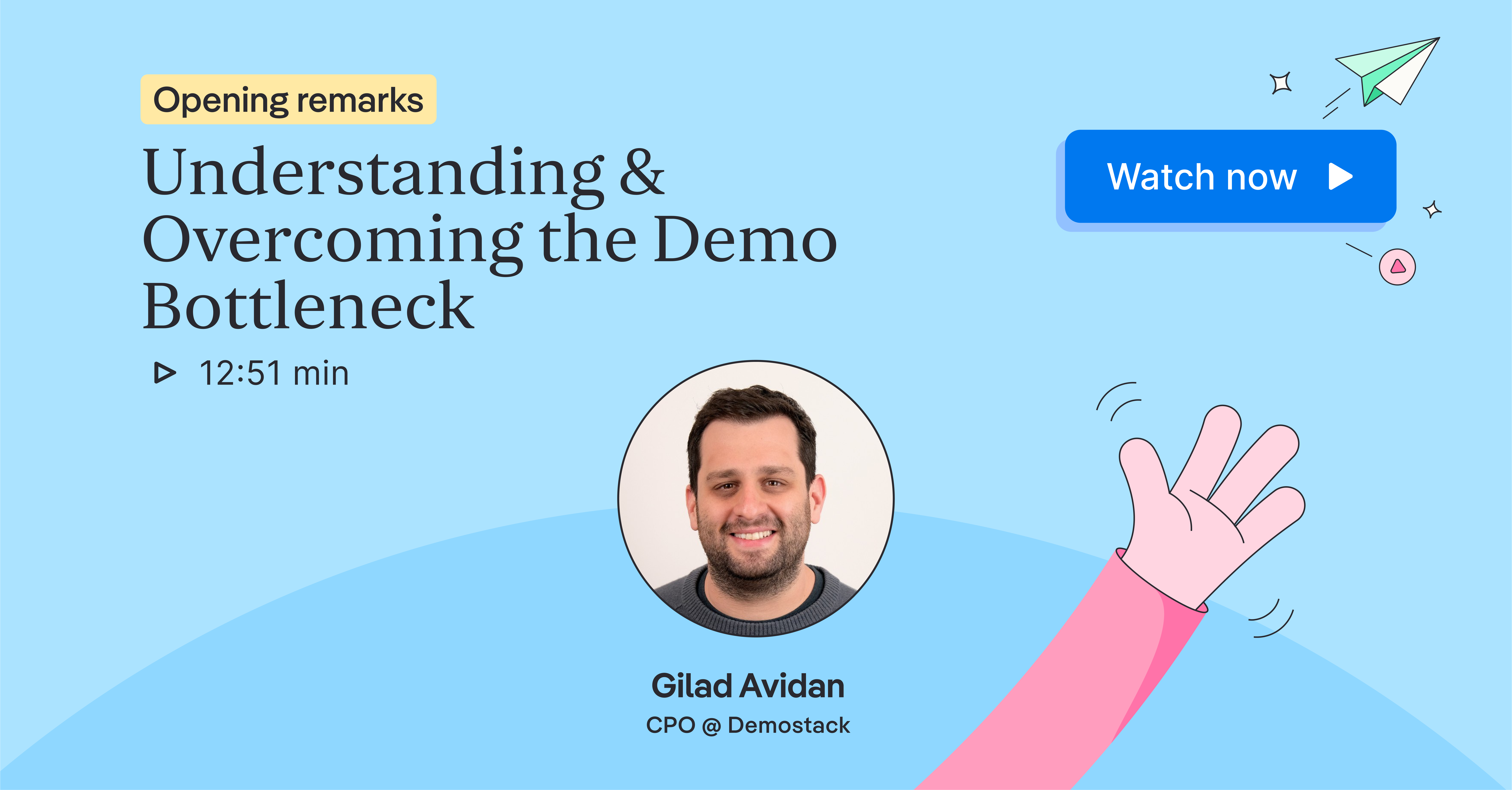
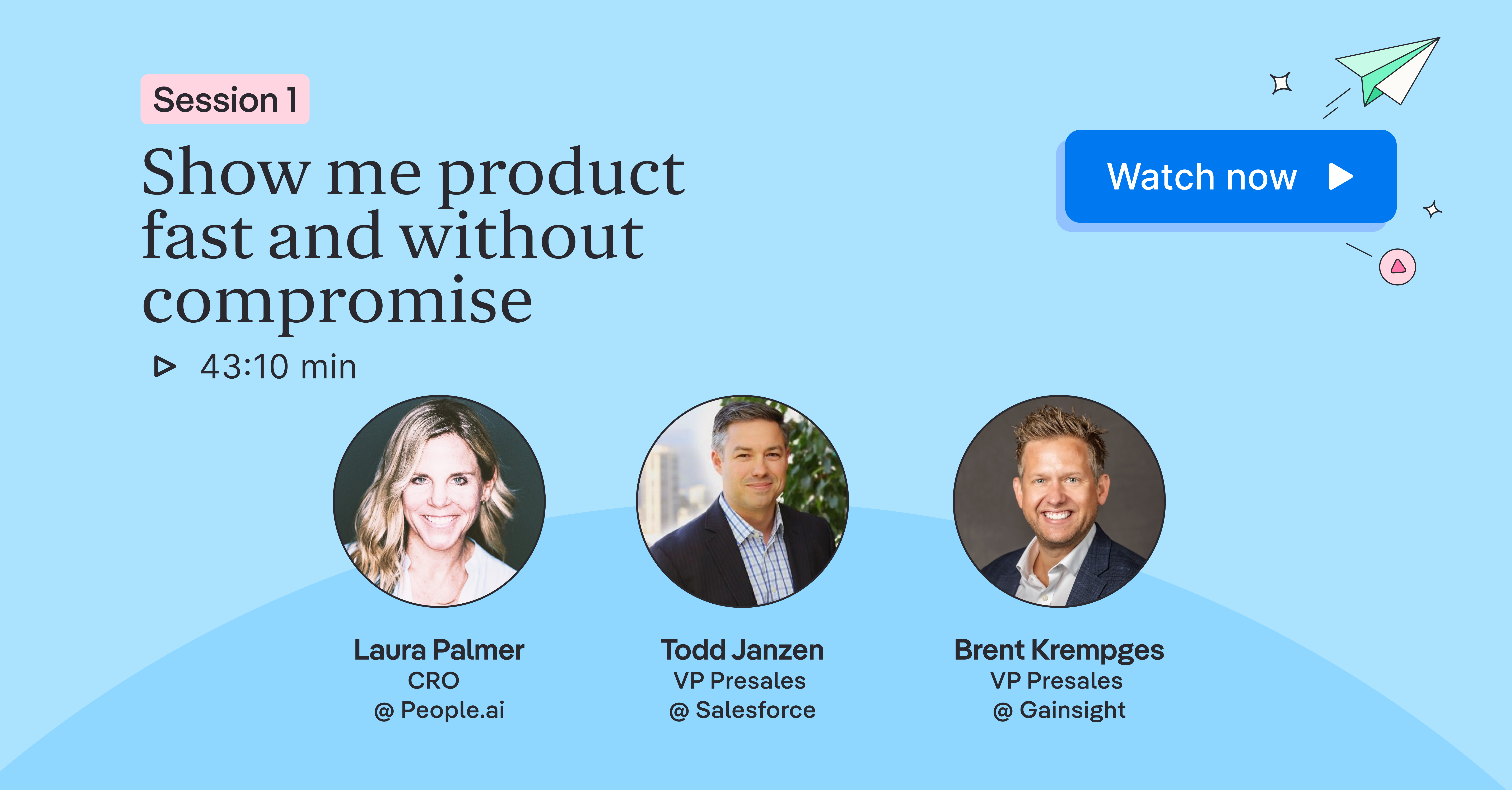
In 2024, how can revenue leaders reach their targets, in a new world, where presales are overworked or even unavailable for every deal?
Watch now to get insights from today's top Sales leaders.

Watch Now
Watch Now
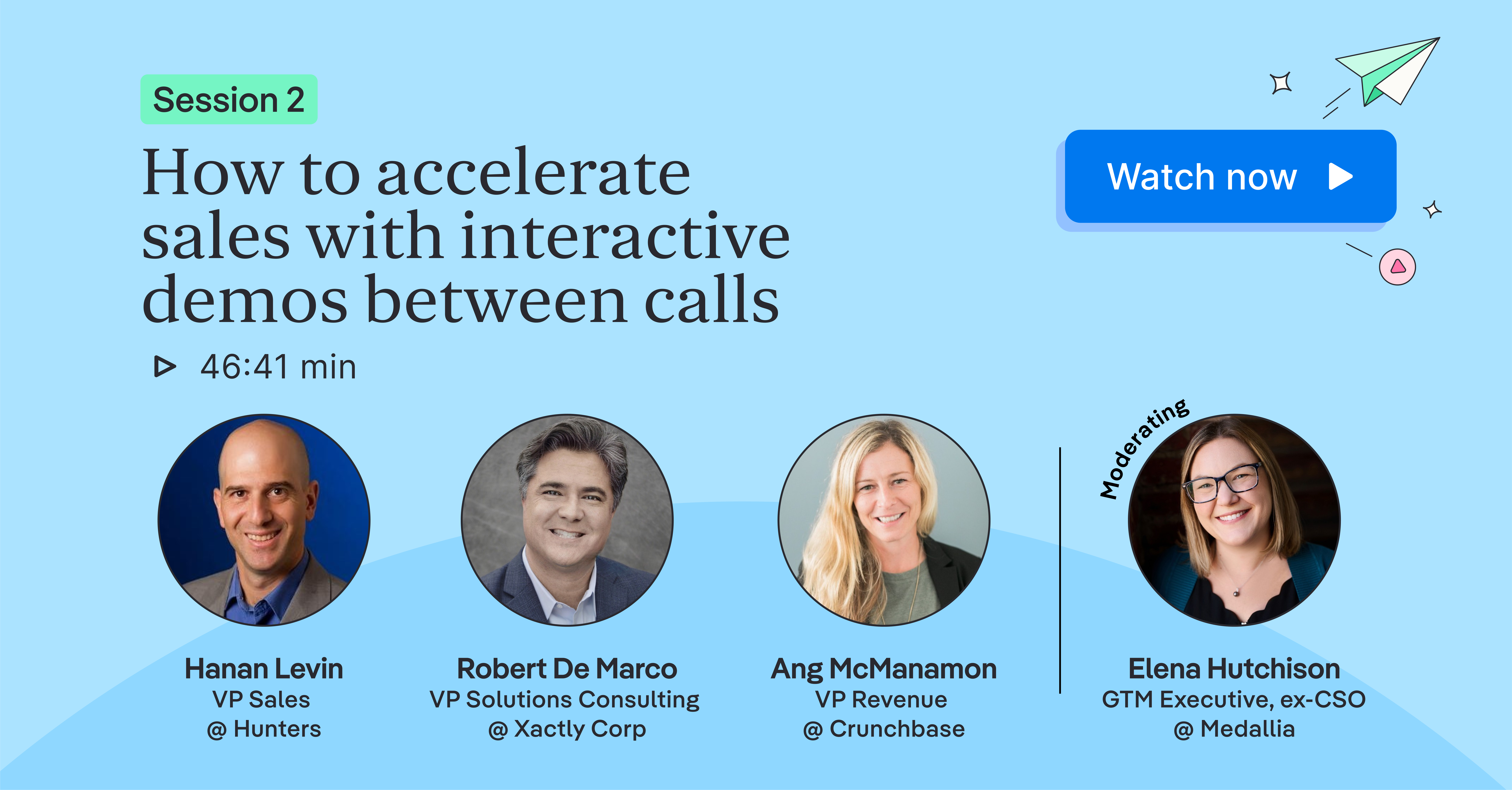
Watch Now
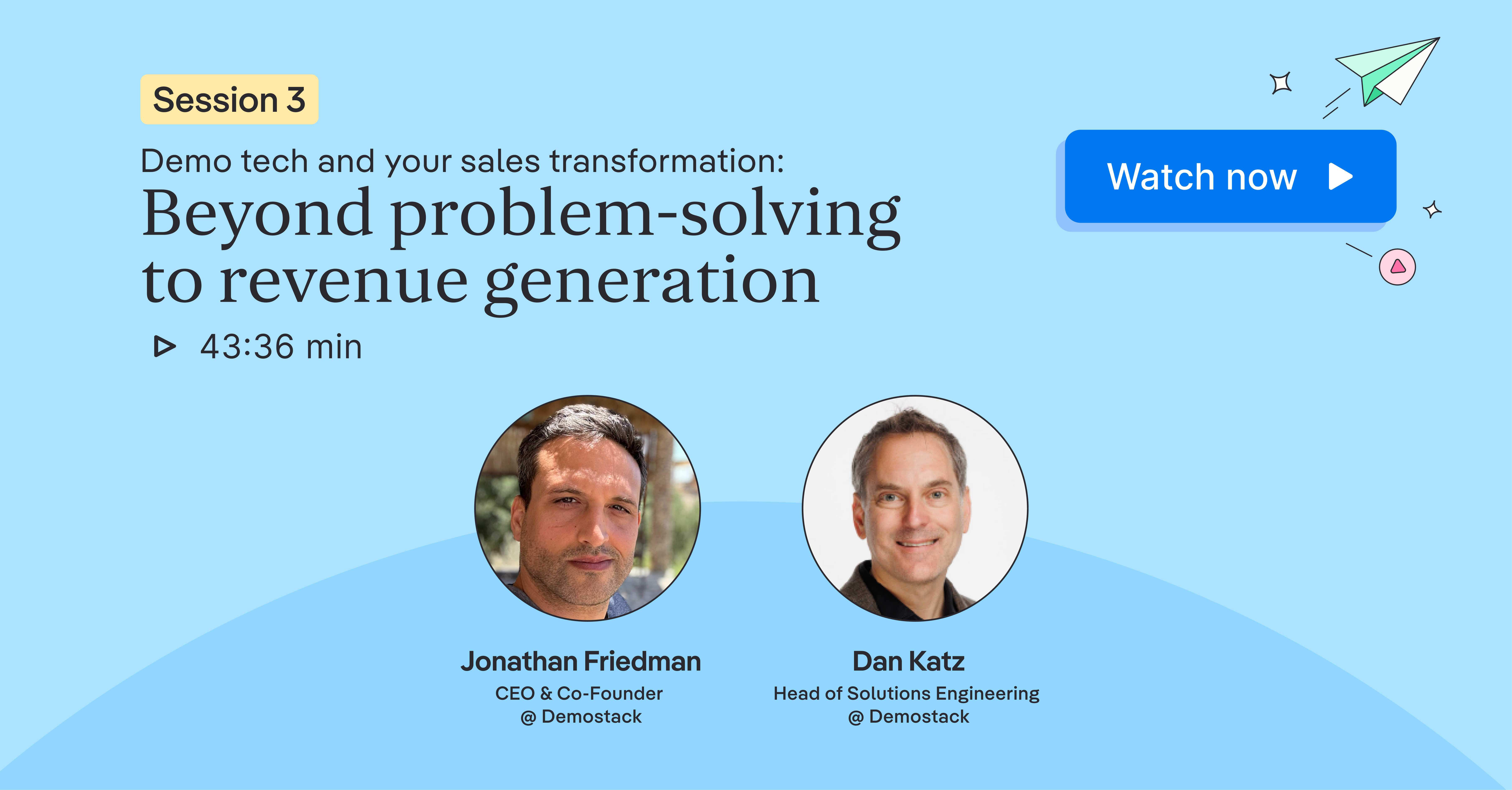
Watch Now
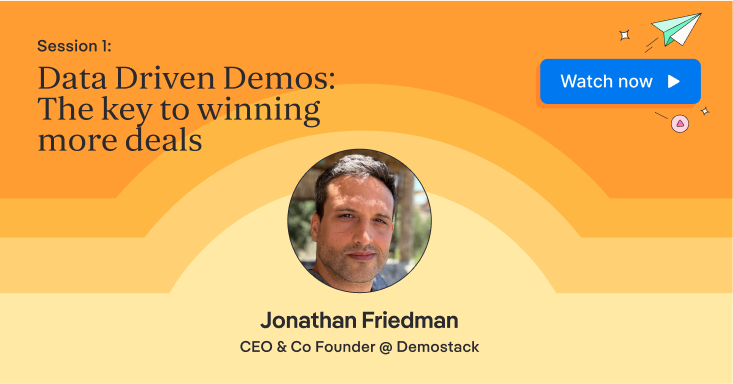
Watch Now
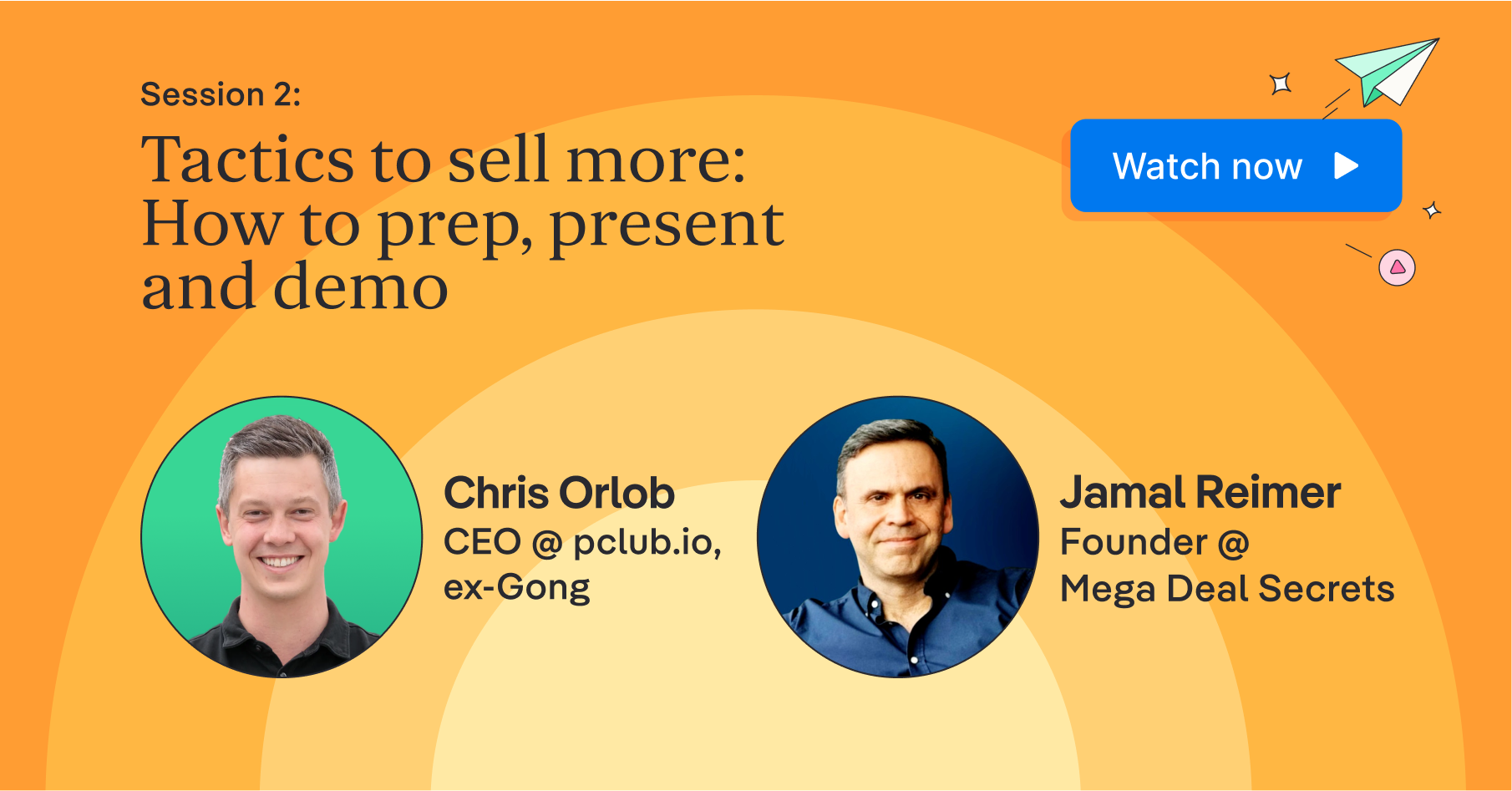
Watch Now
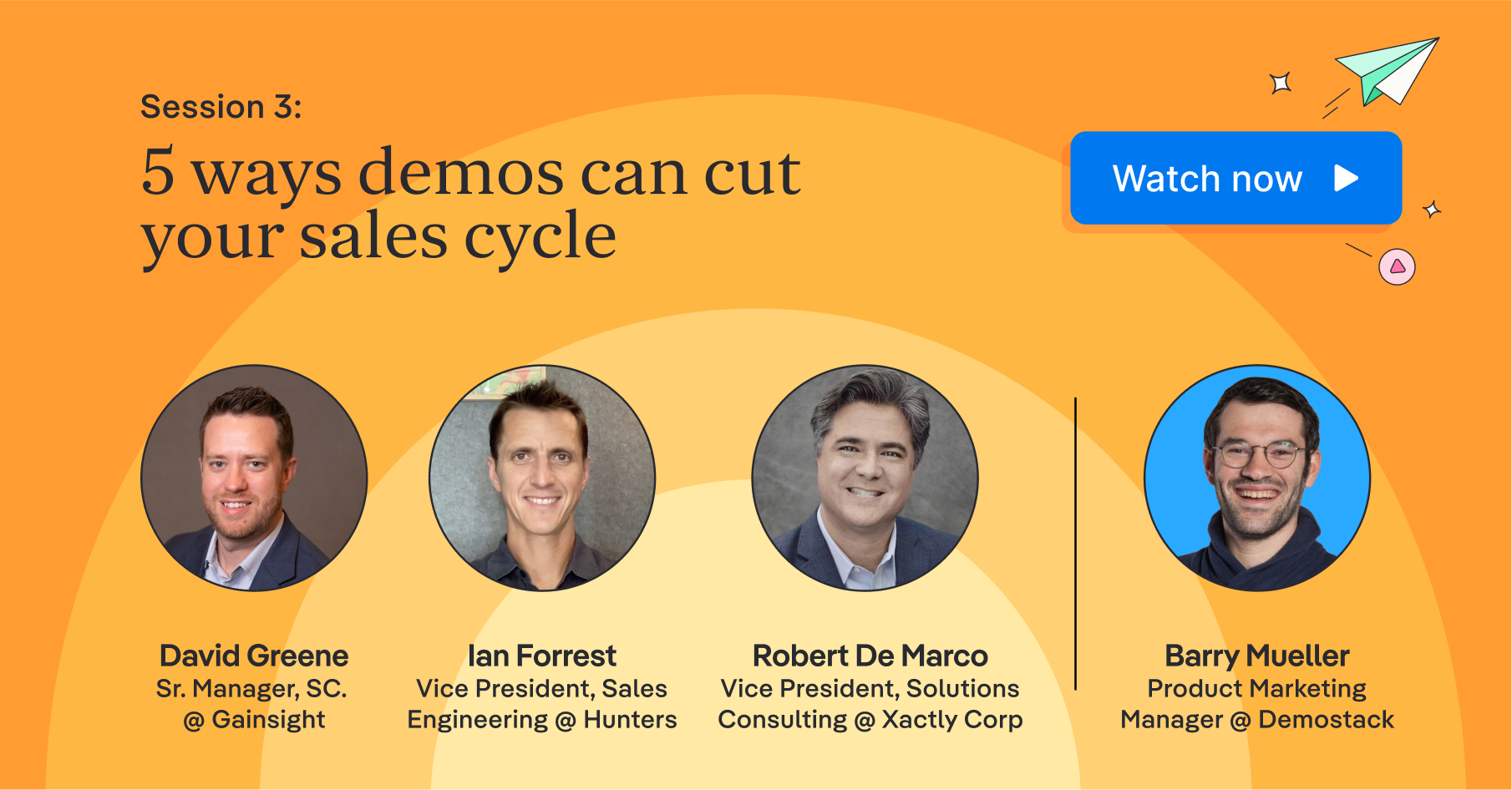
Watch Now
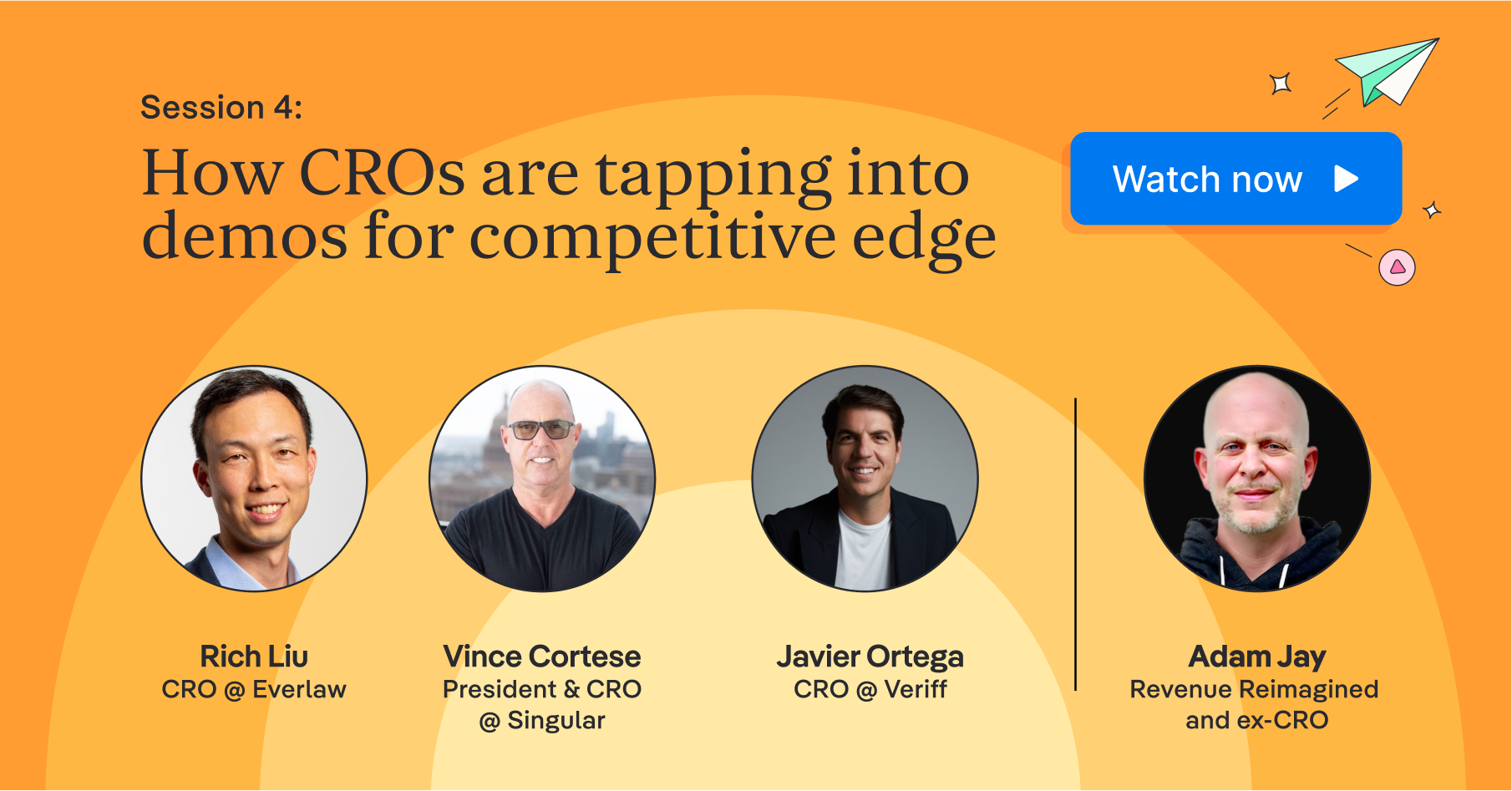
Watch Now
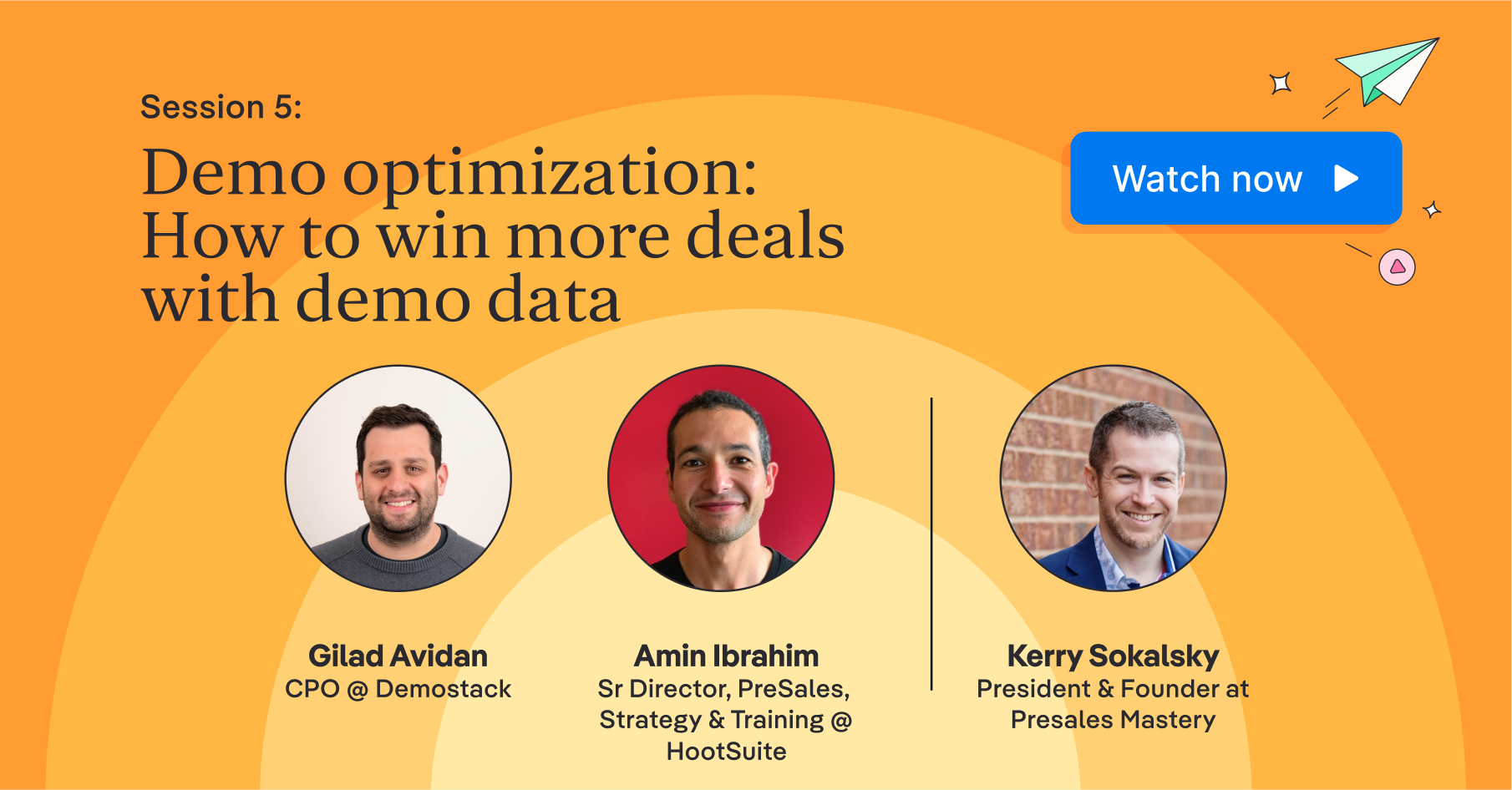
Watch Now
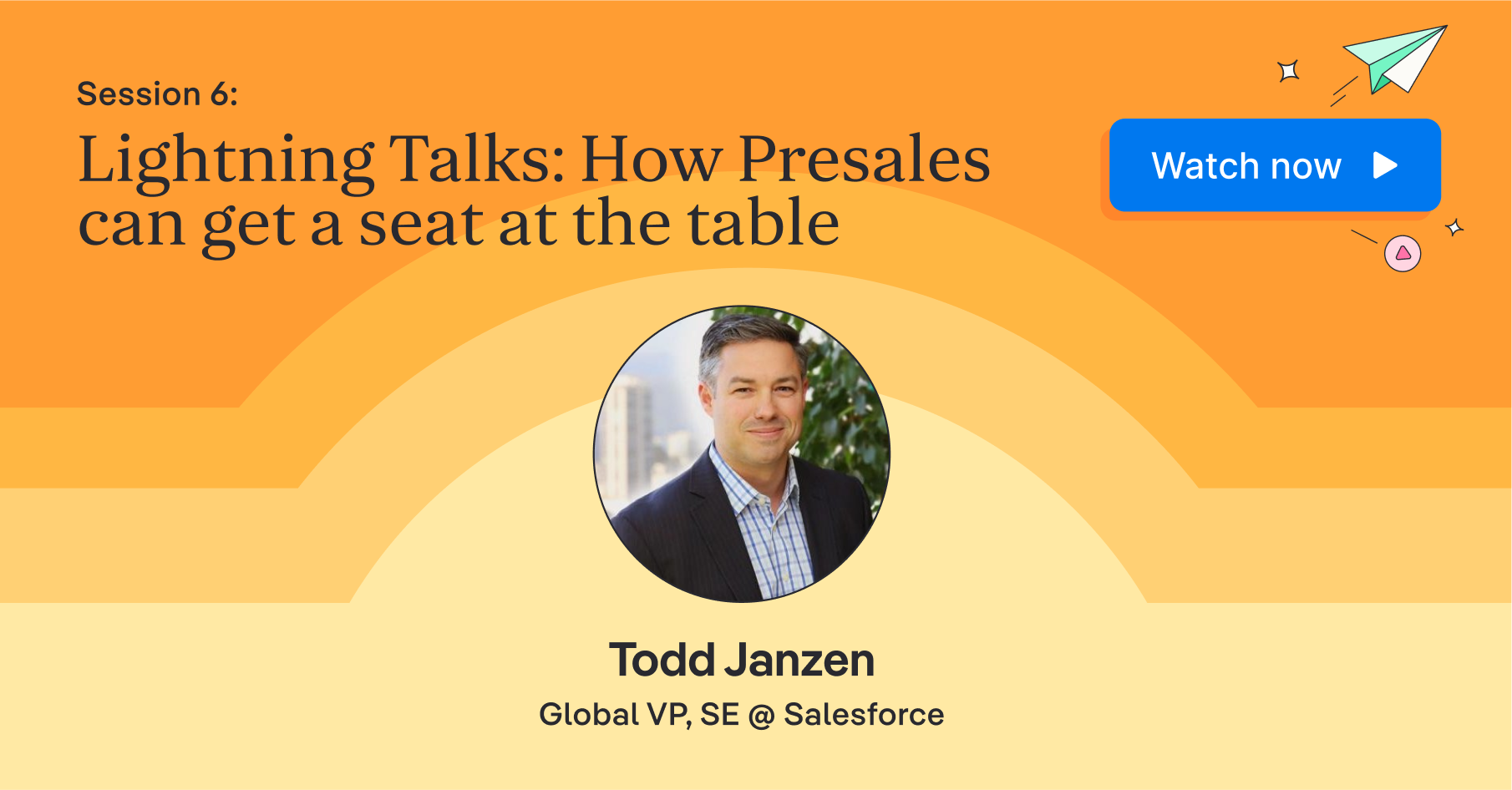
Watch Now
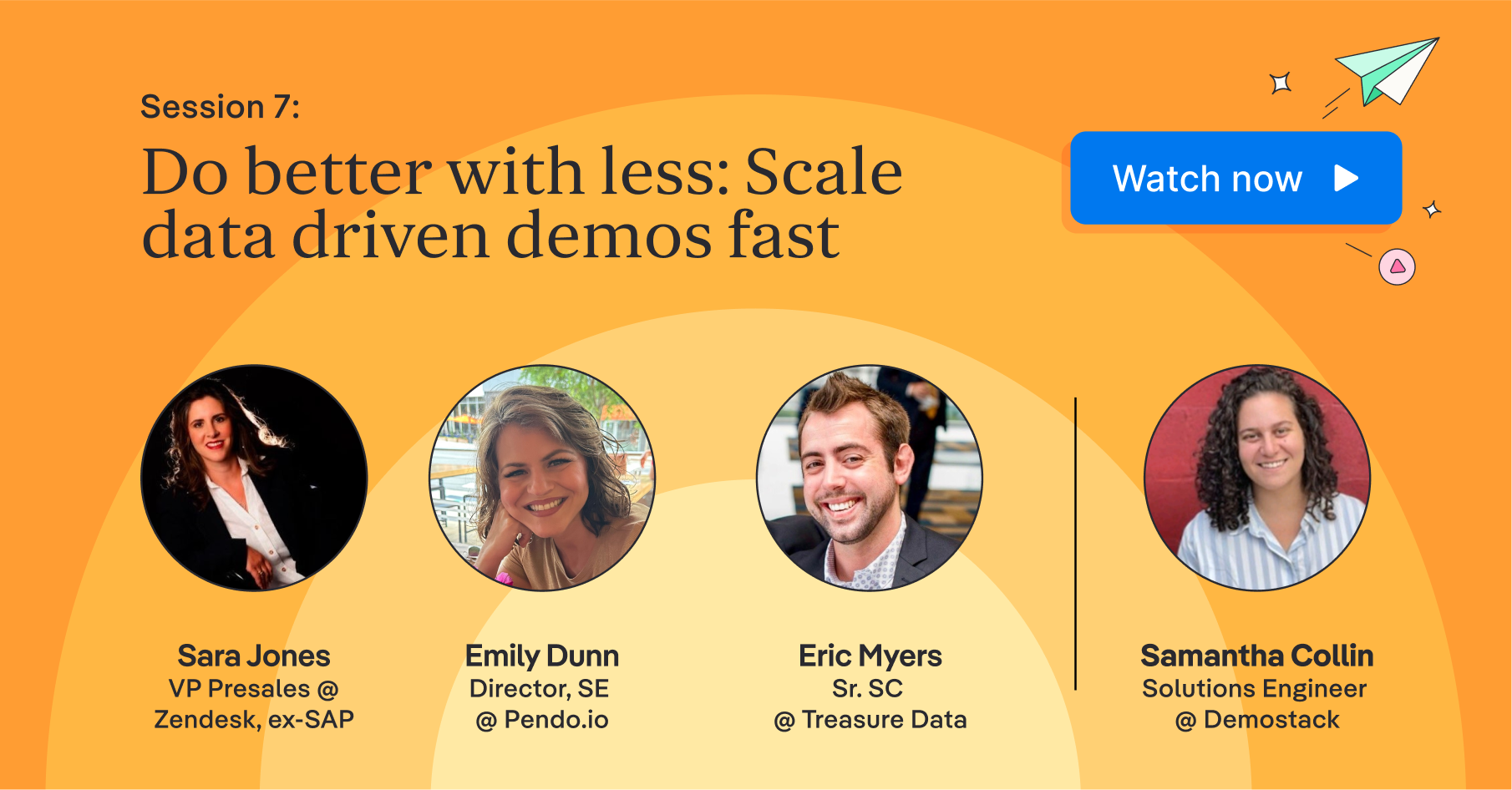
Watch Now
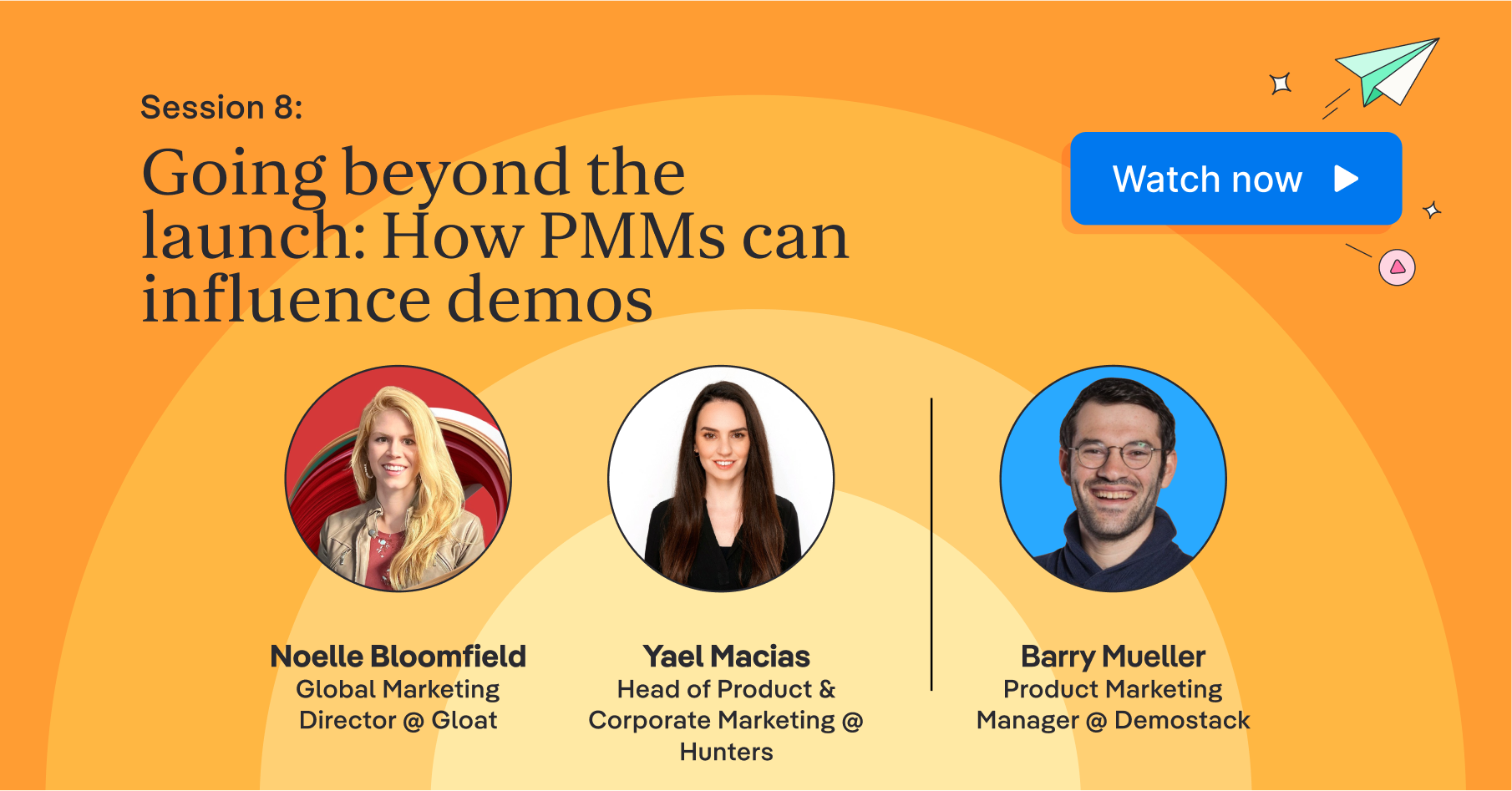
Watch Now

Watch Now
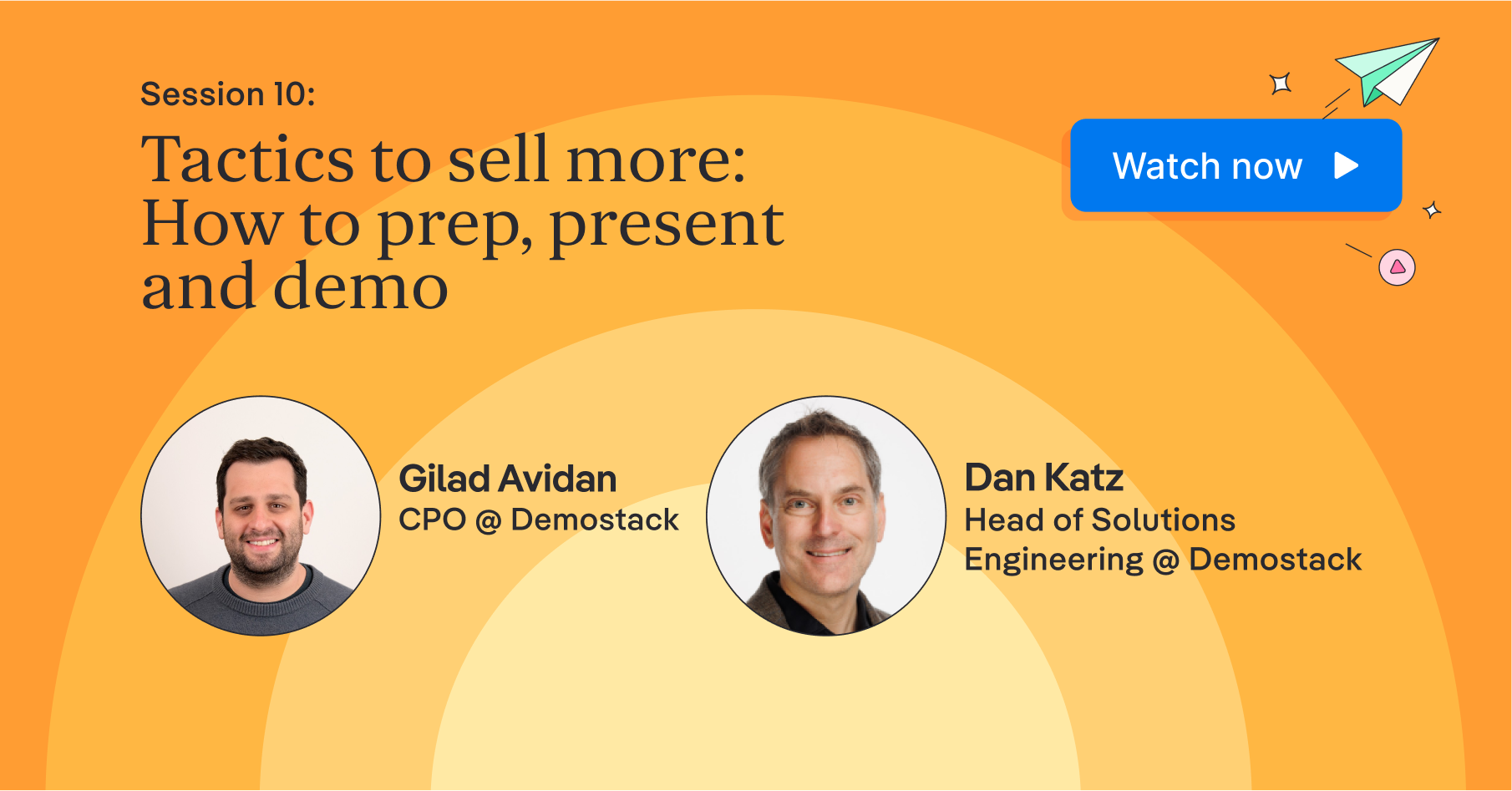
Watch Now
## Demo Enablement & Content Management for the 21st Century
Source: https://www.demostack.com/features/content-management-system
Increase sales productivity with the training, tools, and demo assets they need to close deals.
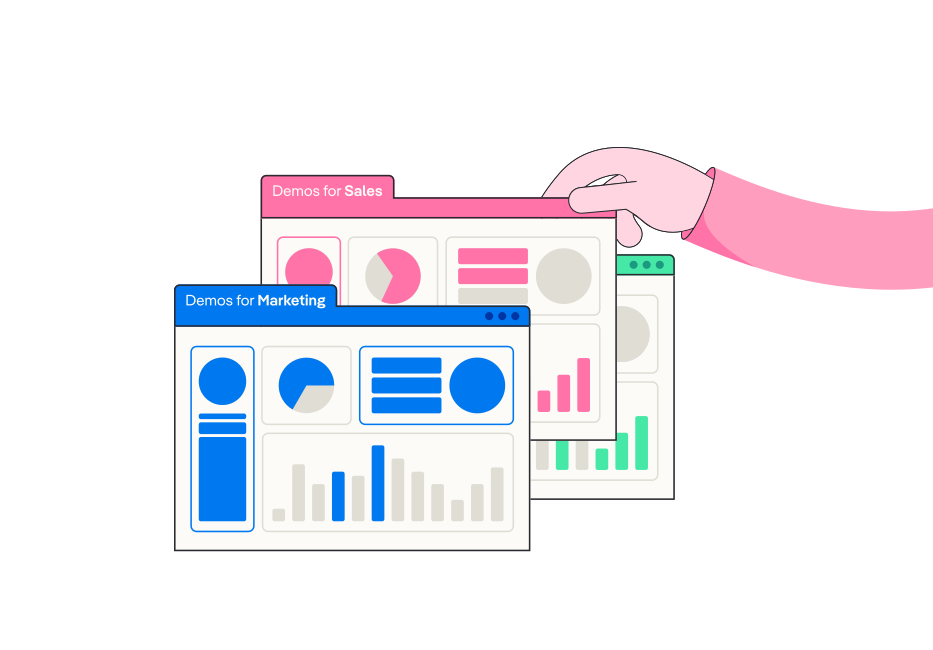
Get a demo
Historically, sales enablement teams have focused on arming their salesforce with post-call buyer enablement assets using sales enablement software. Now, with Demostack, sales enablement and presales teams have the necessary tools to ensure success in live sales demos, a pivotal stage in the sales cycle.
Demostack’s demo library simplifies the process for sales, presales, sales development, channel partners, and customer success teams to discover and access tailor-made demo assets for every sales call.
Curate the right, up-to-date demo, assets to the right team. Everyone can access customized demos, mobile demos, guided product tours and [Demo Playbooks](https://www.demostack.com/platform/features/demo-playbooks) that bundle customized demos alongside essential website pages such as sales decks and PDFs.
Demo Playbooks offer a one-click solution, allowing sales to launch everything needed for a complete demo. They eliminate the need for anyone to manually set up a demo before a call. Instead the customer facing professional just needs to find the appropriate folder and Playbook. That’s it.
Align your sales teams on delivering predictable and repeatable demos, even for new product launches. With an up-to-date library, leaders can drive the necessary behavioral changes across all customer-facing teams.
AEs learning to sell new products or being onboarded will not need to worry about learning the technical parts of setting up custom demos. Rather they can confidently and efficiently launch the appropriate demo from their demo library.
Demo governance is the process of managing the availability, usability, and integrity of demos. With a demo library, custom demo presentations for each vertical, persona, or segment are available and usable for everyone that should have access to them.
With Workspaces, admins can set different roles and permissions for teams. This can be particularly helpful for channel partners who should not have access to beta products for instance. Or Sales Development professionals who should only deliver micro demos and not lengthy harbor demos.
David Greene

Sr. Manager, SC Enterprise at Gainsight
"Gainsight’s sales team has achieved an impressive 8% increase in close-win rates by leveraging Demostack-powered demos. Demostack demos closely replicate the look and feel of our actual products and are easy to customize."
Tim Nordvedt

Solution Architect at Synack
Synack cut demo build time from 100+ hours to under 10 with Demostack. Before, we spend on average 20% of our week on demo building & maintenance . That's 1 working day per week on just demo hygiene!
Rob De Marco

Vice President of Solutions Consulting at Xactly Corp
“With Demostack, our Solution Consultants (SCs) have become significantly more efficient, as Account Executives (AEs) now have access to customized, ready-to-use demos at their disposal.”
Hanan Levin

VP Sales at Hunters.Security
Demostack's Sandbox helped us cut the sales cycle by 50%. Now, both Enterprise and SMBs now buy us in just 4 months, compared to 9 months.
Sarah Goldstein

Head of Product Marketing + GTM at Cyrebro
"With Demostack, over 200 partner users can independently demo our product without concerns about accidentally breaking our demo environment. Demostack allowed us to easily create a demo environment that is 99% indistinguishable from our actual platform, the only solution on the market that could do that."
Sudipto Kar

Senior Solutions Consultant at Gloat
“The platform experience is very intuitive and allows us to manage different versions of the demo environment well. It helps drive a consistent experience for all stakeholders, driving better business outcomes.”
Bryan Rowland

Director of Solutions Architecture at BlueVoyant
“We used Demostack for a multi-million dollar RFP and it allowed us to showcase the value of our product with a much stronger story in the demo. That was all the ROI we needed in one call."
Joe Buchanan

VP of Sales Engineering at Hunters
“I was sold on Demostack within the first 20 minutes of walking through it just knowing all the pain points I’ve had over the years of standing up a demo environment. You’re constantly having to chase down other teams to keep it updated with fresh data and content, and the maintenance becomes just as time consuming as setting it up in the first place. I haven’t seen any other tools that come close to the value that Demostack provides.”
Matthew Bigelow

Director of Global Revenue Enablement at WalkMe
“Demostack is our dream demo environment. Before customizing our dashboards and analytics to tell a story of WalkMe's impact was impossible. With Demostack we can easily edit graphs and showcase data-driven product stories for any deal. It's a total game changer for us.”
## Demostack MCP: Integrate, without making it a project
Your AI tool can now answer questions like "which demo converts best" or "which SE showed what" straight from your Demostack data.
## Your GTM team, multiplied
Source: https://www.demostack.com/AI-agents
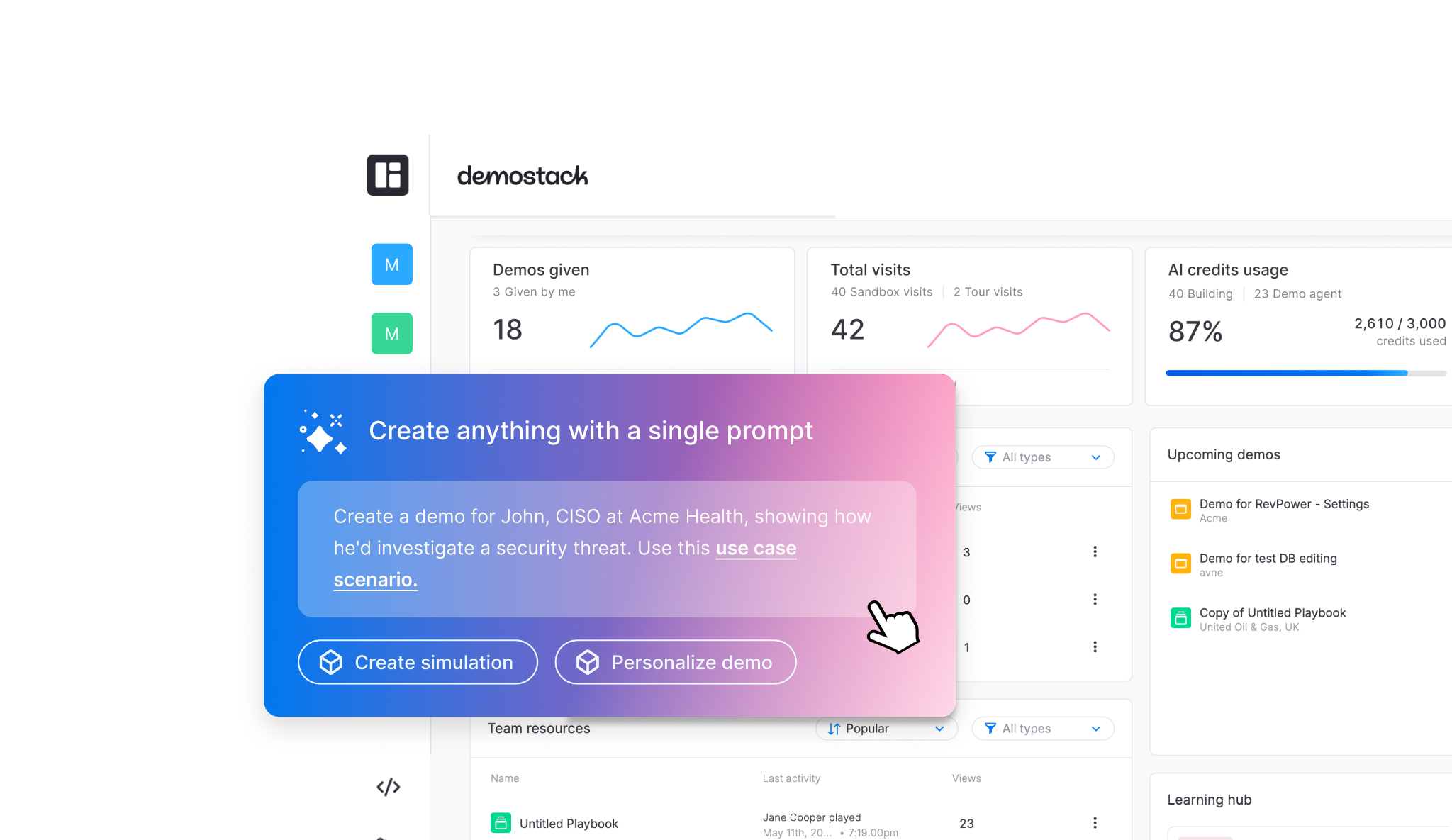
Partner with a team of agents for every demo you present and share. You decide what to show and how the story lands, while your agents tailor and deliver your product story, even when you're not around.
Get a demo
See it in action

A copilot that helps you stay in control
Edit and approve changes to multiple parameters across your simulation with natural language commands and complete transparency.

AI Database Bulk Category Editing
Automate editing of datasets to eliminate manual staging overhead and environment maintenance.

AI Text and
Image Generator
Generate realistic, context-specific content to ensure every simulation mirrors a live, expert-led use cases.

AI for Data Rules
Modify application logic and technical states through natural language instead of manual code overrides.

Hybrid Navigation ("Show Me" vs. "Let Me Try")
Allow users to toggle between an agent-led expert walkthrough and a hands-on practice mode with situational assistance.

In-Situ Technical Explanations
Real-time recognition of on-screen UI elements provides immediate answers to "What does this do?" exactly when the user clicks or asks.

Navigation Guardrails
Interaction blockers that keep sellers and buyers on the "Golden Path," preventing them from getting lost in complex or irrelevant UI areas.

Internal Agent Ecosystem
Build and deploy specialized agents for different product portfolios or verticals to ensure every demo is contextually relevant.

Proficiency & Engagement Analytics
Track granular interaction data beyond the click, identifying exactly where reps or prospects spend time and where they struggle.

Instant Portability
Deploy the agent across any asset—from live discovery playbooks for AEs to self-guided sandboxes for the buying committee.
## Demostack \| Agentic Product Simulation Platform
Source: https://www.demostack.com/
Learn more
Great software simulations are more than just an interactive showcase. They are high-fidelity experiences that show your product in its best light, every time. They are repeatable, fast to produce and personalize. They inform your revenue operation and scale across the entire organization.
Learn more

Accelerate Revenue Velocity
Accelerate the path from product development to market impact. Enable "Day one" field readiness, shorten sales cycles, and reduce the dependency on SE and engineering resources.
With demos independent from your live product, there’s no need to worry about bugs popping up, or new features you weren’t enabled on yet.

Create Consistency & Efficiency
Slash infrastructure cost and create a flexible and scalable product simulation layer, that’s risk-free, and independent of production environments.
Create custom demos in minutes with no R&D. Pssst… that’s weeks shaved off your sales cycle.

Scale Product Expertise
Give front-line teams the independence to showcase real product with the standards and consistency of an expert narrative so anyone can navigate complex demos with confidence.
Shorter sales cycles, higher win rates. And no trials necessary.

Reveal Demo Intelligence
Transform the "dark funnel" into actionable insights. Correlate granular demo engagement and GTM team motions directly to revenue, identifying bottlenecks to optimize GTM focus.
Shorter sales cycles, higher win rates. And no trials necessary.
You’re in control. They do the heavy lifting. Edit multiple parameters across your simulation with natural language commands.

Automate editing of datasets to eliminate manual staging overhead and environment maintenance.

Demostack’s AI Agents empower you to manage simulations with a single prompt, and deliver expert-level guidance, without an expert in the room.

Generate realistic, context-specific content to ensure every simulation mirrors a live, expert-led use cases.

Modify application logic and technical states through natural language instead of manual code overrides.

Scale Expertise, Not environments.
Eliminate the "Groundhog Day" of manual demo environment maintenance. Create stable, high-fidelity clones and custom POCs using AI-powered tools, freeing your team to focus on strategy.

Unlock discovery agility.
Empower your frontline to lead with product value from the very first call. Deliver high-fidelity discovery demos that pivot instantly to showcase specific use cases, allowing AEs to respond to prospect needs in real-time without technical dependency or production environment risks.

Hands-on mastery at scale.
Move beyond static assets and "watch-only" training. Create training "flight simulators" for hands-on certification and partner enablement that replicate the real product without the risk of production environments.

Ensure global narrative consistency.
Launch products faster and keep your field teams "on-narrative." Equip reps with "GPS-guided" playbooks that ensure consistent messaging across every use case, turning every rep into an expert.

Bryan Rowland

Director of Solutions Architecture at BlueVoyant
“We used Demostack for a multi-million dollar RFP and it allowed us to showcase the value of our product with a much stronger story in the demo. That was all the ROI we needed in one call."
Joe Buchanan

VP of Sales Engineering at Hunters
“We’ve already closed 3 deals without a POC thanks to our Demostack Sandbox. It’s accelerating our deals through the funnel - and at a higher ACV.”
Matthew Bigelow

Director of Global Revenue Enablement at WalkMe
“Demostack is our dream demo environment. Before customizing our dashboards and analytics to tell a story of WalkMe's impact was impossible. With Demostack we can easily edit graphs and showcase data-driven product stories for any deal. It's a total game changer for us.”
Tsvika Vishnievsky

VP of Operations, GTM at Yotpo
"Enabling sellers to design tailored product demos promotes confidence and showcases Yotpo's value utilizing realistic examples. In doing so, our prospects are able to visualize precisely how they will be interacting with Yotpo on a daily basis. This helps accelerate deals through the sales funnel."
Javier Ortega Estrada

VP of Sales at Hopin
"Having led multiple teams of sellers of SaaS companies, I realized how complicated it is to find the perfect balance in a demo; having it be both relevant to the customer but that doesn't take a lot of time of the AE away from the phone. The vision of Demostack intersects perfectly between this need and revenue efficiency."
Des Traynor

Co-Founder and Chief Strategy Officer at Intercom
"A great demo is the difference between a product you have to sell, and a product that can sell itself. Demostack solves the Acme problem, the idea that the data in demos never resonates with the customer receiving them."
Nir Zohar

COO & President at Wix
"Empowering businesses to craft a professional digital presence with no coding or design skills needed is core to our mission at Wix. I invested in Demostack, because we share this mission in common and I am impressed with how they are achieving it for creating sales demos."
Leyla Seka

Chief Operating Officer at Ironclad
“The hand off demo is going to have a huge impact on organizations getting deals done faster. Demostack offers the best solution I've seen to get product in the hands of prospects and gain deal-winning insights in exchange.”
Tomer London

Co-Founder and CPO at Gusto
“Demostack will be a productivity boost to any SaaS engineering team. I wish we had something like this when we started.”











## Demostack vs\. Instruqt
Source: https://www.demostack.com/lp/demostack-vs-Instruqt
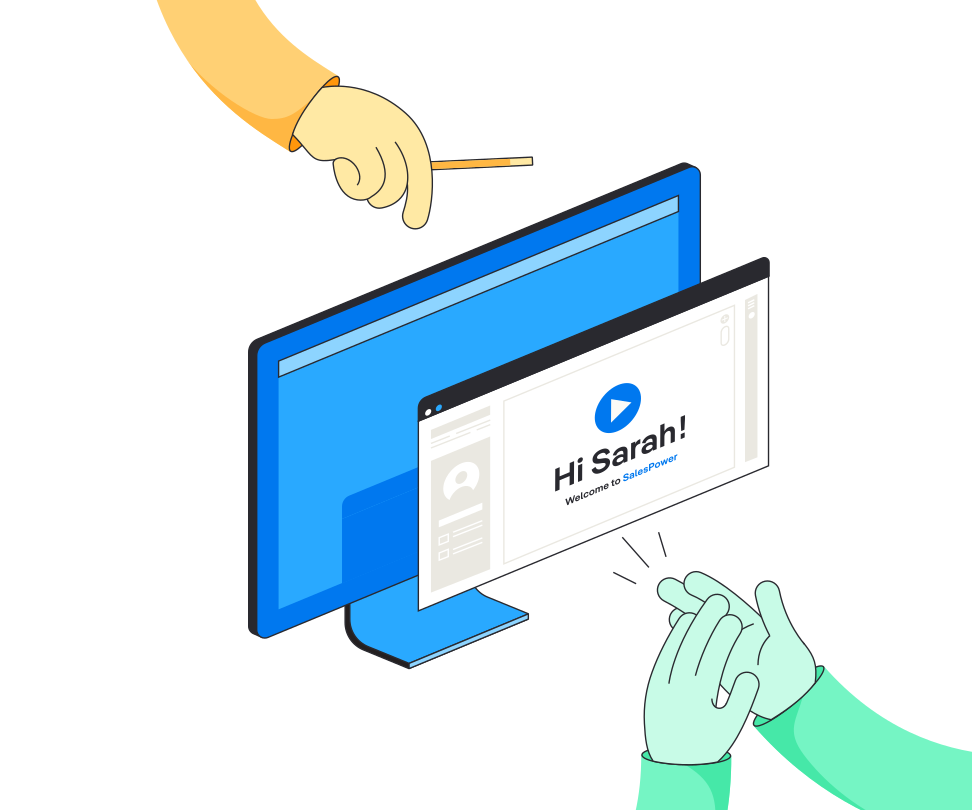
Showcase your product in the best light, without the hassle. It's like staging your home before putting it on the market, but for software.
Get a demo
See how it works
Want to showcase your product in its full glory? See how we stack up.
|
Linear product tours that walk a user through a specific journey.
|
Custom demos that look and act just like your product.
|
|
Light tours that give your prospects a taste before talking to sales.
|
Live or shareable demos tailored to your prospect that showcase your product in its full glory.
|
|
Uses a browser extension to record demo flows, which limits capability to product screenshots that are manually linked together to recreate the product experience.
|
Demostack’s cloning tech creates a 1:1 replica of your product’s front-end, automatically capturing animations, tooltips, and pop-ups. It’s as close as it gets to the real thing but separated from your back-end data.
|
|
Screen visuals can be recorded and personalized quickly, but linking them together to recreate the experience is manual - and doesn’t do your product justice.
|
Cloning captures your entire front end in seconds. Edit charts and data with a point and click, and make mass edits in one step to tailor the story.
|
|
Each product tour can be easily edited, but it's back to square one for your demo when you’ve got a new release rolling out.
|
Keep your demo up-to-date with new product releases by updating your master clone. The edits will trickle down to all your subsequent demo environments, so maintenance is a breeze.
|
You’ve spent enough on marketing and sales to get a qualified buyer on the line. What’s the cost of a live demo that falls flat?

Take control of the demo
Create custom demos in minutes with no R&D. Pssst… that’s weeks shaved off your sales cycle.

Deliver flawless live demos
With demos independent from your live product, there’s no need to worry about bugs popping up, or new features you weren’t enabled on yet.

Win more deals faster
Shorter sales cycles, higher win rates. And no trials necessary.
Turn your prospect into a champion with shareable demos that help them gain buy-in (and look like a hero). You’ll get deal-winning insights in exchange.
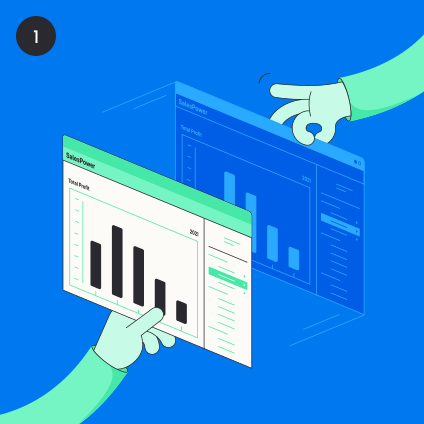
We make it as easy as copying and pasting your URL into our platform. You can use your live app as the base of your demo, or clone it into an independent demo environment. No R&D needed.

Customize the content to your buyer’s use case, persona, or vertical with a few clicks.
Deliver personalized live demos on every call, and let buyers play around with your product on their terms with a Sandbox leave-behind.
It's a clone of your real product experience, built for showcasing. And now you're in the driver's seat to craft the right story. No code needed.
Learn more
We help SaaS companies tell better product stories, from sales tech to security, and everything in between.

Fintech
Sales Tech
Marketing Tech
Enterprise Software
Analytics
Automation
Healthcare
CRM
Business Intelligence
Contract Management
Productivity Software
E-commerce
Review Management
Cyber Security
Customer Experience
Data Warehousing
ERP
Project Management
Supply Chain Tech
Construction
Education
Legal
HR Tech
CMS
David Greene

Sr. Manager, SC Enterprise at Gainsight
"Gainsight’s sales team has achieved an impressive 8% increase in close-win rates by leveraging Demostack-powered demos. Demostack demos closely replicate the look and feel of our actual products and are easy to customize."
Tim Nordvedt

Architect Solution at Synack
"Synack cut demo build time from 100+ hours to under 10 with Demostack. Before, we spend on average 20% of our week on demo building & maintenance . That's 1 working day per week on just demo hygiene!"
Rob De Marco

Vice President of Solutions Consulting at Xactly Corp
“With Demostack, our Solution Consultants (SCs) have become significantly more efficient, as Account Executives (AEs) now have access to customized, ready-to-use demos at their disposal.”
Sarah Goldstein

Head of Product Marketing + GTM at Cyrebro
"With Demostack, over 200 partner users can independently demo our product without concerns about accidentally breaking our demo environment. Demostack allowed us to easily create a demo environment that is 99% indistinguishable from our actual platform, the only solution on the market that could do that."
Sudipto Kar

Senior Solutions Consultant at Gloat
“The platform experience is very intuitive and allows us to manage different versions of the demo environment well. It helps drive a consistent experience for all stakeholders, driving better business outcomes.”
Bryan Rowland

Director of Solutions Architecture at BlueVoyant
“We used Demostack for a multi-million dollar RFP and it allowed us to showcase the value of our product with a much stronger story in the demo. That was all the ROI we needed in one call."
Joe Buchanan

VP of Sales Engineering at Hunters
“We’ve already closed 3 deals without a POC thanks to our Demostack Sandbox. It’s accelerating our deals through the funnel - and at a higher ACV.”
Matthew Bigelow

Director of Global Revenue Enablement at WalkMe
“Demostack is our dream demo environment. Before customizing our dashboards and analytics to tell a story of WalkMe's impact was impossible. With Demostack we can easily edit graphs and showcase data-driven product stories for any deal. It's a total game changer for us.”
Tsvika Vishnievsky

VP of Operations, GTM at Yotpo
"Enabling sellers to design tailored product demos promotes confidence and showcases Yotpo's value utilizing realistic examples. In doing so, our prospects are able to visualize precisely how they will be interacting with Yotpo on a daily basis. This helps accelerate deals through the sales funnel."
Javier Ortega Estrada

VP of Sales at Hopin
"Having led multiple teams of sellers of SaaS companies, I realized how complicated it is to find the perfect balance in a demo; having it be both relevant to the customer but that doesn't take a lot of time of the AE away from the phone. The vision of Demostack intersects perfectly between this need and revenue efficiency."
Des Traynor

Co-Founder and Chief Strategy Officer at Intercom
"A great demo is the difference between a product you have to sell, and a product that can sell itself. Demostack solves the Acme problem, the idea that the data in demos never resonates with the customer receiving them."
Nir Zohar

COO & President at Wix
"Empowering businesses to craft a professional digital presence with no coding or design skills needed is core to our mission at Wix. I invested in Demostack, because we share this mission in common and I am impressed with how they are achieving it for creating sales demos."
Leyla Seka

Chief Operating Officer at Ironclad
“The hand off demo is going to have a huge impact on organizations getting deals done faster. Demostack offers the best solution I've seen to get product in the hands of prospects and gain deal-winning insights in exchange.”
Tomer London

Co-Founder and CPO at Gusto
“Demostack will be a productivity boost to any SaaS engineering team. I wish we had something like this when we started.”
Drive adoption with tailored demos that showcase what success looks like.

Let partners promote your product with on-the-rails demos.

Enable buyers to self-educate with guided product tours.

## Demostack MCP: Integrate, without making it a project
Your AI tool can now answer questions like "which demo converts best" or "which SE showed what" straight from your Demostack data.
## Demostack vs\. Saleo
Source: https://www.demostack.com/demostack-vs-saleo
With Demostack your GTM team builds and updates demos directly. Our AI agents help you build the demos your audience wants, deliver them at scale, and measure every click they make. No coordination with engineering, no backlogs, and no technical specialist needed as your demo evolves.
Clones, live overlay demos, sandboxes, and tours, all on one platform built on our patented technology. Every release stems from the same core, not bolted-on parts, so you move across the whole funnel with a single source of truth. That level of reliability and stability is hard to match when numerous technologies are stitched together.
Demostack simulates your product in an environment you fully control, so every demo is consistent, scalable, and loads instantly, even when your real product is down or being updated. It also handles what's hard on a live product, like a POC, unreleased features, or demo operations at scale, all without putting sensitive data on screen.
|
Yes, full standalone clone
|
No, overlay or snapshots only
|
|
Yes, fully interactive
|
Lite sandbox, from snapshots
|
|
Yes. Robust platform that does not break or fail to load
|
Tied to your live app. If it breaks, your demo does too.
|
|
Yes, in a fully simulated environment
|
Limited on the live product
|
|
Yes. Full dataset, with AI bulk editing
|
Partly. Only where their engineers hooked things up
|
|
Yes. Across the whole demo. Easy to use with Builder Agent.
|
Partly. Only the hooked parts; the rest shows live data
|
|
Your GTM team builds and maintains the demos
|
Needs engineering for setup and for each new screen or dataset
|
|
Instant. Simulate your product once and start demoing
|
Weeks. Every screen and dataset requires custom engineering work with Saleo's team before you can demo it
|
|
Playbook lets you toggle between demos, decks, and URLs, with speaker notes alongside
|
Side feature
|
|
Engagement insights with CRM and MCP integrations
|
Not supported
|
|
Yes. Demo Partner narrates flows and answers questions, live or self-serve
|
None. Every demo depends on a skilled presenter, so delivery and enablement don't scale
|
|
Yes. Builder Agent turns plain-English instructions into a demo
|
Manual, element by element, and often requires coding knowledge
|
|
Query demo data in Claude, ChatGPT, Gemini
|
Not supported
|
|
Yes, live overlay, part of one suite alongside clones, product tours, and sandboxes
|
Yes, Saleo Live
|
|
Yes, part of the same suite alongside clones, live overlay, and sandboxes
|
Yes
|
## The only platform measuring the full demo lifecycle
Measure every action, every click by every user, on every demo experience. Time on screens, clicks on individual buttons, and internal shares all flow to your CRM via API or MCP. Know which demos convert, where buyers drop off, and certify your employees and users on demo completion and progress.


## Customer Subscription Terms
Source: https://www.demostack.com/customersubscription
Stay informed about the security, compliance, and privacy of our products and services.
Privacy Policy
Customer Subscription Terms
Terms of Use
Security Overview
Privacy Notice to End Users
Notice of Demostack IP Rights
# Customer Subscription Terms
**Last updated July 6, 2026**
These Customer Subscription Terms and Conditions (“**Agreement**”) are entered into upon the date of the last signature on the applicable Order Form to which this Agreement is referenced and incorporated therein (“**Effective Date**”),by and between the Demostack legal entity signing an Order Form and its Affiliates (collectively, “**Demostack”**, “**Company**”, “**We**” or “**us**”) and the individual or legal entity using or licensing the Services under an applicable Order Form (“**Customer**”, “**you**” or “**your**” and together with Demostack, the “**Parties**”). For avoidance of doubt, the term “Customer” or “you” shall also include employees or other individuals using the Services.
As of the Effective Date, this Agreement governs the subscription, access to, and use of the services described in your Order Form (the “**Services**”). For purposes herein, “**Order Form**” means the subscription document that sets forth: (i) the subscription term; (ii) the Services; (iii) the fees to be paid by you; (iv) the number of Users (as defined below); and (v) any other subscription terms that may be agreed upon by the Parties.
If you are entering into this Agreement on behalf of a company or other legal entity, you represent that you have the authority to bind such entity and its Affiliates to this Agreement, in which case the terms “Customer” “you” or “your” shall refer to such entity and its Affiliates. If you do not have such authority, or if you do not agree with these terms and conditions, you must not accept this Agreement and shall not be permitted to use the Services. For purposes herein, “**Affiliate**” shall mean an entity that controls, is controlled by, or is under common control with the subject entity; “control,” for purposes of this definition, means direct or indirect ownership of control of more than 50% of the voting. Interests of the subject entity.
This Agreement is solely for paying customers and does not apply to visitors of the Site or users of the free demo.
You must be over the age that is considered to be the age of minors according to the law applicable to you to be able to use the Services. We reserve the right to request proof of age at any stage so that we can verify that minors are not using the Services. In the event that it comes to our knowledge that a person who is a minor is using the Services, we will prohibit and block such person from accessing the Services and will make all efforts to promptly delete any data with regard to such person.
## 1. Use of Service
**1.1. Right to Use the Services.** Subject to Customer’s compliance with this Agreement and applicable Order Forms and full payment of applicable Fees (as defined below), Demostack grants to Customer a non-exclusive, non-transferable, non-sublicensable, limited right to access and use the Services for internal business purposes during the subscription term set forth in the applicable Order Form. All rights in the Services not expressly granted hereunder are reserved to Demostack (or its licensors).
**1.2. Users**. For the purpose of this Agreement, “**User(s)**” means an individual who is authorized by Customer to use the Services, for whom Customer has purchased a subscription (or for whom Services have been provisioned by Demostack), and to whom Customer (or, when applicable, Demostack at Customer’s request) has supplied a user name and password. Users may include, for example, employees, consultants, contractors and agents of Customer, and third parties with which Customer transacts business.
Customer agrees that: (i) it will not allow any User subscription to be used by more than one individual User unless it has been reassigned in its entirety to another individual User, in which case the prior User shall no longer have any right to access or use the Services; (ii) each User shall keep a secure password for their use of the Services; and (iii) it shall not knowingly allow any User to breach any terms of use or service and the Privacy Policy for Users, each as updated by Demostack from time to time, provided such updated terms and policy are shown to the User through the Demostack Services. Customer will be solely responsible for obtaining the authorizations, licenses and consents, if and as required by any applicable law, to make the Services available to Users.
**1.3. ** **Customer Responsibilities.** Customer will: (a) use the Services only in accordance with this Agreement, Order Forms, any additional Demostack user guidelines and other information related to Customer’s use of the Services made available by Demostack to Customer from time to time (“**Documentation**”) and applicable laws and government regulations; (b) be responsible for the accuracy, quality and legality of Customer Data, including the means by which Customer acquired Customer Data, and Customer’s use of Customer Data with the Services; and (c) use commercially reasonable efforts to prevent unauthorized access to or use of the Services, and notify Demostack immediately of any such unauthorized access or use. Any use of the Services in breach of the foregoing by Customer or Users that in Demostack’s good faith judgment threatens the security, integrity, or availability of Demostack’s services, may result in Demostack’s immediate suspension of the Services, however Demostack will use commercially reasonable efforts to provide notice and an opportunity to remedy such violation or threat prior to any such suspension.
**1.4. ** **Use Restrictions**. Other than the rights expressly specified in this Agreement and in an applicable Order Form, no other right or interest is granted to Customer in connection with the Services. Without limiting the foregoing, Customer will not: (a) make the Services available to anyone other than Customer or Users, or use the Services for the benefit of anyone other than Customer or its Affiliates, unless expressly stated otherwise in an Order Form; (b) use the Services to store or transmit infringing, libelous or otherwise unlawful or tortious material, or use the Services to store or transmit material in violation of third-party privacy rights; (c) reverse engineer, decompile, disassemble or otherwise attempt to discover the source code, object code or underlying structure, ideas, know-how or algorithms relevant to the Services, or access the Services to build a competitive product or service, including any product or service using similar ideas, features, functions or graphics of the Services; (d) modify, copy, translate, or create derivative works based on the Services (except to the extent expressly authorized by Demostack); (e) sell, resell, license, sublicense, distribute, rent or lease the Services, or include the Services in a timeshare or service bureau offering; (f) remove any proprietary notices or labels; (g) use the Services to send unsolicited bulk commercial email of any kind, regardless of the content or nature of such messages; (h) interfere or attempt to interfere with the integrity or proper working of the Services; or (i) use the Services in any manner not expressly authorized by this Agreement or applicable Order Forms.
**1.5. Government Use**. As defined in FAR section 2.101, the Software and documentation are “commercial items” and according to DFAR section 252.227-7014(a)(1) and (5) are deemed to be “commercial computer software” and “commercial computer software documentation.” Consistent with DFAR section 227.7202 and FAR section 12.212, any use modification, reproduction, release, performance, display, or disclosure of such commercial software or commercial software documentation by the U.S. Government will be governed solely by the terms of this Agreement and will be prohibited except to the extent expressly permitted by the terms of this Agreement.
**1.6** Customer's use of any Services expressly designated as artificial-intelligence-enabled features ("**AI Features"**) shall be subject to the [**AI Features Terms & Conditions**](https://www.demostack.com/ai-features-terms-and-conditions)
## 2. Demostack Responsibilities
**2.1. Services**. Demostack will: (a) make the Services available to Customer under the terms of this Agreement, applicable Order Form(s) and the Documentation; (b) use commercially reasonable efforts to make the Services available 24 hours a day, seven days a week, except for (i) planned downtime of which Demostack provides advance electronic notice to Customer, and (ii) any unavailability caused by circumstances beyond Demostack’s reasonable control; and (c) comply with laws and government regulations applicable to Demostack’s provision of the Services to its customers, subject to Customer’s and Users’ use of the Services in accordance with this Agreement, applicable Order Form(s) and the Documentation.
**2.2. ** **Security and Privacy of Customer Data**. During the term of this Agreement, Demostack will implement and maintain appropriate administrative, physical, and technical security measures designed to protect the security, confidentiality, and integrity of, and prevent the unauthorized disclosure of, Customer Data. To the extent that Customer provides Demostack with Personal Data, the Parties may execute a separate Data Processing Agreement (“**DPA**”) governing such processing, which will be incorporated by reference into this Agreement upon such execution.
**2.3. Support.** Demostack will strive to respond to Customer support requests submitted by Customer to [support@demostack.com](mailto:support@demostack.com) within one business day and will prioritize needed fixes based upon the severity and criticality of the issues.
## 3. Services Fees and Payments
**3.1. Services Fees.** In consideration for the right to access and use the Services as set forth herein, Customer will pay to Demostack all fees set forth in Order Forms (the “**Fees**”). Except as otherwise set forth in this Agreement or an Order Form, payment obligations are non-cancelable, and Fees paid are non-refundable. Except as otherwise set forth in an Order Form, Fees are subject to change upon renewal.
**3.2. Invoices and Payments**. Except where Customer is paying via credit card, or as otherwise stated in an Order Form, Demostack will invoice Customer for all Fees annually in advance. Unless otherwise stated in an Order Form, full payment for invoiced Fees is due within thirty (30) days after the invoice date.
**3.3. Late Payments.** Overdue Fees may accrue a late payment charge of 1.5% per month on any outstanding balance, or the maximum amount permitted by law, whichever is lower, plus all expenses of collection. In addition, if any Fees are 15 days or more overdue, Demostack may, without limiting its other rights and remedies, immediately suspend Services until such amounts are paid in full. Customer is solely responsible for all taxes associated with its purchase of Services. For clarity, Demostack is solely responsible for taxes assessable against it based on its income, property, and employees.
**3.4. Payment Disputes**. Demostack will not exercise its rights under the “Late Payments” section above if Customer is disputing the applicable charges reasonably and in good faith and is cooperating diligently to resolve the dispute.
## 4. **Proprietary Rights and Licenses**
**4.1. The Services**. Demostack, its Affiliates and licensors reserve all of their right, title and interest in and to the Services, including all of their related intellectual property rights. No rights are granted to Customer hereunder other than as expressly set forth herein.
**4.2. Customer Data**. Customer grants to Demostack, its Affiliates and applicable contractors a non-exclusive, worldwide, royalty-free license to host, copy, use, display and transmit any and all data, information and material input or uploaded to the Services or transmitted to Demostack through the Services by or on behalf of Customer (“**Customer Data**”) as appropriate for Demostack to provide and ensure proper operation of the Services during the Term. Subject to the limited licenses granted herein, Demostack acquires no right, title or interest from Customer or its licensors under this Agreement in or to any Customer Data. Customer and its licensors reserve all of their right, title and interest in and to the Customer Data, including all of their related intellectual property rights.
**4.3. Feedback**. Customer hereby grants Demostack a perpetual, irrevocable, royalty-free, and fully paid right to use and otherwise exploit in any manner any suggestions, ideas, enhancement requests, feedback, recommendations or other information provided by Customer related to the Services or other Demostack products or services, including for the purpose of improving and enhancing the Services, provided that Customer is not referenced in such use.
**4.4. Usage Information**. Notwithstanding anything to the contrary, Demostack may collect and analyze data and other information relating to the provision, use and performance of various aspects of the Services and related systems and technologies (including, without limitation, information concerning Customer Data and data derived therefrom), and Demostack will be free (during and after the term hereof) to: (a) use such information and data to improve and enhance the Services and for other development, diagnostic and corrective purposes in connection with the Services and other Demostack offerings; and (b) disclose such information and data solely in aggregated or other anonymized form in connection with its business.
## 5. Confidentiality
**5.1. Definition of Confidential Information**. For purposes of this Agreement, “**Confidential Information**” shall mean any non-public information disclosed by either party (the “**Disclosing Party**”) to the other party (the “**Receiving Party**”), either directly or indirectly in writing, orally, or by inspection of tangible objects: (a) that the disclosing party identifies as confidential or proprietary at the time of disclosure; or (b) that reasonably appears to be confidential or proprietary because of legends or other markings, the circumstances of disclosure, or the nature of the information itself. Confidential Information of Customer includes Customer Data; Confidential Information of Demostack includes the Services and Documentation, and the terms and conditions of this Agreement and all Order Forms (including pricing). Notwithstanding the foregoing, Confidential Information shall not include any information that the Receiving Party can document (i) is or becomes (through no breach by the Receiving Party of this Agreement or any other obligation of confidentiality applicable to the Receiving Party) generally available to the public; or (ii) was lawfully in its possession or known by it prior to receipt from the Disclosing Party; or (iii) was rightfully disclosed to it without restriction by a third party who is not bound by any confidentiality obligations with respect thereto; or (iv) is independently developed by the Receiving Party without use of or reference to the Confidential Information. For clarity, the non-disclosure obligations set forth in this “Confidentiality” section apply to Confidential Information exchanged between the parties in connection with the evaluation of additional Demostack services and offerings.
**5.2. Protection of Confidential Information**. As between the parties, each party retains all ownership rights in and to its Confidential Information. The Receiving Party will use the same degree of care that it uses to protect the confidentiality of its own confidential information of like kind (but not less than reasonable care) to: (a) not use any Confidential Information of the Disclosing Party for any purpose outside the scope of this Agreement; and (b) except as otherwise authorized by the Disclosing Party in writing, limit access to Confidential Information of the Disclosing Party to those of its and its Affiliates’ employees and contractors who need that access for purposes consistent with this Agreement and who have signed confidentiality agreements with the Receiving Party containing protections not materially less protective of the Confidential Information than those herein. Neither party will disclose the terms of this Agreement or any Order Form to any third party other than its Affiliates, legal counsel and accountants without the other party’s prior written consent, provided that a party that makes any such disclosure to its Affiliate, legal counsel or accountants will remain responsible for such Affiliate’s, legal counsel’s or accountant’s compliance with this “Confidentiality” section. Notwithstanding the foregoing, Demostack may disclose the terms of this Agreement and any applicable Order Form to a contractor to the extent necessary to perform Demostack’s obligations under this Agreement, under terms of confidentiality materially as protective as set forth herein.
**5.3. Compelled Disclosure**. The Receiving Party may disclose Confidential Information of the Disclosing Party to the extent compelled by law to do so, provided the Receiving Party gives the Disclosing Party prior notice of the compelled disclosure (to the extent legally permitted) and reasonable assistance, at the Disclosing Party's cost, if the Disclosing Party wishes to contest the disclosure. If the Receiving Party is compelled by law to disclose the Disclosing Party’s Confidential Information as part of a civil proceeding to which the Disclosing Party is a party, and the Disclosing Party is not contesting the disclosure, the Disclosing Party will reimburse the Receiving Party for its reasonable cost of compiling and providing secure access to that Confidential Information.
## 6. Representations, Warranties and Disclaimers
**6.1. Representations**. Each party represents that it has validly entered into this Agreement and has the legal power to do so.
**6.2. Demostack Warranties**. Demostack warrants that during the applicable subscription term Demostack will not: (a) materially decrease the overall functionality of the Services; or (b) materially decrease the overall security of the Services. For any breach of a warranty above, Customer’s exclusive remedies are as set forth in the “Termination” and “Effect of Termination” sections below.
**6.3. Disclaimers**. EXCEPT AS EXPRESSLY PROVIDED HEREIN, NEITHER PARTY MAKES ANY WARRANTY OF ANY KIND, WHETHER EXPRESS, IMPLIED, STATUTORY OR OTHERWISE, AND EACH PARTY SPECIFICALLY DISCLAIMS ALL IMPLIED WARRANTIES, INCLUDING ANY IMPLIED WARRANTY OF MERCHANTABILITY, FITNESS FOR A PARTICULAR PURPOSE OR NON-INFRINGEMENT, TO THE MAXIMUM EXTENT PERMITTED BY APPLICABLE LAW.
CUSTOMER ACKNOWLEDGES AND AGREES THAT EXCEPT AS EXPRESSLY PROVIDED HEREIN, THE SERVICE(S) AND ANY ACCOMPANYING DOCUMENTATION ARE PROVIDED ON AN “AS IS”, “AS AVAILABLE” BASIS. IN PARTICULAR, DEMOSTACK DOES NOT WARRANT THAT THE OPERATION OF THE SERVICES WILL BE UNINTERRUPTED, CONTAMINANT-FREE OR ERROR-FREE, THAT SYSTEM AVAILABILITY BE MAINTAINED, THAT ANY ERROR, BUG OR PROBLEM BE RESOLVED OR THAT THEY WILL MEET THE CUSTOMER’S REQUIREMENTS.
THIS SECTION DOES NOT LIMIT, AND IS WITHOUT PREJUDICE TO, THE PROVISIONS OF SECTION 8 BELOW.
## 7. Mutual Indemnification
**7.1. Indemnification by Demostack.** Demostack will defend Customer against any claim, demand, suit or proceeding made or brought against Customer by a third party alleging that the Services infringe or misappropriate such third party’s intellectual property rights (a “**Claim** **Against** **Customer**”), and will indemnify Customer from any damages, attorney fees and costs finally awarded against Customer as a result of, or for amounts paid by Customer under a settlement approved by Demostack in writing of, a Claim Against Customer, provided Customer: (a) promptly gives Demostack written notice of the Claim Against Customer; (b) gives Demostack sole control of the defense and settlement of the Claim Against Customer; and (c) gives Demostack all reasonable assistance, at Demostack’s expense. If Demostack receives information about an infringement or misappropriation claim related to the Services, Demostack may in its discretion and at no cost to Customer: (i) modify the Services so that they are no longer claimed to infringe or misappropriate; (ii) obtain a license for Customer’s continued use of the Services in accordance with this Agreement; or (iii) terminate Customer’s subscriptions for the Services upon 30 days’ written notice and refund Customer any prepaid fees covering the remainder of the term of the terminated Services. The above defense and indemnification obligations do not apply if a Claim Against Customer arises from: (I) the use or combination of the Services or any part thereof with software, hardware, data, or processes not provided by Demostack, if the Services or use thereof would not infringe without such combination; (II) modifications to the Services not made by Demostack; or (III) Customer’s breach of this Agreement, applicable Order Forms or the Documentation.
**7.2. Indemnification by Customer**. Customer will defend Demostack and its Affiliates against any claim, demand, suit or proceeding made or brought against Demostack by a third party arising from: (a) Customer’s use of the Services in an unlawful manner or in violation of this Agreement, an Order Form or the Documentation; or (b) any Customer Data or Customer’s use of Customer Data with the Services (each a “**Claim** **Against** **Demostack**”), and will indemnify Demostack from any damages, attorney fees and costs finally awarded against Demostack as a result of, or for any amounts paid by Demostack under a settlement approved by Customer in writing of, a Claim Against Demostack, provided Demostack: (i) promptly gives Customer written notice of the Claim Against Demostack; (ii) gives Customer sole control of the defense and settlement of the Claim Against Demostack; and (iii) gives Customer all reasonable assistance, at Customer’s expense. The above defense and indemnification obligations do not apply if a Claim Against Demostack arises from Demostack’s breach of this Agreement, applicable Order Forms or the Documentation.
**7.3. Sole and Exclusive Remedy.** This Section 7 sets forth the indemnifying party’s sole liability to, and the indemnified party’s exclusive remedy against, the other party for the third-party claims described herein.
## 8. Limitations of Liability
**8.1. Limitation on Indirect Liability.** EXCEPT TO THE EXTENT PROHIBITED BY LAW, NEITHER PARTY OR ITS AFFILIATES WILL HAVE ANY LIABILITY ARISING OUT OF OR RELATED TO THIS AGREEMENT FOR ANY INDIRECT, EXEMPLARY, INCIDENTAL, SPECIAL, PUNITIVE, COVER, BUSINESS INTERRUPTION, LOST PROFIT, OR CONSEQUENTIAL DAMAGES, WHETHER AN ACTION IS IN CONTRACT OR TORT AND REGARDLESS OF THE THEORY OF LIABILITY, EVEN IF A PARTY OR ITS AFFILIATES HAVE BEEN ADVISED OF THE POSSIBILITY OF SUCH DAMAGES OR IF A PARTY’S OR ITS AFFILIATES’ REMEDY OTHERWISE FAILS OF ITS ESSENTIAL PURPOSE.
8.2. TO THE FULLEST EXTENT PERMITTED BY LAW AND OTHER THAN IN THE EVENT OF WILLFUL MISCONDUCT, GROSS NEGLIGENCE OR BREACH OF EITHER PARTY’S INDEMNIFICATION OBLIGATIONS (IN SECTIONS 7.1 AND 7.2, RESPECTIVELY), THE AGGREGATE TOTAL LIABILITY OF EITHER PARTY TOGETHER WITH ITS AFFILIATES ARISING OUT OF OR RELATED TO THIS AGREEMENT SHALL NOT EXCEED THE TOTAL AMOUNTS PAID OR PAYABLE BY CUSTOMER AND ITS AFFILIATES FOR THE SERVICES IN THE TWELVE (12) MONTHS PRECEDING THE EVENT GIVING RISE TO THE LIABILITY (“**LIABILITY CAP**”).
THE FOREGOING LIMITATION WILL APPLY WHETHER AN ACTION IS IN CONTRACT OR TORT AND REGARDLESS OF THE THEORY OF LIABILITY, BUT WILL NOT LIMIT CUSTOMER'S AND ITS AFFILIATES’ PAYMENT OBLIGATIONS UNDER THE “SERVICES FEES AND PAYMENTS” SECTION ABOVE.
## 9. Term and Termination
**9.1. Term.** This Agreement commences on the Effective Date and will remain in effect for so long as Customer has an applicable Order Form in effect, unless otherwise terminated in accordance with the provisions herein (including but not limited to any provisions specified under the Order Form).
**9.2. Renewal.** Except as otherwise stated in the applicable Order Form and subject to applicable law, Order Forms will automatically renew for additional twelve (12) month periods (“**Renewal Term(s)**”), unless either party gives the other party notice of its intent not to renew at least sixty (60) days before the end of the relevant Order Form term. A new Order Form shall only be executed upon renewal in the event of any changes to the subscription terms.
**9.3. Termination.** Either party may terminate this Agreement and any Order Form thereunder for cause: (a) upon thirty (30) days written notice to the other party of a material breach if such breach remains uncured at the end of such period; or (b) upon written notice if the other party becomes the subject of a petition in bankruptcy or any other proceeding relating to insolvency, receivership, liquidation or assignment for the benefit of creditors.
**9.4. Effect of Termination.** Except as otherwise stated herein, in the event of any expiration or termination of this Agreement, all rights granted hereunder shall immediately expire and any and all use of the Services shall immediately cease and expire. If Customer terminates this Agreement pursuant to Section 9.3 above, Demostack will refund Customer any prepaid Fees covering the remainder of the subscription term of all Order Forms after the effective date of termination. Notwithstanding the foregoing, in no event will termination of this Agreement relieve Customer of its obligation to pay any Fees applicable to the period prior to the effective date of termination.
**9.5. Survival.** The following sections will survive any expiration or termination of this Agreement: Section 2.2 (Security and Privacy of Customer Data), for as long as Demostack retains any Customer Data, Section 3 ( Services Fees and Payments), Section 4 (Proprietary Rights and Licenses), Section 5 (Confidentiality), Section 6.3 (Disclaimers), Section 7 (Mutual Indemnification), Section 8 (Limitation of Liability), Section 9.4 (Effect of Termination),” this Section 9.5 (Survival) and Section 10 (Miscellaneous).
## 10. Miscellaneous
**10.1. Entire Agreement, Order of Precedence.** This Agreement is the complete and exclusive statement of the mutual understanding of the parties regarding Customer’s use of Services and supersedes previous and contemporaneous written and oral agreements, communications and other understandings relating to the subject matter of this Agreement. The parties agree that any term or condition stated in any Customer purchase order or other document, except for Order Forms, is void. In the event of a conflict or inconsistency between any Order Form and this Agreement, the Order Form shall control. Titles and headings in this Agreement are for convenience only and will not affect the construction of any provision of this Agreement.
**10.2. Export Compliance.** The Services and derivatives thereof may be subject to export laws and regulations of the United States and other jurisdictions. Demostack and Customer each represents that it is not on any U.S. government denied-party list. Customer will not permit any User to access or use the Services in Russia or a U.S.-embargoed country or region (currently Cuba, Iran, North Korea, Syria or Crimea) or in violation of any U.S. export law or regulation.
**10.3. Relationship of the Parties, Third-Party Beneficiaries.** The parties are independent contractors. This Agreement does not create a partnership, franchise, join venture, agency, fiduciary, or employment relationship between the parties. Each party will be solely responsible for payment of all compensation to its employees, as well as all employment-related taxes. There are no third-party beneficiaries under this Agreement.
**10.4. Waiver, Severability.** No failure or delay in exercising any right under this Agreement shall constitute a waiver of that right. If any provision of this Agreement is held by a court of competent jurisdiction to be contrary to law, the provision will be deemed null and void, and the remaining provisions of this Agreement will remain in effect.
**10.5. Anti-Corruption. **Neither party has received or been offered any illegal or improper bribe, kickback, payment, gift, or thing of value from any employee or agent of the other party in connection with this Agreement.
**10.6. Assignment.** This Agreement is not assignable, transferable, or sub-licensable by Customer except with Demostack’s prior written consent. An Affiliate of the Customer may also acquire Services from Demostack by entering into an Order Form with Demostack and, for the purposes of any such Order Form, the Affiliate executing the Order Form will be considered the “Customer” as that term is used herein and therein, and such Order Form will constitute a contract for the applicable Services between Demostack and the applicable Affiliate executing the Order Form. The Customer shall remain fully liable for the actions and omissions of its Affiliates. Demostack may transfer and assign any of its rights and obligations under this Agreement without consent.
**10.7. Change in Terms.** Demostack reserves the right to modify or otherwise update this Agreement at any time. Such updated version shall only apply to you upon renewal of your subscriptions to the Services, and the most recent version of the Agreement shall always be available here [www.demostack.com/customersubscription](https://www.demostack.com/customersubscription).
**10.8. Notices.** All notices under this Agreement will be in writing and will be deemed to have been duly given when received, if personally delivered; when receipt is electronically confirmed, if transmitted by facsimile or e-mail; the day after it is sent, if sent for next day delivery by recognized overnight delivery service; and upon receipt, if sent by certified or registered mail, return receipt requested.
**10.9. Governing Law and Jurisdiction.** This Agreement and any dispute or lawsuit arising out of or in connection with this Agreement, including its exhibits and the Order Forms, and the courts that have jurisdiction over any such dispute or lawsuit shall be the State of California, USA, without regard to its conflict of laws provisions.
**10.10. Public Reference.** Demostack may make public statements, references, or announcements with respect to this Agreement and/or the use of the Services by the Customer and in such context Demostack may use Customer's name, trademarks, and logos. At the request of Demostack, the Customer shall reasonably cooperate with Demostack in the preparation of a case study document on how the Services are being used by the Customer and how the Customer benefits from such use.
## AI Features Terms & Conditions
Source: https://www.demostack.com/ai-features-terms-and-conditions
Stay informed about the security, compliance, and privacy of our products and services.
Privacy Policy
Customer Subscription Terms
Terms of Use
Security Overview
Privacy Notice to End Users
Notice of Demostack IP Rights
AI Features T&Cs
## AI Features Terms & Conditions
Last Updated July 6, 2026
These AI Features Terms and Conditions (“**AI Addendum**”) is incorporated into and forms part of the Customer Subscription Terms and Conditions (the “**Agreement**”) entered into between Demostack, Inc. (“**Demostack**”) and the customer identified on the Order Form (“**Customer**”).
This AI Addendum applies solely to Customer’s access to and use of those features of the Services that Demostack expressly designates as artificial-intelligence-enabled features (the “**AI Features**”). Capitalized terms used but not defined in this AI Addendum have the meanings given to them in the Agreement. In the event of any conflict between this AI Addendum and the Agreement with respect to the AI Features, this AI Addendum will control.
**Definitions**
“**AI Monthly Credits**”means the fixednumber of monthly AI Credits that Customer may utilize for the AI Features, as specifically set forth in Customer’s applicable Order Form. AI Monthly Credits are non-cumulative and will expire at the end of each monthly billing cycle; any unused Monthly Credits will not roll over or carry forward to any subsequent month.
“**AI Features**” means those features, functions, modules, or capabilities of the Services that Demostack expressly designates (in the Documentation, in-product, or in an Order Form) as making use of generative artificial intelligence, machine-learning models, or large language models, including any successor or replacement features so designated by Demostack.
“**AI Input**” means any prompts, instructions, queries, files, Customer Data, or other content submitted by or on behalf of Customer or a User to or through an AI Feature.
“**AI Output**” means any text, code, data, suggestions, summaries, reports, classifications, demos, clones or other content generated by an AI Feature in response to AI Input.
“**AI Sub-processors**” means the third-party providers of foundation models or other artificial-intelligence services that Demostack uses to deliver the AI Features, as identified in Section 4 (AI Sub-processors) of this AI Addendum.
**Optional Use; Beta Features**
**Optional Component**. The AI Features are an optional component of the Services. Customers are not required to use the AI Features in order to use the remainder of the Services. For use of the AI Features, Customer is provided an initial bucket of AI Monthly Credits, as set forth in the applicable Order Form.Customer may purchase additional AI Monthly Credits subject to an Order Form. Customer may request to disable the AI Features, at any time, through their Demostack account manager. Disabling the AI Features will not entitle Customer to a refund or fee credit except as expressly set forth in an Order Form.
**Beta and Preview Features**. Demostack may designate one or more AI Features as “beta,” “preview,” “alpha,” “experimental,” or similar (each, a “**Preview Feature**”). Preview Features are made available on an “as-is” basis, may be modified or discontinued at any time, and are not subject to any service-level, support, or uninterrupted-availability commitments under the Agreement. Customer’s use of a Preview Feature is voluntary and at Customer’s sole risk.
**AI Input and AI Output**
**AI Input**. As between the parties, AI Input constitutes Customer Data and is subject to the rights, restrictions, and protections applicable to Customer Data under the Agreement, as supplemented by this AI Addendum. Customer is solely responsible for the accuracy, quality, legality, and appropriateness of all AI Input, and for ensuring that Customer has all necessary rights, consents, and authorizations to submit AI Input to the AI Features and to permit Demostack and the AI Sub-processors to process the AI Input as contemplated by this AI Addendum.
**AI Output**. Subject to Customer’s compliance with the Agreement and this AI Addendum, and to the rights of Demostack, the AI Sub-processors, and other third parties (including any third-party rights in the underlying foundation models), as between Demostack and Customer, Customer owns the AI Output generated for Customer, and Demostack hereby assigns to Customer all right, title, and interest it may have in such AI Output. Customer acknowledges that, due to the probabilistic nature of generative artificial intelligence, similar or identical AI Output may be generated for other Demostack customers or third parties in response to similar inputs, and Demostack does not represent or warrant that any AI Output is unique to Customer.
**License to Provide the AI Features**. Customer grants Demostack and its AI Sub-processors a non-exclusive, worldwide, royalty-free license to host, copy, transmit, process, and use AI Input and AI Output solely as necessary to: (a) provide and operate the AI Features for Customer; (b) detect, prevent, investigate, and respond to abuse, fraud, security incidents, illegal activity, and violations of Section 7 (Acceptable Use of AI Features); and (c) comply with applicable law and lawful governmental requests. This license is granted in addition to, and is consistent with, the license set forth in Section 4.2 (Customer Data) of the Agreement.
**Prohibited AI Input**. Customer will not submit, and will not permit any User to submit, as AI Input any: (a) protected health information governed by the U.S. Health Insurance Portability and Accountability Act (HIPAA) or analogous health-privacy laws; (b) payment card data subject to the Payment Card Industry Data Security Standard (PCI DSS); (c) government-issued identifiers (including Social Security numbers, passport numbers, or national identification numbers); (d) biometric or genetic data; (e) personal data of children under the age of sixteen (16) (or such other age as may be defined under applicable law); or (f) any other special categories of personal data as defined under the EU General Data Protection Regulation, the Israeli Privacy Protection Law, or analogous data-protection laws, in each case unless the parties have executed a written agreement expressly permitting such use. The AI Features are not designed or intended to process the foregoing categories of data, and Customer assumes all risk arising from any submission of such data in violation of this Section 3.4.
**AI Sub-processors**
**Identified AI Sub-processors**. Demostack delivers the AI Features through enterprise or commercial offerings of third-party AI providers. As of the Effective Date of this AI Addendum, Demostack’s AI Sub-processors are: (a) Google LLC (in connection with the Vertex AI and Gemini services); and (b) Anthropic, PBC (in connection with the Claude API). Demostack maintains a current list of AI Sub-processors and will provide notice of material changes to that list consistent with the notice practices set forth in any data processing agreement executed between the parties (the “**DPA**”) or, in the absence of a DPA, by updating Demostack’s published trust or sub-processor page.
**Contractual Protections**. Demostack accesses each AI Sub-processor under an enterprise or commercial agreement that contractually prohibits the AI Sub-processor from using AI Input or AI Output to train, fine-tune, or otherwise improve any foundation model that the AI Sub-processor makes generally available. Demostack will not configure the AI Features in a manner that opts AI Input or AI Output into any AI Sub-processor model-training program.
**No Training on Customer Data**
Demostack will not use AI Input or AI Output to train, fine-tune, or otherwise develop or improve any generative artificial-intelligence model that Demostack makes available to other customers or to the public.
Demostack does not train or fine-tune the foundation models provided by the AI Sub-processors. The AI Sub-processors are contractually prohibited from using AI Input or AI Output to train, fine-tune, or improve their foundation models, as described in Section 4.2.
Notwithstanding Sections 5.1 and 5.2, Section 4.4 (Usage Information) of the Agreement remains in effect, and Demostack may collect and use technical metadata and other operational data relating to the AI Features (such as latency, error rates, request volumes, model identifiers, and configuration data) to operate, secure, monitor, troubleshoot, and improve the Services, in each case in aggregated or de-identified form and without using AI Input or AI Output to train any generative AI model that is made generally available.
**Security and Data Protection**
**General**. Demostack maintains administrative, physical, and technical safeguards for the AI Features that include, at a minimum, the controls described in Section 2.2 (Security and Privacy of Customer Data) of the Agreement, supplemented by the controls in this Section 6.
**Encryption**. AI Input and AI Output are encrypted in transit using TLS 1.3 (or a successor protocol of equivalent or greater strength) and encrypted at rest using AES-256 (or a successor algorithm of equivalent or greater strength).
**Tenant Isolation**. The AI Features are designed to maintain tenant isolation between customers. Customer’s AI Input and AI Output are processed within Customer’s logically isolated tenant context and are not commingled with the AI Input or AI Output of other customers in a manner that would result in cross-tenant disclosure.
**Input and Output Governance**. Demostack maintains input validation and sanitization controls intended to mitigate prompt-injection and abuse, and automated output-filtering controls intended to screen AI Output against safety guidelines before AI Output is presented to Users.
**Logging and Retention**. Demostack collects and retains AI Input and AI Output solely for the purposes of providing and operating the AI Features, security monitoring, abuse detection and response, audit, and compliance with applicable law, and in accordance with the retention periods set forth in the DPA or applicable Documentation. Demostack does not sell AI Input or AI Output and does not use AI Input or AI Output for advertising or unrelated marketing purposes.
**Threat Modeling and Testing**. Demostack performs internal security reviews of the AI Features no less frequently than bi-annually, performs threat modeling of AI integrations as part of its software-development lifecycle (with a focus on prompt injection, application-level abuse, and tenant isolation), and includes the AI Features within the scope of its third-party penetration-testing program.
**Model Context Protocol (MCP).** Demostack may make available customer-facing Model Context Protocol (“**MCP**”) endpoints as part of the AI Features, enabling Customer to connect external AI agents, applications, or large language models (LLMs) to Demostack. Demostack does not restrict, vet, or control the specific third-party agents or LLM providers that Customer chooses to connect to these customer-facing MCP endpoints, and Customer remains solely responsible for the security and compliance of its chosen third-party agents. Conversely, any MCP configurations or integrations utilized internally by Demostack to power its own AI Features are restricted to a closed list of approved providers that have successfully met Demostack’s internal security review requirements. Demostack reserves the right to modify its internal list of approved MCP integrations at any time.
**Acceptable Use of AI Features**
**Restrictions**. In addition to the use restrictions set forth in the Agreement, Customer will not, and will not permit any User or third party to, use the AI Features:
(a) to generate or distribute content that is unlawful, defamatory, infringing, harassing, or that violates the rights (including privacy or publicity rights) of any third party;
(b) to develop, train, fine-tune, or improve any artificial-intelligence model or service that competes with the Services, Demostack, or any AI Sub-processor (including by extracting, scraping, or otherwise harvesting AI Output to build a competing model or dataset);
(c) to generate child sexual abuse material, non-consensual intimate imagery, or sexual content depicting minors, or to generate content that promotes terrorism, violent extremism, or self-harm;
(d) to make automated decisions producing legal or similarly significant effects on individuals (including decisions regarding employment, credit, housing, education, healthcare, insurance, immigration, or criminal justice) without meaningful human review by a qualified person;
(e) to generate individualized legal, medical, financial, or other professional advice that, in the ordinary course, would be provided by a licensed professional, except where Customer is itself a regulated professional acting within the scope of its license and Customer accepts responsibility for the use of such AI Output;
(f) for biometric identification or categorization, facial recognition, emotion inference, or social scoring of natural persons;
(g) to mislead any individual into believing that AI Output was generated by a human in circumstances in which such concealment would deceive a reasonable person to that person’s detriment, or to impersonate a real person without authorization;
(h) to circumvent, disable, or interfere with safety, security, content-moderation, or rate-limit features of the AI Features, the AI Sub-processors, or any underlying foundation model (including by means of prompt injection or jailbreak techniques);
(l) to reverse engineer, extract, or attempt to derive the weights, parameters, hyperparameters, architecture, or training data of any foundation model underlying the AI Features, or to use the AI Features to probe for, elicit, or reconstruct training data of any AI Sub-processor; or
(i) in violation of any usage policy or acceptable-use policy of an AI Sub-processor, as Demostack may make available or reference from time to time;
(j) to generate or distribute, in a demonstration environment or otherwise, AI Output that contains false or misleading representations regarding Customer’s products, services, customers, partners, financial performance, security posture, or compliance certifications, or that incorporates the names, logos, trademarks, or testimonials of third parties without authorization;
**End-User Disclosure**. Where Customer makes AI Output available to its own end users or to other third parties, Customer is solely responsible for providing any disclosures required by applicable law (including any applicable AI-transparency or labeling requirements) regarding the use of artificial intelligence and the nature of the AI Output.
**Suspension**. A breach of this Section 7 will be deemed a material breach of the Agreement. In addition to any rights and remedies available under the Agreement, Demostack may immediately suspend Customer’s access to the AI Features upon notice to Customer if Demostack reasonably believes that continued use of the AI Features by Customer or any User presents a risk of harm to Demostack, the Services, an AI Sub-processor, or any third party, or violates an AI Sub-processor’s usage policy.
**Disclaimers Regarding AI Output**
**Probabilistic Nature**. Customer acknowledges that the AI Features rely on machine-learning models that are inherently probabilistic and non-deterministic, and that AI Output may be inaccurate, incomplete, biased, offensive, or otherwise unsuitable for Customer’s purposes.
AI OUTPUT IS PROVIDED ON AN “AS IS” AND “AS AVAILABLE” BASIS. TO THE MAXIMUM EXTENT PERMITTED BY APPLICABLE LAW, DEMOSTACK DOES NOT WARRANT THAT AI OUTPUT WILL BE ACCURATE, COMPLETE, CURRENT, RELIABLE, FREE OF BIAS, FIT FOR ANY PARTICULAR PURPOSE, OR FREE OF INFRINGEMENT. AI OUTPUT MAY CONTAIN ERRORS, OMISSIONS, OR FABRICATED CONTENT (COMMONLY REFERRED TO AS “**HALLUCINATIONS**”), AND THE SAME OR SUBSTANTIALLY SIMILAR AI OUTPUT MAY BE GENERATED FOR OTHER USERS IN RESPONSE TO SIMILAR INPUTS.
**Customer Review**. Customer is responsible for evaluating, verifying, and reviewing AI Output before relying on, sharing, publishing, or otherwise acting on it. Customer agrees not to use AI Output as the sole basis for decisions that may have material legal, financial, medical, safety, employment, or other significant effects.
**Indemnification and Liability**
**Demostack Indemnity Carve-Out.** For clarity’s sake, Demostack’s defense and indemnification obligations existing under the Agreement do not extend to: (a) any claim that AI Output infringes or misappropriates the intellectual-property rights of a third party; (b) any claim arising from AI Input or from Customer’s combination, modification, or use of AI Output; or (c) any claim arising from Customer’s use of an AI Feature in violation of the Agreement, this AI Addendum, the Documentation, or applicable law.
**Customer Indemnity**. In addition to Customer’s indemnification obligations under the Agreement, Customer will defend, indemnify, and hold harmless Demostack and its Affiliates from and against any third-party claim arising out of or related to: (a) AI Input; (b) Customer’s use, distribution, or publication of AI Output (including any claim that AI Input or Customer’s use of AI Output infringes or misappropriates the intellectual-property rights of a third party, violates privacy or publicity rights, or violates applicable law); or (c) any breach by Customer or its Users of Section 7 (Acceptable Use of AI Features) of this AI Addendum.
**Limitations of Liability**. All limitations of liability set forth in the Agreement apply to all liabilities arising out of or related to this AI Addendum.
**Modifications and Termination**
**Changes to AI Features**. Demostack may add to, modify, suspend, or discontinue any AI Feature, AI Sub-processor, foundation model, or other component of the AI Features at any time, provided that, with respect to AI Features that are not Preview Features, Demostack will not materially decrease the overall functionality of an AI Feature during the then-current subscription term, except (a) where reasonably necessary to comply with applicable law, an order of a governmental authority, or a policy or requirement of an AI Sub-processor; or (b) where required to address a material security, safety, intellectual-property, or operational risk.
**Termination of AI Features**. Demostack may terminate Customer’s right to use any AI Feature upon thirty (30) days’ written notice if Demostack discontinues the AI Feature generally for similarly situated customers. Termination of an AI Feature alone does not terminate the Agreement or any Order Form, except as expressly set forth in an Order Form.
**Suspension of AI Features**. Demostack reserves the right tosuspend Customer’s access to use the AI Features in the event that Customer fails to pay any undisputed overage fees due on Customer’s usage in excess ofthe designated amount of AI Monthly Credits, in accordance with the rate and terms set forth in the Order Form.
## Customer Stories
Source: https://www.demostack.com/customer-stories
RxSS sales reps use Demostack to present prescription-savings demos to prospects, replacing slow, internal portals with live, story-driven demos that surface the savings opportunities available to buyers. The result: a 4x lift in sales enablement efficiency and 18 months of engineering backlog cleared.
View story
Get a demo



























David Greene

Sr. Manager, SC Enterprise at Gainsight
"Gainsight’s sales team has achieved an impressive 8% increase in close-win rates by leveraging Demostack-powered demos. Demostack demos closely replicate the look and feel of our actual products and are easy to customize."
Tim Nordvedt

Solution Architect at Synack
Synack cut demo build time from 100+ hours to under 10 with Demostack. Before, we spend on average 20% of our week on demo building & maintenance . That's 1 working day per week on just demo hygiene!
Rob De Marco

Vice President of Solutions Consulting at Xactly Corp
“With Demostack, our Solution Consultants (SCs) have become significantly more efficient, as Account Executives (AEs) now have access to customized, ready-to-use demos at their disposal.”
Hanan Levin

VP Sales at Hunters.Security
Demostack's Sandbox helped us cut the sales cycle by 50%. Now, both Enterprise and SMBs now buy us in just 4 months, compared to 9 months.
Sarah Goldstein

Head of Product Marketing + GTM at Cyrebro
"With Demostack, over 200 partner users can independently demo our product without concerns about accidentally breaking our demo environment. Demostack allowed us to easily create a demo environment that is 99% indistinguishable from our actual platform, the only solution on the market that could do that."
Sudipto Kar

Senior Solutions Consultant at Gloat
“The platform experience is very intuitive and allows us to manage different versions of the demo environment well. It helps drive a consistent experience for all stakeholders, driving better business outcomes.”
Bryan Rowland

Director of Solutions Architecture at BlueVoyant
“We used Demostack for a multi-million dollar RFP and it allowed us to showcase the value of our product with a much stronger story in the demo. That was all the ROI we needed in one call."
Joe Buchanan

VP of Sales Engineering at Hunters
“I was sold on Demostack within the first 20 minutes of walking through it just knowing all the pain points I’ve had over the years of standing up a demo environment. You’re constantly having to chase down other teams to keep it updated with fresh data and content, and the maintenance becomes just as time consuming as setting it up in the first place. I haven’t seen any other tools that come close to the value that Demostack provides.”
Matthew Bigelow

Director of Global Revenue Enablement at WalkMe
“Demostack is our dream demo environment. Before customizing our dashboards and analytics to tell a story of WalkMe's impact was impossible. With Demostack we can easily edit graphs and showcase data-driven product stories for any deal. It's a total game changer for us.”
## Demostack MCP: Integrate, without making it a project
Your AI tool can now answer questions like "which demo converts best" or "which SE showed what" straight from your Demostack data.
## Integrations
Source: https://www.demostack.com/integrations
Demostack connects revenue-driven simulation insights to the tools, models, and workflows your go-to-market teams already use. Every demo feeds your pipeline, your CRM, and your AI stack in real time.
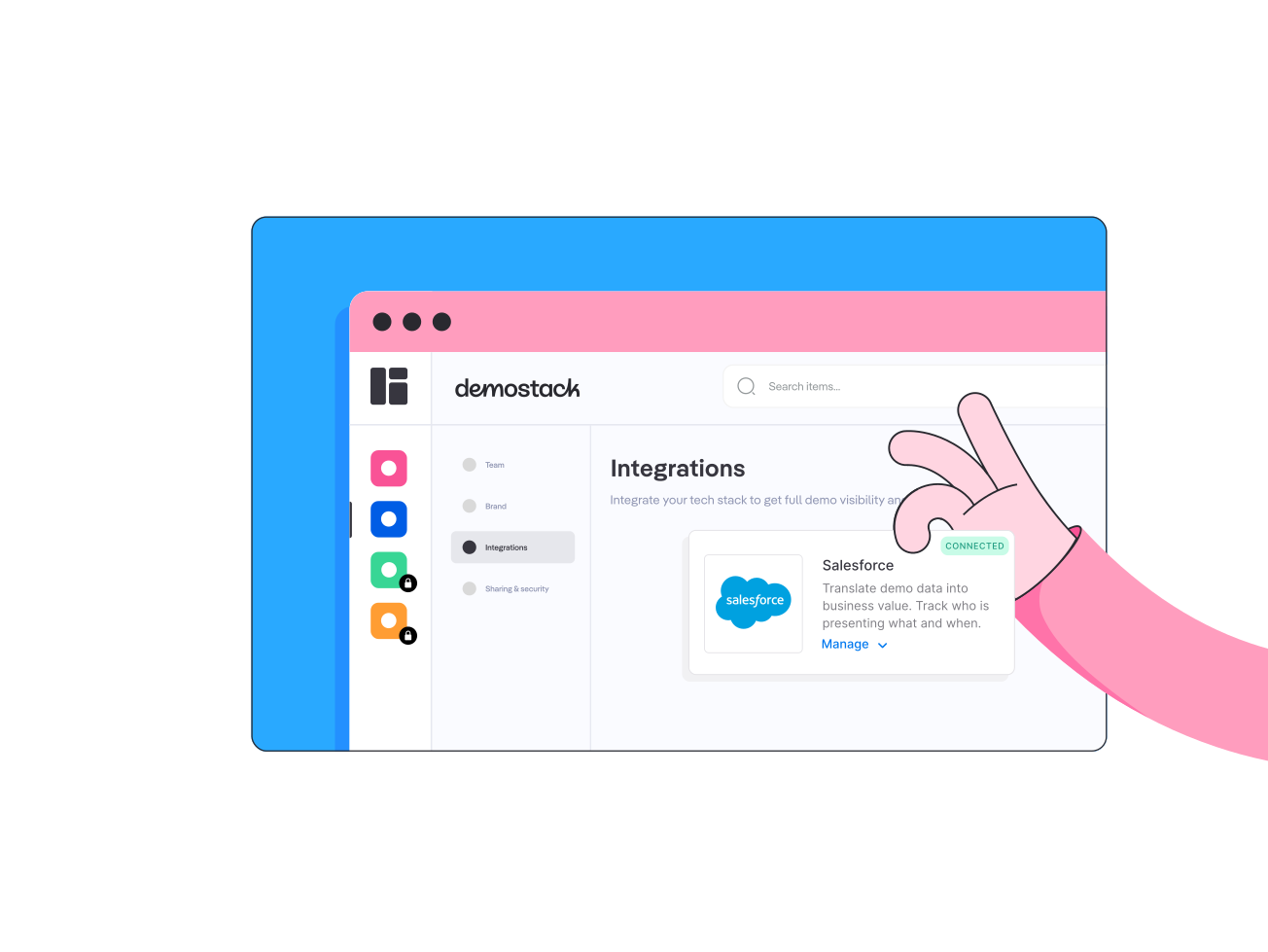
Get a demo
Bring demo intelligence into Claude, ChatGPT, or Gemini and combine it with your CRM, Slack, and call data in one conversation. Plain-English questions, instant answers, no integration project.

Push real-time demo events to any CRM, data warehouse, BI tool, or custom endpoint. Auto-follow-up when a session ends, flag deals gone cold when demos go untouched, and analyze demo activity alongside the rest of your GTM data.

Sync your Demostack data directly into Salesforce to track how demos impact deals and drive engagement. Automatically create leads, log demos as activity events, and capture what matters most in custom fields. And with webhooks, demo activity reaches Salesforce the moment it happens, like a prospect opening a demo or finishing a session.

See demo engagement alongside your deals in HubSpot. Log sessions as activities, enrich contacts with demo behavior, and trigger follow-up sequences the moment a prospect finishes a session.

Bring demo activity into the channels where your team already works. Reps get pinged when a prospect engages, enablement tracks training completion, and leaders see demo momentum without pulling a report.

Easily gate Demostack tours and demos using your own branded forms in your marketing automation platform (MAP). Visitor activity data is actually captured and logged in your CRM lead details.

Learn More
## Demostack MCP: Integrate, without making it a project
Your AI tool can now answer questions like "which demo converts best" or "which SE showed what" straight from your Demostack data.
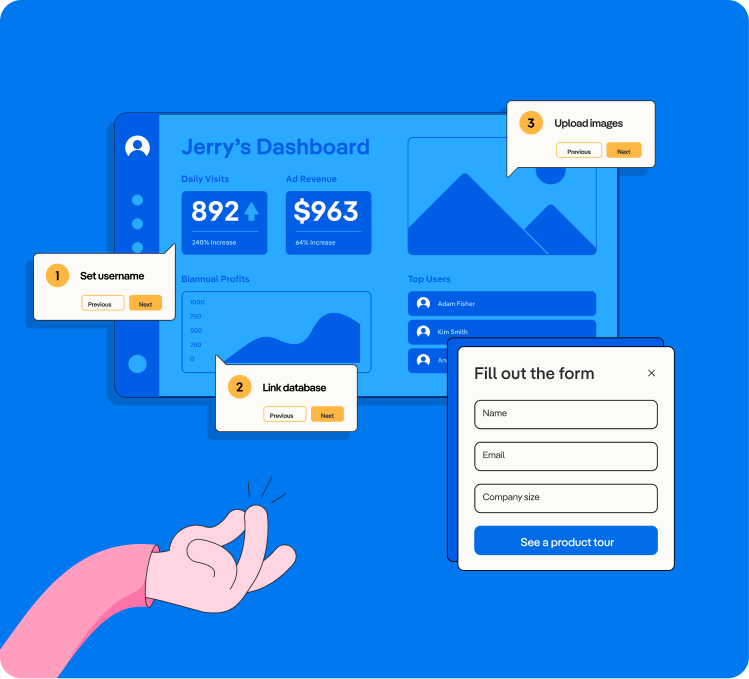
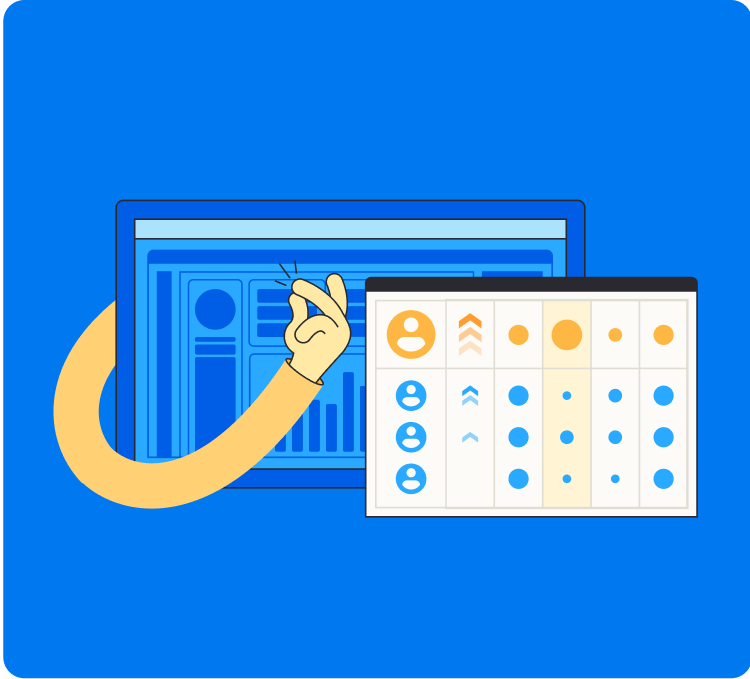
## Pricing
Source: https://www.demostack.com/pricing
Schedule a demo
## AI Data Generator \- Customized Demos At Scale
Source: https://www.demostack.com/ai-data-generator
Win more deals with Demostack's AI Data Generator.
Create a diverse demo library effortlessly, tailored for every segment, persona, and industry. Start with an empty environment or tailor your existing environments. With AI, the possibilities for demos are endless.

Get a Demo
It’s simple. Custom demos don't just tell a better story; they empower you to win more deals. Gainsight’s sales team, for example, has achieved an impressive** 8% increase in win rates** by leveraging Demostack-powered demos that are tailored to their prospects.
With the AI Data Generator, it is now even easier to create demos and [Playbooks](https://www.demostack.com/platform/features/demo-playbooks) tailored to every segment, persona, and industry, without the burden of it becoming a full-time job. Start with an empty environment or tailor your existing environments.
Generate realistic data effortlessly. Customize data tables and charts to fit your story for every sales scenario.
With GenAI, the possibilities for demos are boundless:
- Sell internationally with local phone numbers, names and addresses
- Break into new verticals with new product content and terminology
- Sell upmarket by replacing smaller numbers with larger numbers
Ensure your demos are not only engaging but also compliant. Scrubbing Personally Identifiable Information (PII) from your production environment is a necessary evil, but Demostack's AI Data Generator makes it a quick process. Replace PII with new names, credit card numbers, asterisks, and more, while tailoring each data type by location. Empower your team. Safeguard your customers.
Many products need time before they fill up with demo-worthy data. This forces sales to say “imagine if” or to present with Figma.
With the Demostack AI Data Generator, populating realistic data at scale is easy. As is improving demo environments that have stale or outdated data too.
David Greene

Sr. Manager, SC Enterprise at Gainsight
"Gainsight’s sales team has achieved an impressive 8% increase in close-win rates by leveraging Demostack-powered demos. Demostack demos closely replicate the look and feel of our actual products and are easy to customize."
Tim Nordvedt

Solution Architect at Synack
Synack cut demo build time from 100+ hours to under 10 with Demostack. Before, we spend on average 20% of our week on demo building & maintenance . That's 1 working day per week on just demo hygiene!
Rob De Marco

Vice President of Solutions Consulting at Xactly Corp
“With Demostack, our Solution Consultants (SCs) have become significantly more efficient, as Account Executives (AEs) now have access to customized, ready-to-use demos at their disposal.”
Hanan Levin

VP Sales at Hunters.Security
Demostack's Sandbox helped us cut the sales cycle by 50%. Now, both Enterprise and SMBs now buy us in just 4 months, compared to 9 months.
Sarah Goldstein

Head of Product Marketing + GTM at Cyrebro
"With Demostack, over 200 partner users can independently demo our product without concerns about accidentally breaking our demo environment. Demostack allowed us to easily create a demo environment that is 99% indistinguishable from our actual platform, the only solution on the market that could do that."
Sudipto Kar

Senior Solutions Consultant at Gloat
“The platform experience is very intuitive and allows us to manage different versions of the demo environment well. It helps drive a consistent experience for all stakeholders, driving better business outcomes.”
Bryan Rowland

Director of Solutions Architecture at BlueVoyant
“We used Demostack for a multi-million dollar RFP and it allowed us to showcase the value of our product with a much stronger story in the demo. That was all the ROI we needed in one call."
Joe Buchanan

VP of Sales Engineering at Hunters
“I was sold on Demostack within the first 20 minutes of walking through it just knowing all the pain points I’ve had over the years of standing up a demo environment. You’re constantly having to chase down other teams to keep it updated with fresh data and content, and the maintenance becomes just as time consuming as setting it up in the first place. I haven’t seen any other tools that come close to the value that Demostack provides.”
Matthew Bigelow

Director of Global Revenue Enablement at WalkMe
“Demostack is our dream demo environment. Before customizing our dashboards and analytics to tell a story of WalkMe's impact was impossible. With Demostack we can easily edit graphs and showcase data-driven product stories for any deal. It's a total game changer for us.”
Make the live demo count, and win more deals faster.


Enable buyers to self-educate with guided product tours.


Let partners promote your product with on-the-rails demos.


## Why Demostack
Source: https://www.demostack.com/why-demostack
Complete control over how you demo your product – live, self-serve, or hands-on.
Get a demo
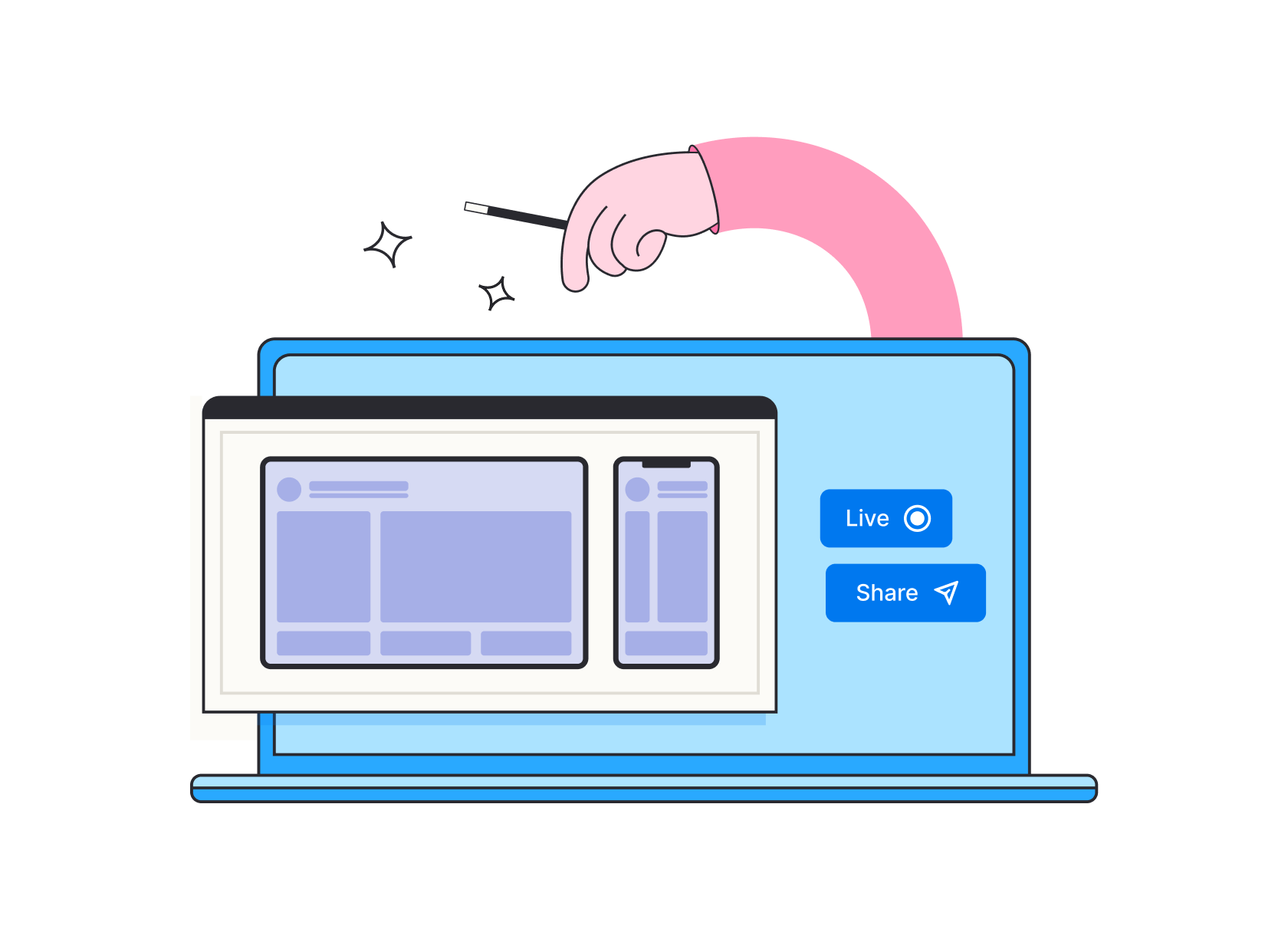
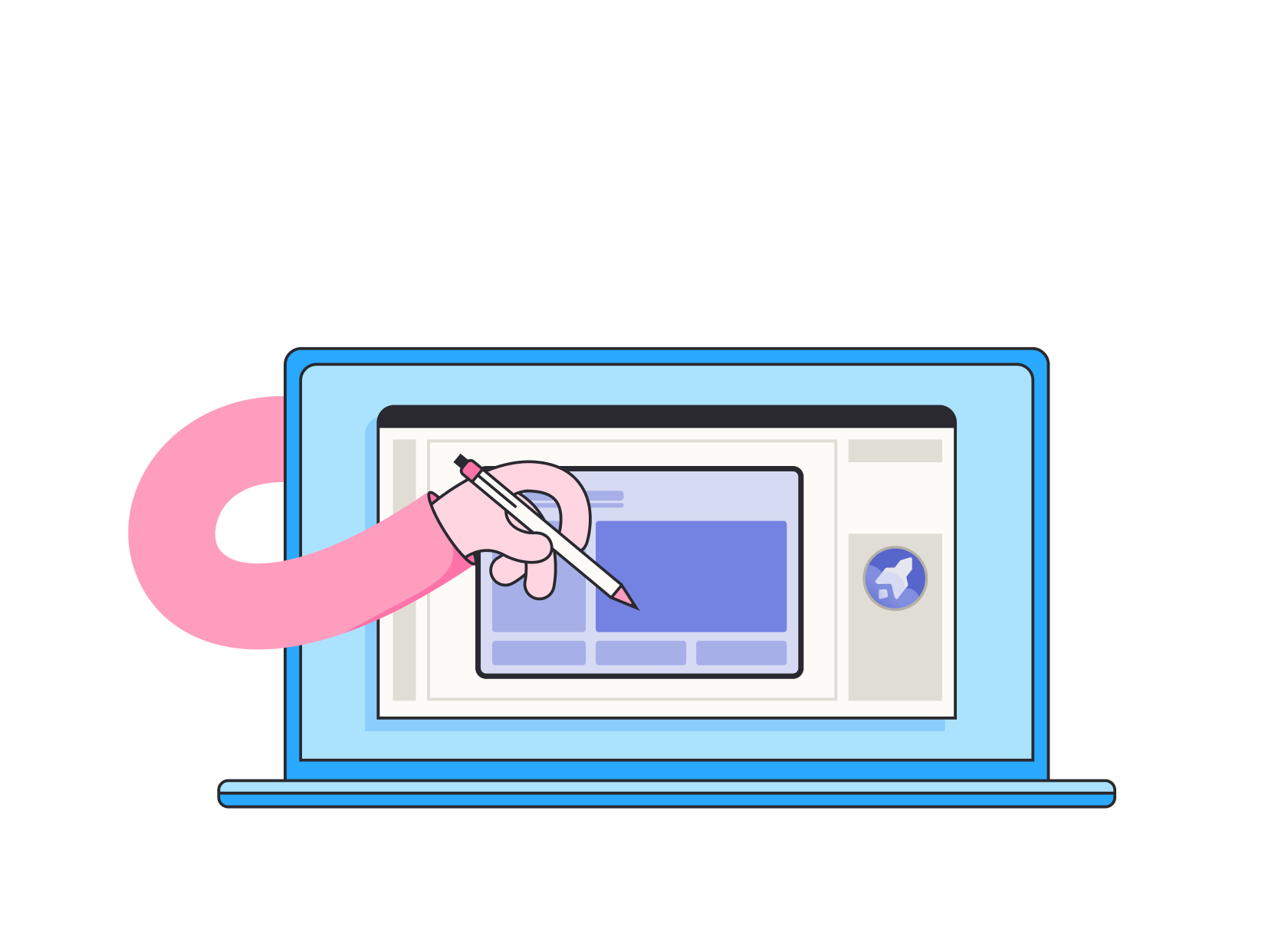
See how it works
Choosing the right demo platform is critical for delivering a seamless buyer experience and accelerating sales cycles. Don’t limit your demo capabilities.
|
Click-through tours or limited live and hands-on demo tools
|
Cloned environments, live overlays, interactive tours, and sandboxes
|
|
Static screenshots, limited editing or require R&D support
|
Fully editable demos—modify text, data, and images in minutes
|
|
Requires technical setup or pre-built templates
|
No backend access needed—any GTM team can create and update demos
|
|
Basic engagement tracking, limited CRM sync
|
Advanced insights, CRM sync, and pipeline impact tracking
|
|
Requires mobile device mirroring
|
Demo mobile apps directly from your laptop—no extra software needed
|
|
Most are only pre-sales demos and tours
|
Sales, partner enablement, onboarding, and internal training
|
David Greene

Sr. Manager, SC Enterprise at Gainsight
"Gainsight’s sales team has achieved an impressive 8% increase in close-win rates by leveraging Demostack-powered demos. Demostack demos closely replicate the look and feel of our actual products and are easy to customize."
Tim Nordvedt

Architect Solution at Synack
"Synack cut demo build time from 100+ hours to under 10 with Demostack. Before, we spend on average 20% of our week on demo building & maintenance . That's 1 working day per week on just demo hygiene!"
Rob De Marco

Vice President of Solutions Consulting at Xactly Corp
“With Demostack, our Solution Consultants (SCs) have become significantly more efficient, as Account Executives (AEs) now have access to customized, ready-to-use demos at their disposal.”
Sarah Goldstein

Head of Product Marketing + GTM at Cyrebro
"With Demostack, over 200 partner users can independently demo our product without concerns about accidentally breaking our demo environment. Demostack allowed us to easily create a demo environment that is 99% indistinguishable from our actual platform, the only solution on the market that could do that."
Sudipto Kar

Senior Solutions Consultant at Gloat
“The platform experience is very intuitive and allows us to manage different versions of the demo environment well. It helps drive a consistent experience for all stakeholders, driving better business outcomes.”
Bryan Rowland

Director of Solutions Architecture at BlueVoyant
“We used Demostack for a multi-million dollar RFP and it allowed us to showcase the value of our product with a much stronger story in the demo. That was all the ROI we needed in one call."
Joe Buchanan

VP of Sales Engineering at Hunters
“We’ve already closed 3 deals without a POC thanks to our Demostack Sandbox. It’s accelerating our deals through the funnel - and at a higher ACV.”
Matthew Bigelow

Director of Global Revenue Enablement at WalkMe
“Demostack is our dream demo environment. Before customizing our dashboards and analytics to tell a story of WalkMe's impact was impossible. With Demostack we can easily edit graphs and showcase data-driven product stories for any deal. It's a total game changer for us.”
Tsvika Vishnievsky

VP of Operations, GTM at Yotpo
"Enabling sellers to design tailored product demos promotes confidence and showcases Yotpo's value utilizing realistic examples. In doing so, our prospects are able to visualize precisely how they will be interacting with Yotpo on a daily basis. This helps accelerate deals through the sales funnel."
Javier Ortega Estrada

VP of Sales at Hopin
"Having led multiple teams of sellers of SaaS companies, I realized how complicated it is to find the perfect balance in a demo; having it be both relevant to the customer but that doesn't take a lot of time of the AE away from the phone. The vision of Demostack intersects perfectly between this need and revenue efficiency."
Des Traynor

Co-Founder and Chief Strategy Officer at Intercom
"A great demo is the difference between a product you have to sell, and a product that can sell itself. Demostack solves the Acme problem, the idea that the data in demos never resonates with the customer receiving them."
Nir Zohar

COO & President at Wix
"Empowering businesses to craft a professional digital presence with no coding or design skills needed is core to our mission at Wix. I invested in Demostack, because we share this mission in common and I am impressed with how they are achieving it for creating sales demos."
Leyla Seka

Chief Operating Officer at Ironclad
“The hand off demo is going to have a huge impact on organizations getting deals done faster. Demostack offers the best solution I've seen to get product in the hands of prospects and gain deal-winning insights in exchange.”
Tomer London

Co-Founder and CPO at Gusto
“Demostack will be a productivity boost to any SaaS engineering team. I wish we had something like this when we started.”

Arm your team with easy-to-use demos, track performance, and optimize sales strategies. With real-time analytics and customized demos that require no technical support, reps can confidently showcase your product and close deals faster.


Capture high-intent buyers by letting them experience your product before talking to sales. Interactive product tours drive engagement, improve lead quality, and increase conversions across demand gen and ABM campaigns.

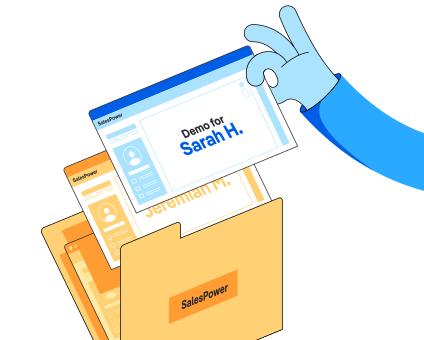
Give your partners ready-made demos they can confidently deliver. Standardized demo environments ensure consistency while allowing for customization, helping partners showcase your product effectively without relying on your team.


Scale your demo operation, allowing AEs to handle early-stage demos, create tailored demo templates, and deliver sandboxes, so SEs can focus on high-value deals.

Turn product training into an interactive experience with self - guided demos and sandbox environments.
Onboard new hires, certify reps, and ensure every seller - internal and external - can demo with confidence from day one.

## Demostack MCP: Integrate, without making it a project
Your AI tool can now answer questions like "which demo converts best" or "which SE showed what" straight from your Demostack data.
## new
Source: https://www.demostack.com/new
Stay informed about the security, compliance, and privacy of our products and services.
Privacy Policy
Customer Subscription Terms
Terms of Use
Security Overview
Privacy Notice to End Users
Notice of Demostack IP Rights
new
## The demo technology layer for enterprise software
Source: https://www.demostack.com/demo-technology-enterprise-software
Great demo experiences are more than just an interactive showcase. They are high-fidelity simulations that show your product in its best light, every time. They are repeatable, fast to produce and personalize. They inform your revenue operation scale across the entire organization - Sales, SEs, Marketing, Customer Success, L&D, and Partners.
Learn More

Empower Every Seller
Deploy personalized, guided, high-fidelity demos AEs can confidently deliver, improving discovery and accelerating qualification.

Streamline Operations
Replace fragile environments with reliable, clone-based demos that never break and always look perfect.

Free SE Capacity
Shift repetitive walkthroughs to scalable AE-ready demos so SEs focus on complex, strategic work.

Get Actionable Demo Insights
Visibility into demo usage and engagement to understand what resonates and drives deal movement.

Tell Consistent Stories
Standardized demo narratives across AEs, SEs, partners, and training—aligned to core value props.

Scale Your Partner Ecosystem
Reusable playbooks, clones, sandboxes, tours, and live workflows managed from a single source of truth.
Drive adoption with tailored demos that showcase what success looks like.
Enable buyers to self-educate with guided product tours.

Enable buyers to self-educate with guided product tours.

Drive adoption with tailored demos that showcase what success looks like.

Let partners promote your product with on-the-rails demos.

Enable employees with a demo sandbox to get them ramped and ready.

Tsvika Vishnievsky

VP of Revenue Operations at Yotpo at Yotpo
“I was sold on Demostack within the first 20 minutes of walking through it just knowing all the pain points I’ve had over the years of standing up a demo environment. You’re constantly having to chase down other teams to keep it updated with fresh data and content, and the maintenance becomes just as time consuming as setting it up in the first place. I haven’t seen any other tools that come close to the value that Demostack provides.”
David Greene

Sr. Manager, SC Enterprise at Gainsight
"Gainsight’s sales team has achieved an impressive 8% increase in close-win rates by leveraging Demostack-powered demos. Demostack demos closely replicate the look and feel of our actual products and are easy to customize."
Rob De Marco

Vice President of Solutions Consulting at Xactly Corp
“With Demostack, our Solution Consultants (SCs) have become significantly more efficient, as Account Executives (AEs) now have access to customized, ready-to-use demos at their disposal.”
Sarah Goldstein

Head of Product Marketing + GTM at Cyrebro
"With Demostack, over 200 partner users can independently demo our product without concerns about accidentally breaking our demo environment. Demostack allowed us to easily create a demo environment that is 99% indistinguishable from our actual platform, the only solution on the market that could do that."
Sudipto Kar

Senior Solutions Consultant at Gloat
“The platform experience is very intuitive and allows us to manage different versions of the demo environment well. It helps drive a consistent experience for all stakeholders, driving better business outcomes.”
Bryan Rowland

Director of Solutions Architecture at BlueVoyant
“We used Demostack for a multi-million dollar RFP and it allowed us to showcase the value of our product with a much stronger story in the demo. That was all the ROI we needed in one call."
Joe Buchanan

VP of Sales Engineering at Hunters
“We’ve already closed 3 deals without a POC thanks to our Demostack Sandbox. It’s accelerating our deals through the funnel - and at a higher ACV.”
Matthew Bigelow

Director of Global Revenue Enablement at WalkMe
“Demostack is our dream demo environment. Before customizing our dashboards and analytics to tell a story of WalkMe's impact was impossible. With Demostack we can easily edit graphs and showcase data-driven product stories for any deal. It's a total game changer for us.”
Javier Ortega Estrada

VP of Sales at Hopin
"Having led multiple teams of sellers of SaaS companies, I realized how complicated it is to find the perfect balance in a demo; having it be both relevant to the customer but that doesn't take a lot of time of the AE away from the phone. The vision of Demostack intersects perfectly between this need and revenue efficiency."
Des Traynor

Co-Founder and Chief Strategy Officer at Intercom
"A great demo is the difference between a product you have to sell, and a product that can sell itself. Demostack solves the Acme problem, the idea that the data in demos never resonates with the customer receiving them."
Nir Zohar

COO & President at Wix
"Empowering businesses to craft a professional digital presence with no coding or design skills needed is core to our mission at Wix. I invested in Demostack, because we share this mission in common and I am impressed with how they are achieving it for creating sales demos."
Leyla Seka

Chief Operating Officer at Ironclad
“The hand off demo is going to have a huge impact on organizations getting deals done faster. Demostack offers the best solution I've seen to get product in the hands of prospects and gain deal-winning insights in exchange.”
Tomer London

Co-Founder and CPO at Gusto
“Demostack will be a productivity boost to any SaaS engineering team. I wish we had something like this when we started.”











## Make your product your best sales enablement asset
Source: https://www.demostack.com/sales-enablement-asset


### **From Product Knowledge to Sales Execution**
Demostack turns product expertise into a managed system for sales execution, so sellers improve faster and enablement leaders can optimize what drives revenue.
GTM, enablement, Solutions Engineering, and Product Marketing teams use Demostack to:
- Define and control how product value is demonstrated in real scenarios
- Guide sellers through realistic workflows
- Ensure consistency across teams and regions
- Improve sales capability using real performance data


Self-contained, safe demo environments that perfectly reflect real workflows and specific use cases. No PII exposure. No broken workflows.

Learn More
Built-in narratives, tooltips, guardrails and customizable flows that help sellers learn fast, deliver with confidence and improve over time. No blank canvas No SE and R&D bottleneck

Learn more
Visibility into what features within demos are emphasized, what use cases are missed and what moves deals forward in your CRM and product pipeline.

Learn More
### Enablement and Product Marketing move upstream
From managing assets to owning execution strategy
### Sales reps ramp faster
Deliver more consistent messaging, and build use-case expertise
### Reduce dependency
On over-resourced SE and R&D teams
### Revenue leaders
Gain visibility and predictability into what actually drives growth.
VP

Sales Enablement at Enterprise SaaS
"Demostack gave us a way to finally manage how our product is demonstrated in the field. Instead of guessing what works, we can see it - and scale it."
## Turn Enablement into a Scalable System
Enablement and Product Marketing leaders don't just support sales. They define how revenue scales.
Learn more about the Demostack Platform
## Demostack vs\. Consensus
Source: https://www.demostack.com/demostack-vs-consensus-alternative
Demostack is the only all-in-one demo platform for live, guided, and leave-behind formats—designed for how GTM teams actually sell.
Get a demo
Demostack leads in ease of use, setup, and support - because great demos shouldn’t require a project plan or engineering.
Consensus limits you to pre-recorded tours. Demostack supports live demos, interactive walkthroughs, and sandbox environments all in one platform.

Unlike Consensus, Demostack was built for AEs and SEs. It’s easy to learn, quick to use, and doesn’t require engineering support to build or deliver demos.

Consensus helps automate interest. Demostack helps close deals. See how the platforms stack up where it matters most.
|
Enable buyers to self-educate with guided product walkthroughs (interactive and easy to update).
|
Enable buyers to self-educate with video demos and tours.
|
|
Mask your existing environment with a story that resonates on every live demo.
|
No overlay capabilities; relies on video demos and screen recordings.
|
|
Clone your product into an independent demo environment with a few clicks.
|
Limited to video recordings and guided tours of existing applications.
|
|
Share a trial-like environment after your live demo, get deal-winning insights, and shorten the POC.
|
Send a video-based tour with limited interactivity.
|
|
Patented mobile app demo technology allowing seamless presentation without devices or cables.
|
Optimized for desktop web experiences, not native mobile app demos.
|
|
AI Data Generator instantly creates smart, contextual data tailored to industries, personas, and use cases.
|
No data injection or synthetic data capabilities, uses existing application data in video recordings.
|
|
Unified platform for tours, overlays, sandboxes, and live demos
|
Focused on buyer-led video tours; other formats not supported.
|
|
No-code, browser-based interface designed for GTM teams
|
Intuitive for enablement, difficult for sales teams.
|
|
Full engagement tracking and CRM-integrated insights across all demo types.
|
Robust analytics and stakeholder mapping.
|
While both Consensus and Demostack are leaders in demo automation and presales software, they cater to distinct needs within the sales process.
Consensus emphasizes video demos for pre and post-sales calls, focusing on user-chosen content through treemap logic.
Demostack, on the other hand, specializes in live technical demos, enabling presales teams to create and manage custom, scalable templates, offering autonomy in maintaining a reliable demo environment without relying on R&D resources.
David Greene

Sr. Manager, SC Enterprise at Gainsight
"Gainsight’s sales team has achieved an impressive 8% increase in close-win rates by leveraging Demostack-powered demos. Demostack demos closely replicate the look and feel of our actual products and are easy to customize."
Tim Nordvedt

Solution Architect at Synack
Synack cut demo build time from 100+ hours to under 10 with Demostack. Before, we spend on average 20% of our week on demo building & maintenance . That's 1 working day per week on just demo hygiene!
Rob De Marco

Vice President of Solutions Consulting at Xactly Corp
“With Demostack, our Solution Consultants (SCs) have become significantly more efficient, as Account Executives (AEs) now have access to customized, ready-to-use demos at their disposal.”
Hanan Levin

VP Sales at Hunters.Security
Demostack's Sandbox helped us cut the sales cycle by 50%. Now, both Enterprise and SMBs now buy us in just 4 months, compared to 9 months.
Sarah Goldstein

Head of Product Marketing + GTM at Cyrebro
"With Demostack, over 200 partner users can independently demo our product without concerns about accidentally breaking our demo environment. Demostack allowed us to easily create a demo environment that is 99% indistinguishable from our actual platform, the only solution on the market that could do that."
Sudipto Kar

Senior Solutions Consultant at Gloat
“The platform experience is very intuitive and allows us to manage different versions of the demo environment well. It helps drive a consistent experience for all stakeholders, driving better business outcomes.”
Bryan Rowland

Director of Solutions Architecture at BlueVoyant
“We used Demostack for a multi-million dollar RFP and it allowed us to showcase the value of our product with a much stronger story in the demo. That was all the ROI we needed in one call."
Joe Buchanan

VP of Sales Engineering at Hunters
“I was sold on Demostack within the first 20 minutes of walking through it just knowing all the pain points I’ve had over the years of standing up a demo environment. You’re constantly having to chase down other teams to keep it updated with fresh data and content, and the maintenance becomes just as time consuming as setting it up in the first place. I haven’t seen any other tools that come close to the value that Demostack provides.”
Matthew Bigelow

Director of Global Revenue Enablement at WalkMe
“Demostack is our dream demo environment. Before customizing our dashboards and analytics to tell a story of WalkMe's impact was impossible. With Demostack we can easily edit graphs and showcase data-driven product stories for any deal. It's a total game changer for us.”
## Demostack MCP: Integrate, without making it a project
Your AI tool can now answer questions like "which demo converts best" or "which SE showed what" straight from your Demostack data.
## Demostack vs Consensus2
Source: https://www.demostack.com/demostack-vs-consensus
From format flexibility to mobile support, see how Demostack and Saleo stack up across what matters most to GTM teams.
|
Guided, interactive walkthroughs—easy to create and update.
|
Not supported.
|
|
Built-in overlay option, no extension required.
|
Chrome extension overlays on live product.
|
|
Fully cloned, stable environments—no product access needed.
|
Runs on top of your live product
|
|
Fully self-serve, interactive, and trackable.
|
Not supported.
|
|
Demo your mobile app from your laptop.
|
Not supported.
|
|
AI Data Generator instantly creates smart, contextual data.
|
AI-powered UI editing of live product data.
|
|
Tours, overlays, sandboxes, and mobile all in one platform.
|
Overlays only. No unified demo workspace.
|
|
Built for AEs and SEs. No plugins or handoffs required.
|
Requires Chrome extension. More technical to manage and scale.
|
|
Engagement insights with CRM integration.
|
Basic tracking only. No CRM tie-in.
|
While both Consensus and Demostack are leaders in demo automation and presales software, they cater to distinct needs within the sales process.
Consensus emphasizes video demos for pre and post-sales calls, focusing on user-chosen content through treemap logic.
Demostack, on the other hand, specializes in live technical demos, enabling presales teams to create and manage custom, scalable templates, offering autonomy in maintaining a reliable demo environment without relying on R&D resources.
## Demostack MCP: Integrate, without making it a project
Your AI tool can now answer questions like "which demo converts best" or "which SE showed what" straight from your Demostack data.
## How it works
Source: https://www.demostack.com/how-it-works
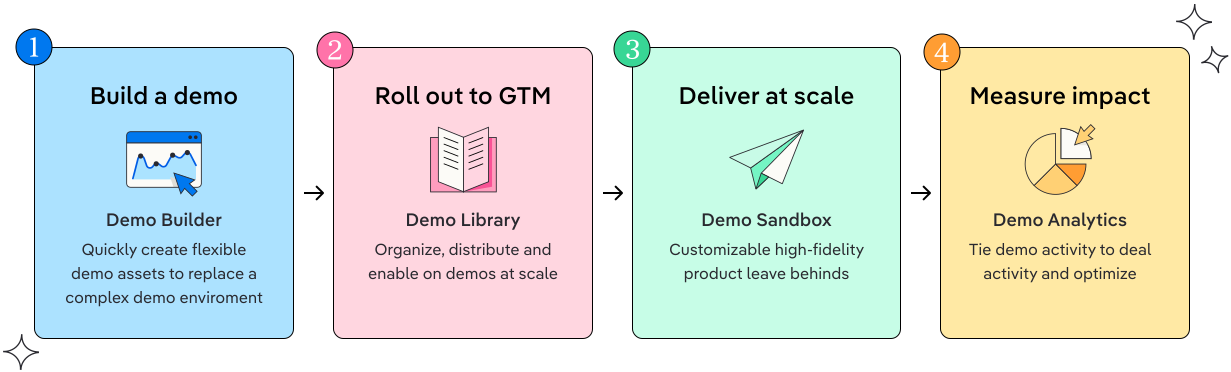
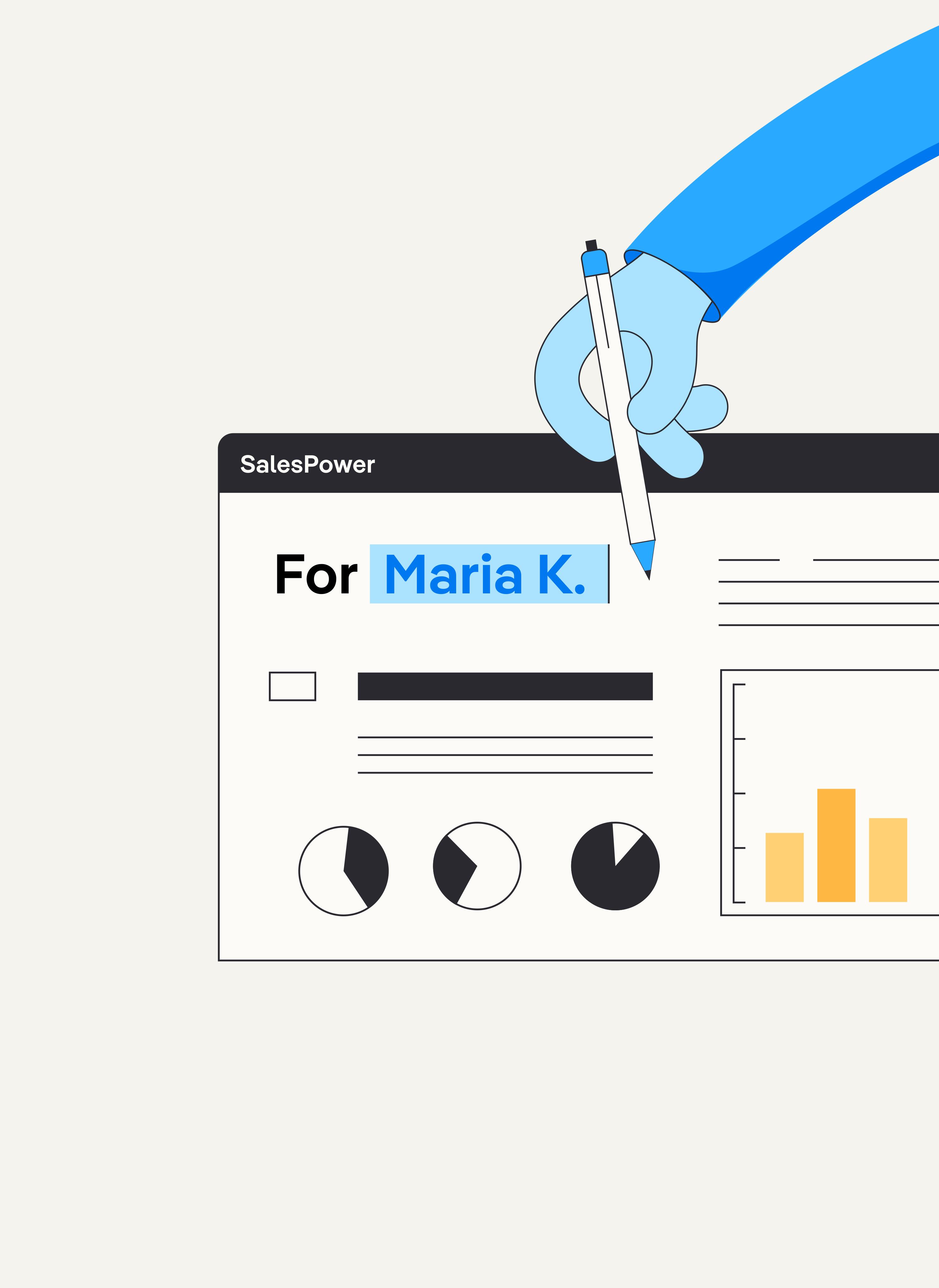

Instantly update branding, messaging, and data to craft a relevant story for every audience—no engineering needed.

Demo the latest version of your product without worrying about maintenance or version control.

Show what your product can do without exposing sensitive information or outdated content.
Get Demo


The Cloner captures how your front end interacts with the backend, replicating key product workflows and user experience while eliminating live system dependencies, including API failures or unexpected bugs.

Once your demo is cloned, customize it with content, including text, numbers, images, and workflows. Every session resets automatically, ensuring consistency for every demo.

Shared with prospects as interactive leave-behinds, complete with guided tours and clickable highlights that point out important product areas—no need for live system access.
Get demo
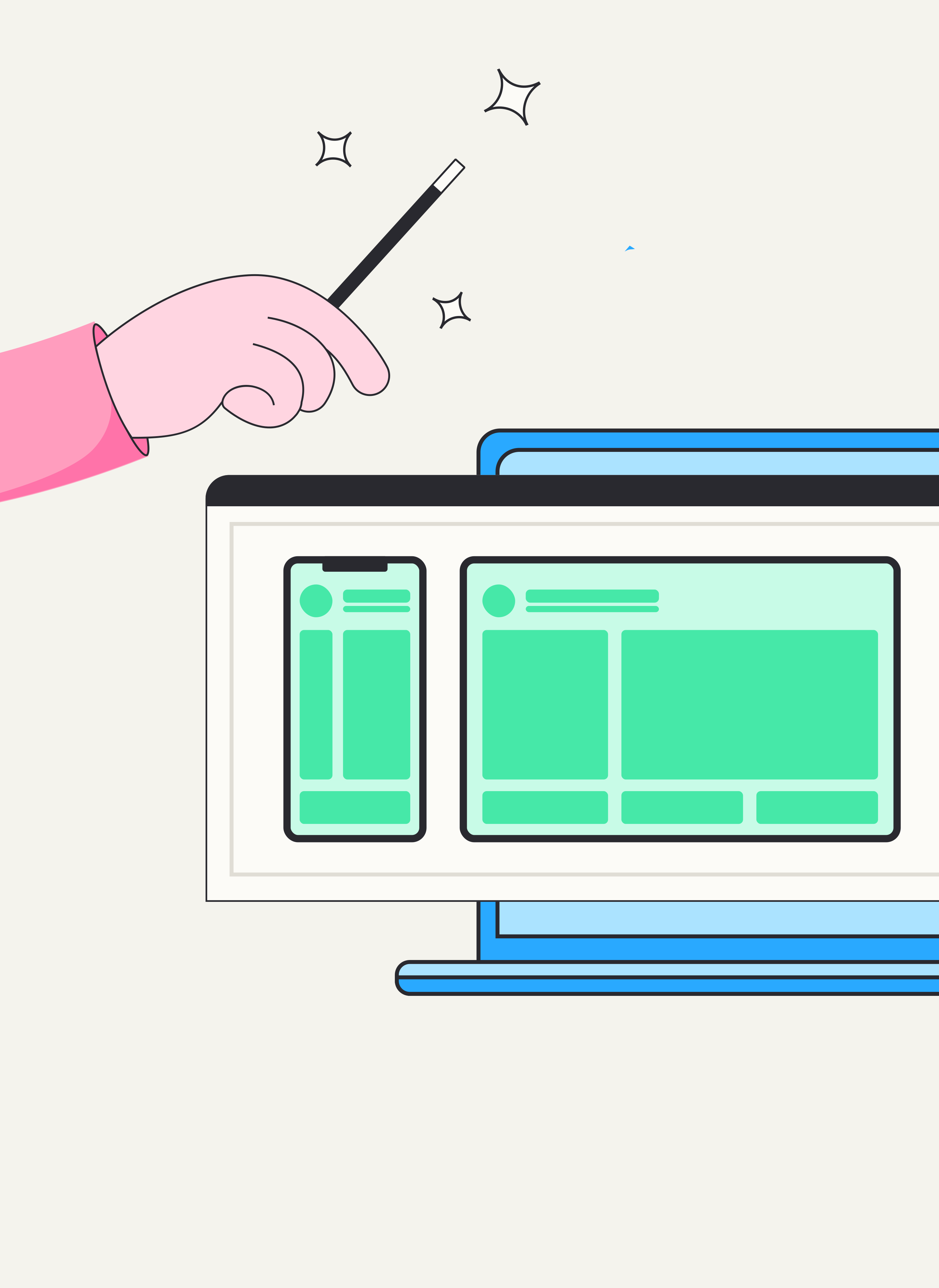

Set it up once and demo your mobile app anytime—no devices or ongoing engineering support needed.

Present your web and mobile apps together from a single screen—no switching between tabs or devices.

Share a link post-demo, allowing buyers to explore the mobile app on their own and share with their team.
Get demo
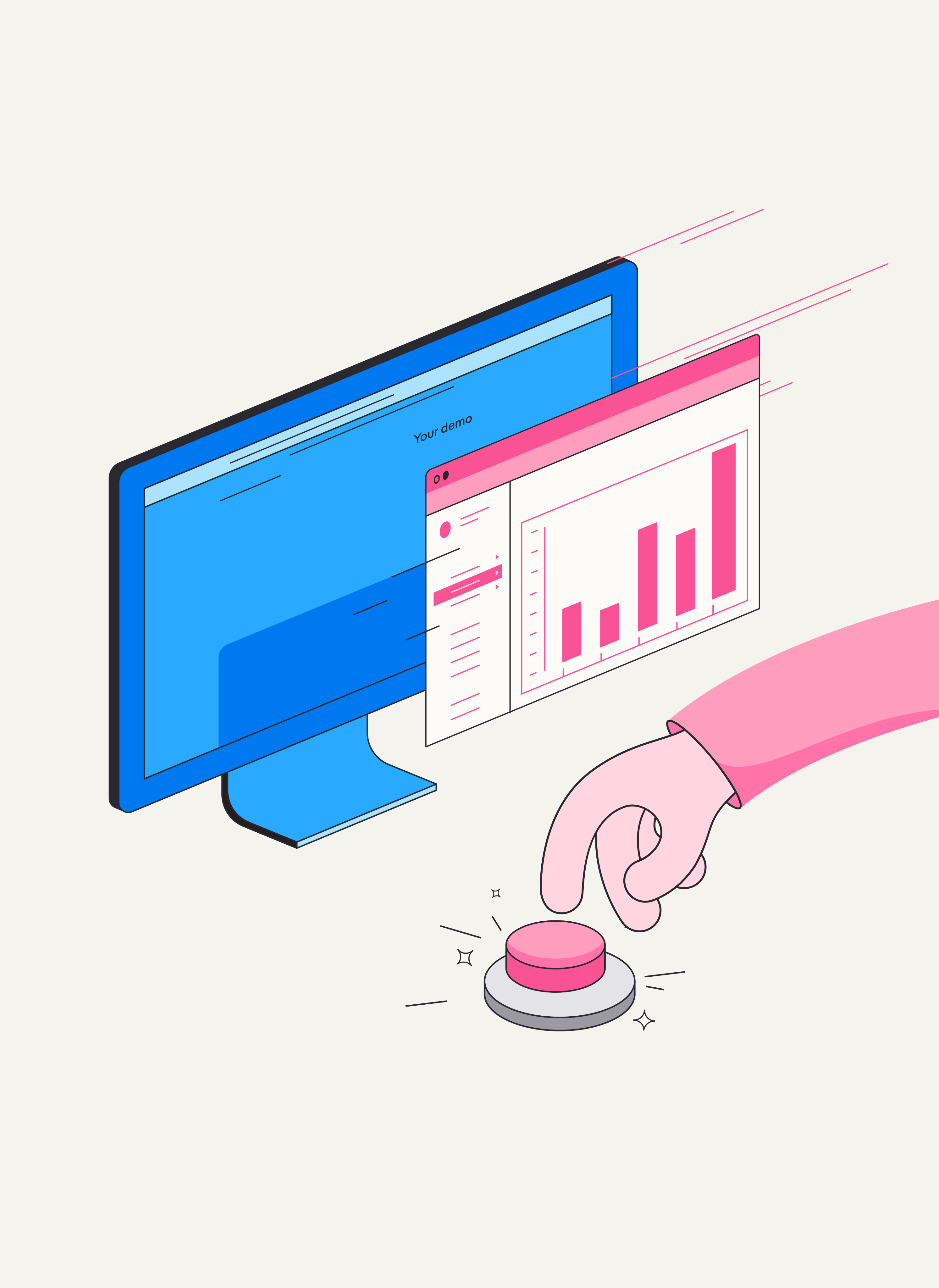

Bundle demos of any type, slide decks, case studies, and product tours into playbooks for easy access. Create playbooks by use case, persona, industry, partner, and more.

Launch and present assets from one interface to keep prospects focused and engaged without distractions.

Quickly update logos, prospect names, and key details before each meeting.
Get demo
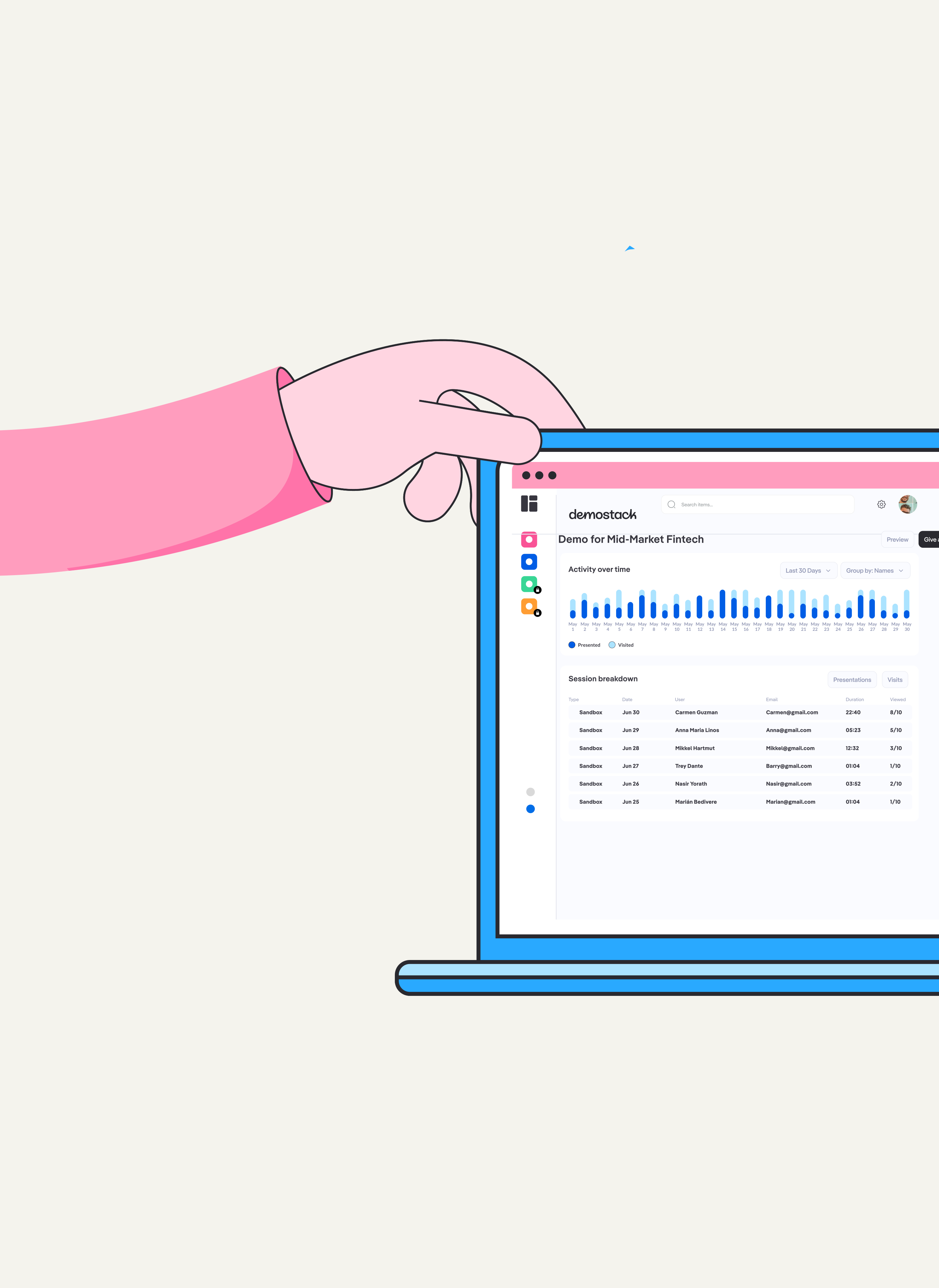

Monitor how buyers interact with leave-behind assets like sandboxes and tours. Know who engaged, for how long, which features they explored, and whether they shared it with their team.

Link demo activity to deal progression in your CRM. Identify which demos accelerate deals, measure ROI, and correlate demo engagement with pipeline impact. Create before-and-after comparisons to pinpoint trends and optimize sales strategies.

Gain full visibility into demo activity to see how your team is performing and coach them. See how many demos are delivered, who’s running them, what’s being shown, and how long prospects are engaged.
Get demo
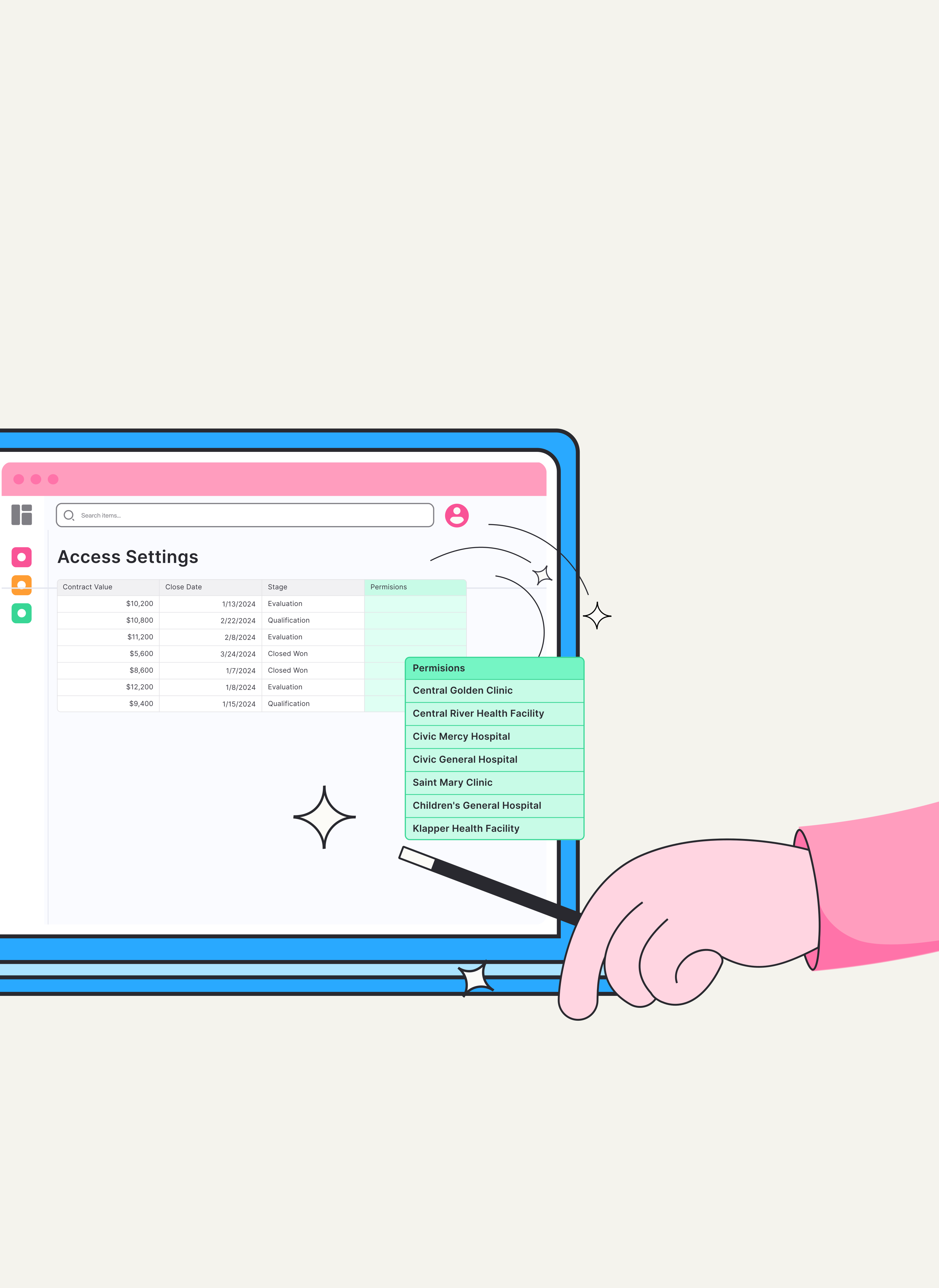

Seamless integration with popular identity providers, such as Google Workspace and OKTA.

Assign access to features based on user roles, ensuring employees only see what they need.

Earned SOC2 Type II attestation with PWC, effective January 31, 2025

Our platform aligns with GDPR, CCPA, and HIPAA frameworks.

Continuous monitoring with Google’s Security Command Center and regular pentesting via HackerOne.
Get demo
## Win deals with Demostack
Get a personalized demo and see our platform in action.
## Cloner
Source: https://www.demostack.com/cloner
Clone your product into an independent demo environment, built for showcasing - and free of any unwanted surprises throwing off your game.
Get a demo
Our cloning technology serves as a proxy between your frontend and backend, so you don’t have to deal with all the backend complexities. The cloner learns how your backend responds to requests from the browser, and then simulates that same response during playback - so you can showcase all the right functionality, without the headache.
With robust editing capabilities, you can customize your demo to each and every buyer in a matter of minutes.


No need to worry about bugs popping up, new features you weren’t expecting, or R&D running tests during your demo. Running demos off of a Clone of your product means it’s independent from all the changes happening in production - and built specifically for showcasing.
Share a trial-like environment after the live demo and get product into your customer’s hands faster. You’ll get deal-winning insights like who’s engaging with what, when, what features they care about, and more.
Learn more
David Greene

Sr. Manager, SC Enterprise at Gainsight
"Gainsight’s sales team has achieved an impressive 8% increase in close-win rates by leveraging Demostack-powered demos. Demostack demos closely replicate the look and feel of our actual products and are easy to customize."
Tim Nordvedt

Architect Solution at Synack
"Synack cut demo build time from 100+ hours to under 10 with Demostack. Before, we spend on average 20% of our week on demo building & maintenance . That's 1 working day per week on just demo hygiene!"
Rob De Marco

Vice President of Solutions Consulting at Xactly Corp
“With Demostack, our Solution Consultants (SCs) have become significantly more efficient, as Account Executives (AEs) now have access to customized, ready-to-use demos at their disposal.”
Sarah Goldstein

Head of Product Marketing + GTM at Cyrebro
"With Demostack, over 200 partner users can independently demo our product without concerns about accidentally breaking our demo environment. Demostack allowed us to easily create a demo environment that is 99% indistinguishable from our actual platform, the only solution on the market that could do that."
Sudipto Kar

Senior Solutions Consultant at Gloat
“The platform experience is very intuitive and allows us to manage different versions of the demo environment well. It helps drive a consistent experience for all stakeholders, driving better business outcomes.”
Bryan Rowland

Director of Solutions Architecture at BlueVoyant
“We used Demostack for a multi-million dollar RFP and it allowed us to showcase the value of our product with a much stronger story in the demo. That was all the ROI we needed in one call."
Joe Buchanan

VP of Sales Engineering at Hunters
“We’ve already closed 3 deals without a POC thanks to our Demostack Sandbox. It’s accelerating our deals through the funnel - and at a higher ACV.”
Matthew Bigelow

Director of Global Revenue Enablement at WalkMe
“Demostack is our dream demo environment. Before customizing our dashboards and analytics to tell a story of WalkMe's impact was impossible. With Demostack we can easily edit graphs and showcase data-driven product stories for any deal. It's a total game changer for us.”
Tsvika Vishnievsky

VP of Operations, GTM at Yotpo
"Enabling sellers to design tailored product demos promotes confidence and showcases Yotpo's value utilizing realistic examples. In doing so, our prospects are able to visualize precisely how they will be interacting with Yotpo on a daily basis. This helps accelerate deals through the sales funnel."
Javier Ortega Estrada

VP of Sales at Hopin
"Having led multiple teams of sellers of SaaS companies, I realized how complicated it is to find the perfect balance in a demo; having it be both relevant to the customer but that doesn't take a lot of time of the AE away from the phone. The vision of Demostack intersects perfectly between this need and revenue efficiency."
Des Traynor

Co-Founder and Chief Strategy Officer at Intercom
"A great demo is the difference between a product you have to sell, and a product that can sell itself. Demostack solves the Acme problem, the idea that the data in demos never resonates with the customer receiving them."
Nir Zohar

COO & President at Wix
"Empowering businesses to craft a professional digital presence with no coding or design skills needed is core to our mission at Wix. I invested in Demostack, because we share this mission in common and I am impressed with how they are achieving it for creating sales demos."
Leyla Seka

Chief Operating Officer at Ironclad
“The hand off demo is going to have a huge impact on organizations getting deals done faster. Demostack offers the best solution I've seen to get product in the hands of prospects and gain deal-winning insights in exchange.”
Tomer London

Co-Founder and CPO at Gusto
“Demostack will be a productivity boost to any SaaS engineering team. I wish we had something like this when we started.”
## Demostack MCP: Integrate, without making it a project
Your AI tool can now answer questions like "which demo converts best" or "which SE showed what" straight from your Demostack data.
## Meeting Form
Source: https://www.demostack.com/meeting-form
Complete the form to book an appointment with the team.


25%
increase in win rate

50%
faster sales cycles with sandboxes

100%
of AEs can now demo

100%
of partners can now demo


Sr. Manager, SC Enterprise at Gainsight, Sr. Manager, SC Enterprise at Gainsight
"Gainsight’s sales has achieved an impressive 8% increase in close-win rates by leveraging Demostack-powered demos. Demostack demos closely replicate the look & feel of our products & are easy to customize"


Senior Solutions Consultant at Gloat, Senior Solutions Consultant at Gloat
“The platform experience is very intuitive and allows us to manage different versions of the demo environment well. It helps drive a consistent experience for all stakeholders, driving better business outcomes”


VP of Sales Engineering at Hunters, VP of Sales Engineering at Hunters
“We’ve already closed 3 deals without a POC thanks to our Demostack Sandbox. It’s accelerating our deals through the funnel - and at a higher ACV.”
## Demostack vs\. Reprise
Source: https://www.demostack.com/lp/demostack-vs-reprise
The only all-in-one demo platform built for how GTM teams sell with tours, overlays, sandboxes, and mobile included. Demostack delivers a better demo experience. Simpler to use, easier to manage, and trusted by teams who need to move fast.
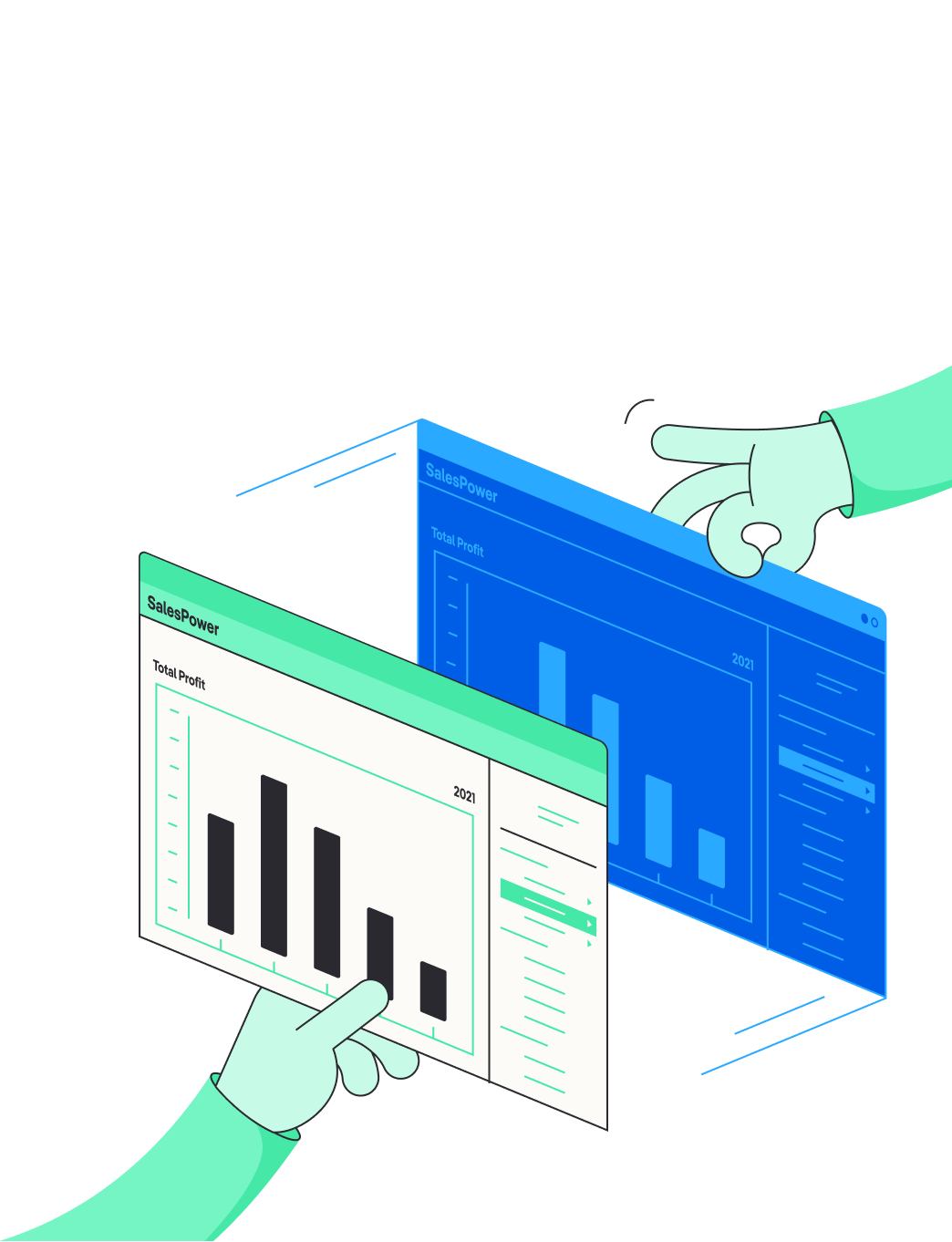
Get a demo
Demostack leads in ease of use and setup on G2 - because the best demo platform should actually be easy to demo.
Reprise makes you juggle multiple tools. With Demostack you get tours, overlays, and sandboxes and mobile all in one place, no R&D needed.

Unlike Reprise, Demostack lets you demo your mobile app straight from your laptop. No devices, no mirroring, no extra work.

Both platforms have features. Only Demostack turns them into a seamless, scalable experience for your entire GTM team.
|
Enable buyers to self-educate with guided product walkthroughs (interactive and easy to update).
|
Enable buyers to self-educate with guided product walkthroughs ((HTML capture-based with limitations).
|
|
Mask your existing environment with a story that resonates on every live demo.
|
Must depend on App Capture for live demos, requiring a lengthy implementation.
|
|
Clone your product into an independent demo environment with a few clicks.
|
Capture the look and feel of your product with App Capture, and the help of Reprise SEs.
|
|
Share a trial-like environment after your live demo, get deal-winning insights, and shorten the POC.
|
Share a leave-behind product tour, built from screenshot tech.
|
|
Patented mobile app demo technology allowing seamless presentation without devices or cables.
|
Limited mobile capabilities with inconsistent performance on complex mobile apps.
|
|
AI Data Generator instantly creates smart, contextual data tailored to industries, personas, and use cases.
|
Data injection capabilities that require more technical setup and maintenance.
|
|
Unified platform for tours, overlays, sandboxes, and live demos
|
Split across three products (Replay, Reveal, Replicate).
|
|
No-code, browser-based interface designed for GTM teams
|
Requires desktop app and technical skills for advanced setup.
|
|
Full engagement tracking and CRM-integrated insights across all demo types.
|
More robust tracking analytics require paid add-ons
|
Today’s GTM teams need more than a patchwork of demo tools. That’s why they’re moving Reprise to Demostack—a single platform that’s easier to manage, faster to scale, and built for how modern teams sell. With tours, overlays, sandboxes, and mobile support all in one place, Demostack delivers the complete demo experience Reprise never quite pulled together.
David Greene

Sr. Manager, SC Enterprise at Gainsight
"Gainsight’s sales team has achieved an impressive 8% increase in close-win rates by leveraging Demostack-powered demos. Demostack demos closely replicate the look and feel of our actual products and are easy to customize."
Tim Nordvedt

Solution Architect at Synack
Synack cut demo build time from 100+ hours to under 10 with Demostack. Before, we spend on average 20% of our week on demo building & maintenance . That's 1 working day per week on just demo hygiene!
Rob De Marco

Vice President of Solutions Consulting at Xactly Corp
“With Demostack, our Solution Consultants (SCs) have become significantly more efficient, as Account Executives (AEs) now have access to customized, ready-to-use demos at their disposal.”
Hanan Levin

VP Sales at Hunters.Security
Demostack's Sandbox helped us cut the sales cycle by 50%. Now, both Enterprise and SMBs now buy us in just 4 months, compared to 9 months.
Sarah Goldstein

Head of Product Marketing + GTM at Cyrebro
"With Demostack, over 200 partner users can independently demo our product without concerns about accidentally breaking our demo environment. Demostack allowed us to easily create a demo environment that is 99% indistinguishable from our actual platform, the only solution on the market that could do that."
Sudipto Kar

Senior Solutions Consultant at Gloat
“The platform experience is very intuitive and allows us to manage different versions of the demo environment well. It helps drive a consistent experience for all stakeholders, driving better business outcomes.”
Bryan Rowland

Director of Solutions Architecture at BlueVoyant
“We used Demostack for a multi-million dollar RFP and it allowed us to showcase the value of our product with a much stronger story in the demo. That was all the ROI we needed in one call."
Joe Buchanan

VP of Sales Engineering at Hunters
“I was sold on Demostack within the first 20 minutes of walking through it just knowing all the pain points I’ve had over the years of standing up a demo environment. You’re constantly having to chase down other teams to keep it updated with fresh data and content, and the maintenance becomes just as time consuming as setting it up in the first place. I haven’t seen any other tools that come close to the value that Demostack provides.”
Matthew Bigelow

Director of Global Revenue Enablement at WalkMe
“Demostack is our dream demo environment. Before customizing our dashboards and analytics to tell a story of WalkMe's impact was impossible. With Demostack we can easily edit graphs and showcase data-driven product stories for any deal. It's a total game changer for us.”
## Demostack MCP: Integrate, without making it a project
Your AI tool can now answer questions like "which demo converts best" or "which SE showed what" straight from your Demostack data.
## Glossary
Source: https://www.demostack.com/glossary
Useful terms and definitions for product demos.
## Mobile app demos: Phone not required
Source: https://www.demostack.com/mobile-demos
Your product demo isn’t complete without showing your mobile app. It’s finally time to demo it with ease and professionalism.
Get a demo
Until today, demoing your mobile app could prove difficult or even impossible, resulting in missed revenue opportunities. This is a shame, considering that your mobile app may set your sales motion apart and serve as a key competitive advantage.
Equip your sales team with everything they need to win deals - including the ability to demo your mobile app.
Today, even if your sales team can demo their mobile app, it's not easy. Cable connections and 3rd-party apps can lead to broken demos. During mobile demos, unprofessional home screens and embarrassing notifications can derail a deal.
With Demostack, set up your mobile demo once for the whole org, empowering sales to showcase your mobile app without the need for repetitive setups. Demo it alongside your web app demos from one unified platform that is built for demoing. No distractions or pop-ups.
|
|
|
|
|
|
|
To demo your mobile app with Demostack, you'll need to perform a one-time implementation. Demostack will generate a shareable link for your mobile app. This link can then be used alongside web app demos. This one-time implementation frees sales from connecting a mobile phone forever. No R&D needed.
Sharing your mobile app during a demo is straightforward. Utilize the shareable link created with Demostack and perform a screen share from your desktop. This allows you to showcase both your web app and mobile app side-by-side in real-time.
No, you don't need a mobile phone for demos with Demostack. You can launch cable-free, phone-free mobile app demos in seconds.
Absolutely. After a call with a prospect, you can create and send a Demostack Sandbox link. This enables your champion and other stakeholders to independently explore the app without your presence in the room.
Yes, you can demo your web app's mobile interface using Demostack.
No, you can use any web conferencing tool that supports desktop screen sharing. There's no need to log in separately from your mobile phone and desktop app.
Currently, our beta product is designed for Android apps. However, if you have an iOS app, please still reach out, and we can explore compatibility options.
If showcasing integrations with third-party apps is essential for your demo, feel free to talk to us to see if we can accommodate your requirements.
Yes, you can seamlessly demonstrate the interaction between your web app and mobile app from a single screen. There's no need to switch between tabs.
During the beta phase, our sales engineers will handle customizing your mobile app content for the demo.
No. Your app source code is not required.
Security is a priority for Demostack. We are certified SOC 2 Type I and Type II.
Demostack offers dedicated customer support and resources to assist you with any issues or questions you may have while using our platform.
Demostack's pricing structure may vary depending on your specific needs and usage. See our pricing page.
## Demostack MCP: Integrate, without making it a project
Your AI tool can now answer questions like "which demo converts best" or "which SE showed what" straight from your Demostack data.
## Notice of Demostack IP Rights
Source: https://www.demostack.com/notice-of-demostack-ip-rights
Stay informed about the security, compliance, and privacy of our products and services.
Privacy Policy
Customer Subscription Terms
Terms of Use
Security Overview
Privacy Notice to End Users
Notice of Demostack IP Rights
## Notice of Demostack IP Rights
Demostack’s intellectual property and brand, including, without limitation, Demostack’s patents, trademarks, copyrights and domains, are some of Demostack’s most valuable assets. Our brand helps distinguish Demostack’s products and services from those of Demostack’s competitors and signifies to the public the high quality of those products and services.
Demostack uses several terms and logos as trademarks in branding its products and services, including those displayed below. Some are registered or are in the process of becoming registered in the U.S. as well as other countries, and others are common law trademarks.
Service mark of Demostack wordmark (Demostack®) and Demostack design marks below:
We thank you for helping us preserve our brand and these rights. If you have any questions regarding the above or would like to request permission to use any Demostack intellectual property, please email us at [legal@demostack.com](mailto:legal@demostack.com).
## Terms of Use
Source: https://www.demostack.com/termsandconditions
Stay informed about the security, compliance, and privacy of our products and services.
Privacy Policy
Customer Subscription Terms
Terms of Use
Security Overview
Privacy Notice to End Users
Notice of Demostack IP Rights
# Terms of Use
**Last updated April 6, 2023**
Demostack, Inc. and its Affiliates (collectively, “**Demostack”**, “**Company**”, “**We**” or “**us**”) welcome you (the “**User**”, “**you**” or “**your**”) to our: (i) website at [https://www.demostack.com/](https://www.demostack.com/) and any additional website or webpages owned and/or operated by Demostack (collectively, the “**Site**”), (ii) free trial version (“**Free Trial Services**”) of our demo environment solution (“**Platform**”) ; (iii) full paid version of our Platform for individuals who register as end users or otherwise interact with our Customers ‘s demos via our Platform (“**End User(s)**”) (iv) desktop application of our Platform (“**Desktop App**”); and/or (v) beta version of any of our features and/or products that you may receive access to (collectively, the “**Services**”).
For purposes herein, “**Affiliate**” shall mean an entity that controls, is controlled by, or is under common control with the subject entity; “control,” for purposes of this definition, means direct or indirect ownership or control of more than 50% of the voting interests of the subject entity.
By entering, connecting to, accessing or using the Site and/or Services (and with respect to the Desktop App, also by downloading it and/or by clicking on the “I AGREE” button upon initial installation thereof and any updates thereof) you acknowledge that you have read and understood and agreed to be bound by the terms and conditions herein (“**Terms of Use**”), including the Demostack Privacy Policy, incorporated herein by reference (available at: [https://www.demostack.com/privacy](https://www.demostack.com/privacy)) (collectively, the “**Terms**”) regarding your use of the Site and Services. **If you do not agree to these Terms please do not access or use the Site and/or Services.**
If you are entering into these Terms on behalf of a company or other legal entity, you represent that you have the authority to bind such entity to the Terms, in which case the terms “User” “you” or “your” shall refer to such entity. If you do not have such authority, or if you do not agree with these Terms, you must not accept these Terms and shall not be permitted to use the Services.
By accepting these Terms, you represent and warrant that any and all information you provide us through the Site and Services is true, accurate and complete. The provision of false or fraudulent information is strictly prohibited.
## 1. Site & Services
These Terms govern your access and use of the following:
- **Use of Demostack**. Use by the End Users of Customer of such Demostack services as set forth in the Customer’s applicable order form.
- **Demostack Free Trial Services. **The Demostack Free Trial Services** **offers Users a free, limited version of the Demostack cloud-based SaaS platform for a short trial evaluation basis. The Free Trial Services enables Users to get a feel for the platform for a limited period. The Free Trial Services may offer limited features and functionality.
- **Desktop App**. The Demostack App offers Users a free, limited software version of the Demostack platform to be downloaded to your computer (Mac/Windows). The Desktop App may offer limited features and functionality.
- **Site. **Our Site offers basic information on our company, technology and various products and features we offer. You may also contact Demostack through our Site or a landing page of an ad to access certain Services.
- **Beta Version. **We may sometimes offer you access to our beta version of exciting new features of products. Access to such beta versions shall be limited and may stop at any time.
The license to use some of the Services (such as the Free Trial Services and/or Desktop App) is provided, as of the date hereof, free of charge. Demostack reserves the rights to cease such free-of-charge license and use and charge fees therefor at any time subject to terms to be separately agreed.
Demostack reserves the right to modify, correct, amend, enhance, improve, make any other changes to, or discontinue, temporarily or permanently the Site, and/or Services (or any part thereof, including but not limited to the Demostack content and the Desktop App) without notice, at any time and at its sole discretion. You agree that Demostack shall not be liable to you for any modification, suspension, or discontinuance of our Site and/or Services.
## 2. Accounts & Passwords
**2.1. **In order to access and use the Services you may need to create a User account and provide certain identifying details to create such account (“**Account**”). If you are not logging on through a third-party network (such as Google SSO), you must also create a password to access your Account. You are solely responsible for maintaining the confidentiality of your Account and password and you must not share such credentials with any third party. You should ensure that you exit from your Account at the end of each session and take particular caution when accessing your Account from public or shared computers. You agree to notify us immediately (at legalnotices@demostack.com ) of any unauthorized access to or use of your Account or password or any other breach of security.
**2.2. **All information you provide for registration of your Account will be stored and used in accordance with our Privacy Policy (available at: [https://www.demostack.com/privacy](https://www.demostack.com/privacy)).
## 3. Eligibility
You must be over the age that is considered to be the age of minors according to the law applicable to you to be able to use the Services. We reserve the right to request proof of age at any stage so that we can verify that minors are not using the Services. In the event that it comes to our knowledge that a person who is a minor is using the Services, we will prohibit and block such person from accessing the Services and will make all efforts to promptly delete any data with regard to such person.
## 4. User Representations and Undertakings; Indemnification
**4.1. Representations**. You represent and warrant at all times throughout your use of the Site and/or Services (including, without limitation, the Desktop App) that: (i) you have full authority to agree to these Terms, and there is no restriction, limitation, contractual obligation or statutory obligation which prevents you from fulfilling your obligations under these Terms; (ii) you are and will continue to be in compliance with all applicable laws, rules, and governmental (state, local, and community) and regulatory levies and requirements relating to your use of the Site and/or the Services; (iii) your use of the Site and/or Services has not been previously blocked, suspended or terminated; (iv) you do not authorize a third party to do any of the foregoing; and (v) you will not infringe or violate any of these Terms.
**4.2. Indemnification**. You agree to defend, indemnify and hold harmless Demostack from and against any and all claims, damages, obligations, losses, liabilities, costs, debts, fines, late fees, cancellation fees and expenses (including attorney’s fees) arising directly or indirectly from your violation of the obligations set forth in Section 4.1 above.
## 5. Rights to Access and Use
**5.1. General License. **Except as otherwise specified herein, Demostack is granting you a limited, personal, non-exclusive, non-assignable, non-transferrable, non-sublicensable, revocable (at Demostack’s discretion) right to access and use the Site and the Services (including, without limitation, the Desktop App) subject to these Terms and in connection with websites, applications, or other web-based services that you own, license, or have a right to use, solely for the purpose for which the Site and the Services were intended in accordance with all associated documentation provided to you or referenced therein, and in any event for your own internal use.
For clarity’s sake, with respect to the Desktop App, the above license and right is extended to also allow you to install the Desktop App and use the software underlying it in object code format only.
**5.2. Free Trial Services. **For use of the Free Trial Services, Demostack is granting you a limited, personal, non-exclusive, non-assignable, non-transferrable, non-sublicensable, revocable (at Demostack’s discretion) license to access and use any applicable software components included with the Demostack Free Trial Services for a Trial Period. For purposes herein “**Trial Period**” shall mean a period of ten (10) business days from User’s first access to the Free Trial Services.
## 6. Use Restrictions & User Data
**6.1. Use Restrictions**. Certain conduct is strictly prohibited on and/or with respect to the Site and/or Services (including, without limitation, the Desktop App). Your failure to comply with the provisions set forth below may result, in the termination or suspension of your access to the Site and/or Services, which is in Demostack’s sole and absolute discretion, and may also expose you to civil and/or criminal liability.
Other than the rights expressly specified in these Terms, no other right or interest is granted to User in connection with the Site and/or Services, including without limitation, the Desktop App (or any part thereof). Without limiting the foregoing, User will not: (a) make the Services available to anyone, or use the Services for the benefit of anyone, unless expressly agreed otherwise with Demostack; (b) use the Site and/or Services to store or transmit infringing, libellous or otherwise unlawful or tortious material, or use the Site and/or Services to store or transmit material in violation of third-party privacy rights; (c) reverse engineer, decompile, disassemble or otherwise attempt to discover the source code, object code or underlying structure, ideas, know-how or algorithms relevant to the Site and/or Services, or access the Site and/or Services to build a competitive product or service, including any product or service using similar ideas, features, functions or graphics of the Site and/or Services; (d) modify, copy, translate, or create derivative works based on the Site and/or Services (except to the extent expressly authorized by Demostack); (e) sell, resell, license, sublicense, distribute, rent or lease the Site and/or Services or include the Site and/or Services in a timeshare or service bureau offering; (f) remove any proprietary notices, restrictions, signs, or labels; (g) use the Site and/or Services to send unsolicited bulk commercial email of any kind, regardless of the content or nature of such messages; (h) interfere or attempt to interfere with the integrity or proper working of the Site and/or Services; or (i) use the Site and/or Services in any manner not expressly authorized by these Terms or otherwise not in accordance with applicable law (including, without limitation, DFAR section 227.7202 and FAR section 12.212).
**6.2. User Data**. User grants to Demostack and its applicable contractors a non-exclusive, worldwide, royalty-free license to host, copy, use, display and transmit any and all data, information and material input or uploaded to the Site and/or Services (including, without limitation, through the Desktop App) or transmitted to Demostack through the Site and/or Services by or on behalf of User (“**User Data**”) as appropriate for Demostack to provide and ensure proper operation of the Site and/or Services. Subject to the limited licenses granted herein, Demostack acquires no right, title or interest from User or its licensors under these Terms in or to any User Data. User and its licensors reserve all of their right, title and interest in and to the User Data, including all of their related intellectual property rights.
You understand and agree that you are solely responsible for your User Data and the consequences of publishing such User Data on the Site and/or Services. You represent that you are the rightful owner of the User Data you upload to the Site and/or Services or that you have (and will continue to have) all necessary licenses, rights, consents and permissions for such use of User Data and that such data does not infringe on any third-party rights.
**Any User Data that the User enters into the Free Trial Services or Desktop App will be permanently lost unless User purchases a subscription to the same services as those covered by the Free Trial Services or Desktop App or exports such User Data before the end of the Trial Period or prior to deletion of Desktop App.**
## 7. Confidentiality
**7.1. Definition of Confidential Information. **For purposes of these Terms, “**Confidential Information**” shall mean any non-public information disclosed by either party (the “**Disclosing Party**”) to the other party (the “**Receiving Party**”), either directly or indirectly in writing, orally, or by inspection of tangible objects: (a) that the disclosing party identifies as confidential or proprietary at the time of disclosure; or (b) that reasonably appears to be confidential or proprietary because of legends or other markings, the circumstances of disclosure, or the nature of the information itself. Confidential Information of User includes User Data; Confidential Information of Demostack includes the Free Trial Services and any documentation included in or referred to in the Site and/or Services, and the terms and conditions of these Terms and all Order Forms (including pricing). Notwithstanding the foregoing, Confidential Information shall not include any information that the Receiving Party can document (i) is or becomes (through no breach by the Receiving Party of these Terms or any other obligation of confidentiality applicable to the Receiving Party) generally available to the public; or (ii) was lawfully in its possession or known by it prior to receipt from the Disclosing Party; or (iii) was rightfully disclosed to it without restriction by a third party who is not bound by any confidentiality obligations with respect thereto; or (iv) is independently developed by the Receiving Party without use of or reference to the Confidential Information. For clarity, the non-disclosure obligations set forth in this “Confidentiality” section apply to Confidential Information exchanged between the parties in connection with the evaluation of additional Demostack services and offerings.
**7.2. Protection of Confidential Information**. As between the parties, each party retains all ownership rights in and to its Confidential Information. The Receiving Party will use the same degree of care that it uses to protect the confidentiality of its own confidential information of like kind (but not less than reasonable care) to: (a) not use any Confidential Information of the Disclosing Party for any purpose outside the scope of these Terms; and (b) except as otherwise authorized by the Disclosing Party in writing, limit access to Confidential Information of the Disclosing Party to those of its and its Affiliates’ employees and contractors who need that access for purposes consistent with these Terms and who have signed confidentiality agreements with the Receiving Party containing protections not materially less protective of the Confidential Information than those herein. Neither party will disclose the terms of these Terms or any Order Form to any third party other than its Affiliates, legal counsel and accountants without the other party’s prior written consent, provided that a party that makes any such disclosure to its Affiliate, legal counsel or accountants will remain responsible for such Affiliate’s, legal counsel’s or accountant’s compliance with this “Confidentiality” section. Notwithstanding the foregoing, Demostack may disclose the terms of these Terms and any applicable Order Form to a contractor to the extent necessary to perform Demostack’s obligations under these Terms, under terms of confidentiality materially as protective as set forth herein.
**7.3. Compelled Disclosure.** The Receiving Party may disclose Confidential Information of the Disclosing Party to the extent compelled by law to do so, provided the Receiving Party gives the Disclosing Party prior notice of the compelled disclosure (to the extent legally permitted) and reasonable assistance, at the Disclosing Party's cost, if the Disclosing Party wishes to contest the disclosure. If the Receiving Party is compelled by law to disclose the Disclosing Party’s Confidential Information as part of a civil proceeding to which the Disclosing Party is a party, and the Disclosing Party is not contesting the disclosure, the Disclosing Party will reimburse the Receiving Party for its reasonable cost of compiling and providing secure access to that Confidential Information.
## 8. Intellectual Property Rights
**8.1. Intellectual Property Rights.** The Site, the Services (including, without limitation, the Desktop App), the design, logos, graphics, icons, images, as well as the selection, assembly and arrangement thereof, Demostack’s proprietary software, algorithms and any and all intellectual property rights pertaining thereto, including, without limitation, inventions, patents and patent applications, trademarks, trade names, logos, copyrightable materials, graphics, text, images, designs (including the “look and feel” of the Site and/or Services and any part thereof), specifications, methods, procedures, information, know-how, data, technical data, interactive features, source and object code, files, interface, GUI and trade secrets, whether or not registered and/or capable of being registered (collectively, “**Intellectual Property**”), are owned by and/or licensed to Demostack, and are subject to copyright and other applicable intellectual property rights under U.S. and Israeli laws, foreign laws and international conventions.
**8.2.** **Trademarks**. All logos and other proprietary identifiers used by Demostack in connection with the Site, Services, and other Demostack products and services, (“**Demostack Trademarks**”) are all trademarks and/or trade names of Demostack, whether or not registered. All other trademarks, service marks, trade names and logos, which may appear on or with respect to the Site and/or Services belong to their respective owners (“**Third-Party Marks**”). No right, license, or interest to Demostack Trademarks and/or to the Third-Party Marks is granted hereunder, and you agree that no such right, license, or interest shall be asserted by you with respect to Demostack Trademarks or the Third-Party Marks and you will not use any of these marks, unless expressly permitted to do so.
**8.3.** **Feedback**. User hereby grants Demostack a perpetual, irrevocable, royalty-free, and fully paid-up right and license to use and otherwise exploit in any manner any suggestions, ideas, enhancement requests, feedback, recommendations or other information provided by User related to the Site and/or Services or other Demostack products or services, including for the purpose of improving and enhancing the Site and/or Services, provided that User is not referenced in such use. User hereby represents and warrants that it shall not provide any Feedback which is subject to any third-party rights or any limitations, and, without derogating from the foregoing, shall promptly inform Demostack as soon as it becomes aware of any third- party right or limitation which may apply to Feedback already provided.
**8.4.** **Usage Information**. Notwithstanding anything to the contrary, Demostack may collect and analyze data and other information relating to the provision, use and performance of various aspects of the Site and/or Services and related systems and technologies (including, without limitation, information concerning User Data and data derived therefrom), and Demostack will be free (during and after the term hereof) to: (a) use such information and data to improve and enhance the Site and/or Services and for other development, diagnostic and corrective purposes in connection with the Site and/or Services and other Demostack offerings; and (b) disclose such information and data solely in aggregated or other anonymized form in connection with its business.
## 9. Privacy
For the purpose of providing the Site and/or Services, the ongoing operation thereof, and/or for security purposes, Demostack collects, processes and stores certain data. Demostack respects your privacy and is committed to protecting the information you share with us. Demostack believes that you have a right to know our practices regarding the information Demostack collects when you connect to, access or use the Site and/or Services.
**9.1. Privacy Policy.** Our policy, practices and information about what data we collect and how we collect such data are described in our Privacy Policy available at: [https://www.demostack.com/privacy](https://www.demostack.com/privacy). If you intend to connect to, access or use our Site and/or Services you must first read and agree to the Privacy Policy, which is incorporated by reference herein.
**9.2. End Users of Paid Customer Subscription.** With respect to End Users, Demostack shall: (i) Process the Personal Data (as defined in the Privacy Policy) only in accordance with the customer subscription terms entered into with such Customer (“**Agreement**”); (ii) ensure persons authorized to process the Personal Data have committed themselves to confidentiality or are under an appropriate statutory obligation of confidentiality and train such personnel to be aware of their responsibilities under applicable laws and the Agreement; (iii) reasonably assist Customer, at Customer’s expense, as needed to cooperate with and respond to requests from supervisory authorities, data subjects, or customers by providing information related to Demostack’s practices of Processing Personal Data; (iv) notify the Customer without undue delay after becoming aware of a security breach incident related to Customer’s and its Users’ Personal Data; (v) only process or use Personal Data on its systems or facilities to the extent necessary to provide the Services, perform its obligations under the Agreement and the Privacy Policy; (vi) not lease, sell or otherwise distribute Personal Data other than as part of the Services agreed between the parties (excluding in case of assignment of the Agreement under its terms and if legally required); (vii) purchase and maintain throughout the term of the Agreement or the term in which it retains the Personal Data, professional liability insurance customary to cover liabilities related to cyber security; (viii) maintain the Personal Data separately from any other data it holds for its other clients and/or third parties; (ix) appoint a designated contact person who will be responsible for any cooperation with the Customer with respect to the processing of Personal Data (x) report to the Customer at its request in writing regarding security and obligations related to data processing and (xi) allow Customer to conduct an audit regarding the processing of Personal Data by Demostack under the Agreement. For this purpose, Demostack will, following reasonable prior written notice by Customer, provide Customer with information reasonably necessary for such purpose. Any such audit shall be subject to appropriate non-disclosure agreements between the audit performing personnel and Demostack and within reasonable intervals (but no more than once every 12 months) to Demostack. In case Customer processes through the Services information of any EU citizens, Customer may execute a separate DPA governing such process.
## 10. Third Party Services
**10.1. **The Site and/or Services may be linked to and/or through certain third-party websites and other third-party services (collectively, “**Third-Party Services**”). Such Third-Party Services are independent from the Site and/or Services. You hereby acknowledge that Demostack has no control over such Third-Party Services, and further acknowledge and agree that Demostack is not responsible for the availability of Third-Party Services, and does not endorse nor is it responsible or liable for any goods, services, content, advertisements, products, or any materials available on and/or through such Third Party Services.
**10.2. **You further acknowledge and agree that Demostack shall not be responsible or liable, directly or indirectly, for any damage or loss whatsoever caused, or alleged to be caused, by or in connection with use of or reliance on any goods, services, content, products or other materials available on or through any Third-Party Services. Most Third-Party Services provide legal documents, including terms of use and privacy policy, governing the use of each such Third-Party Services, their contents and services. We encourage you to read these legal documents carefully before using any such Third-Party Services.
**10.3. **No reference made in this Site and/or the Services to any specific commercial product, process, or service (or provider of such product, process or service) other than such products, processes, or services of Demostack, constitute or imply an endorsement, recommendation or favoring by Demostack.
## 11. No Warranties; Limitation of Liability
**11.1. DISCLAIMER OF WARRANTY**. THE SITE AND SERVICES (INCLUDING, WITHOUT LIMITATION, THE DESKTOP APP) ARE PROVIDED “AS IS” WITHOUT ANY WARRANTIES OF ANY KIND, WHETHER EXPRESS, IMPLIED OR STATUTORY, AND EXPRESSLY EXCLUDING ANY WARRANTIES OF MERCHANTABILITY, FITNESS FOR A PARTICULAR PURPOSE, TITLE, AND NON-INFRINGEMENT. WITHOUT LIMITING THE FOREGOING, DEMOSTACK AND ITS AFFILIATES AND ITS LICENSORS DO NOT REPRESENT OR WARRANT TO THE USER THAT: (A) USER’S USE OF THE SITE AND/OR SERVICES WILL MEET USERS’ REQUIREMENTS, (B) USERS’ USE OF THE SITE AND/OR SERVICES WILL BE UNINTERRUPTED, TIMELY, SECURE OR FREE FROM ERROR, AND (C) USAGE DATA RELATED TO THE SITE AND/OR SERVICES WILL BE ACCURATE. NOTWITHSTANDING ANYTHING TO THE CONTRARY, USER SHALL BE FULLY LIABLE UNDER THESE TERMS TO DEMOSTACK AND ITS AFFILIATES FOR ANY DAMAGES ARISING OUT OF USER’S USE OF THE SITE AND/OR SERVICES AND/OR ANY BREACH BY USER OF THESE TERMS.
**11.2. LIMITATION OF LIABILITY**. EXCLUDING EACH PARTY’S WILLFUL MISCONDUCT, GROSS NEGLIGENCE AND ITS OBLIGATION OF CONFIDENTIALITY UNDER SECTION 2, AND USER’S BREACH OF SECTION 4 OR OTHER VIOLATION OF DEMOSTACK’S INTELLECTUAL PROPERTY RIGHTS, (A) EACH PARTY, ITS AFFILIATES AND LICENSORS SHALL NOT BE LIABLE TO THE OTHER PARTY OR ANY THIRD PARTY FOR ANY DIRECT, INDIRECT, INCIDENTAL, SPECIAL CONSEQUENTIAL OR EXEMPLARY DAMAGES INCURRED BY SUCH PARTY, AND (B) THE TOTAL LIABILITY OF EACH PARTY ARISING OUT OF OR RELATED TO THESE TERMS WILL NOT EXCEED $1,000 IN THE AGGREGATE. NO ACTION MAY BE BROUGHT BY YOU FOR ANY BREACH OF THESE TERMS MORE THAN ONE (1) YEAR AFTER THE ACCRUAL OF SUCH CAUSE OF ACTION. **AS SOME STATES DO NOT ALLOW THE EXCLUSION OR LIMITATION OF INCIDENTAL OR CONSEQUENTIAL DAMAGES, THEN SUCH LIMITATIONS ONLY MAY NOT APPLY TO A USER IN SUCH STATES.**
## 12. Termination of Service
**12.1.** Demostack has the right to terminate or suspend your access to all or part of the Site and/or Services for any or no reason, including without limitation, any violation of the Terms.
**12.2.** Except as otherwise stated herein, in the event of any expiration or termination of these Terms, all rights granted hereunder shall immediately expire and any and all use of the Site and/or Services shall immediately cease and expire. Such sections intended to survive termination shall so survive, including without limitation, Section 4 (User Representations and Undertakings); Section 6 (Use Restrictions & User Data); Section 7 (Confidentiality): Section 8 (Intellectual Property Rights); Section 9 (Data Protection & Privacy); Section 10 (Third Party Services); Section 11 (No Warranties; Limitation of Liability); Section 12 (Termination of Services); and Section 16 (Miscellaneous).
## 13. Amendments to Terms
**13.1.** Demostack reserves the right to modify or otherwise update these Terms at any time. Continued access or use of Site and/or Services by the User following such update shall indicate User’s acceptance of the most recent version of the Terms (always available at: [www.demostack.com/termsandconditions]()).
Demostack will make commercially reasonable efforts to notify you of any substantial changes to these Terms by posting the new Terms on the Site and/or Services Such substantial changes will take effect seven (7) days after such notice was provided by any of the abovementioned methods. Otherwise, all other changes to these Terms are effective as of the stated “Last Update” date and your continued use of the Site and/or Service after the Last Updated date will constitute acceptance of, and agreement to be bound by, those changes. Please note that in the event that the Terms should be amended to comply with any legal requirements, such amendments may take effect immediately and without any prior notice, as may be required by law.
## 14. Direct Marketing
You hereby agree that we may use your contact details provided by you through the Site for purpose of informing you regarding our products and/or Services, which may interest you, to contact you by telephone (including texting), and to send to you other marketing material, transmitted by e-mail, notices, and/or messages on the Site. You may revoke your consent to any individually targeted communications at any time by contacting us at [hello@demostack.com](mailto:hello@demostack.com).
## 15. Misconduct & Copyright Policy
**15.1. **We care for your safety and well-being. If you believe a User acted inappropriately including, but not limited to, offensive, violent or sexually inappropriate behaviour or content, please report such person immediately to the appropriate authorities and to us.
**15.2. **We take claims of copyright infringement seriously. We will respond to notices of alleged copyright infringement that comply with applicable law. If you believe any materials accessible on or from the Site and/or Services infringe your copyright, you may request removal of those materials (or access to them) from the Site and/or Services by submitting written notification to our copyright agent designated below. In accordance with the Online Copyright Infringement Liability Limitation Act of the Digital Millennium Copyright Act (17 U.S.C. § 512) (“**DMCA**”), the written notice (the “**DMCA Notice**”) must substantially include the following information: (i) a physical or electronic signature of a person authorized to act on behalf of the owner of the copyright; (ii) a description of the copyrighted work that you claim has been infringed; (iii) a description of the material that you claim to be infringing or to be the subject of infringing activity and that is to be removed or access to which is to be disabled and information sufficient to permit Demostack to locate the material (including URL address or screen capture of such infringing activity); (iv) information so that the Demostack can contact you, such as address, telephone number and e-mail address; (v) a statement that you believe in good faith that use of the material in the manner complained of is not authorized by the copyright owner, its agent, or the law; and (vi) a statement that the information in the notification is accurate and, under penalty of perjury, you are the copyright owner or are authorized to act on behalf of the owner of a copyright that is allegedly infringed. Demostack’s Copyright Agent can be reached at:
Demostack, Inc.
548 Market St. #21596
San Francisco, CA 94104-5401
Attn: DMCA Copyright Agent
Email: [legalnotices@demostack.com](mailto:legalnotices@demostack.com)
**15.3. **If you fail to comply with all of the requirements of Section 512(c)(3) of the DMCA, your DMCA Notice may not be effective.
**15.4.** If you believe that material you posted on the Site and/or Services was removed or access to it was disabled by mistake or misidentification, you may file a counter-notification with us (a “**Counter-Notice**”) by submitting a written notification to our copyright agent designated above. Pursuant to the DMCA, the Counter-Notice must include substantially the following: (i) full name, address, phone number and physical or electronic signature; (ii) identification of the material and its location before removal; (iii) a statement under penalty of perjury that the material was removed by mistake or misidentification; (iv) consent to an appropriate judicial body; and (v) any other information required under the relevant applicable law. Demostack reserves the right to notify the person or entity providing the infringement notice of such counter-notice and provide any details included therein. The DMCA allows us to restore the removed content if the party filing the original DMCA Notice does not file a court action against you within ten (10) business days of receiving the copy of your Counter-Notice.
**15.5.** Please be aware that if you knowingly materially misrepresent that certain material or activity on the Site and/or Services was removed or disabled by mistake or misidentification, you may be held liable for damages (including costs and reasonable attorneys’ fees) under Section 512(f) of the DMCA. It is our policy, in appropriate circumstances, to disable and/or terminate the accounts of Users who are repeat infringers.
## 16. Miscellaneous
User agrees to comply strictly with all U.S. export laws and assume sole responsibility for obtaining United States government export licenses to export or re-export as may be required. These Terms will be governed by the laws of the State of Delaware without reference to conflict of law principles. Each party agrees to submit to the exclusive jurisdiction of the courts located within the county of Wilmington County, Delaware to resolve any legal matter arising from these Terms. User may not assign any of its rights or obligations under these Terms, whether by operation of law or otherwise, without the prior written consent of Demostack (not to be unreasonably withheld). The parties are independent contractors and these Terms does not create a partnership, franchise, join venture, agency, fiduciary, or employment relationship between the parties. There are no third-party beneficiaries under these Terms. These Terms are the entire agreement between the parties relating to the subject matter hereof. Waivers and amendments of any provision of these Terms shall be effective only if signed by both parties. The failure of either party to enforce its rights under these Terms at any time for any period shall not be construed as a waiver of such rights. If any provision of these Terms is held invalid or unenforceable, the remainder of these Terms will continue in full force and effect. Neither party has received or been offered any illegal or improper bribe, kickback, payment, gift, or thing of value from any employee or agent of the other party in connection with these Terms. All notices under these Terms will be in writing and will be deemed to have been duly given when received, if personally delivered; when receipt is electronically confirmed, if transmitted by facsimile or e-mail; the day after it is sent, if sent for next day delivery by recognized overnight delivery service; and upon receipt, if sent by certified or registered mail, return receipt requested. These Terms may be delivered by electronic transmission, and electronic signatures shall be binding as originals. The Services and other technology Demostack makes available, and derivatives thereof may be subject to export laws and regulations of the United States and other jurisdictions. You represent you are not named on any U.S. government denied-party list. You may not access or use any of the Services in a U.S. embargoed country or in violation of any U.S. export law or regulation.
## 17. Contact
If you have any questions (or comments) concerning the Terms or the Site and/or the Services, you are welcome to send us an email to the following address, and we will make an effort to reply within a reasonable timeframe: [legalnotices@demostack.com](mailto:legalnotices@demostack.com).
By contacting us, you represent that you are free to do so and that you will not knowingly provide Demostack with information that infringes upon third parties’ rights, including any Intellectual Property Rights. You further acknowledge that notwithstanding anything herein to the contrary, any and all rights, including Intellectual Property Rights in such information provided, shall belong exclusively to Demostack, and Demostack may use or refrain from using any such information at its sole discretion.
## Privacy Notice to End Users
Source: https://www.demostack.com/privacy-notice-to-end-users
Stay informed about the security, compliance, and privacy of our products and services.
Privacy Policy
Customer Subscription Terms
Terms of Use
Security Overview
Privacy Notice to End Users
Notice of Demostack IP Rights
## Privacy Notice to End Users
This demo is powered by Demostack. Demostack provides a solution which allows its Customers to create and deliver interactive and personalized product demos. Demostack, in its role as a 'data processor', collects insights and analytics on your user experience and engagement on behalf of its Customer and is subject to its agreement with its Customer and the Customer's privacy practices.
## Interactive Product Tours
Source: https://www.demostack.com/interactive-product-tours
Utilize Demostack's interactive product tours to give buyers a taste of the product before talking to sales.
Talk To Us
Give buyers a self-guided way to explore your product. Show them the features and use cases that matter most, and focus your time on buyers who are ready to take the next step.
Prospects get a clickable view into your product, helping your team turn visitors into qualified leads.
Get a demo



Build tours for any campaign, audience, or industry with just a few clicks. Use insights to fine-tune messaging and maximize impact.

See exactly how prospects interact with your tours—their journey from start to finish, completion rates, and the features they explore most.

Get instant alerts when prospects dive into your tours. Score leads based on engagement and focus on buyers who are ready to act.

Sync engagement data with your MAP or CRM to uncover trends, refine strategies, and create follow-ups that land.

How it works
Get partners up and running quickly with the product training they need to confidently sell your product.
Give internal teams a hands-on way to explore the product, master key features, align on messaging and sharpen every pitch.
## Demostack MCP: Integrate, without making it a project
Your AI tool can now answer questions like "which demo converts best" or "which SE showed what" straight from your Demostack data.
## Sandbox
Source: https://www.demostack.com/sandbox
Get product into your buyers hands faster with a shared demo sandbox. It’s the meaningful hands-on product experience they need to move forward.
Get a demo
Buyers can explore your product with a hands-on, trial-like experience tailored to their needs. Whether testing features independently or being guided step-by-step, they can share with their team and see how your solution fits- all on their own time.
Demostack sandboxes make POCs faster, easier, and more impactful. Tailored environments, instant setup, and engagement insights keep deals moving - no engineering required.
Track real-time sandbox engagement to see how buyers interact with your product-down to the features that matter most. Automatically integrate this data into your MAP or CRM to better qualify leads.
Help your champions share your product with decision-makers and engage the buying committee.
David Greene

Sr. Manager, SC Enterprise at Gainsight
"Gainsight’s sales team has achieved an impressive 8% increase in close-win rates by leveraging Demostack-powered demos. Demostack demos closely replicate the look and feel of our actual products and are easy to customize."
Tim Nordvedt

Architect Solution at Synack
"Synack cut demo build time from 100+ hours to under 10 with Demostack. Before, we spend on average 20% of our week on demo building & maintenance . That's 1 working day per week on just demo hygiene!"
Rob De Marco

Vice President of Solutions Consulting at Xactly Corp
“With Demostack, our Solution Consultants (SCs) have become significantly more efficient, as Account Executives (AEs) now have access to customized, ready-to-use demos at their disposal.”
Sarah Goldstein

Head of Product Marketing + GTM at Cyrebro
"With Demostack, over 200 partner users can independently demo our product without concerns about accidentally breaking our demo environment. Demostack allowed us to easily create a demo environment that is 99% indistinguishable from our actual platform, the only solution on the market that could do that."
Sudipto Kar

Senior Solutions Consultant at Gloat
“The platform experience is very intuitive and allows us to manage different versions of the demo environment well. It helps drive a consistent experience for all stakeholders, driving better business outcomes.”
Bryan Rowland

Director of Solutions Architecture at BlueVoyant
“We used Demostack for a multi-million dollar RFP and it allowed us to showcase the value of our product with a much stronger story in the demo. That was all the ROI we needed in one call."
Joe Buchanan

VP of Sales Engineering at Hunters
“We’ve already closed 3 deals without a POC thanks to our Demostack Sandbox. It’s accelerating our deals through the funnel - and at a higher ACV.”
Matthew Bigelow

Director of Global Revenue Enablement at WalkMe
“Demostack is our dream demo environment. Before customizing our dashboards and analytics to tell a story of WalkMe's impact was impossible. With Demostack we can easily edit graphs and showcase data-driven product stories for any deal. It's a total game changer for us.”
Tsvika Vishnievsky

VP of Operations, GTM at Yotpo
"Enabling sellers to design tailored product demos promotes confidence and showcases Yotpo's value utilizing realistic examples. In doing so, our prospects are able to visualize precisely how they will be interacting with Yotpo on a daily basis. This helps accelerate deals through the sales funnel."
Javier Ortega Estrada

VP of Sales at Hopin
"Having led multiple teams of sellers of SaaS companies, I realized how complicated it is to find the perfect balance in a demo; having it be both relevant to the customer but that doesn't take a lot of time of the AE away from the phone. The vision of Demostack intersects perfectly between this need and revenue efficiency."
Des Traynor

Co-Founder and Chief Strategy Officer at Intercom
"A great demo is the difference between a product you have to sell, and a product that can sell itself. Demostack solves the Acme problem, the idea that the data in demos never resonates with the customer receiving them."
Nir Zohar

COO & President at Wix
"Empowering businesses to craft a professional digital presence with no coding or design skills needed is core to our mission at Wix. I invested in Demostack, because we share this mission in common and I am impressed with how they are achieving it for creating sales demos."
Leyla Seka

Chief Operating Officer at Ironclad
“The hand off demo is going to have a huge impact on organizations getting deals done faster. Demostack offers the best solution I've seen to get product in the hands of prospects and gain deal-winning insights in exchange.”
Tomer London

Co-Founder and CPO at Gusto
“Demostack will be a productivity boost to any SaaS engineering team. I wish we had something like this when we started.”


## Demostack MCP: Integrate, without making it a project
Your AI tool can now answer questions like "which demo converts best" or "which SE showed what" straight from your Demostack data.
## Get demo cyber
Source: https://www.demostack.com/get-demo-cyber
Cybersecurity
Faster, safer demos
Show how your product stops threats, integrates seamlessly, and proves value
**Speed up sales cycles
**Cyber customers have cut deal cycles by 50%
**Let your AEs demo
**Pre-built, no-risk environments reduce SE reliance for first call demos
**Secure demos your team can trust
**No risk of exposed PII, data leaks, or live environments
**Close more deals through partners
**Build standardized, stable demos partners can show to prospects.
**Tailored for every buyer
**Customize demos or any use case without R&D







25%
increase in win rate

50%
faster sales cycles with sandboxes

100%
of AEs can now demo

100%
of partners can now demo


VP of Sales Engineering at Hunters, VP of Sales Engineering at Hunters
“We’ve already closed 3 deals without a POC thanks to our Demostack Sandbox. It’s accelerating our deals through the funnel - and at a higher ACV.”



Schedule a demo
## Create the best in class SaaS demos
Source: https://www.demostack.com/lp/demostack-create-the-best-in-class-saas-demos
Create best-in-class SaaS demos in no time, with no code. Showcase your product in the best light, without the hassle.

Get a demo
See how it works
You’ve spent enough on marketing and sales to get a qualified buyer on the line. What’s the cost of a live demo that falls flat?

Take control of the demo
Create custom demos in minutes with no R&D. Pssst… that’s weeks shaved off your sales cycle.

Deliver flawless live demos
With demos independent from your live product, there’s no need to worry about bugs popping up, or new features you weren’t enabled on yet.

Win more deals faster
Shorter sales cycles, higher win rates. And no trials necessary.
Turn your prospect into a champion with shareable demos that help them gain buy-in (and look like a hero). You’ll get deal-winning insights in exchange.

We make it as easy as copying and pasting your URL into our platform. You can use your live app as the base of your demo, or clone it into an independent demo environment. No R&D needed.

Customize the content to your buyer’s use case, persona, or vertical with a few clicks.

Deliver personalized live demos on every call, and let buyers play around with your product on their terms with a Sandbox leave-behind.
It's a clone of your real product experience, built for showcasing. And now you're in the driver's seat to craft the right story. No code needed.
Learn more
We help SaaS companies tell better product stories, from sales tech to security, and everything in between.

Fintech
Sales Tech
Marketing Tech
Enterprise Software
Analytics
Automation
Healthcare
CRM
Business Intelligence
Contract Management
Productivity Software
E-commerce
Review Management
Cyber Security
Customer Experience
Data Warehousing
ERP
Project Management
Supply Chain Tech
Construction
Education
Legal
HR Tech
CMS
David Greene

Sr. Manager, SC Enterprise at Gainsight
"Gainsight’s sales team has achieved an impressive 8% increase in close-win rates by leveraging Demostack-powered demos. Demostack demos closely replicate the look and feel of our actual products and are easy to customize."
Tim Nordvedt

Architect Solution at Synack
"Synack cut demo build time from 100+ hours to under 10 with Demostack. Before, we spend on average 20% of our week on demo building & maintenance . That's 1 working day per week on just demo hygiene!"
Rob De Marco

Vice President of Solutions Consulting at Xactly Corp
“With Demostack, our Solution Consultants (SCs) have become significantly more efficient, as Account Executives (AEs) now have access to customized, ready-to-use demos at their disposal.”
Sarah Goldstein

Head of Product Marketing + GTM at Cyrebro
"With Demostack, over 200 partner users can independently demo our product without concerns about accidentally breaking our demo environment. Demostack allowed us to easily create a demo environment that is 99% indistinguishable from our actual platform, the only solution on the market that could do that."
Sudipto Kar

Senior Solutions Consultant at Gloat
“The platform experience is very intuitive and allows us to manage different versions of the demo environment well. It helps drive a consistent experience for all stakeholders, driving better business outcomes.”
Bryan Rowland

Director of Solutions Architecture at BlueVoyant
“We used Demostack for a multi-million dollar RFP and it allowed us to showcase the value of our product with a much stronger story in the demo. That was all the ROI we needed in one call."
Joe Buchanan

VP of Sales Engineering at Hunters
“We’ve already closed 3 deals without a POC thanks to our Demostack Sandbox. It’s accelerating our deals through the funnel - and at a higher ACV.”
Matthew Bigelow

Director of Global Revenue Enablement at WalkMe
“Demostack is our dream demo environment. Before customizing our dashboards and analytics to tell a story of WalkMe's impact was impossible. With Demostack we can easily edit graphs and showcase data-driven product stories for any deal. It's a total game changer for us.”
Tsvika Vishnievsky

VP of Operations, GTM at Yotpo
"Enabling sellers to design tailored product demos promotes confidence and showcases Yotpo's value utilizing realistic examples. In doing so, our prospects are able to visualize precisely how they will be interacting with Yotpo on a daily basis. This helps accelerate deals through the sales funnel."
Javier Ortega Estrada

VP of Sales at Hopin
"Having led multiple teams of sellers of SaaS companies, I realized how complicated it is to find the perfect balance in a demo; having it be both relevant to the customer but that doesn't take a lot of time of the AE away from the phone. The vision of Demostack intersects perfectly between this need and revenue efficiency."
Des Traynor

Co-Founder and Chief Strategy Officer at Intercom
"A great demo is the difference between a product you have to sell, and a product that can sell itself. Demostack solves the Acme problem, the idea that the data in demos never resonates with the customer receiving them."
Nir Zohar

COO & President at Wix
"Empowering businesses to craft a professional digital presence with no coding or design skills needed is core to our mission at Wix. I invested in Demostack, because we share this mission in common and I am impressed with how they are achieving it for creating sales demos."
Leyla Seka

Chief Operating Officer at Ironclad
“The hand off demo is going to have a huge impact on organizations getting deals done faster. Demostack offers the best solution I've seen to get product in the hands of prospects and gain deal-winning insights in exchange.”
Tomer London

Co-Founder and CPO at Gusto
“Demostack will be a productivity boost to any SaaS engineering team. I wish we had something like this when we started.”
Drive adoption with tailored demos that showcase what success looks like.

Let partners promote your product with on-the-rails demos.

Enable buyers to self-educate with guided product tours.

## Demostack MCP: Integrate, without making it a project
Your AI tool can now answer questions like "which demo converts best" or "which SE showed what" straight from your Demostack data.
## Go Beyond the Demo Video
Source: https://www.demostack.com/lp/go-beyond-the-demo-video
Product demos videos stir interest. Custom demos win deals.
Showcase your product in the best light, without the hassle.

Get a demo
See how it works
You’ve spent enough on marketing and sales to get a qualified buyer on the line. What’s the cost of a live demo that falls flat?

Take control of the demo
Create custom interactive demos in minutes with no R&D. Pssst… that’s weeks shaved off your sales cycle.

Deliver flawless live demos
With demos independent from your live product, there’s no need to worry about bugs popping up, or new features you weren’t enabled on yet.

Win more deals faster
Shorter sales cycles, higher win rates. And no trials necessary.
Turn your prospect into a champion with shareable demos that help them gain buy-in (and look like a hero). You’ll get deal-winning insights in exchange.

We make it as easy as copying and pasting your URL into our platform. You can use your live app as the base of your demo, or clone it into an independent demo environment. No R&D needed.

Customize the content to your buyer’s use case, persona, or vertical with a few clicks.

Deliver personalized live demos on every call, and let buyers play around with your product on their terms with a Sandbox leave-behind.
It's a clone of your real product experience, built for showcasing. And now you're in the driver's seat to craft the right story. No code needed.
Learn more
We help SaaS companies tell better product stories, from sales tech to security, and everything in between.

Fintech
Sales Tech
Marketing Tech
Enterprise Software
Analytics
Automation
Healthcare
CRM
Business Intelligence
Contract Management
Productivity Software
E-commerce
Review Management
Cyber Security
Customer Experience
Data Warehousing
ERP
Project Management
Supply Chain Tech
Construction
Education
Legal
HR Tech
CMS
David Greene

Sr. Manager, SC Enterprise at Gainsight
"Gainsight’s sales team has achieved an impressive 8% increase in close-win rates by leveraging Demostack-powered demos. Demostack demos closely replicate the look and feel of our actual products and are easy to customize."
Tim Nordvedt

Architect Solution at Synack
"Synack cut demo build time from 100+ hours to under 10 with Demostack. Before, we spend on average 20% of our week on demo building & maintenance . That's 1 working day per week on just demo hygiene!"
Rob De Marco

Vice President of Solutions Consulting at Xactly Corp
“With Demostack, our Solution Consultants (SCs) have become significantly more efficient, as Account Executives (AEs) now have access to customized, ready-to-use demos at their disposal.”
Sarah Goldstein

Head of Product Marketing + GTM at Cyrebro
"With Demostack, over 200 partner users can independently demo our product without concerns about accidentally breaking our demo environment. Demostack allowed us to easily create a demo environment that is 99% indistinguishable from our actual platform, the only solution on the market that could do that."
Sudipto Kar

Senior Solutions Consultant at Gloat
“The platform experience is very intuitive and allows us to manage different versions of the demo environment well. It helps drive a consistent experience for all stakeholders, driving better business outcomes.”
Bryan Rowland

Director of Solutions Architecture at BlueVoyant
“We used Demostack for a multi-million dollar RFP and it allowed us to showcase the value of our product with a much stronger story in the demo. That was all the ROI we needed in one call."
Joe Buchanan

VP of Sales Engineering at Hunters
“We’ve already closed 3 deals without a POC thanks to our Demostack Sandbox. It’s accelerating our deals through the funnel - and at a higher ACV.”
Matthew Bigelow

Director of Global Revenue Enablement at WalkMe
“Demostack is our dream demo environment. Before customizing our dashboards and analytics to tell a story of WalkMe's impact was impossible. With Demostack we can easily edit graphs and showcase data-driven product stories for any deal. It's a total game changer for us.”
Tsvika Vishnievsky

VP of Operations, GTM at Yotpo
"Enabling sellers to design tailored product demos promotes confidence and showcases Yotpo's value utilizing realistic examples. In doing so, our prospects are able to visualize precisely how they will be interacting with Yotpo on a daily basis. This helps accelerate deals through the sales funnel."
Javier Ortega Estrada

VP of Sales at Hopin
"Having led multiple teams of sellers of SaaS companies, I realized how complicated it is to find the perfect balance in a demo; having it be both relevant to the customer but that doesn't take a lot of time of the AE away from the phone. The vision of Demostack intersects perfectly between this need and revenue efficiency."
Des Traynor

Co-Founder and Chief Strategy Officer at Intercom
"A great demo is the difference between a product you have to sell, and a product that can sell itself. Demostack solves the Acme problem, the idea that the data in demos never resonates with the customer receiving them."
Nir Zohar

COO & President at Wix
"Empowering businesses to craft a professional digital presence with no coding or design skills needed is core to our mission at Wix. I invested in Demostack, because we share this mission in common and I am impressed with how they are achieving it for creating sales demos."
Leyla Seka

Chief Operating Officer at Ironclad
“The hand off demo is going to have a huge impact on organizations getting deals done faster. Demostack offers the best solution I've seen to get product in the hands of prospects and gain deal-winning insights in exchange.”
Tomer London

Co-Founder and CPO at Gusto
“Demostack will be a productivity boost to any SaaS engineering team. I wish we had something like this when we started.”
Drive adoption with tailored demos that showcase what success looks like.

Let partners promote your product with on-the-rails demos.

Enable buyers to self-educate with guided product tours.

## Demostack MCP: Integrate, without making it a project
Your AI tool can now answer questions like "which demo converts best" or "which SE showed what" straight from your Demostack data.
## Spin Up a Demo Environment in Minutes
Source: https://www.demostack.com/lp/demostack-spin-up-a-demo-environment-in-minutes
Showcase your product in the best light, without the hassle. It's like staging your home before putting it on the market, but for software.

Get a demo
You’ve spent enough on marketing and sales to get a qualified buyer on the line. What’s the cost of a live demo that falls flat?

Take control of the demo
Create custom demos in minutes with no R&D. Pssst… that’s weeks shaved off your sales cycle.

Deliver flawless live demos
With demos independent from your live product, there’s no need to worry about bugs popping up, or new features you weren’t enabled on yet.

Win more deals faster
Shorter sales cycles, higher win rates. And no trials necessary.
Turn your prospect into a champion with shareable demos that help them gain buy-in (and look like a hero). You’ll get deal-winning insights in exchange.

We make it as easy as copying and pasting your URL into our platform. You can use your live app as the base of your demo, or clone it into an independent demo environment. No R&D needed.

Customize the content to your buyer’s use case, persona, or vertical with a few clicks.

Deliver personalized live demos on every call, and let buyers play around with your product on their terms with a Sandbox leave-behind.
We help SaaS companies tell better product stories, from sales tech to security, and everything in between.

Fintech
Sales Tech
Marketing Tech
Enterprise Software
Analytics
Automation
Healthcare
CRM
Business Intelligence
Contract Management
Productivity Software
E-commerce
Review Management
Cyber Security
Customer Experience
Data Warehousing
ERP
Project Management
Supply Chain Tech
Construction
Education
Legal
HR Tech
CMS
David Greene

Sr. Manager, SC Enterprise at Gainsight
"Gainsight’s sales team has achieved an impressive 8% increase in close-win rates by leveraging Demostack-powered demos. Demostack demos closely replicate the look and feel of our actual products and are easy to customize."
Tim Nordvedt

Architect Solution at Synack
"Synack cut demo build time from 100+ hours to under 10 with Demostack. Before, we spend on average 20% of our week on demo building & maintenance . That's 1 working day per week on just demo hygiene!"
Rob De Marco

Vice President of Solutions Consulting at Xactly Corp
“With Demostack, our Solution Consultants (SCs) have become significantly more efficient, as Account Executives (AEs) now have access to customized, ready-to-use demos at their disposal.”
Sarah Goldstein

Head of Product Marketing + GTM at Cyrebro
"With Demostack, over 200 partner users can independently demo our product without concerns about accidentally breaking our demo environment. Demostack allowed us to easily create a demo environment that is 99% indistinguishable from our actual platform, the only solution on the market that could do that."
Sudipto Kar

Senior Solutions Consultant at Gloat
“The platform experience is very intuitive and allows us to manage different versions of the demo environment well. It helps drive a consistent experience for all stakeholders, driving better business outcomes.”
Bryan Rowland

Director of Solutions Architecture at BlueVoyant
“We used Demostack for a multi-million dollar RFP and it allowed us to showcase the value of our product with a much stronger story in the demo. That was all the ROI we needed in one call."
Joe Buchanan

VP of Sales Engineering at Hunters
“We’ve already closed 3 deals without a POC thanks to our Demostack Sandbox. It’s accelerating our deals through the funnel - and at a higher ACV.”
Matthew Bigelow

Director of Global Revenue Enablement at WalkMe
“Demostack is our dream demo environment. Before customizing our dashboards and analytics to tell a story of WalkMe's impact was impossible. With Demostack we can easily edit graphs and showcase data-driven product stories for any deal. It's a total game changer for us.”
Tsvika Vishnievsky

VP of Operations, GTM at Yotpo
"Enabling sellers to design tailored product demos promotes confidence and showcases Yotpo's value utilizing realistic examples. In doing so, our prospects are able to visualize precisely how they will be interacting with Yotpo on a daily basis. This helps accelerate deals through the sales funnel."
Javier Ortega Estrada

VP of Sales at Hopin
"Having led multiple teams of sellers of SaaS companies, I realized how complicated it is to find the perfect balance in a demo; having it be both relevant to the customer but that doesn't take a lot of time of the AE away from the phone. The vision of Demostack intersects perfectly between this need and revenue efficiency."
Des Traynor

Co-Founder and Chief Strategy Officer at Intercom
"A great demo is the difference between a product you have to sell, and a product that can sell itself. Demostack solves the Acme problem, the idea that the data in demos never resonates with the customer receiving them."
Nir Zohar

COO & President at Wix
"Empowering businesses to craft a professional digital presence with no coding or design skills needed is core to our mission at Wix. I invested in Demostack, because we share this mission in common and I am impressed with how they are achieving it for creating sales demos."
Leyla Seka

Chief Operating Officer at Ironclad
“The hand off demo is going to have a huge impact on organizations getting deals done faster. Demostack offers the best solution I've seen to get product in the hands of prospects and gain deal-winning insights in exchange.”
Tomer London

Co-Founder and CPO at Gusto
“Demostack will be a productivity boost to any SaaS engineering team. I wish we had something like this when we started.”
## Demostack MCP: Integrate, without making it a project
Your AI tool can now answer questions like "which demo converts best" or "which SE showed what" straight from your Demostack data.
## Demostack vs\. Tourial
Source: https://www.demostack.com/lp/demostack-vs-tourial
Showcase your product in the best light, without the hassle. It's like staging your home before putting it on the market, but for software.

Get a demo
See how it works
Want to showcase your product in its full glory? See how we stack up.
|
Linear product tours that walk a user through a specific journey.
|
Custom demos that look and act just like your product.
|
|
Light tours that give your prospects a taste before talking to sales.
|
Live or shareable demos tailored to your prospect that showcase your product in its full glory.
|
|
Uses a browser extension to record demo flows, which limits capability to product screenshots that are manually linked together to recreate the product experience.
|
Demostack’s cloning tech creates a 1:1 replica of your product’s front-end, automatically capturing animations, tooltips, and pop-ups. It’s as close as it gets to the real thing but separated from your back-end data.
|
|
Screen visuals can be recorded and personalized quickly, but linking them together to recreate the experience is manual - and doesn’t do your product justice.
|
Cloning captures your entire front end in seconds. Edit charts and data with a point and click, and make mass edits in one step to tailor the story.
|
|
Each product tour can be easily edited, but it's back to square one for your demo when you’ve got a new release rolling out.
|
Keep your demo up-to-date with new product releases by updating your master clone. The edits will trickle down to all your subsequent demo environments, so maintenance is a breeze.
|
You’ve spent enough on marketing and sales to get a qualified buyer on the line. What’s the cost of a live demo that falls flat?

Take control of the demo
Create custom demos in minutes with no R&D. Pssst… that’s weeks shaved off your sales cycle.

Deliver flawless live demos
With demos independent from your live product, there’s no need to worry about bugs popping up, or new features you weren’t enabled on yet.

Win more deals faster
Shorter sales cycles, higher win rates. And no trials necessary.
Turn your prospect into a champion with shareable demos that help them gain buy-in (and look like a hero). You’ll get deal-winning insights in exchange.

We make it as easy as copying and pasting your URL into our platform. You can use your live app as the base of your demo, or clone it into an independent demo environment. No R&D needed.

Customize the content to your buyer’s use case, persona, or vertical with a few clicks.

Deliver personalized live demos on every call, and let buyers play around with your product on their terms with a Sandbox leave-behind.
It's a clone of your real product experience, built for showcasing. And now you're in the driver's seat to craft the right story. No code needed.
Learn more
We help SaaS companies tell better product stories, from sales tech to security, and everything in between.

Fintech
Sales Tech
Marketing Tech
Enterprise Software
Analytics
Automation
Healthcare
CRM
Business Intelligence
Contract Management
Productivity Software
E-commerce
Review Management
Cyber Security
Customer Experience
Data Warehousing
ERP
Project Management
Supply Chain Tech
Construction
Education
Legal
HR Tech
CMS
David Greene

Sr. Manager, SC Enterprise at Gainsight
"Gainsight’s sales team has achieved an impressive 8% increase in close-win rates by leveraging Demostack-powered demos. Demostack demos closely replicate the look and feel of our actual products and are easy to customize."
Tim Nordvedt

Architect Solution at Synack
"Synack cut demo build time from 100+ hours to under 10 with Demostack. Before, we spend on average 20% of our week on demo building & maintenance . That's 1 working day per week on just demo hygiene!"
Rob De Marco

Vice President of Solutions Consulting at Xactly Corp
“With Demostack, our Solution Consultants (SCs) have become significantly more efficient, as Account Executives (AEs) now have access to customized, ready-to-use demos at their disposal.”
Sarah Goldstein

Head of Product Marketing + GTM at Cyrebro
"With Demostack, over 200 partner users can independently demo our product without concerns about accidentally breaking our demo environment. Demostack allowed us to easily create a demo environment that is 99% indistinguishable from our actual platform, the only solution on the market that could do that."
Sudipto Kar

Senior Solutions Consultant at Gloat
“The platform experience is very intuitive and allows us to manage different versions of the demo environment well. It helps drive a consistent experience for all stakeholders, driving better business outcomes.”
Bryan Rowland

Director of Solutions Architecture at BlueVoyant
“We used Demostack for a multi-million dollar RFP and it allowed us to showcase the value of our product with a much stronger story in the demo. That was all the ROI we needed in one call."
Joe Buchanan

VP of Sales Engineering at Hunters
“We’ve already closed 3 deals without a POC thanks to our Demostack Sandbox. It’s accelerating our deals through the funnel - and at a higher ACV.”
Matthew Bigelow

Director of Global Revenue Enablement at WalkMe
“Demostack is our dream demo environment. Before customizing our dashboards and analytics to tell a story of WalkMe's impact was impossible. With Demostack we can easily edit graphs and showcase data-driven product stories for any deal. It's a total game changer for us.”
Tsvika Vishnievsky

VP of Operations, GTM at Yotpo
"Enabling sellers to design tailored product demos promotes confidence and showcases Yotpo's value utilizing realistic examples. In doing so, our prospects are able to visualize precisely how they will be interacting with Yotpo on a daily basis. This helps accelerate deals through the sales funnel."
Javier Ortega Estrada

VP of Sales at Hopin
"Having led multiple teams of sellers of SaaS companies, I realized how complicated it is to find the perfect balance in a demo; having it be both relevant to the customer but that doesn't take a lot of time of the AE away from the phone. The vision of Demostack intersects perfectly between this need and revenue efficiency."
Des Traynor

Co-Founder and Chief Strategy Officer at Intercom
"A great demo is the difference between a product you have to sell, and a product that can sell itself. Demostack solves the Acme problem, the idea that the data in demos never resonates with the customer receiving them."
Nir Zohar

COO & President at Wix
"Empowering businesses to craft a professional digital presence with no coding or design skills needed is core to our mission at Wix. I invested in Demostack, because we share this mission in common and I am impressed with how they are achieving it for creating sales demos."
Leyla Seka

Chief Operating Officer at Ironclad
“The hand off demo is going to have a huge impact on organizations getting deals done faster. Demostack offers the best solution I've seen to get product in the hands of prospects and gain deal-winning insights in exchange.”
Tomer London

Co-Founder and CPO at Gusto
“Demostack will be a productivity boost to any SaaS engineering team. I wish we had something like this when we started.”
Drive adoption with tailored demos that showcase what success looks like.

Let partners promote your product with on-the-rails demos.

Enable buyers to self-educate with guided product tours.

## Demostack MCP: Integrate, without making it a project
Your AI tool can now answer questions like "which demo converts best" or "which SE showed what" straight from your Demostack data.
## Demostack vs\. Navattic
Source: https://www.demostack.com/lp/demostack-vs-navattic
Showcase your product in the best light, without the hassle. It's like staging your home before putting it on the market, but for software.

Get a demo
See how it works
Want to showcase your product in its full glory? See how we stack up.
|
Linear product tours that walk a user through a specific journey.
|
Custom demos that look and act just like your product.
|
|
Light tours that give your prospects a taste before talking to sales.
|
Live or shareable demos tailored to your prospect that showcase your product in its full glory.
|
|
Uses a browser extension to record demo flows, which limits capability to product screenshots that are manually linked together to recreate the product experience.
|
Demostack’s cloning tech creates a 1:1 replica of your product’s front-end, automatically capturing animations, tooltips, and pop-ups. It’s as close as it gets to the real thing but separated from your back-end data.
|
|
Screen visuals can be recorded and personalized quickly, but linking them together to recreate the experience is manual - and doesn’t do your product justice.
|
Cloning captures your entire front end in seconds. Edit charts and data with a point and click, and make mass edits in one step to tailor the story.
|
|
Each product tour can be easily edited, but it's back to square one for your demo when you’ve got a new release rolling out.
|
Keep your demo up-to-date with new product releases by updating your master clone. The edits will trickle down to all your subsequent demo environments, so maintenance is a breeze.
|
You’ve spent enough on marketing and sales to get a qualified buyer on the line. What’s the cost of a live demo that falls flat?

Take control of the demo
Create custom demos in minutes with no R&D. Pssst… that’s weeks shaved off your sales cycle.

Deliver flawless live demos
With demos independent from your live product, there’s no need to worry about bugs popping up, or new features you weren’t enabled on yet.

Win more deals faster
Shorter sales cycles, higher win rates. And no trials necessary.
Turn your prospect into a champion with shareable demos that help them gain buy-in (and look like a hero). You’ll get deal-winning insights in exchange.

We make it as easy as copying and pasting your URL into our platform. You can use your live app as the base of your demo, or clone it into an independent demo environment. No R&D needed.

Customize the content to your buyer’s use case, persona, or vertical with a few clicks.

Deliver personalized live demos on every call, and let buyers play around with your product on their terms with a Sandbox leave-behind.
It's a clone of your real product experience, built for showcasing. And now you're in the driver's seat to craft the right story. No code needed.
Learn more
We help SaaS companies tell better product stories, from sales tech to security, and everything in between.

Fintech
Sales Tech
Marketing Tech
Enterprise Software
Analytics
Automation
Healthcare
CRM
Business Intelligence
Contract Management
Productivity Software
E-commerce
Review Management
Cyber Security
Customer Experience
Data Warehousing
ERP
Project Management
Supply Chain Tech
Construction
Education
Legal
HR Tech
CMS
David Greene

Sr. Manager, SC Enterprise at Gainsight
"Gainsight’s sales team has achieved an impressive 8% increase in close-win rates by leveraging Demostack-powered demos. Demostack demos closely replicate the look and feel of our actual products and are easy to customize."
Tim Nordvedt

Architect Solution at Synack
"Synack cut demo build time from 100+ hours to under 10 with Demostack. Before, we spend on average 20% of our week on demo building & maintenance . That's 1 working day per week on just demo hygiene!"
Rob De Marco

Vice President of Solutions Consulting at Xactly Corp
“With Demostack, our Solution Consultants (SCs) have become significantly more efficient, as Account Executives (AEs) now have access to customized, ready-to-use demos at their disposal.”
Sarah Goldstein

Head of Product Marketing + GTM at Cyrebro
"With Demostack, over 200 partner users can independently demo our product without concerns about accidentally breaking our demo environment. Demostack allowed us to easily create a demo environment that is 99% indistinguishable from our actual platform, the only solution on the market that could do that."
Sudipto Kar

Senior Solutions Consultant at Gloat
“The platform experience is very intuitive and allows us to manage different versions of the demo environment well. It helps drive a consistent experience for all stakeholders, driving better business outcomes.”
Bryan Rowland

Director of Solutions Architecture at BlueVoyant
“We used Demostack for a multi-million dollar RFP and it allowed us to showcase the value of our product with a much stronger story in the demo. That was all the ROI we needed in one call."
Joe Buchanan

VP of Sales Engineering at Hunters
“We’ve already closed 3 deals without a POC thanks to our Demostack Sandbox. It’s accelerating our deals through the funnel - and at a higher ACV.”
Matthew Bigelow

Director of Global Revenue Enablement at WalkMe
“Demostack is our dream demo environment. Before customizing our dashboards and analytics to tell a story of WalkMe's impact was impossible. With Demostack we can easily edit graphs and showcase data-driven product stories for any deal. It's a total game changer for us.”
Tsvika Vishnievsky

VP of Operations, GTM at Yotpo
"Enabling sellers to design tailored product demos promotes confidence and showcases Yotpo's value utilizing realistic examples. In doing so, our prospects are able to visualize precisely how they will be interacting with Yotpo on a daily basis. This helps accelerate deals through the sales funnel."
Javier Ortega Estrada

VP of Sales at Hopin
"Having led multiple teams of sellers of SaaS companies, I realized how complicated it is to find the perfect balance in a demo; having it be both relevant to the customer but that doesn't take a lot of time of the AE away from the phone. The vision of Demostack intersects perfectly between this need and revenue efficiency."
Des Traynor

Co-Founder and Chief Strategy Officer at Intercom
"A great demo is the difference between a product you have to sell, and a product that can sell itself. Demostack solves the Acme problem, the idea that the data in demos never resonates with the customer receiving them."
Nir Zohar

COO & President at Wix
"Empowering businesses to craft a professional digital presence with no coding or design skills needed is core to our mission at Wix. I invested in Demostack, because we share this mission in common and I am impressed with how they are achieving it for creating sales demos."
Leyla Seka

Chief Operating Officer at Ironclad
“The hand off demo is going to have a huge impact on organizations getting deals done faster. Demostack offers the best solution I've seen to get product in the hands of prospects and gain deal-winning insights in exchange.”
Tomer London

Co-Founder and CPO at Gusto
“Demostack will be a productivity boost to any SaaS engineering team. I wish we had something like this when we started.”
Drive adoption with tailored demos that showcase what success looks like.

Let partners promote your product with on-the-rails demos.

Enable buyers to self-educate with guided product tours.

## Demostack MCP: Integrate, without making it a project
Your AI tool can now answer questions like "which demo converts best" or "which SE showed what" straight from your Demostack data.
## Demostack vs\. Storylane
Source: https://www.demostack.com/lp/demostack-vs-Storylane
Showcase your product in the best light, without the hassle. It's like staging your home before putting it on the market, but for software.

Get a demo
See how it works
Want to showcase your product in its full glory? See how we stack up.
|
Linear product tours that walk a user through a specific journey.
|
Custom demos that look and act just like your product.
|
|
Light tours that give your prospects a taste before talking to sales.
|
Live or shareable demos tailored to your prospect that showcase your product in its full glory.
|
|
Uses a browser extension to record demo flows, which limits capability to product screenshots that are manually linked together to recreate the product experience.
|
Demostack’s cloning tech creates a 1:1 replica of your product’s front-end, automatically capturing animations, tooltips, and pop-ups. It’s as close as it gets to the real thing but separated from your back-end data.
|
|
Screen visuals can be recorded and personalized quickly, but linking them together to recreate the experience is manual - and doesn’t do your product justice.
|
Cloning captures your entire front end in seconds. Edit charts and data with a point and click, and make mass edits in one step to tailor the story.
|
|
Each product tour can be easily edited, but it's back to square one for your demo when you’ve got a new release rolling out.
|
Keep your demo up-to-date with new product releases by updating your master clone. The edits will trickle down to all your subsequent demo environments, so maintenance is a breeze.
|
You’ve spent enough on marketing and sales to get a qualified buyer on the line. What’s the cost of a live demo that falls flat?

Take control of the demo
Create custom demos in minutes with no R&D. Pssst… that’s weeks shaved off your sales cycle.

Deliver flawless live demos
With demos independent from your live product, there’s no need to worry about bugs popping up, or new features you weren’t enabled on yet.

Win more deals faster
Shorter sales cycles, higher win rates. And no trials necessary.
Turn your prospect into a champion with shareable demos that help them gain buy-in (and look like a hero). You’ll get deal-winning insights in exchange.

We make it as easy as copying and pasting your URL into our platform. You can use your live app as the base of your demo, or clone it into an independent demo environment. No R&D needed.

Customize the content to your buyer’s use case, persona, or vertical with a few clicks.

Deliver personalized live demos on every call, and let buyers play around with your product on their terms with a Sandbox leave-behind.
It's a clone of your real product experience, built for showcasing. And now you're in the driver's seat to craft the right story. No code needed.
Learn more
We help SaaS companies tell better product stories, from sales tech to security, and everything in between.

Fintech
Sales Tech
Marketing Tech
Enterprise Software
Analytics
Automation
Healthcare
CRM
Business Intelligence
Contract Management
Productivity Software
E-commerce
Review Management
Cyber Security
Customer Experience
Data Warehousing
ERP
Project Management
Supply Chain Tech
Construction
Education
Legal
HR Tech
CMS
David Greene

Sr. Manager, SC Enterprise at Gainsight
"Gainsight’s sales team has achieved an impressive 8% increase in close-win rates by leveraging Demostack-powered demos. Demostack demos closely replicate the look and feel of our actual products and are easy to customize."
Tim Nordvedt

Architect Solution at Synack
"Synack cut demo build time from 100+ hours to under 10 with Demostack. Before, we spend on average 20% of our week on demo building & maintenance . That's 1 working day per week on just demo hygiene!"
Rob De Marco

Vice President of Solutions Consulting at Xactly Corp
“With Demostack, our Solution Consultants (SCs) have become significantly more efficient, as Account Executives (AEs) now have access to customized, ready-to-use demos at their disposal.”
Sarah Goldstein

Head of Product Marketing + GTM at Cyrebro
"With Demostack, over 200 partner users can independently demo our product without concerns about accidentally breaking our demo environment. Demostack allowed us to easily create a demo environment that is 99% indistinguishable from our actual platform, the only solution on the market that could do that."
Sudipto Kar

Senior Solutions Consultant at Gloat
“The platform experience is very intuitive and allows us to manage different versions of the demo environment well. It helps drive a consistent experience for all stakeholders, driving better business outcomes.”
Bryan Rowland

Director of Solutions Architecture at BlueVoyant
“We used Demostack for a multi-million dollar RFP and it allowed us to showcase the value of our product with a much stronger story in the demo. That was all the ROI we needed in one call."
Joe Buchanan

VP of Sales Engineering at Hunters
“We’ve already closed 3 deals without a POC thanks to our Demostack Sandbox. It’s accelerating our deals through the funnel - and at a higher ACV.”
Matthew Bigelow

Director of Global Revenue Enablement at WalkMe
“Demostack is our dream demo environment. Before customizing our dashboards and analytics to tell a story of WalkMe's impact was impossible. With Demostack we can easily edit graphs and showcase data-driven product stories for any deal. It's a total game changer for us.”
Tsvika Vishnievsky

VP of Operations, GTM at Yotpo
"Enabling sellers to design tailored product demos promotes confidence and showcases Yotpo's value utilizing realistic examples. In doing so, our prospects are able to visualize precisely how they will be interacting with Yotpo on a daily basis. This helps accelerate deals through the sales funnel."
Javier Ortega Estrada

VP of Sales at Hopin
"Having led multiple teams of sellers of SaaS companies, I realized how complicated it is to find the perfect balance in a demo; having it be both relevant to the customer but that doesn't take a lot of time of the AE away from the phone. The vision of Demostack intersects perfectly between this need and revenue efficiency."
Des Traynor

Co-Founder and Chief Strategy Officer at Intercom
"A great demo is the difference between a product you have to sell, and a product that can sell itself. Demostack solves the Acme problem, the idea that the data in demos never resonates with the customer receiving them."
Nir Zohar

COO & President at Wix
"Empowering businesses to craft a professional digital presence with no coding or design skills needed is core to our mission at Wix. I invested in Demostack, because we share this mission in common and I am impressed with how they are achieving it for creating sales demos."
Leyla Seka

Chief Operating Officer at Ironclad
“The hand off demo is going to have a huge impact on organizations getting deals done faster. Demostack offers the best solution I've seen to get product in the hands of prospects and gain deal-winning insights in exchange.”
Tomer London

Co-Founder and CPO at Gusto
“Demostack will be a productivity boost to any SaaS engineering team. I wish we had something like this when we started.”
Drive adoption with tailored demos that showcase what success looks like.

Let partners promote your product with on-the-rails demos.

Enable buyers to self-educate with guided product tours.

## Demostack MCP: Integrate, without making it a project
Your AI tool can now answer questions like "which demo converts best" or "which SE showed what" straight from your Demostack data.
## Live Tailored Demos, Made In Minutes
Source: https://www.demostack.com/lp/demostack-live
Demostack Live lets sales, presales, and enablement teams mask their real product with a story that resonates on every live demo. Learn why Amplitude, Xactly, and BetterCloud use Demostack to create and edit demo templates with no code.
Get a demo


















Win more deals with better product storytelling. Craft a story that’s tailored to your buyer, and connect your product to value. Edit text, images, charts, and more with no-code.
Overlay edits sit on top of your real product. That means you’ve got the flexibility to demo all your product’s functionality - like a feed of real-time data, search results, or a workflow that’s making calls to your backend.
Customize demo templates at scale by replacing text and images.
Personalize each demo by adding your customer's logos and products.

Easily find and replace text and images.
Even text you haven't written yet can be changed.
Add your prospects logos and products to further personalize.

Empower your AEs to personalize every demo. With variables add a placeholder for customer name, company name, product name, and anything else you can think of.

Get a Demo
Build deal momentum after the live demo with a customized product tour. Engage champions and reach the buying committee, Champions will share, while you gather insights on who’s viewing what. Buyer enablement at its best.
Get a demo
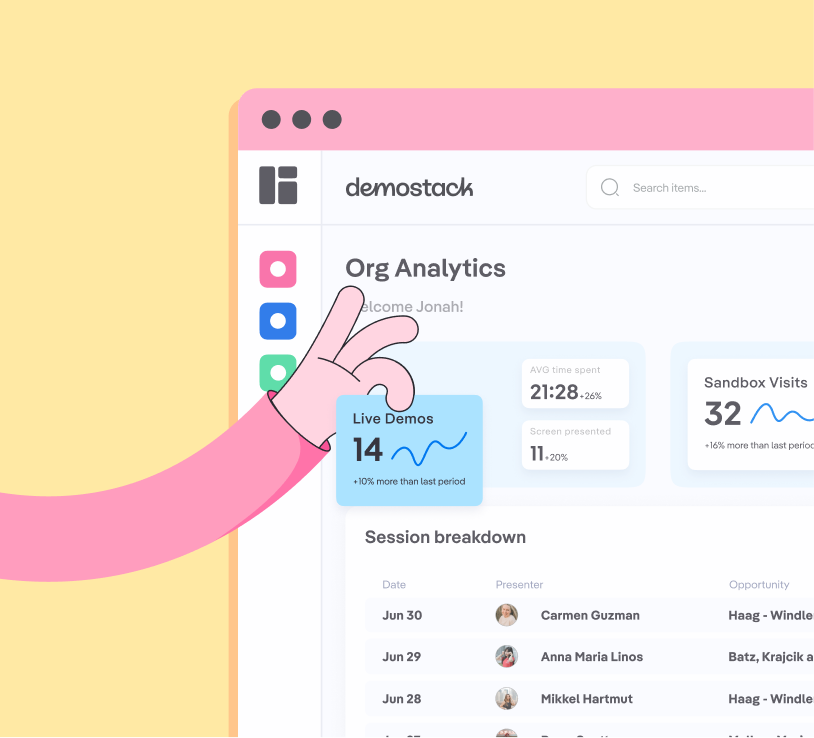
Get actionable demo insights. Your demo operation was a black box - until now. Understand your most effective demo flows, how many demos it takes to close a deal by segment, which features your buyers care about, and more.
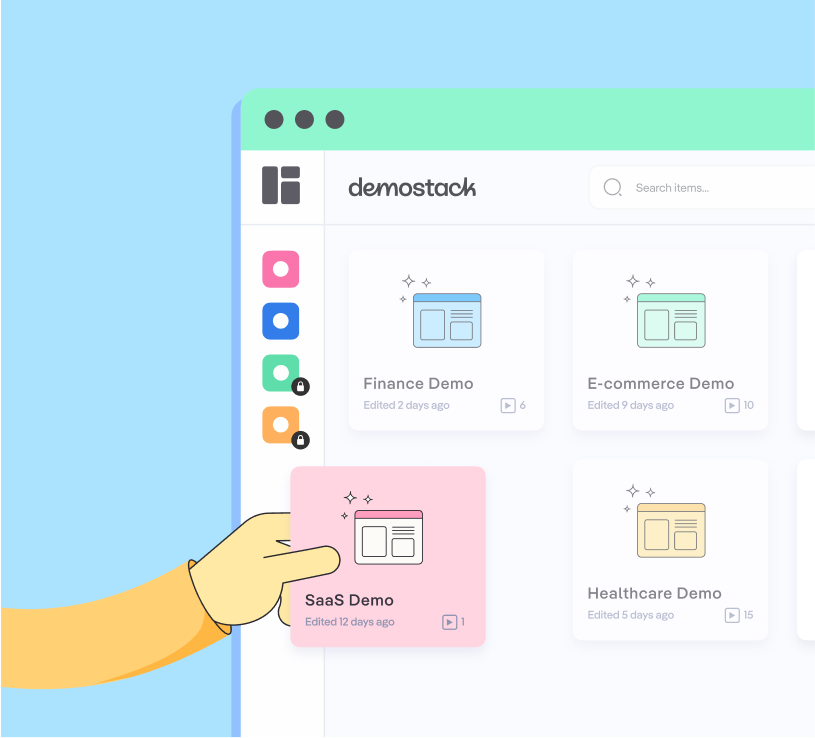
Let your SEs create demo templates by persona, use case, or vertical, so your AEs can showcase a tailored product story, even on the first call.
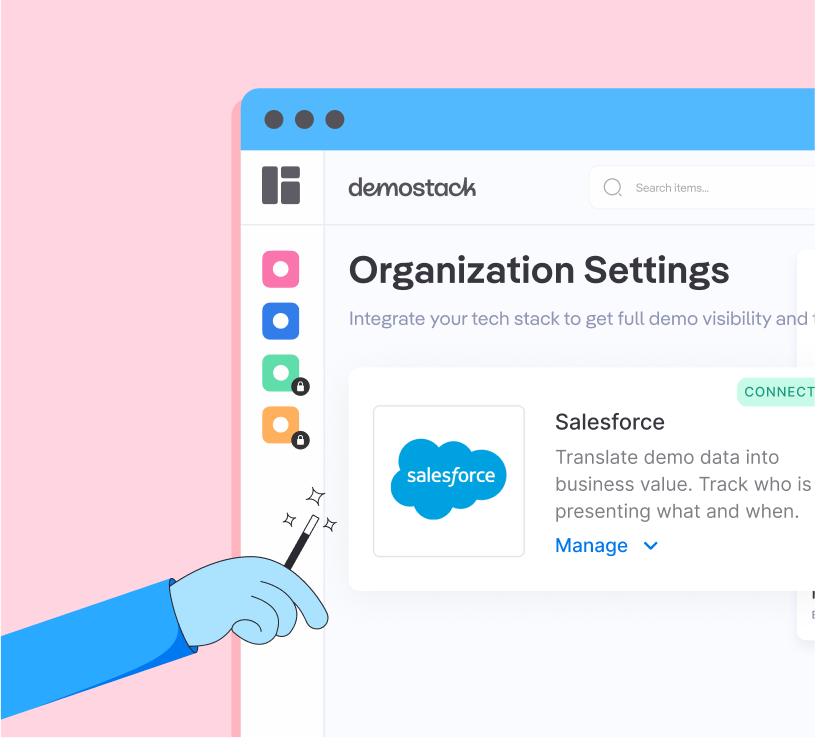
Sync all your Demostack data into your CRM, so you can see how your demos are impacting deals, get notified when a prospect views your leave-behind, or prioritize accounts based on demo engagement.
## Demostack MCP: Integrate, without making it a project
Your AI tool can now answer questions like "which demo converts best" or "which SE showed what" straight from your Demostack data.
## Sales Demo Environment
Source: https://www.demostack.com/sales-demo-environment
Scale your demo operation with an independent environment, built for showcasing.
Get a demo

No code
No more waiting weeks on R&D. Go-to-market teams can take control of the demo environment, and tailor the story with a point and click.

Reliable demos
With a stable, always-on demo environment, there’s no need to worry about bugs popping up, unexpected changes, or features you weren’t enabled on yet.
It shouldn’t take weeks to spin up a demo environment. And that’s just the initial setup - nevermind the ongoing maintenance. Demostack lets you create custom demos in minutes and update them in a snap - so you can focus your SEs on more strategic deals, not demo admin.
Learn more
Create a version of your product built for showcasing - no code needed. It’s as close as it gets to your real product experience, without all the backend complexity.
No more constantly piping in dummy data sets to the backend. Edit charts and data with a point and click to create a product story that resonates.
With reliable demos independent from your live product, you can walk into each call without having to blame the WiFi for any bugs popping up, or product changes you weren’t expecting.
Get product into your customer’s hands faster with a trial-like environment that’s curated with content tailored to their business. They can explore the product and share with other internal stakeholders who weren't on the call, while you gather insights on who’s viewing what, when.
David Greene

Sr. Manager, SC Enterprise at Gainsight
"Gainsight’s sales team has achieved an impressive 8% increase in close-win rates by leveraging Demostack-powered demos. Demostack demos closely replicate the look and feel of our actual products and are easy to customize."
Tim Nordvedt

Architect Solution at Synack
"Synack cut demo build time from 100+ hours to under 10 with Demostack. Before, we spend on average 20% of our week on demo building & maintenance . That's 1 working day per week on just demo hygiene!"
Rob De Marco

Vice President of Solutions Consulting at Xactly Corp
“With Demostack, our Solution Consultants (SCs) have become significantly more efficient, as Account Executives (AEs) now have access to customized, ready-to-use demos at their disposal.”
Sarah Goldstein

Head of Product Marketing + GTM at Cyrebro
"With Demostack, over 200 partner users can independently demo our product without concerns about accidentally breaking our demo environment. Demostack allowed us to easily create a demo environment that is 99% indistinguishable from our actual platform, the only solution on the market that could do that."
Sudipto Kar

Senior Solutions Consultant at Gloat
“The platform experience is very intuitive and allows us to manage different versions of the demo environment well. It helps drive a consistent experience for all stakeholders, driving better business outcomes.”
Bryan Rowland

Director of Solutions Architecture at BlueVoyant
“We used Demostack for a multi-million dollar RFP and it allowed us to showcase the value of our product with a much stronger story in the demo. That was all the ROI we needed in one call."
Joe Buchanan

VP of Sales Engineering at Hunters
“We’ve already closed 3 deals without a POC thanks to our Demostack Sandbox. It’s accelerating our deals through the funnel - and at a higher ACV.”
Matthew Bigelow

Director of Global Revenue Enablement at WalkMe
“Demostack is our dream demo environment. Before customizing our dashboards and analytics to tell a story of WalkMe's impact was impossible. With Demostack we can easily edit graphs and showcase data-driven product stories for any deal. It's a total game changer for us.”
Tsvika Vishnievsky

VP of Operations, GTM at Yotpo
"Enabling sellers to design tailored product demos promotes confidence and showcases Yotpo's value utilizing realistic examples. In doing so, our prospects are able to visualize precisely how they will be interacting with Yotpo on a daily basis. This helps accelerate deals through the sales funnel."
Javier Ortega Estrada

VP of Sales at Hopin
"Having led multiple teams of sellers of SaaS companies, I realized how complicated it is to find the perfect balance in a demo; having it be both relevant to the customer but that doesn't take a lot of time of the AE away from the phone. The vision of Demostack intersects perfectly between this need and revenue efficiency."
Des Traynor

Co-Founder and Chief Strategy Officer at Intercom
"A great demo is the difference between a product you have to sell, and a product that can sell itself. Demostack solves the Acme problem, the idea that the data in demos never resonates with the customer receiving them."
Nir Zohar

COO & President at Wix
"Empowering businesses to craft a professional digital presence with no coding or design skills needed is core to our mission at Wix. I invested in Demostack, because we share this mission in common and I am impressed with how they are achieving it for creating sales demos."
Leyla Seka

Chief Operating Officer at Ironclad
“The hand off demo is going to have a huge impact on organizations getting deals done faster. Demostack offers the best solution I've seen to get product in the hands of prospects and gain deal-winning insights in exchange.”
Tomer London

Co-Founder and CPO at Gusto
“Demostack will be a productivity boost to any SaaS engineering team. I wish we had something like this when we started.”
## Demostack MCP: Integrate, without making it a project
Your AI tool can now answer questions like "which demo converts best" or "which SE showed what" straight from your Demostack data.
## Sales Enablement
Source: https://www.demostack.com/sales-enablement
Arm your AEs with easy-to-use, first call demos, so your SEs can focus on more strategic deals.
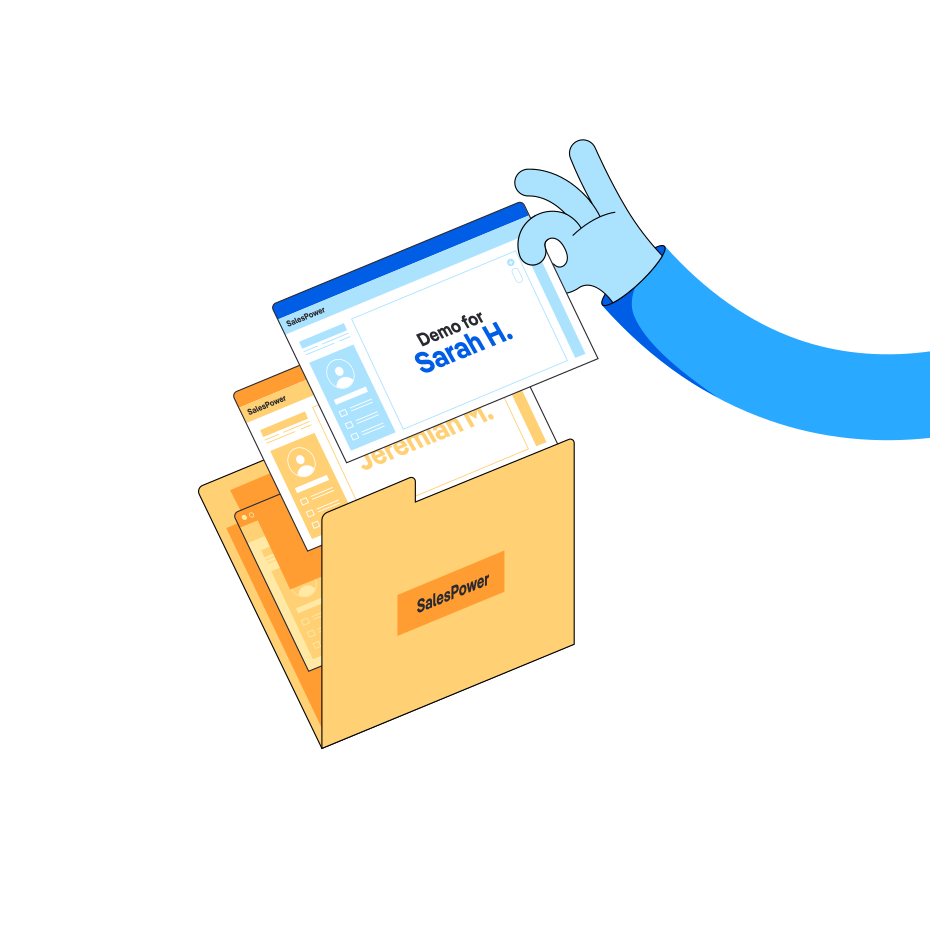
Get a demo
There’s a better way. One that lets you increase sales productivity without burning out your solutions engineers. Enabling your sellers to show micro demos at the top of the funnel allows your SE team to spend more time getting the technical win on your highest value opportunities.

Higher win rate

Faster deal velocity

Larger ACV
Let your SEs create customized demo environments by persona, use case, or vertical, so your sellers can showcase a product story that resonates, even on the first call.
Get a demo
Welcome to the modern demo experience, where your buyers see a tailored demo without jumping through hoops, your sellers are enabled to show product, and your SEs can do what they do best: get the technical win.
## Demostack MCP: Integrate, without making it a project
Your AI tool can now answer questions like "which demo converts best" or "which SE showed what" straight from your Demostack data.
## Demostack Virtual Patents Marking & Trademarks
Source: https://www.demostack.com/demostack-virtual-patents-marking-and-trademarks
## **Demostack virtual patents marking**
Demostack products are protected by patents in the U.S. and elsewhere. The information on this webpage is provided to satisfy the virtual patent marking provisions of various jurisdictions including the virtual patent marking provisions of the America Invents Act. The following list of Demostack products may not be all inclusive, and other Demostack products not listed here may be protected by one or more patents.Protected by U.S. Patents 11,909,807, 17,949,263.Additional patents may be pending in Europe and elsewhere.
## **Current trademarks**
The following are registered and unregistered trademarks and service marks owned by Demostack in the U.S. and other countries. If you have any questions concerning the trademarks on this list, please send an e-mail to [legal@demostack.com](mailto:legal@demostack.com)
The absence of any trademark or service mark from this list does not constitute a waiver of Demostack’s trademark or other intellectual property rights with respect to that trademark or service mark.
Please refer to the Demostack Trademark Usage Guidelines for important information regarding the proper usage of these trademarks:
Demostack®
## Trust Center
Source: https://www.demostack.com/trust-center
At Demostack, we're passionate about implementing privacy, security and transparency programs to continue to earn your trust.

We believe honesty is the best policy, so we'll always be proactive and transparent in our security measures.

Privacy
Protecting our users privacy is paramount. Demostack recognizes the importance of Privacy and Data Protection regulations such as GDPR and CCPA, and aligns with these and other frameworks. We promote Privacy by Design and are committed to protecting your and your customers' data.

Compliance
Demostack has earned its SOC 2 attestation with PWC, effective October 31, 2023. The Auditor’s report is “unqualified,” meaning no control gaps were identified. We never sell your data to any third party. We encrypt data at rest and in flight and use HackerOne for regular penetration tests.

Security
Our goal is to maximize the security of your demos and users. We use tools like Google's Security Command Center and Snyk to find and fix vulnerabilities and misconfigurations on a continuous basis.

System Status
In the spirit of true transparency, we publish 90-day statistics of the availability of our platform, warts and all.
[Real-Time Systems Status](https://status.demostack.com/)
Protecting your data is vital to our shared success. So to ensure the security of our systems, we maintain a Vulnerability Disclosure Program for ethical hackers to report potential bugs.
[Report a bug](mailto:bug_bounty@demostack.com)
Demostack is proactively compliant with leading privacy regulations and security standards. We'll handle the compliance - you focus on demos.

SOC 2 Type II
Demostack has earned its SOC2 Type II attestation with PWC, effective October 31, 2023.

GDPR
Our policies and procedures prioritize compliance with GDPR and data protection regulations worldwide. We embrace Privacy by Design principles. Our DPA is based upon the post-Schrems II Standard Contractual Clauses (SCCs).

HIPAA Compliant
Demostack is compliant with the HIPAA Privacy and Security standards as a Business Associate, and we have the policies, procedures and systems to protect your ePHI.
Demostack protects your data to fulfill your privacy obligations and give you peace of mind.

With third-party audits and certifications, Demostack meets your compliance requirements.

At Demostack, we are committed to protecting our customers' data through multiple layers of protection.

## Demostack vs\. Walnut
Source: https://www.demostack.com/lp/demostack-vs-walnut
Replace your demo environment with Demostack - the only full-stack demo experience platform built for your entire GTM team.

Get a demo
See how it works
|
Product tours that walk a user through a specific journey.
|
Custom demos that look and act just like your product.
|
|
Top-of-funnel marketing tours, repurposed for sales demo calls.
|
A demo environment solution built for the sales use case, and a shareable Sandbox to avoid the POC bottleneck.
|
|
Share a product tour that walks through a specific flow.
|
Share a Sandbox so your prospect can explore a trial-like environment on their own. We have customers closing deals without POCs because of this.
|
|
Product screenshots manually linked together to recreate specific flows from your demo, without the Javascript interactivity of your real product experience, like animations, hovers, drag and drop, and more.
|
Demostack’s cloning tech creates a 1:1 replica of your product’s front-end, automatically capturing Javascript interactivity - animations, tooltips, drag and drop, hovers, pop-ups, and more. It’s as close as it gets to the real thing.
|
|
Screen visuals can be recorded and personalized quickly, but linking them together to recreate the experience is labor intensive. You have to manually choose which screens to link where and create an entire map of click paths, which can get out-of-hand quickly.
|
Cloning captures your entire front end in seconds. Edit charts and data with a point and click, and make mass edits in one step to tailor the story.
|
|
Find and replace each individual piece of sensitive text. If you have 100 sensitive names, you'll have to find and replace 100 times.
|
Mask every sensitive type of data at scale - like phone numbers, email addresses, or credit card information - all in one step.
|
You’ve spent enough on marketing and sales to get a qualified buyer on the line. What’s the cost of a live demo that falls flat?

Take control of the demo
Create custom demos in minutes with no R&D. Pssst… that’s weeks shaved off your sales cycle.

Deliver flawless live demos
With demos independent from your live product, there’s no need to worry about bugs popping up, or new features you weren’t enabled on yet.

Win more deals faster
Shorter sales cycles, higher win rates. And no trials necessary.
While others were building screenshot technology for the top-of-funnel marketing use case, we built a full stack demo platform, with the live demo use case at its core. Repurposing screenshot technology for live sales demo will cost you weeks of painful, low-value work.

We make it as easy as copying and pasting your URL into our platform. You can use your live app as the base of your demo, or clone it into an independent demo environment. No R&D needed.

Customize the content to your buyer’s use case, persona, or vertical with a few clicks.

Deliver personalized live demos on every call, and let buyers play around with your product on their terms with a Sandbox leave-behind.
David Greene

Sr. Manager, SC Enterprise at Gainsight
"Gainsight’s sales team has achieved an impressive 8% increase in close-win rates by leveraging Demostack-powered demos. Demostack demos closely replicate the look and feel of our actual products and are easy to customize."
Tim Nordvedt

Solution Architect at Synack
Synack cut demo build time from 100+ hours to under 10 with Demostack. Before, we spend on average 20% of our week on demo building & maintenance . That's 1 working day per week on just demo hygiene!
Rob De Marco

Vice President of Solutions Consulting at Xactly Corp
“With Demostack, our Solution Consultants (SCs) have become significantly more efficient, as Account Executives (AEs) now have access to customized, ready-to-use demos at their disposal.”
Hanan Levin

VP Sales at Hunters.Security
Demostack's Sandbox helped us cut the sales cycle by 50%. Now, both Enterprise and SMBs now buy us in just 4 months, compared to 9 months.
Sarah Goldstein

Head of Product Marketing + GTM at Cyrebro
"With Demostack, over 200 partner users can independently demo our product without concerns about accidentally breaking our demo environment. Demostack allowed us to easily create a demo environment that is 99% indistinguishable from our actual platform, the only solution on the market that could do that."
Sudipto Kar

Senior Solutions Consultant at Gloat
“The platform experience is very intuitive and allows us to manage different versions of the demo environment well. It helps drive a consistent experience for all stakeholders, driving better business outcomes.”
Bryan Rowland

Director of Solutions Architecture at BlueVoyant
“We used Demostack for a multi-million dollar RFP and it allowed us to showcase the value of our product with a much stronger story in the demo. That was all the ROI we needed in one call."
Joe Buchanan

VP of Sales Engineering at Hunters
“I was sold on Demostack within the first 20 minutes of walking through it just knowing all the pain points I’ve had over the years of standing up a demo environment. You’re constantly having to chase down other teams to keep it updated with fresh data and content, and the maintenance becomes just as time consuming as setting it up in the first place. I haven’t seen any other tools that come close to the value that Demostack provides.”
Matthew Bigelow

Director of Global Revenue Enablement at WalkMe
“Demostack is our dream demo environment. Before customizing our dashboards and analytics to tell a story of WalkMe's impact was impossible. With Demostack we can easily edit graphs and showcase data-driven product stories for any deal. It's a total game changer for us.”
## Demostack MCP: Integrate, without making it a project
Your AI tool can now answer questions like "which demo converts best" or "which SE showed what" straight from your Demostack data.
## Demostack vs\. TestBox
Source: https://www.demostack.com/demostack-vs-testbox
Streamline your demo operation with Demostack - the only full-stack demo experience platform built for your entire GTM team.
Get a demo
See how it works
For live demos, TestBox brings an innovative approach to building custom demos. However, it fails to meet product compatibility requirements for most B2B companies, as it relies on customers scaling their trial accounts and leveraging their APIs.
Demostack, on the other hand, empowers anyone to add an overlay of edits on top of their production environment and to create an uncoupled Demostack demo environment. No API or coding needed.
Your team will deliver the best demo presentation every time with Demostack, the only full-stack demo platform built for your entire demo operation. Go beyond product demos and empower sales to deliver the best demo presentations. Demo governance features like one-click Demo Playbooks, folders, roles, permissions, and analytics help drive sales efficiency, predictability, and consistency. Move deals forward with product tours and sandbox-leave behinds paired with real-time notifications.
|
Live demos dependent on customer’s trial accounts and API reliability.
|
Full-stack demo platform for your entire demo operation, with product tours, live demos, and sandbox leave-behinds.
|
|
Repurposes trial account. If your product can’t scale trial accounts, TestBox won’t work.
|
Clone your product into an independent demo environment built for showcasing - and say goodbye to product surprises during live demos.
|
|
TestBox adds data on top of your trial accounts.
|
Demo a Demostack demo environment or your production environment with edits.
|
|
Share a limited trial account after your live demo.
|
Share a trial-like environment after your live demo, get deal-winning insights, and shorten the POC.
|
|
Salesforce
|
Salesforce, HubSpot, Slack
|
Enable buyers to self-educate with guided product walk-throughs.

Mask your existing environment with a story that resonates on every live demo.

Scale your demo operation with an independent demo environment, built for showcasing.

David Greene

Sr. Manager, SC Enterprise at Gainsight
"Gainsight’s sales team has achieved an impressive 8% increase in close-win rates by leveraging Demostack-powered demos. Demostack demos closely replicate the look and feel of our actual products and are easy to customize."
Tim Nordvedt

Solution Architect at Synack
Synack cut demo build time from 100+ hours to under 10 with Demostack. Before, we spend on average 20% of our week on demo building & maintenance . That's 1 working day per week on just demo hygiene!
Rob De Marco

Vice President of Solutions Consulting at Xactly Corp
“With Demostack, our Solution Consultants (SCs) have become significantly more efficient, as Account Executives (AEs) now have access to customized, ready-to-use demos at their disposal.”
Hanan Levin

VP Sales at Hunters.Security
Demostack's Sandbox helped us cut the sales cycle by 50%. Now, both Enterprise and SMBs now buy us in just 4 months, compared to 9 months.
Sarah Goldstein

Head of Product Marketing + GTM at Cyrebro
"With Demostack, over 200 partner users can independently demo our product without concerns about accidentally breaking our demo environment. Demostack allowed us to easily create a demo environment that is 99% indistinguishable from our actual platform, the only solution on the market that could do that."
Sudipto Kar

Senior Solutions Consultant at Gloat
“The platform experience is very intuitive and allows us to manage different versions of the demo environment well. It helps drive a consistent experience for all stakeholders, driving better business outcomes.”
Bryan Rowland

Director of Solutions Architecture at BlueVoyant
“We used Demostack for a multi-million dollar RFP and it allowed us to showcase the value of our product with a much stronger story in the demo. That was all the ROI we needed in one call."
Joe Buchanan

VP of Sales Engineering at Hunters
“I was sold on Demostack within the first 20 minutes of walking through it just knowing all the pain points I’ve had over the years of standing up a demo environment. You’re constantly having to chase down other teams to keep it updated with fresh data and content, and the maintenance becomes just as time consuming as setting it up in the first place. I haven’t seen any other tools that come close to the value that Demostack provides.”
Matthew Bigelow

Director of Global Revenue Enablement at WalkMe
“Demostack is our dream demo environment. Before customizing our dashboards and analytics to tell a story of WalkMe's impact was impossible. With Demostack we can easily edit graphs and showcase data-driven product stories for any deal. It's a total game changer for us.”
## Demostack MCP: Integrate, without making it a project
Your AI tool can now answer questions like "which demo converts best" or "which SE showed what" straight from your Demostack data.
## Demo HQ Day Webinars \+ More
Source: https://www.demostack.com/demo-hq-day-webinars-more
We brought together the best in the business to discuss how to think strategically about the demo operation, methodologies to build for scale, and how to do more with less.
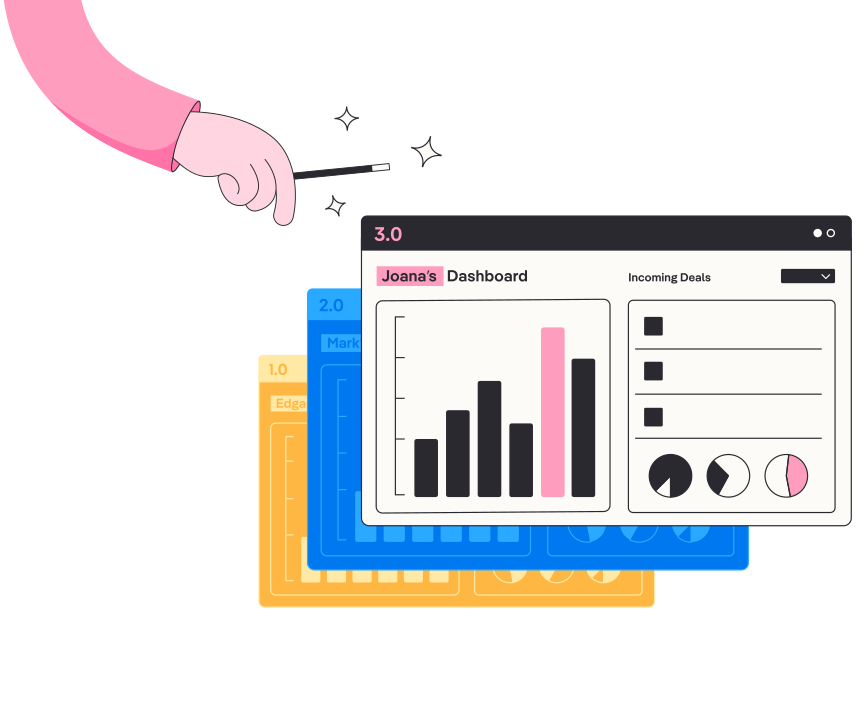
Demo HQ Day Sessions
Watch all of the sessions below.
In this action-packed panel, we'll walk through what that transformation looks like across your GTM teams, with the Demo HQ as your command center.
This session will walk through your playbook for running a world-class demo operation, like how to create the right assets, deliver them at scale, and leverage demo analytics to better spot what's working (and what isn't).
This session will break down the various types of demo technology, who plays where, and what use cases are best suited for each.
Learn tactical measures to bridge the gap between SE and AE. Strengthening this relationship will not only lead to better demos but also to closing bigger deals faster.
Watch this fireside chat with Des Traynor, Co-Founder and Chief Strategy Officer at Intercom, for a deep dive on how they've built a truly successful PLS motion, and their learnings along the way.
How can you scale your SE resources without stretching your team too thin? This session will cover practical ways that Gainsight, Xactly, and BetterCloud are solving this problem.
Demostack CEO Jonathan Friedman will walk through The Demo Maturity Model, a methodology to help your sales org determine when to show what - so you can minimize the input needed from the buyer, and maximize personalization.
Recent Webinars
Let’s face it: technical security information can feel dry, making it easy for your audience to check out - and your pitch to fall flat. But storytelling is what makes your buyer connect with your message and understand the value of your offering. It’s what makes cybersecurity relatable.
In this session, we’ll walk through what makes a story stick, practical ways to integrate storytelling into your sales process, and best-in-class examples of who’s doing it right in cybersecurity.
Is your demo like a game of whack-a-mole? Or, is it the golden ticket to your next customer?
In Part 2 of our series, join our Sales Engineer experts, Kerry Sokalsky and Dan Katz, for a live conversation to help you get out of the demo weeds and focus on the prospect win.
Learn how your demo can help lead the prospect conversation and close business faster.
Be honest - is your demo environment the best representation of your product? Start 2023 with a demo environment that can back up your business goals.
This is Part 1 of our 2-part series, where our expert panelists [Jakub Suchy](https://www.linkedin.com/in/jakubsuchyus/) and [Dan Katz](https://www.linkedin.com/in/mtndan/) will highlight the biggest issues when building in-house demo environments vs. buying a demo solution that can meet your specific needs.
## Demostack MCP: Integrate, without making it a project
Your AI tool can now answer questions like "which demo converts best" or "which SE showed what" straight from your Demostack data.
## Demystifying the demo solution landscape \- LP
Source: https://www.demostack.com/lp/demystifying-the-demo-solution-landscape
It's hard to be a buyer when it comes to demo solutions. This guide breaks down the various types of demo technology, who plays where, and what use cases are best suited for each.
Download now

Demo solution use cases
When evaluating a demo solution, always start with what problem you’re trying to solve. We’ll break down the 3 main use cases and how they inform the technology you need.

Demo technology
There’s no one-size-fits-all in terms of demo tech. We’ll clarify how each method works and what demo assets you can create with each type of technology.

Who plays where
We’ll demystify which solution providers offer each type of demo tech, so you can cut through the noise and find a tool that actually solves your needs.
## Demostack MCP: Integrate, without making it a project
Your AI tool can now answer questions like "which demo converts best" or "which SE showed what" straight from your Demostack data.
## Contact Us
Source: https://www.demostack.com/contact-us
Please select a topic below related to your inquiry.
General inquiry
Enter your work email to contact us to see how we can work together.
Contact us
See Demostack in action
Enter your work email to get a personalized demo with our team.
Get a demo
Join the team
If you're interested in joining our team, we'd love to hear from you.
See open roles
We believe a great demo experiences build connections between people and products.
Learn more

Demo to prospects earlier to build trust, qualify, and gain insight faster

Break free from presentation mode and use demos to facilitate discussion

Customize every demo with content that will resonate

Track demo performance and continually improve based on data

Deliver tailored demo experiences at every step of the customer journey

Hand off demos for prospects to explore without requiring an account


















David Greene

Sr. Manager, SC Enterprise at Gainsight
"Gainsight’s sales team has achieved an impressive 8% increase in close-win rates by leveraging Demostack-powered demos. Demostack demos closely replicate the look and feel of our actual products and are easy to customize."
Tim Nordvedt

Solution Architect at Synack
Synack cut demo build time from 100+ hours to under 10 with Demostack. Before, we spend on average 20% of our week on demo building & maintenance . That's 1 working day per week on just demo hygiene!
Rob De Marco

Vice President of Solutions Consulting at Xactly Corp
“With Demostack, our Solution Consultants (SCs) have become significantly more efficient, as Account Executives (AEs) now have access to customized, ready-to-use demos at their disposal.”
Hanan Levin

VP Sales at Hunters.Security
Demostack's Sandbox helped us cut the sales cycle by 50%. Now, both Enterprise and SMBs now buy us in just 4 months, compared to 9 months.
Sarah Goldstein

Head of Product Marketing + GTM at Cyrebro
"With Demostack, over 200 partner users can independently demo our product without concerns about accidentally breaking our demo environment. Demostack allowed us to easily create a demo environment that is 99% indistinguishable from our actual platform, the only solution on the market that could do that."
Sudipto Kar

Senior Solutions Consultant at Gloat
“The platform experience is very intuitive and allows us to manage different versions of the demo environment well. It helps drive a consistent experience for all stakeholders, driving better business outcomes.”
Bryan Rowland

Director of Solutions Architecture at BlueVoyant
“We used Demostack for a multi-million dollar RFP and it allowed us to showcase the value of our product with a much stronger story in the demo. That was all the ROI we needed in one call."
Joe Buchanan

VP of Sales Engineering at Hunters
“I was sold on Demostack within the first 20 minutes of walking through it just knowing all the pain points I’ve had over the years of standing up a demo environment. You’re constantly having to chase down other teams to keep it updated with fresh data and content, and the maintenance becomes just as time consuming as setting it up in the first place. I haven’t seen any other tools that come close to the value that Demostack provides.”
Matthew Bigelow

Director of Global Revenue Enablement at WalkMe
“Demostack is our dream demo environment. Before customizing our dashboards and analytics to tell a story of WalkMe's impact was impossible. With Demostack we can easily edit graphs and showcase data-driven product stories for any deal. It's a total game changer for us.”
## Marketing \- Inbound Event LP
Source: https://www.demostack.com/use-cases/marketing-event-inbound
Let website visitors experience the magic of your product before ever talking to sales with a self-guided demo.
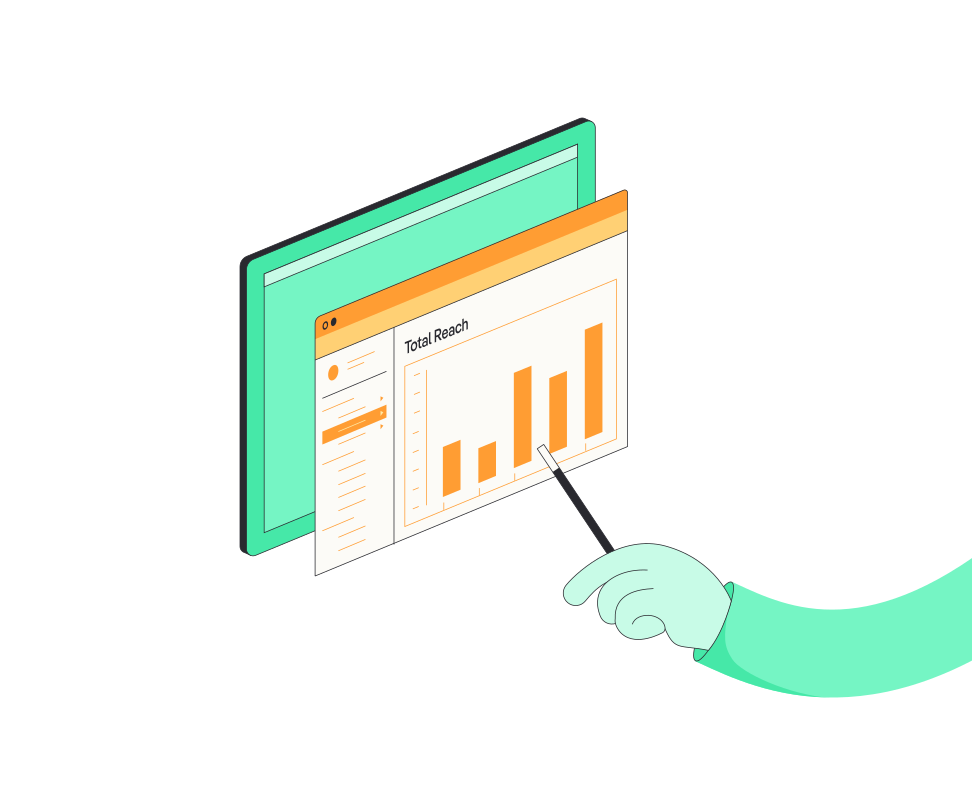

Product marketing
Showcase product experiences with interactive, guided demos embedded on your website.

Demand generation
Increase conversions with high quality leads that already understand your product’s value.

Account-based marketing
Create highly targeted, self-guided demos in minutes and level up your account-based marketing campaigns.

We make it as easy as copying and pasting your URL into our platform. You can use your live app as the base of your demo, or clone it into an independent demo environment. No R&D needed.

Customize the content to your buyer’s use case, persona, or vertical with a few clicks.

Deliver personalized live demos on every call, and let buyers play around with your product on their terms with a Sandbox leave-behind.
It's a clone of your real product experience, built for showcasing. And now you're in the driver's seat to craft the right story. No code needed.
Learn more
We help SaaS companies tell better product stories, from sales tech to security, and everything in between.

Fintech
Sales Tech
Marketing Tech
Enterprise Software
Analytics
Automation
Healthcare
CRM
Business Intelligence
Contract Management
Productivity Software
E-commerce
Review Management
Cyber Security
Customer Experience
Data Warehousing
ERP
Project Management
Supply Chain Tech
Construction
Education
Legal
HR Tech
CMS
David Greene

Sr. Manager, SC Enterprise at Gainsight
"Gainsight’s sales team has achieved an impressive 8% increase in close-win rates by leveraging Demostack-powered demos. Demostack demos closely replicate the look and feel of our actual products and are easy to customize."
Tim Nordvedt

Architect Solution at Synack
"Synack cut demo build time from 100+ hours to under 10 with Demostack. Before, we spend on average 20% of our week on demo building & maintenance . That's 1 working day per week on just demo hygiene!"
Rob De Marco

Vice President of Solutions Consulting at Xactly Corp
“With Demostack, our Solution Consultants (SCs) have become significantly more efficient, as Account Executives (AEs) now have access to customized, ready-to-use demos at their disposal.”
Sarah Goldstein

Head of Product Marketing + GTM at Cyrebro
"With Demostack, over 200 partner users can independently demo our product without concerns about accidentally breaking our demo environment. Demostack allowed us to easily create a demo environment that is 99% indistinguishable from our actual platform, the only solution on the market that could do that."
Sudipto Kar

Senior Solutions Consultant at Gloat
“The platform experience is very intuitive and allows us to manage different versions of the demo environment well. It helps drive a consistent experience for all stakeholders, driving better business outcomes.”
Bryan Rowland

Director of Solutions Architecture at BlueVoyant
“We used Demostack for a multi-million dollar RFP and it allowed us to showcase the value of our product with a much stronger story in the demo. That was all the ROI we needed in one call."
Joe Buchanan

VP of Sales Engineering at Hunters
“We’ve already closed 3 deals without a POC thanks to our Demostack Sandbox. It’s accelerating our deals through the funnel - and at a higher ACV.”
Matthew Bigelow

Director of Global Revenue Enablement at WalkMe
“Demostack is our dream demo environment. Before customizing our dashboards and analytics to tell a story of WalkMe's impact was impossible. With Demostack we can easily edit graphs and showcase data-driven product stories for any deal. It's a total game changer for us.”
Tsvika Vishnievsky

VP of Operations, GTM at Yotpo
"Enabling sellers to design tailored product demos promotes confidence and showcases Yotpo's value utilizing realistic examples. In doing so, our prospects are able to visualize precisely how they will be interacting with Yotpo on a daily basis. This helps accelerate deals through the sales funnel."
Javier Ortega Estrada

VP of Sales at Hopin
"Having led multiple teams of sellers of SaaS companies, I realized how complicated it is to find the perfect balance in a demo; having it be both relevant to the customer but that doesn't take a lot of time of the AE away from the phone. The vision of Demostack intersects perfectly between this need and revenue efficiency."
Des Traynor

Co-Founder and Chief Strategy Officer at Intercom
"A great demo is the difference between a product you have to sell, and a product that can sell itself. Demostack solves the Acme problem, the idea that the data in demos never resonates with the customer receiving them."
Nir Zohar

COO & President at Wix
"Empowering businesses to craft a professional digital presence with no coding or design skills needed is core to our mission at Wix. I invested in Demostack, because we share this mission in common and I am impressed with how they are achieving it for creating sales demos."
Leyla Seka

Chief Operating Officer at Ironclad
“The hand off demo is going to have a huge impact on organizations getting deals done faster. Demostack offers the best solution I've seen to get product in the hands of prospects and gain deal-winning insights in exchange.”
Tomer London

Co-Founder and CPO at Gusto
“Demostack will be a productivity boost to any SaaS engineering team. I wish we had something like this when we started.”
Make the live demo count, and win more deals faster.


Drive adoption with tailored demos that showcase what success looks like.

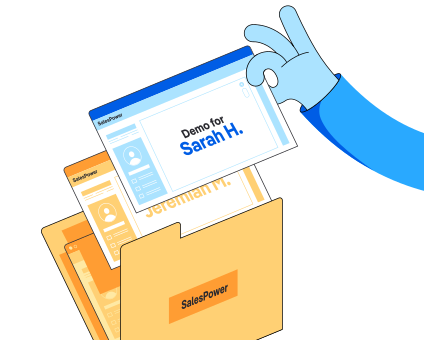
Enable employees with a demo sandbox to get them ramped and ready.


## Demostack MCP: Integrate, without making it a project
Your AI tool can now answer questions like "which demo converts best" or "which SE showed what" straight from your Demostack data.
## Trade Show Demos
Source: https://www.demostack.com/trade-show-demos
Conference season is upon us. You've invested big on events - don't let your product demo fall flat.
Get a demo
See how it works
A lot of time and resources went into setting up that trade show booth to get the attention of your buyers. What’s the cost of a product demo that falls flat?

Take control of the demo
Create custom demos in minutes with no R&D. Then tailor the story to fit your audience with a point and click.

Deliver flawless live demos
With demos independent from your live product, there’s no need to worry about bugs popping up, or new features you weren’t enabled on yet.

Increase event ROI
With a winning demo at your booth, you'll come home with quality pipeline - and a much higher ROI on event sponsorships.
Tailor the content to your buyer’s use case, persona, or vertical with a few clicks. Edit charts and data to craft a story that resonates.

We make it as easy as copying and pasting your URL into our platform. You can use your live app as the base of your demo, or clone it into an independent demo environment. No R&D needed.

Customize the content to your buyer’s use case, persona, or vertical with a few clicks.

Deliver personalized live demos on every call, and let buyers play around with your product on their terms with a Sandbox leave-behind.
David Greene

Sr. Manager, SC Enterprise at Gainsight
"Gainsight’s sales team has achieved an impressive 8% increase in close-win rates by leveraging Demostack-powered demos. Demostack demos closely replicate the look and feel of our actual products and are easy to customize."
Tim Nordvedt

Solution Architect at Synack
Synack cut demo build time from 100+ hours to under 10 with Demostack. Before, we spend on average 20% of our week on demo building & maintenance . That's 1 working day per week on just demo hygiene!
Rob De Marco

Vice President of Solutions Consulting at Xactly Corp
“With Demostack, our Solution Consultants (SCs) have become significantly more efficient, as Account Executives (AEs) now have access to customized, ready-to-use demos at their disposal.”
Hanan Levin

VP Sales at Hunters.Security
Demostack's Sandbox helped us cut the sales cycle by 50%. Now, both Enterprise and SMBs now buy us in just 4 months, compared to 9 months.
Sarah Goldstein

Head of Product Marketing + GTM at Cyrebro
"With Demostack, over 200 partner users can independently demo our product without concerns about accidentally breaking our demo environment. Demostack allowed us to easily create a demo environment that is 99% indistinguishable from our actual platform, the only solution on the market that could do that."
Sudipto Kar

Senior Solutions Consultant at Gloat
“The platform experience is very intuitive and allows us to manage different versions of the demo environment well. It helps drive a consistent experience for all stakeholders, driving better business outcomes.”
Bryan Rowland

Director of Solutions Architecture at BlueVoyant
“We used Demostack for a multi-million dollar RFP and it allowed us to showcase the value of our product with a much stronger story in the demo. That was all the ROI we needed in one call."
Joe Buchanan

VP of Sales Engineering at Hunters
“I was sold on Demostack within the first 20 minutes of walking through it just knowing all the pain points I’ve had over the years of standing up a demo environment. You’re constantly having to chase down other teams to keep it updated with fresh data and content, and the maintenance becomes just as time consuming as setting it up in the first place. I haven’t seen any other tools that come close to the value that Demostack provides.”
Matthew Bigelow

Director of Global Revenue Enablement at WalkMe
“Demostack is our dream demo environment. Before customizing our dashboards and analytics to tell a story of WalkMe's impact was impossible. With Demostack we can easily edit graphs and showcase data-driven product stories for any deal. It's a total game changer for us.”
We help SaaS companies tell better product stories, from sales tech to security, and everything in between.

Fintech
Sales Tech
Marketing Tech
Enterprise Software
Analytics
Automation
Healthcare
CRM
Business Intelligence
Contract Management
Productivity Software
E-commerce
Review Management
Cyber Security
Customer Experience
Data Warehousing
ERP
Project Management
Supply Chain Tech
Construction
Education
Legal
HR Tech
CMS
## Demostack MCP: Integrate, without making it a project
Your AI tool can now answer questions like "which demo converts best" or "which SE showed what" straight from your Demostack data.
## Pre\-sales Engineering
Source: https://www.demostack.com/lp/pre-sales-engineering
Pre-sales engineers can showcase product capabilities in the best light, without the hassle. It's like staging your home before putting it on the market, but for software.

Get a demo
See how it works
You’ve spent enough on marketing and sales to get a qualified buyer on the line. What’s the cost of a live demo that falls flat?

Take control of the demo
Create custom interactive demos in minutes with no R&D. Pssst… that’s weeks shaved off your sales cycle.

Deliver flawless live demos
With demos independent from your live product, there’s no need to worry about bugs popping up, or new features you weren’t enabled on yet.

Win more deals faster
Shorter sales cycles, higher win rates. And no trials necessary.
Turn your prospect into a champion with shareable demos that help them gain buy-in (and look like a hero). You’ll get deal-winning insights in exchange.

We make it as easy as copying and pasting your URL into our platform. You can use your live app as the base of your demo, or clone it into an independent demo environment. No R&D needed.

Customize the content to your buyer’s use case, persona, or vertical with a few clicks.

Deliver personalized live demos on every call, and let buyers play around with your product on their terms with a Sandbox leave-behind.
It's a clone of your real product experience, built for showcasing. And now you're in the driver's seat to craft the right story. No code needed.
Learn more
We help SaaS companies tell better product stories, from sales tech to security, and everything in between.

Fintech
Sales Tech
Marketing Tech
Enterprise Software
Analytics
Automation
Healthcare
CRM
Business Intelligence
Contract Management
Productivity Software
E-commerce
Review Management
Cyber Security
Customer Experience
Data Warehousing
ERP
Project Management
Supply Chain Tech
Construction
Education
Legal
HR Tech
CMS
David Greene

Sr. Manager, SC Enterprise at Gainsight
"Gainsight’s sales team has achieved an impressive 8% increase in close-win rates by leveraging Demostack-powered demos. Demostack demos closely replicate the look and feel of our actual products and are easy to customize."
Tim Nordvedt

Architect Solution at Synack
"Synack cut demo build time from 100+ hours to under 10 with Demostack. Before, we spend on average 20% of our week on demo building & maintenance . That's 1 working day per week on just demo hygiene!"
Rob De Marco

Vice President of Solutions Consulting at Xactly Corp
“With Demostack, our Solution Consultants (SCs) have become significantly more efficient, as Account Executives (AEs) now have access to customized, ready-to-use demos at their disposal.”
Sarah Goldstein

Head of Product Marketing + GTM at Cyrebro
"With Demostack, over 200 partner users can independently demo our product without concerns about accidentally breaking our demo environment. Demostack allowed us to easily create a demo environment that is 99% indistinguishable from our actual platform, the only solution on the market that could do that."
Sudipto Kar

Senior Solutions Consultant at Gloat
“The platform experience is very intuitive and allows us to manage different versions of the demo environment well. It helps drive a consistent experience for all stakeholders, driving better business outcomes.”
Bryan Rowland

Director of Solutions Architecture at BlueVoyant
“We used Demostack for a multi-million dollar RFP and it allowed us to showcase the value of our product with a much stronger story in the demo. That was all the ROI we needed in one call."
Joe Buchanan

VP of Sales Engineering at Hunters
“We’ve already closed 3 deals without a POC thanks to our Demostack Sandbox. It’s accelerating our deals through the funnel - and at a higher ACV.”
Matthew Bigelow

Director of Global Revenue Enablement at WalkMe
“Demostack is our dream demo environment. Before customizing our dashboards and analytics to tell a story of WalkMe's impact was impossible. With Demostack we can easily edit graphs and showcase data-driven product stories for any deal. It's a total game changer for us.”
Tsvika Vishnievsky

VP of Operations, GTM at Yotpo
"Enabling sellers to design tailored product demos promotes confidence and showcases Yotpo's value utilizing realistic examples. In doing so, our prospects are able to visualize precisely how they will be interacting with Yotpo on a daily basis. This helps accelerate deals through the sales funnel."
Javier Ortega Estrada

VP of Sales at Hopin
"Having led multiple teams of sellers of SaaS companies, I realized how complicated it is to find the perfect balance in a demo; having it be both relevant to the customer but that doesn't take a lot of time of the AE away from the phone. The vision of Demostack intersects perfectly between this need and revenue efficiency."
Des Traynor

Co-Founder and Chief Strategy Officer at Intercom
"A great demo is the difference between a product you have to sell, and a product that can sell itself. Demostack solves the Acme problem, the idea that the data in demos never resonates with the customer receiving them."
Nir Zohar

COO & President at Wix
"Empowering businesses to craft a professional digital presence with no coding or design skills needed is core to our mission at Wix. I invested in Demostack, because we share this mission in common and I am impressed with how they are achieving it for creating sales demos."
Leyla Seka

Chief Operating Officer at Ironclad
“The hand off demo is going to have a huge impact on organizations getting deals done faster. Demostack offers the best solution I've seen to get product in the hands of prospects and gain deal-winning insights in exchange.”
Tomer London

Co-Founder and CPO at Gusto
“Demostack will be a productivity boost to any SaaS engineering team. I wish we had something like this when we started.”
Drive adoption with tailored demos that showcase what success looks like.

Let partners promote your product with on-the-rails demos.

Enable buyers to self-educate with guided product tours.

## Demostack MCP: Integrate, without making it a project
Your AI tool can now answer questions like "which demo converts best" or "which SE showed what" straight from your Demostack data.
## Article: New release: Database Editing for Demos with AI
Source: https://www.demostack.com/post/new-from-demostack-database-editing-for-demos-with-ai
#### _In the ever-evolving world of software sales and customer engagement, efficiency and accuracy reign supreme. Managing and editing database content has always been a complex and time-intensive task - until now. With Demostack’s AI-powered database editing features, we’ve redefined how sales teams handle data for their demos. Let’s explore how this groundbreaking technology makes your workflows smarter and more intuitive._
### **Why AI for Database Editing?**
Traditionally, database editing requires deep technical knowledge, relentless manual effort, and constant cross-checking for errors. Whether it’s aligning demo content with a prospect’s unique needs or making bulk updates to datasets, these tasks often slow down your go-to-market motion.
Demostack’s new AI-driven solution eliminates these roadblocks, enabling sales teams to edit databases faster and more accurately. No coding skills required. Just streamlined, user-friendly tools that get the job done in seconds.
### **Key Features of Demostack’s AI-Powered Database Editing**
#### **1. Smart Field Identification**
Our AI technology analyzes your database structure, automatically detecting and categorizing fields. This makes it easy to identify the elements that matter most, from customer names to transaction dates—cutting down the time spent hunting through rows of data.
#### **2. Automated PII Masking**
Privacy concerns are a thing of the past. Demostack’s AI can detect Personally Identifiable Information (PII) and either mask or replace it with realistic dummy data, ensuring your demos remain compliant and secure without sacrificing authenticity.
#### **3. Contextual Suggestions**
Why make educated guesses when your AI assistant can guide you? With contextual recommendations based on the data in your database, Demostack enables you to craft tailored content that resonates with your audience.
#### **4. Effortless Bulk Updates**
Updating thousands of rows is no longer a chore. Use natural language prompts to describe what changes you need. For example, simply type, “Replace all instances of 'Trial' with 'Premium' for customers in California,” and watch as Demostack’s AI handles the rest.
#### **5. AI-Generated Data Filling**
No complete dataset? No problem. Generate realistic, scenario-specific data to fill gaps in your demo. This ensures a seamless and persuasive narrative without risking exposure of real customer data.
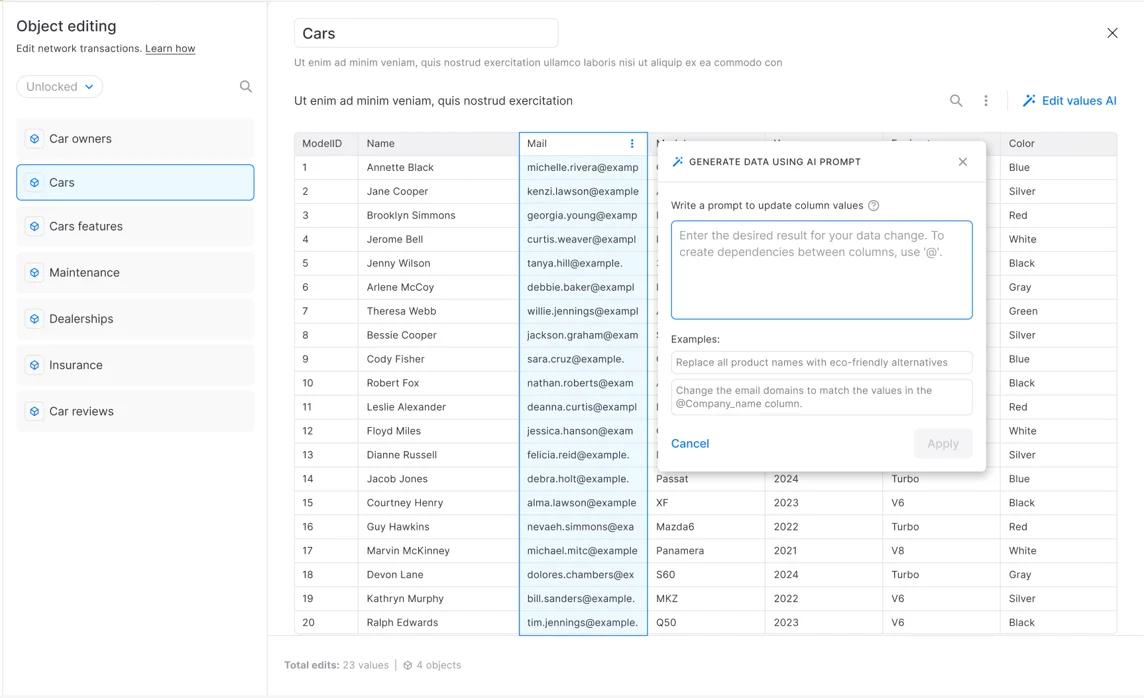
### **Benefits for Sales Teams**
#### **Save Time and Focus on Selling**
By automating mundane tasks, Demostack allows sales professionals to spend more time building relationships and closing deals.
#### **Enhance Personalization**
Tailored demos make lasting impressions. Our AI tools help you create experiences that speak directly to your prospects’ needs.
#### **Minimize Errors**
Human error is inevitable, but with AI precision, you can rest assured your demo data is accurate and professional.
#### **Strengthen Data Security**
Compliance and trust are critical in today’s market. Features like automated PII masking ensure your demos meet regulatory standards without compromising usability.

### **Real-World Impact**
Sales teams using Demostack’s AI-powered database editing report significant improvements in productivity, with some reducing their demo preparation time by over 50%. One user shared, “The ability to generate realistic data and make bulk changes with just a few clicks has transformed how we approach demos.”
### **Ready to Experience the Difference?**
Demostack’s AI-driven database editing is more than a tool—it’s a competitive advantage. Whether you’re demoing a SaaS product, pitching a new feature, or crafting a compelling narrative for your audience, our solution empowers you to create, edit, and deliver with unmatched efficiency and precision.
Explore how Demostack can redefine your demo workflows. [Learn more ](https://help.demostack.com/articles/database-editing-with-ai)and [get started today](https://www.demostack.com/win-more-deals-lp).
## Article: Finding Our Magic: How we developed our company values and brought them to life
Source: https://www.demostack.com/post/company-values
## How we Developed our Company Values
Company value creation is often met with hesitation and chalked up as a useless exercise from HR. _Is this really a priority? How will this help us develop better products or improve efficiency?_
In truth, this is where we started our values journey, feeling a bit cynical.
However, I’m happy to say that our cynicism was quickly replaced with enthusiasm for our values, from leadership all the way down to our most junior Demostackers. How did we do it?
## The Why
We first started with why. At Demostack, we strive to create a high-performance culture. One where employees are highly motivated, supported, and aligned with our mission, vision, and values. Pay isn’t typically the reason that a person chooses to work at one company over another. And price isn’t necessarily the reason a protential customer selects a solution. It’s our mission, vision, and values that make the difference.
While we had already articulated our mission and vision during our previous rebranding, our values were missing. And our values are our core set of beliefs that guide our actions and our day-to-day decision making.
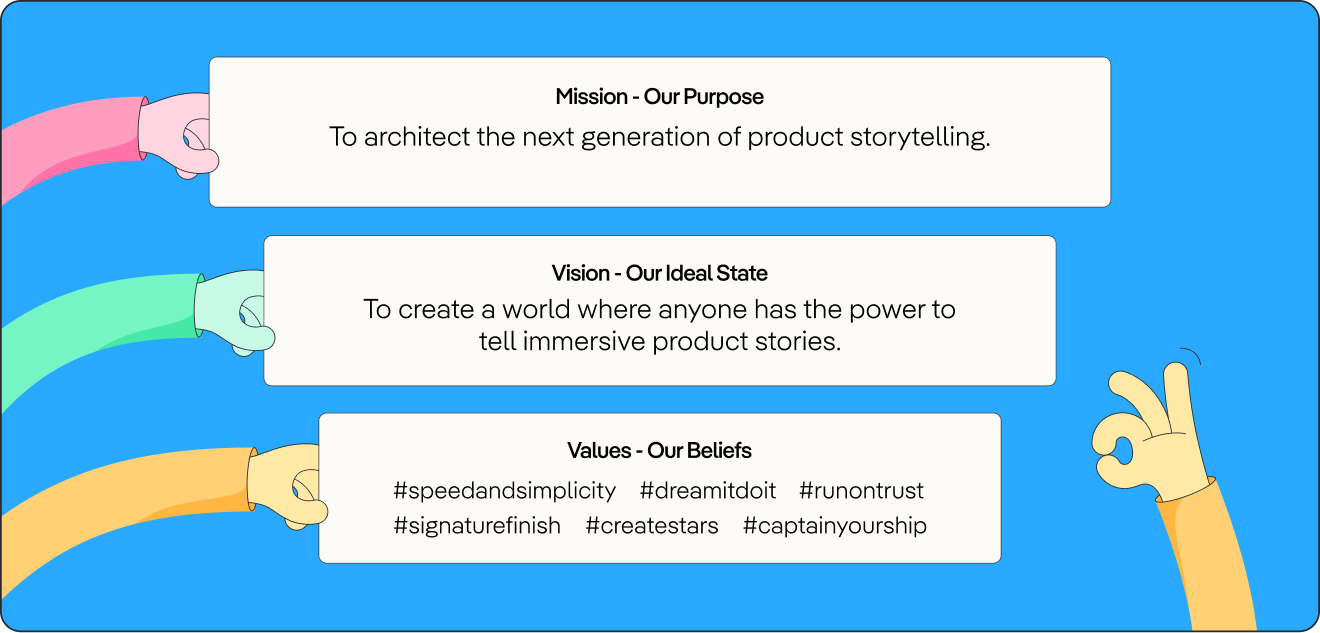
Developing a core set of values enables us to achieve:
- **Our goal** of becoming a high-performing workplace
- **Our mission** to architect the next generation of product storytelling
- **Our vision** to create a world where anyone has the power to tell immersive product stories
And ensures our unique culture scales with us as we grow - keeping that same _Demostack magic_ since day one.
## The How
After aligning on the why, we kicked off our company values journey with our three founders and a virtual whiteboard, placing stickies on the board as we debated what values make us uniquely Demostack.
Lucky for us, we didn’t have to start from scratch or approach this as an exercise to dream up the world’s best set of values, but rather one to capture the essence of who we are and what we believe as Demostackers. We noticed we already had some circulating lingo that felt very real and organic to depict this “magic.”
So, we ran a small focus group with a few early team members to ensure these values resonated with their experience and captured the essence of what it is to be a Demostacker. Then we incorporated their feedback to formulate our final six values:
1. Signature Finish
2. Run on Trust
3. Dream it, Do it
4. Create Stars
5. Speed and Simplicity
6. Captain your Ship
Then our design team helped us create these amazing visuals to represent each value using our unique brand. Who would have thought hands could be so expressive?
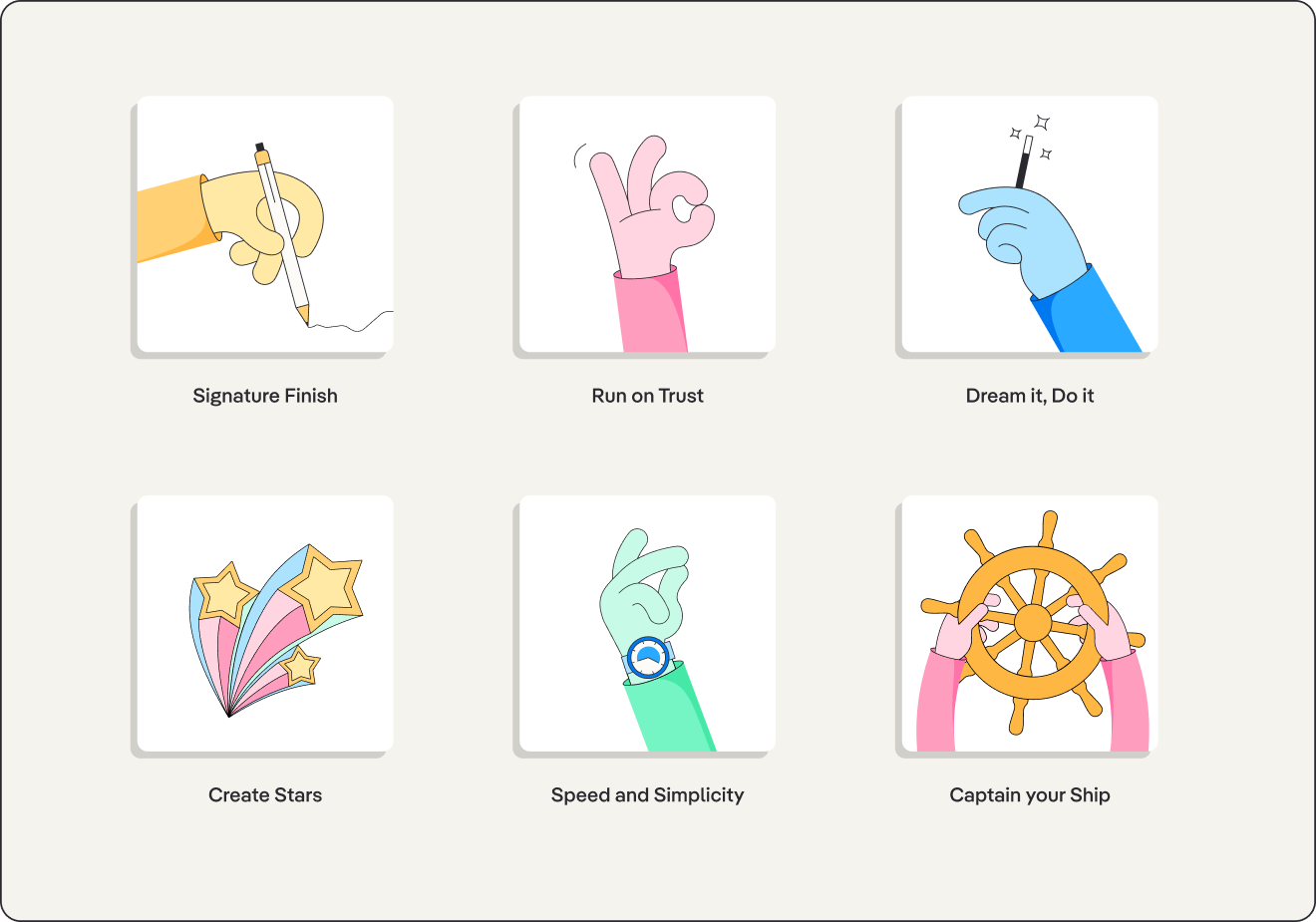
## Living our Values
After creating our values, we didn’t want them to die on a poster board on the wall. So we are bringing them to life by:
### 1. Adding them to our website
We added our [values on our website](https://www.demostack.com/about) to hold ourselves accountable and communicate what we’re all about so you know who you’ll be working with before you join us as a Demostacker or a partner. We want to be transparent in who we are and what we believe as an organization.
### 2. Launching peer-to-peer recognition
We launched a peer-to-peer recognition tool allowing everyone in the organization to start using the new language in their day-to-day and celebrate those demonstrating our values.
### 3. Developing Zoom/ Meets backgrounds
Our design team created awesome Zoom/ Meets backgrounds so we can all have a little fun with our values by displaying a value background that speaks to you that day!
###
4. Creating emojis to celebrate
We also created value emojis so employees can celebrate one another as they live our values. Who doesn’t love a fun emoji? This works especially well in our Slack channels.
And it doesn’t stop there. We will continue to weave our values into everything we do and across the stages of our talent lifecycle.
## The Impact
Our values have created a shared language for our global team to come together, discuss what we believe, and how we show up as Demostackers.
It’s not easy to find language to describe how things feel. It’s also challenging to write down values since it forces you to look in the mirror and ask yourself if indeed, everyone in the company embodies them. It’s actually an important part of the exercise. It’s ok to list some of the values you don’t 100% exemplify but you strive to display.
Overall, we're incredibly happy with how our organization received our values and the positive feedback we received from our Demostackers. Now, we're excited to live out our values each day.
## Article: How Motive Built a Demo Program That Actually Scales
Source: https://www.demostack.com/post/how-motive-scaled-demo-program
Most demo programs fail the same way. A few great sellers build great product demos. Everyone else improvises. The gap compounds quarter over quarter until leadership asks why win rates vary 30 points across the same product.
Motive faced a harder version of this problem. Their fleet management platform surfaces live dash cam footage, real-time driver locations on interactive maps, and safety alerts as they trigger. Traditional sales demo approaches had no answer for it.
So Motive built a demo program from scratch using the D.E.M.O. Framework: Diagnose, Engineer, Mobilize, Optimize. What they built now runs across hundreds of reps, certifies nearly every seller to give a first-call sales demo independently, and drives measurable improvements in trial conversion and win rate.
Below is how they did it, step by step.
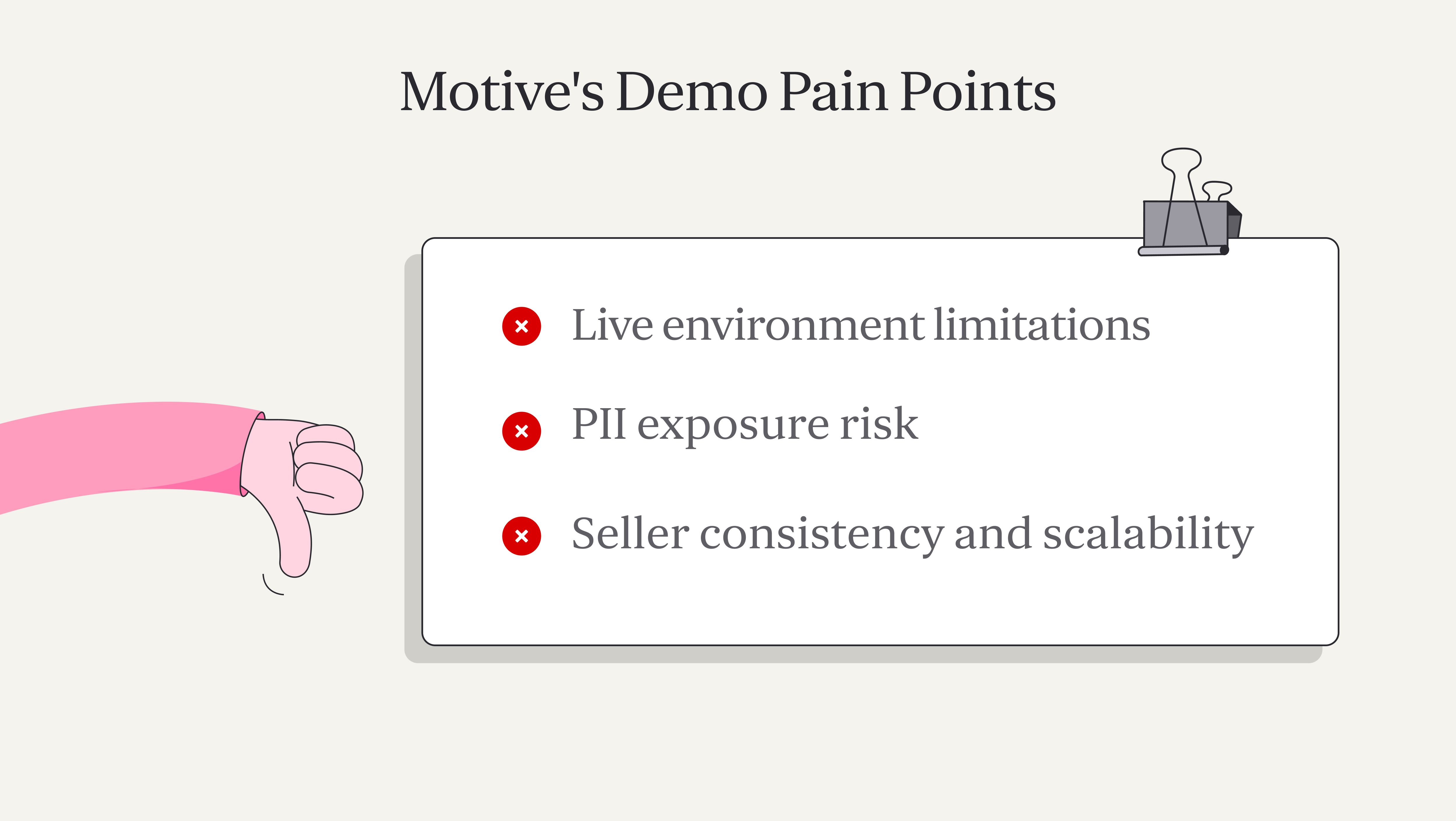
## **Diagnose: Start With the Real Problem, Not the Obvious One**
Before Motive touched any demo tools, they had to name what was actually broken.
Their internal demo environment used dummy data generated through a custom demo engine. On paper, it worked. In practice, it created friction that slowed every sales cycle. Sellers couldn’t control which vehicle videos appeared during a live demo. Financial dashboards showed stale or nonsensical data because updating them required filing a Jira ticket and waiting on engineering.
The knock-on effects ran deep. AEs avoided first-call product demos because the environment felt too unpredictable. Nearly every discovery call required an SE present as a backstop. New reps took months to ramp because they had nothing stable to practice on.
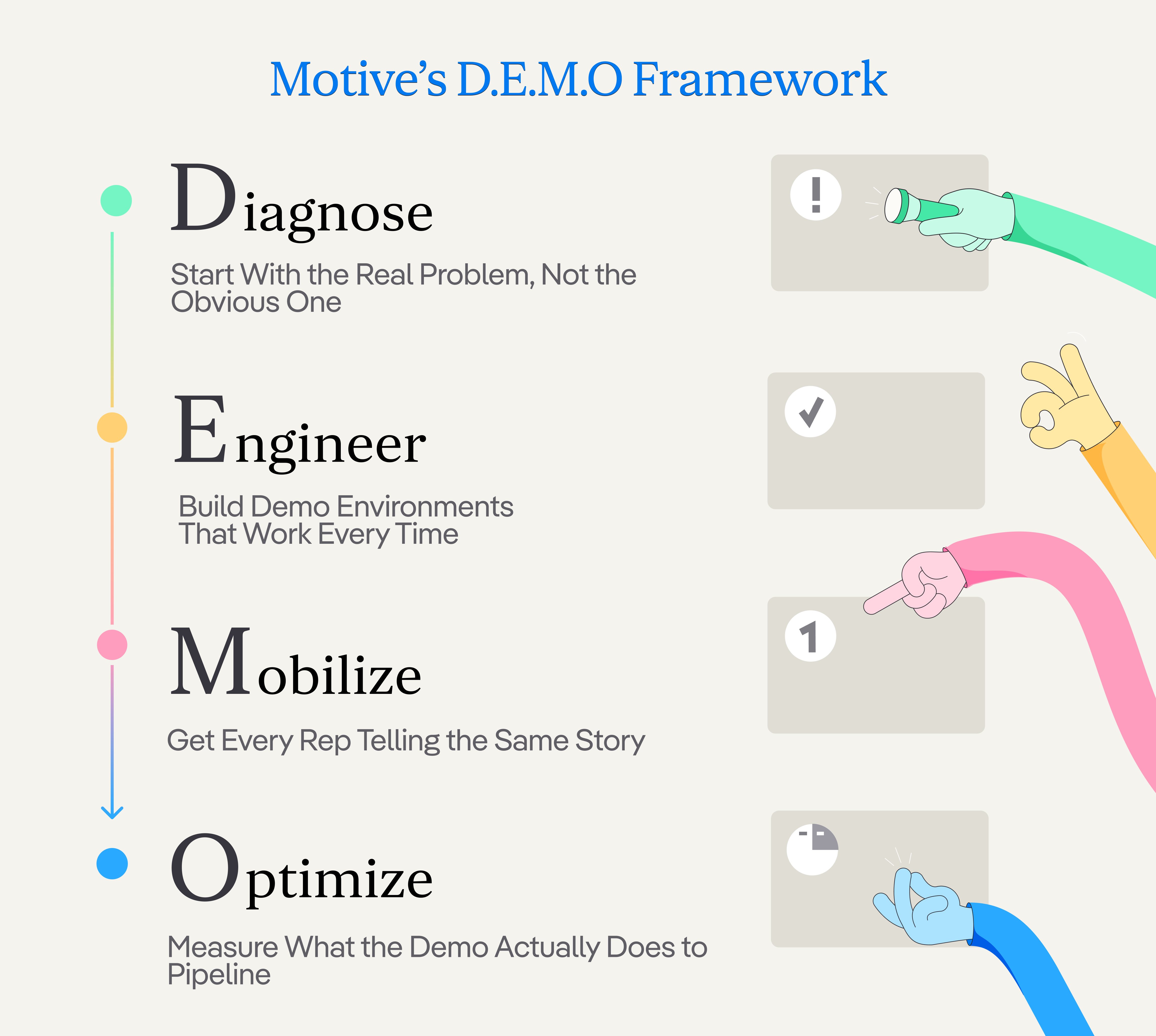
Motive’s leadership identified three strategic priorities that product demos had to support. Fleet managers need to see actual dash cam footage and live map interfaces to trust the product works in real conditions. Prospects expect to engage with the product immediately, not sit through a slide deck. And reps who demo deeply learn the product more deeply, making demos a teaching tool as much as a sales tool.
That reframing changed the problem entirely. Instead of asking “how do we build a better demo environment,” they asked “how do we enable every seller to confidently show the product on every call?” Those are different problems with different solutions.
Two options fell off the list quickly. Investing more in the internal sandbox meant more engineering allocation to an already unsustainable motion. Conventional demo software built around screenshot capture and image editing couldn’t handle videos, maps, or data that updated in real time. As Chief Customer Officer Robson Grieve explained the decisive factor: every alternative was essentially a dressed-up presentation, while Motive needed an interactive demo platform that actually behaved like the software.
## **Engineer: Build Demo Environments That Work Every Time**
Stable demo environments have one non-negotiable property: they perform identically regardless of who ran the last demo, when the last product update shipped, or how many reps are running live demos simultaneously.
Motive’s shared environment violated all three. One rep completing a workflow could break another rep’s demo. Product UI changes required engineering tickets that stretched into weeks. Data states were unpredictable and couldn’t be sequenced for effective storytelling.
### **Solving the “who moved my cheese” problem**
In shared environments, one person’s actions contaminate everyone else’s session. A rep triggers a safety alert, works through a workflow, or changes a data state, and suddenly every other rep’s demo reflects those changes until someone manually resets it. With Demostack’s Cloner, each rep gets their own isolated instance. No more pre-call reset rituals. No more discovering mid-demo that someone else changed the data.
### **Curating content that tells the right story**
Motive’s safety feature detects more than 15 unsafe driving behaviors. In their live environment, video feeds streamed continuously from real fleet operations. Sellers had no control over what appeared, couldn’t guarantee approval to show it, and couldn’t rely on finding a compelling coaching example on demand. Customer privacy added another constraint: not every video from a live fleet could appear in a sales demo without risking PII exposure.
Using Demostack’s interactive demo platform, Motive’s demo team curated a library of approved video content and surfaced the most representative scenarios first. A seller navigating to the Safety page now sees the best examples at the top, every time, across every instance. No digging. No worrying about what might surface.
### **Eliminating the engineering ticket dependency**
Populating a fleet operations dashboard with meaningful data previously required contacting engineering, filing a Jira request, waiting for prioritization, and repeating the entire cycle every time the product UI changed. The result was a demo program permanently bottlenecked by engineering availability.
## **Mobilize: Get Every Rep Telling the Same Story**
A stable demo environment is necessary. But stable environments sitting unused by sellers who lack confidence don’t move the pipeline.
Mobilization is the gap most demo programs underinvest in. Motive closed it through two initiatives that changed how sellers relate to the product.
### **Beat the Boss**
Every year, Motive runs a March Madness-style competition called Beat the Boss. The CEO records an example product demo, and every sales and customer-facing rep tries to beat it.
The stated goal is a competition. The actual outcome is more durable. Reps who don’t demo daily stay current on the full platform. Sellers practice features outside their comfort zone. Product knowledge spreads through doing rather than observing.
_“This creates a culture shift in our account executives and CSMs to always show the platform instead of using a presentation to show differentiation.” — Haley Cen_
One seller captured the effect plainly: the preparation gave them a much deeper understanding of the product, along with more effective ways to pitch it and articulate key differentiators. Competitions fade. Culture compounds. Beat the Boss works because it makes hands-on software demo training a shared expectation, not an individual achievement.
### **First-call sales demo certification**
Before Demostack, Motive AEs avoided demoing early in sales cycles. The environment felt unpredictable. Fleet locations might scatter randomly across the map. The best safety video might not load. Financial data could look stale or incoherent.
Resistance to early demos is rational when the environment doesn’t inspire confidence. Motive addressed the root cause, the environment itself, rather than trying to train their way through it.
After implementing stable, curated demo instances and running sellers through Beat the Boss, Motive achieved greater than 95% first-call demo certification across all sellers. AEs now run sales demos on first calls because they trust what will appear. They know exactly what the environment contains, can control the narrative flow, and don’t need SE backup until genuine technical depth is required.
### **Sales demo personalization at scale**
A critical part of Motive’s mobilization approach was giving sellers the ability to customize what prospects see without rebuilding from scratch. Sales demo personalization, tailoring the data, use case, and industry context to each buyer, moved from an SE-only capability to something any trained AE could execute. The demo sandbox gave sellers a safe space to customize without breaking shared environments, which meant personalization no longer required a support ticket.
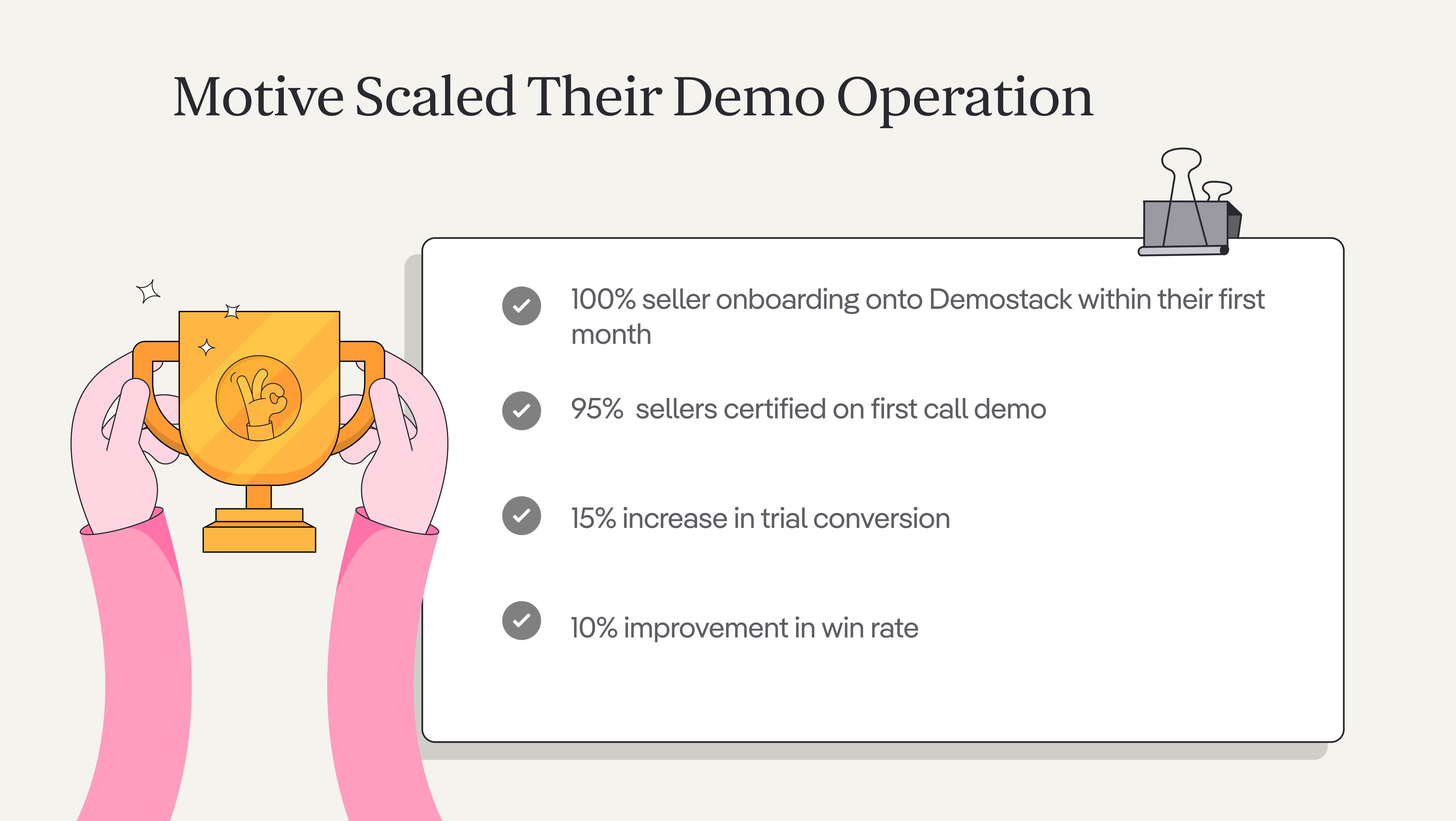
## **Optimize: Measure What the Demo Actually Does to Pipeline**
Motive doesn’t treat demo program improvement as intuition work. They measure it.
After implementing Demostack and scaling the D.E.M.O. Framework, their results were concrete:
- 100% seller onboarding onto Demostack within their first month
- Greater than 95% first-call demo certification across all sellers
- 15% increase in trial conversion
- 10% improvement in win rate
Beyond the numbers, sellers consistently report two things: confidence in what will appear during a live demo, and stronger product knowledge from hands-on practice with Demostack environments.
The feedback loop drives continuous iteration. Haley’s team doesn’t wait for sellers to flag problems. They proactively watch calls, identify friction points, and update demo environments on a regular cadence. She dedicates two to three hours weekly to live customer calls and Gong recordings, listening for what lands and what doesn’t.
**_“You won’t be able to create a good demo, a good product internally for internal sellers, if you don’t have empathy for them.” - Haley Cen_**
Haley’s approach to demo operations runs like a product team. She maintains a roadmap, collects feedback from sellers, and prioritizes based on company OKRs and the highest-frequency customer use cases rather than one-off requests. Without a roadmap, every executive, PM, and seller with a specific need pulls the team in a different direction. With one, the team builds for strategic impact.
## **What the D.E.M.O. Framework Reveals About Demo Programs**
The D.E.M.O. Framework isn’t a technology prescription. Motive’s story makes clear that demo tools are the third problem, not the first.
The first problem is diagnosis. Most teams skip it entirely. They feel the pain of broken demo environments or inconsistent seller execution, and they reach for new demo software. But the tool can’t fix a program that doesn’t know what problem it’s solving. Motive’s leadership spent real time naming the strategic priorities their product demo program had to serve before evaluating a single vendor. That sequence matters.
The second problem is ownership. Most demo programs live inside the wrong function, owned by whoever has the most energy for them rather than being resourced and governed like the GTM infrastructure they actually are. When demos live in someone’s Google Drive folder, get updated through informal Slack requests, and change every time a new feature ships, they can’t compound. Motive solved this by treating demo operations as an internal product with a roadmap, a PM mindset, and feedback loops from real users.
The third problem is adoption. Stable environments and good content don’t self-distribute. Motive’s 95% first-call certification rate didn’t happen because sellers suddenly felt confident. Motive built a structured path to confidence: stable demo sandbox environments to practice in, a competition that made product mastery a shared cultural expectation, and a certification process with a clear bar to clear.
For sales enablement leaders, the relevant question from Motive’s story isn’t “what demo software did they use.” It’s “what would our interactive demo program look like if we ran it against a stable, always-current environment?” And for SE leaders: “how many hours per week is my team spending on environment maintenance that should be going toward deal work?”
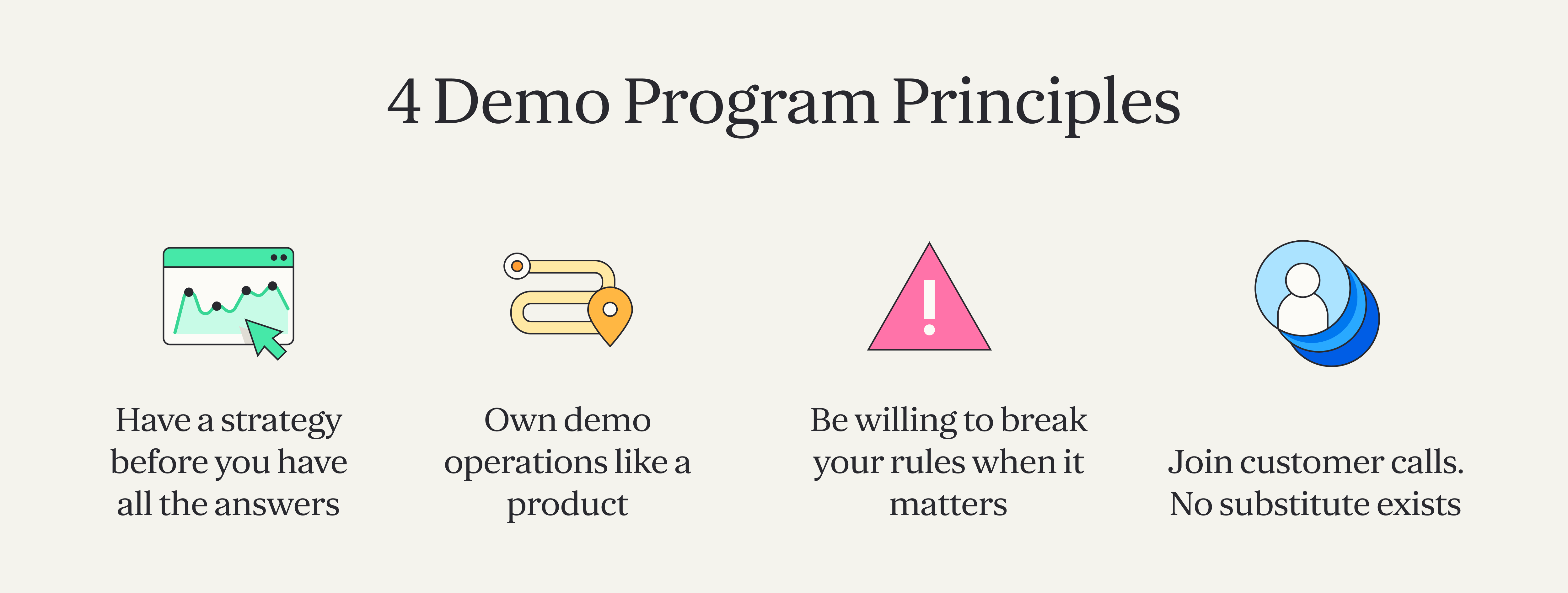
## **Four Principles From Motive’s Demo Engineering Lead**
Motive demo engineering lead distilled the program into four pieces of advice for anyone building toward the same maturity level.
**Have a strategy before you have all the answers.** Without one, every seller, executive, and PM pulls the demo team in a different direction and the team becomes reactive. Pick one story to tell well. Get feedback. Iterate. But start.
**Own demo operations like a product.** Run a roadmap. Use a prioritization framework. Track adoption. Treat sellers as users and their feedback as product input. You’re the PM for the demo program. Own it.
**Be willing to break your rules when it matters.** A fully built roadmap should flex for the biggest deal in company history. Revenue comes first. The roadmap is a tool, not a constraint.
**Join customer calls. No substitute exists.** Hypothesis-driven demo design only gets you so far. Live customer reactions reveal what no amount of internal feedback can. Dedicate two to three hours weekly to watching calls and build from observable reality.
## **The Bigger Picture**
The D.E.M.O. Framework gave Motive a shared operating system for what “good” looks like: one that scales across hundreds of reps, handles a technically complex interactive product demo, and turns demo quality from a variable into a standard.
When every seller can run a live demo with confidence, when the demo sandbox never breaks mid-call, when trial conversion moves 15 points, that’s not a quarterly win. That’s infrastructure.
If your demo program still depends on individual heroics, unpredictable environments, or engineering tickets to update a chart, the D.E.M.O. Framework is where to start.
Hubspot form
## Article: Certify Your Sellers: How to Build a Crawl–Walk–Run Demo Enablement Program
Source: https://www.demostack.com/post/demo-enablement
Most sales orgs spend months onboarding new sellers and still end up with reps who can't confidently show the product. They rely on SEs. They only know one way through the demo. Or they avoid it altogether.
It’s not a training issue. It’s a system issue. And the fix isn’t complicated—yet too many sales orgs overlook it.
A structured demo certification program can help your entire team tell a consistent product story, improve first-call execution, and speed pipeline —without adding more enablement headcount or dragging out onboarding.
Teams like Motive made demo certification part of their enablement process—and saw measurable results:
- 15% increase in trial conversions
- 10% lift in win rates
- Fewer demo handoffs. More confident reps.
And the best part? You don’t need a week-long bootcamp to get started. This post breaks down how to structure demo certification with the Crawl–Walk–Run model—with product tours, sandbox environments, and simple scorecards.
**Why Demo Certification Matters**
If your reps are still defaulting to “Let me loop in an SE,” that’s not just inefficient—it’s slowing deal progress. Demo certification gives you a scalable way to validate whether a rep can actually run a product conversation whether it’s a rep’s first month or their third year. It’s not about memorizing a script. It’s about navigating the product, connecting features to value, and adapting on the fly.
The benefits go beyond sales:
- SEs stop being the crutch
- Enablement gets a measurable benchmark
- Product marketing sees message consistency
- CS and presales speak the same product language
Whether you're onboarding a new seller or upleveling the team, the goal is the same: give reps the skills, space, and structure to confidently show your product—and prove they can do it.
## **From Good to Great: Motive Made Demo Certification a Cornerstone of Enablement**
Before introducing formal demo certification, Motive’s sales reps leaned heavily on SEs to deliver technical demos. Product knowledge varied across the team, and even experienced reps struggled to tell a consistent story.
So they made demo enablement a priority.
Sellers followed a structured path: guided product tours, sandbox-based practice, and a recorded demo walkthrough. The bar was clear: be able to run the demo start to finish, without needing backup.
To make it stick, they launched a “Beat the Boss” challenge—where reps competed to out-demo their CEO in a bracket-style tournament. Certification became more than a requirement. It became a cultural milestone.
**The results:**
- 15% increase in trial conversions
- 10% lift in win rates
- Reps who could confidently show the product—without waiting on an SE
## **How to Structure a Demo Certification Program: Use the Crawl–Walk–Run Model**
The best demo certification programs aren’t built around checklists—they’re built around real learning. The Crawl–Walk–Run model works because it builds confidence step by step, using tools your team already understands: product tours, sandbox environments, and internal playbooks.
**Crawl: Learn the product story**
Sellers don’t need full platform access at this stage—they need context. What does the product do? Who is it for? What problems does it solve?
At Motive, this starts with guided product tours that walk through core workflows, narrated with persona context. These aren’t generic walkthroughs—they’re tailored to real-world scenarios, like “coaching a driver” or “triggering an alert.”
Other teams compile libraries of annotated demo recordings from top reps, helping new sellers see _how_ to tell the story—not just what to say.
The goal here is orientation, not mastery.
## **Walk: Practice in a sandbox**
Once sellers understand the story, they need a safe space to practice telling it.
That’s where demo sandboxes come in. These are clean, demo-ready environments designed for learning—not production. No backend issues. No live data. Just a place to explore workflows, rehearse talk tracks, and build confidence.
At Motive, reps walk through curated “golden nugget” scenarios—pre-sequenced examples that are ready to show out of the box. Reps rehearse on their own, then pressure-test with a peer or coach.
This stage is all about comfort and consistency: Can the rep navigate the flow? Connect features to outcomes? Recover when something goes off-script?
## **Run: Apply and certify**
Now it’s time to perform.
Reps either record a full demo walkthrough or present live to a manager, peer, or enablement lead. It’s not about perfection. It’s about fluency, structure, and control.
At Motive, the “Beat the Boss” challenge turned this final stage into something competitive—and memorable. Reps competed in a bracket-style tournament to out-demo the CEO. The result? Stronger demos, a shared standard, and a culture of storytelling.
Certification formats vary, but the goal stays the same: reps should be able to lead a product conversation on their own—before they face a live prospect.
### **What Good Looks Like**
You don’t need a massive training program to make demo certification work. You need a clear standard—and a way to reinforce it early.
Here’s what we’ve seen top teams do:
- Set the expectation: “You’ll be certified in 30–45 days”
- Define “good” with examples and a simple scorecard
- Use product tours, sandbox practice, and live reviews—not heavy LMS modules
- Keep it light, but visible—and consistent across the org
This isn’t about gatekeeping. It’s about giving your team a repeatable way to deliver better product conversations.
### **Final Takeaway: If You Want Consistency, Certify It**
The fastest way to tighten your pipeline isn’t another pitch workshop. It’s stronger product conversations. A good demo doesn’t just show features—it makes value real. It builds trust. It moves deals forward. And if your sellers can’t run one—on their own, early, and well—you’re leaving revenue on the table.
So stop assuming they’ll figure it out. [**Certify them.**](https://www.demostack.com/win-more-deals-lp)
## Article: 7 Limitations Of Interactive Demo Software
Source: https://www.demostack.com/post/limitations-interactive-demo-software
Interactive demo tools are _very_ powerful. They let you spin up a polished tour, create a robust overlay, or hand over a sandbox without waiting weeks for engineering.
Each can help a GTM team punch above its weight when used properly. Prospects can click around, see enough to understand the basics, and move deeper into the sales cycle.
The problem is that those types of demos only get you so far, especially when you are running live calls with prospects and have to go off script to answer a question. Or your team is trying to personalize demo flows for every prospect.
For complex apps with layers of workflows, API calls, and sensitive data, the breakdown is even sharper. Interactive demo software wasn’t built to carry that weight. Yet so many teams are scrambling to “_just make it work_.”
This isn’t about knocking tours or overlays. They have a role in every demo operation, and we have tons of customers who use them every day.
If you’re running high-stakes live calls with complex products, you need a demo approach that won’t buckle the second someone on your team has to improvise.
One sales leader put it bluntly: _“If something breaks in the middle of a demo, it kills the momentum.”_
Demostack was built to change that. Our cloning approach turns shaky homegrown demo environments into stable and customizable product stories without leaning on engineering or SEs for every small update.
Below, we outline where interactive demo software excels, the various limitations, and how cloning is the smarter path for many enterprise solutions. Let’s get into it.
## What is interactive demo software
[Interactive demo software](https://www.demostack.com/post/interactive-demo-software) gives GTM teams a sustainable way to create demos and product stories without leaning on engineering. Instead of waiting weeks for an updated flow or chasing an SE to patch together a demo, reps can spin up product experiences that look convincing enough to guide a buyer through the story.
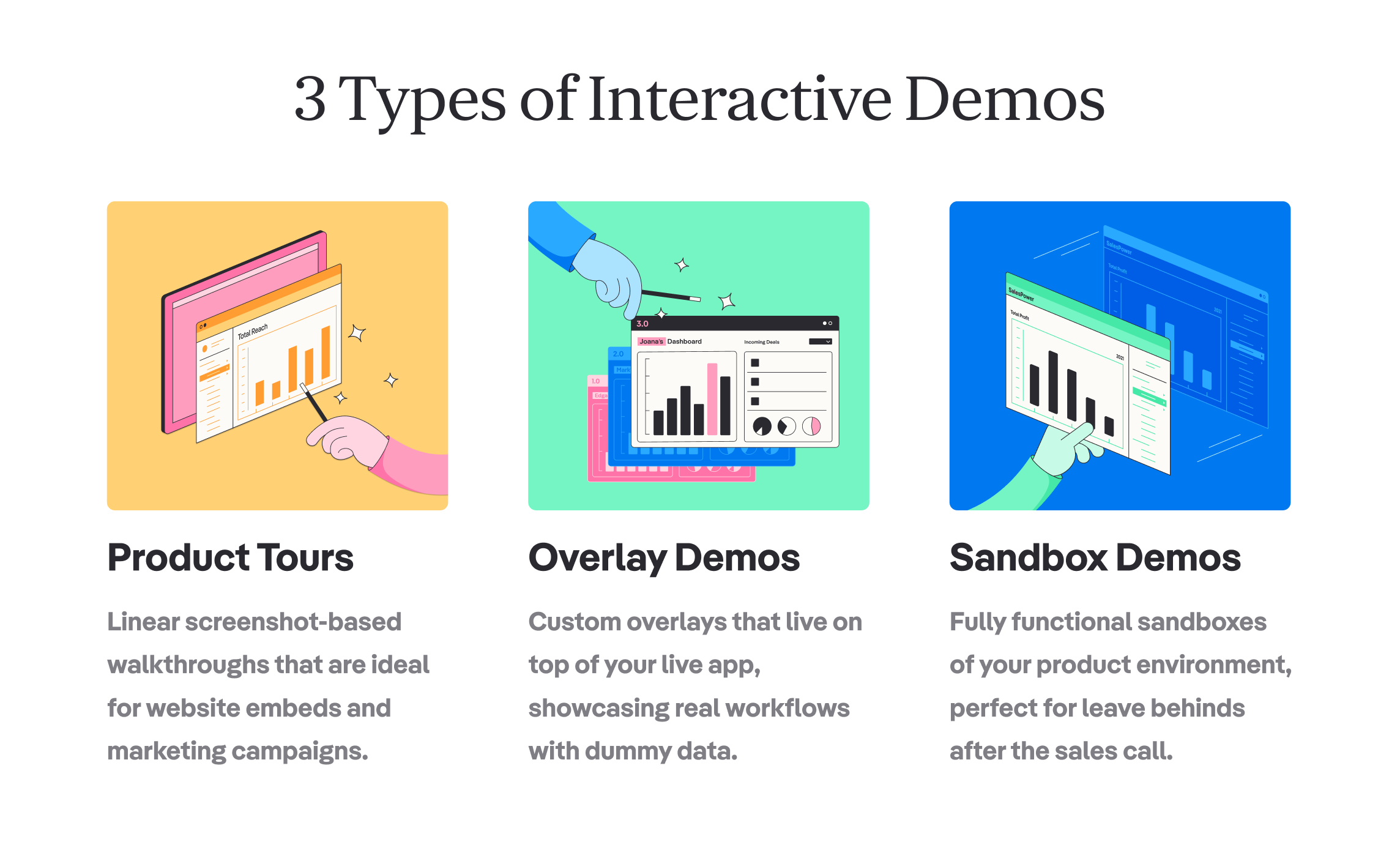
The main interactive demos you’ll likely to see are:
- **Product tours**: Pre-set click-throughs, often built from screenshots, that give prospects a linear view of the product. Good for top-of-funnel awareness, not so much for depth.
- **Overlay demos**: Layers placed on top of the real app, letting you swap in dummy data and customize fields while keeping the UI intact. Useful when you need a live feel without showing sensitive information.
- **Sandbox demos**: Standalone environments where prospects can explore on their own. Often used later in the cycle for evaluations, POCs, or internal stakeholder sharing.
Each option helps reduce friction early on and can be packaged into marketing campaigns or pre-sales leave-behinds. For async discovery and evaluations, they can help a GTM team get the job done.
As soon as you step into a live call with complex workflows, integrations, or custom data, you start to see where these tools are limited.
## Limitations of interactive demo software
Interactive demo software can be an empowering starting point for many GTM teams. Tours, overlays, and sandboxes give reps something to share early in the cycle, and they work well for simple products or async exploration.
Once you step into live calls or start selling complex solutions with multiple data layers, those tools begin to strain. The gaps don’t show up in marketing cadences or website embeds. They always tend to appear when the stakes are high and you can’t afford for a demo to go haywire.
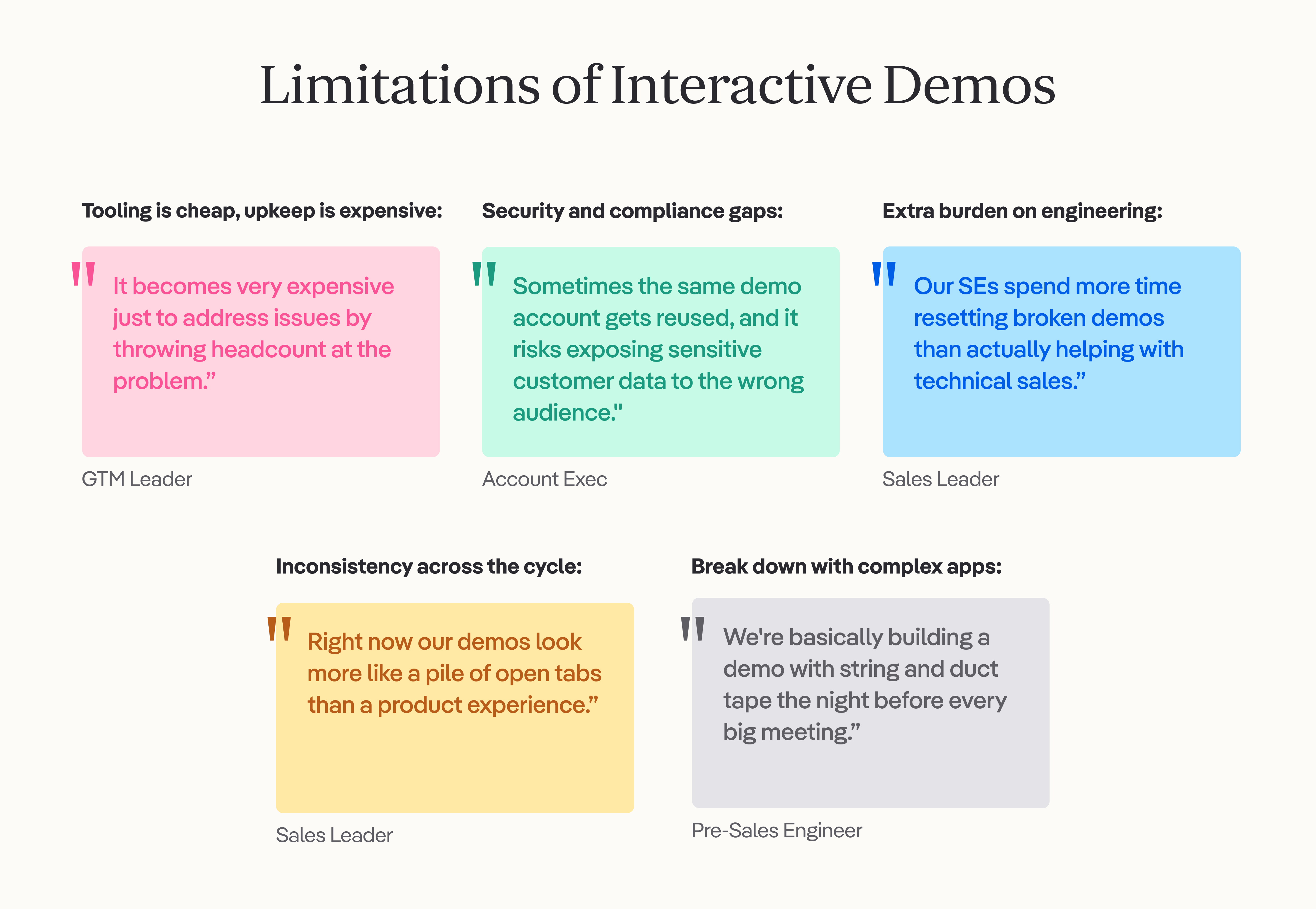
### 1. Tooling is cheap, upkeep is expensive
Interactive demo tools often look attractive at first glance because they are priced like a traditional SaaS tool. The real costs show up a few months later when each release triggers a ton of rework.
Every product update creates a cascade of maintenance work. Like tour sequences that worked last week, suddenly break because the UI moved a button. And overlays that perfectly highlighted a feature now point to empty space.
One GTM leader summed it up: _“It becomes very expensive just to address issues by throwing headcount at the problem.”_
The problem isn’t the recurring cost of a few hundred bucks. It’s the constant upkeep that drains both sales capacity and engineering budget. What starts as a cost-saving move quickly becomes one of the most resource-heavy parts of the process.
### 2. Can’t win live calls or pivot easily
Live demos expose the fundamental mismatch between how these tools work and what selling actually requires.
Tours tend to lock you into predetermined paths that rarely align with buyer questions. When a prospect asks to see something specific, you're stuck either following the script or jumping to a completely different asset.
Sandboxes offer more flexibility, which creates a special type of chaos. With unlimited options and no clear narrative, demos turn into meandering feature tours that bury the value under a ton of random clicks.
As one rep put it, _"Our demo today tries to show everything at once, instead of a focused version we can adapt to the buyer."_ A demo that overwhelms rarely builds confidence in your app, and once that slips, it’s almost impossible to win it back.
### 3. Inconsistency across the cycle
A prospect can meet four versions of your product in a single week. And they all might be outdated.
Monday’s tour on the website runs on last month’s captures, Tuesday’s overlay uses staging with different labels and fake data, Thursday’s live demo reflects yesterday’s UI, and Friday’s sandbox takes a new route altogether. It's a mess.
Each touchpoint creates a different impression of what your product actually is. While each piece probably works fine in isolation, together they feel like completely different products. Prospects start asking which version is real, and sellers struggle to explain the inconsistencies.
As one sales leader told us, _“Right now our demos look more like a pile of open tabs than a product experience._” The inconsistency doesn’t just distract; it makes it hard for your team to really feel like a solution to their pain points.
### 4. Break down with complex apps
Simple products can get away with lightweight demos like tours or overlays. Enterprise software quickly exposes the limits of interactive demo software.
Tours assume linear workflows, but complex applications have logic and integrations that don't fit predetermined paths. Try to show how your product handles different user roles or data scenarios, and the tour becomes a screenshot pretty quickly.
Overlays depend on static page structures, while enterprise applications feature more dynamic content that changes constantly. The carefully positioned overlays that worked in staging become unpredictable when the real application starts to behave even a little differently.
A pre-sales engineer put it plainly: “_We’re basically building a demo with string and duct tape the night before every big meeting.”_
Faced with these constraints, sales teams have to make an impossible choice to either oversimplify the product and lose credibility or risk showing broken workflows and lose confidence. Neither is ideal when you need a stable demo environment across the board.
### 5. Security and compliance gaps
In regulated industries like healthcare or finance, the “hacks” that make tours, overlays, and sandboxes easy to deploy can stall deals before they start.
Tours often capture real customer data in their recordings, creating compliance exposure that legal teams notice. Overlays built on live environments can leak sensitive information through cached content or test data. And sandboxes often get reused across multiple prospects, creating data contamination risks that make security teams bang their heads on the desk.
The pressure to move quickly leads to dangerous shortcuts. As one AE shared, _"Sometimes the same demo account gets reused, and it risks exposing sensitive customer data to the wrong audience."_ It only takes one slip like that to derail trust and set back the entire sales cycle.
A demo isn't just about showing what the product can do. It's also a test of whether [your company takes security seriously](https://www.demostack.com/trust-center) enough to earn the buyer's trust.
### 6. Extra burden on engineering
Despite promises of GTM-owned demo creation, these tools often drag technical and _expensive_ teams back into the sales cycle. Reps wait weeks for fixes while engineers lose cycles to demo maintenance instead of product development.
Spread that across regions or verticals, and you’ve built a shadow backlog that you can never clear.
One sales leader nailed it: _“Our SEs spend more time resetting broken demos than actually helping with technical sales.”_
Instead of enabling sales, the demo layer turns into another system you have to monitor and constantly repair. Which brings us back nicely to all the hidden costs associated with these inexpensive tools.
### 7. Analytics that don’t say much
The metrics that tours, overlays, and sandboxes provide look impressive on dashboards, but they don’t tell you a lot about deal progression or buyer intent.
Tour completion rates can’t predict which prospects will book the next meeting. Overlay click counts won’t explain which features actually resonated with a new prospect. And sandbox session lengths don't indicate genuine interest versus someone leaving it open on their browser all day.
Without visibility into demo engagement, follow-up remains generic and deals lose momentum. The difference comes when demo analytics connect to pipeline outcomes instead of just tracking surface-level activity.
These limitations aren't implementation problems or edge cases; they're fundamental constraints of how tours, overlays, and sandboxes work.
Each format serves its purpose in early-stage marketing and self-guided exploration. That said, none of these were really designed for the demands of live enterprise sales calls or complex product demos.
## Beyond interactive demo software
If tours, overlays, and sandboxes helped you get moving, that's valuable progress. The limitations we outlined above do point to a fundamental need: demos that work as reliably in live calls as they do in marketing campaigns.
Clone-first platforms, like Demostack, solve this by creating one authoritative source that powers everything.
With Demostack's [cloning technology,](https://www.demostack.com/post/how-to-clone-your-app) you're working with a replica of your live product that preserves the real functionality, logic, and workflows while staying completely isolated from production data. No more broken tour sequences after UI updates or feature releases. And no more sandbox environments that guide your prospect into a random part of your app.
Best of all, after creating a clone of your app, your live demos, tours, overlays, and leave-behinds can all run from the same demo environment. So when your product ships updates, just re-capture a fresh clone, then update your playbook with a new flow that exactly matches your live product.
Demostack puts the power back into the hands of your GTM team as well. They can customize logos, data, screens, and workflows in minutes without filing ANY engineering tickets.
Say goodbye to waiting weeks for developers to rebuild broken tour flows or reposition overlay elements. This approach allows AEs to create custom demos for any use case while SEs focus on complex, high-value opportunities where their expertise actually matters.
[Security is handled with extreme care with Demostack](https://www.demostack.com/trust-center). No more recycled demo accounts or shared environments that create compliance risks. When you need to record a demo, you're capturing from a safe clone rather than real production data.
Additionally, internal analytics connect every demo interaction to CRM records. So you will know which features, screens, or assets drive deals forward instead of constantly guessing.
Let us be clear, tours, overlays, and sandboxes aren't useless; they're just constantly being asked to do jobs they weren't designed for. They work well for early-stage marketing campaigns and self-guided exploration. But forcing those assets into live sales calls or complex product demos isn’t how you win new deals.
The most effective GTM teams recognize that different parts of the sales cycle require different demo assets. With Demostack, you can power all of those assets, and more.
**Want to learn more about improving your demo operation? Check out the [D.E.M.O. Framework ebook and webinar:](https://www.demostack.com/guide/demo-frame-work)**
Link: https://www.demostack.com/post/the-demo-framework
## Article: Demostack joins the HubSpot App Marketplace
Source: https://www.demostack.com/post/demostack-hubspot-app-marketplace
**San Francisco, –** Today, Demostack, the leading demo platform for SaaS GTM teams, announced that it is now listed in the [HubSpot App Marketplace](https://ecosystem.hubspot.com/marketplace/apps). App Partners are independent software vendors who have built an integration with HubSpot and been accepted to the App Marketplace.
Demostack's HubSpot integration brings sales demos to life, automatically capturing prospect engagement data that transforms how teams track, nurture, and close deals. Sales teams can now seamlessly link interactive product demos to HubSpot records while marketers turn product tours into lead-generating machines, delivering the personalized experiences modern buyers demand.
HubSpot’s App Partner Program is an ecosystem of valuable third-party integrations. App Partners comply with a [set of requirements](https://www.hubspot.com/connect/connect-program-policies).
"This integration bridges the gap between product demonstrations and revenue outcomes by bringing critical engagement data directly into the HubSpot workflow," said Manny Ataebi, CMO at Demostack. "Both sales and marketing teams can now showcase their product's full value through interactive experiences that tell a compelling story, capturing valuable prospect insights while eliminating the need to divert precious R&D resources for demo creation."
"We're excited to welcome Demostack to the HubSpot App Marketplace," says Scott Brinker, VP of Platform Ecosystem at HubSpot. "Their integration brings interactive product demos directly into the customer journey, helping sales teams deliver personalized experiences that resonate with buyers. It's exactly the kind of practical innovation that helps our customers close more deals without adding technical complexity."
Learn more about the integration [here](https://ecosystem.hubspot.com/marketplace/apps/demostack-1452872).
## Article: Clone your app in 30 seconds with Demostack
Source: https://www.demostack.com/post/how-to-clone-your-app
Congrats, your team just shipped an amazing feature that they have been working on for months.
Marketing is excited, product can’t wait for people to start using it, and the sales team can’t wait to show it off.
But there’s a catch. When is it going to show up in your demo environment? Next week? Next quarter? Maybe next year?
Demostack lets GTM teams create fresh demo environments in minutes with no engineering bottlenecks. Clone the app once, and when updates ship, drop the new slice into your demo or playbook without rebuilding everything from scratch.
The hardest part of cloning is just picking the parts of your app you want to show off and the product story you want to tell.
Let us show you how quick and easy it is to clone your app. Yes, even your _“super complicated app that could never be cloned._” We can do that too.
## Your homegrown environments are impacting growth
Before we show you how easy it is to clone your app with Demostack, let’s highlight some hidden costs of homegrown demo environments.
Anytime a new feature ships, GTM teams are left waiting weeks for a refreshed demo or scrambling to, as one customer put it, “_build something with string and duct tape.”_
When that environment finally shows up, it’s extremely not very user-friendly. Only SEs can update it or show off the product, creating bottlenecks that slow your sales cycle to a crawl and frustrate the whole GTM team.
Even worse, it doesn’t stay fresh for long. Small interface changes make demo environments go stale in just a few weeks.
We’ve even heard teams say it only takes a few days before their demo no longer matches the product. As one GTM leader simply put it: _“By the time our demo was ready, the product had already changed.”_
Reliability is another big issue with homegrown demos. Ask the CEO of Synack what happened when they tried to demo in front of a big client at Black Hat. _Spoiler alert: black screen of death._
Cloning replaces all of that homegrown chaos with a clean, consistent demo anyone can spin up in minutes.
No delays. No bottlenecks. No scrambling to _“make it work”_ hours before a big sales call. Just demos that stay current and keep your sales cycle moving.
## How to clone your app + create a demo
We have been talking about how easy it is to create a clone of your app, so let’s finally do it. All you need to have in hand is the Demostack app and a link to your app. Get your stopwatch ready because this is going to be quick.
1. First, navigate to your **Demostack workspace**
2. Click the blue **Create New** button in the top right corner
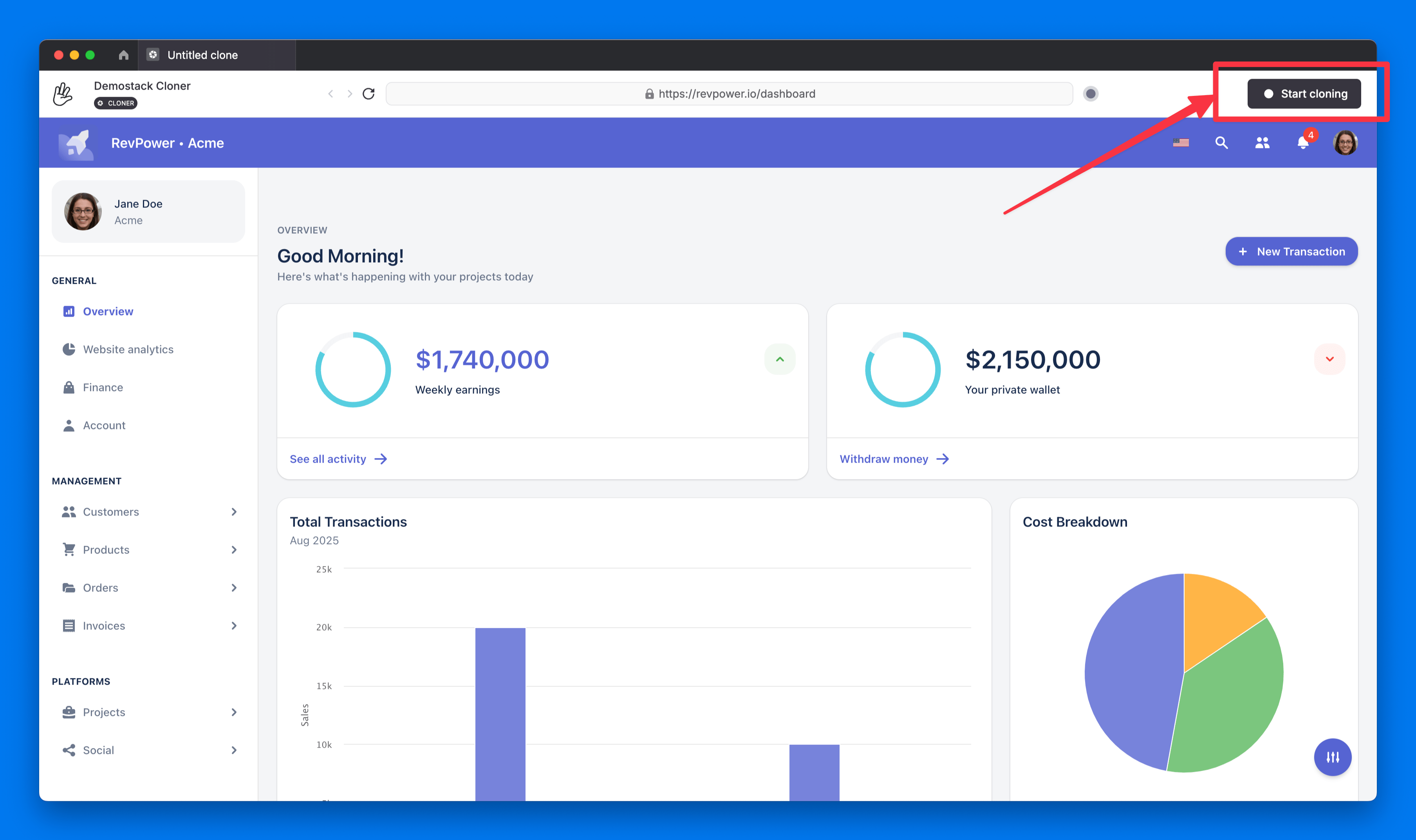
3. Select **Clone** from the **Create new** drop-down menu
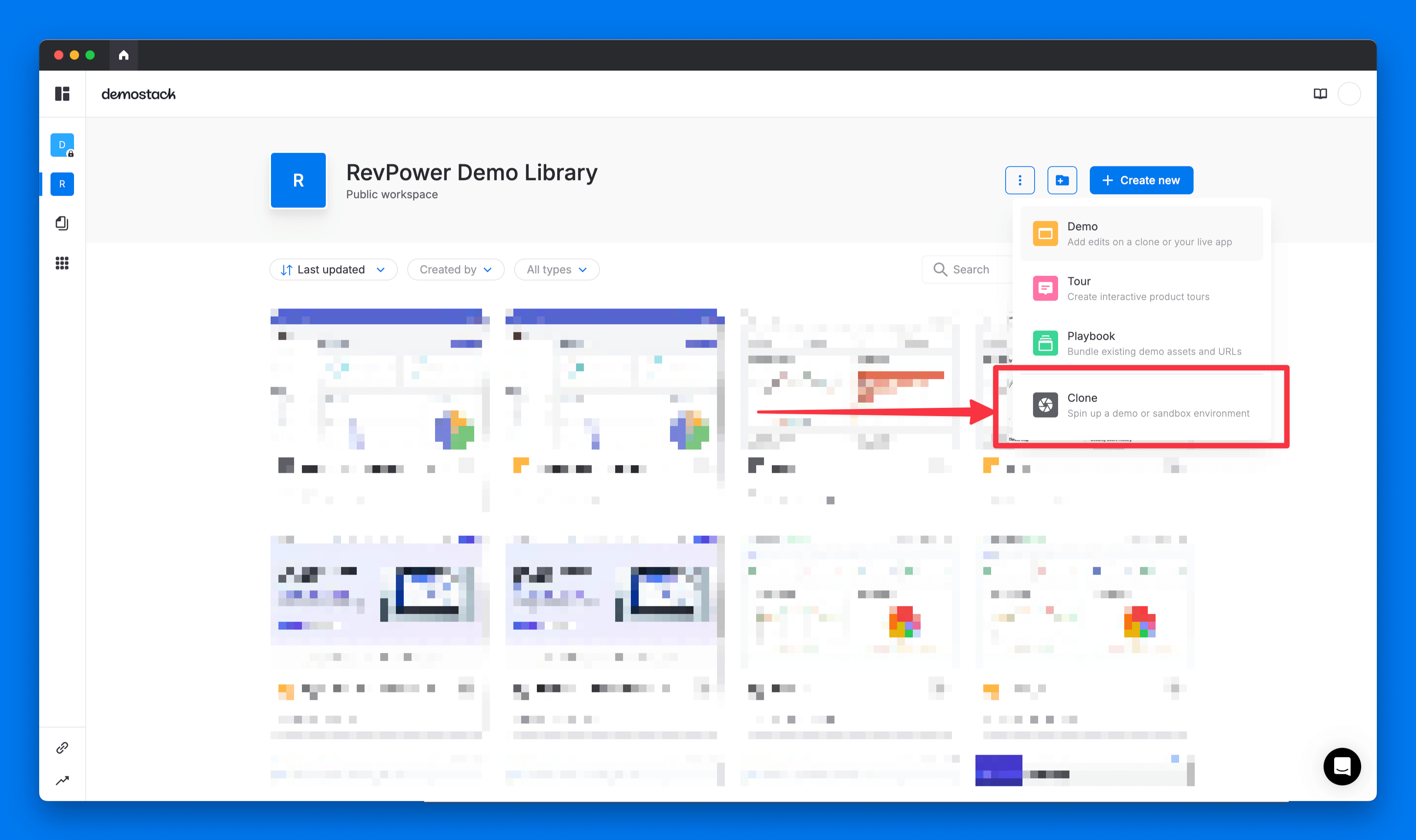
4. **Enter the URL** of your live app or website
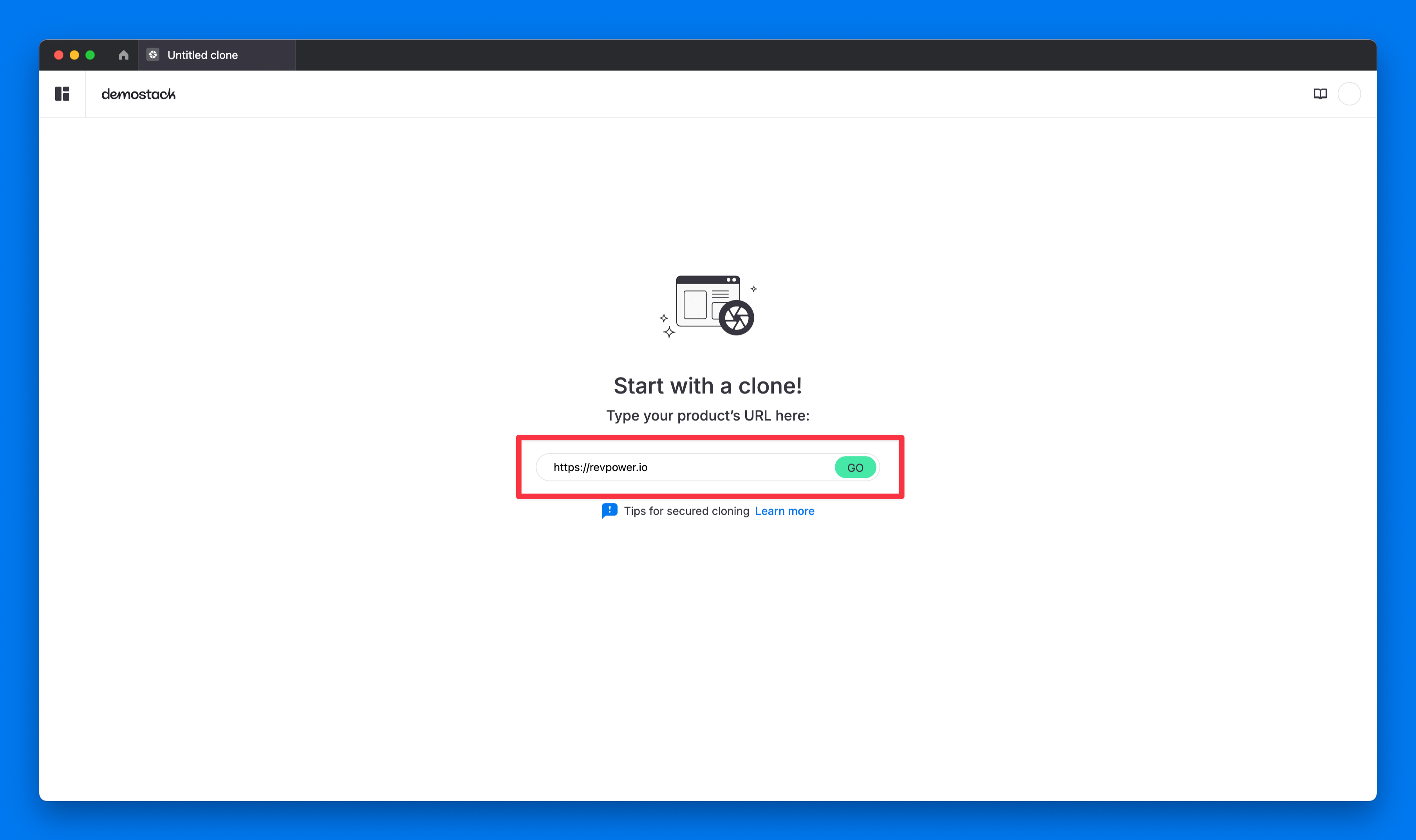
5. Sign in to the app with your credentials, which won’t be shared
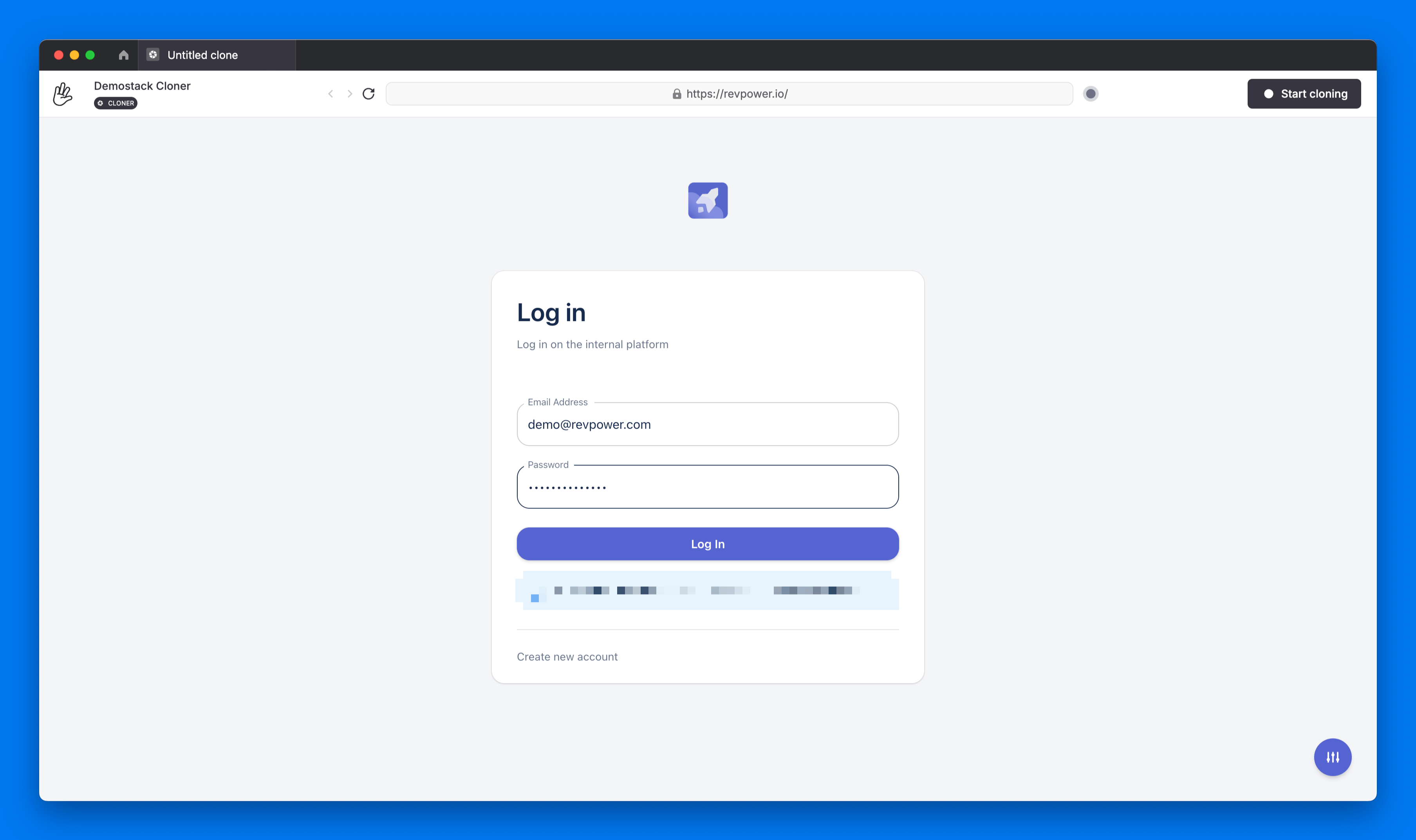
6. Hit the **Start Cloning** button in the top right

7. Click around to different pages in your app to clone them
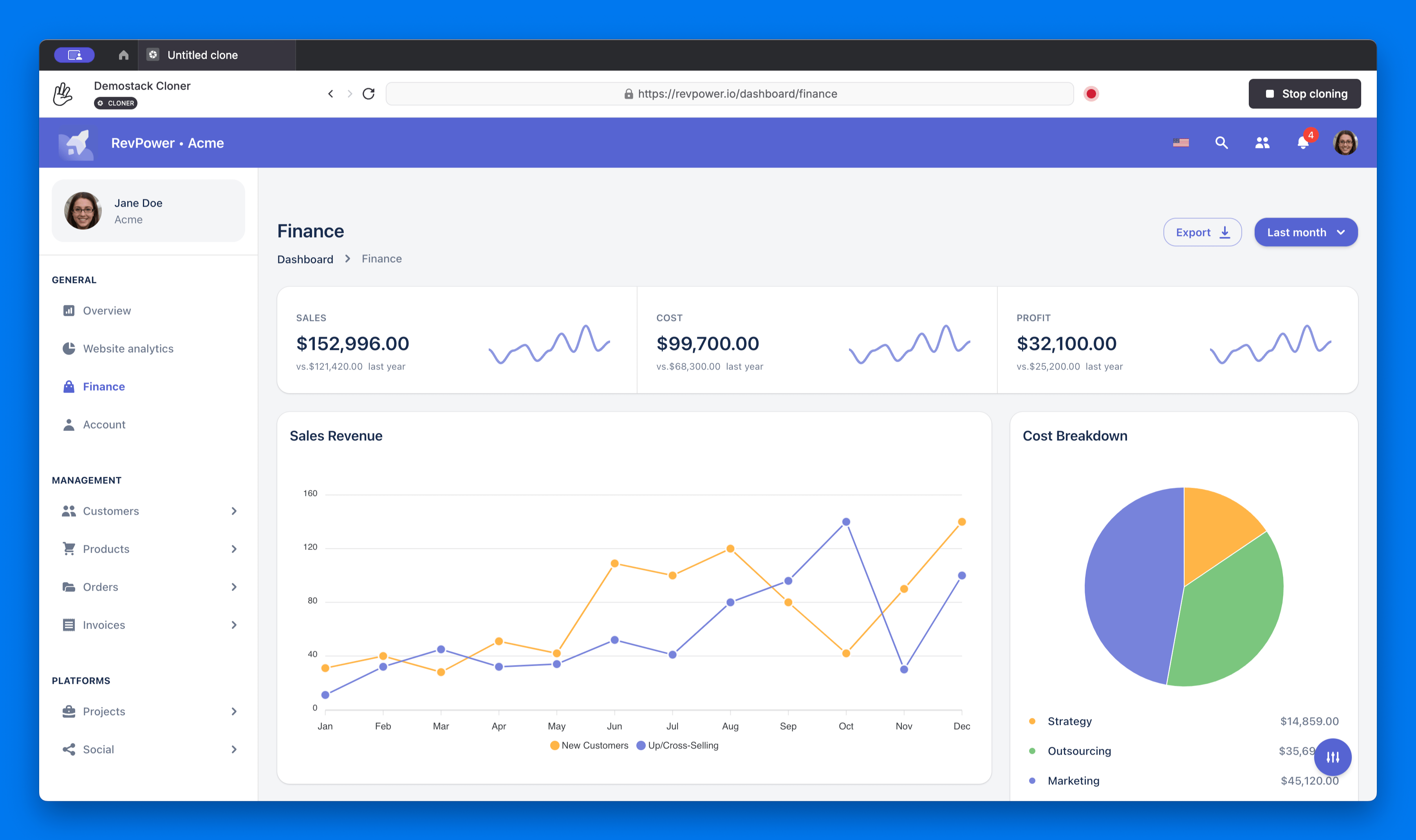
8. All the front-end visuals and back-end functionality, like API calls, will be cloned instantly
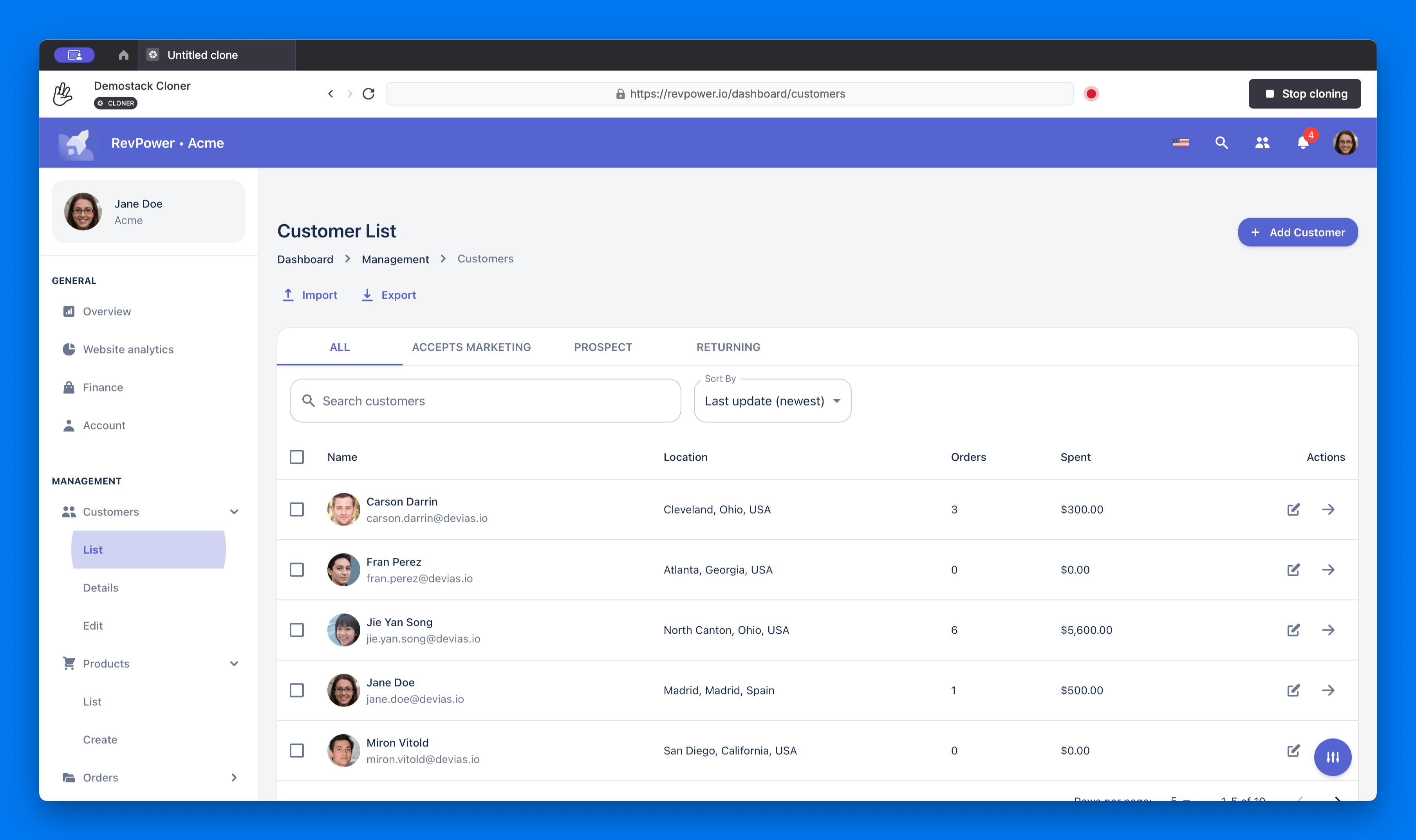
9. Once you have cloned your ideal path or story, click **Stop Cloning**
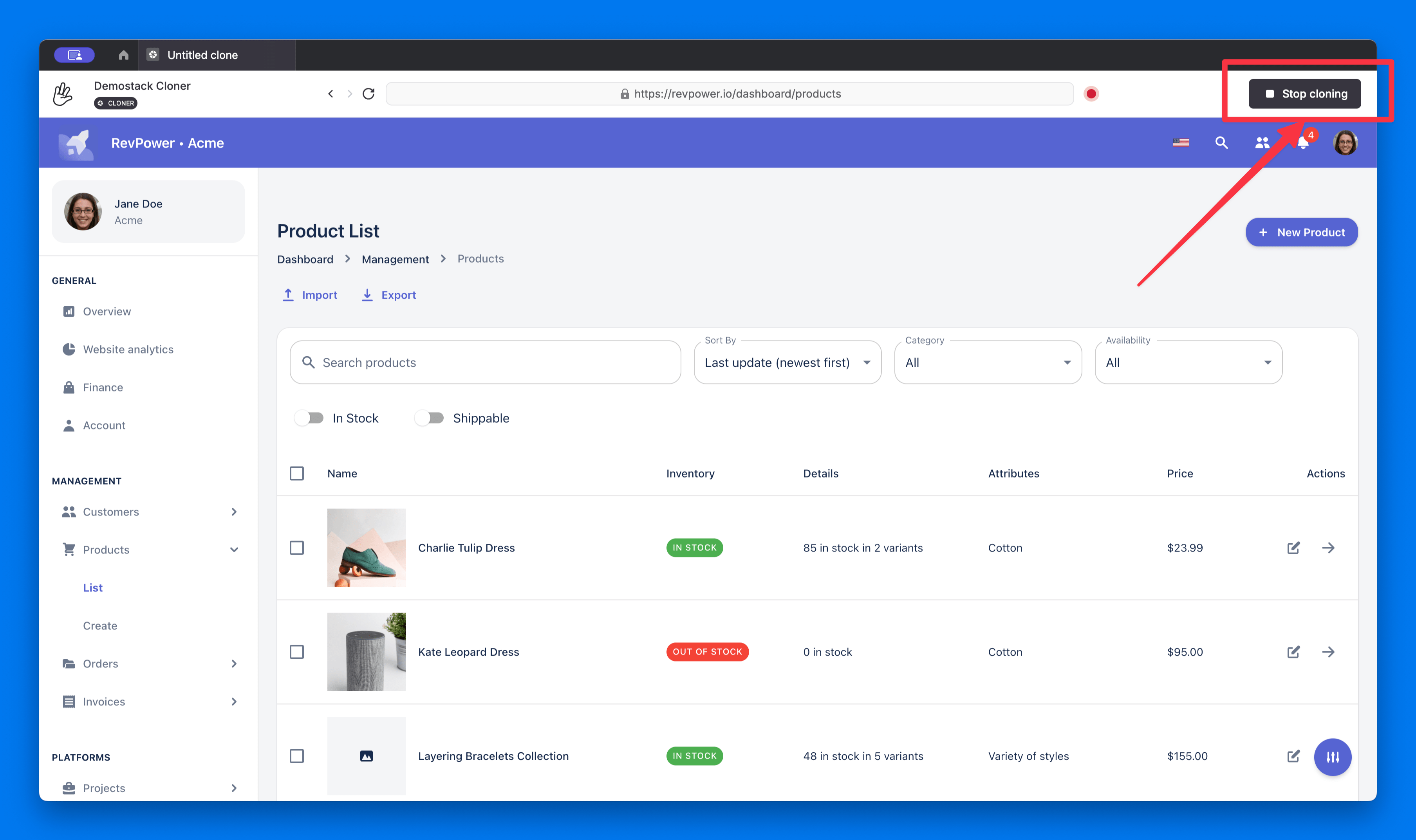
10. Give the clone a descriptive name, select the right workspace, and **click Save**
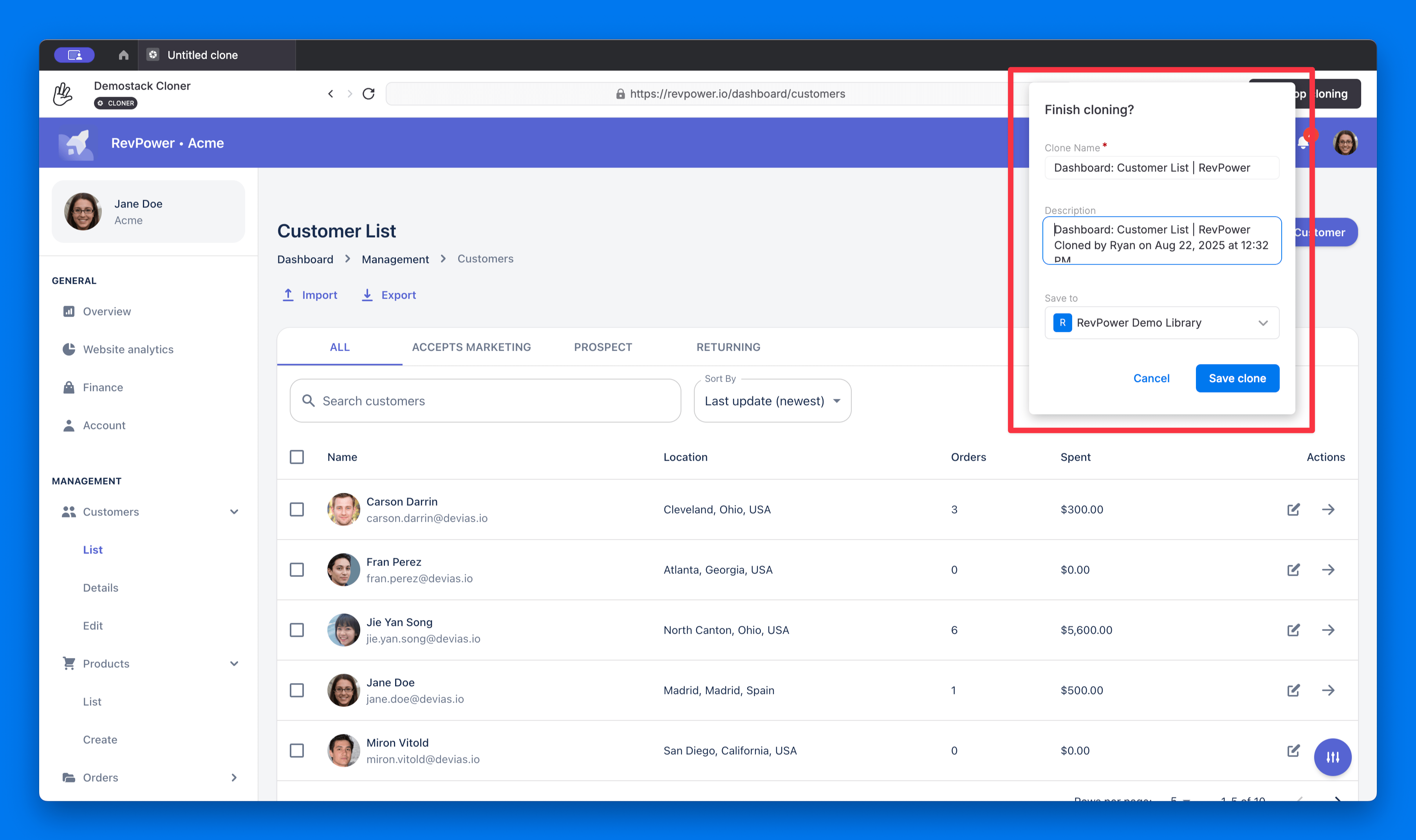
You are done cloning! Wasn’t that easy? In a handful of clicks, you can create a pixel-perfect, fully independent sandbox of your product that is ready to customize and demo in a few minutes.
Now use the Demostack editor to customize text, data, images, and flows in that clone, then share as a live demo, tour, or sandbox. You can even start editing right after clicking Save:
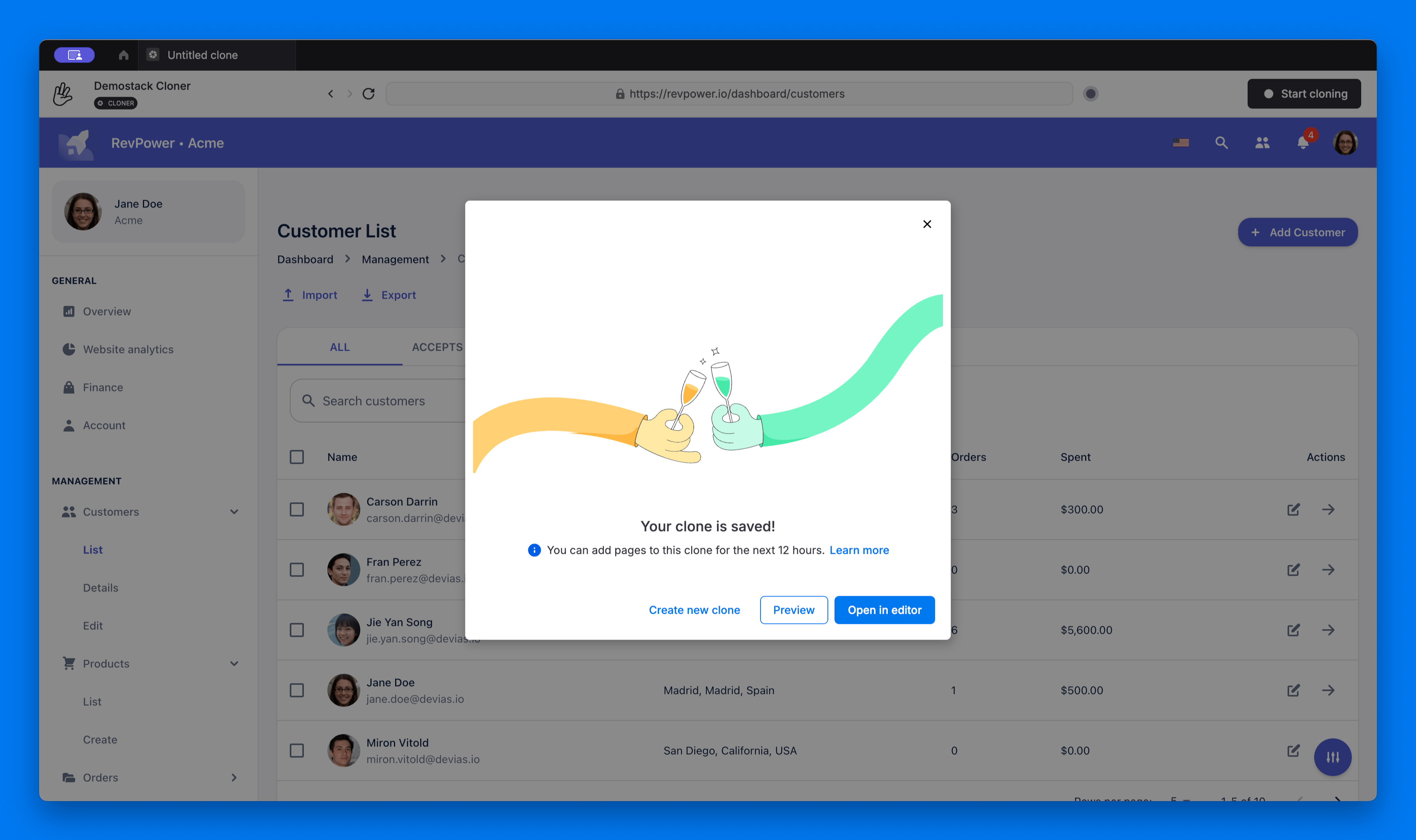
Imagine walking into your next sales call with a fresh, customized demo of a feature that shipped yesterday. And not a single line of code or support ticket was written.
### Cloning helps you create better demos
Understanding how easy it is for an AE or anyone on the GTM team to create a clone with Demostack is essential.
Once you clone your app or product, you can use it to power basically any demo you may have to give across the entire sales cycle.
But the value of cloning goes far past being able to create a new demo quickly; it will make you rethink your entire demo operations.
AEs can stop hunting for “_golden nuggets_” or the perfect moment in a live app. With a clone, you can create those winning “_aha moments_” in your product before the call and highlight them confidently in front of prospects.
Also, SEs and engineers can get their time back, instead of spending hours resetting demos or chasing down demo bugs. We can already hear them thanking you for using Demostack.
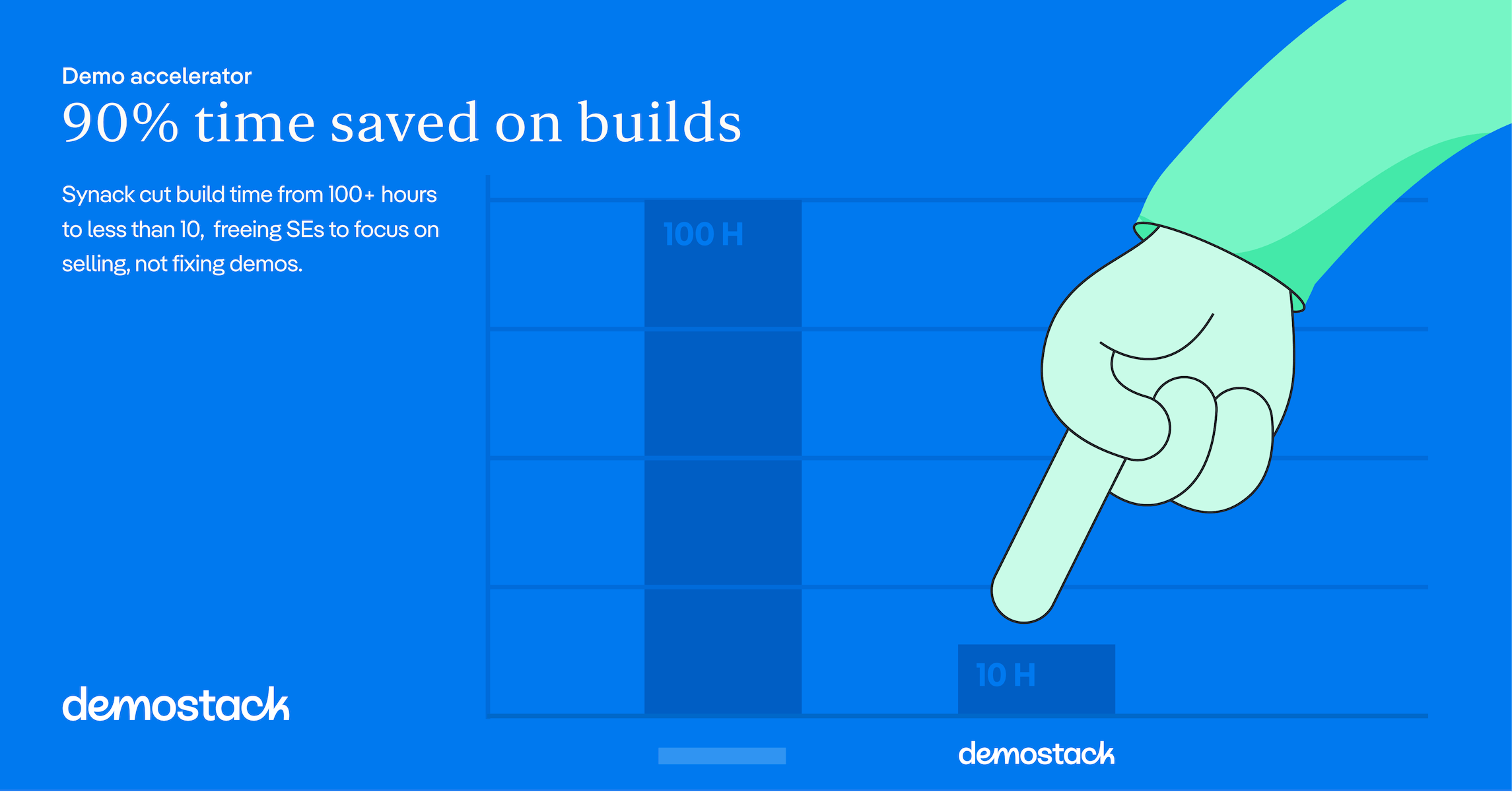
Teams like [Synack](https://www.demostack.com/webinar/scaling-enterprise-demos-how-synack-replaced-their-demo-environment) used to burn ~20% of SE hours just maintaining fragile environments. They calculated it out, and it ended up costing them the same as hiring another full-time engineer. After switching to Demostack, builds dropped from over 100 hours to under 10, and new demos ship the same day product updates are live.
Cloning also keeps your GTM team up to date with a constantly changing product. When the UI changes or a brand new feature drops, anyone on your team can create a new clone of the live app and turn it into a new demo in no time.
Because it’s a clone of your live product, not a recording or a slide deck, it doesn’t break down in the middle of a call. Or on stage at Black Hat.
The best part of creating clones with Demostack is that the same asset can power leave-behinds, guided tours, or the sandbox your champion forwards to their team. One good demo turns into company-wide momentum and allows you to tell a consistent story across the entire sales cycle.
So stop gambling on a homegrown environment. Cloning with Demostack is how you scale a product story across your entire org without scaling chaos.
## Ready to check out Demostack?
See how Synack cut its demo prep time from over [100 hours to under 10 with Demostack:](https://www.demostack.com/webinar/scaling-enterprise-demos-how-synack-replaced-their-demo-environment)
Link: https://www.demostack.com/webinar/scaling-enterprise-demos-how-synack-replaced-their-demo-environment
### Cloning FAQs
Creating a clone of your app with Demostack sounds like magic, and it is. No other company in the space offers such a powerful way to create and maintain demos.
Here are a few questions that come up when we chat with other companies about creating clones:
**1. How long does a typical clone take with Demostack?**
- A basic happy path can be captured in well under a minute. But you can clone your entire app, front-end and back-end, in just a few minutes.
**2. Do we need SEs/engineering to create clones or maintain demos?**
- Nope! Anyone you authorize on the GTM team can create clones and then edit those clones to create new demos or playbooks. You can add roles and approvals if you want more guardrails/security.
**3. Does cloning touch our production environment or real data?**
- A clone is a wholly separate demo environment. Any edits that are made to the cloned app **do not ever** impact the production app or modify databases.
**4. What exactly gets cloned, and does it call our live APIs?**
- The front‑end HTML/CSS, the backend network/API calls, and the data schema model are cloned. After you finish cloning, the clone operates completely separate from your live app and can effectively replace your backend for demos.
**5. Are my credentials exposed to anyone who views the demo?**
- No, you sign in during cloning just to your app, but viewers never see or use your credentials.
**6. Our app changes weekly. Do we have to rebuild our demo every time?**
- Not at all! Simply re-run the Cloner on the updated areas of your app, then keep tailoring in the editor.
## Ready to check out Demostack?
_Gainsight used Demostack to improve their win rate by 25% and cut 40+ hours of monthly demo prep time._
**_[Book a 30‑minute walkthrough](https://www.demostack.com/win-more-deals-lp) with our sales team, and they will show off the whole product stack and answer any questions you may have._**
## Article: Stop Forcing GTM Alignment: Why Productive Friction Drives Revenue
Source: https://www.demostack.com/post/stop-forcing-gtm-alignment-why-productive-friction-drives-revenue
Most go-to-market teams say they’re aligned. But if you’ve worked in sales, marketing, product, or customer success, you’ve probably experienced something different.
Sales needs help from product. Product wants more input from customer success. Marketing is trying to get the story straight. Everyone’s pulling—but not always in the same direction. Instead of feeling aligned, it can feel like a constant game of tug-of-war.
For example, engineering ships a major new feature. Marketing and sales start pushing it, but it hasn’t been added to the demo—and worse, no one’s been trained on it. What should feel like momentum turns into confusion and crossed wires.
And when that tension builds, the results are familiar: delayed launches, mismatched messaging, stalled deals, and post-sale experiences that don’t match what was promised. These aren’t just internal issues—they affect buyers, too. And when that happens, revenue takes a hit.
The real problem isn’t a lack of alignment; it’s how teams handle the friction that naturally exists between them.
## **Friction Isn’t the Enemy. It’s the Opportunity.**
Most companies treat internal friction like something to avoid. And yes, some of it should be—things like unclear approvals, redundant steps, or constant back-and-forth over simple decisions.
But not all friction is bad. At its core, friction is neutral—it’s just resistance. And when handled well, it can bring important issues to the surface, sharpen thinking, and help teams work better together. It can even lead to stronger ideas, better collaboration, and a smoother sales process.
The key is knowing the difference between **destructive friction**—the kind that slows you down and erodes trust—and **productive friction**—the kind that challenges teams to improve, together.
Trying to remove all friction creates fragility. But managing it intentionally? That’s what builds resilience.
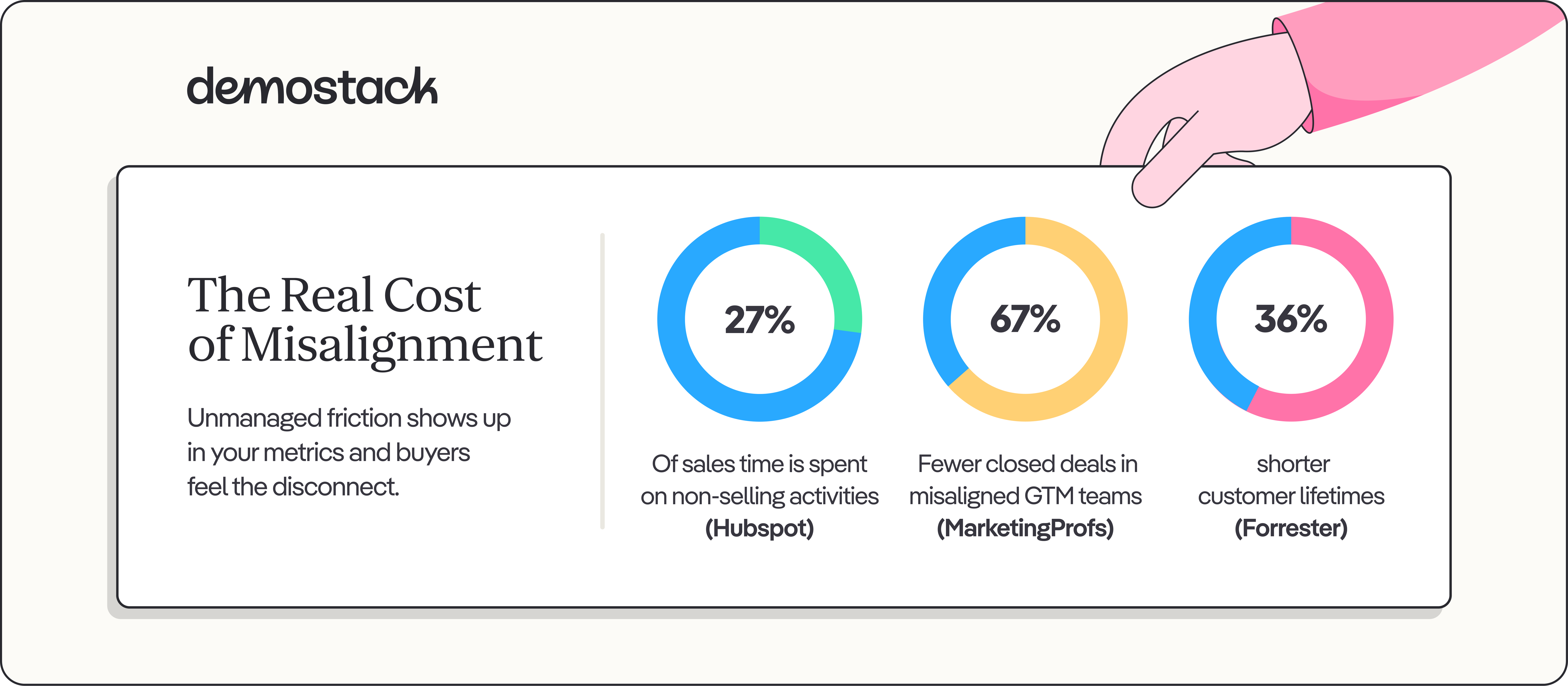
## **Turning Friction Into Momentum: The Friction Flywheel**
Instead of aiming for perfect alignment, focus on managing friction in a way that moves your team forward.
Start by removing the friction that creates confusion and delays—like approval bottlenecks, unclear roles, or repetitive steps that don’t add value. But don’t stop there. Some friction is worth keeping: space for open feedback, healthy debate, or thoughtful disagreement. That kind of tension often leads to better decisions.
When done right, managing friction becomes a growth driver. We call this the **Friction Flywheel**.
Here’s how it works:
- **Clear communication** ensures everyone knows what’s expected, what’s changing, and why.
- **Confidence** grows when teams feel prepared, heard, and not caught off guard.
- **Trust** builds when people follow through, share context, and give each other space to do their best work.
- **Growth** happens when your team works together smoothly—without needing constant resets or escalations.
Each step feeds the next. The more you turn the flywheel, the easier it gets to keep deals moving, messages sharp, and teams in sync.
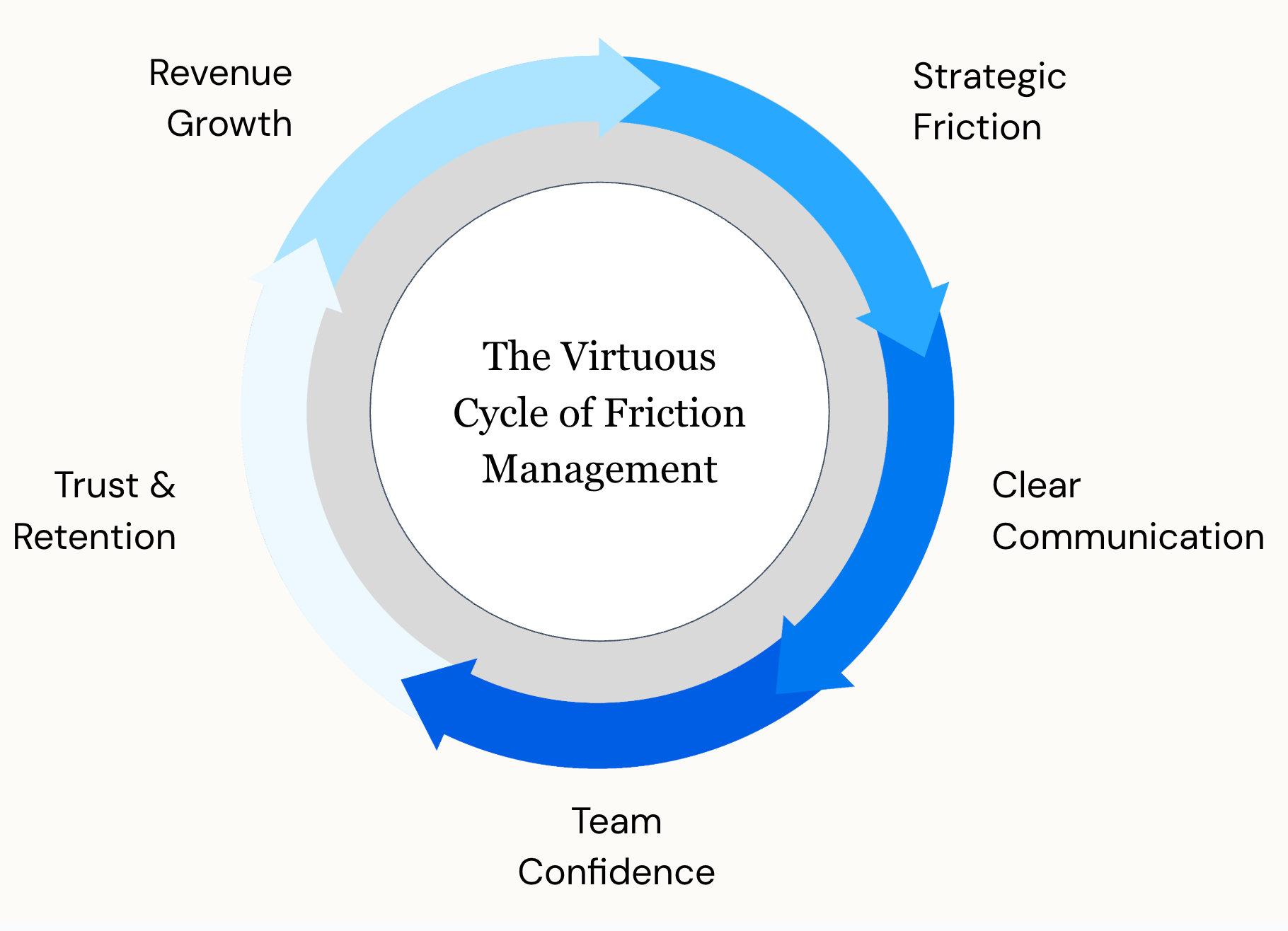
**Who's Involved in the Flywheel?**
Everyone plays a part in making this work—but revenue leaders are often the ones best positioned to keep the flywheel spinning. They’re at the center of cross-functional collaboration, where sales, marketing, product, and customer success meet.
Here’s what each team brings:
- **Sales** surfaces real buyer questions, objections, and patterns from the field.
- **Marketing** shapes the message that sets expectations and creates demand.
- **Product and engineering** deliver on the promise—and need input when that promise falls short.
- **Customer success** sees what’s working (and what’s not) after the deal closes—and feeds that insight back into the loop.
When these teams work in sync, friction becomes a tool, not a problem. When they don’t, the flywheel breaks—and everything starts to slow down.
## **How to Put the Flywheel to Work**
You don’t need to overhaul your entire GTM motion to start managing friction better. Small shifts can create real impact.
Here’s where to begin:
1. **Find the friction.** Map out where deals slow down or communication breaks. Is sales waiting on product for every demo? Is legal redlining the same contract terms over and over?
2. **Fix what’s wasteful.** Remove anything that adds delay without value—duplicated reviews, unclear ownership, inconsistent processes.
3. **Keep what’s useful.** Not every disagreement is bad. Build in time for cross-functional feedback, especially between product and GTM teams. Good tension leads to better decisions.
4. **Make it repeatable.** Put systems in place that support strong habits: shared OKRs, regular team reviews, clear handoffs, and aligned priorities. When collaboration becomes routine, the flywheel keeps turning.
In the earlier example, that new feature launch created more confusion than momentum. Now imagine the same moment—but managed differently. Product gives a heads-up before release. Sales enablement rolls out talk tracks and demo updates in advance. Solutions and CS teams get trained early, so everyone’s prepped and ready.
These small changes make it easier for teams to move quickly—without cutting corners or losing trust.
## **Friction Shouldn’t Be Feared. It Should Be Used.**
Friction is part of every growing team. The question is whether you let it wear your team down—or use it to sharpen how you work.
When you manage it with intention, friction becomes a signal. It shows you where to slow down, where to improve, and where to double down on what’s working. Once that flywheel starts turning, your GTM motion gets stronger, faster, and more in sync with your buyers.
**Want to eliminate friction from your demo process?**Demostack helps GTM teams deliver faster, more flexible demos—without relying on engineering or fighting with fragile environments.
Link: https://www.demostack.com/webinar/mastering-the-art-of-demos-with-motive
## Article: Why Cybersecurity Demos Are So Hard & What to Do About It
Source: https://www.demostack.com/post/why-cybersecurity-demos-are-so-hard-
Selling cybersecurity software comes with unique challenges. It isn’t like selling ERP or project management software. Your buyers are highly technical, deeply skeptical, and demand proof that your product actually works. But giving them that proof? That’s where things get complicated.
Live demos in cyber require secure, stable environments—ones that won’t expose sensitive data or break due to backend dependencies. Maintaining multiple demo environments across different operating systems, integrations, and policy configurations is a logistical, time-consuming nightmare. And giving prospects hands-on experience? Most cybersecurity products simply can’t support that, leading to drawn-out PoCs that slow deal velocity.
So how do you show your product’s value without putting your data at risk or burning out your SEs? In this article, we’ll break down the biggest demo challenges in cybersecurity sales and how to overcome them.
**The Importance of the Demo in Cybersecurity Sales**
Cybersecurity is one of the most competitive software markets, where buyers are highly skeptical and often evaluate multiple vendors at once. They want to see the product, not just get a pitch. Standing out isn’t just about having the best product—it’s about how well you communicate its value.
A compelling demo isn’t just a walkthrough of your UI; it’s your best opportunity to show how your solution stops threats,gives visibility, or strengthens security postures, all while integrating into their prospect’s existing stack. When it comes to cyber demos, effective storytelling is just as important as technical validation. A well-executed demo shows prospects that you’ve actually listened to what the buyer is telling you during discovery, understand their challenges, and can solve them better than anyone else. Buyers want to see how your product addresses their pain points, fits into their environment, and gives them the best view of potential threats. A generic, one-size-fits-all demo won’t cut it.
Delivering that kind of demo—one that’s personalized, technically sound, and secure—is where many cyber companies struggle. Let’s break down the key challenges and how to solve them.
## **The Challenges:**
Keeping your demo process efficient and effective isn’t easy. Here are the most common challenges cybersecurity sales teams face:
- **Complex Configurations & Integrations:** Cybersecurity tools don’t work in isolation. They integrate with identity providers, SIEMs, cloud platforms, and existing security stacks. Demonstrating full functionality means juggling multiple configurations, OS compatibility, and policy settings—leading to high demo maintenance and frequent technical roadblocks.
- **Security Risks & Compliance Concerns:** Using production environments for demos can inadvertently expose sensitive data or configurations. Even dedicated demo or staging environments can be risky if they contain sensitive data, live customer information, or outdated security policies that shouldn’t be exposed.
- **Reliance on SEs for Every Demo:** In cyber, Account Executives may be able to demo, but without guardrails, SEs often don’t trust they’ll get it right—keeping SEs involved in nearly every sales conversation. This creates bottlenecks, slows down sales cycles, and limits the number of deals teams can effectively work.
- **No Secure, Interactive Leave-Behinds:** Sending prospects a way to interact with your product after the demo is nearly impossible without exposing sensitive data, leading to long and resource-heavy PoCs.
|
### Traditional Cybersecurity Demos
|
### Scalable Demo Environments
|
|
**Live demo environments are fragile**
Backend dependencies, integrations, and policy configurations create instability and require constant maintenance.
|
**Cloned demo environments ensure stability**
Independent replicas eliminate backend dependencies, ensuring a controlled, reliable demo experience.
|
|
**Security risks limit what can be shown**
Running live demos risks exposing sensitive data or configurations.
|
**Fully secure and isolated environments**
Protects sensitive data while providing a full-fidelity product experience.
|
|
**Sales teams rely heavily on SEs**
AEs often lack the technical expertise or trust to confidently demo complex products
|
**Enable AEs to demo independently**
Structured environments with guardrails in place, allow AEs (or even partners) to showcase product value without technical risk.
|
|
**No hands-on buyer experience**
Most cybersecurity products lack interactive leave-behinds, requiring prospects to wait for PoCs.
|
**Guided sandbox environments accelerate decisions**
Prospects can explore safely after a demo, reinforcing key capabilities.
|
|
**PoCs are long and resource-intensive**
SEs spend excessive time maintaining and managing PoC environments.
|
**Shorter, structured PoCs**
Pre-built environments reduce setup time, keeping deal momentum high.
|
## **How Demostack Can Help You Remove Demo Roadblocks**
Demostack eliminates these roadblocks by providing secure, flexible, and scalable demo solutions—ensuring every demo tells the right story while protecting sensitive data.
**1. No More Broken Demo Environments:**
Cloned demo environments replicate your product’s exact look and feel—without backend dependencies, security risks, or maintenance headaches. Every demo is stable, secure, and always up to date.
**2. AEs Can Demo with Confidence:** Equip AEs with customizable demo templates that highlight key integrations and use cases, allowing them to tell a compelling product story—without needing deep technical knowledge or SE support.
**3. Faster PoCs with Guided Sandboxes:** Give prospects **a hands-on, trial-like sandbox experience** with built-in guidance to showcase key features. Instead of long, drawn-out PoCs, prospects get immediate value—speeding up the sales cycle.
**4. Secure, Controlled Demo Experiences:** Protect sensitive configurations with controlled, non-editable demo environments. Show prospects the right product story—without exposing critical security policies or risking competitive intelligence leaks.

Link: https://www.demostack.com/customer/hunters
### **How Hunters Transformed Demo Operations with Demostack**
Hunters, a leader in SOC cybersecurity, struggled with an unpredictable demo environment that was difficult to maintain. Frequent updates, backend dependencies, and integration complexities made it nearly impossible to deliver a consistent, high-quality demo. The team’s homegrown demo setup required constant maintenance, causing delays and making their product story appear outdated—especially during high-stakes moments like trade shows.
With Demostack, Hunters gained a secure, easy-to-maintain demo environment that eliminated backend dependencies and ensured a flawless demo every time. As Hunters' VP of Sales Engineering, Chris Buchanan, put it, _“I was sold on Demostack within the first 20 minutes.”_ This shift allowed Hunters to deliver compelling demos consistently, a crucial factor in shortening their sales cycle.
With a reliable demo foundation and sandbox environments for post-demo exploration, Hunters could engage buyers more effectively and move deals forward faster. By eliminating demo and PoC roadblocks, Hunters reduced many sales cycles by 50%, freeing up pre-sales resources and reinforcing their reputation for innovation and reliability in the SOC space.
### **The Future of Cybersecurity Sales Demos**
Cybersecurity sales require demos that are stable, secure, and effective. Without the right solution, teams struggle to maintain environments, overburden SEs, and rely on lengthy PoCs to prove product value.
Demostack helps cybersecurity companies demo with confidence - reducing risk, increasing speed, and improving conversion rates. Ready to see it in action?[ Talk to us](https://www.demostack.com/win-more-deals-lp), we are here to help!

Link: https://www.demostack.com/win-more-deals-lp
## Article: More Control, Less Overhead Across Every Demo
Source: https://www.demostack.com/post/whats-new-in-demostack-more-control-less-overhead-across-every-demo
If you've ever watched a deal stall because a demo wasn't ready, a logo was wrong, or a live environment threw an error at the worst possible moment, this one's for you.
Over the past few months, the Demostack team has been heads-down on a very specific problem: GTM teams lose too much time and too many deals to demo friction that shouldn't exist in the first place. Reps wait on design, SEs juggle ten versions of the same demo, and revenue leaders fly blind on what actually moves buyers.
So instead of shipping a grab-bag of features, the team focused on tightening the entire demo workflow, from build to delivery to follow-up, and built updates that solve real problems in real selling situations. Below is everything that's new and, more importantly, why it matters for your team.
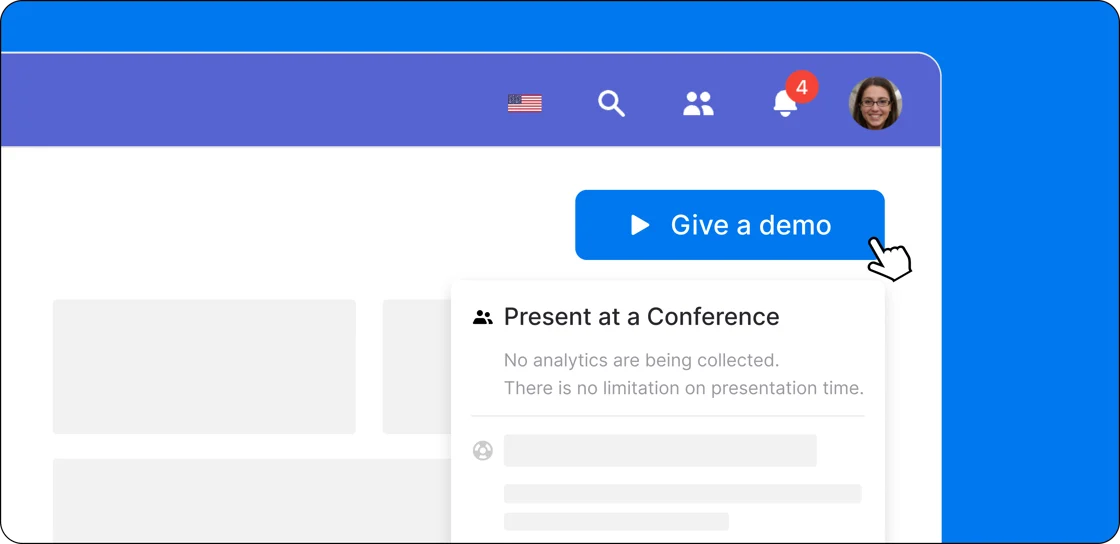
## **Conference Mode: Demo Anywhere Without the Noise**
Trade shows and roadshows create a very different kind of pressure. You're running back-to-back sessions, you need the environment to be completely stable, and the last thing you want is analytics pinging your CRM or a system pop-up killing your flow mid-demo in front of a room of prospects.
**Conference Mode** solves exactly that. Enable it, and Demostack pauses analytics collection, silences background activity, and lets your team present cleanly across dozens or hundreds of sessions - whether that's a trade show floor, an internal enablement day, or an executive briefing where privacy is non-negotiable.
Teams now use it for trade shows, roadshows, internal SKOs, and high-stakes exec briefings. The setup is simple: visibility when you want it, silence when you don't.
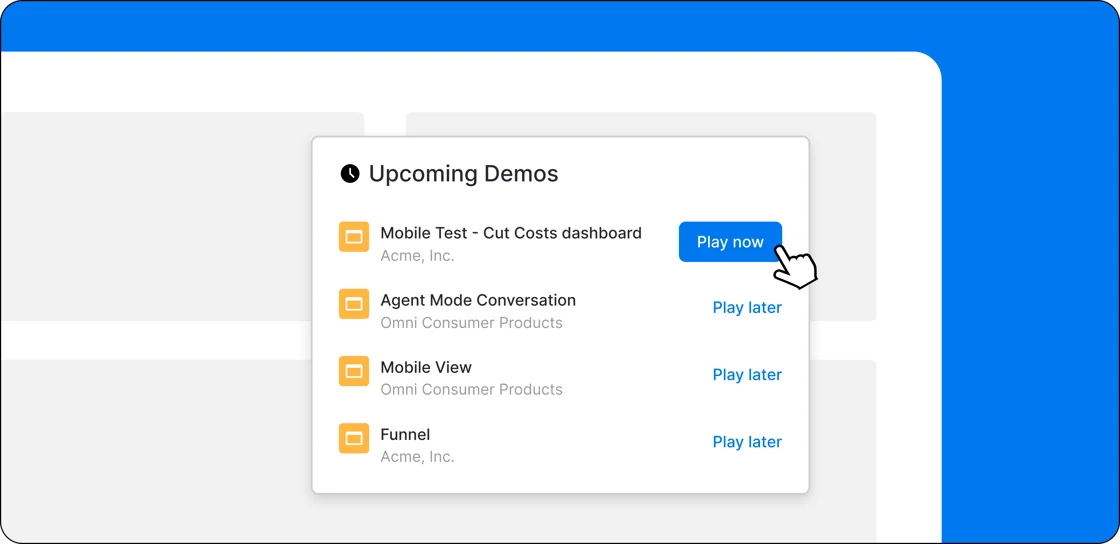
## **Your Demo Library, Actually Organized**
As demo libraries scale, finding the right version fast becomes its own problem. Shared folders get cluttered. Reps can't easily pick up where they left off. Practice sessions don't have a clean home. And anyone who's dug through a team folder right before a call knows exactly how that feels.
The new **Personalized "Play Later" Lists** fix this at the individual level. Each rep sees only the demos they've saved, practiced, or modified - and can clean up their own list without touching the shared library. Important demos stay easy to find, even as the team's overall library keeps growing.
For teams juggling multiple accounts, industries, or regions, removing that friction before a call starts actually matters - even if it sounds like a small change.
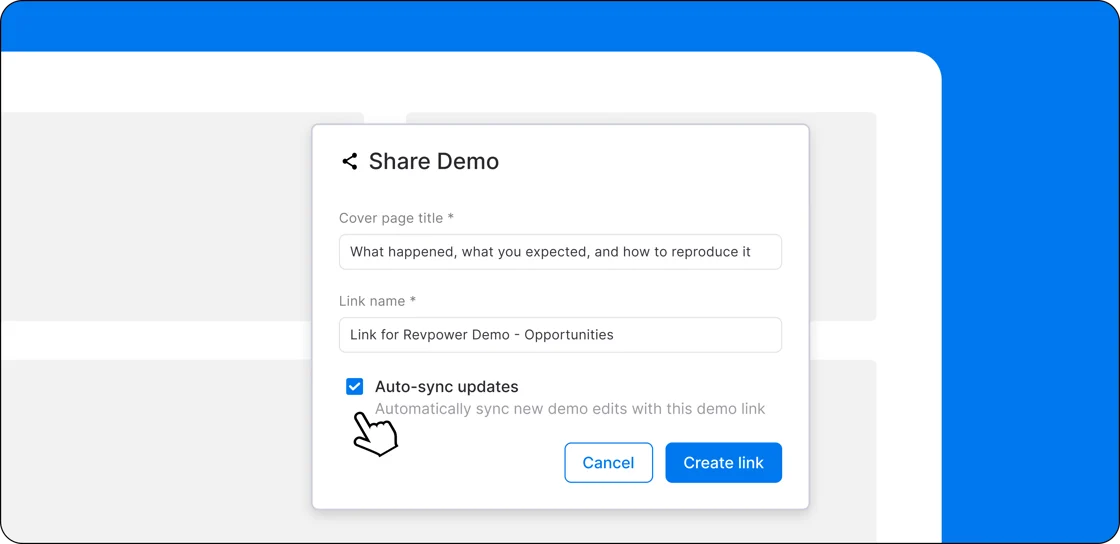
## **One Link That Doesn't Break When You Iterate**
Every high-velocity sales team has lived this: you push a demo update, and suddenly you're chasing down old share links, updating emails, and trying to figure out which version a buyer actually saw. It's a coordination tax that compounds fast.
**Auto-Sync Demo Share Links** eliminates that loop. When teams add new variables or make updates inside a sandbox, the share link updates automatically. Buyers always see the latest version, reps keep one stable link in circulation, and iteration happens freely behind the scenes.
A couple of guardrails worth knowing: changes to existing variables don't auto-sync yet, and links created from live demo presentations remain unchanged. But for teams running high-volume iterations across a live pipeline, this removes a genuinely painful coordination step.
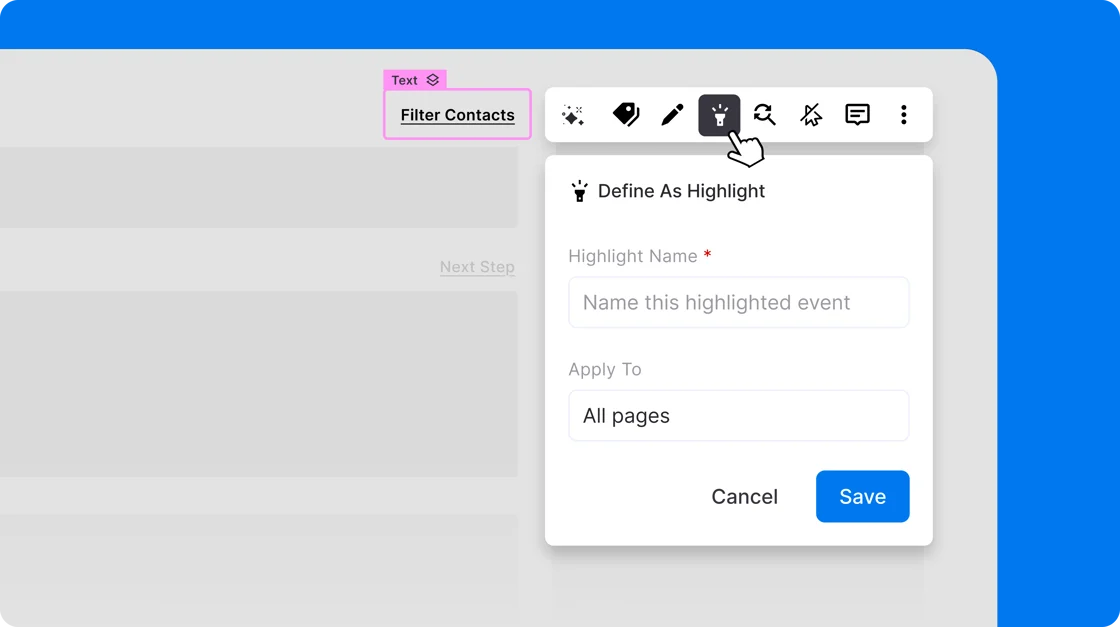
## **Stop Guessing Which Demo Moments Actually Matter**
Time-spent metrics are easy to collect and hard to trust. A buyer spending three minutes on a slide tells you almost nothing about intent. What you actually want to know is what they clicked, what they skipped, and which moments made them lean in - because that's what shapes a good follow-up.
**Demo Highlights** gives teams exactly that. You define the interactions that matter - specific clicks, views, or actions - and Demostack tracks them. After a session, you can see which highlights a buyer reached and build follow-up around what they actually engaged with, not what you assumed they cared about. Setup happens directly inside the builder, with no extra tools or configuration steps slowing things down.
For deal teams, the difference is real: outreach grounded in buyer behavior versus outreach built on optimism.
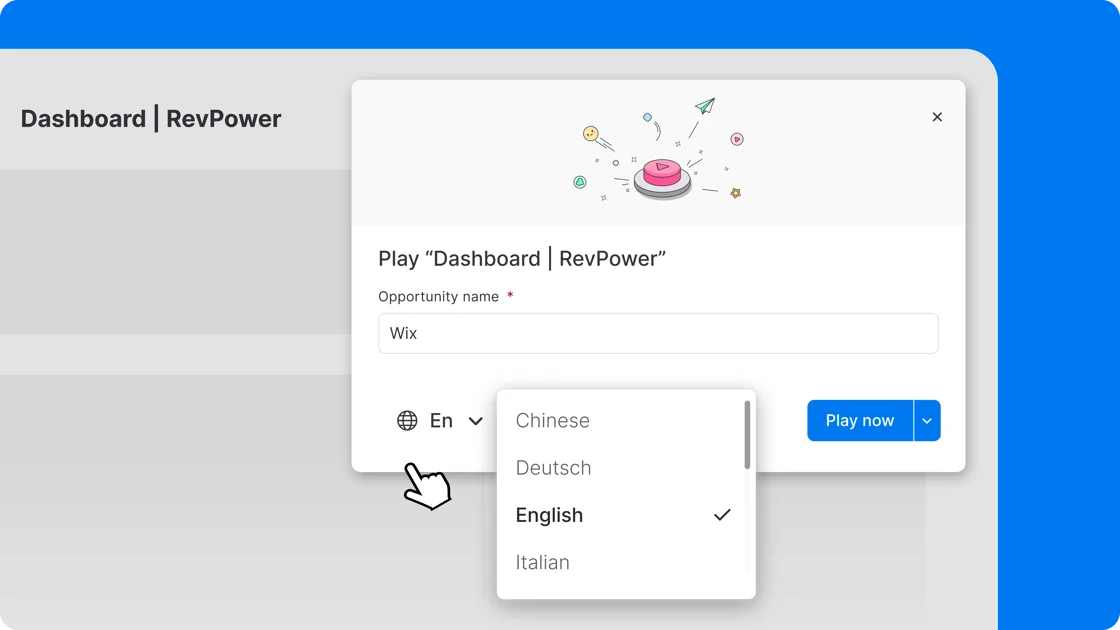
## **Global Teams, Without the Localization Headache**
Most global revenue teams have lived this tradeoff at some point - wait weeks for a localized demo, or ship something that feels slightly off for the region. Neither option is great, and both cost deals in markets where credibility matters from the first slide.
**Global Translation** flips that dynamic. With a single click, teams can localize demos into ten languages. Admins maintain narrative consistency and governance at the center, while regional teams move at their own pace - no forks, no duplicate demo libraries, no waiting on a localization queue.
Demos now travel as easily as the products they represent.
## **The API: Demos as Infrastructure, Not a Side Task**
At enterprise scale, manually staging demos for every new opportunity is a bottleneck that doesn't get better over time. The teams running the most efficient demo programs already treat demos like pipeline infrastructure - triggered, tracked, and managed through the same systems that run the rest of their GTM motion.
The **Demostack API** makes that possible for any team. Auto-provision demos when opportunities hit a certain stage in your CRM. Manage demo access programmatically. Reduce manual setup across large account volumes - all without leaving the systems already running your pipeline.
With this release, Demostack moves from "demo tool" to core GTM infrastructure, and for enterprise teams operating at scale, that's a meaningful shift in how the platform fits into their workflow.
## **The Bigger Picture**
Each of these updates solves a specific problem. But taken together, they're pointing in the same direction: a demo workflow built for real enterprise conditions — not ideal ones.
Faster prep. Cleaner delivery. Smarter follow-up. Less coordination overhead. More signals from every buyer interaction. And a platform that connects to the systems your team already depends on.
If any of these hit close to home, the fastest way to understand the impact is to see it running on your actual demos.
**Book a 30-minute demo →** No pitch deck, no canned walkthrough. Bring your current demo setup and see exactly how these features change your workflow.
## Article: Trust, AI, and the Modern Sales Engineer: Turning Demo Chaos into Confidence
Source: https://www.demostack.com/post/ai-and-sales-engineer
Trust has always mattered in sales. But in a selling environment increasingly shaped by AI and automation, trust has become the most valuable currency in presales.
John Care put it plainly in Demostack’s recent webinar: sales engineers are not just technical translators. They are the trust builders in every deal.
Link: https://www.demostack.com/webinar/trust-ai-and-the-sales-engineer
That is a strong statement, and it is true. But it comes with a hard reality.
Building trust is getting harder.
Buyers arrive better informed, yet more skeptical. They expect instant, personalized experiences. They can sense when a demo feels canned or inconsistent. At the same time, SEs are stretched thinner than ever, juggling technical validation, product configuration, and firefighting for every AE who needs help right now.
This is where AI, done right, can rebuild the bridge between humans and technology.
Not by replacing SEs, but by removing the demo chaos that undermines trust.
### **The trust gap in modern presales**
“Buyers do not trust demos that look rehearsed. They trust experiences that feel real” says Care.
A rehearsed demo can be polished and still feel hollow. It is too generic. The data is obviously fake. The workflow does not match how the buyer actually operates. The use case isn’t realistic. An SE narrating a script instead of responding to what the buyer cares about is a sure recipe for lack of trust and a failed sales motion.
But the deeper problem is that many teams are forced into rehearsed demos because it’s too labor intensive, or entirely impossible to showcase reality.

Most demo prep still looks like stitching together screenshots, dummy data, and duct taped environments that break mid call. It is a grind that burns out SEs and quietly erodes buyer confidence.
The root cause is simple: most products are not built to be demoed easily.
Live environments are unfit for a demo. Cloned demos drift out of sync. Engineering is busy. Data is sensitive. Product keeps shipping. And SEs end up maintaining a fragile system that was never designed to support high stakes selling.
This creates a predictable set of downstream problems.
##### **1) Reliability anxiety**
The demo environment can break. It might load slowly. A workflow might not work as expected. Data might be empty. Or worse, it might reveal something it should not.
Even if nothing goes wrong, the fear changes the way an SE shows up. Less curiosity, more control. Less dialogue, more guarding the script.
**2) Personalization bottlenecks**
Every buyer wants to see themselves in the demo. Every AE wants a custom story. Every vertical pitch requires relevant scenarios.
But personalization is expensive if you are doing it manually. It becomes a tax on SE time. And the result is usually a compromise: a generic demo plus some talk track gymnastics.
**3) The AE dependency loop**
AEs want to demo more often. SEs cannot be everywhere. When the environment is fragile, reps cannot run it without help.
So SEs become the bottleneck. Not because they lack skill, but because the system behind the demo is not scalable.
### **The demo is still the trust moment**
Care reminded the audience that demos are more than product showcases. They are proof moments. It is where buyers decide, “I trust this company can deliver.”
And yet too often, the moment of truth becomes the moment of glitch.
One line from the webinar nails the cost: every time a demo crashes, it does not just cost time. It costs credibility.
That is why “fixing demos” is not an operational project. It is a revenue and trust project.

Caption: Demo Copilot
## **AI as the sales engineer’s copilot**
Here is the key distinction: AI’s role in presales should be augmentative, not automated.
SEs do not want bots running their demos. They want tools that eliminate the repetitive, low trust parts of the process.
Think about what SEs actually spend time on that does not create trust:
- Sanitizing demo data and rebuilding scenarios
- Cloning environments and fixing drift
- Making last minute edits for a new persona
- Duplicating the same prep work deal after deal
- Maintaining versions that still break in front of buyers
That is exactly the kind of work AI can take on, especially when paired with the right demo infrastructure.
## **How Demostack turns demo chaos into confidence**
Demostack reframes the conversation. Instead of treating demos as risky live performances, it treats them as trust building systems.
At a practical level, Demostack creates controlled, no code demo environments that can be edited, versioned, and shared across the buyer journey, from website tours to partner enablement to post call sandboxes.
The platform’s cloning approach captures the front end experience of a live product and replicates it in a stable, sandboxed environment. No backend dependencies. No PII risk. Just a clean, reliable copy that looks and feels like the real thing.
Once cloned, SEs or AEs can personalize text, data, charts, and even workflows in minutes, without touching code. The goal is not to fake the product. The goal is to control the experience so you can tell the truth clearly and consistently.
Demostack reframes the conversation. Instead of treating demos as risky live performances, it treats them as trust building systems.
At a practical level, Demostack creates controlled, no code demo environments that can be edited, versioned, and shared across the buyer journey, from website tours to partner enablement to post call sandboxes.
The platform’s cloning approach captures the front end experience of a live product and replicates it in a stable, sandboxed environment. No backend dependencies. No PII risk. Just a clean, reliable copy that looks and feels like the real thing.
Once cloned, SEs or AEs can personalize text, data, charts, and even workflows in minutes, without touching code. The goal is not to fake the product. The goal is to control the experience so you can tell the truth clearly and consistently.
### **Problem: Live demos break, trust breaks with them**
- **Trust impact:** buyers equate glitches with risk
- **Demostack fix:** stable demo environments that run consistently, so you do not have to apologize for your tooling
### **Problem: Personalization is too slow**
- **Trust impact:** buyers feel like “just another lead”
- **Demostack fix:** fast editing and versioning so each buyer sees relevant data and workflows
### **Problem: SEs become the bottleneck**
- **Trust impact:** fewer demos, slower cycles, less coverage
- **Demostack fix:** AEs can run reliable demos without heavy technical setup, while SEs focus on technical validation and deal strategy
That is what “AI done right” looks like. It does not take over the relationship. It protects it.
### **From burnout to empowerment**
The SE role has quietly become one of the most overextended roles in B2B sales. Every new feature launch means a demo to update. Every new vertical means a story to rebuild. Every AE request adds another layer of maintenance.
When demo creation and personalization become repeatable, the pressure changes.
AEs can spin up branded, data safe demos tailored to the conversation. SEs can spend their time where they add the most value: solving complex problems, guiding technical champions, and building confidence with skeptical buyers.
One example from the draft: Gainsight’s team saw a reported 25 percent increase in win rates after shifting to Demostack powered demos, combining full product like fidelity with less SE time spent on demo maintenance.
The bigger point is not the number. It is the mechanism. When the demo stops being fragile, the team stops selling defensively. They start selling confidently.
###
**What great looks like: the future operating model**
The next chapter of presales will not be defined by how much AI can automate. It will be defined by how intelligently it can empower.
Here is what “great” looks like in modern demo operations:
- Demos are always ready, not rebuilt per deal
- Personalization is quick, safe, and consistent
- AEs can run the core story, SEs drive the complex moments
- Buyers can explore asynchronously after the meeting
- The demo experience stays aligned from first touch to late stage validation
Demostack calls this the Demo Transformation: freeing go to market teams from the technical friction that slows deals, while making every buyer interaction feel authentic and personalized.
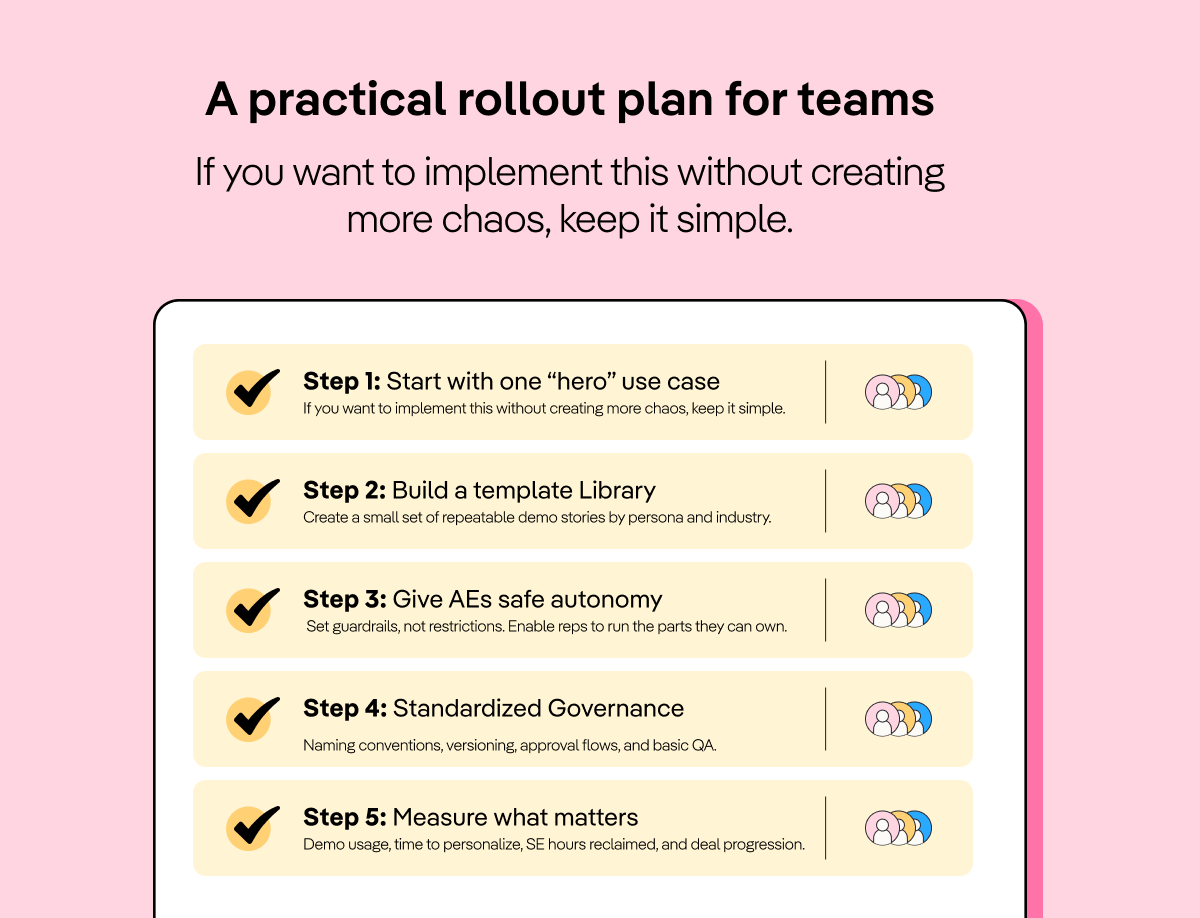
Caption: A plan for teams
### **Closing: when SEs trust their demos, buyers trust them**
Ironically, the rise of AI is making human trust more valuable, not less.
As more parts of sales become automated, the demo remains one of the most human moments in the buying process. It is a shared exploration of possibilities. Buyers do not want perfection. They want authenticity, guided by someone who understands both the product and their pain.
And that is why the work matters.
When SEs trust their demos, buyers trust them.
That, not automation, is the real power of AI in sales.
## Article: Product Demonstration: A B2B Seller’s Guide
Source: https://www.demostack.com/post/b2b-sales-demos
B2B sellers know their product is valuable and how it will make buyers' lives easier. But convincing prospects of this truth is often an uphill battle. Conveying the benefits of complex products to multiple stakeholders throughout lengthy sales cycles is no easy feat when you're facing a distracted buyer.
Sellers whip product demonstrations out of their toolkits to help cement all this information. But these demos are no longer a late-stage formality that’s hastily presented to uninterested prospects. Now, demos are the moment of truth to help seal the deal and an invaluable part of successful sales enablement. With this in mind, it's no surprise that improving sales enablement remains the #1 growth tactic for sales leaders.
Buyers expect you to meet their needs, even if that need is self-guided discovery, where they don’t want to hear from your team at all—and that’s okay. There are practical strategies for creating compelling product demonstrations that cater to buyers at _every_ stage of their journey (even independent research) and drive revenue. It all comes down to segmenting the stages of your sales cycle. To win in modern B2B sales, teams must show the best version of their product—tailored for every use case, every time.
## **What Is a Product Demonstration in B2B Sales, and Why Does It Matter?**
**A product demonstration is a live, pre-recorded, or simulated walkthrough of your B2B company's products to potential clients.** The goal is to showcase the product's value and how it can help solve the prospect's business challenges and highlight the key features and capabilities.
There's no copy-and-paste template for a great product demonstration. **The best demos are personalized to the audience, offering insights tailored to their unique needs or customer persona**. You can go super granular by adapting the demo to the stage in the sales pipeline, whether that's a:
- First-call interview
- Technical walkthrough
- Proof-of-concept interactive experiences
**Just as important as personalization is consistency. The experience should feel polished and aligned, whether an AE or an SE runs it.** After all, the content of your demo directly impacts the speed, size, and success of the final deal.
In the fast-paced B2B SaaS world, you might only get one shot, particularly if a [software demo](https://www.demostack.com/post/software-demo-best-practices) is the first real product touchpoint. You must provide memorable, reliable, and well-executed demo experiences to accelerate decision-making and keep friction to a minimum.
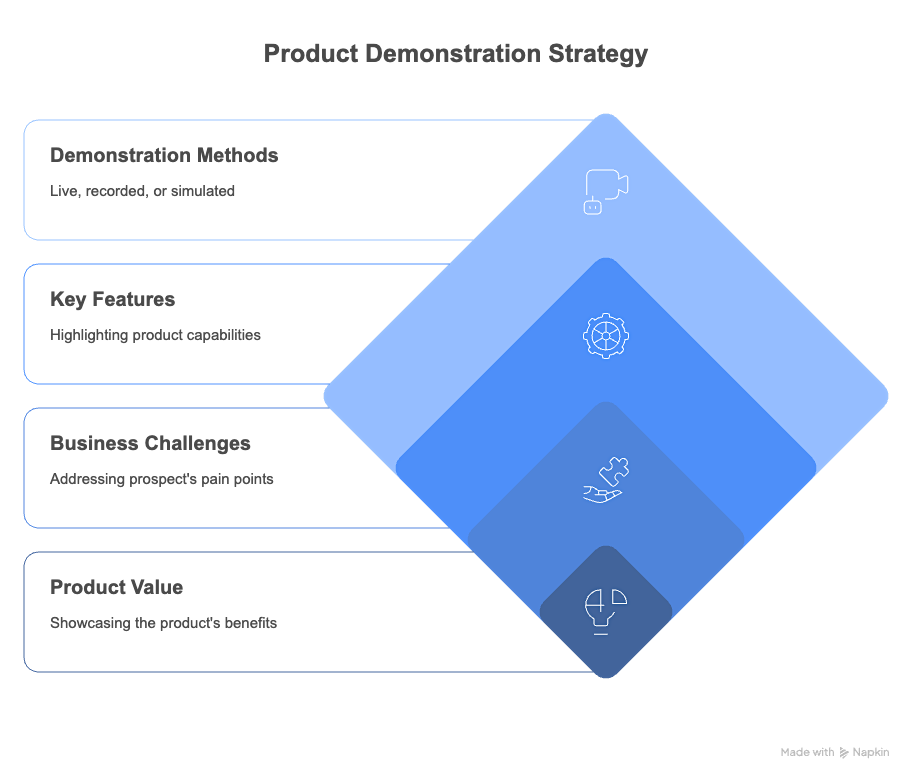
## **6 Key Elements of an Effective Product Demonstration**
High-performing sales teams build empathy and deep connections with prospects. A static, generic demo just doesn't cut it compared to the pillars of an excellent product demonstration:
### **1. Personalization**
A generic demo is unlikely to engage and resonate with the buyer. **Customizing the experience to each prospect’s use case, role, industry, and deal cycle stage helps educate them on the proof of concept and how the product will solve their unique business challenges.**
### **2. Value-first Storytelling**
Sure, buyers want to know about the product’s features—but that’s not enough to seal the deal. **Every demo should champion the product’s value proposition and grab the buyer’s attention through interactive storytelling.**
### **3. Reliable Environment**
Pulling off a smooth demo without bugs, version mismatches, and assistance from engineering teams can be a huge hurdle to demo success. **With demos independent from your live product (e.g., using cloning technology), you don’t need to worry about bugs, unstable features, or missing configurations during critical meetings.**
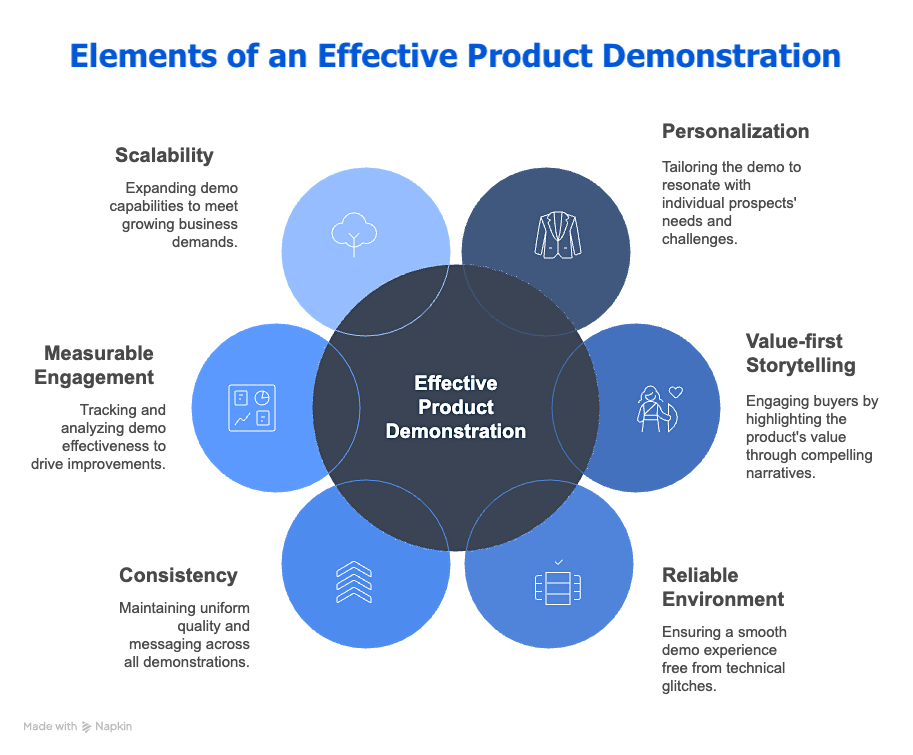
### **4. Consistency Across Reps and Teams**
Customizing traditional demos used to require all hands on deck. Account executives would waste time waiting for sales and R&D teams to give their two cents. **Luckily, automated demo solutions give you the luxury of repeatable playbooks, consistent quality, and cross-team messaging that [aligns presales and sales](https://www.demostack.com/post/aligning-sales-and-presales-to-deliver-winning-demos).**
These tools also open the door for scalable demo templates that teams can customize for verticals, roles, or deal stages—without sacrificing consistency.
### **5. Measurable Engagement**
**It’s essential to leverage proper tracking and analytics to measure the effectiveness of demos and identify areas for improvement.** Using a solution with a built-in dashboard means you can understand what resonates with each type of buyer and whether your product demonstration efforts are converting to sales. Integrating this data with your CRM or MAP can also help prioritize high-intent leads and optimize follow-ups.
### **6. Scalability**
Delivering a handful of demos is doable, but business growth involves providing demo experiences to a wide range of prospects across various verticals and segments. **Your demo infrastructure must be scalable, and automating demo creation and delivery frees up valuable time for sales and engineering teams.**
## **Types of Product Demonstrations (and When to Use Them)**
Buyers are curious and difficult to convince, particularly in large enterprises. In practice, high-performing teams often combine multiple demo types across the sales cycle to reinforce key messages and match stakeholder needs.
**Need to match demo formats to the prospect’s spot in the sales cycle? This table is your how-to guide.**
|
**Type of product demo**
****
|
**When to use it**
|
**Why to use it**
|
**Demostack example**
|
|
**Live demo**
|
Classic account/sales executive walkthrough during a sales call.
|
Go beyond a tour with live demos that showcase your product in the best light, tailored for any stage of the deal cycle.
|
**Demostack platform: **One stable environment for all demos, plus an intuitive analytics dashboard.
|
|
**Cloned demo**
|
Fully replicated product environment that buyers can explore and use.
|
Provides a stable, fully independent environment that mirrors your product—eliminating risks tied to live systems or backend dependencies.
|
**Demostack Cloner:** Clones your product into an independent and customizable demo environment.
|
|
**Overlay demo**
|
Real-time customization layer over live product.
Immerse buyers in tailored storytelling so they can understand your product’s value right off the bat.
|
Immerse buyers in tailored storytelling so they can understand your product’s value right off the bat.
|
**Demostack Overlay: **Add an overlay of tailored edits on top of your existing environment.
|
|
**Sandbox demo**
|
Hands-on environment for buyer evaluation.
|
Enables the buyers to take the product for a test drive in a trial-like scenario.
|
**Demostack Sandboxes:** Put the product into your customer’s hands faster, so they can see a blueprint for future implementation.
|
|
**Self-guided tour**
|
Website or email-embedded tours for early engagement.
Qualify interest early by giving buyers a hands-on preview before engaging sales.
|
Qualify interest early by giving buyers a hands-on preview before engaging sales.
|
**Demostack Tours:** Gives buyers a modern and interactive demo experience to explore the basics on their own time.
|
## **How to Optimize Your Demo Strategy Across the Sales Funnel**
### **1. Top-of-the-Funnel (TOFU): Spark Interest and Qualify Leads**
B2B buyers provided with a self-guided buying journey are 147% more likely to purchase. They're in the discovery phase, independently exploring solutions. **Waiting for live conversations to begin before providing a demo experience means you could miss out on interested prospects browsing on their own terms.**
**Who owns it:** Marketing, sales development, or account executives focused on lead generation and qualification. Their goal is to attract the attention of busy buyers.
**Demo format:** Self-guided product tours or sandbox previews. This format allows leads to qualify themselves. After exploring the product, interested buyers will naturally progress through the funnel. Uninterested parties will drift away, ready to be picked up through follow-up touchpoints.
**Purpose:** Offer low-friction, interactive ways for prospects to receive a demo experience without needing hands-on involvement from your sales team.
**Example TOFU demo tactics:**
- **Embedded tours:** Early-stage buyers might find your business through your website, blog posts, landing pages, and social media. Embed your demo in all these touchpoints to capture buyer engagement data and drive momentum.
- **Personalized experiences:** Customize tours by vertical, use case, role, deal cycle, segment, and more to support ABM efforts and deliver engaging, personalized experiences.
- **Scheduled follow-ups:** Choose a demo automation platform that provides transparent data to track engagement, completion rates, and in-demo event analytics. With data, you can see what hands-off TOFU buyers are interested in without jumping into live conversations too early.
**How to use Demostack at the TOFU stage:** Use Demostack Tours to create scalable, self-serving, click-through demos highlighting key value propositions. Filter window shoppers and generate demo-qualified leads, then sync engagement data with your CRM or MAP to fuel lead scoring and see what’s working. This kind of scalable early-stage engagement gives your team more qualified leads without increasing effort or relying on technical support.
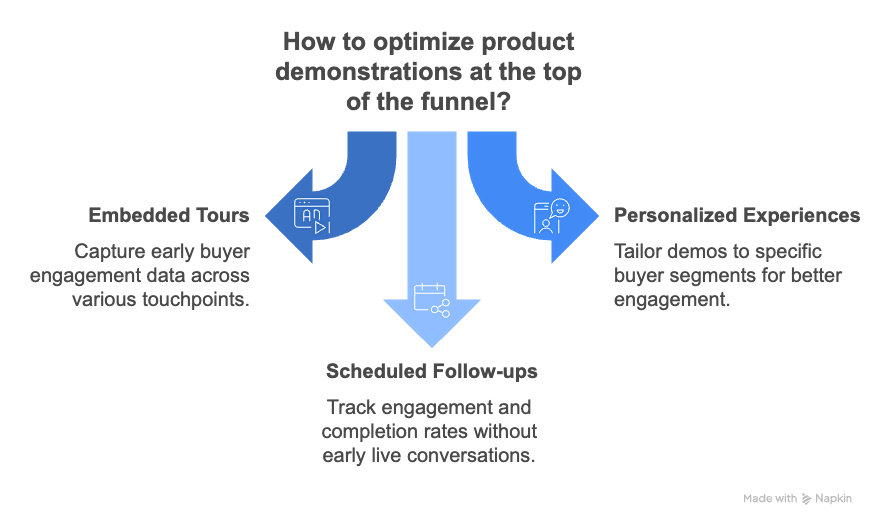
**Next steps:** Once you've captured an interested and engaged buyer, the light-touch stage is over. It's time to transition into more personalized interactions that directly address each buyer's unique pain points and challenges.
### **2. Middle-of-the-Funnel (MOFU): Personalize Engagement and Drive Alignment**
Where the TOFU stage is about self-guided, non-committal research, middle-of-the-funnel (MOFU) buyers are now actively evaluating potential solutions. **The secret is to shift from showcasing generic value propositions to tailored product storytelling—every product demonstration should directly address their specific pain points and business goals.**
**Who owns it:** Depending on the buyer's technical depth and complexity of requirements, account executives take the lead with the support of sales teams.
**Demo format:** Cloned demos or overlays that are delivered live. These formats give you a stable, customized environment for live demos without the risk of technical issues or delays.
**Purpose:** Showcase tailored storytelling and how the product solves the buyer’s unique business challenges—all while pulling off a seamless live [sales demo](https://www.demostack.com/post/sales-demo-examples-that-inspire) experience without bugs, version mismatches, or dependencies on your sales engineering teams.
**Example MOFU demo tactics:**
- **Clone product environments:** Replicate the look and feel of your actual products and customize them for the buyer—whether that’s segment, vertical, use case, or role.
- **Overlay live demos:** Add a real-time customization layer (including content and visuals) over your live product without complicated backend changes. The best demo automation platforms have built-in editing capabilities that let you adjust charts, variables, and visuals on top of your live product without needing backend changes.
- **Be consistent:** Use reusable templates or demo playbooks to ensure consistency across teams while tailoring the experience to each buyer.
**How to use Demostack at the MOFU stage:** Running demos using a Clone of your product means it’s independent of all changes happening in production and built specifically for showcasing. That means you can deliver a polished, buyer-specific demo with minimum technical setup and no risk of unexpected events.
How would a Clone really work for your teams? For SE leaders, using a Clone means reducing the pressure on technical staff who are constantly trying to configure and troubleshoot demo environments.
Sales enablement teams can also benefit from the ability to add consistent messaging. This approach benefits both AEs and SEs—AEs can personalize demos with minimal lift, while SEs stay focused on strategic technical validations.
For example, a fintech AE might leverage a cloned demo featuring a secure payments dashboard customized to AI compliance workflows and reporting relevant to the buyer’s specific regulatory requirements.
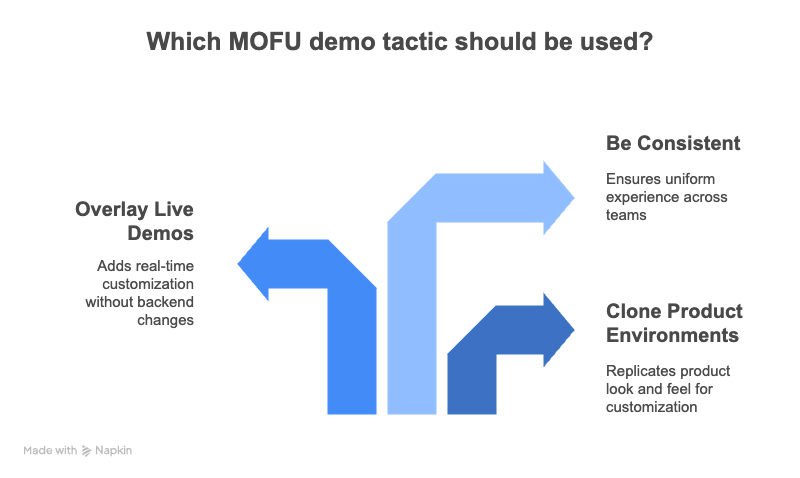
**Next steps:** Repeatable, high-impact demos can accelerate sales cycles at the MOFU stage while preserving your SE teams’ bandwidth and time. Once buyers have explored how the product solves their business challenges, they’re ready to discuss the technical aspects at the BOFU stage.
### **3. Bottom-of-the-Funnel (BOFU): Enable Hands-On Validation**
So, buyers have engaged with your Clone demo and are ready to progress. **The bottom-of-the-funnel (BOFU) stage is the opportunity for technical buyers to get their hands dirty: testing workflows, validating specific requirements, and securing technical buy-in.**
**Who owns it:** SEs take the lead here, sometimes collaborating with AEs to align technical validation with wider business goals.
**Demo format: Interactive sandboxes** provide a controlled environment for technical stakeholders to explore and evaluate the product in detail.
**Purpose:** Provide a trial-like experience for technical stakeholders. Allow them to independently explore key features and test integrations while receiving support from your sales team when validating the solution.
**Example BOFU demo tactics:**
- **Deliver customized sandboxes:** Provide an interactive sandbox tailored to the buyer's specific workflows or integrations. For example, provide a proof of concept of how the product integrates with their existing CRM.
- **Monitor user activity:** Track which product features are tested the most by each buyer to understand which features should inform follow-up conversations.
- **Provide leave-behind experiences:** Giving buyers access to a dedicated leave-behind sandbox environment enables them to act as advocates by sharing the demo with other internal stakeholders.
**How to use Demostack at the BOFU stage:** Demostack Sandboxes create secure, resettable, hands-on environments for proof of concepts. Put the product in your buyer’s hands without requiring backend access or risking live production.
For example, your field CTOs and InfoSec teams want to feel confident that the product is stable, secure, and usable without compromising or exposing live systems. Let’s say you have a healthcare buyer testing user permissions in a simulated patient data sandbox—the last thing you want is to give real permissions or dive into the backend.
A sandbox removes that risk by offering a secure and repeatable environment that builds trust without compromising your live product.
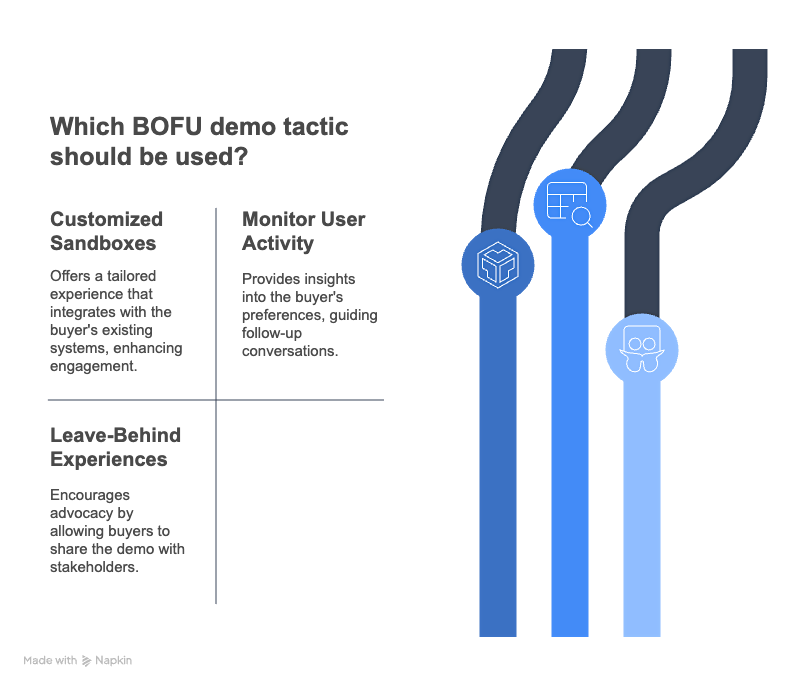
**Next steps:** Hands-on validation significantly speeds up technical sign-off, enabling technical stakeholders to do their due diligence. A sandbox is particularly valuable in high-stakes or heavily regulated environments where buyers need to put trust in your product.
Once you’ve sealed the deal, it’s time to look at how demos can support internal enablement and efficiency.
### **4. Post-Sale and Internal Enablement: Extend Demo Value**
The strategic value of your product demonstration doesn't end with a closed deal. **Demos play a valuable part in driving ROI across crucial post-sale activities, including customer training, internal onboarding, and partner enablement.**
**Who owns it:** Many teams, including enablement teams, product trainers, and partnership management, are involved in the post-sale process.
**Demo format:** Sandboxes, tours, and playbooks are all valuable for providing product walk-throughs and activities like internal enablement for new features.
**Purpose:** Accelerate onboarding, maintain consistent product messaging, and give partners the tools they need to confidently represent your solution.
**Example Post-sale demo tactics:**
- **Leverage playbooks:** A well-organized playbook can provide a single source of truth for activities like demo scripts and environment access instructions for various use cases and audiences.
- **Train new hires:** Guided product tours tailored to responsibilities and target markets help new sales reps familiarize themselves with product features and key selling points.
- **Certify internal teams:** Providing dedicated sandbox environments allows internal teams and partners to practice delivering demos and become proficient with the product in a safe space before engaging with live prospects.
**How to use Demostack at the post-sale stage:** With Demostack's Playbooks, Sandboxes, and Tours, your teams can onboard faster, maintain consistent messaging and sales strategies, and confidently deliver demos to a range of prospects without deviating from core value propositions.
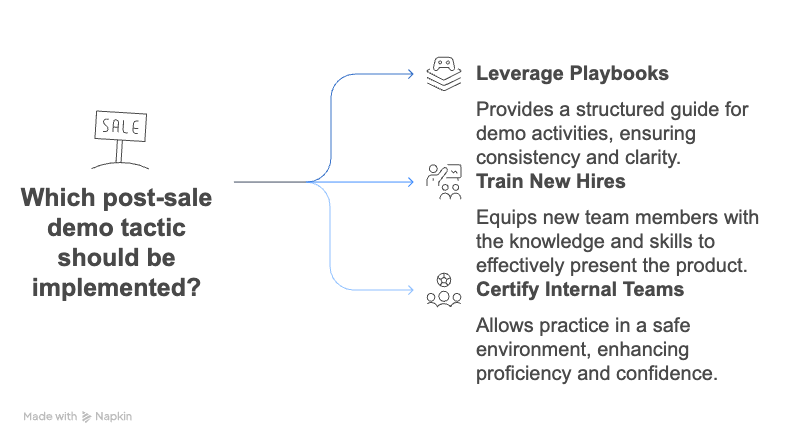
**The value of demos extends far beyond closing deals, contributing to overall customer success and internal efficiency.** These use cases extend the ROI of your demo infrastructure and strengthen cross-functional alignment across sales, enablement, and partnerships.
## **Create Demo Success Across the Entire Buyer Journey**
Product demonstrations have always been a go-to for closing deals, but the positive impact of demo experiences extends to every stage of the buyer journey. **With Demostack, you can move beyond basic product walkthroughs and deliver tailored, impactful demos with the right message for each buyer at every stage.**
By now, it’s clear that different stages require different demo experiences. **Demostack supports live, sandbox, clones, and tour formats, empowering every member of your sales team to work in alignment** and deliver consistent product demonstrations that get results.
**[Try Demostack today](https://www.demostack.com/win-more-deals-lp) to create product demonstrations that win with custom instances that are easy to build, distribute, and measure.**
## Article: The 6 Silent Killers of Enterprise POCs \(and the Alignment Framework to Beat Them\)
Source: https://www.demostack.com/post/enterprise-poc
> _From our webinar, Turning POCs into Revenue, produced with RevGenius and featuring John Care, author of Mastering Technical Sales, and Gilad Komorov, three-time CRO and GTM advisor. [Watch the recording](https://www.demostack.com/webinar/turning-pocs-into-sales-revenue)_
Your proof of concept is the most expensive stage of your sales cycle. It's also the one most likely to quietly kill your deal.
Enterprise SaaS teams optimize the top of the funnel relentlessly. Then a deal that took 12 to 18 months and tens of thousands of dollars to nurture reaches the POC stage and stalls. It doesn't lose to a competitor or fail on product-market fit. It dies in a “no decision.”
The good news: POC failure is a system problem, and you can fix a system. Below are the six failure modes that sink enterprise evaluations, and the alignment framework that beats them.
## First, put a price tag on your POC
The numbers make the case:
- The average enterprise sales cycle runs 10+ months, and the POC, typically 4 to 8 weeks, is the single longest stage inside it.
- For six-figure ACV deals, you spend nearly $2 for every $1 of revenue you eventually book.
- 40 to 60% of pipeline deals end in no decision, so they don't lose so much as evaporate.
- A single POC costs roughly $35,000 to $60,000+ once you add acquisition cost, AE and SE time, enablement, customer success, and the infrastructure to show value.
Put a dollar figure on it. Once you treat every POC as a $50K to $70K investment, your whole approach changes. You walk away from evaluations you can't win, and you run the ones you do enter with far more intent.
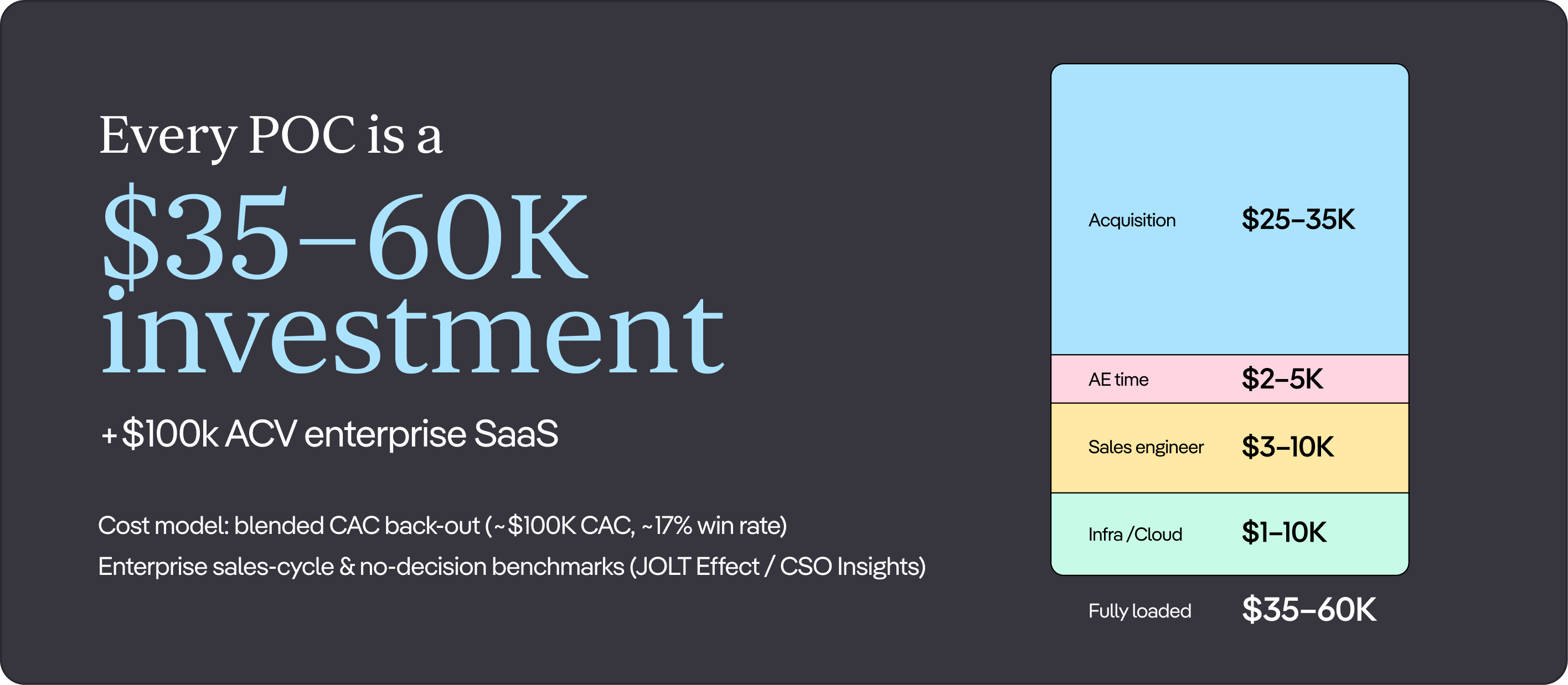
## The mistake almost everyone makes
The biggest misconception is treating the POC as a technical validation exercise.
The technical win matters, and it's table stakes. If your product can't solve the problem, nothing else counts. But plenty of teams land the technical win and still lose to no decision. The POC turns on alignment around value and impact. Proving the tech runs is only the entry ticket.
A technical win means the customer agrees you're uniquely qualified to run in their environment and solve their business problems. It's a precursor to the business win, usually by five or six weeks. Any SE who thinks “my job is to make this POC work, then I'm done” has misread the job. The technology and the business are intertwined, and you have to complete both.
## The alignment framework
Invert the six killers and the framework writes itself.
####
**Before the POC.**
Align on use cases and objectives. Send a short pre-POC questionnaire so the customer supplies the context you need to run something focused and intentional.
Build a POC kickoff deck. The deck is the artifact that forces the conversation. It should cover objectives, measurable success criteria (the decision can't come down to a gut feeling, it has to be a clean yes/no), stakeholders, and process. On stakeholders, aim for 3x3 alignment: AE, SE, and executive sponsor on your side; business champion, technical champion, and executive sponsor on theirs. More alignment there means less risk in the deal.
On timeline, there's no magic number. Forget the reflexive 30-day POC. The right length is however fast you can prove value. Some teams close a one-day POC when that's all it takes to show impact.
#### **During the POC.**
Streamlined execution, confined to the agreed use cases. Tempting as it is to show off adjacent features, hold the line and stay inside the scope tied to your objectives and success criteria.
#### **After the POC.**
Treat the wrap-up with real respect. Dry run with your champion, testimonials in hand, success criteria demonstrated, and a tight plan to convert the POC into a signed deal.
Ownership is a tag team. The AE kicks off the POC properly, hands the baton to the SE to lead execution (with the AE still navigating from the passenger seat), then climbs back into the driver's seat to bring it home. The SE is the most trusted voice in the room, the person buyers consistently rank as providing the most value in a deal. Few teams use that advantage.
### What sharper discovery surfaces
Discovery is the multiplier under all of this. In one competitive evaluation, three vendors ran week-long POCs with about half a million dollars on the line. One team did far deeper discovery and surfaced the real stakes: a delayed product launch would cost the customer $8 million and eight weeks. Same product, same week, very different framing, and the deal followed the vendor who understood what the POC was actually protecting.
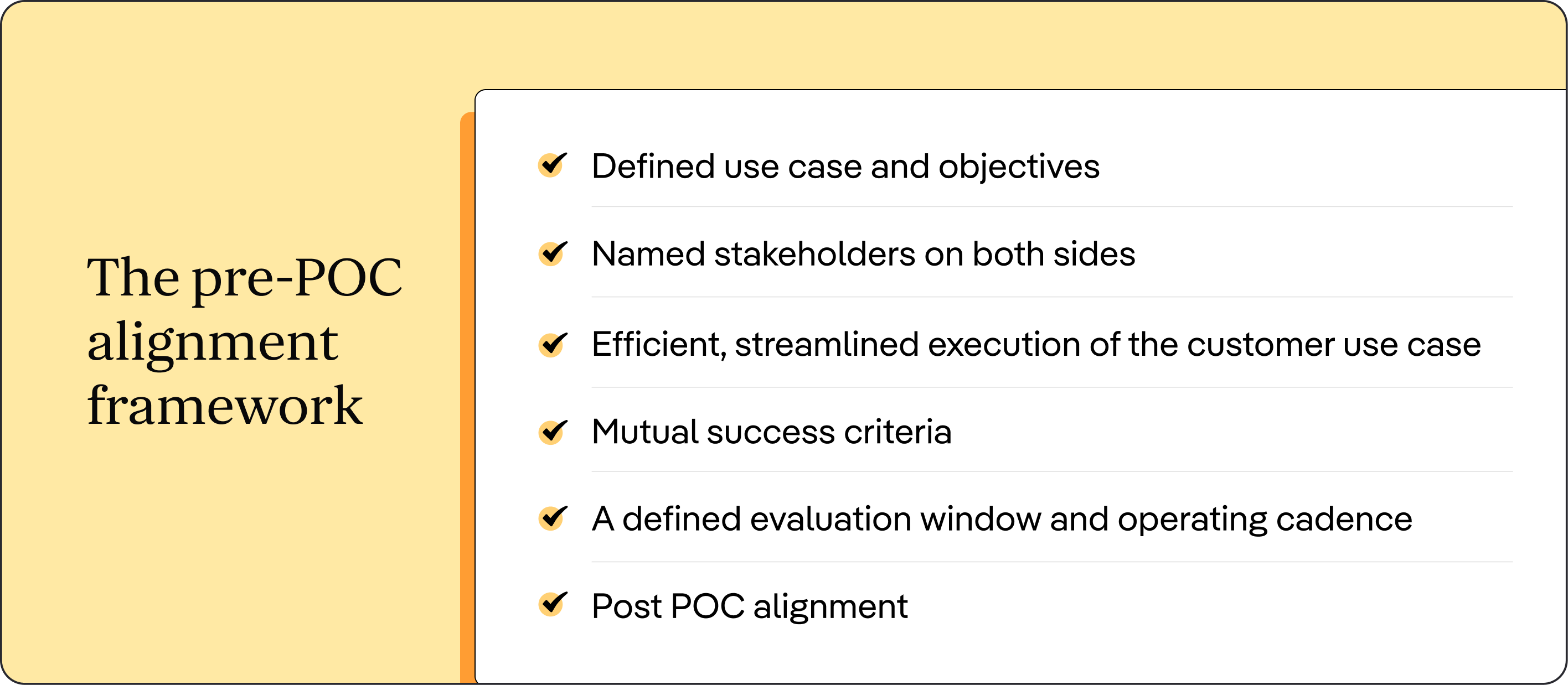
##
Where Demostack fits
Most of this framework is process. One part is tooling: the lighter-weight alternative to a full POC.
A [Demostack sandbox](https://www.demostack.com/sandbox) gives your buyer a hands-on, trial-like environment tailored to their world, with no engineering setup and no production risk. Rather than spending weeks provisioning a custom POC, an SE sends a sandbox leave-behind the buyer and their committee can explore on their own time.
It answers three of the six killers directly:
- The generic environment: sandboxes reflect the customer's reality instead of abstract sample data, and they set up instantly.
- The management gap: usage tracking runs automatically, so you know whether the committee is running the agreed use cases.
- The visibility gap: engagement analytics show exactly which features landed, and that data flows into your CRM so the evaluation never goes dark.
Hunters proved the model. By replacing their traditional POC motion with a sandbox-led “Express POC,” they [cut many sales cycles in half](https://www.demostack.com/customer/hunters), freed their SEs from weeks of environment setup, trimmed the cloud cost of standing up POC environments, and gave channel partners a controlled environment to demo in on the first call. Their VP of Sales Engineering has closed deals with no POC at all, at a higher ACV, off the strength of the sandbox alone.
## The bottom line
The framework is how you win the POCs you run. The sandbox is how you run fewer of them, and win more of the deals underneath. Price the POC like the investment it is, refuse to enter without alignment, and give the buyer a hands-on path to value that doesn't cost you six weeks of engineering time.
## Article: From Shared Tenant to Demo Sandbox: How a Cybersecurity Leader Scaled Live Demos to 5,000 Users
Source: https://www.demostack.com/post/cybersecurity-demo
Picture this: your team is two months out from the largest live demo event in your company's history. Five thousand cybersecurity practitioners, all logging in at once. All expecting hands-on access to your platform. All counting on the experience to be flawless.
Now picture your current setup: a single shared tenant, distributed credentials, PDF guides, and a track record of performance issues any time more than a handful of people log in together.
That was the moment of truth for one of the world's largest cybersecurity vendors. A planned Capture the Flag event was about to expose every weakness in how they ran demos at scale. Here's how they rebuilt the foundation around an on-demand demo sandbox model — and what it unlocked across product marketing, [sales engineering](https://www.demostack.com/solution-engineering), and partner enablement.
## The Challenge: A Live Demo Model Stretched to Its Limit
For years, the team had relied on a single shared tenant for demos, training, and partner workshops. It worked when audiences were small and presenters were experts. But as the company grew across endpoint detection, cloud security, and threat investigation, the model started cracking under three different kinds of pressure.
**Scale was a constant battle.** Distributing credentials to hundreds of concurrent users was a manual coordination project every single time. The more people logged in, the worse the live demo environment performed. Large events meant real risk of system-wide failure.
**Quality varied wildly.** A demo from a top-performing sales engineer looked nothing like the same demo from a recently onboarded partner. The "tribal knowledge" required to navigate live environments under pressure simply didn't transfer. And software demo training across hundreds of partners was a near-impossible logistical exercise.
**Every product launch made it worse.** New SKUs piled new demos on top of teams already stretched thin. You couldn't scale enablement without scaling headcount — and that math doesn't work for a multi-product portfolio.
Then came the CTF announcement: 5,000 concurrent users, hands-on the platform, no margin for error. The shared-tenant approach wasn't going to make it.
## The Solution: From Shared Tenant to Demo Sandbox Environments
The team rebuilt their demo architecture on Demostack with four moves that worked together.
### 1. On-demand sandbox demos replaced shared access
Every user now spins up their own isolated [demo sandbox](https://www.demostack.com/sandbox) that behaves exactly like production. One presenter's clicks never collide with another's session. No more coordinating who's "in" the demo right now. Cloned environments mean infinite parallel sessions, every one of them stable.
### 2. Demo tours encoded the expert playbook
Every demo deliverable now pairs a clickable, step-by-step [demo tour](https://www.demostack.com/tours) with a live Demostack instance. Talk tracks and click paths are baked into the content itself. Presenters follow prescribed flows — and consistently land them.
### 3. A centralized repository made content findable
The team built a structured content architecture — internally nicknamed _the tesseract_ — that organizes every demo tour and live demo by product, use case, and SKU. One source of truth. Automatic versioning. No more hunting for "the latest version."
### 4. CTF integration made provisioning invisible
For the Capture the Flag event, Demostack was wired into a custom CTF platform. Participants clicked "Launch environment" and got an automatically provisioned sandbox demo. No credentials handed out. No authentication friction. A textbook demo automation play that turned a logistically impossible event into a one-click experience.
## What Made the Implementation Stick
A few decisions made the difference between a tool deployment and a real transformation.
**Demo tours doubled as enablement guardrails.** New hires and partners now follow the same flows as the company's top SEs. Roughly ten run-throughs of a demo tour is enough for any presenter to deliver it confidently - a dramatic compression of ramp time and a far more scalable approach to software demo training.
**Content creation became its own QA process.** Because demo tour steps are built from screenshots of actual Demostack sandbox environments, the demo gets thoroughly tested in the act of being documented. By the time the tour is compiled, the demo has been validated end-to-end.
**Storytelling came before the product reveal.** When the head of product marketing rolled out the new model internally and to partner executives, they led with the problem and the outcome - not the platform. Audiences bought into the approach before they learned Demostack powered it. A useful reminder that even the right tool needs the right narrative.
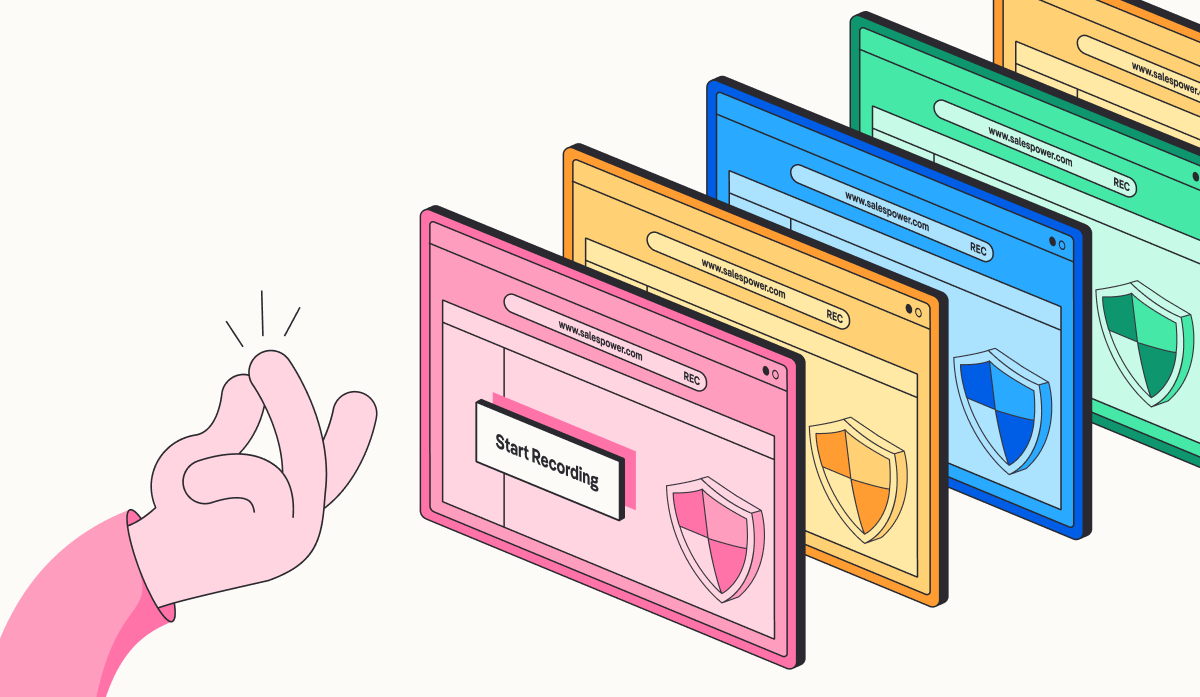
## The Results
The first Demostack-powered CTF supported up to 5,000 concurrent users with zero performance degradation. Every participant got a dedicated demo sandbox that launched instantly, no auth required.
Beyond the headline event:
- **Partner enablement transformed.** [Channel partners](https://www.demostack.com/partner-marketing-and-certification) now deliver enterprise-grade live demos without deep product expertise. They use the same content as internal teams, pulled from the central repo.
- **Delivery quality leveled up across the board.** Demo tours guarantee consistent demos regardless of who's presenting. New hires ramp faster. Partners need less training.
- **Operational drag dropped.** SEs aren't coordinating credentials. Facilitators aren't worrying about environment crashes. Content updates propagate automatically.
## What's Next: Closing the Loop on Demo ROI
The team's next chapter is about connecting demo performance to downstream sales outcomes. Through CRM API integrations, they're working toward tracking which demo scenarios drive pipeline, which features resonate most with buyers, and how demo analytics can feed back into content strategy.
In other words: demos as a measurable growth lever, not just an enablement asset.
**The takeaway for marketing and enablement leaders:** if your demo motion still depends on a shared environment and tribal knowledge, you've already hit the ceiling on what your team can scale to. A demo sandbox model and structured demo tours don't just make events possible — they make every live demo, from a 1:1 SE call to a 5,000-person CTF, predictable, polished, and yours to measure.
**Curious what scalable, sandbox-based live demos could look like for your team?** [See Demostack in action →](https://www.demostack.com/win-more-deals-lp)
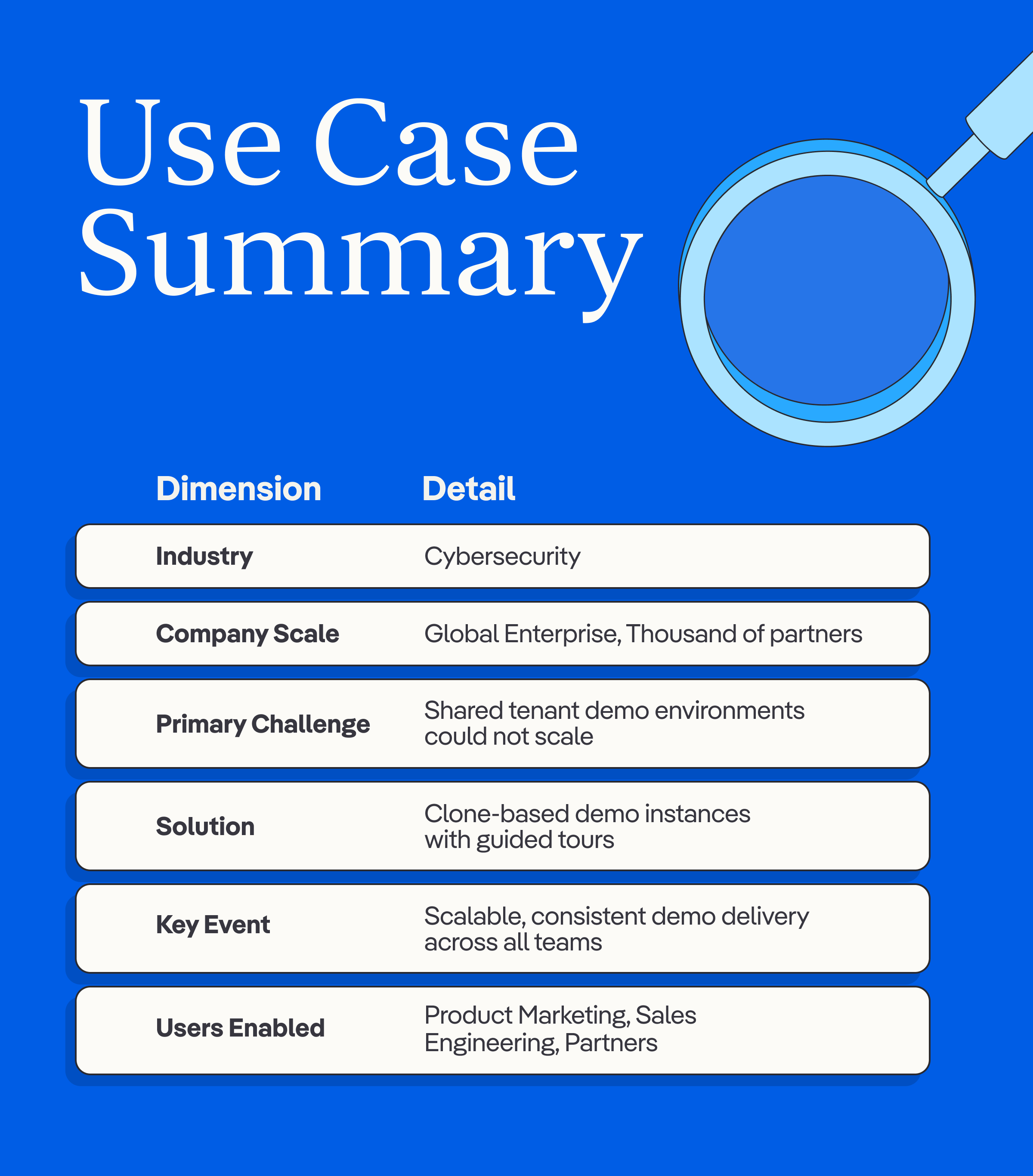
## Article: Demostack launches Demo Partner and Builder Agent
Source: https://www.demostack.com/post/demostack-launches-demo-partner-and-builder-agent-bringing-agentic-ai-to-every-step-of-the-product-simulation-lifecycle
**New AI agents turn every [Demostack](https://www.demostack.com/) user into a demo subject matter expert and every demo into a self-serve GTM engine.**
San Francisco, June 8, 2026, Demostack, the enterprise-grade product simulation and demo automation platform for go-to-market teams, announced [two new agentic AI](https://www.demostack.com/AI-agents) products: Demo Partner and Builder Agent. Together, they transform how teams build and deliver demos, cutting the time, expertise, and headcount needed to scale tailored, on-brand simulations across the GTM motion.
For years, demo creation and delivery have been bottlenecked by two structural problems. Building a great demo required deep technical expertise and constant reliance on a small group of demo champions, R&D, or design. Delivering product showcases required a live human in the room, forcing sales engineers, customer success managers, and product leaders to repeat the same walkthrough to every new hire, partner, prospect, and customer. Demostack’s new agents are built to eliminate both bottlenecks.
"Teams are being asked to deliver more with less, and the pressure on go-to-market is only building,” said Dan Katz, General Manager of Demostack US. “It’s no longer just the established category players competing for the same buyers - AI-native challengers can stand up a credible product with almost no headcount. In that environment, the team that tells its product story most clearly wins. That’s what Builder Agent and Demo Partner are built for. Builder Agent lets anyone build high-fidelity product simulations tailored to any GTM use case - sales demos, training labs, enablement, lead generation… without having to master a new set of tools. Demo Partner makes sure that product story gets delivered consistently, every time."
_Demo Partner in action: users define an agent’s identity, persona, and area of expertise in a few guided steps, creating a self-serve enablement engine for every demo._
"Demos have always been one of the highest-leverage moments in the entire go-to-market motion, and one of the hardest to scale," said Rotem Maya, Head of Product at Demostack. "With Demo Partner and Builder Agent, we're putting an agentic crew behind every product use case. Anyone on a GTM team can now build a tailored, on-brand demo in plain English, and every demo can present itself, live or self-serve, extending the expertise of your best sales engineers to every touch point of the GTM motion. This is the future of product storytelling: AI-native, infinitely scalable, and grounded in your story."
###
Builder Agent: Any Demostack user is now a Demostack champion
Builder Agent is an intelligent orchestration layer that bridges the gap between a user’s vision and the Demostack technical suite. Whether teams need to swap out branding, update datasets, or perform complex global edits, they no longer need to hunt through menus or rely on a dedicated expert. By simply entering a natural-language prompt, the agent analyzes the request and automatically generates an optimized modification kit, selecting the precise tools needed to execute changes instantly.
With Builder Agent, users can describe their vision (for example, “Change all instances of ‘Acme Corp’ to ‘Global Industries’ and update the primary theme color to emerald green”), review a proposed plan of modifications, refine the changes, and apply them in real time. Builder Agent is purpose-built for sales engineers, SE leaders, marketing teams, and individual sales reps who need to create personalized, on-brand product simulation experiences, without waiting on R&D or design.
###
Demo Partner: Every demo becomes a self-serve enablement engine
Demo Partner is an agentic layer that sits on top of an interactive demo. It is trained on the customer’s story, follows the steps the team defines, and presents the product the way the best sales enablement champions would. Demostack’s Demo Partners speak about, and navigate software applications with proficiency, expert-level knowledge and consistency that enterprises demand.
Demo Partner is purpose-built for enablement at scale, unlocking new use cases across the GTM motion:
- Internal enablement at scale: share a feature demo with a dedicated training agent instead of running another live session for new hires.
- POC self-guided exploration: share a sandbox with a sales agent so prospects can walk through key flows on their own time.
- Customer “what’s new”: share a sandbox with a customer education agent so accounts can explore new features without booking a call.
- Partner onboarding, give partners a guided walkthrough that’s always on, always on-brand.
**About Demostack**
Demostack is the enterprise-grade product simulation and demo automation platform for modern go-to-market teams. Demostack lets revenue, marketing, and enablement teams create high-fidelity, on-brand product simulations and deliver them at scale, accelerating revenue velocity, scaling product expertise. Hundreds of leading companies trust Demostack to power their demos. Learn more at demostack.com.
## Article: Demostack MCP: Reveal demo intelligence from the AI tool you already use
Source: https://www.demostack.com/post/demo-intelligence-inside-claude-chatgpt-and-gemini
**_Demostack MCP is one part of our broader agentic strategy: putting the simulation layer into every tool, team, and department across your go-to-market._**
The demo data you need is sitting somewhere. Inside dashboards, inside reports, inside Demostack itself.
The work that depends on that data isn’t. It’s happening inside Claude, inside ChatGPT, inside Gemini, inside Slack threads and doc comments and pipeline reviews and launch retros. The GTM motion that runs your business now runs through the AI tools your teams already have open.
Every question about your demos used to mean a tab switch, a report pull, a CSV export, and a paste back into whatever AI workspace you started in. Then the same loop the next time the question shifted.
The Demostack MCP Server collapses that loop. You ask a question in plain English. The AI pulls real Demostack context and answers from your actual data.
## **Monday morning, without the scramble**
Five minutes to the pipeline review. The old version of this moment meant trying to remember which deals had real demo engagement behind them, which were ghost forecasts, and which had a stakeholder who opened the sandbox last week.
Now the question lands in the AI tool that’s already open. “Who from [target account] has visited our sandbox this week?” “Which shared links have more than three unique visitors?” “Who’s my most active presenter this quarter?”
The pipeline review opens with answers tied to actual buyer behavior, not a spreadsheet your RevOps lead built at 11pm the night before.
## **One question, many tools**
The bigger shift isn’t that Demostack data is now reachable from Claude, ChatGPT, and Gemini. It’s that the AI assistant can pull from Demostack and the rest of your stack in the same breath, so the user no longer has to be the integration.
Say you want to know what John from Acme thought about the demo he just sat through. The old path has four tabs and a stopwatch: open Gong (who are also working on launching MCP connection), find the call, scrub the transcript, jump to Demostack, figure out which sandbox was actually presented, and stitch the two together in your head. With the Demostack MCP connected alongside something like Gong, you ask Claude one question, “What did John from Acme think about the demo he was just given, and which demo was it?”, and the answer comes back with the prospect’s reactions from the transcript tied to the exact Demostack instance they saw.
Multiply that across pipeline reviews, win-loss debriefs, and enablement audits and the pattern is the same: fewer tab switches, fewer copy-pastes, and answers that already know how your tools relate to each other.
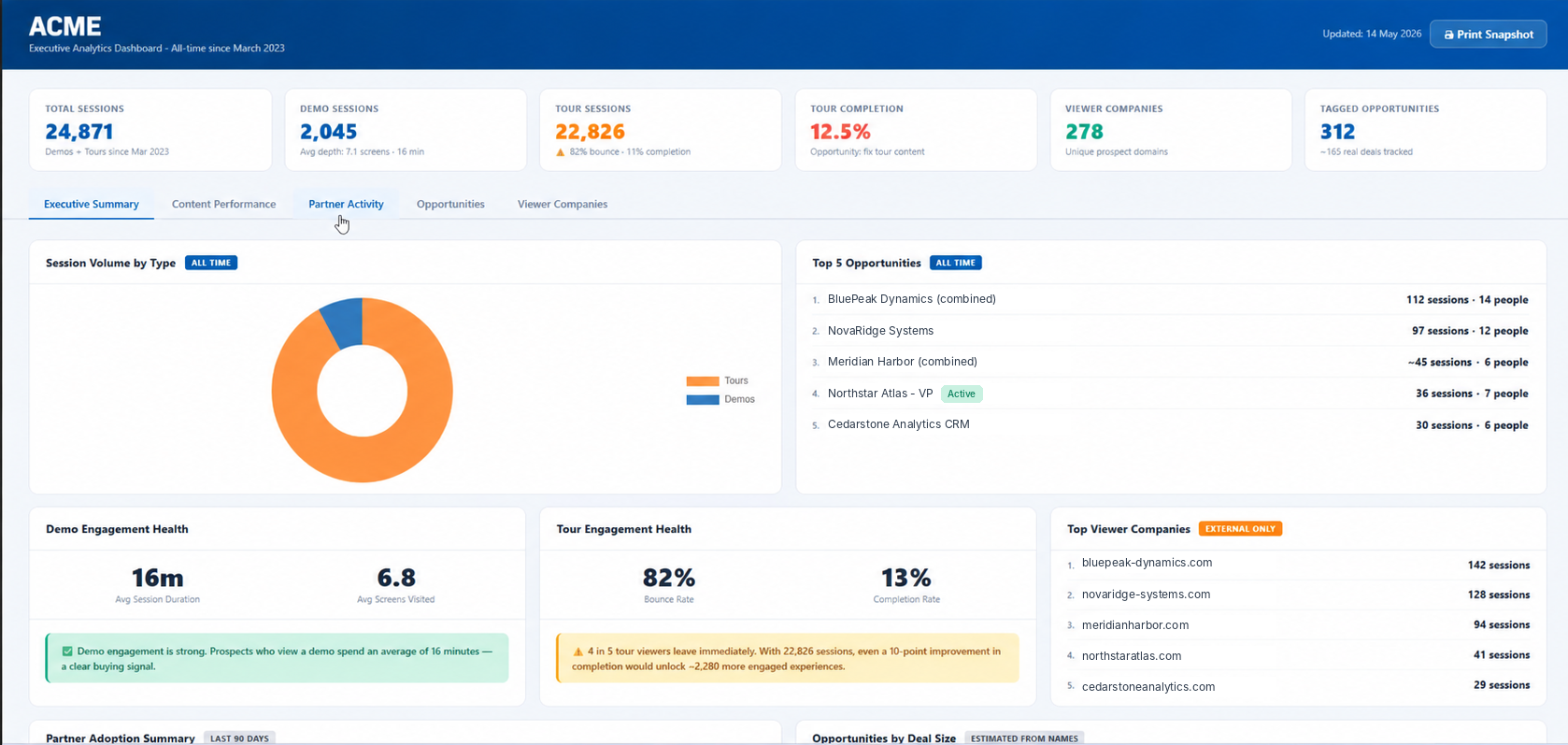
Caption: Mockup of a live dashboard built by a Demostack power user using Claude Code with Demostack's MCP integration.
## **A library that audits itself**
The bigger your demo library gets, the harder it is to know which demos are still earning their place. Add partner access on top of that, and visibility goes dark. You give partners the keys and hope.
The old way to fix it was a quarterly cleanup project nobody wanted to own. The new way is two questions.
“Which demos haven’t been used in the last 90 days?” “Which of my partners are using my demos, and which demos do they use most?”
Five minutes of conversation replaces a project. Your SEs get their attention back for the work that moves deals forward.
## **Adoption you can see after a launch**
Every launch produces a wave of playbooks, training assets, certification content, and field-ready demos. Whether the field uses them, and which features actually land, used to be a guess assembled from Gong recordings and gut feel.
A few questions into the AI workspace, and the guess becomes a picture. “Which assets are getting the most engagement this quarter?” “Who from our key target accounts is engaging with our content?” “Which demos haven’t been touched in 90 days, and which AEs were the last to use them?”
Completion rates no longer carry the enablement story. Real demo activity does, and the case in front of a CRO gets a lot easier to make.
## **Where the MCP sits alongside Demostack’s demo agents**
Demostack’s agentic platform is already live. Demo agents build, tailor, and deliver agentic demos on your behalf, putting agentic product simulations into every part of the GTM motion.
The MCP adds a new layer to that platform. Demo agents act on your demos. The MCP lets you ask questions about that work from whichever AI tool you’re already using. Together they cover both sides of the GTM loop: agents that move the work forward, and intelligence that surfaces what’s happening across it.
[See the full Demostack AI agents lineup](https://www.demostack.com/AI-agents).
## **What you can ask, and how to set it up**
The MCP launches with a focused set of questions covering presenter activity, prospect engagement, demo performance, content usage, and partner adoption. When you ask something outside that set, it tells you directly instead of guessing.
Want to learn more about Demostack Agents? [explore Demostack’s agents](https://www.demostack.com/AI-agents) to see the rest of the agentic platform the MCP plugs into. Want to see it live? [Book a demo with our team](https://www.demostack.com/win-more-deals-lp)
## Article: 11 Best AI Tools for Sales
Source: https://www.demostack.com/post/ai-sales-tools
Seven in ten enterprise revenue leaders now trust AI to regularly make business decisions. That number comes from [Gong’s State of Revenue AI 2026 report](https://www.gong.io/state-of-revenue-ai/), which analyzed 7.1 million sales opportunities. Teams using AI as a core driver of revenue strategy are 65% more likely to increase win rates.
“AI for sales” now covers a wide surface area. CRM enrichment, conversation intelligence, demo automation, presales operations, outreach personalization, revenue forecasting - each category solves a different bottleneck. Picking the wrong tool for the wrong problem wastes budget and creates new friction instead of removing it.
This guide covers the 11 best AI tools for sales and presales teams in 2026. Every entry is mapped to a specific use case, with honest notes on who it’s built for and what it doesn’t do.
## **11 Best AI Tools for Sales and Presales Teams at a Glance**
1. Best AI-powered Demo Platform: [Demostack](https://www.demostack.com/)
2. Best AI-powered CRM: [HubSpot Smart CRM](https://www.hubspot.com/products/crm/ai-crm)
3. Best Buyer Enablement Tool: [Allego](https://www.allego.com/)
4. Best Conversation Intelligence and Sales Intelligence Platform: [Gong](https://www.gong.io/)
5. Best AI Writing Tool for Sales: [Lavender](https://www.lavender.ai/)
6. Best Prospecting and Outreach Tool: [Apollo.io](https://www.apollo.io/)
7. Best Notes and Documentation Tool: [Fireflies.ai](https://fireflies.ai/)
8. Best Customer Service Support Tool: [Intercom](https://www.intercom.com/)
9. Best Sales Meeting Assistant: [Otter.ai](https://otter.ai/)
10. Best Proposal Automation Tool: [Qwilr](https://qwilr.com/)
11. Best Presales Operations Platform: [Vivun](https://www.vivun.com/)
## **AI Tools for Sales: What Are They, & How Are Sales Teams Using Them?**
AI tools for sales are software applications that use artificial intelligence to support real sales work. The technology underneath includes automation and machine learning, but what makes them valuable is how they fit into the day-to-day flow of a sales cycle.
These solutions connect to systems teams already use - CRMs, calendars, email, and meeting platforms. They process data from those systems to identify changes in buyer engagement and point sales teams toward where their attention is most needed.
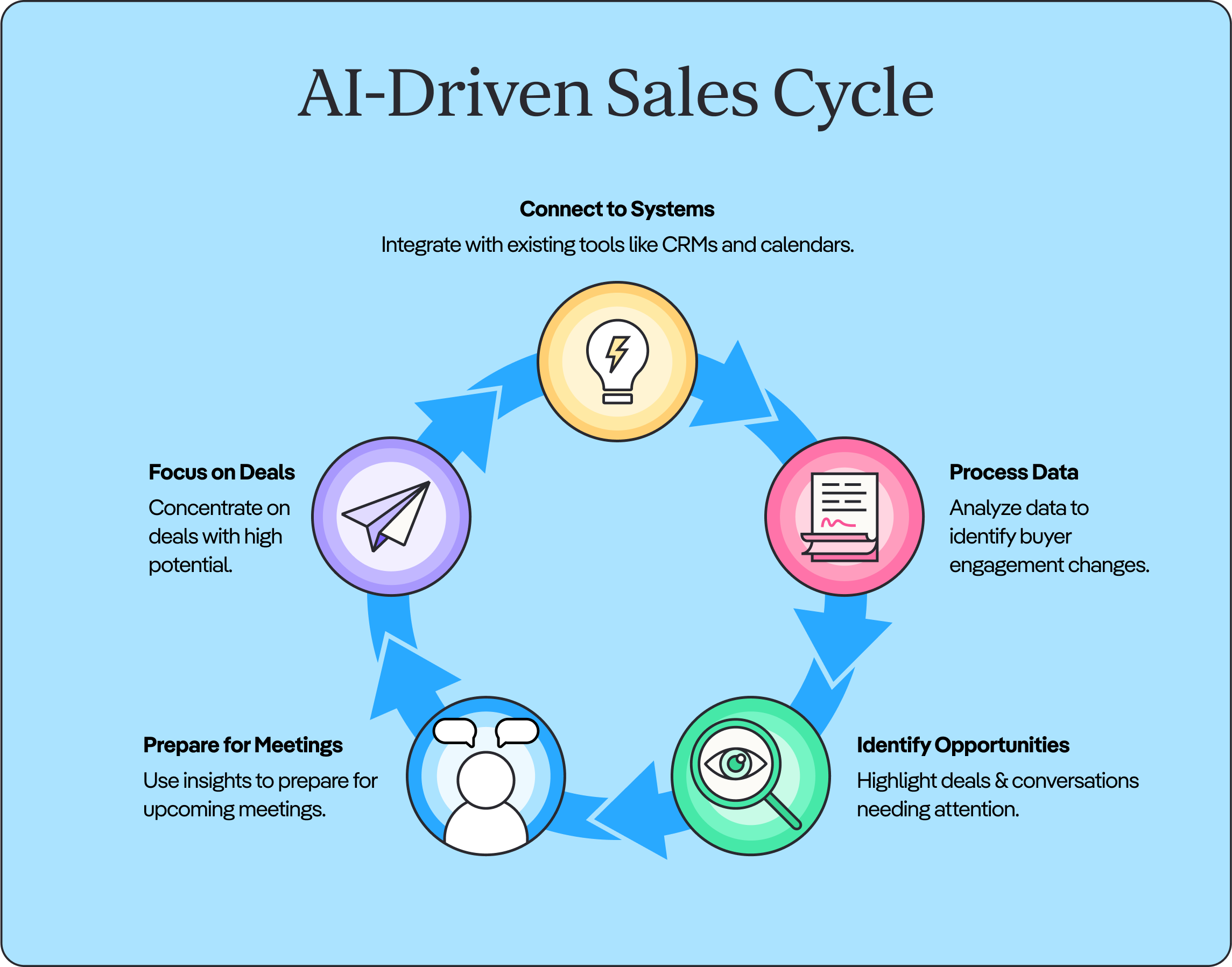
Here is how different roles are using them:
- Account executives use them to identify engaged accounts, prepare for meetings based on recent activity, and streamline follow-up.
- Presales and solutions engineering teams rely on [demo-focused AI tools](https://www.demostack.com/product-demos) to customize product demonstrations based on prior activity, eliminate environment maintenance overhead, and scale partner enablement without adding headcount.
- Sales enablement teams use AI-powered tools to track how reps perform across conversations and content, then adjust coaching to improve execution where it falls short.
- Revenue and sales leaders use forecasting and pipeline intelligence tools to spot risk early and make decisions grounded in actual buyer behavior, not rep self-reporting.
**A note on presales teams specifically**
Presales and solutions engineering teams use AI tools differently from AEs or sales leaders. Their core bottlenecks are environment maintenance (rebuilding demo instances, cleaning data, managing staging systems), bandwidth constraints (supporting 20–40 AEs with a team of 3–8), and partner enablement (giving external partners safe, independent demo access without production system risk).
The tools that solve those problems - [demo automation software](https://www.demostack.com/product-demos), presales operations platforms, and conversation intelligence - are distinct from the outreach and prospecting tools that dominate most “AI for sales” lists. Both categories are covered below.
## **What Are the 10 Main Types of AI Tools for Sales?**
**Here are the primary types of AI tools for sales and how they use artificial intelligence to enhance what they do:**
### **1. AI-Powered Demo Platforms (Sales Demo Software)**
Demo platforms with built-in AI reduce the technical overhead of creating and delivering [sales demos](https://www.demostack.com/product-demos) at scale. The best product demo software and sales demo software automatically clone live product environments, then let teams update data, branding, and workflows in minutes without engineering support. Leading [interactive demo software](https://www.demostack.com/tours) solutions also support self-serve [sandbox environments](https://www.demostack.com/sandbox) for post-call buyer evaluation, partner certification programs, and website product tours.
### **2. Conversation Intelligence and Sales Intelligence Platforms**
These platforms record, transcribe, and analyze every sales call, email, and meeting. AI surfaces patterns, objections, competitor mentions, and buying signals. The best platforms go beyond call analysis: they use that same behavioral data to drive revenue forecasting and pipeline intelligence, giving leaders an accurate view of deal health based on what buyers actually said rather than what reps entered into the CRM.
### **3. AI-Powered CRM Systems**
CRMs with built-in AI features reduce manual data entry by capturing emails, meetings, and calendar updates automatically. They help ensure deal stages and contact records stay current, and surface lead scores and next-best-action recommendations based on behavioral data. Demostack’s [CRM integrations](https://www.demostack.com/integrations) with Salesforce and HubSpot connect demo engagement directly to deal records, so demo activity becomes part of the CRM picture.
###
**4. Presales Operations Platforms**
Purpose-built for solutions engineers and presales leaders, these tools centralize presales workflows, measure technical win rates, and connect SE activity to deal outcomes. They give SE managers the pipeline visibility they currently track manually in spreadsheets, and help align presales, product, and sales teams around shared signals.
### **5. Prospecting and Outreach Tools**
Sales reps use these to identify which accounts to contact and how to approach them. Integrated AI detects buyer signals like email engagement or web activity, recommends who to reach out to and when, and generates message drafts based on account history or intent.
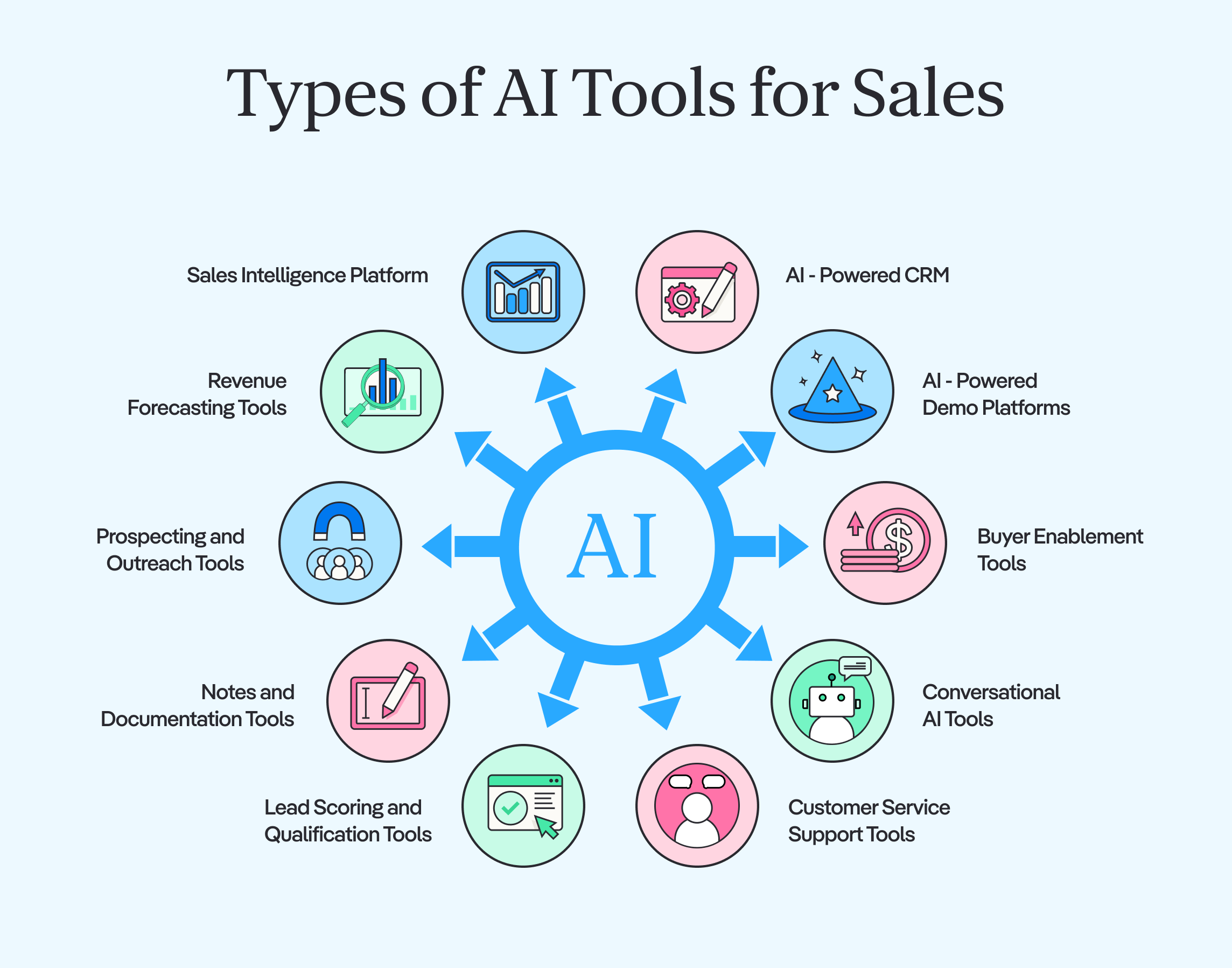
### **6. AI Writing Tools for Sales**
Email coaching tools that analyze outreach in real time, suggest clearer language, appropriate tone, and relevant personalization. They score emails and optimize templates based on what actually generates replies.
### **7. Notes and Documentation Tools**
During calls, these AI tools transcribe what is said and identify important details. Reps review summaries instead of digging through entire recordings. Many sync notes to CRM fields automatically.
### **8. Buyer Enablement Tools**
These help prospects continue evaluating a product after the sales call ends. AI recommends which materials to send based on previous interactions and deal stage, and creates digital sales rooms where buying committees can explore content on their own. [Demostack’s sandbox leave-behinds](https://www.demostack.com/sandbox) serve a similar function: hands-on product environments prospects can explore and share internally after the demo.
### **9. Sales Meeting Assistants**
Automate meeting workflows by joining calls, transcribing conversations in real time, and generating summaries with action items. The best ones identify key sales insights and sync notes directly to CRM platforms.
**10. Proposal Automation Tools**
Generate personalized proposals from CRM data, reducing manual work and versioning errors. Interactive documents include dynamic pricing, embedded video, and e-signatures. Real-time analytics track buyer activity on proposals.
### **11. Customer Service Support Tools**
Give sales teams insight into account health after the initial purchase. AI tracks usage patterns and support trends that may signal churn risk or create expansion opportunities.
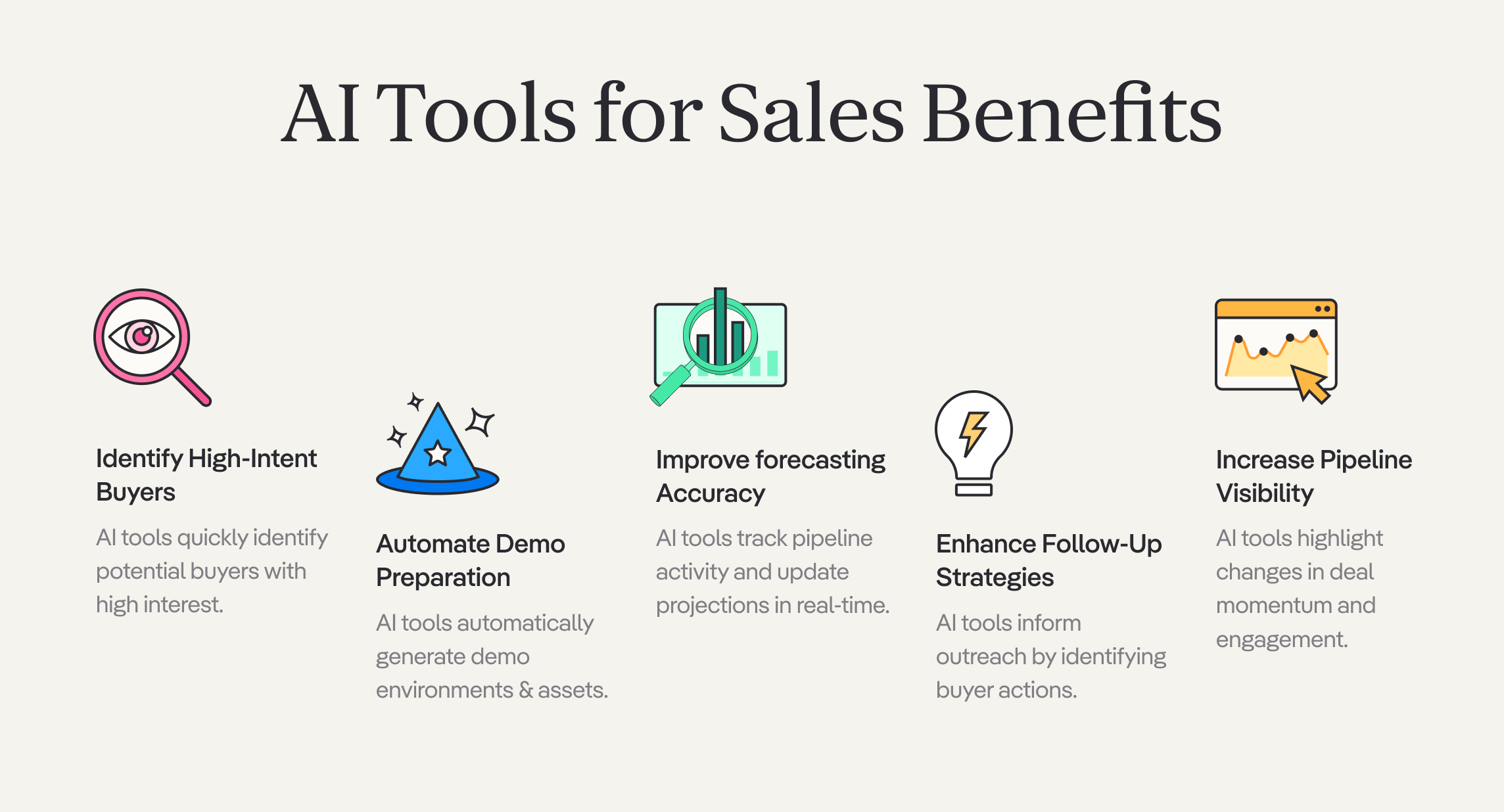
## **Benefits of AI Tools for Sales**
AI tools for sales offer teams several concrete advantages:
- Earlier lead qualification: AI tools identify high-intent buyers faster, so teams can focus efforts on opportunities more likely to convert.
- Faster demo preparation: [Generating demo environments automatically](https://www.demostack.com/product-demos) and recommending relevant assets based on buyer use case reduces manual setup and lets teams run more demos per week without adding headcount.
- More accurate forecasting: Tracking pipeline activity in real time and updating projections based on engagement signals improves planning and decision-making.
- Smarter follow-up: Outreach informed by what buyers actually did keeps communication timely and relevant throughout the deal cycle.
- Stronger pipeline visibility: AI highlights changes in deal momentum and engagement so teams spot where action is needed before pipeline stalls.
- SE capacity recapture: For presales teams specifically, [demo automation software](https://www.demostack.com/product-demos) eliminates the maintenance overhead that consumes hours of SE time weekly, shifting capacity toward actual deal work.
## **Key Features to Look for in AI Tools for Sales**
When evaluating AI sales tools, focus on the types that directly support how your team sells. These capabilities matter across categories:
- CRM integration: AI tools that sync with your CRM ensure everyone works with the same up-to-date information. Demostack’s [Salesforce and HubSpot integrations](https://www.demostack.com/integrations) push demo engagement data directly to deal records.
- Real-time insights: Sales teams can act on engagement signals and deal movement as they happen.
- Activity-based triggers: Buyer behavior can automatically prompt tasks, alerts, or follow-ups tied to specific deals.
- User-level visibility: Teams can see how the tool influences activity and outcomes across the pipeline.
- Interaction summaries: AI extracts key details from sales activity and presents them in a format that is quick to review.
- Adaptability to your data: Tools that learn from your sales history generate insights and recommendations that reflect how your team actually works.
## **11 Best AI Tools for Sales**
### **1. Best AI-powered Demo Platform: [Demostack](https://www.demostack.com/)**
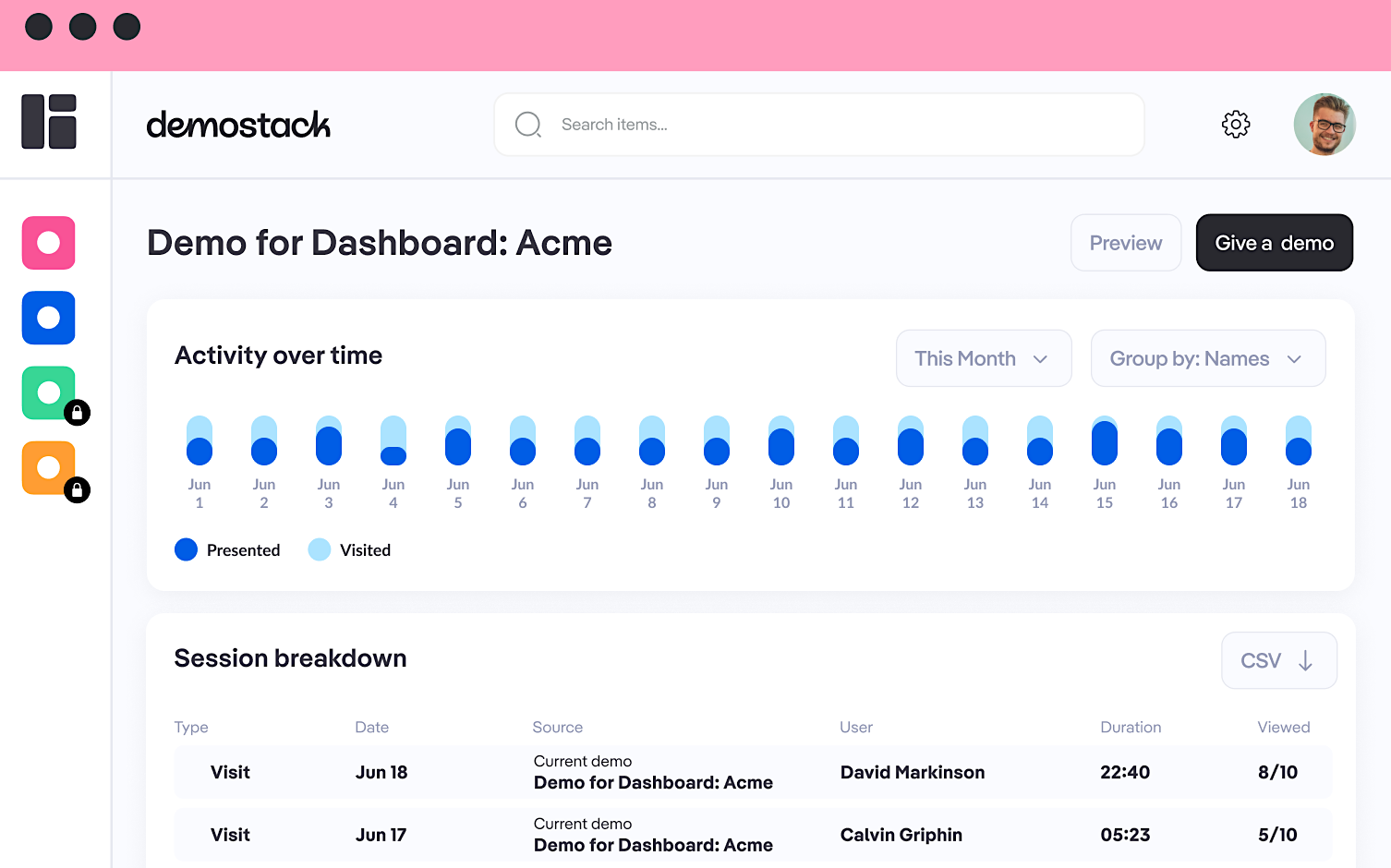
[Gainsight’s sales team](https://www.demostack.com/customer/gainsight) achieved a 25% win-rate increase after deploying Demostack-powered demos. [Hunters](https://www.demostack.com/customer/hunters) reduced sales cycle length by 50% after replacing their POC motion with Demostack sandboxes. Those two proof points frame what the platform actually does: it gives GTM teams and AEs the infrastructure to deliver tailored sales demos quickly and independently, without waiting on engineering or solutions engineers.
Demostack is the product simulation layer for enterprise software. Its patented Cloner creates fully independent, high-fidelity [demo environments](https://www.demostack.com/product-demos) that mirror the live product without depending on backend systems — meaning no crashes, no stale data, no production system exposure. That matters most for presales teams running high-stakes demos where a failed environment kills the deal.
The platform covers the full demo lifecycle: pre-call, in-call, and post-call. Key capabilities include:
- Any demo format: cloned environments, live overlays, [interactive product tours](https://www.demostack.com/tours), and hands-on [sandbox leave-behinds](https://www.demostack.com/sandbox) in a single platform.
- [Sales demo personalization](https://www.demostack.com/ai-data-generator): AI Data Generator creates demo libraries segmented by persona, industry, and use case without manual rebuilds.
- Playbooks and Presenter Pro: navigation guardrails, hidden talking points, and cheat sheets that let AEs run expert-level first-call demos independently. See how on the [Sales Solutions page](https://www.demostack.com/teams).
- Partner certification: read-only partner workspaces with interaction guardrails let channel partners demo independently without production system access. [Hunters](https://www.demostack.com/customer/hunters) scaled to 200+ partner users with this model.
- Analytics tied to CRM: demo engagement data flows directly to Salesforce and HubSpot via [native integrations](https://www.demostack.com/integrations), connecting demo activity to deal outcomes.
- Sales demo software governance: a governed demo library with auto-sync keeps content current after product launches, solving the stale-demo problem for enablement teams.
### **2. Best AI-powered CRM: [HubSpot Smart CRM](https://www.hubspot.com/products/crm/ai-crm)**
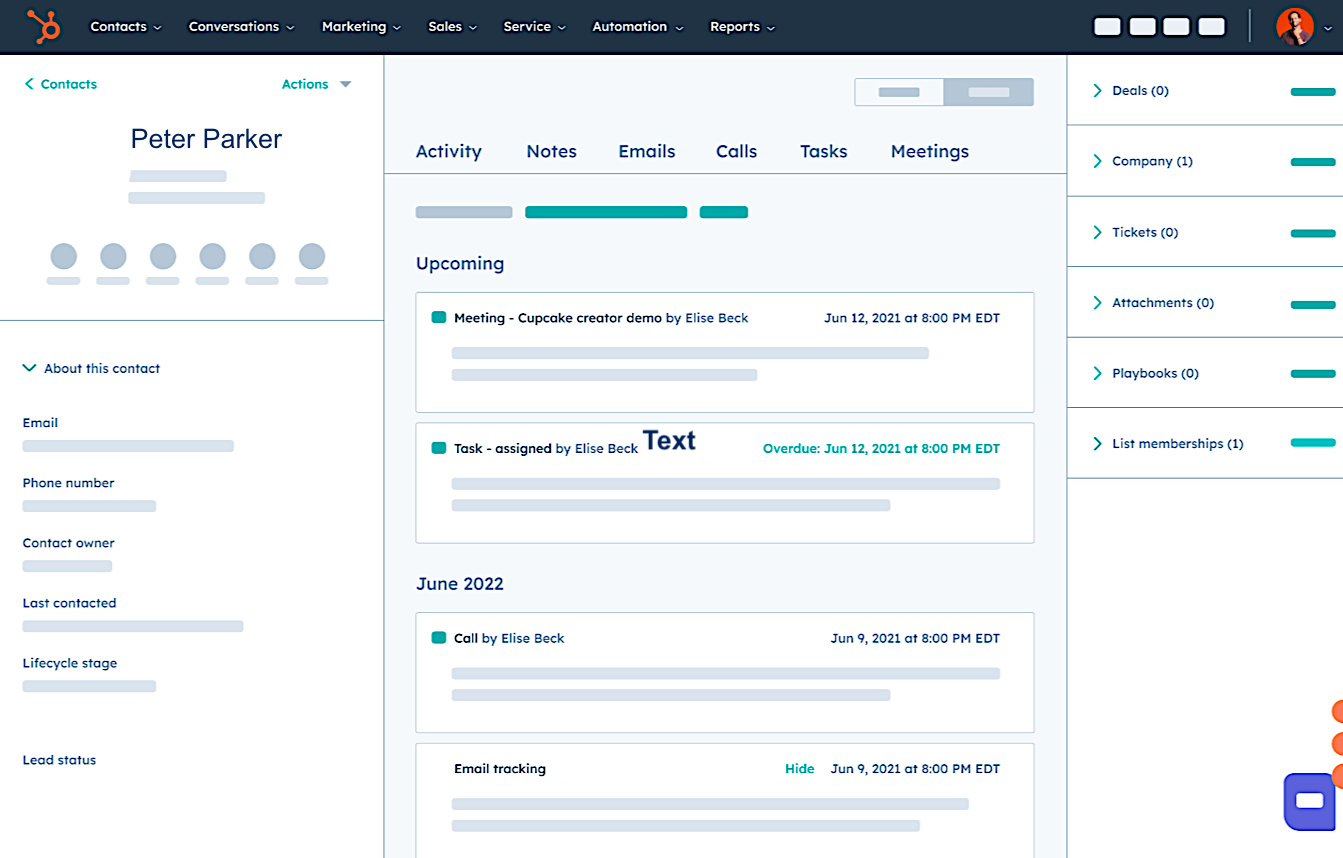
HubSpot’s Smart CRM automates data capture by syncing emails, meetings, and calls directly to contact records. The integrated Breeze AI suite handles email drafting, meeting scheduling, data enrichment, and content generation. Breeze Copilot surfaces AI-driven lead scoring and prioritization models tailored to your pipeline, while Breeze Agents automate specific workflows across prospecting, content, and customer service. Demostack’s [native HubSpot integration](https://www.demostack.com/integrations) connects demo engagement directly to HubSpot contact and deal records.
**Price:** Limited free version available. Full version included with any premium HubSpot software purchase.
**Best for:** Mid-market B2B teams wanting CRM, marketing automation, and AI tooling in a single platform without the complexity of enterprise Salesforce implementations.
### **3. Best Buyer Enablement Tool: Allego**
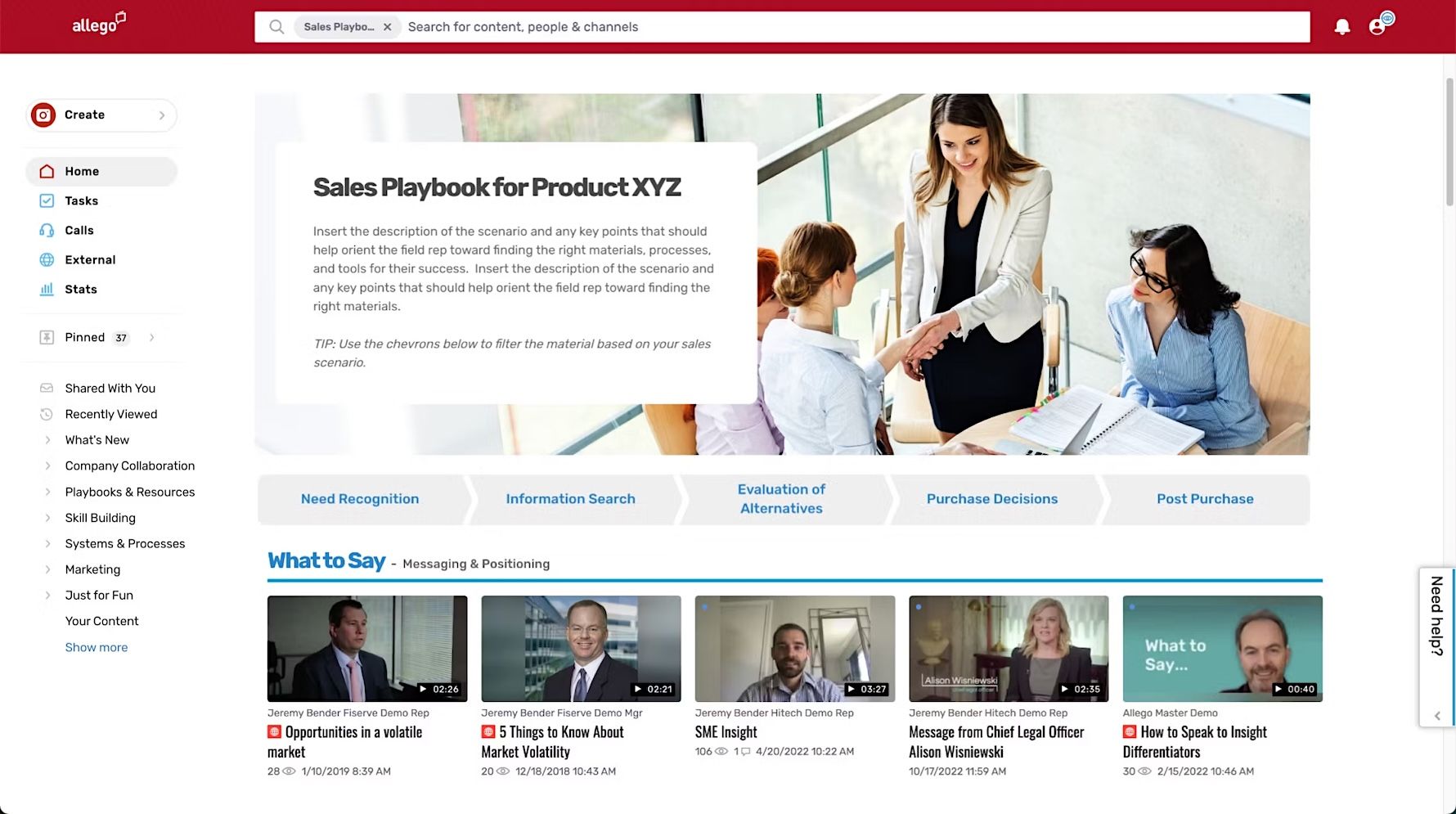
Allego uses AI to power digital sales rooms where buyers explore personalized content and collaborate with reps between meetings. Conversation intelligence analyzes calls for buyer sentiment and key insights. AI-driven content recommendations ensure reps share relevant materials at the right deal stage, while built-in coaching helps improve sales skills over time.
**Price:** By inquiry.
**Best for:** Enterprise teams running complex, multi-stakeholder deals who need to keep buying committees engaged between live calls. For presales teams looking to extend buyer engagement post-demo, [Demostack’s sandbox leave-behinds](https://www.demostack.com/sandbox) complement Allego’s digital sales room approach.
### **4. Best Conversation Intelligence and Sales Intelligence Platform: [Gong](https://www.gong.io/)**
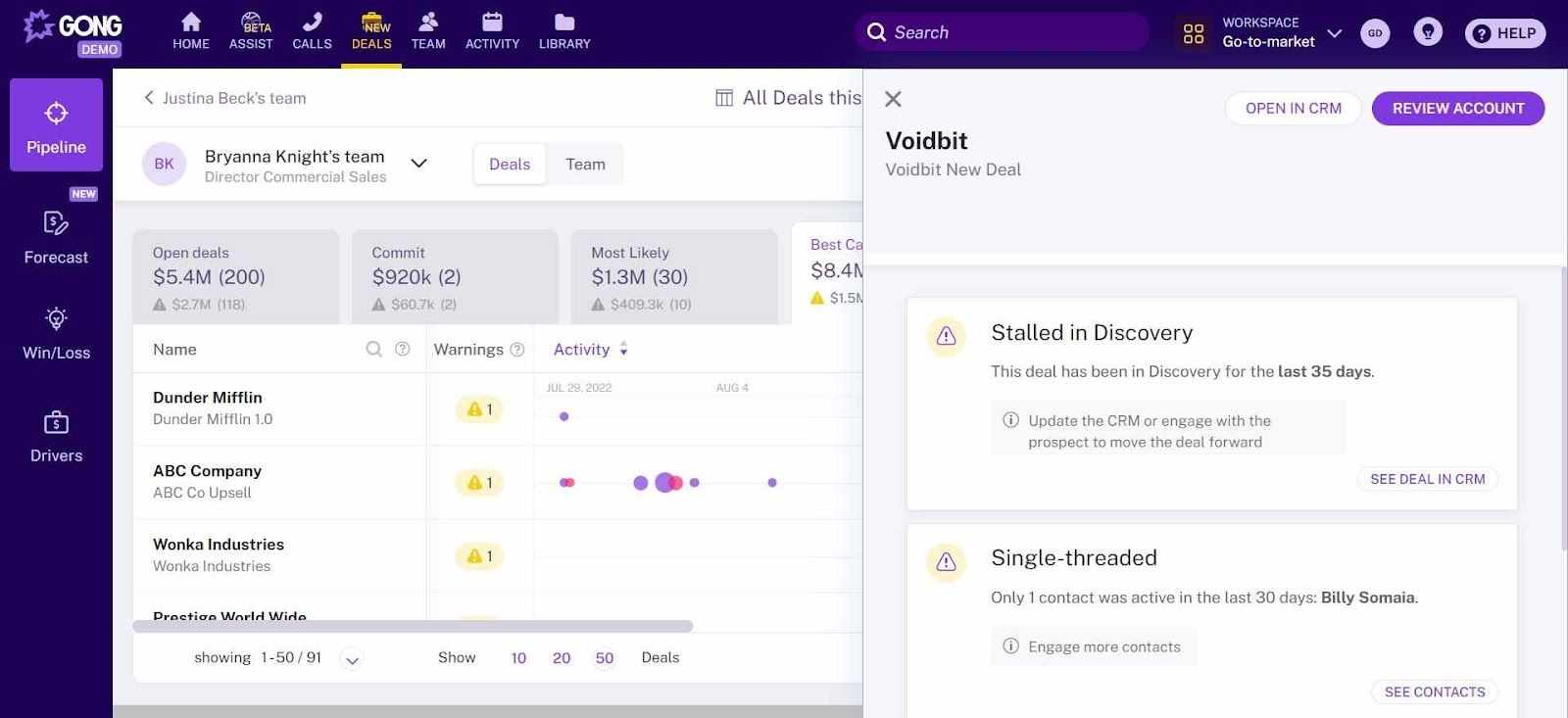
Gong is the standard for conversation intelligence in enterprise B2B sales. Its Revenue AI Operating System captures and analyzes customer interactions across calls, emails, and meetings, then turns that data into pipeline insights, coaching recommendations, and automated workflows.
In February 2026, [Gong launched Mission Andromeda](https://venturebeat.com/technology/gong-launches-mission-andromeda-with-ai-sales-coaching-chatbot-and-open-mcp), its most significant platform update to date. The release added Gong Enable (AI-powered sales coaching grounded in real customer conversations), Gong Assistant (a conversational AI chatbot for revenue teams), Account Console (unified account activity and risk signals), and MCP interoperability connecting Gong data to Salesforce, HubSpot, and Microsoft systems. The company now serves more than 5,000 enterprise customers.
Core capabilities:
- Conversation intelligence: records, transcribes, and analyzes every sales call and meeting for objections, competitive mentions, buying signals, and deal risk.
- Gong Enable: AI Call Reviewer grades reps against your methodology post-call. AI Trainer lets reps practice against AI-simulated scenarios built from real customer conversations.
- Gong Forecast: uses 300+ live signals from buyer engagement and conversation data to project revenue with Deal Likelihood scoring. ADP reported higher win rates on enterprise deals where reps reviewed calls in Gong.
- Gong Agents: automate follow-ups, pipeline edits, enablement triggers, and forecast corrections. One team reported saving 6,700 hours across call prep, follow-up, and CRM updates.
- Revenue Graph: proprietary data layer connecting phone calls, Zoom meetings, emails, texts, and WhatsApp into a unified intelligence system.
**Price:** Custom enterprise pricing. Gong Enable is priced separately.
**Best for:** Enterprise B2B sales teams who need conversation intelligence, accurate pipeline forecasting, and rep coaching grounded in actual buyer behavior. Gong’s Revenue Graph gives it a data advantage over standalone forecasting tools: where those tools aggregate what reps enter into the CRM, Gong captures what buyers actually say and do, then uses that signal to drive both coaching and pipeline intelligence.
### **5. Best AI Writing Tool for Sales: Lavender**
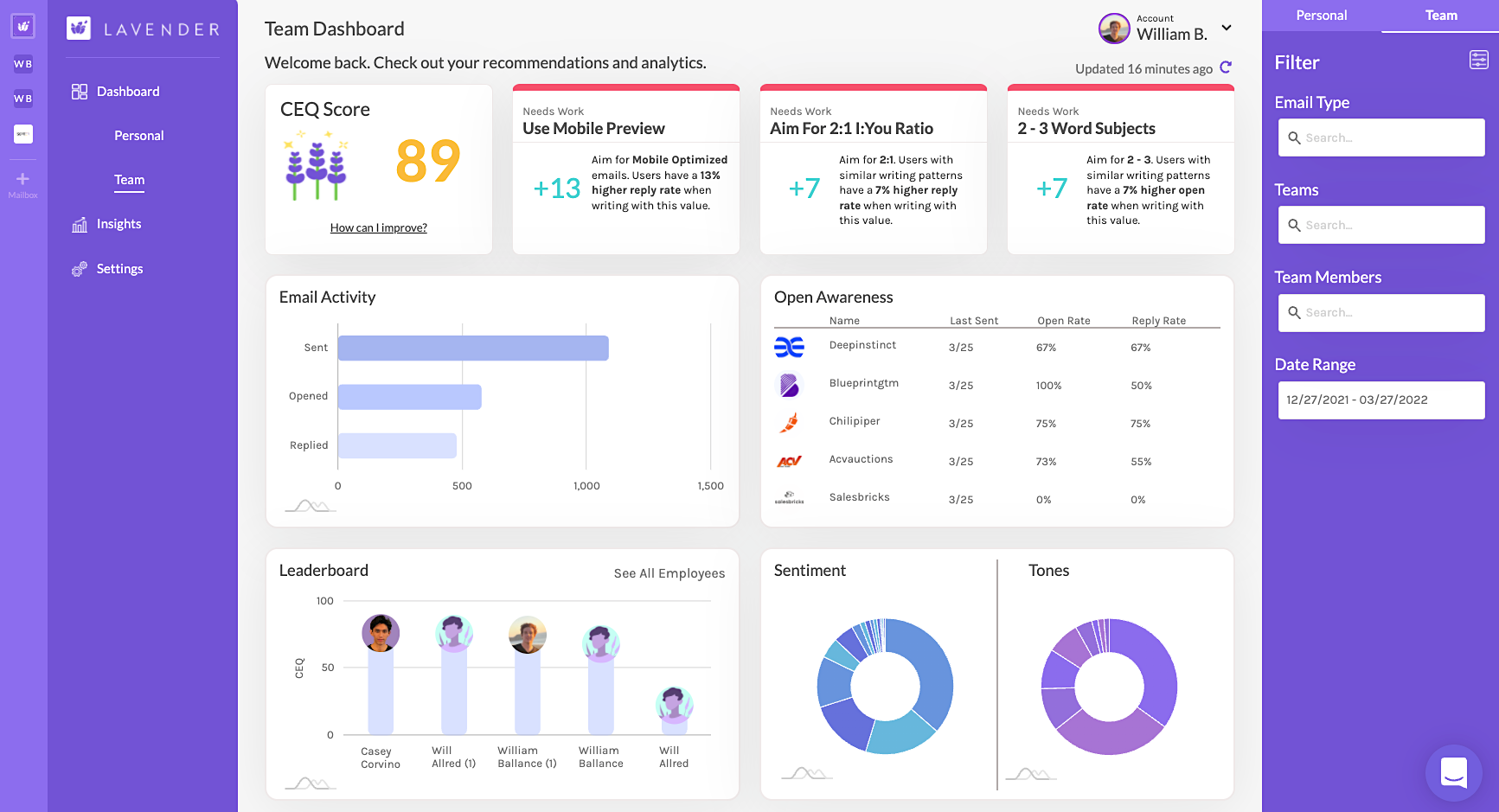
Lavender’s AI Sales Email Coach analyzes and improves sales emails in real time, suggesting clearer language, appropriate tone, and relevant personalization by pulling recipient research directly into your inbox. It integrates with Gmail and Outlook, scores emails before you send them, and provides analytics to track performance and refine outreach strategy.
**Price:** Free, Starter at $27/mo., IndividualPro at $45/mo., Team Plan at $89/seat/mo.
**Best for:** AEs and SDRs running high-volume outbound sequences who want to improve reply rates without manually rewriting every email.
### **6. Best Prospecting & Outreach Tool: Apollo.io**
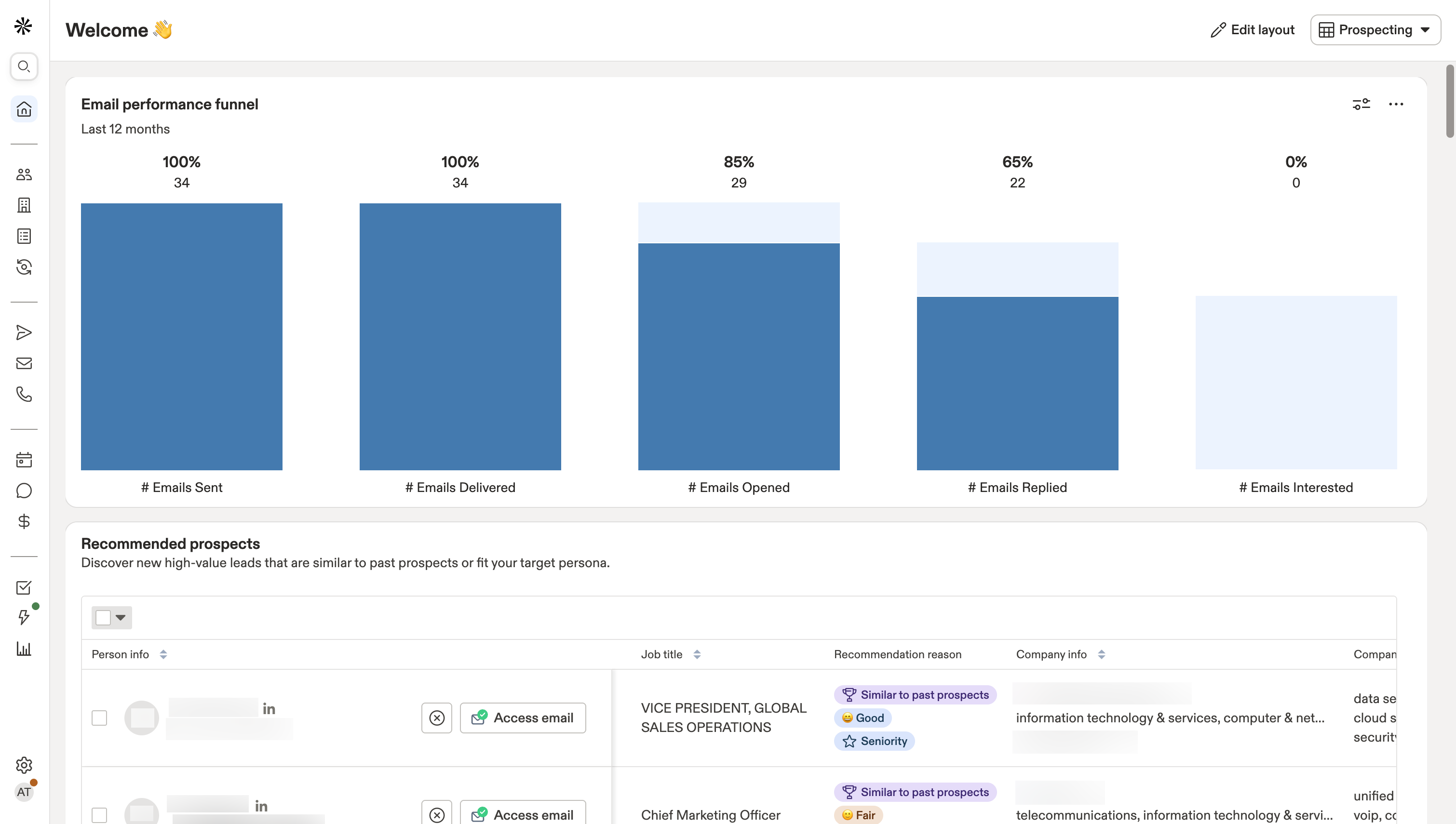
Apollo.io combines AI with a database of over 210 million contacts to prioritize leads, generate outbound messages, and run multi-channel campaigns. AI detects buyer signals like email engagement and web activity, recommends who to reach out to and when, and transcribes and summarizes prospect meetings. It generates message drafts based on account history or intent data.
**Price:** Free (1 user), Basic at $49/user/mo., Professional at $79/user/mo., Organization at $119/user/mo.
**Best for:** AE and SDR teams who need prospecting, outreach sequencing, and meeting intelligence in a single tool.
### **7. Best Notes & Documentation Tool: Fireflies.ai**
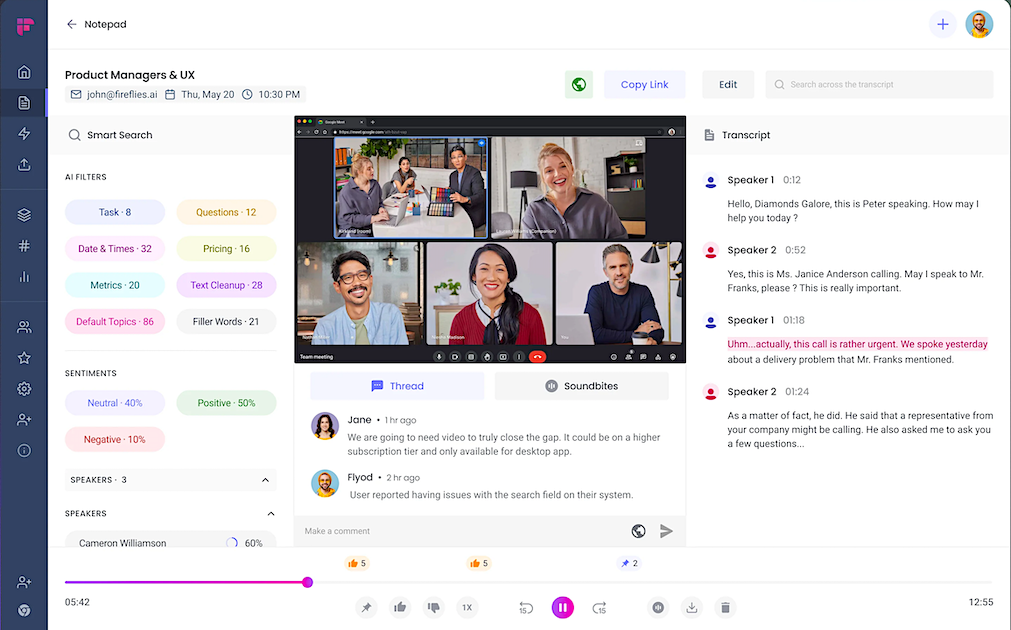
Fireflies.ai uses AI to record, transcribe, and summarize meetings across Zoom, Google Meet, and Microsoft Teams. It identifies speakers, extracts key points, and logs action items. AI-generated transcripts and notes sync with Salesforce, HubSpot, Slack, and Notion automatically. For presales teams, the ability to surface technical requirements and action items from discovery calls without manual note-taking recovers meaningful prep time.
**Price:** Free, Pro at $10/user/mo., Business at $19/user/mo., Enterprise at $39/user/mo.
**Best for:** Sales and presales teams who need reliable meeting transcription and CRM sync without the enterprise complexity of Gong.
### **8. Best Customer Service Support Tool: Intercom**
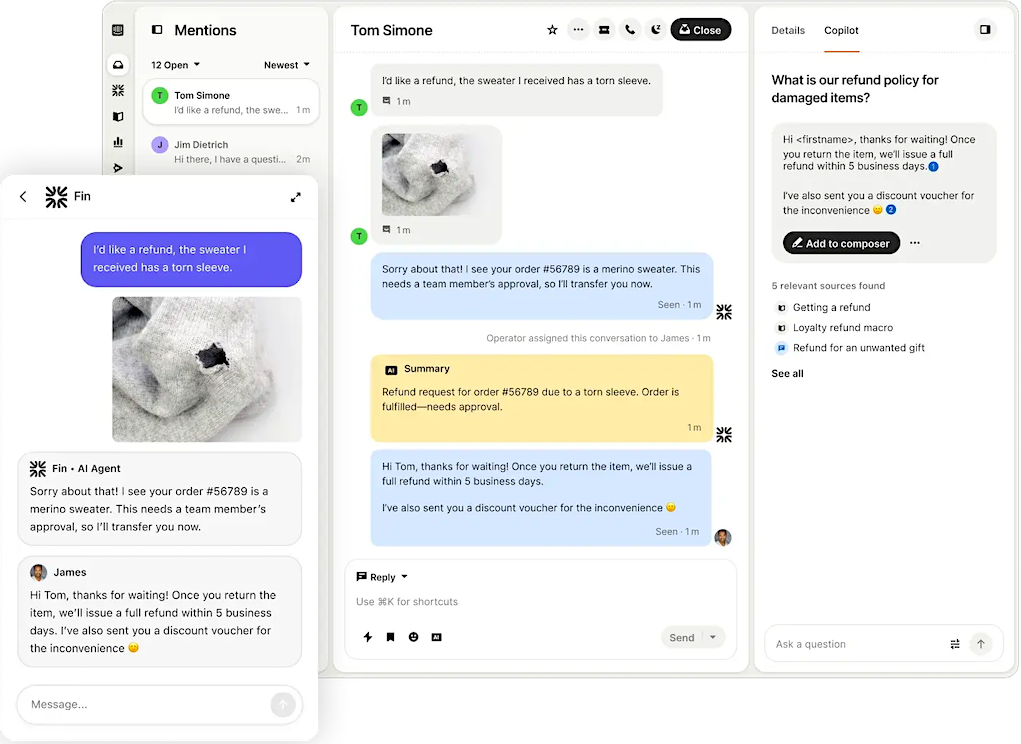
Intercom’s AI customer service platform supports sales by handling inbound product questions with its Fin AI Agent, which pulls answers from your knowledge base. It escalates complex conversations and summarizes context for handoff. AI-enhanced features include conversation routing, tone rewriting, and workflow automation that help sales reps respond to queries faster.
**Price:** By request.
**Best for:** Product-led growth companies where inbound product questions frequently convert to sales opportunities.
### **9. Best Sales Meeting Assistant: Otter.ai**
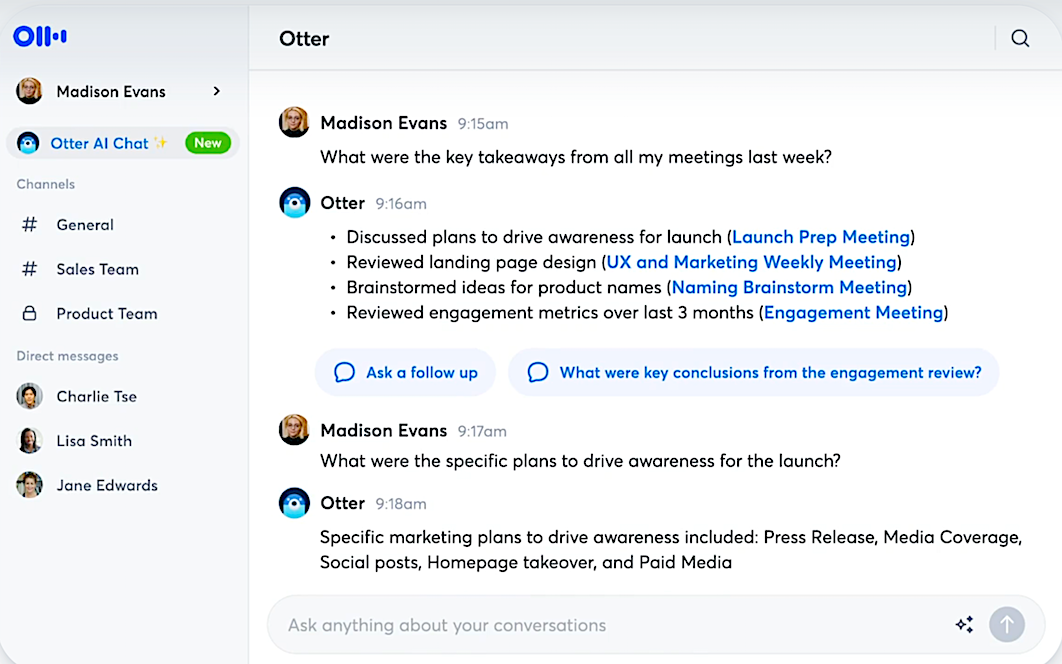
Otter.ai automates sales meeting workflows by joining calls, transcribing conversations in real time, and generating summaries with action items. It identifies key sales insights including BANT signals, and syncs notes directly to HubSpot or Salesforce. Otter AI Chat lets teams query meeting content and draft follow-up emails after the call.
**Price:** Free, Pro at $8.33/user/mo., Business at $20/user/mo., Enterprise pricing available.
**Best for:** Smaller sales teams that want affordable meeting transcription and CRM sync without Gong’s enterprise pricing or implementation complexity.
### **10. Best Proposal Automation Tool: Qwilr**
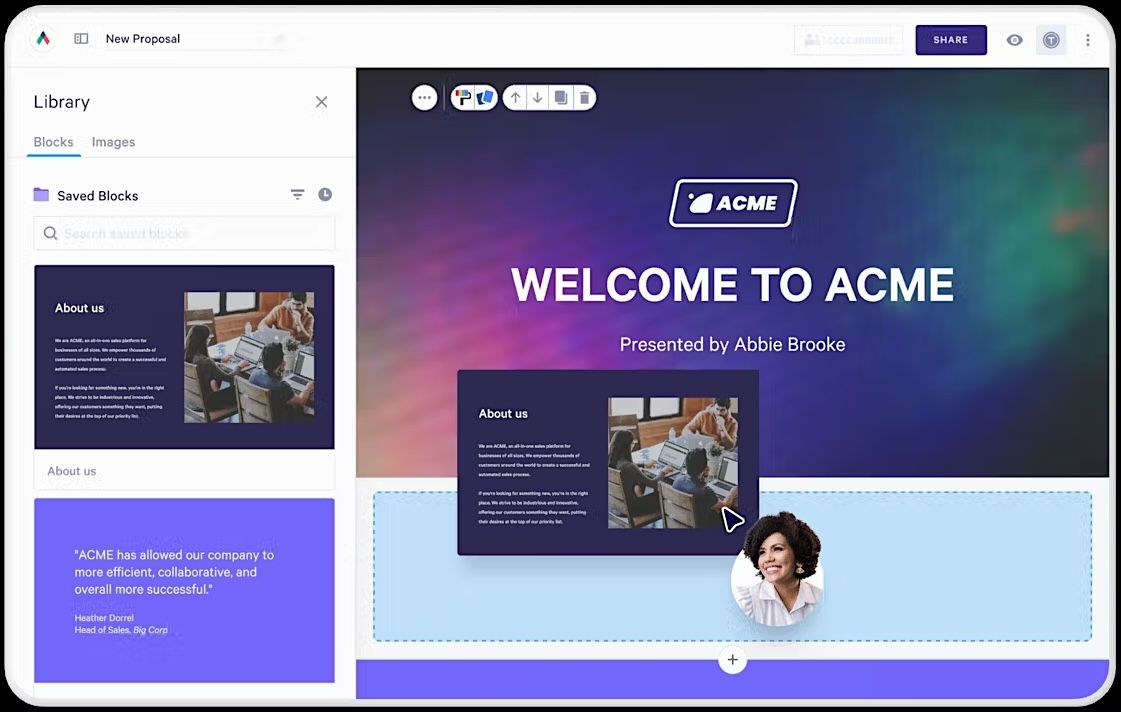
Qwilr uses AI to generate personalized proposals from CRM data, reducing manual work and versioning errors. Sales teams create interactive documents with dynamic pricing, embedded video, and e-signatures. Real-time analytics track buyer activity on proposals, and integrations with CRMs keep deal progress visible across the sales cycle.
**Price:** Business at $35/user/mo., Enterprise at $59/user/mo.
**Best for:** AEs who send high-volume proposals and want buyer engagement data feeding back into their CRM.
### **4. Best Presales Operations Platform: [Vivun](https://www.vivun.com/)**
Vivun looks like a sales tool because it integrates with Salesforce and surfaces deal signals. The distinction is who it is actually built for: SE managers and VP of Presales who have no reliable way to report how their team’s technical work connects to pipeline outcomes. Gong tells you what happened on calls. Salesforce tells you what reps entered. Neither tells the SE manager how many hours their team spent on deals that closed, which accounts are consuming SE time disproportionately, or what technical objections keep surfacing across the pipeline. Vivun captures that layer specifically. It tracks SE activity across deals, measures technical win rates (whether SE involvement correlated with a won deal), and routes prospect product feedback to product teams. The core user is the SE manager who currently runs their coverage reporting out of a spreadsheet and has no credible number to bring to a CRO review.
Core capabilities:
- AI Sales Agent (Ava): auto-generates technical briefs, summaries, and scripts to cut SE prep time.
- Calendar Intelligence: turns meeting data into trackable presales activity without manual entry.
- Deal Health Analytics: scores deals based on presales signals, helping identify pipeline risk earlier.
- Feature Request Clustering: groups product asks from prospects so product managers can see what actually drives revenue.
- CRM and workflow integrations: syncs with Salesforce, HubSpot, Gong, and Slack to centralize presales work.
## **Close Deals Faster with the Right AI Tool for Sales**
The teams winning in 2026 are not the ones using the most AI tools. They are the ones that matched the right tool to the right bottleneck and built the discipline to use it consistently.
For sales and presales teams selling complex enterprise software, the demo is the highest-leverage moment in the buying cycle. A demo that crashes, runs generic data, or forces an SE onto every early-stage call is a compounding velocity problem. [Demostack](https://www.demostack.com/) is the AI-powered demo platform built to solve that problem: high-fidelity AI demo environments, [sales demo personalization](https://www.demostack.com/ai-data-generator) at scale, and analytics that connect demo engagement to pipeline outcomes in your CRM.
See [what Demostack does for sales and presales teams](https://www.demostack.com/win-more-deals-lp).
## Article: From Conflict to Collaboration: A Practical Framework for Sales and SE Alignment
Source: https://www.demostack.com/post/from-conflict-to-collaboration-a-practical-framework-for-sales-and-se-alignment
Tension between Sales and Solutions Engineering shows up in almost every revenue organization.
Account Executives want demos faster. Solutions Engineers feel like demo machines.Both sides carry real pressure and often believe the other side does not fully see it.
The problem rarely comes from effort or intent. The problem comes from teams working without shared frameworks that help them collaborate under pressure.
That reality sat at the center of a recent Demostack webinar featuring Dan Katz, General Manager at Demostack, and Aileen McNabb, presales coach and author of _Three Secrets of Engineering Success_. The conversation focused on how teams move from quiet friction to true collaboration using people skills, self-awareness, and execution systems that remove daily strain.
## Why “Good Enough” Quietly Hurts Deals
Many Sales and SE partnerships operate in a state that feels functional.
Demos happen. Deals move forward. Nobody openly argues.
Yet friction lingers beneath the surface. Sales feels slowed down. SEs feel rushed. Small frustrations repeat because no shared language exists to address them.
Buyers sense that tension even when teams do not name it. Confidence drops during demos. Momentum softens late in the cycle. Trust erodes in subtle ways.
Alignment raises the ceiling for performance.Mediocre alignment quietly lowers it.
## Leadership Lessons From High-Performing Teams
Aileen opened the webinar with a story about leadership that resonated far beyond sports.
Toronto Blue Jays manager John Schneider inherited a team full of talent that had underperformed for years. Results changed when he focused on how people worked together rather than trying to replace individuals.
Schneider emphasized clear expectations, predictable routines, and systems that removed unnecessary decisions. Players spent less energy navigating friction and more energy performing.
Sales and Presales teams face the same challenge. Talent exists. Pressure remains constant. Structure determines whether collaboration breaks down or scales.
## Social Styles Explain Friction Without Blame
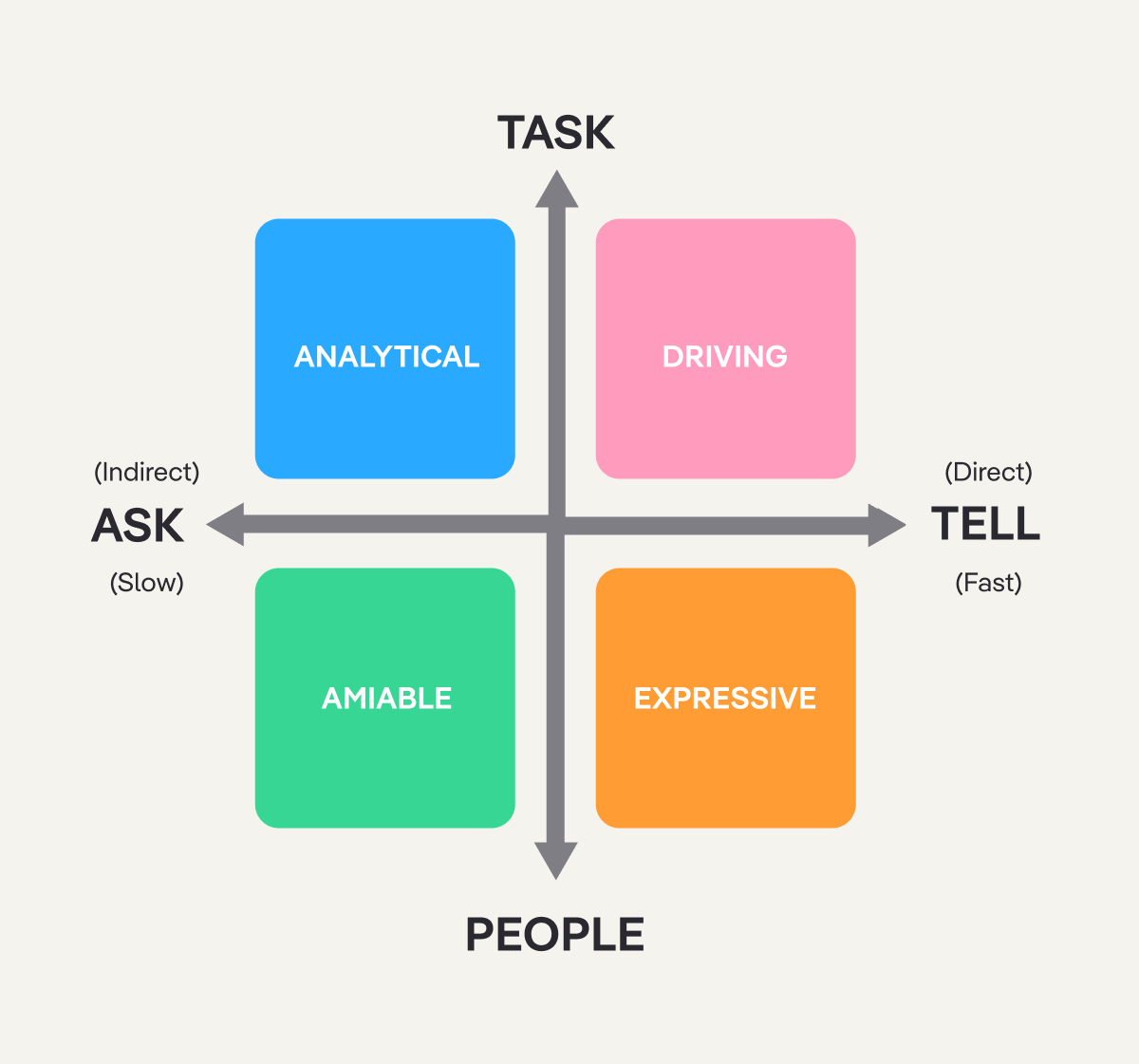
People communicate and decide differently based on two dimensions: assertiveness and responsiveness. Those differences create four common social styles: Analytical, Driver, Amiable, and Expressive.
An Analytical SE often values preparation, accuracy, and structure.A Driver AE often prioritizes speed, outcomes, and decisiveness.
That pairing produces friction when teams lack awareness. The SE reads urgency as recklessness. The AE reads caution as resistance.
Neither interpretation holds up.
Aileen’s coaching experience showed a consistent pattern. Teams improve when they stop trying to change styles and start accommodating them. Awareness depersonalizes conflict and opens the door to practical adjustment.
## Versatility Matters More Than Preference
Self-awareness matters as much as understanding others.
An Expressive SE might enjoy rapport-building during demos. A Driver buyer often wants direct answers first. Flexing communication style based on the room strengthens credibility.
The strongest presales professionals adapt without losing authenticity. They deliver clarity for direct audiences and context for analytical ones. That flexibility separates solid performers from trusted advisors.
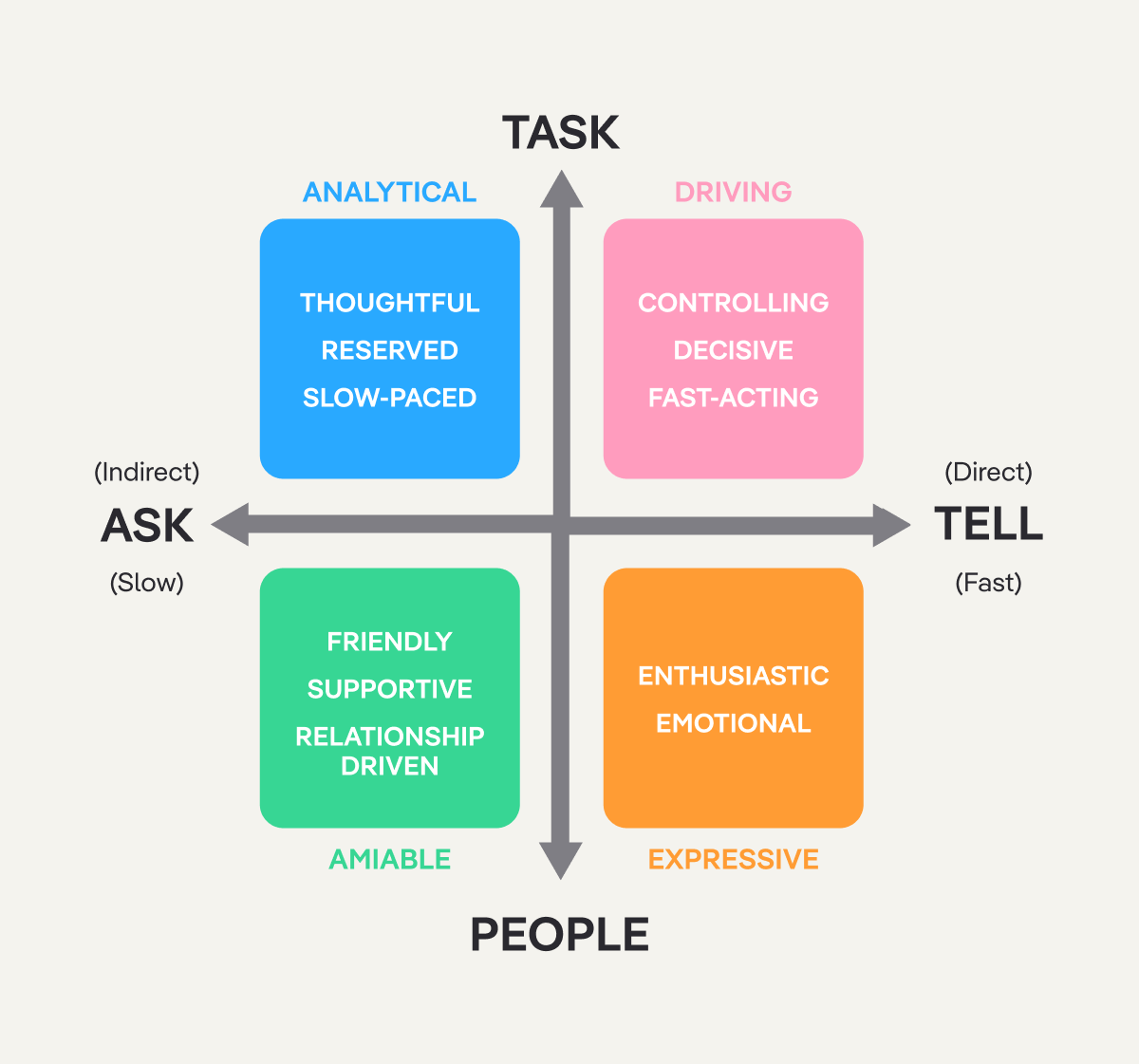
## Character Strengths Shape How People Work
Character strengths describe what energizes people, not just what they do well. The VIA framework identifies 24 strengths, with most people operating from a small set of signature strengths.
Curiosity energizes exploration and learning. Prudence supports risk assessment and precision.Social intelligence fuels relationship-building.
Strengths influence how people respond to pressure. Overuse creates friction. Underuse leads to disengagement.
Teams benefit when leaders pair complementary strengths. An analytical SE working with a socially intuitive AE often covers more ground together than two identical profiles.
## Stress Reveals Patterns Teams Ignore
Quarter - end pressure exposes everything.
Direct teammates issue commands. Expressive teammates criticize delivery.Conflict-averse teammates stay quiet. Analytical teammates disengage.
Those behaviors signal stress, not disrespect.
Teams that recognize stress responses early adjust communication before damage spreads. Clear answers replace long explanations. Structure replaces improvisation. Confidence returns.
## Demos Sit at the Center of Misalignment
Most Sales and SE tension surfaces around demos.
Late changes. Unclear ownership. Fragile environments.
Each issue increases pressure. Each failure triggers defensiveness. Over time, demos stop feeling collaborative and start feeling risky.
High - performing teams treat demos as shared infrastructure rather than one-off performances.
## Where Enablement Tools Change the Equation
Frameworks and awareness help teams communicate better. Execution systems remove daily strain.
Aileen referenced Steve Jobs’ choice to wear the same outfit daily as a way to reduce decision fatigue. The same principle applies to presales work.
Every rebuilt demo environment consumes mental energy. Every manual customization steals focus from strategic selling.
Demo platforms like Demostack remove that load. Stable demo environments, reusable templates, and controlled customization reduce friction between Sales and SEs. Teams spend less time negotiating logistics and more time aligning on the buyer story.
The tool does not replace people skills. It supports them.
## Putting the Framework Into Practice
Teams looking to reduce misalignment can start with three steps:
- Begin with social styles. Share results openly and reference them during moments of friction. Style language depersonalizes tension and speeds resolution.
- Identify character strengths. Understanding what energizes teammates helps leaders assign work that sustains performance rather than burning people out.
Audit demo workflows. Look for repetitive tasks that drain SE time and delay sales momentum. Those friction points signal opportunities for better systems.
## Moving From Collaboration to Consistency
The strongest Sales and SE partnerships do not happen by accident.
They form when teams understand how people operate under pressure, respect different working styles, and rely on execution systems that remove unnecessary obstacles.
Aileen described the goal as moving beyond collaboration toward repeatable best practices. Teams develop playbooks based on what works rather than improvising under stress.
Demostack supports that shift by giving teams a stable foundation for demos. Alignment becomes easier when execution stops fighting collaboration.
When Sales and SEs share understanding, strengths, and systems, buyers feel confidence. Deals move faster. Teams scale without burning out.
That progression turns conflict into collaboration and collaboration into consistency.
## Article: How Synack Transformed Their Demo Strategy
Source: https://www.demostack.com/post/synack-demo-strategy
If your demo program feels like it's held together with duct tape and hope, you're in good company. Many B2B teams wrestle with messy staging environments that overtake the calendar of solutions engineers and leave prospects underwhelmed.
Synack lived that reality for years. Their solutions engineers spent a good chunk of their week resetting demo data and rehearsing safe click paths. Engineering burned time updating seeding scripts every time a new feature shipped. And despite all that effort, demos still broke at the worst possible moments. At a major conference, their CEO demoed to a big prospect and hit a blank error screen.
That failure became the catalyst for change. By counting the hidden costs of their homegrown environment and turning feature tours into short problem-solving flows, with Demostack woven in from the start, Synack cut demo build time from months to hours and freed SEs to focus on buyers.
## The Hidden Costs of Homegrown Demos
Synack combines human researchers with machine intelligence to find security vulnerabilities across complex attack surfaces like web apps, APIs, cloud infrastructure, and mobile. Their platform coordinates thousands of vetted security researchers who probe client systems for weaknesses, then triages and validates every finding before it reaches the customer.
It's a sophisticated orchestration of people, automation, and data that needs to come alive in demos. Like many teams selling complex products, they built a staging environment seeded with fake vulnerability data and relied on a carefully memorized click path to avoid broken pages. The setup worked….until it didn't.
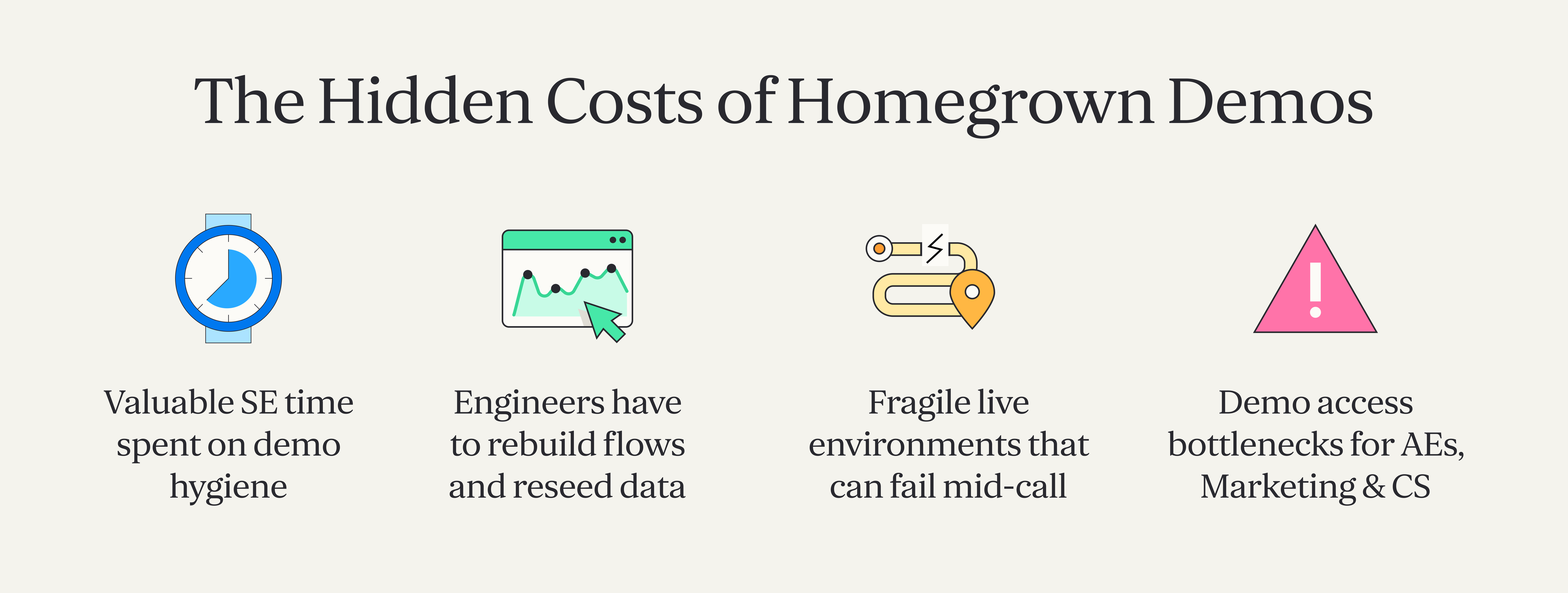
With this homegrown approach, they found that their solutions engineers were spending roughly 20 % of their time, or about one working day per week, just resetting demo data, cleaning user accounts, and rehearsing the safe path for every call. While engineering burned precious time and effort updating the seeding script whenever new features shipped.
Sellers call this reset chaos, among other, more colorful terms. It steals time from the only thing that matters: talking to buyers.
Even with all that effort across the team, the demos still were hit or miss. At a major conference, Synack's CEO tried to demo a familiar flow with a big client and was hit with a blank error screen. And that was the end of that sales cycle. That single failure turned their simmering annoyance with their demo approach into a board-level concern and triggered the search for a safer platform.
But the real cost wasn't just the broken demo. It was the constraints of their homegrown platform. Every demo followed the same flow, hit the same pages, clicked the same buttons, and told almost the same story. CISOs sat through technical weeds while analysts endured executive dashboards. It was a mess.
Worst of all, AEs wouldn't present without an SE there to guide every click, which created another bottleneck. Now every demo required an hour or more from a solutions engineer.
Marketing couldn't repurpose anything for the website or customer onboarding because they had no visibility or access to the homegrown environment. The demo was trapped in pre-sales, doing a fraction of the work it should have been doing across the entire buyer journey.
Other companies have measured what this costs. Gainsight saved more than 40 SE hours per month and improved win rates by 25% after abandoning their homegrown environment for a dedicated platform. Synack saw the same pattern in their own numbers and made the call: change was worth the investment.
## A Moment of Truth and a Mindset Shift
After the conference disaster, Synack's leadership formed a tiger team to find a better solution. The first step was simple: figure out how much demo maintenance is costing us.
They tallied the hours spent resetting data and counted every engineering ticket tied to demo maintenance. The number shocked them. It costs a full-time engineer’s worth of time and salary each year just to keep the main demo running. Once they saw that number on paper, there was no going back to their homegrown environment.
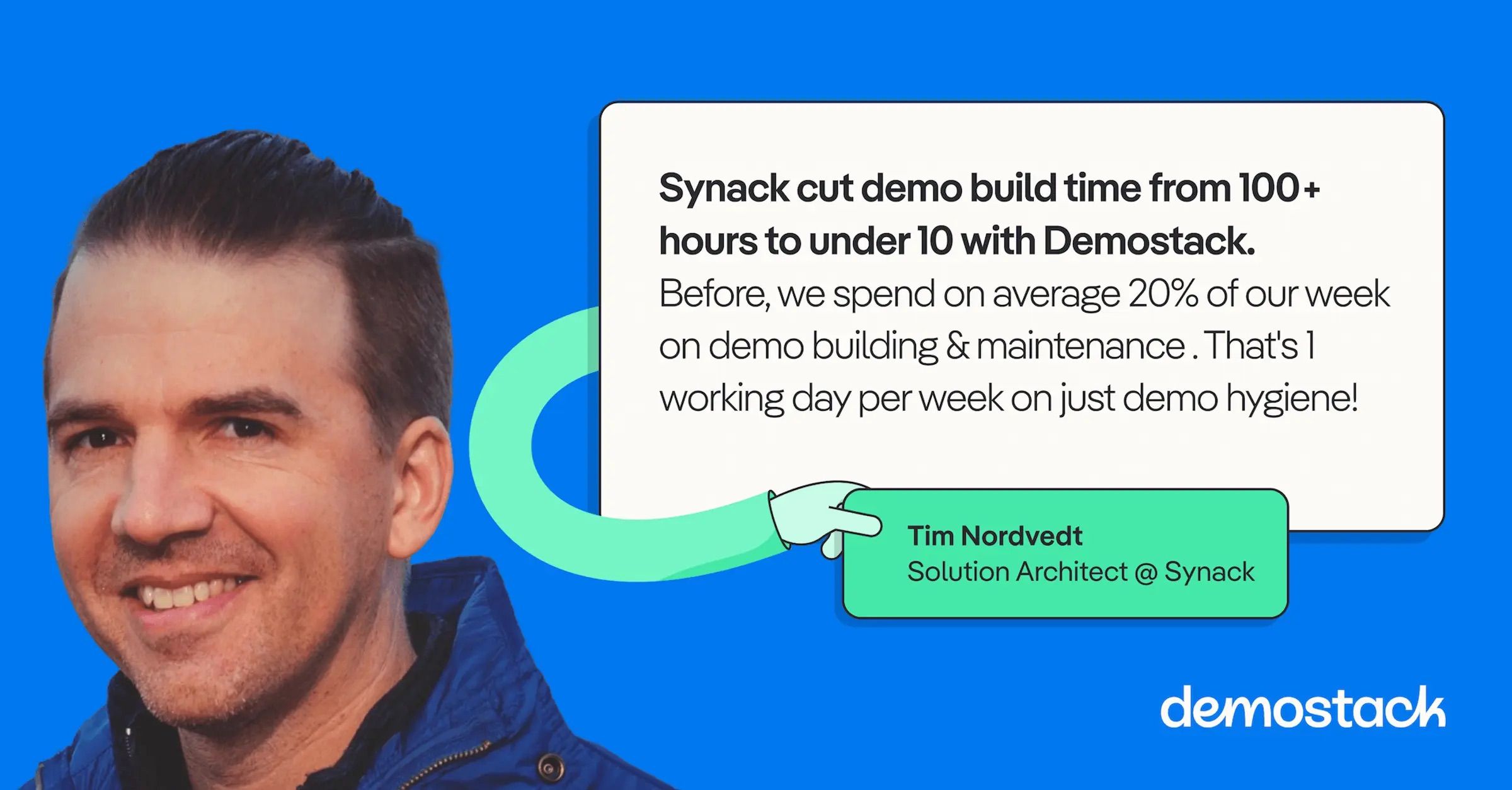
But the team didn't just want to fix the technical problem. They wanted to rethink the entire demo strategy. Their old approach tried to show every feature and prove the platform could do everything by overwhelming the prospect. That needed to change as well.
Prospects don't want to hear a list of capabilities; that’s what the website is for. They want to see how the product solves their specific problem in a handful of clicks. So Synack started building focused stories for each persona, mapping pain points to high-impact moments. Their goal with each demo quickly shifted from a generic product walkthrough to a personalized problem-solving session.
That insight about the cost of demo maintenance led to another realization across the team.
Demos couldn't stay locked in the SE team. AEs needed to run demos without an SE sitting on calls, watching every click. Marketing needed assets they could put on the website. Customer success needs onboarding experiences. None of that was possible with a fragile homegrown environment where one wrong turn broke everything.
They needed clone environments that looked and behaved like production, modular assets that could be assembled into different stories, and tools that let non-technical users operate confidently. The requirements were clear. Now they needed a platform that could deliver.
## **Selecting the Right Demo Platform**
Synack's evaluation came down to three non-negotiables. A platform that wouldn't break during a board meeting. Modular demos that could be mixed and matched without calling engineering. And the ability for everyone on the go-to-market team to run demos without an SE on standby.
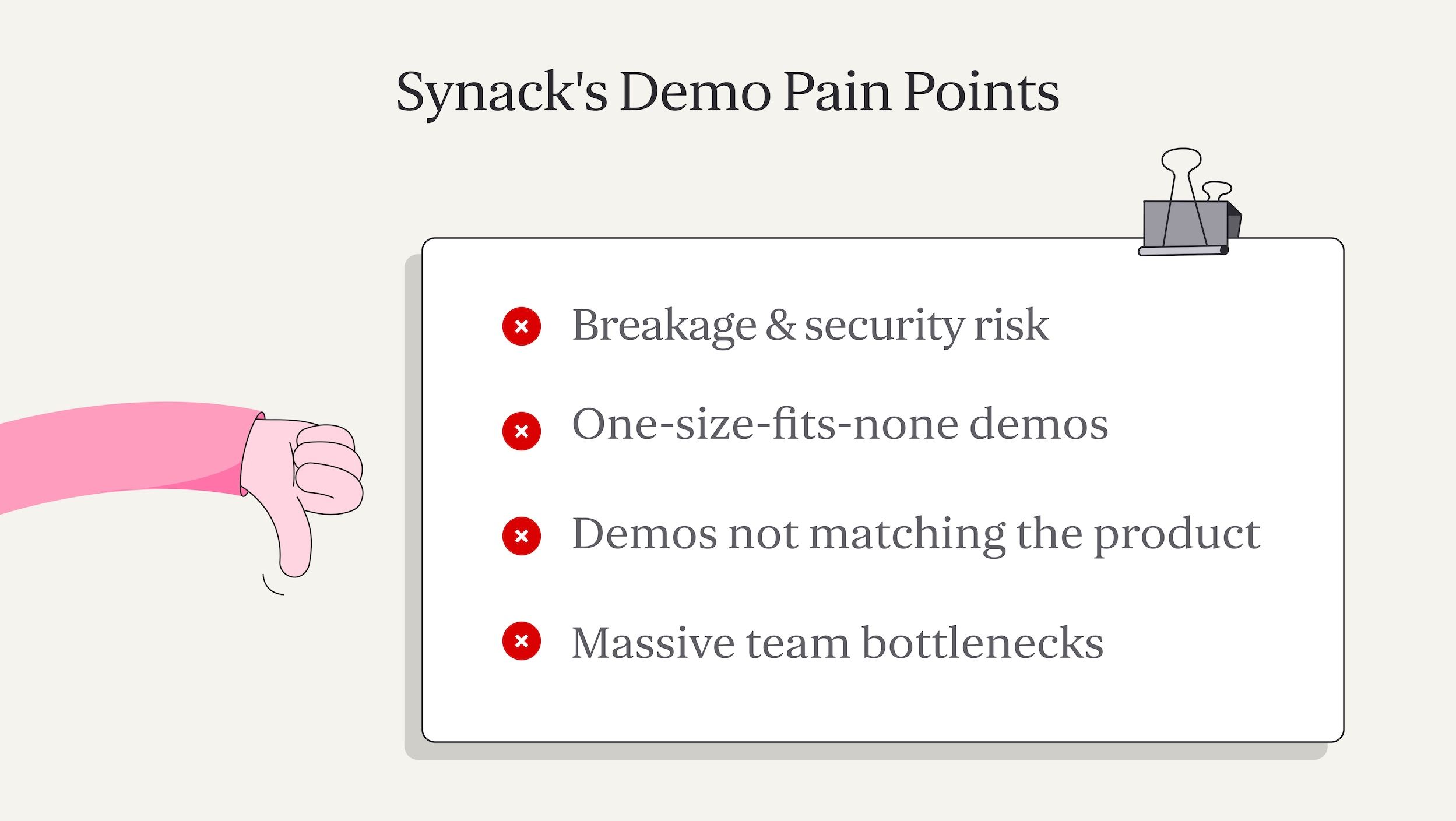
Demostack met those requirements in ways their homegrown setup never could.
First, the security and stability problem. Synack needed sandboxed replicas of their production environment with no back-end dependencies. Demostack clones the product so prospects see a version that looks, feels, and behaves like the real thing without touching live systems or exposing customer data. No more safe paths, no more memorized click sequences, no more crossing fingers before a big presentation.
Second, the modularity problem. Instead of one monolithic demo that tried to show everything to everyone, Synack wanted short, focused flows they could assemble for different personas and buying stages. Demostack makes that possible. Solutions engineers build a library of modules (a CISO dashboard here, a vulnerability report there) and sellers pull the right pieces together in minutes. Live demos, self-guided tours, leave-behind sandboxes. All built once, then mixed into playbooks for discovery, technical evaluation, or executive review.
Third, the speed problem. Synack needed to keep pace with product releases without waiting on engineering to rebuild environments every time a feature shipped. Demostack's cloning tools and AI-driven data editing meant updates could happen in hours instead of weeks, with no technical support required.
Fourth, the accessibility problem. Demostack puts demos within reach of the entire go-to-market team. Deep links embedded in internal wikis let sellers grab the right demo in one click, customize a few details if needed, and launch. The same assets work for customer success onboarding and marketing can embed tours on the website. When anyone can find and use a demo in seconds, it stops being a pre-sales bottleneck and becomes a company-wide asset.
Synack's decision reflected what Demostack has been building toward for years: clone your app quickly, tell modular stories, put demos in everyone's hands, and iterate based on what works. By choosing a platform that supports live demos, async tours, and leave-behinds, Synack could meet buyers wherever they were and keep the story consistent no matter who delivered it. Now they just needed to implement it.
## Mini-Demos + Accelerated Sales Cycles
Once Synack had the platform, they rebuilt their approach. Hour-long feature tours became 10 to 15-minute demos woven throughout the sales cycle. Sometimes even shorter.
An SDR on a qualification call might show a 90-second glimpse of the CISO dashboard when a prospect mentions visibility concerns. A later technical conversation digs deep into vulnerability reports. This nuanced approach respects the buyer's time and delivers the "aha" moment in the first ten minutes instead of burying it forty-five minutes deep into a slog.
With this new approach, SEs built a library of focused assets like dashboards, reports, and workflows. Sellers grabbed what they needed to build personalized Playbooks for each conversation.
AEs ran demos without an SE babysitting every click. Customer success used the same assets for onboarding. Marketing embedded ungated tours on the website, and lead conversion improved because prospects self-qualified before ever talking to sales.
The time savings were real. SEs stopped spending 20% of their week on demo hygiene. That's a full working day they got back to spend with customers. And engineering stopped burning tickets to fix broken seeding scripts.
The culture also shifted throughout the company. SEs moved from maintenance mode to designing flows and coaching colleagues. The whole company rallied around telling a consistent story.
Synack isn't alone. Gainsight saw a 25% increase in win rates and saved more than 40 SE hours per month after making similar changes. Motive's trial conversions and win rates improved almost overnight. Qualtrics generated 1,000 marketing-qualified leads and $7.2 million in pipeline within 90 days. When you combine modular demos with company-wide access and fast iteration, the results follow.
## A Blueprint for Scaling Your Demo Program
Synack didn't just swap tools and call it done. They rethought their entire approach to demos. The shift from fragile staging environments to a scalable platform required changes in how they built demos, who could run them, and what they measured. These lessons also map nicely to what we call the D.E.M.O. Framework. It's a repeatable approach that other teams can follow to get similar results.
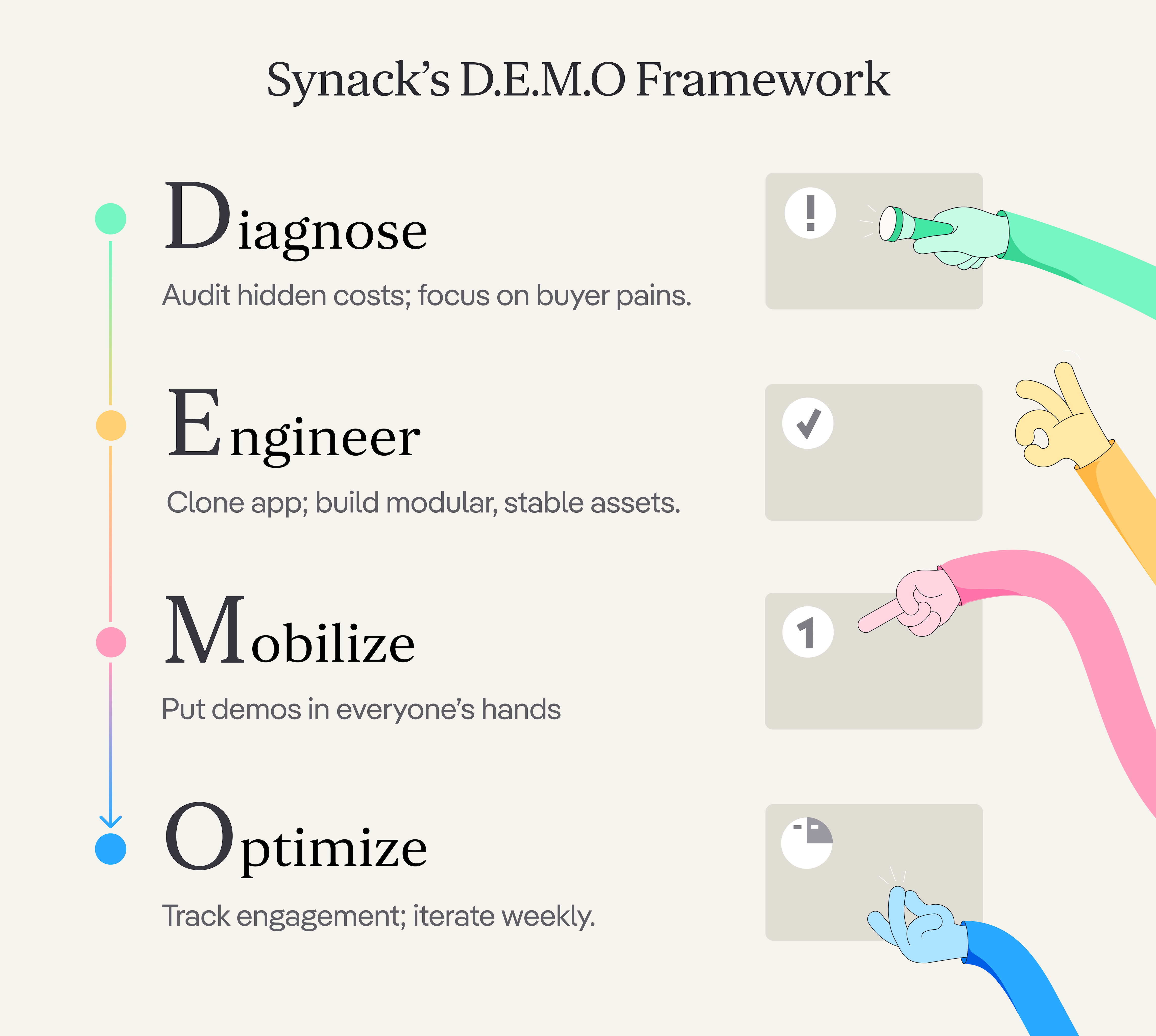
**Audit the hidden costs.** Before you can build the business case for change, you need to know what the current approach actually costs. Count how many hours your SEs or engineers spend resetting demos or updating data each week. Synack found they were burning the equivalent of a full FTE just on demo management. That number shocked them and built the business case for change.
**Obsess over your customer's story, not your product features.** Once you understand the cost, shift your focus to what buyers actually need. Synack stopped trying to show every button or screen and started focusing on their key personas’ pain points. They built short demos that solve those problems in five minutes or less. And cut the rest. This is what the D.E.M.O. Framework calls the Diagnose step. Take the time to dive deep during discovery to understand what matters to the buyer, then map those pains to high-impact moments in your product that solve them. Less is almost always more in this case.
**Put demos in everyone's hands.** After you know what to build, create the infrastructure that lets anyone use it. Clone your application into a new environment and create modular assets you can mix and match. Synack built its library of modules once in Demostack, and now sellers assemble custom playbooks in minutes. Make demos accessible throughout your team so anyone can launch them without calling engineering.
**Treat demos as flexible assets.** The final step is extending demos beyond the sales call. Synack doesn't just use demos for live calls. They embed tours on their website, include them in emails, and tailor them for different conversations. Track what prospects engage with, sync that data to your CRM, and use it to refine your approach. When demos work across the entire buyer journey, they stop being a bottleneck and become a growth lever.
Synack's story shows that scaling enterprise demos isn't about doing more. It's about doing demos differently. Homegrown environments and monolithic narratives sap resources and frustrate buyers. By adopting a clone-based platform, focusing on the buyer's problems, and empowering the entire go-to-market team, Synack turned demos from a bottleneck into a strategic advantage.
## Download the D.E.M.O. Framework ebook
So if you’re done gambling on unpredictable homegrown environments, scattered stories, and unclear analytics, download the ebook below.
Link: https://www.demostack.com/guide/demo-frame-work
## Article: No More, No Less: How To Give Better Demos
Source: https://www.demostack.com/post/no-more-no-less-demos
There is a moment in almost every demo when the energy changes.
Discovery went well, and the prospect was pumped, but then the demo call started to stretch. And it really never stopped stretching.
A click here, another tab there, a new workflow to view, one more feature that nobody asked to see, a new sandbox after the call. It’s a lot to take in.
That story you were trying to tell starts to blur, and the buyer tries to connect the dots on their own.
What began as a simple conversation feels like a full-blown training session. Next stop, confusion! Population, your prospect. Well, ex-prospect.
The best demos don’t attempt to show everything.
Instead, they do one thing very well: address the pains the buyer shared in discovery and try to “_solve exactly_” those pains. **No more, no less.**
When you carry that discipline through the demo prep or call, your team stops over-demoing to a prospect and starts presenting actual solutions to their pains. It’s a game-changer.
## Why teams over-demo
If over-demoing is such an obvious mistake, why does it happen so often?
Most of the time, over-demoing comes from fear, and sometimes laziness.
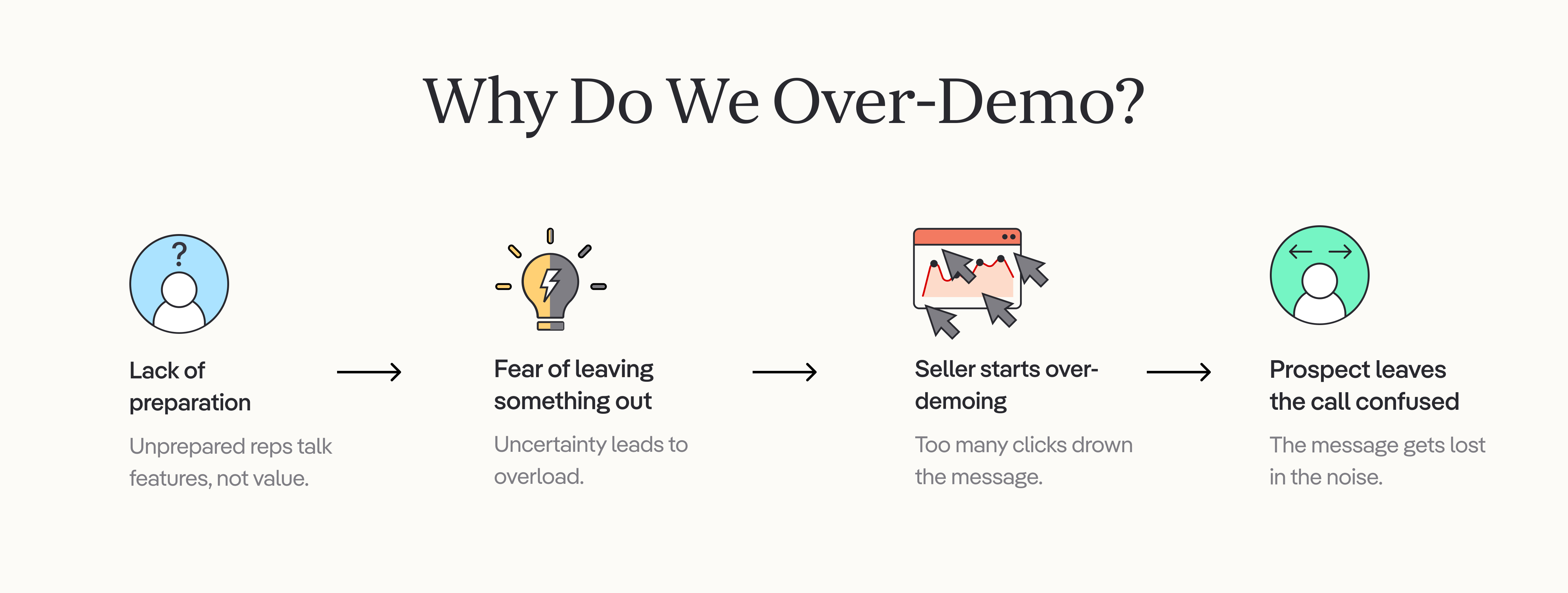
Sellers are afraid of leaving something out of their demo that actually might move the needle with a specific prospect. Mostly because reps don’t take the time, or don’t have an idea how, to truly understand what a prospect is struggling with. And how the product they are selling can be a solution to those pain points.
So they show everything in your product, and more. It seems like a lot of reps have the mindset of: _“If we don’t show this feature, the buyer might think it doesn’t exist._”
That feeling doesn’t stop with the rep. Product teams push new releases into the demo environment, hoping to get more airtime and usage. Before long, that clean story that you hoped to tell is crowded out by the company’s internal agenda. What was supposed to be a conversation about the buyer’s pain mutates into a rambling product onboarding session.
Nobody really trains reps on what _not_ to show. So when the pressure is really on, their muscle memory takes over, and the marathon of clicks follows. Showing every screen or feature feels a heck of a lot safer than awkward silence. Yet, those frantic clicks rob the story of its punch.
And the people best positioned to break the cycle or spot all the flaws with over-demoing are often too busy to do it. SEs are stuck running from call to call, patching busted environments, and burning themselves out. One sales leader told us: _“We spend more time resetting broken demos than helping reps close.”_
So without that coaching and guidance, over-demoing continues across your team. Your reps probably believe that throwing everything at the buyer feels safer than holding back.
The opposite almost always happens, especially with complex product demos. Instead of leaving the demo feeling like their pain was understood, buyers are unsure what they should care about. Sure, they saw a lot of cool things, but how is that going to help them sell more next quarter or onboard their team more effectively? Maybe your competitors will have some answers.
## No More, No Less in practice
You have just a few minutes before the prospect starts to tune you out and think about what they are going to have for lunch. _No More, No Less_ is how you grab their attention from the beginning and keep it.
A strong opening sets the tone. Instead of diving headfirst into the product, take a beat and succinctly repeat the pain point or key problem back to the prospect. That single move does two things at once: it proves you listened, and it frames the entire conversation around their world, not yours.
That is what “_solve exactly_” means. You shape the conversation around the pains you already uncovered. If the buyer told you they have three challenges, you show them three solutions. No more, no less.
This removes the pressure to show everything and replaces it with a path you can follow. This principle is not about hiding the weaker parts of your app or not telling a complete story. It is about keeping the focus on what matters to this prospect. And your newest feature usually isn't what they care most about.
On the call, stay focused and conversational. Before each new screen or feature, restate the relevant pain point and then immediately show how your product can address it. Once the link is clear to them, ask them to imagine how their day-to-day would change if this product went live at their company tomorrow. That question pushes the demo beyond clicks and screens into the real world and makes it so much easier for them to champion this product after the call.
Detours from your ideal path will happen, but they don’t have to break the flow. If someone asks to see something unrelated to their main pain points, promise to follow up on their question and move on.
With Demostack, that follow up is easy. Drop the flow into a sandbox or a short guided tour and send it directly to them after the call. It's a win-win. They get their answers, and you don’t get distracted from your story.
Don’t forget to finish the call as focused as you kicked it off. Take the time to recap the problems in their words and the screens, flow, or features you highlighted to solve them. Then connect those problems or pain points to the overarching business goals of the company. If you have done your research, all of this information should be easy to highlight.
To really put a bow on the whole demo, send your prospect a leave-behind that mirrors the same journey. They can replay it, share it, and validate it on their own. Use Demostack to not only create that asset but also get insight into what they explored, who saw the asset, and where to follow up.
That’s _No More, No Less_ in a nutshell. It’s not an overly complicated principle, but it works. And almost every GTM team can benefit from it. If there’s only one thing you take from this section, let it be this: the buyer’s pain points are key, not your product's newest features.
## From practice to playbook
A principle is only as strong as the system around it. Sellers can’t _“solve exactly”_ if your team doesn’t have a way to show the right things safely, reliably, and on demand.
That’s why _No More, No Less_ can’t just be a mantra that you mention in training. It only becomes powerful when sellers have a system that makes it easy and automatic. The companies that succeed don’t just tell sellers to stay focused; they design it into the way demos are prepared and delivered.
That discipline begins with discovery calls, where every opportunity should highlight not only the business problem as a whole but the pains beneath it. On the surface, this feels a lot like admin work, which is why teams often skip it.
Ask any experienced sales rep, and they will tell you it’s the whole foundation of the demo. If the problem is unclear, there is no through line that a rep can follow. So over-demoing quickly fills that void.
Once all that information is clear, transform the business goals and pain points into an easy-to-follow story. Enable each rep with a compelling story that they could run in their sleep. This guided approach makes the story repeatable, not robotic. When you make this time investment, buyers start to see a compelling and confident demo, while reps know exactly how to show _No More, No Less_ without panicking.
All of this assumes that reps can easily create, personalize, and scale demos, which isn’t always the case with homegrown demo environments.
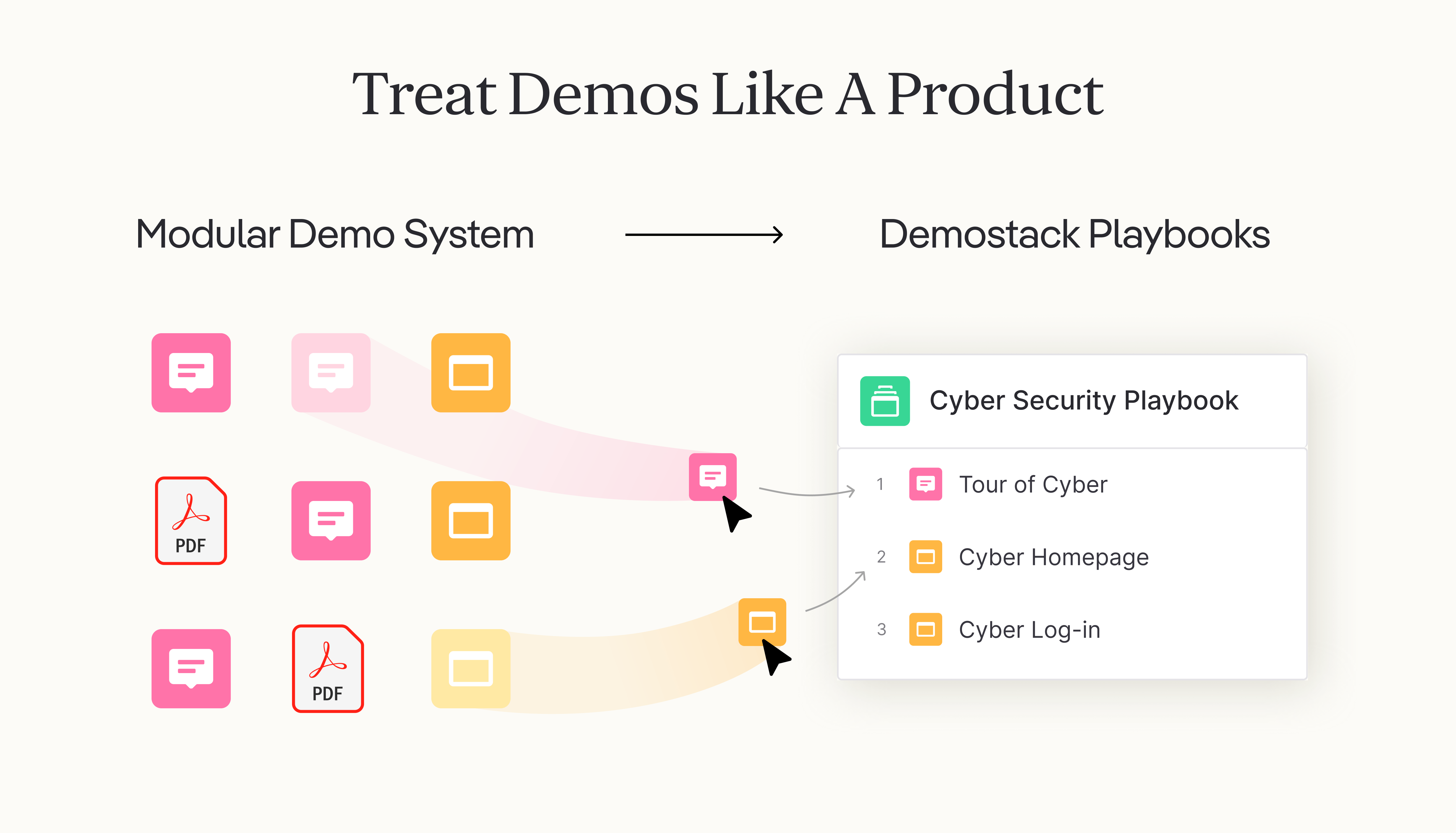
This is where Demostack shifts your whole approach to demo creation. Instead of hoping a fragile demo environment actually works, or waiting for an engineer to rebuild one, GTM teams can spin up a customized demo in minutes.
The personalized demo looks and feels authentic because it is an exact copy of your live app. By [creating a clone](https://www.demostack.com/post/how-to-clone-your-app), you're protected from showing sensitive data and experiencing demo failures. That gives sellers the confidence to tee up their entire demo and know it will run perfectly with a prospect.
Keeping those demos up to date is just as easy. When the product ships new UI updates or a killer feature, the team just re-runs the [Cloner](https://www.demostack.com/cloner), and the story stays current. That same asset can be used across the entire sales cycle, so the message stays consistent whether or not you’re in the room.
With a managed demo system for personalizing demos, everyone on the GTM team can do their best work. AEs can run crisp first-call demos, SEs can focus on technical depth later, and the sales cycle starts to shrink.
That is how _No More, No Less_ stops being a theory and becomes an operating system.
## Scaling No More, No Less
Even when a team applies _No More, No Less_ well, the story can fall apart once you zoom out across an entire company. Every rep ends up running demos their own way. Instead of clarity, the buyer sees inconsistency across the cycle. And worst of all, leaders are left guessing what story is _actually_ resonating with the market.
The practical fix is to treat demos like a real product owned by the GTM team, not a pile of static assets. First, build a modular demo library with overlays, live environments, tours, and sandboxed leave-behinds so sellers can mix and match what they need. Then simply combine those assets into demo Playbooks by industry, persona, or stage of the deal, giving every rep a reliable path and consistent story.
Consistency is not enough. Buyers still want to see their world reflected in your product. Demostack makes personalization easy. With just a few clicks, a seller can update key info and data without breaking the underlying demo environment. The result is a demo that feels tailored to the prospect yet remains aligned with the company’s story.
Visibility across the entire process is what takes the system to the next level. Demostack automatically connects to your favorite CRM and tracks every demo interaction across the cycle. Team leaders can see how closely they follow the intended story and how buyers interact with the leave-behinds. Coaching improves as well, because the advice and guidance are grounded in observable patterns rather than gut feelings.
A demo approach that once felt like a collection of off-the-cuff performances can now become a wholly managed operation that the company can refine, measure, expand, and trust. That is the point where _No More, No Less_ evolves from a tactic for individuals or teams into an operating model for the entire organization.
## The takeaway
Great demos feel smooth because the hard work is already handled behind the scenes.
When the GTM team operationalizes discovery and demo creation, with clear playbooks ready to deploy, sellers stop worrying about breakage and start understanding the buyers.
Confidence in their story replaces clutter, and the demo flow converges on only the problems or pain points that matter.
Every click or screen needs to earn its place in your demo because attention is the scarcest budget on any call. And patience evaporates once the story shifts from their problem to your product.
That is the promise of Demostack: stable demos that tell a consistent story, without relying on engineering, giving every rep a clear path to demo success.
And because the demo lives outside fragile, homegrown environments, teams stop fearing surprise updates and focus on guiding the conversation to real value.
With this approach, sellers start to feel prepared for every call on the calendar, and they show _No More, No Less._
Want to learn more about improving your demo operation? Check out the D.E.M.O. Framework ebook and webinar:
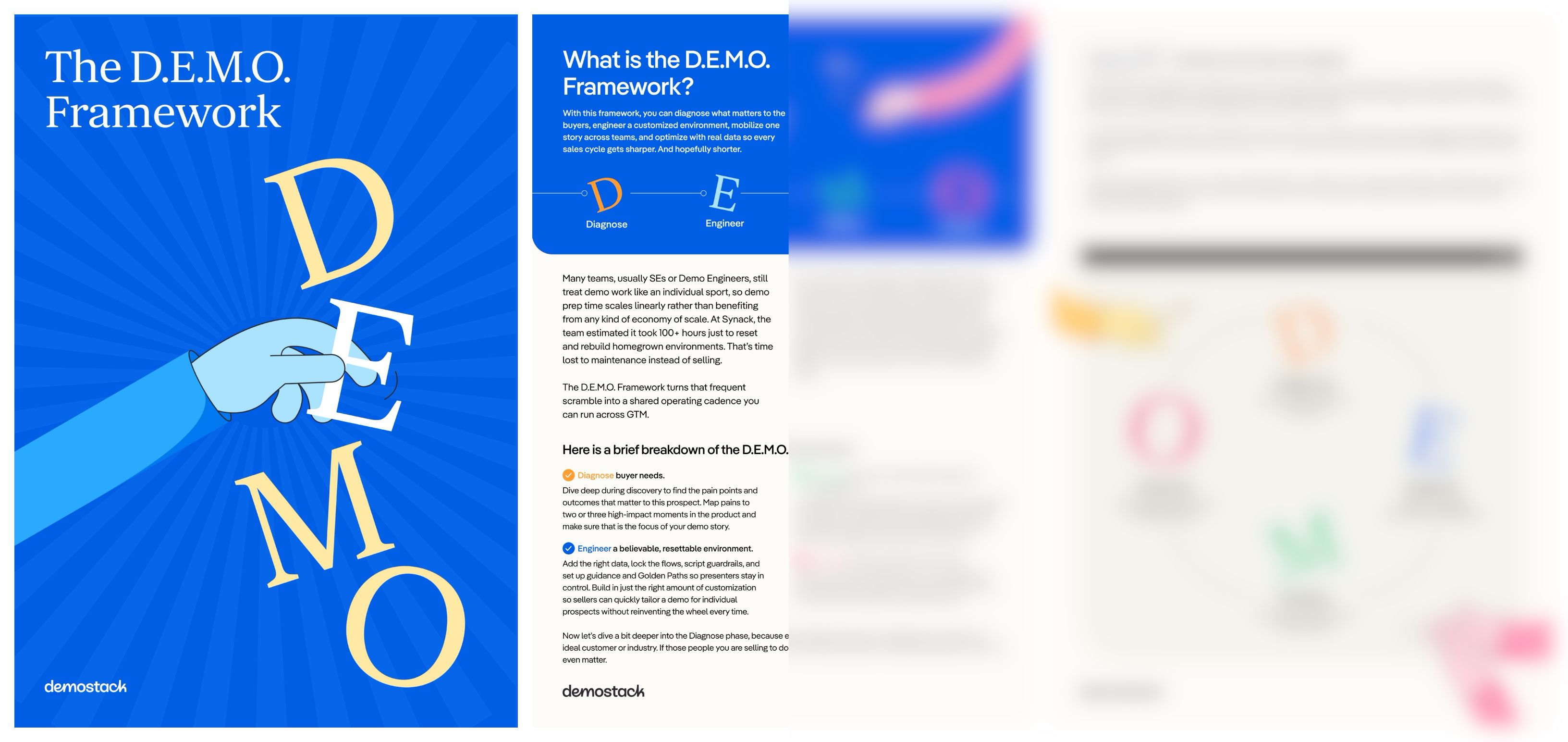
Link: https://www.demostack.com/guide/demo-frame-work
## Article: The D\.E\.M\.O\. Framework: Turn Chaotic Demo Prep Into A Shared Operating System
Source: https://www.demostack.com/post/the-demo-framework
You know the feeling when a demo goes sideways.
Extra windows open, the sample data looks…off, and the new feature you wanted to spotlight doesn’t seem to exist.
Buyers don’t see “_a small glitch,”_ they see a product they can’t trust.
Instead of telling a focused and personalized story with the demo, the call quickly devolves into a tour of the whole product. Just to fill some time.
This isn’t a talent issue; it’s an operations problem.
When every person on the GTM team builds their own environment, updates need an engineer to ship, and data changes overnight, even top sellers get tripped up.
The pain comes through clearly when you listen to GTM leaders and teams. They all spend hours, sometimes hundreds of hours, preparing demos, only to watch them fall apart in front of buyers.
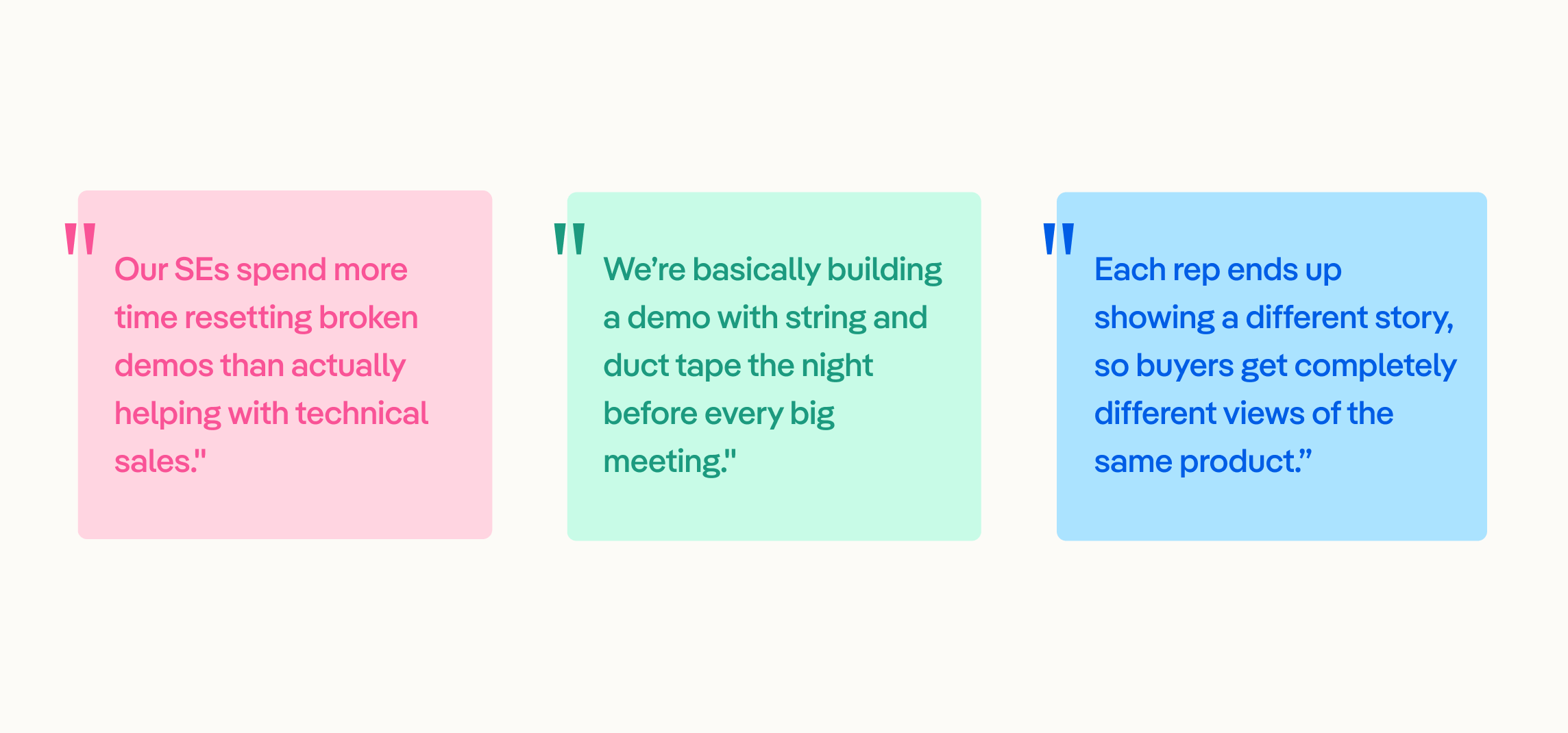
What should be a repeatable system turns into a series of one‑off fire drills. And your SEs are being pulled in a hundred different directions.
The D.E.M.O. Framework was built to fix that.
With this framework, you can diagnose what matters to the buyers, engineer a customized environment, mobilize one story across teams, and optimize with real data so every sales cycle gets sharper. And hopefully shorter.
## What is the D.E.M.O. Framework?
Many GTM teams still treat demo work like an individual sport, so demo prep time balloons quickly, and first meetings…don’t always land.
The pain comes through clearly when you listen to GTM leaders and teams. They all spend hours, sometimes hundreds of hours, preparing demos, only to watch them fall apart in front of buyers.
The D.E.M.O. Framework turns that frequent scramble into a shared operating cadence that you can run across ICPs and segments:
- **Diagnose** what actually matters to the buyer.
- **Engineer** a stable, resettable environment with guardrails.
- **Mobilize** one story across every AE, SE, and partner.
- **Optimize** with real analytics so every cycle gets sharper.
This isn’t just another checklist to follow. It’s an operating rhythm that gives AEs a plan, SEs a stable environment, leaders reliable coaching signals, and the whole GTM team a ton of data to act on. When teams run this framework at scale, demo chaos becomes a thing of the past.
Motive saw trial conversions lift once reps stopped hunting for “_golden nuggets_” and followed a clean Golden Path. While Synack learned how expensive rebuilds had become and cut demo reset time from 100+ hours to only 10 by standardizing the environment.
##
Download the D.E.M.O. Framework ebook
So if you’re done gambling on unpredictable homegrown environments, scattered stories, and unclear analytics, download the ebook below.

Link: https://www.demostack.com/guide/demo-frame-work
It not only breaks down each step of the framework with examples but also includes a 30-60-90 day playbook that you can use to bring D.E.M.O. to your team.
You’ll also see how leading teams cut rebuild hours to single digits and lifted conversions by standardizing the path.
Download the guide and start running the D.E.M.O. framework with Demostack today.
## Article: 10 Sales Communities Young Sales Professionals Should Join Today
Source: https://www.demostack.com/post/sales-communities-to-join-engage-and-grow-with-today
Open up your favorite note-taking app and read closely - we’ve rounded up the 10 best sales communities where you can connect with real sales pros and level up your game.
Included in this list are some large groups with thousands of followers, and some smaller groups with just a few hundred close-knit members. Following larger groups can be helpful for asking questions and getting a broad range of answers, while membership in smaller groups can connect you with others in your specific community, affinity group, or field.
We’ve done the research so you don’t have to - these are, in no particular order, 10 of the best [sales communities]( https://www.demostack.com/post/pre-sales-pros-you-need-to-follow) to join, engage, and grow with today.
## 10 Sales communities to join in 2024
## 1. RevOps Co-op
**2,400+ members**
RevOps Co-op is trusted by over 2,400 sales professionals from respected companies like Slack, Lyft, Stack Overflow, Clari, and Miro, this group, created by Funnel IQ, regularly hosts AMAs, shares video sessions, and runs a weekly newsletter that is essential reading for every sales professional.
> RevOps Co-op provides resources, content, and community for those who ❤️ revenue operations. [Our] weekly newsletter features collected tweets, posts and thoughts on a variety of RevOps topics. We also have a private Slack community with > 2,400 RevOps pros from companies like Slack, Lyft, Clari, Miro, and more.
##
## 2. Women in Tech Sales
**1,500+ members**
Female salespeople in the tech industry looking to connect with other women in the field should consider joining [Women in Tech Sales](), a LinkedIn-based group. Women in Tech Sales offers an online forum and gathering place for female tech sales experts to form stronger networks, build relationships, and discuss tricks of the trade. Here’s their brief description from LinkedIn:
> This group is for women who work in sales. It is meant to be a place for women in sales to connect with each other, support each other, and learn from each other.
##
## 3. National Sales Network
**50k+ members**
The National Sales Network (NSN) is a huge community for sales professionals, run by CEO David Richardson. According to their About Us page, NSN was formed in 1992 in Newark, New Jersey, and has since expanded to twenty different cities/areas from Los Angeles to New England. They hold large yearly conferences; the 2021 conference is being held in Washington, D.C. in November. Here’s a little bit about NSN, from their website:
> National Sales Network (NSN) is a 501(c)(3), not-for-profit membership organization whose objective is to meet the professional and developmental needs of sales and sales management professionals and individuals who want to improve their professional sales skills...NSN [also] conducts an annual conference & career fair. The conference is attended by 1,400+ people from all major metro areas.
##
## 4. Society of Asians in Sales & Success
**800+ members**
The Society of Asians in Sales & Success (SASS) is an organization dedicated to uplifting Asian sales professionals and connecting them with others within the Asian-American community across the US. While the community is mostly based in Slack, they also have groups on LinkedIn and Meetup where Asian folks can build relationships and share expertise. Their Meetup group has been consistently active since October of 2020, hosting regular online events.
A little bit about SASS from their Meetup page:
> We aim to see more Asian thriving in our field by empowering each other towards greater success and leadership. We hold monthly events that aim to empower careers, giving Asians in tech sales a voice and platform to empower each other, build community, carving space for our shared experience and the complexities and challenges in Asian representation in tech, [and] celebrate culture, highlighting our heritage and identity in addition to our wins and accomplishments.
##
## 5. r/Sales on Reddit
**154k+ members**
Reddit’s r/Sales is one of the biggest online communities for sales professionals - with over 150,000 members, you can engage with sales pros from every industry and demographic group imaginable. Reddit is so popular because of the sense of anonymity it offers (since, unlike LinkedIn, Reddit doesn’t require full names, profile pictures, or company affiliations), which can help encourage honest opinions. Here’s what r/Sales says about themselves:
> [We have] everything you need to know about sales, selling, business development, lead generation, prospecting, closing and more! ...This community exists to provide everything you need to know about sales from lead generation to closing the deal.../r/Sales provides insight from sales professionals within various industries and experience levels.
##
## 6. Sales Best Practices
**374k+ members**
Sales Best Practices is an enormous LinkedIn group for folks in the sales field to exchange ideas. In groups as large as this one, it’s not hard to get a wide variety of opinions and answers to questions. They refer to themselves as “mainly a discussion group,” and offer a place for sales professionals to talk with like-minded people about the best techniques and processes for selling.
Here’s what they say about themselves, from their LinkedIn page:
> The Sales Best Practices group is about sharing our experiences and solutions as it relates to Selling, marketing and Best Practices. Some of these topics include: Sales Development/Prospecting, Marketing, Cold Calls, Productivity, Team management, Sales Tools or Software (CRM), Business Strategy, Closing Strategies, and Recruitment.
##
## 7. Blacks Excelling in Sales and Technology
**500+ members**
For Black experts in sales and tech looking to connect with other Black folks in the field, Blacks Excelling in Sales and Technology (BEST) is the go-to community. This LinkedIn-based community offers Black sales and tech professionals a (virtual) space to gather and share wisdom. This group was formed in Chicago but boasts members from around the country. Co-founder Francesca Fontenot was even featured in Chicago Business’s 40 Under 40 series.
Here’s a bit about BEST from their LinkedIn page.
> The Black employee resource groups at the premier tech companies (Twitter, Google, LinkedIn, Facebook, Salesforce, GoGo, Braintree, Uber, Spotify, Oracle & Yelp) in Chicago have aligned to form B.E.S.T - Blacks Excelling in Sales & Technology.
##
## 8. PreSales Collective
**14k+ followers on LinkedIn**
The PreSales Collective is an organization for pre-sales professionals to network and co-educate through discussion and webinars. While they’re a majorly Slack-based community, they also have an active LinkedIn page with over 14k followers, a blog, and a [podcast](https://www.presalescollective.com/podcast) run by co-founder James Kaikis. Under the PreSales Collective umbrella, they’ve also formed the Women in Solutions Excellence group (WISE), and the Diversity, Equity, Equality & Inclusion Advisory Council (DEEI).
Here’s what the PreSales Collective says about themselves and their efforts:
> There are more than 500,000 PreSales professionals globally, yet no organization has existed to support the growth and development of this group. It's time to change that. Our mission is to elevate the role of PreSales in organizations worldwide. We aim to provide PreSales professionals with the resources, knowledge, network, and mentorship to develop long, impactful careers.
## 9. Women in Sales Development
200+ followers on LinkedIn
Women in Sales Development is a group created by and for female SDR’s and sales managers. Women in Sales Development supports their community through both LinkedIn and in-person events, which (according to their website) happen quarterly in both in San Francisco and NYC for people of all genders. They also publish videos in their Career Development Series, where Ashley Stewart of Vendition interviews female sales pros. Here’s what Women in Sales Development says about themselves from their About page:
> Women in Sales Development is a non-profit, public benefit organization dedicated to providing the next generation of women sales leaders access to the training, networking, and career opportunities required to accelerate their careers.
## 10. Sales Engineers and Managers Best Practices
13k+ members
Much like the larger Sales Best Practices LinkedIn group, Sales Engineers and Managers Best Practices is focused on knowledge-sharing between sales engineers and managers, and emphasizes the necessity for conversation between professionals in the world of pre-sales. In their group rules, Sales Engineers and Managers Best Practices forbids any sort of self-advertising and job posting - this page is emphatically a thought-sharing platform, not a job board. More about the group, straight from their LinkedIn page:
> The group will serve as place for technical sales team managers and members (i.e. Sales Engineers, Application Engineers, Solution Consultants, Systems Engineers, Solution Architects, Technical Account Managers, Technical Sales Managers and Directors, Presales, etc.) to share best practices and to learn about how to excel in their role.
##
Bonus - 11. Sales Hacker Community
15k+ members
The Sales Hacker Community is a LinkedIn group offshoot of “the world’s largest community for B2B sales,” SalesHacker.com. Sales Hacker is beloved for their honest and informative articles, and this tone extends into the LinkedIn group, which hosts over 15,000 members. The Sales Hacker Community group guidelines emphasize the necessity for intentional discussion, encouraging members to avoid hasty posts or comments. A glimpse at that philosophy (a quote from their guidelines):
> [We are] a place for Sales Hackers to ask questions and engage in conversations focused on the modern B2B salesperson and process...Share valuable content and tell us how it has benefited you, share your personal thoughts on a topic, ask challenging questions, and comment on others’ posts with thoughtful feedback and insights. It is what you make it!
## Article: 10 Best Interactive Demo Software Solutions For 2025
Source: https://www.demostack.com/post/interactive-demo-software
Modern SaaS and enterprise buyers no longer want to listen to a 30-minute sales pitch; they expect to actively explore your product before committing to another call.
Yet GTM teams spend days rebuilding those demo environments after every product update and are locked into rigid demo environments that they hope don’t break mid-call. All while the expensive and scarce SE resources are tied up customizing simple logos, data, and views for every prospect.
Interactive demo software addresses those frustrations head-on by enabling your GTM team to create demos from scratch, update those flows in minutes, and let SEs focus on more technical challenges.
When prospects test‑drive your product with an interactive demo, discovery is richer and deals close sooner. According to real-world insights from Demostack customers [Gainsight](https://www.demostack.com/customer/gainsight) and [Motive](https://www.demostack.com/webinar/mastering-the-art-of-demos-with-motive), interactive demos can reduce sales cycles by up to 30%.
We built this guide to show exactly how interactive demo platforms work, their limitations, where they fit in your go‑to‑market motion, and how to choose the right solution for 2025 and beyond. So let’s get into it.
## 1. What is interactive demo software?
Interactive demo software enables GTM and sales teams to build, personalize, and deliver product experiences, live or self‑guided, without deep code edits or bugging engineers.
There are three main demo types that interactive demo software enables your team to create from scratch: product tours, overlay demos, and sandbox demos.
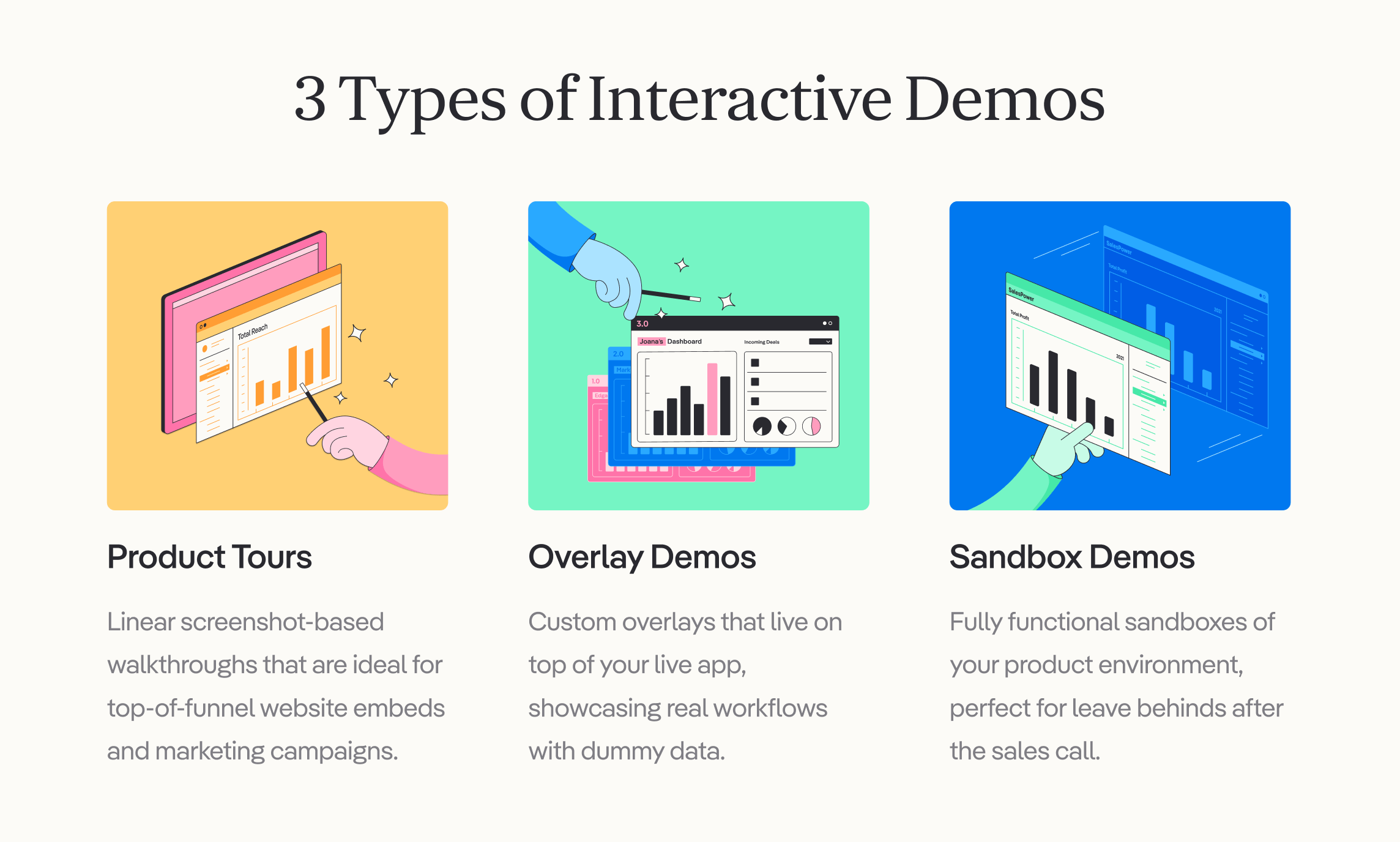
Link: https://www.demostack.com/product-demos
- **Product Tours** - Linear screenshot-based walkthroughs that are ideal for top-of-funnel website embeds and marketing campaigns.
- **Overlay Demos** - Custom overlays that live on top of your live app, showcasing real workflows with dummy data injected in real time.
- **Sandbox Demos** - Fully functional sandboxes of your product environment, perfect for leave-behinds that your champion can share with the rest of the company.
Demostack helps you create all three types of interactive demos in one product. A few solutions focus only on tours or have a powerful overlay tool, but not many can offer tours, overlays, and cloned demos.
The market is crowded this year, so here is a table to quickly compare different demo solutions:
|
**Platform**
|
**Strengths**
|
**Best For**
|
|
Demostack
|
Cloning, live app demos, shareable sandboxes, guided tours
|
Full-funnel GTM teams
|
|
Reprise
|
Code-level overlays & sandboxes
|
Developer-driven presales
|
|
Saleo
|
Real-time data masking on live product
|
Teams with strict data controls
|
|
TestBox
|
Demo data for sandboxes
|
Fast-moving GTM teams
|
|
Consensus
|
Interactive video hubs & stakeholder insights
|
Complex enterprise presales
|
|
Navattic
|
No-code HTML tours for top-of-funnel
|
Demand-gen & PLG marketers
|
|
Storylane
|
Social-ready guided tours
|
Growth marketing teams
|
|
Walnut
|
Collaborative editing & analytics
|
Mid-market & partner-led sales
|
|
Arcade
|
Lightweight microsite demos
|
PLG-first marketers
|
|
Demoboost
|
AI-powered guided tours & call-recap summaries
|
SMB & SDR teams
|
As you can see, there are a ton of different types of interactive demo software in the marketplace now. But a true demo platform needs to do a lot more than show a “live” collection of product screenshots or videos. That's yesterday’s playbook.
Instead, demo software should aim to reduce friction in the sales cycle, weave a personalized story for each prospect, and collect real insights you can act on.
## **Ready to check out Demostack?**
Link: https://www.demostack.com/webinar/mastering-the-art-of-demos-with-motive
## 2. Limitations of interactive demo software
Interactive demo software has become a catch-all name for a lot of modern demo solutions.
To be honest, almost all of the tools that are in the interactive demo space focus heavily on tours or product overlays.
Tours and overlays are valuable. They’re lightweight, easy to publish, and a great way for marketing or SDR teams to put a clickable product experience in front of buyers before the first call.
But they can’t power your entire demo operations. Especially when it comes to live calls and post-sales conversations. Yet so many teams try to “_just make it work_.”
Let’s break down some of the main limitations.
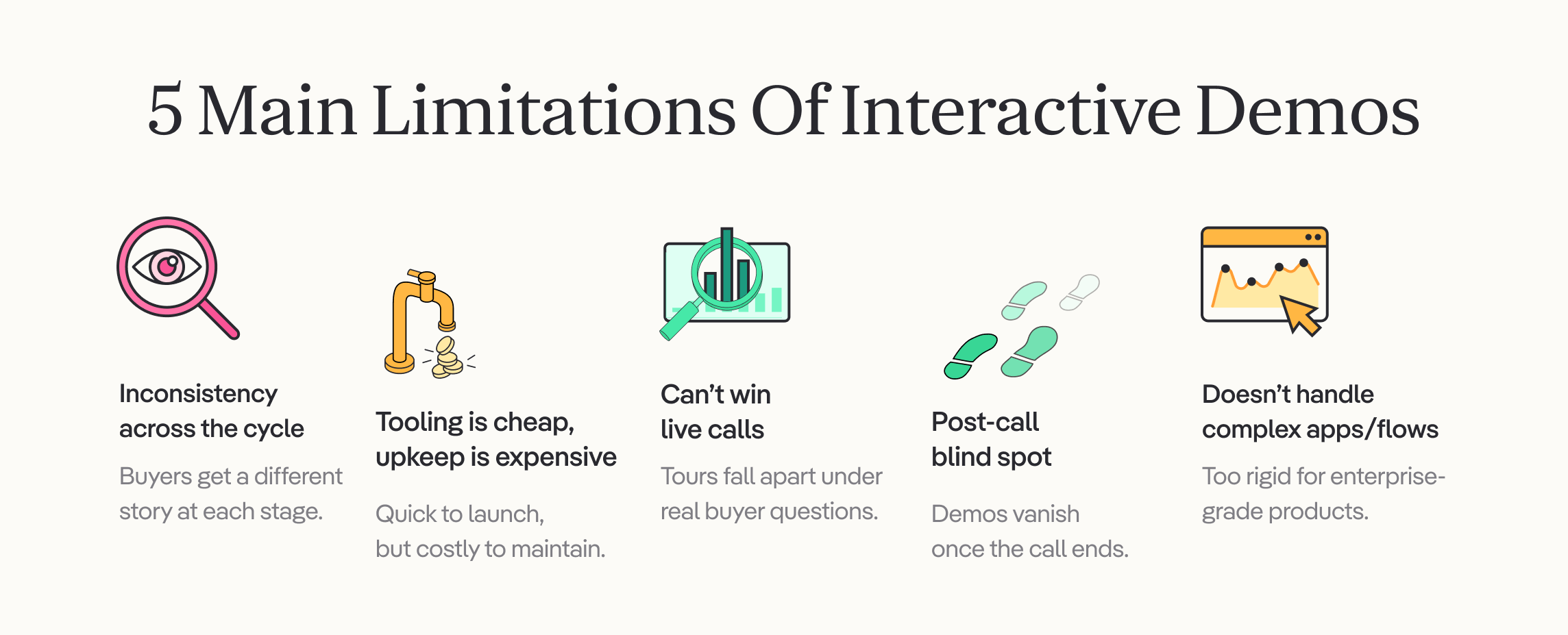
### 1. Inconsistency across the cycle
Buyers don’t experience one cohesive demo story when interacting with your product. They may click through a polished tour on your website, only to see something different when the AE runs a live demo, and then receive a static PDF afterward. That inconsistency creates confusion and can make it difficult to push a prospect to their “_aha moment_.”
### 2. Tooling is cheap, upkeep is expensive
Spinning up a product tour is easy, but keeping it updated and relevant is a huge hidden cost. Teams spend hours recapturing flows after every release or relying on engineers to patch demo data. The low costs of some demo software might look great in the beginning, but the ongoing operational drag and bottlenecks start to add up quickly.
One customer described it as “_paying the equivalent of a full-time engineer just to keep demos alive._”
### 3. Can’t win live calls
Tours are optimized for marketing, and they rarely hold up when buyers ask tough questions in a live sales call. Without reliable demo environments, reps fall back on fragile homegrown systems or just start using an old-fashioned slide deck.
### 4. Post-call blind spot
Momentum doesn’t stop when the call ends, unless your demo story starts to disappear. Buyers want to revisit what they saw and share it with colleagues. Tours don’t provide that, leaving sellers blind to post-call engagement. Motive solved this by using resettable sandboxes as leave-behinds, increasing trial conversions by 5%.
### 5. Doesn’t handle complex apps/flows
Interactive demos can handle simple linear workflows, but once you’re demoing enterprise-grade products with multiple integrations, they start to show some cracks.
Limited pathways, rigid sequences, and browser restrictions leave GTM teams taping together environments, splicing in screenshots, or defaulting to live production apps. Complex products need environments that scale, and tours or overlays can’t carry that weight.
## 3. Why GTM teams need better demo software
After listening to dozens of discovery and evaluation calls from our sales team, three demo frustrations seem to pop up in almost every call.
The exact wording changes, but the overarching themes include: GTM teams needing engineering time for simple updates, inconsistency in the demo experience, and stale environments because the product is moving so fast.
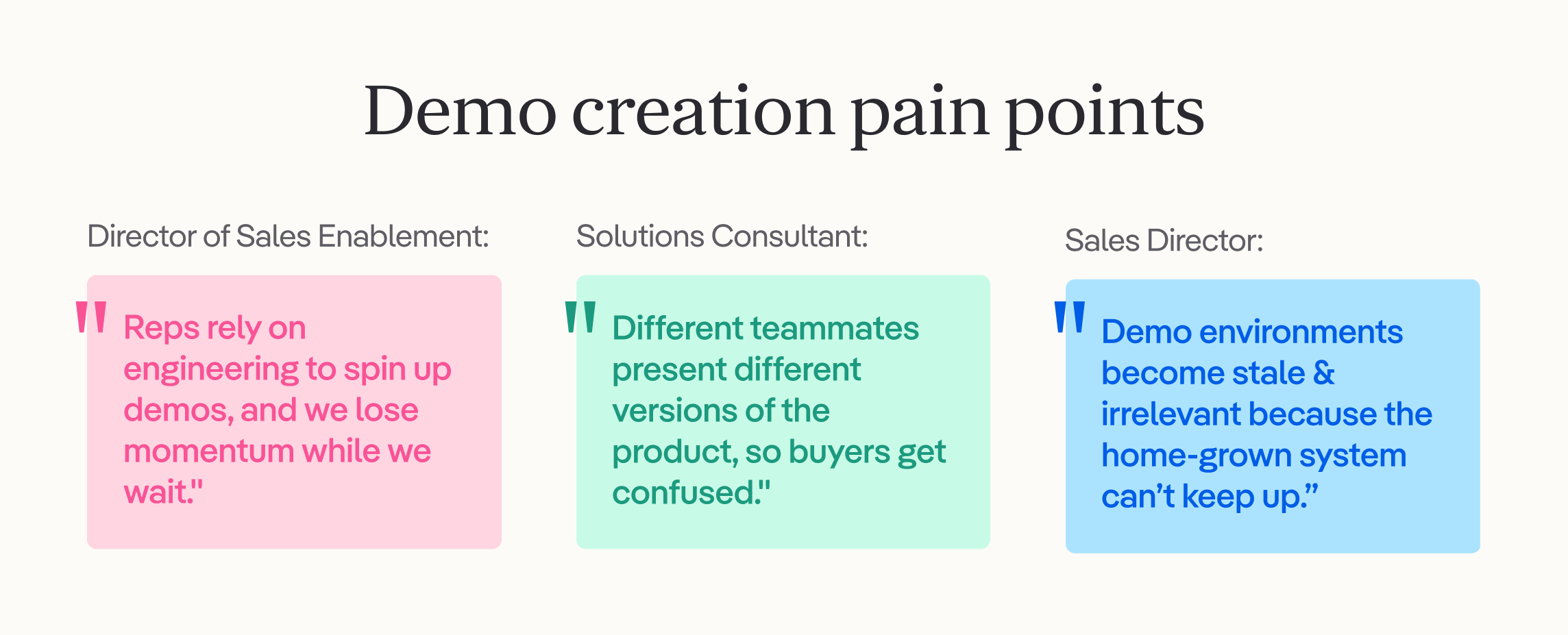
- _"Reps rely on engineering to spin up demos, and we lose momentum while we wait."_ – Director of Sales Enablement
- _"Different teammates present different versions of the product, so buyers get confused."_ – Solutions Consultant
- _"Demo environments become stale and irrelevant because the home-grown system can’t keep up.”_ – Sales Director
At the end of the day, your buyers do not care if you’re team is waiting on an engineering team to spin up a fresh [demo environment](https://www.demostack.com/post/sales-demo-environment-your-complete-guide). They want to see how your product works and be able to interact with the best version of it, not something from 3 months ago.
That’s why interactive demo solutions have become so important over the past few years. They truly empower GTM teams to build and personalize demo experiences and drive real revenue across the organization.
## 4. How interactive demos drive revenue
Deals usually don’t break down because the product isn’t perfect for the prospect. A lot of the time, they fall apart because the best version of the product shows up too late. Or sometimes not at all.
[Synack](https://www.youtube.com/watch?v=GT4RJj-28cI) felt this pain in a very public way. At Black Hat, their CEO opened a demo environment for a huge prospect and was met with a blank _“screen of death._” To make it worse, this was right in front of hundreds of attendees and dozens of competitors’ booths.
With interactive demos, buyers can experience a realistic, safe, and fully functional version of your product very early in the sales cycle.
When a great demo shows up at the right moment, your sales cycle starts to accelerate and revenue follows:
- **Faster time to value:** Reps enter first calls with a fully tailored demo ready to go, eliminating delays as engineering builds a custom solution and awkward follow-up emails looking to check out the product. [Demostack customers](https://www.demostack.com/customer-stories) report up to a 30% reduction in overall sales cycle length.
- **Stories that stick:** Buyers immediately recognize their unique pain points and workflows in the demo, turning walkthroughs into meaningful problem-solving conversations. After adopting Demostack, [Gainsight saw a +25% increase in win rates](https://www.youtube.com/watch?v=7c3PkDs1bjg) by consistently telling the right story.
- **Rock-solid reliability:** [Cloned demo environments](https://www.demostack.com/post/how-to-clone-your-app) and overlays ensure demos stay in sync with every product release, so your team never faces last-minute failures.
- **More SE bandwidth:** Free your solution engineers from the tedious demo maintenance so they can focus on high-value, complex deals instead of resetting environments. At Synack, annual demo upkeep was costing the equivalent of a full-time engineer's salary before they switched to Demostack.
After [Synack started using Demostack,](https://www.demostack.com/customer/Synack) they eliminated demo failures entirely, cut demo prep from over 100 hours to just 10 hours, and started launching tailored playbooks that every AE can use to deliver their own high-impact stories.
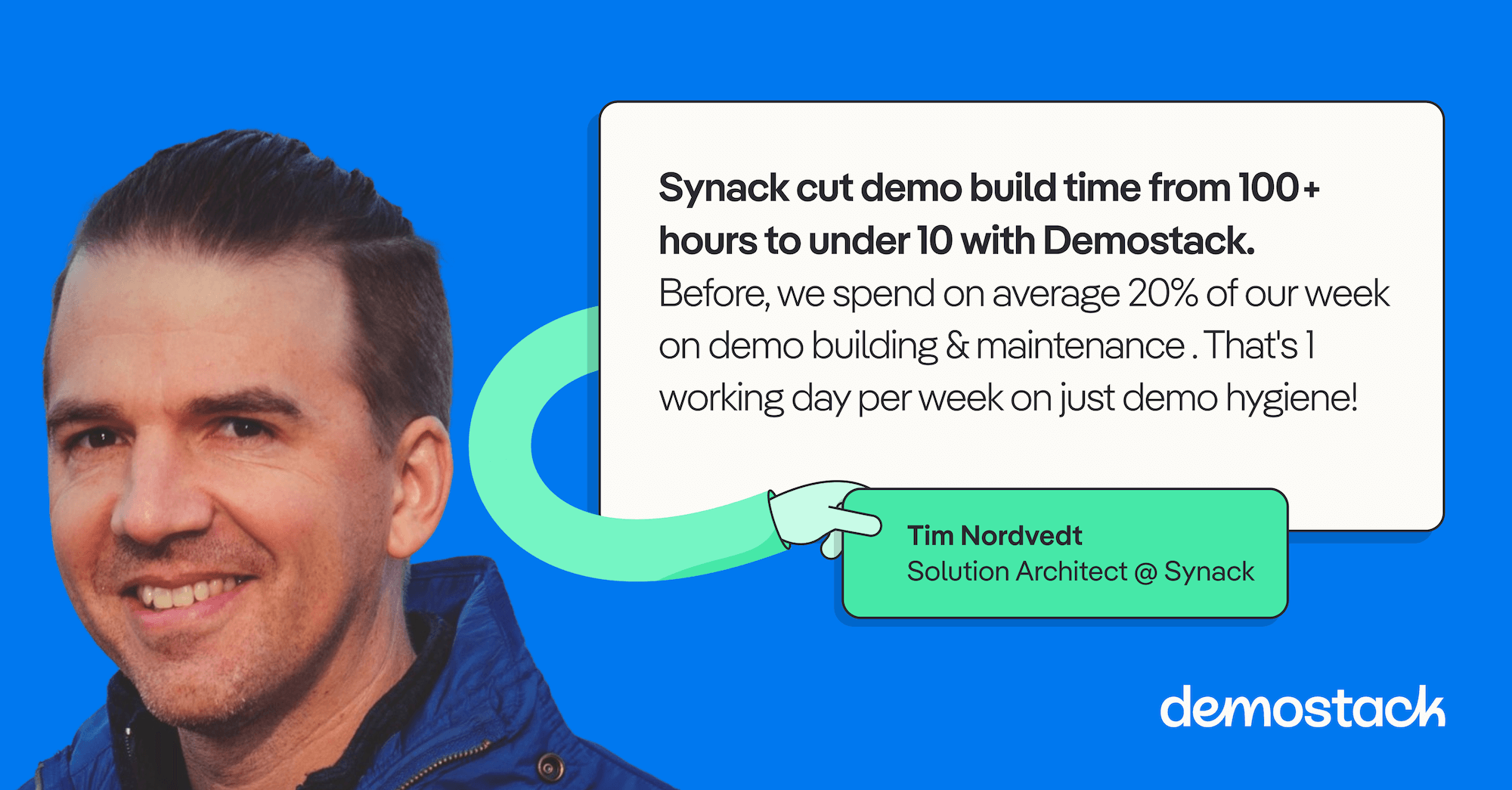
With interactive demos, you can stop asking prospects to imagine your value and show them exactly what it looks like in action. When you demonstrate this value early in the process, you don't just accelerate deals; you can instantly change their outcome.
### Want to learn more about Demostack?
Synack cut its demo prep time from over 100 hours to under 10 with Demostack:
Link: https://www.demostack.com/webinar/scaling-enterprise-demos-how-synack-replaced-their-demo-environment
## 5. Best interactive demo software platforms
Imagine giving prospects direct access to a live demo that always mirrors your latest release. The best interactive demo software enables this. Too often, GTM teams waste days rebuilding fragile sandboxes or stitching in clean data just to keep demos functional. Meanwhile, buyers lose interest when the experience disappears after the call.
The right demo software should help your team build environments with a few clicks and let you adjust content on the fly, without any engineering help. In this section, we'll break down ten different demo solutions, highlighting their strengths and weaknesses.
## 1. Demostack
**Best for GTM teams who want total control and flexible demos without engineering**
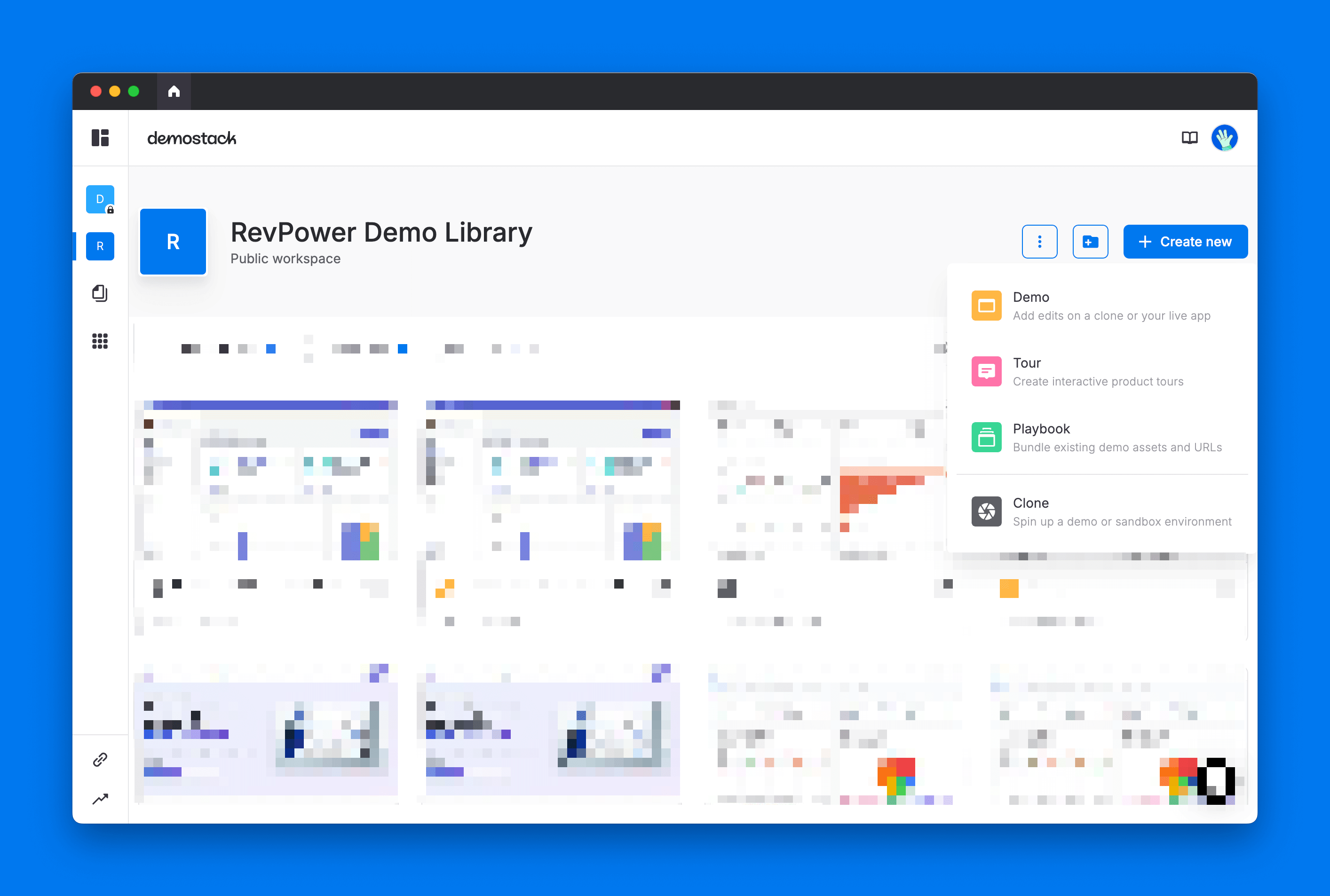
Link: https://www.demostack.com/
Demostack is a no-code demo platform that truly puts control back into the hands of GTM teams. With just a few clicks,[ you can spin up pixel-perfect clones](https://www.demostack.com/post/how-to-clone-your-app) of your live product, then customize the text, data, and visuals for each prospect.
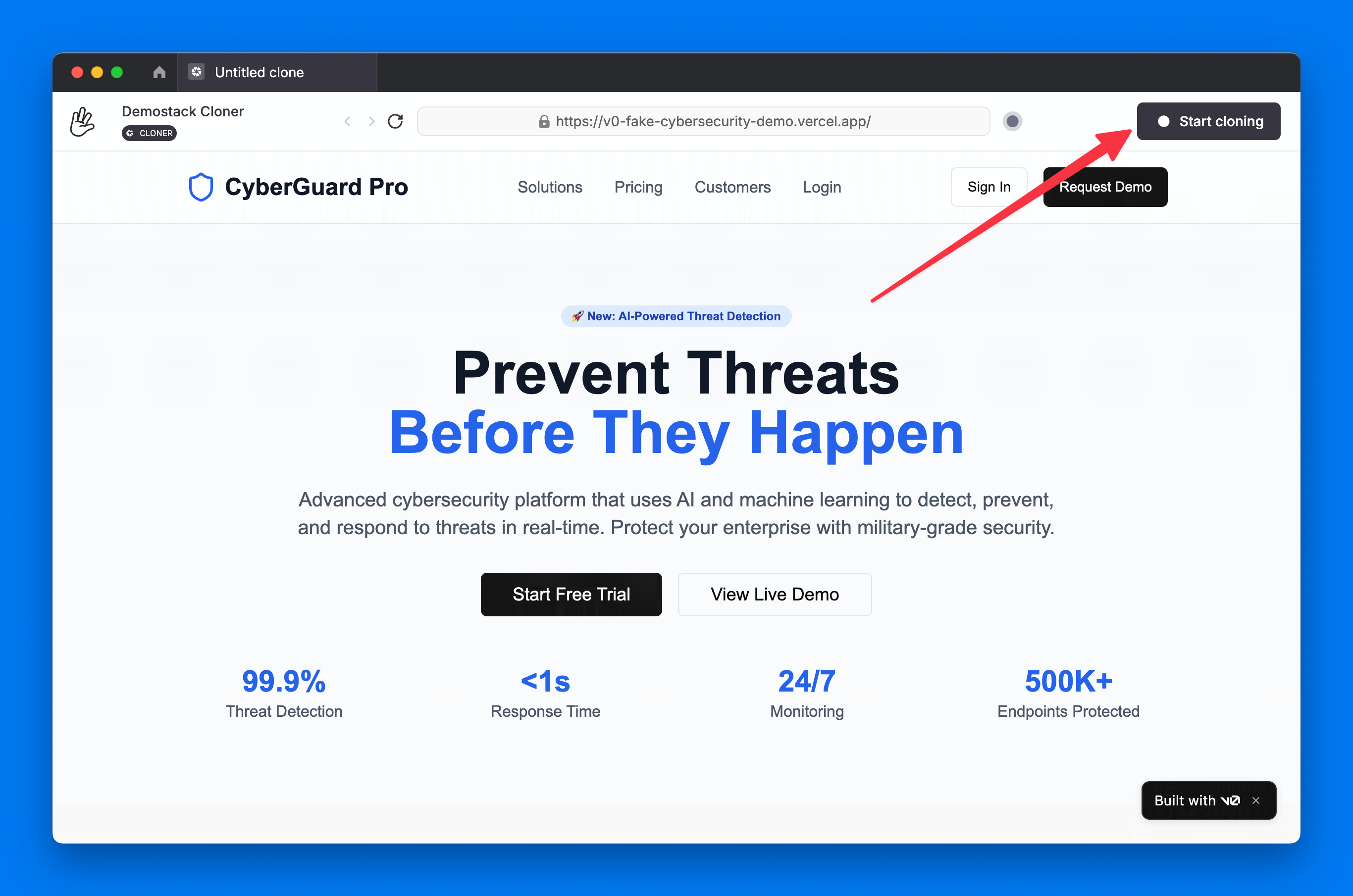
Link: https://www.demostack.com/
With guided product tours, sandbox leave-behinds, powerful demo playbooks, and best-in-class cloning, your reps can deliver personalized demos without relying on SEs or engineering. And because it’s all wrapped in enterprise-grade security and robust analytics, you’ll know exactly which parts of the story resonate with every prospect.
Check out Demostack if you finally want to ditch your homegrown demo environment and eliminate the bottlenecks slowing down your sales team.
**Demostack is best for:**
**DIY demo creation -** empower any rep or marketer to spin up their own demo environment in minutes, no SE or code required.
**Instant personalization -** swap data, images, and messaging on the fly to match each prospect’s needs.
**Consistent storytelling at scale -** maintain one source of truth for every demo, with automatic version control and multi-product playbooks.
**Actionable engagement insights -** see exactly where people clicked and tie it back into your CRM to optimize for the next step in your sales process.
**AI-powered data customization -** auto-populate and edit demo data using generative AI so your environments stay realistic, compliant, and tailored, without writing a single line of code.
## 2. Reprise
Link: https://www.demostack.com/lp/demostack-vs-reprise
**Best for technical teams willing to trade simplicity for deep customization**
Reprise offers three separate demo tools for overlays, cloning, and guided tours, but seems to be leaning hard into the AI agents. Each tool can be pretty powerful if you’ve got time and resources to invest, which is less ideal for fast-moving GTM teams.
**Tradeoffs:**
- Longer implementation for some brands
- More technical for non-SEs
- Limited mobile demo support
[**_Learn more about Reprise vs. Demostack._**](https://www.demostack.com/lp/demostack-vs-reprise)
## 3. Saleo
Link: https://www.demostack.com/demostack-vs-saleo
**Best for showcasing live data in real-time overlays**
Saleo uses overlays to add real data inside your live product, which is a very unique approach for visual demos. But demoing live environments leads to more complexity and a lot of headaches when they don’t work.
**Tradeoffs:**
- No mobile, sandbox, or leave-behind options
- Setup requires upfront data modeling
- Shallow demo analytics for follow-up
- Live dependency means more risk, less flexibility
[_See how Saleo stacks up vs. Demostack here._](https://www.demostack.com/demostack-vs-saleo)
## 4. TestBox
**Best for PLG teams offering hands-on trials**
TestBox creates fully functional demo environments with AI-generated data. Great for quick product trials, but not built for deep, customizable storytelling.
**Tradeoffs:**
- No support for guided demo narratives
- Limited control over data, flow, or persona tailoring
- Can’t replace SE-driven demos in early or mid-funnel
## 5. Consensus
Link: https://www.demostack.com/demostack-vs-consensus-alternative
**Best for async buyer education via guided video tours**
Consensus automates product walkthroughs with branching paths and its own Demolytics insights. Built for marketing and buying committees, but doesn’t thrive in live sales calls.
**Tradeoffs:**
- No mobile or real-time demo capabilities
- Lacks support for sandbox or cloned experiences
- Doesn’t reduce SE burden during early-stage discovery
[_See how Consensus vs. Demostack shakes out._](https://www.demostack.com/demostack-vs-consensus-alternative)
## 6. Navattic
Link: https://www.demostack.com/lp/demostack-vs-navattic
**Best for embedded click-through tours on websites or in email campaigns**
Navattic builds self-guided product tours that embed easily. A solid PLG and demand gen tool, but not equipped for deeper technical demos.
**Tradeoffs:**
- No sandbox, mobile, or dynamic personalization
- Basic analytics, limited insight into sales impact
- Doesn’t solve demo speed or AE/SE bottlenecks
_[Learn more about Navattic vs. Demostack](https://www.demostack.com/lp/demostack-vs-navattic)._
## 7. Storylane
**Best for fast, no-code demos in early-stage outbound or ABM**
Storylane offers CRM integrations, token-based personalization, and solid UX for async tours. Still maturing when it comes to deeper use cases and seems to be focusing mostly on marketing tours for now.
**Tradeoffs:**
- No sandboxing or live demo customization
- Not ready for technical sales or SE handoffs
- Rapid development means occasional feature gaps
## 8. Walnut
Link: https://www.demostack.com/lp/demostack-vs-walnut
**Best for GTM teams that want click-through demos with personalization**
Walnut is a no-code demo tool that captures your product UI and lets you build clickable interactive walkthroughs or tours. It’s a solid option for structured and repeatable demos, but not ideal for quick iterations or multi-step setups.
**Tradeoffs:**
- Editing flow can feel rigid and time-consuming, especially for non-SEs
- Demo updates often require recapturing or manual tweaks
- Advanced features like offline mode or white-labeling require enterprise plans
[_Compare Walnut vs. Demostack here._](https://www.demostack.com/lp/demostack-vs-walnut)
## 9. Arcade
**Best for fast, short demos embedded in marketing content**
Arcade is a no-code tool that lets teams create short, click-through demo stories for websites, blogs, and outbound. It's built for ease of use and shareability, not really for replicating complicated live product environments.
**Tradeoffs:**
- Doesn’t support live product flows, sandboxing, or overlays
- Not suited for technical sales, SEs, or multi-product walkthroughs
- Only works in Chrome, not optimized for mobile or full sales team use
## 10. Demoboost
**Best for scaling async demo content across presales and outbound**
Demoboost helps GTM teams create and share templatized, async demos across outbound, marketing, and presales. It’s optimized for speed and volume, not live selling or technical deep dives.
**Tradeoffs:**
- No live product interaction or sandbox demo functionality
- Interactivity is limited; most demos are click-through templates
- Doesn’t support mobile demos or multi-product demo stitching
## 6. Why GTM teams choose Demostack
It’s one thing to talk about the value of interactive demos in theory. It’s a lot more impactful to see how real teams use them to tell a compelling product story.
Whether it was cutting the SE queue, scaling a product launch, or getting more trials to convert, each of these companies used Demostack to fix a different part of their sales motion.
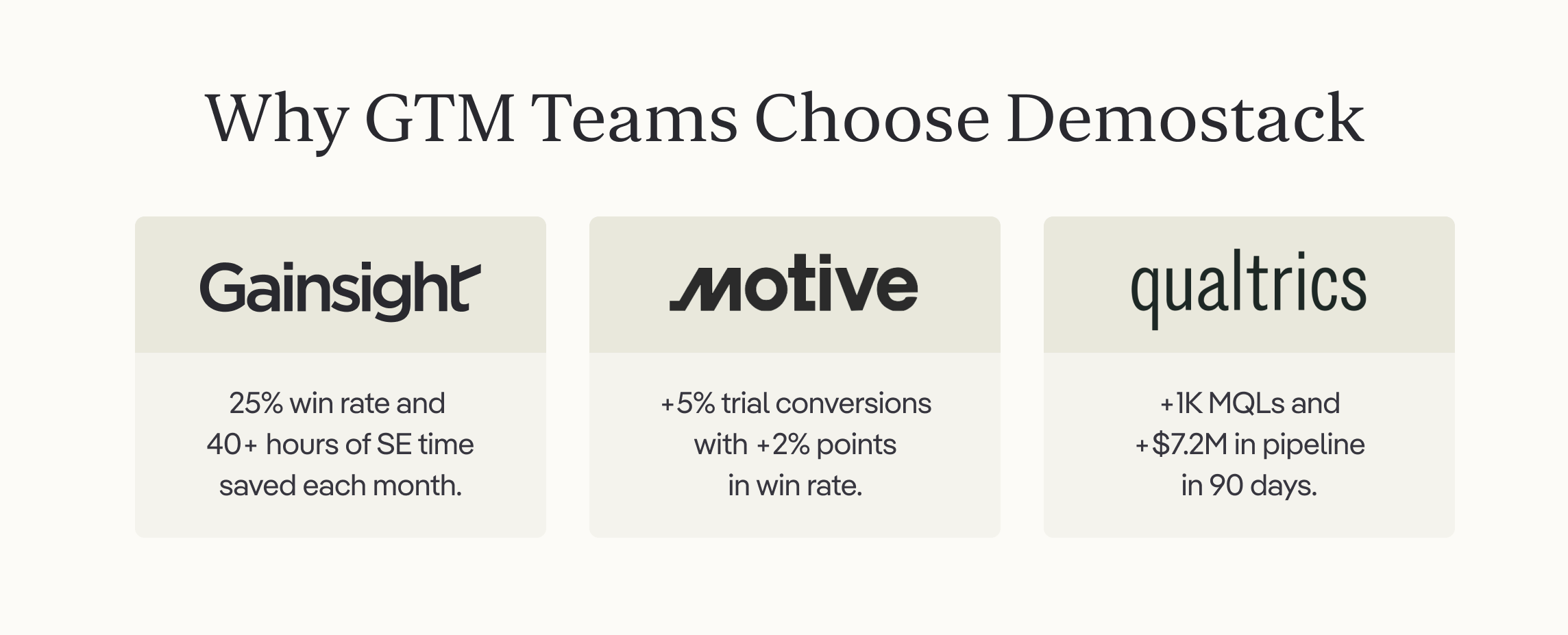
Link: https://www.demostack.com/customer-stories
- [**Gainsight**](https://www.demostack.com/customer/gainsight) - To reduce SE bottlenecks and unify messaging across product lines, Gainsight rolled out Demostack across the organization in Q3 2024. Their reps now run more calls without waiting on technical help and tell a more impactful product story every time.
- [**Motive**](https://www.demostack.com/webinar/mastering-the-art-of-demos-with-motive) - Motive used Demostack demos in nurture sequences for SMB buyers. With hands-on demos replacing generic product videos, more prospects moved from trial to paid, and reps had clearer buying signals from the start.
- [**Qualtrics**](https://www.demostack.com/post/enable-aes-to-demo-and-accelerate-sales-) - For their global product launch, Qualtrics deployed Demostack tours across every new feature. It gave prospects a self-guided way to explore, and gave marketing a direct line to a qualified pipeline.
Many demo platforms promise faster deals and better engagement, but most will leave your GTM teams waiting on IT, piecing together multiple tools or wrestling with stale data.
Demostack removes those hidden roadblocks by bringing every demo format into one intuitive platform. All while putting control of the demo back into the hands of your sales or GTM team, no engineering handoffs required.
## Tell a complete product story with a powerful demo
Interactive demos let you weave your product’s story around each buyer’s unique needs, no more one-size-fits-all slide decks or static walkthroughs.
By putting prospects in control of real workflows, you turn abstract features into tangible solutions. They can click through scenarios that mirror their pain points, building trust faster and shrinking objections.
Interactive demos transform your story from something you yell from the rooftops into something buyers can experience themselves.
**_Ready to turn demos into a repeatable growth driver? [Book a call with our sales team and learn how you can use Demostack](https://www.demostack.com/win-more-deals-lp)_ to eliminate SE bottlenecks, build personalized demos for every prospect, and accelerate your sales cycle.**
## Article: 7 Software Demo Best Practices That Get Results
Source: https://www.demostack.com/post/demo-software-tips
Software demos play a pivotal role in driving conversions at every sales funnel stage, from the earliest educational stages to closing the deal at the end. Because they're such an essential sales tool, getting software demos right is vital. However, too many of them fall flat because they lack a clear message, a compelling narrative, or personal relevance to the buyer. That's why mastering effective software demo best practices is critical for success.
B2B software buyers are increasingly self-sufficient, trained on consumer-friendly ecommerce tactics, and eager to do their own research. But they still want to be understood by the company whose solutions they are interested in purchasing. According to Salesforce, 86% of buyers are more likely to convert if those companies comprehend their goals.
That's why your software demo needs to do more than show off cool features. Only by engaging prospects with a clear demonstration of business value can you expect to drive them toward a decision in favor of your solution. The best practices outlined in this post, implemented in a way that aligns presales with sales and highlights the unique advantages of your software, give your demos the best chance of driving conversions.
## **Benefits of Software Demo Best Practices**
**Following software demo best practices means your demo has all the right elements to make a persuasive case to potential buyers. Here are the key benefits:**
- **Higher Conversion Rates -** Demos developed with input from both sales and presales teams are more likely to address the buyer's needs and pain points directly. When a demo quickly and clearly demonstrates value, prospects are more likely to make a decision and take action.
- **Stronger Buyer Engagement -** A demo process that is collaborative and well-structured can engage buyers with a seamless narrative from discovery to presentation, holding their attention the whole way through.
- **Shorter Sales Cycles -** When demos are designed with best practices in mind, they're more focused on the features that buyers want to test out. This avoids deep dives into unnecessary processes that are unlikely to help your buyer come to a purchase decision.
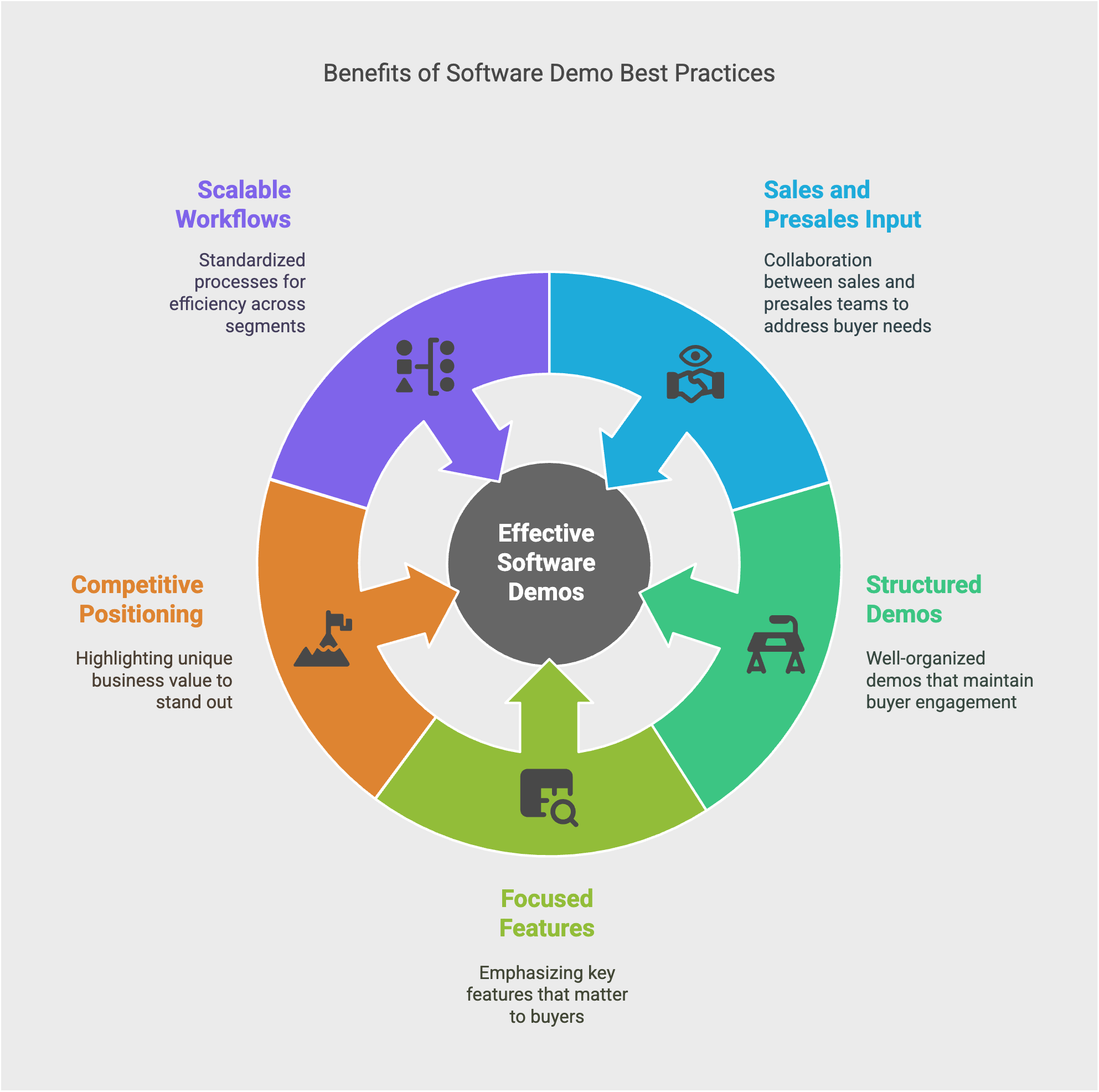
- **Better Competitive Positioning -** A unified strategy that [aligns presales with sales](https://www.demostack.com/post/aligning-sales-and-presales-to-deliver-winning-demos) will result in demos that emphasize business value and the key features that differentiate you from your competitors—instead of showing off standard feature sets that won't wow your buyers.
- **Scalability and Efficiency -** Standardizing your workflows and using tools like Demostack enables your development team to refine and scale compelling demos across a variety of audience segments.
## **7 Foundational Elements of a Successful Software Demo**
**Several foundational elements contribute to a successful software demo that delivers on its promises and drives sales. These should all be taken into account and incorporated from the earliest planning stages:**
### **1. Personalization**
**The demo should be tailored to the target audience's needs, their industry, and their specific challenges.** The more you customize it for each prospective client, the more it will engage them.
### **2. Solution-Selling Approach**
**Use a [solution-selling approach](https://www.demostack.com/post/the-8-components-of-the-solution-selling-methodology) that focuses on demonstrating how your product directly addresses the prospect's problems rather than simply listing features.** Structure the demo around their pain points and highlight the tangible business outcomes you can deliver.
### **3. Get Interactive**
**Allow your prospects to engage with the product during the demo, either through live interactions or self-guided experiences such as exploration in sandbox environments.** Tools like Demostack facilitate this by enabling safe interactivity with assets and data for all sorts of use cases.
### **4. Go for Visual Storytelling**
**Successful demos use clear visuals and relatable examples to illustrate how the software will work in live scenarios.** When you're building a storytelling framework, remember that the client is the main character—not your company or the product.
### **5. Use Realistic Demo Data**
Generic demos can be too abstract to provide a clear picture of how the solution will address clients' actual challenges. **Instead of using placeholder data, incorporate mirrored data from relevant real-world situations.**
### **6. Incorporate Case Studies and Real-World Examples**
**Demo scenarios should be modeled around real cases of other companies that have solved their problems and found success using your product.** For example, if you were creating a demo for AI governance software, you could demonstrate how the platform helps companies perform a responsible AI audit.
### **7. Use a Clear Call to Action (CTA)**
**End the demo with a prompt to take a specific next step**, such as scheduling a follow-up call, registering for a free trial of the full product, or advancing to proof-of-concept testing.
## **7 Best Practices for Software Demo Prep and Delivery**
**The following software demo best practices will help you optimize your preparation and delivery:**
### **1. Establish Clear Objectives**
**Clearly define the purpose of each demo, with input from both presales and sales teams.** While the ultimate goal is to sell the product, there are critical differences between demos designed to educate buyers on why they need your solution, demos that differentiate you from your competitors, and demos that close the deal on a client who is nearing a final decision.
**Key factors to consider at this stage are the client's main challenges and pain points, the features that will appeal to them the most, and the ultimate business outcome they're aiming for.**
### **2. Share Detailed Client Insights**
Sales teams will often have detailed information about prospective clients that can be shared with presales. **This critical background information helps them build the demo to precise specifications that:**
- **Address the client's pain points** effectively.
- **Speak to the priorities of the stakeholders** who will be weighing in on the final purchase decision.
- **Highlight the attributes that make your solution a better choice** than your competitors.
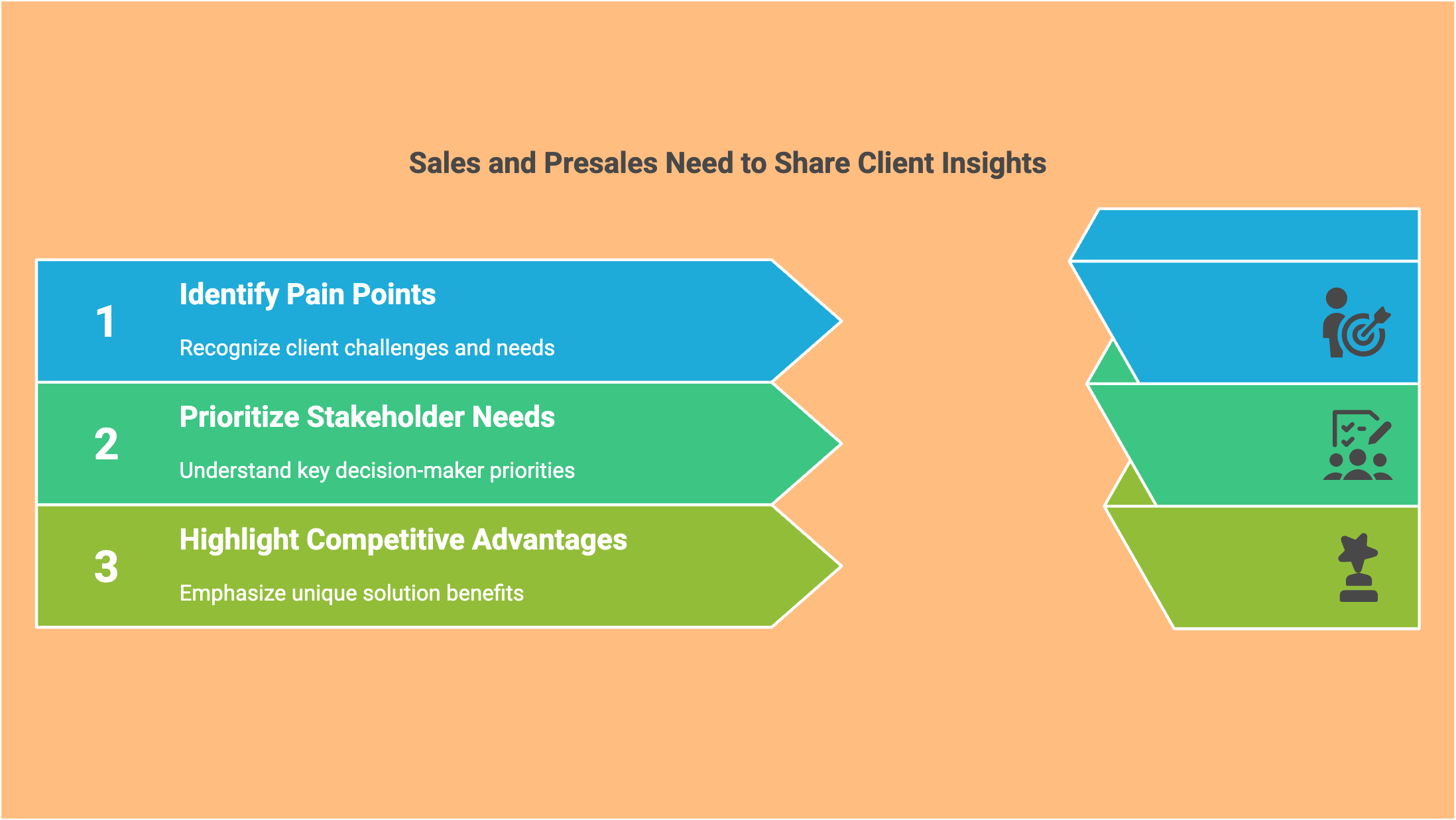
### **3. Create a Joint Demo Strategy**
Demos tailored to the client's specific challenges and needs are more engaging and likely to shorten the decision-making process. **Aligned presales and sales teams should collaborate on compelling, client-specific demo flows:**
- **You can map it out by starting with the primary problem the client is trying to solve,** as this sets the context for everything that follows.
- **Next, emphasize your solution's unique value proposition** to differentiate it from competing products.
- **Show off the specific features that will mitigate your client's problem.**
- Lastly, **conclude with a compelling CTA.**
### **4. Leverage Collaboration Tools**
**The right shared tools will support and strengthen presales and sales alignment. These include:**
- **CRM automation** for tracking client interactions (especially their demo history)
- **Demo platforms like Demostack** for shared access and version control
- **Real-time communication tools for coordinating** during development and after launch.
**Tools that support collaboration can lead to a streamlined development process, seamless team-to-team handoffs, better demos, and higher levels of customer satisfaction.**
### **5. Test the Demo Beforehand**
**Before your demo goes live, conduct a dry run to see if you need to make any technical adjustments or refine the messaging.** Ensure that the demo environment is functional and stable, and review the flow to make sure the messaging is clear and engaging.
**You'll also want to identify any possible issues the client might raise and look for ways to address them.** For example, if you were creating a demo for lab inventory management software, you would want to be sure that it addressed streamlined inventory tracking and automated reordering to prevent stockouts.
### **6. Deliver the Demo with Flexibility**
**Be prepared to modify your demo based on buyer engagement signals. When a client responds strongly to a particular feature, lean into that aspect of the solution instead of sticking to the script.** This kind of flexibility can be much easier to achieve with tools like Demostack that automate elements of the demo creation process and leverage AI to integrate customizations swiftly.
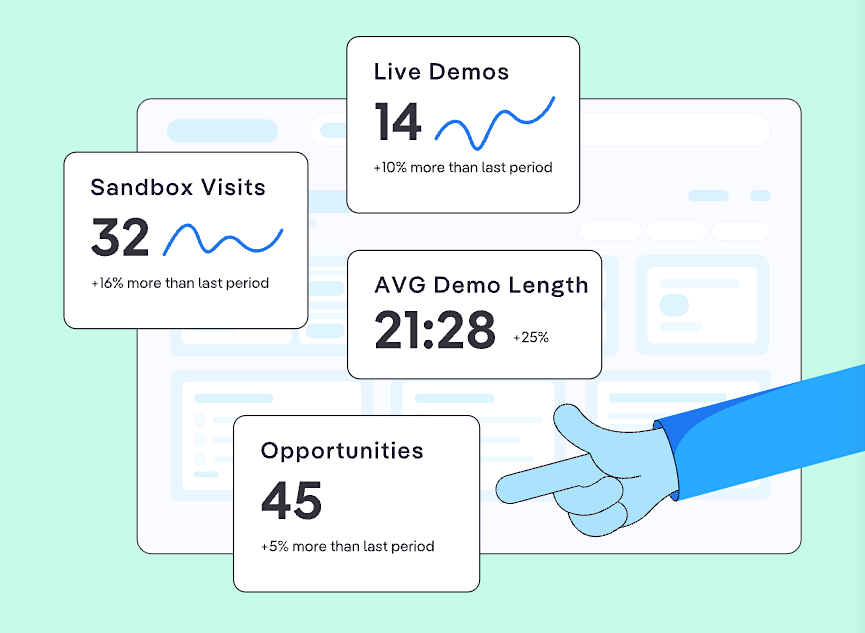
### **7. Incorporate Feedback Loops**
**Schedule a debriefing with the sales team after each client demo to gather insights that will help you [improve future presentations](https://www.demostack.com/post/sales-demo-8-tips-to-improve-your-demo-conversion-rates).** This meeting should involve a discussion of the elements that resonated most positively with the client, and an effort to identify areas where improvements are necessary. **Once all the relevant feedback has been received and analyzed, you can adjust your demo templates to reflect the lessons learned in this final step.**
## **Software Demo Best Practices Meet Your Prospects’ Needs**
**When you use software demo best practices, your demos will engage your buyers on the specific challenges they face.** Meeting their needs by targeting the pain points they struggle with, as well as the key differentiators that distinguish your solution, will do far more to drive sales than a one-size-fits-all display of basic functions and features.
**Tools like Demostack enable you to enhance your demo capabilities with sandbox environments, engagement tracking, and interactive product tours.** The platform empowers your presales and sales teams to work in seamless alignment, delivering engaging, personalized demos that boost your sales velocity.
[Try Demostack today](https://www.demostack.com/win-more-deals-lp) and see how easy it is to deliver tailored, consistent demos that engage buyers and close deals faster.
## Article: 5 ways to create interactive sales demos
Source: https://www.demostack.com/post/create-interactive-demo
Want more engaging sales demos? Here's how to create an interactive demo.
Interactive sales demos win deals. The more engaging, exciting, and captivating a demo is, the more your prospects will want to purchase.
The science is simple, when people are engaged, they become more emotionally invested. Combine that with actually solving their problems, and you have a winning deal.
However, creating an interactive product demo is easier said than done, especially if you are dealing with difficult prospects who may not be very chatty.
To create interactive, engaging, and [winning demos](https://www.demostack.com/post/give-a-demo), that wow decision-makers here’s what you should do:
## Personalize as much as possible
Want your prospects to really engage? [Personalize as much of your demo](https://www.demostack.com/post/5-ways-to-win-more-deals-with-personalized-demos) as possible. Include their names, their company name, logos, and customer names within your demo instance so they can see exactly how your platform will look when they use it. Your prospects should feel like they are experiencing your solution, not just using it.
Speaking of what your buyers are experiencing... Even though many pain points can be generalized, never take them for granted. Take the time to understand your prospect's unique needs and let your software demo reflect that.
To make your sales demo even more relevant, ensure you use an instance that reflects the vertical your prospects are in and even customize the data they see. Larger or smaller numbers than their own may sway their opinion of your platform, making them think it is meant for larger or smaller companies than theirs.
One way to keep your demo relevant is to feature a case study from a similar company, to show the results you earned from them.
Of course, a demo experience platform allows sales reps to customize every aspect of a demo in minutes, guaranteeing the most consistent and personalized experience with the least amount of effort.
## Collaborate on the agenda
When it comes to your demo plan, don’t dominate the agenda. Instead, whether it be before the demo call, or at the beginning of the presentation, ask your prospects what they would like to see and what’s most important to them.
The truth is you’ll never know if you don’t ask. So, to maximize the effectiveness of your sales demo, prioritize what your prospect wants to see. Then, if you know there are certain competitive advantages or outstanding features, work those in as well.
If you show your buyers what they are most interested in, you will grab their attention and keep them engaged. People tend to be passive about things they don’t care about, no matter how exciting you think it is.
Further, when you give a demo, don't just focus on closing the deal. Instead, seek to actually uncover and solve your prospect's pain points. When you truly solve problems, the deal should close itself.
## Encourage discussion during the demo
The same approach to collaboration applies during the demo itself as well. Demos should not be a monologue, and you shouldn’t spend the entire time talking (no matter how much you like to hear yourself).
Go beyond a simple product tour and instead ask questions during your product demonstration. Look for feedback, check in, and even ask your prospects what they would like to see.
Make your demos a f[ree-flowing conversation](https://www.demostack.com/post/demo-led-revenue-acceleration) that touches on predetermined points. The best sellers are able to make a structured route, with what the prospect asks to see, feel natural and flowing. This should not be a simple product walkthrough, instead make it an engaging experience.
Moreso, when you check-in. Don’t ask standard questions like, “how are we feeling so far,” or “do we have any questions.” Instead, give specific prompts about aspects of the demo, or ask your prospects how they can see themselves using a feature so they are more engaged.
## Ask follow-up questions
As your prospects engage with you during a demo, you can bring their participation to the next level by asking follow-up questions to their questions or comments. Rather than them making a statement and simply saying, “sounds good,” “okay,” or “I’ll make a note of that,” the best sales reps ask follow-up questions during a demo to drive more discussion and get more engagement.
Get deeper by asking them about specific use cases, the situations they can see themselves being in, how they’ve tried to solve problems in the past, and what prior outcomes were. All of this not only creates a more interactive sales demo but nets you more information you can use to close effectively.
## Show your actual product
Perhaps the best way to create an interactive sales demo and drive an engaging conversation is to [show your actual product](https://www.demostack.com/product/demo-experience) during the call.
If you’re still using slides, screenshots, or even just videos, it's time to ditch that all together. Your prospects want to see your product, what it looks like, how it works, and how it actively solves their issues. To do that, they must see it.
But, sometimes showing the actual product isn’t always feasible, or effective. In-house demo instances have their issues and are prone to errors, unforeseen changes, and a myriad of other issues. Sales teams are often at the mercy of product or engineering when it comes to their demos, and never know what may happen.
Instead, a demo experience platform like Demostack guarantees flawless, interactive sales demos every time. These demo platforms give sellers complete control over the demo, and therefore their sales process.
## Article: What is a Demo Experience Platform and How Can It Benefit Your Sales Team?
Source: https://www.demostack.com/post/demo-experience-platform
Today, a **demo experience platform** is changing the way products are shown, making it easy for businesses to give personalized and effective demos to attract and win over customers.
Let's dive into what a demo experience platform really is and how it's setting a new standard for product demonstrations.
## What is a demo experience platform?
A [demo experience platform](https://www.demostack.com/post/demo-experience-platform-for-sales-kickoff) is a no-code solution that clones your entire product - including all of the functionality and data customizability - without being tied to a database.
Meaning, your entire your entire product, including all of its functionality and visuals, is replicated without being tied to a back end.
A demo experience platform allows you to showcase your product in the best possible light, so your buyer understands its value faster. You’re able to tell an immersive product story that’s tailored to your buyer’s specific needs and use case - and do it at scale.
Think of [showcasing your software](https://www.demostack.com/post/evaluating-product-demo-software) product like putting your home on the market. Which home sells faster, the one that’s staged, or the one that’s not?
An open house that’s perfectly set with new furniture, freshly cut flowers, and smells of cookies straight out of the oven sells better than an empty home. It’s simple: Staged houses sell faster (and at top dollar) because the buyer can actually visualize themselves in the home.
The same goes for selling software. When you can showcase your product in a way that lets your buyer visualize themselves using it, you’re a lot more likely to win the deal.
Crafting that story has been a tall task until now. If you’ve gone to the lengths of creating a demo environment, you’re well aware of the headache it can create. You’re likely putting a significant amount of time and resources into keeping your in-house demo up-to-date. Whether it be with new product releases, or constantly piping in dummy data to keep the analytics looking fresh.
Further, since your R&D team is more focused on developing the actual product, the demo environment gets ignored. Your sales team is left with a clunky demo to try to communicate how your product is a game changer, but the story falls flat.
With a demo experience platform, you’re able to showcase your product in a way that resonates with your buyer, without the headache. You can craft a tailored product story in minutes - which means it’s built for scale.
These platforms are the key to [effective, powerful demos that win deals](https://www.demostack.com/webinar/how-to-enable-sales-with-better-product-demos) in the age of digital and remote sales.
To stand out in today’s highly competitive marketplaces, sellers must personalize every single interaction with their current and potential buyers.
Moreover, their conversations, presentations, and demonstrations must directly address the needs of those buyers. Salespeople must uncover the true needs of a prospect and deliver a solution that fulfills those needs. When it comes to the demo, that means that standardized screens and data simply no longer work. Neither will a tour of every feature and function of your entire product.
Many teams then turn to homegrown demo environments. But, this solution heavily taxes the engineering team, removes them from important product improvement duties, and requires a significant amount of time.
The demo experience platform solves these problems by empowering go-to-market, RevOps, and sales teams to create their own custom demos with no code at scale.
Read on to find out:
1. **Why your sales team needs a demo experience platform**
2. **What a demo platform is, exactly**
3. **Demo experience platform approaches**
4. **What a demo experience platform is**
5. **What a demo experience is not**
6. **Who is the demo experience platform for?**
7. **How to drive product-led growth with a demo platform**
## Why your sales team needs a demo experience platform
The demo is arguably the most important part of any sales process. If the demo fails, your deal just walked out the door.
Yet, as sales has evolved, been digitized, and gone remote, the demo has remained the same.
Buyers have grown tired of the same, standardized product pitches and instead are looking for products that impress, excite, and inspire them. But most of all, they want to see products that fulfill their needs.
Demo experience platforms promise to revolutionize the sales demo and bring it beyond the pace of innovation elsewhere in sales. They provide [unparalleled customization and scalability](https://www.demostack.com/guide/guide-to-demo-automation) so teams can create custom demos for every prospect, without the hassle.
### The problem with sales demos
Your marketing and sales/business development teams work hard to bring in qualified, ready-to-buy prospects that want to be wowed by your product.
Unfortunately, many demos lack the value story that converts prospects into customers. The demo is the pivotal moment that establishes your product as the clear winner and moves your account forward, yet sellers don’t always treat it that way.
Today, teams use slide decks, visual/verbal descriptions, and standard demo environments that simply do not connect with prospects. These simple benefit tours do little more than highlight features. Instead, they should use custom demos that clearly showcase how your product will solve your audience's specific use case,
To be truly inspired, buyers must see, experience, and “feel” the value that your platform can provide. Where benefits are akin to features, value truly conveys the power of using a product.
Sellers must move past simple product tours and feature explanations and into complete product storytelling that conveys this value through use cases and illustrative examples.
Previously, the solution was to either create entirely new instances for every custom demo, or demo from the same standard demo environment for each deal.
Standard environments filled with fake, old, and generic data, simply do not resonate with prospects. They don’t see themselves within the platform and fail to understand how it impacts their specific business. If your demo is set up to be shown to both a rapidly growing startup or a well-established enterprise player, neither of them will get it.
Custom environments are more relatable but are also _expensive._ One-off demo environments require engineering resources to build. This not only takes time away from other projects but adds a long lead-up to when a demo can occur.
When R&D resources spend time building demo environments rather than working on your product, costs add up. Engineers are expensive, so why pay them to create different versions of your current instance over and over. Further, bugs, issues, and even lost deals caused by a lack of engineering add to the overall cost of building and managing demos in-house.
As a band-aid to the above-stated problems, many teams have begun to use tools that essentially stitch together product screenshots. Buttons are clickable, but rather than using your actual UI, it simply moves from one screenshot to the next on a tour of your features.
The downside is that the fidelity of these screenshots is nowhere close to the actual product experience. Additionally, since they only work in a linear flow, sellers cannot pivot to different scenarios should one arise during a demo. They work well at the top of the marketing funnel to generate interest but fail in actual live demo use cases.
Moreso, these tours must be updated every time the product is changed or a new feature is released. If not, your team is showing outdated, outplayed, and incomplete features.
This screenshot method is time-consuming, as the data, buttons, and personalization must be done manually and can become quite clumsy. Further, simple screenshots do not fully convey the nature of today’s enterprise solutions, which are highly complex, fluid, and have expansive product breadth and depth.
### The solution: Demo experience platforms
The solution then is clear. Teams need a demo experience platform that can clone their product’s front end and allow for customization in seconds without the involvement of engineering or other departments.
These solutions must be free of the clunkiness of a homegrown demo environment, while simultaneously offering the fidelity of the actual product.
Organizations need to minimize the time and resources required to showcase their product’s value to a prospect. In doing so, you’ll accelerate the deal cycle and increase win rates without sacrificing quality or resources. This will not only transform your sales experience but result in higher win rates and more closed deals.
The best demos are the ones that tell a story around how your product will impact their specific business. This is accomplished through three main factors:
- **Tailored to the buyer.** They only show what that specific prospect/persona cares about, rather than the generic story that’s one size fits all.
- **Not a feature tour through the whole product, but instead focused on elements of the product that add value around their specific use case.**
- **Flexible so you can pivot at any point during a live conversation**
[Demo experience platforms like Demostack](https://www.demostack.com/product/demo-experience) allow teams to create custom and flexible demos, on the fly. In most cases, sellers can create a demo and customize it within just minutes.
This approach leads to higher conversions, shorter sales cycles, and more revenue since every single demo can be customized to the buyer’s needs. It also places control of the demo firmly back in the hands of sales and relieves engineering and other resources so they can focus on the actual product.
## What a demo experience platform is, exactly
With Demostack, a vendor can essentially import their product’s entire front end into a demo environment that’s decoupled from their back-end.
Unlike the screenshot method, a true demo experience platform provides you with a high-fidelity demo that looks and acts just like the actual product. The demo experience platform automatically captures the animations, pop-ups, and tooltips that give your product that extra bit of magic and makes it feel alive.
Then, non-technical teams easily edit the data in the demo to make it relevant and tailored to every conversation. Plus, it’s shareable, which means SaaS vendors can get the product into the customer’s hands faster without the need for a trial.
### Demo platform approaches
There are two ways to approach a demo platform. Either by stitching together a series of product screenshots or by capturing the actual front-end experience of a product.
With the screenshot method, the output is useful for embedding into a website for prospects to engage with, or to share for basic use case demonstrations. The drawback is that it struggles to capture the massively complex nature of a SaaS enterprise product.
A true demo experience platform can completely reproduce the visuals of any size product, to the point where it’s entirely indistinguishable from the actual product. Graphs, charts, tables, and menus all look and function as they should, and data is even current.
### A demo experience platform is:
- **A carbon copy of your product**: Looks, feels, and acts like the real thing
- **Detached from the database**: The demo is on a stable server separated from the backend. There is no data to fetch or log. It works completely on its own.
- **No-code**: A completely intuitive interface for customization and personalization with no code or technical skills required. No need for engineering or R&D to create custom demos.
- **Customizable**: Simple point and click editing of all fields: names, financial information, job titles, and more so prospects can see themselves in the product.
- **A demo environment built for scale**: No more maintenance on your bulky homegrown demo environment. A demo experience platform allows you to stand up a demo environment in seconds, and tailor the story for every conversation.
### A demo experience platform is not:
- **A series of screenshots**: A true demo experience platform clones the front-end experience of your product, it doesn’t just take pictures of it.
- **Code-intensive:** Real demo experience platforms are built for go-to-market teams to use without code - whether it be marketing, sales, revenue operations, or customer success.
- **Tied to your backend**: This allows you to showcase functionality in a stable environment without constantly piping dummy data
## Who is the demo experience platform for?
### Sales teams/Sellers
With a demo experience platform, sales teams are once again in charge of their fate. Instead of relying on engineering, product, sales engineering, and so on, sellers can create their own personalized demos in minutes.
With a demo experience platform, [sellers can demonstrate the product](https://www.demostack.com/use-cases/sales) earlier in the sales cycle, even during a discovery call. After all, prospects are there to see a solution, not play 21 questions. The ability to show products earlier in the sales process significantly shortens that sales process, leading to revenue acceleration.
Thanks to the ease of recording and editing, sellers can always have a personalized demo ready. Since they can fine-tune each demo and what they show to the prospect’s unique needs, they can better address pain points, leading to more revenue won.
### Sales engineering
Sales engineering are the technical selling heroes of a sales team.
When it comes to complex products, integrations, implementation, functionality, and ensuring that, the sales engineer steps in to ensure the technical aspects of a sale are successful. To do so, sales engineers also help to build, personalize, and customize demos to maximize revenue.
Often, sales engineers either participate in demos with sales reps, or run their own.
A [demo experience platform empowers the sales engineering](https://www.demostack.com/use-cases/sales-engineering) team to customize demos at scale. They can easily record new demos to show specific functionality for each prospect, or duplicate existing ones and simply change names and companies for extra personalization.
A demo experience platform finally empowers sales engineering to own the demo end-to-end. Sellers no longer have to rely on engineering to build demos and can manage the entire process in-house. This greatly increases their ability to scale and reduces sales cycle length.
When control of the demo is placed firmly in the hands of a sales engineer, they can provide the best demo experience possible. Now, they can show how their product and/or solutions actually solve the buyer’s problems, provide true value, and why it is the best choice.
In the meantime, the sales rep can handle more commercial aspects of a sale, manage relationships, and engage key contacts in the discussions that create a win.
It is this one-two punch that creates revenue acceleration within an organization.
A strong customer experience leads to shorter sales cycles and more revenue, and sales engineering must be just as empowered as every team to deliver. When it comes to the demo, the sales engineering team must be equipped to deliver highly customized demos for each lead.
### Revenue operations
The rise of revenue operations is perhaps one of the most impactful occurrences within the last few years of sales.
RevOps takes ownership over the entirety of the go-to-market and revenue processes. With all sales, marketing, and customer success data, platforms, operations, and processes under one roof, revenue operations streamlines and optimizes the revenue stream to maximize output and ROI.
This includes the demo process… If custom demos win deals, RevOps must scale that action.
[Demo experience platforms provide RevOps](https://www.demostack.com/use-cases/revenue-operations) with two main benefits. They can bring all demo functions under the umbrella of the revenue team, and make it possible to monitor those demos and replicate success.
Demo experience platforms relieve engineers from the demo environment and instead but revenue teams in control. Sales, RevOps, and so on can build custom demos themselves, in minutes rather than weeks. No more waiting for important meetings.
Also, winning demos can be saved, cloned, and personalized for each buyer, over and over. These demo templates standardize winning processes. This gives RevOps the ability to create consistent, repeatable performance.
### Marketing
Marketing works hard to target ideal customers, gain their interest, and bring them in. Collaboration between your sales and marketing team is essential.
A [demo experience platform enables marketers](https://www.demostack.com/use-cases/marketing) to provide a self-guided demo of your product on the website. This is a great way to educate prospective buyers on your solution and capture interest before they even speak to sales.
A short self-guided demo with a sales experience platform on your website is a memorable experience that helps qualify contacts before they ever enter your sales cycle. Further, those that do engage are far more emotionally connected, since they have already felt what your product can do.
### Engineering
To date, the heavy lifting on custom demos has fallen entirely on your R&D department. Sales has relied on engineering to build the demo environments, manage the infrastructure, ensure its stability, and fill it with relevant data and content.
There is a price though, as sales teams must wait days, if not weeks for their custom environments. This delays important conversations with prospects that should be had as quickly as possible.
The work of custom demos puts a massive strain on engineering and development teams, which must choose between working on new features and product improvements or creating fake environments.
When engineering is working within the production environment, they must worry about security permissions, access, and admin roles on demo instances. Further, they must ensure that no real data makes its way in from internal or customer environments.
A demo experience platform instead places the entire demo process firmly in the hands of sales, relieving engineering from all responsibility. Sales can create their own custom demos in seconds and edit them with no-code interfaces that are as intuitive as sending an email.
## How to drive product-led growth with a demo platform
With product-led growth quickly becoming the next big thing, demo experience platforms stand at the ready to act as the forefront of your go-to-market strategy.
Demo experience platforms fit within every stage of the sales cycle, from acquisition to expansion and retention:
Beginning with the acquisition stage, a demo experience platform delivers the true value of your product to a buyer. It helps them visualize what it will look like in their organization, how they will use it, and the benefits they will gain. Your sales demo platform acts as a bridge between the self-serve PLG movement and the enterprise sale that still requires a high-touch process. This is accomplished by putting the product front and center during every step of the sales cycle.
With a more engaging, powerful, insightful, and personalized demo, prospects are more apt to buy. Your sales team will see more demo-to-win conversions, a shortened sales cycle, and increased revenue. And, when sellers can edit any demo in real-time, it gives them the ability to create personalized demos, faster.
Once someone becomes a customer, a [demo experience platform](https://www.demostack.com/post/your-perfect-demo-environment-is-not-your-own) can be used for onboarding. The demo platform gives a clear vision of what success looks like and allows CS to introduce new features, upsell, or cross-sell to other teams or use cases.
Bottom line: your product deserves a better demo, and a demo experience platform makes that possible at scale.
## Article: Sales Demo: 8 Tips to Improve Your Demo Conversion Rates
Source: https://www.demostack.com/post/sales-demo-roi
B2B software purchasing decisions often hinge on value and impact, and sales demos play a pivotal role in the process. Sales demos are a critical opportunity to showcase your product's unique capabilities, address pain points, and forge a connection with potential buyers. Mastering the art of the sales demo can significantly impact your bottom line.
Research from Gartner shows that 35% of B2B buyers engage with a seller's interactive demo during the purchasing process. This statistic underscores the immense potential of optimizing demos to boost conversion rates. But how can you ensure that your sales demos consistently deliver results?
The answer is to transform your product demonstrations into powerful conversion engines with proven strategies, tactics, and the right sales demo tool. Let's take a closer look at sales demo conversion rates and eight actionable tips to increase your demos' efficacy.
## **Understanding Sales Demo Conversion Rates**
Your sales demo conversion rate represents the percentage of prospects who, after experiencing your demo, take the desired action—such as signing up for a free trial, requesting a quote, or buying your product.
This metric is critical because it directly reflects the effectiveness of your demos in influencing buying decisions. High conversion rates indicate that your demonstrations resonate with your target audience, effectively showcase your product's value, and compel prospects to move forward in the sales process.
Ultimately, a high demo conversion rate translates to more closed deals, increased revenue, and accelerated business growth. A good benchmark for B2B SaaS companies is around[ 10-20%](https://www.saastr.com/what-is-a-good-demo-conversion-rate-for-saas-startup/).
Other indicators of successful demo conversions include:
- **Engagement During the Demo -** Active participation from prospects, questions asked, and overall attentiveness.
- **Positive Feedback -** Comments or inquiries after the demo indicating interest or a desire for further information.
- **Follow-up Actions -** Requests for additional demos, pricing information, or trial signups.
These signals suggest that your demo has piqued interest and created a deeper connection that may turn your [prospects into customers](https://www.demostack.com/post/how-to-turn-prospects-into-customers).
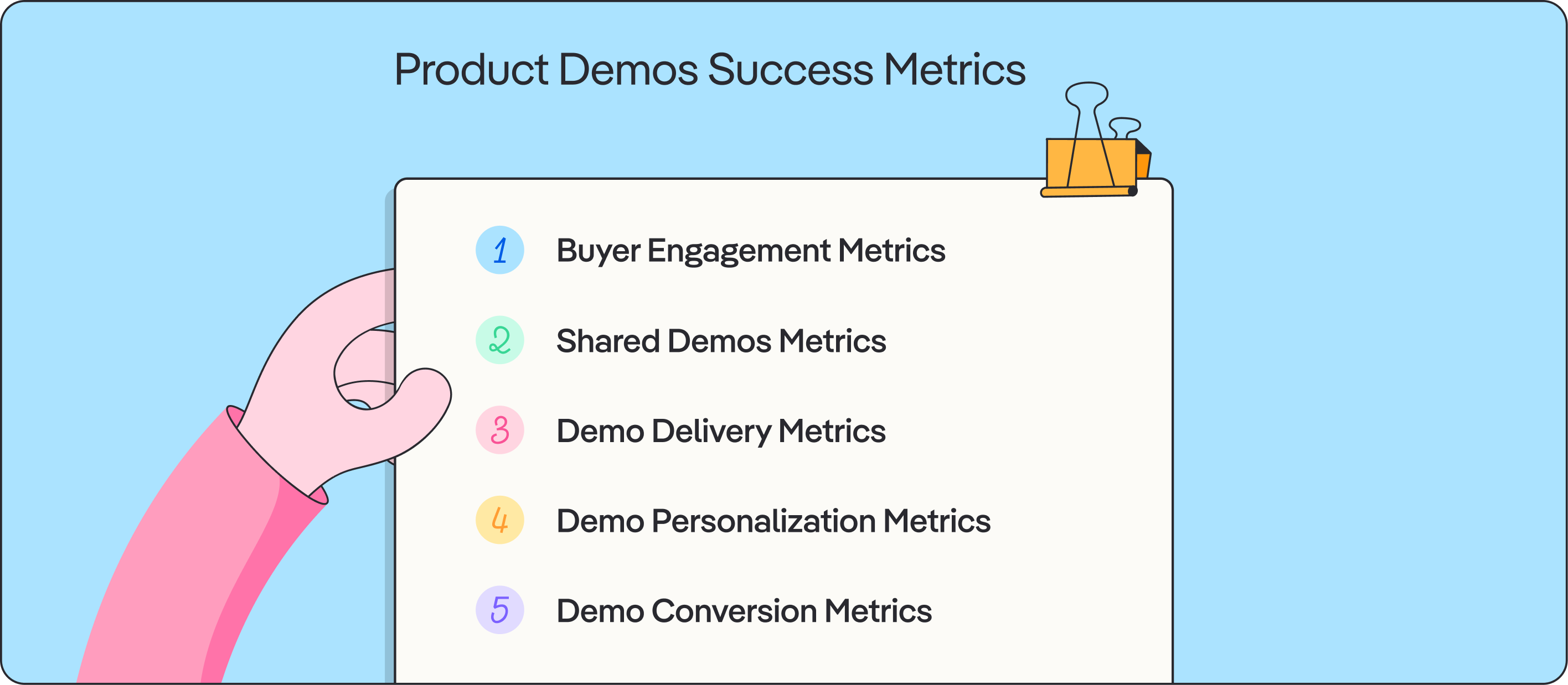
## **Common Challenges Affecting Sales Demo Conversion Rates**
However, it's not always smooth sailing with sales demos. Several challenges can hinder your impact your ability to turn prospects into paying customers, including:
- **Capturing and Maintaining Prospect Attention -** A dull or generic presentation can easily lead to disinterest and missed opportunities. Grabbing and holding your prospect's attention throughout the demo, especially in a virtual setting, requires a captivating and engaging approach.
- **Addressing Specific Needs and Concerns -** A one-size-fits-all approach rarely yields optimal results because each prospect has unique pain points and requirements. Failing to tailor the demo to their specific needs can leave them feeling unheard and unconvinced about your product's value proposition.
- **Overcoming Objections and Hesitations -** Prospects often have reservations or concerns that need to be addressed before they commit to a purchase. Anticipating and proactively addressing these objections during the demo is essential to building trust and moving the deal forward.
- **Technical Glitches and Demo Hiccups -** Nothing derails a demo faster than technical difficulties or unexpected hiccups. Whether it's a slow internet connection, a software malfunction, or a presenter stumbling over their words, these issues can disrupt a demo's flow and leave a negative impression on prospects.
- **Lack of Clear Call to Action (CTA) -** Once the demo is complete, failing to provide prospects with a specific next step can lead to confusion and inaction. A winning sales demo should always culminate with a clear and concise CTA that guides them toward a purchase.
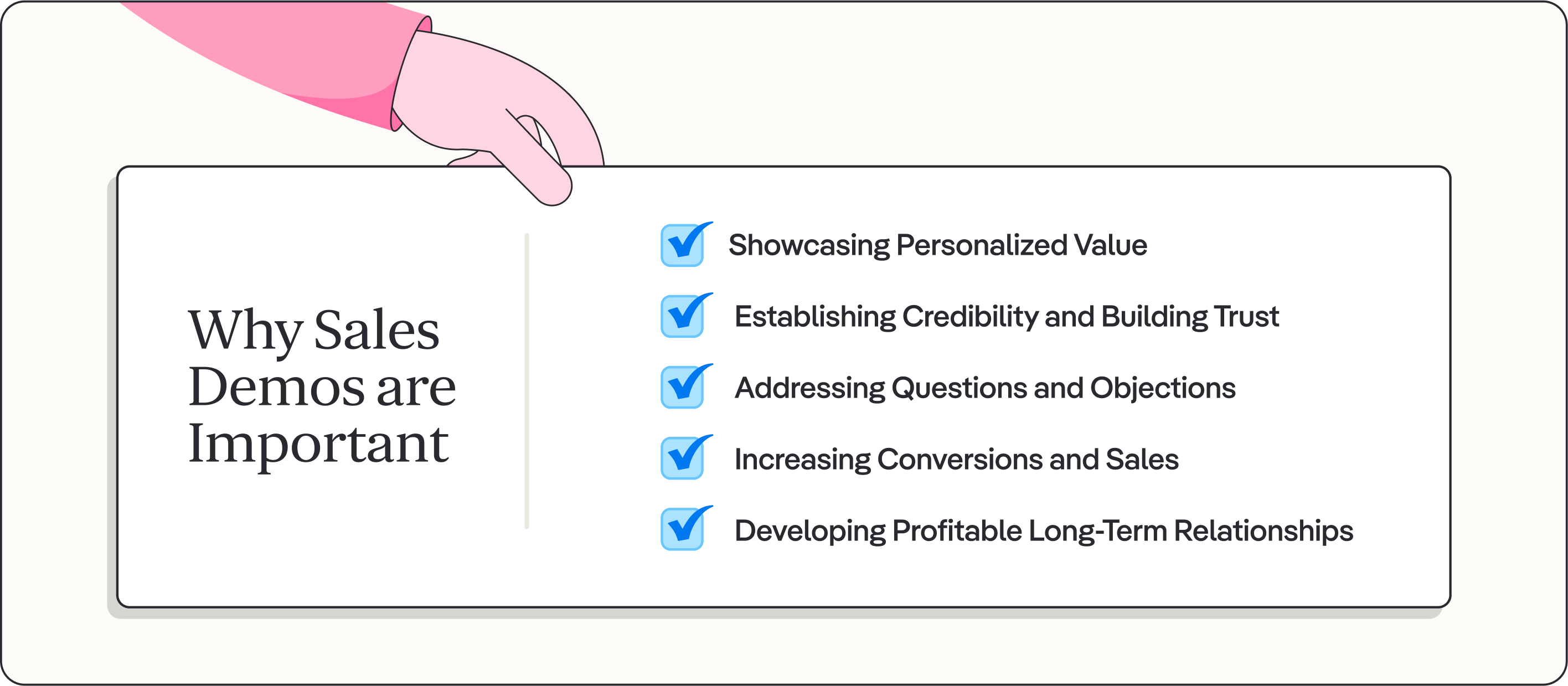
### **8 Tips to Improve Your Demo Conversion Rates**
Here are eight actionable tips to create more effective sales demos and boost conversions:
### **1. Know Your Audience**
The foundation of a successful sales demo lies in a deep understanding of your audience. Use [discovery calls](https://www.demostack.com/post/how-to-maximize-discovery-call-success-12-essential-tips) to gather information about your prospects’ business needs. Invest time in researching their industry, pain points, and goals, such as:
- What challenges do they face?
- What are their priorities?
- What metrics matter most to them?
Enter the data into a CRM integrated with your demo platform. Segment your audience based on this information and tailor your demos accordingly. Speaking directly to your prospects' unique needs and challenges establishes a stronger connection and increases the likelihood of conversion.
Demostack's customization features enable you to create personalized demo experiences for different audience segments, making your presentations more relevant and engaging. You can leverage prospect data to dynamically adjust the content, focus, and messaging of your demos.
### **2. Create a Compelling Story**
Features alone rarely win deals. What truly captivates prospects is the story behind those features—the problems they solve and the transformations they enable.
Craft a narrative that highlights your product's value proposition and resonates with your audience's pain points and aspirations. Instead of just listing functionalities, paint a vivid picture of how your product streamlines workflows, boosts productivity or drives revenue growth.
Weave this narrative seamlessly into your demos. Use overlays to spotlight key features in context or build custom clones to show personalized customer journeys. Add rich visuals, testimonials, and data visualizations to create an immersive experience.
### **3. Focus on Value, Not Features**
While it's still necessary to showcase your product's features, demonstrating their value is even more crucial. Avoid overwhelming your audience with technical jargon and instead highlight the benefits and ROI they can expect. Focus on how your product solves their problems, improves their efficiency, or boosts their bottom line.
Interactive, customized sales demos are key to effectively showcasing your product's unique value proposition. Create demos that focus on outcomes, not just functionalities, so your prospects clearly see the tangible benefits your product offers and become more inclined to convert.
### **4. Leverage Interactive Elements**
Static presentations can be dull and forgettable. Consider incorporating interactive content elements like polls, quizzes, or live Q&A sessions to keep your audience engaged and encourage active participation.
Interactive demo features like clickable product tours and simulated scenarios enhance audience engagement and facilitate a deeper understanding of your product. Allowing prospects to interact with your product hands-on makes the sales demo more memorable and increases your chances of conversion.
### **5. Personalize the Sales Demo Experience**
A generic demo rarely resonates with prospects. Research indicates that faster-growing companies drive 40% more of their revenue from personalization.
Instead, personalize each demo to the specific pain points and needs of the individual or company you're presenting to. Research their industry, challenges, and goals beforehand, and customize your demo to address their unique situation. This demonstrates that you've taken the time to understand their needs and reinforces the value your product can bring.
Demostack's powerful personalization tools enable you to quickly and easily tailor demos to meet the specific needs of each prospect in minutes.
The editor allows you to quickly customize everything on-screen—including text, data, and charts—to create dynamic, customized demos that address your prospect's pain points and showcase how your product can solve their specific challenges. You can even create templates to be used or modified for other prospects or stakeholders.
### **5. Ensure a Seamless Technical Experience**
Unfortunately, technical glitches can derail even the most well-prepared sales demo. Thoroughly test your demo environment, internet connection, and any software or tools you'll be using to ensure a seamless technical experience. Have a backup plan in case of unexpected issues, and be prepared to troubleshoot on the fly.
A smooth, professional demo experience reinforces your credibility and instills confidence in your product. Ideally, you should use a [demo platform](https://www.demostack.com/post/top-10-demo-automation-software-for-2024) that prioritizes stability and reliability to minimize the risk of technical disruptions while prospects are experiencing self-guided demos. Features like automated environment setup and real-time monitoring let you focus on delivering a flawless demo without worries.
### **7. Gather and Act on Feedback**
After each demo, solicit feedback from participants to gain valuable insights into its effectiveness. Use surveys, follow-up emails, or direct conversations to gauge their level of interest, understanding, and any remaining concerns.
Most importantly, carefully review your demo platform's analytics to get actionable data on engagement. This data allows you to identify areas for improvement and continuously refine your approach. Pay close attention to metrics like drop-off rates, feature interactions, and overall sentiment to understand what resonates with prospects and what needs refinement.
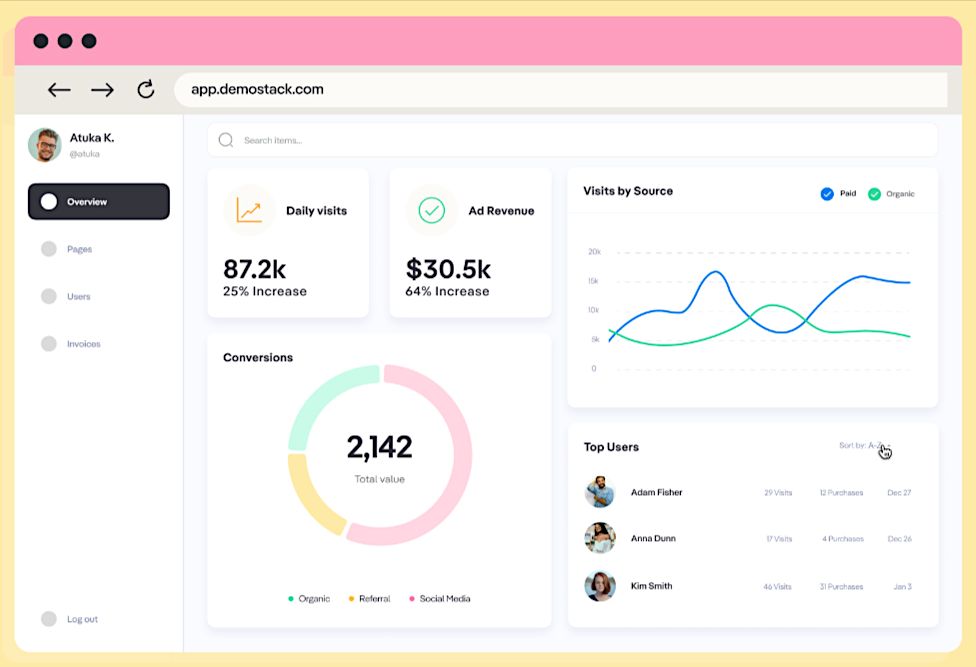
### **8. Follow Up Effectively**
The demo doesn't end when the presentation concludes. Follow up promptly with personalized emails or calls to recap key points, address any outstanding questions, and provide additional resources. Maintain consistent communication to nurture the relationship and guide prospects toward a purchase decision.
Use Demostack's CRM integrations to track demo engagement, review key sales and marketing analytics, and automate follow up communications. A well-timed and personalized follow up can reinforce the value of your product and keep the conversation moving forward to a sale.
## **Transform Your Demos, Improve Your Conversion Rates**
Compelling sales demos are a critical factor for success in B2B software sales, so keeping the process optimized for conversions is imperative. Using these eight tips will significantly enhance your demo's impact and drive higher conversion rates. But to do it right, you need a [sales enablement](https://www.demostack.com/post/top-10-best-sales-enablement-software) and demo automation platform like Demostack.
Demostack's robust and versatile platform provides the tools and insights to create impactful, personalized demos that resonate with your prospects. With Demostack, you can streamline sales demo creation, automate personalization, gather valuable analytics, and scale your demos effortlessly—transforming your demos into powerful sales engines.
**[Try Demostack today](https://www.demostack.com/) to unleash the full potential of your product sales demos.**
## Article: What is dummy data
Source: https://www.demostack.com/post/dummy-data
In the world of software product demonstrations, the importance of dummy data cannot be overstated. When our customers want to buy us to customize their demos to tell a better story, they are usually referring to making it easier [to add and customize dummy data](https://www.demostack.com/platform/features/ai-data-generator). Dummy data, often referred to as demo data, plays a crucial role in showcasing the capabilities of a product.
In this blog post, we'll explore what dummy data is, how it is used in demos, who is responsible for incorporating it into demo environments, the complexity of the process, and the significance of quality dummy data. Additionally, we'll delve into the innovative use of [AI Data Generators](https://www.demostack.com/platform/features/ai-data-generator), particularly within Demostack, and provide alternatives for those without access to this platform.
## What is Dummy Data?
Dummy data, also known as demo data, is simulated information that mimics the characteristics of real data but generally lacks any meaningful content. Its purpose is to provide a representative sample for testing, development, and, most notably, for creating realistic demonstrations of software applications.
## Who is responsible for incorporating Dummy Data into demo environments?
The task of integrating dummy data into demo environments typically falls on the shoulders of developers, product managers, or demo managers, who usually also do presales. These individuals need to carefully curate data that accurately represents the product's functionality while avoiding sensitive or confidential information.
## Is adding Dummy Data hard?
The process of adding dummy data to demo environments can be complex, depending on the intricacies of the product being demonstrated. Factors such as data structure, relationships, and volume must be considered to ensure a seamless and authentic representation of the product.
Now, if you multiply this complex process to multiple demo instances, it starts becoming overwhelming. Leading many companies to make only one or a few tailored demo instances or not even try to customize demo instances.
## What are the Characteristics of Good Dummy Data?
Quality dummy data is a key factor in successful demos. Good dummy data should resemble real-world scenarios, cover a variety of use cases, and reflect the potential challenges users might face. Striking the right balance between complexity and simplicity is essential for creating a compelling demonstration. When dummy data does not mirror the challenges of a prospect, then it really is dumb data and not so helpful to the salesperson telling their product’s story
## How You Can Scale Dummy Data with AI Data Generator by Demostack
Demostack, a platform designed for product demonstrations, offers an AI Data Generator powered by Open AI’s product GPT-4 Turbo. It empowers companies to transform their dummy data into smart data. This tool simplifies the process of generating realistic data sets, ensuring that demos are not only visually appealing but also provide an accurate representation of the product's capabilities. Since it is so easy to use, demo managers can create hundreds of demo templates (or instances) for their sales team. Imagine a demo template for every persona, segment, and industry. The options are limitless.
## Alternatives: Top Mock Data Generators
For those without access to Demostack (starting price is $15K), several other mock data generators can be employed to achieve results outside of Demostack. Check out these three companies:
## [Mockaroo:](https://www.mockaroo.com/)
- Mockaroo is a powerful online tool that allows users to generate a variety of dummy data, including names, addresses, emails, and more. It supports customization and provides APIs for integration into different environments.
## [Randomuser.me:](https://randomuser.me/)
- This easy-to-use API generates random user data, including names, addresses, and profile pictures. With a simple HTTP request, developers can obtain diverse and realistic dummy data for their demos.
## [Faker:](https://fakerjs.dev/)
- A popular library available in multiple programming languages, Faker enables developers to create customized dummy data with ease. It offers localization for various regions and is widely used in testing and development.
In the realm of product demonstrations, the role of dummy data is pivotal. Whether through advanced [AI Data Generators like the one provided by Demostack](https://www.demostack.com/platform/features/ai-data-generator) or other mock data generators, the ability to scale dummy data into smart data is crucial for creating compelling and realistic demos. As technology continues to evolve, these tools will play an increasingly important role in ensuring that demonstrations accurately reflect the potential of the products they represent.
## Article: How to reduce your sales cycle length
Source: https://www.demostack.com/post/reduce-sales-cycles
Decrease your sales cycle length by improving your demos with a demo experience platform.
The sales cycle length is a crucial sales metric monitored by every level of the organization, from managers to the executive level, and even on to investors.
Why? The timing of revenue generation is crucial for nearly everything in sales. Sales cycle length impacts everything from forecasting to hiring, investments, acquisitions, improvements, even new features.
A quicker sales cycle means:
- Revenue is realized quicker, and more is generated in a given amount of time
- Investments necessary to optimize the business, such as new technology or headcount, can be made sooner
- The pace of innovation increases, meaning the product becomes more competitive, faster
- More logos are captured within a given period
- Overall business performance increases
According to Hubspot, the average SaaS B2B sales cycle length is 83 days. Other studies have pinned B2B buying cycles at longer than four months.
This means that a typical B2B deal will either close at the very end of, or outside of the quarter in which it began.
To be more competitive, revenue teams must seek to shorten the length of their sales cycle as much as possible. But how?
## How to reduce sales cycle length
Many of the current strategies to reduce sales cycle length utilize more technical methods that involve the use of technology. Such as:
**1. Automating repetitive tasks**
Tools can streamline sellers’ workflows like data entry, meeting notes, forecasting, and reporting so they can spend less time doing administrative tasks and more time talking with buyers and advancing deals.
**2. Self-scheduling through shared calendar links**
Eliminate the constant back and forth emailing to schedule meeting times with a simple link that allows buyers to choose the best time to meet for them in a few clicks.
**3. Enable document collaboration, sharing, and signing from anywhere**
For faster reviews and signatures, revenue teams can employ platforms that allow for the remote viewing and signing of NDA’s, purchase agreements, and so on.
**4. Automatic meeting reminders and follow-up**
Rather than sellers individually tracking each meeting, sales tools can send automatic meeting reminders to all participants. This helps ensure meeting attendance so deals can progress forward in a timely manner.
**5. Lead scoring and prioritization**
Revenue platforms track each lead’s activity and engagement with multiple factors, including website visits, emails, meeting participation, and so on. They score these leads to help sellers prioritize the hottest and most interested contacts who will ideally close quickly.
**There are also non-technical methods of decreasing sales cycle length. These include:**
**1. Agree upon goals before each call**
To make the most of every engagement, sellers should discuss the goals for each call with their buyers. That way they can ensure common checkpoints are being met and that a timeline for the deal can be followed.
**2. Surface objections early**
****The earlier objections to a deal are surfaced, the quicker a deal can move. Sales reps can address any issues with a deal at the beginning, so they don’t arise later and throw off the process.
**3. Use social proof**
Buyers will rarely take a seller’s word. Instead, leverage social proof to show the value your product has generated at other, similar organizations. When buyers see success first hand, they are more likely to purchase, quicker.
**4. Discuss pricing early**
Don’t let the price become a surprise. It’s best to discuss pricing at the beginning of the deal. That way, buyers will understand the value they get for their money, and there’s no haggling at the end to slow a deal down.
**5. Align marketing and sales messaging**
Sales and marketing must work together to achieve their goals. When this isn’t happening, the sales cycle can suffer. HubSpot research shows that sales only rates 7% of leads they received from their marketing organizations as high quality. There must be a constant feedback loop of not only the quality of leads but also the conversations that they are having.
Marketing-sourced leads see all types of ads, messages, and content before they talk to sales. So, they come with certain expectations. When sales doesn’t deliver that same messaging, they start from nothing. Align your sales and marketing messaging to maintain momentum and speed up the sales cycle.
## Shortening the sales cycle with a demo experience platform
The demo is the single more important component of your sales process. It shows the buyer exactly how your solution will look, act, and work for them. It is the moment that will make or break a deal.
Yet, in many sales processes, the demo takes weeks to get to. There are multiple conversations, endless back and forth, at least one discovery call, all piling up before the actual product is even shown. This creates a major traffic jam that significantly slows the momentum of any deal.
This is the exact opposite of what buyers want. In fact, Hubspot found that 54% of prospects want to see how the product works _on the first call._
To significantly decrease the length of your sales cycle, give your buyers a demo as soon as possible.
This is difficult for many reasons. Buyers don’t buy based on generic pitches, generalized demos, and non-specific value propositions. To be most effective, everything your buyer is exposed to should be personalized to them.
But, personalized demos don’t scale well. Typically sales engineers must build out custom instances for each demo that feature familiar names, logos, and numbers, and so on. Depending on their workload, this alone can take weeks.
Then, there is the constant worry that a demo environment may not be fully functional, stable, or may even look different. Sellers don’t want to show a demo on the first call as they fear that they may not be showing the best version of their product.
## Article: Sales demo environment: Your complete guide
Source: https://www.demostack.com/post/demo-environment
A sales [demo environment]( https://www.demostack.com/post/your-perfect-demo-environment-is-not-your-own) is the space in which your sales demonstration occurs. Not only does it include the demo instance of your product, but what you present it through, and the features and functionality shown within the demo.
Think of your sales demo environment as not only the movie set, but the lighting, sound, cameras, props, and actors within it. As soon as one of those goes wrong, the illusion is ruined. To properly showcase your product, you have to get every part of the demo environment right.
## What is a sales demo environment?
Your sales demo environment is the environment in which you immerse your prospects when you provide demos.
The crucial thing to know with a sales demo environment is that any sales organization that gives demos of their product has one, whether it is intentionally thought of or not.
When it comes to your demo environment, it’s important to consider the fact that it goes beyond your product. It is the data, charts, graphs, and features shown within your demo, as well as the tools that you use to present it.
It is the demo instance or [demo experience platform](https://www.demostack.com/post/demo-experience-platform) itself, or even the conferencing tools you use, the slides you show, and who attends. Any one of these factors can result in a broken demo environment.
The goal is to create the most realistic use case for your product as possible. You should not only show your prospects what it looks like in a real-life environment but what it looks like in their world.
Think of a movie that brings you somewhere else. The set, lighting, sound, camerawork, and editing all transport you to a different place or time. Yet, if you were to take the same actors and same lines to a stage set for a middle-school play, you wouldn’t be nearly as convinced.
In the sales world, this means your [demo environment](https://www.demostack.com/post/your-demo-environment-build-or-buy) must have realistic names, logos, and data. No more “Elon Musk,” or “Acme Co.” The difference between a highly personalized and realistic environment and one filled with fake, outdated data is astounding.
Imagine for a moment you are Truman Burbank in the Turman Show. Everything about the environment he is in convinces him that it is real until the facade fails.

## Why is a demo environment important?
Imagine the last time you received a demo that had a poor video connection, maybe the screen froze, the sound went out, or perhaps the speaker had a lot of background noise. Even though the demo itself may have been fine, the other factors created a less than ideal demo environment that may have given you second thoughts.
That’s why so important that sales organizations are aware of their [entire demo environment ](https://www.demostack.com/post/your-demo-environment-build-or-buy)and the experiences that they provide to their customers.
By ensuring that not only are you providing quality experiences, but also using quality tools, and delivering value, you stand to exponentially increase your sales effectiveness.
## How to create the perfect sales demo environment
### Set the stage
As previously mentioned, your sales [demo environment]( https://www.demostack.com/post/your-demo-environment-build-or-buy) goes beyond the actual production of the demo. Revenue organizations should go to great lengths to ensure that their reps can deliver quality demos, have strong internet connections, clean desktops, and good cameras/microphones.
Also, ensure the right people are on the call, from both sides, whether it be a sales engineer, account executive, the engineering team, or decision-maker
### Use the right tools
Ensure your sellers have everything they need to succeed. A [demo platform](https://www.demostack.com/product), conversation analysis tool, and the right content can go a long way to upleveling any [software demo](https://www.demostack.com/post/evaluating-product-demo-software).
### Personalization is key
If you haven’t realized by now, personalization is King in sales. It’s probably most true during the demo. Sellers should understand exactly what problems their buyers are looking to solve, what their ideal outcomes are, their pain points, their uses, and their needs.
Further, the demo instance itself should be personalized with names, logos, customers, and data that are all relevant to the prospect. Ensure that figures fit the company size so as to not come off as a solution meant for a company too large or too small.
### Tell a story
The simple problem to solution format doesn’t connect anymore, especially in the highly competitive marketplace present in nearly every industry. Humans connect with stories. We share them, remember them, and derive understanding from them.
Therefore, your demo experience should be a story. Highlight the flow of information, provide real-world examples, and share real successes. Of course, always relate the stories back to your buyers and show your product solves their problems.
### Make it interactive
No one wants to just sit and listen to you talk. Your demo should be as [interactive as possible](https://www.demostack.com/post/create-an-interactive-sales-demo). Show your product in real-time, not on videos or slides. Ask questions and be engaging. If you can, let your prospects interact with your product and take it for a test drive.
## Article: Top 10 Demo Automation Software for 2024
Source: https://www.demostack.com/post/demo-automation
Time is money in B2B sales, and nothing eats up time like scheduling product demos. The endless back-and-forth emails, the frantic calendar juggling — it's enough to make your head spin. But what if there was a better way? Imagine if prospects could experience your product on their own time, whenever they're ready. That's the power of demo automation software.
With pre-recorded, customizable demos at their fingertips, buyers can explore your solution on their terms. The best part is that there are no scheduling nightmares required, since most buyers do substantial research before even talking to sales. If you need another reason to adopt demo automation software, consider that research shows that 65% of sales leaders who invest in their enablement teams outperform revenue targets.
Demo automation software gives your sales team a serious advantage. With a streamlined demo process, you'll shorten sales cycles, close more deals, and free up your team to focus on driving revenue. Let's review the top demo automation software that can take your sales demos to the next level.
## **What is demo automation software?**
Demo automation software is a strategic tool designed to streamline and enhance the product demonstration process, and is a vital component of a robust sales enablement strategy. It allows businesses to create pre-recorded, interactive demos that prospects can access on-demand, and it eliminates the need for time-consuming live demo sessions.
This software is particularly valuable for companies that require an in-depth explanation of complex products or services. Providing self-service demos allows potential buyers to explore your product at their own pace and convenience, while your sales representatives can focus on building relationships and closing deals.
Demo automation software enables you to:
- [**Personalize the demo experience**](https://www.demostack.com/post/8-essential-steps-to-master-outbound-sales-in-2024--demostack) by tailoring demos to specific industries, use cases, or buyer personas to resonate with individual prospects.
- **Track engagement to gain valuable insights** into how prospects interact with your demos, identifying areas of interest and potential roadblocks.
- **Scale your demo efforts to reach a wider audience** without increasing your sales team's workload, making your demos more accessible to potential customers.
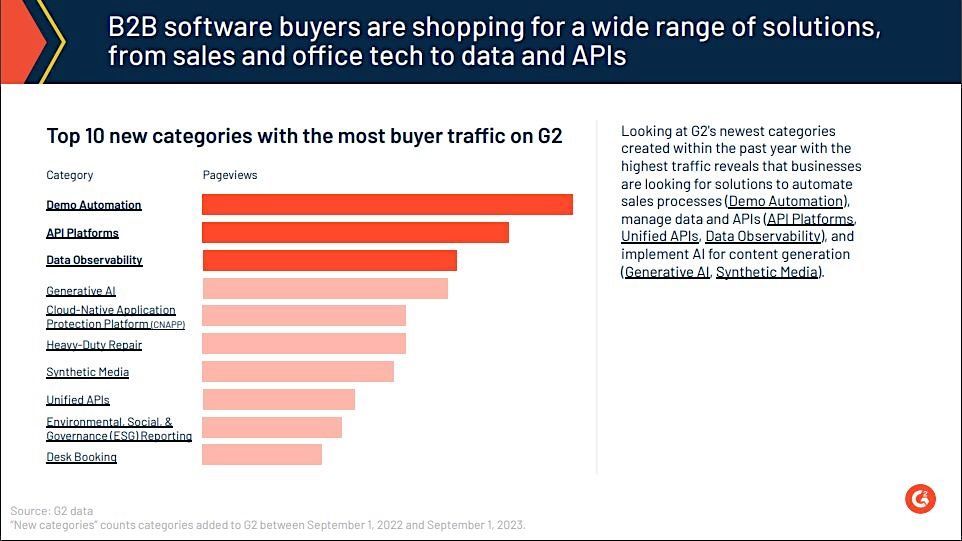
## **Types of Demo Automation Software**
Demo automation solutions are leveraged at different stages of the sales cycle, and can be differentiated based on the following use cases:
### **1. Product Tours**
These tools provide interactive, self-guided walkthroughs of your software product via HTML or screen capture technology, highlighting key features and benefits. Product tours can be embedded on your website or sent to prospects as leave-behinds.
### **2. Live Demo Solutions**
Other solutions empower sales reps and sales engineers to showcase live versions of your product during demo calls. They often include features like data overlay or injection to personalize the demo experience and pre-configured accounts to demonstrate specific use cases.
### **3. Sandbox or POC Automation**
This type of software enables you to create pre-configured or cloned environments where prospects can have a hands-on trial experience with your product. This is helpful for complex products where prospects need to understand how the solution fits into their specific workflows.
## **Benefits of Demo Automation Software**
Demo automation software offers many benefits, including:
- **Accelerated Sales Cycles -** Providing instant access to demos eliminates scheduling bottlenecks and empowers prospects to move through the sales funnel faster.
- **Increased Sales Productivity -** Your sales team can focus on high-value activities rather than spending hours on repetitive demo calls.
- **Improved Lead Qualification -** Tracking demo engagement provides valuable insights into prospect interest and readiness to buy, allowing you to prioritize leads effectively.
- **Enhanced Buyer Experience -** Prospects can engage with your product on their terms, leading to a more positive and [personalized buying journey](https://www.demostack.com/post/demostack-is-revolutionizing-sales-enablement-for-demos).
- **Consistent Messaging -** Ensure that every prospect receives the same polished, accurate, and up-to-date product information, regardless of who delivers the demo.
- **Scalability -** Expand your reach and demo capacity without needing to hire additional sales staff.
- **Cost Savings -** Reduce expenses and time spent on in-person demos.
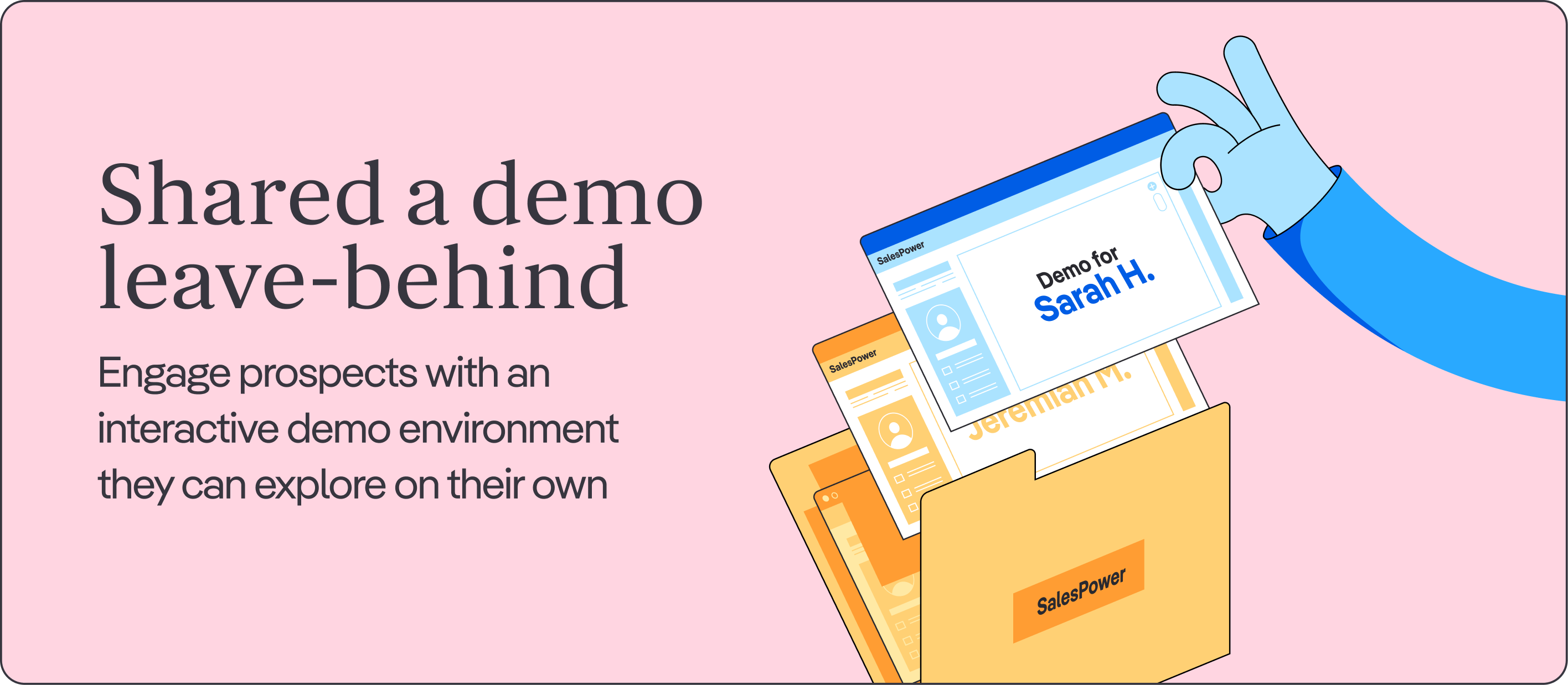
## **Key Features of Demo Automation Software**
When choosing demo automation software, prioritize these key features to streamline your demo creation process, enhance the buyer experience, and drive sales:
- **Automated Demo Creation -** Automatically capture application screens or workflows to reduce time and effort in creating and updating demos.
- **Personalization Capabilities -** Tailor [fresh, relevant demos](https://www.demostack.com/post/Maintaining-Software-Demos) for specific audiences by modifying data, adding personalized text or video overlays, and customizing the demo flow.
- **Sharing and Embedding Options -** Easily share demos via email, embed them on your website, or use them in live demonstrations.
- **Engagement Analytics -** Access to robust analytics on demo usage (such as views, clicks, and time spent) to gain insights into prospect behavior and refine your demo strategy.
- **Integration with Business Systems -** Ensure seamless integration with your CRM, marketing automation, or analytics software for smooth data flow and insight tracking.
## **Top 10 Demo Automation Software**
### **1. [Demostack](https://www.demostack.com/)**
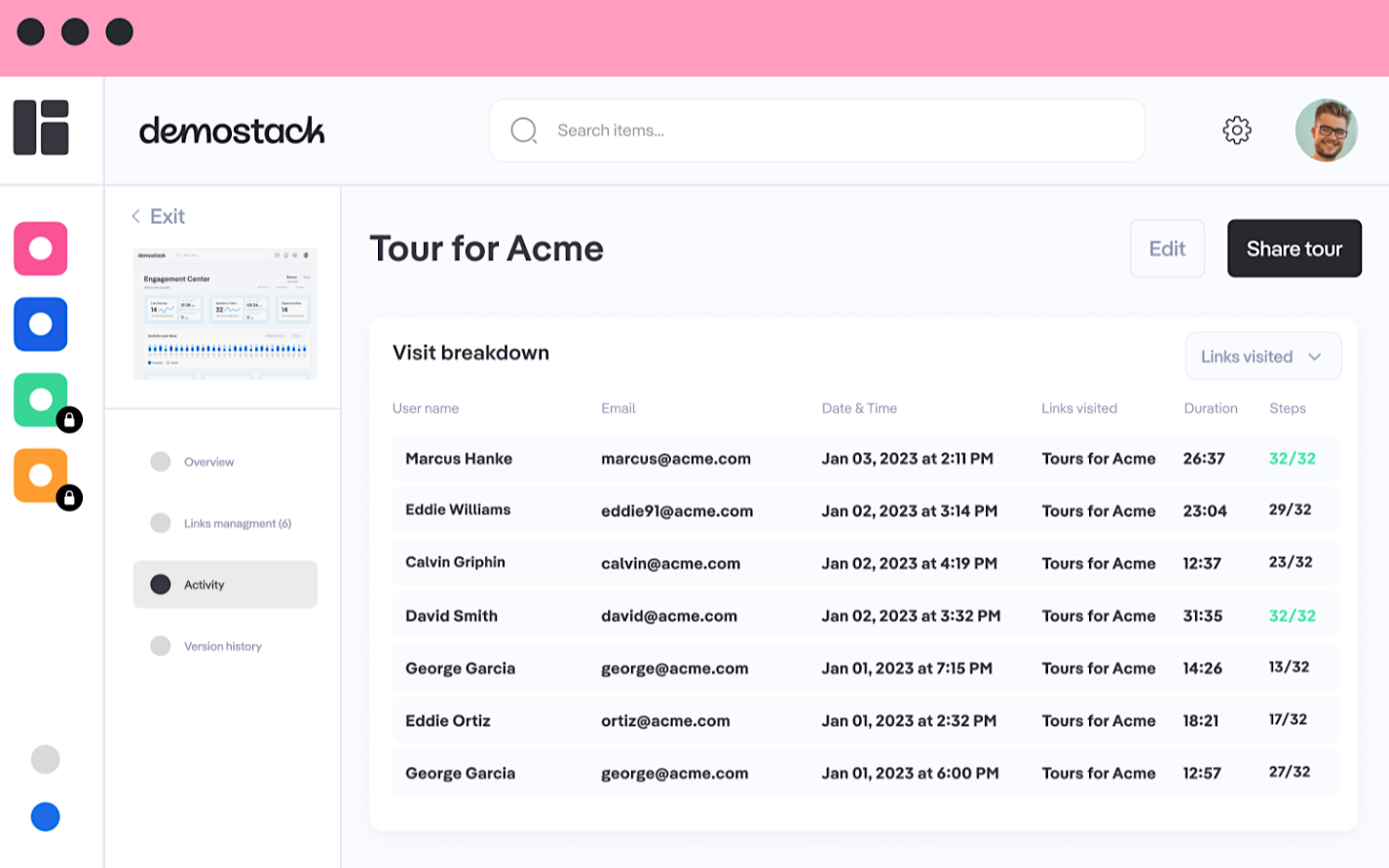
**Demostack** is a leading demo automation software that delivers personalized, interactive product demos quickly and efficiently. The no-code platform, intuitive interface, and robust features allow you to easily tailor demos to specific use cases, industries, and buyer personas.
Demostack's robust features include capturing live demos and injecting data overlays for a more personalized experience, as well as tracking engagement metrics to refine your sales approach continuously. This powerful demo automation software allows product teams to focus on innovation while enabling sales teams to win more deals faster.
**Best for:** B2B sales teams with complex products or a need for highly personalized demos that resonate with diverse audiences.
**Price:** Custom quotes available, annual pricing starts at $50,000.
**Review:** _“Demostack has been an awesome tool to add to my tool belt when it comes to demoing and saves me a ton of time to make customizations to tell better stories.”_
### **2. [TestBox](https://www.testbox.com/)**
**TestBox** allows you to create live, interactive demos and sandbox environments from your actual product, ensuring prospects experience the most up-to-date version. Its AI-generated data populates these environments which saves you time and effort while providing realistic use cases. It also integrates with popular CRMs and sales enablement tools.
**Best for:** Sales teams who want to offer prospects a hands-on experience with a live version of their product.
**Price:** Starts at $38,000/year for 15 users.
[**Review:**](https://www.g2.com/products/testbox/reviews) _“TestBox offers some unique solutions to our problems but their solution is still relatively new.”_
### **3. Storylane**
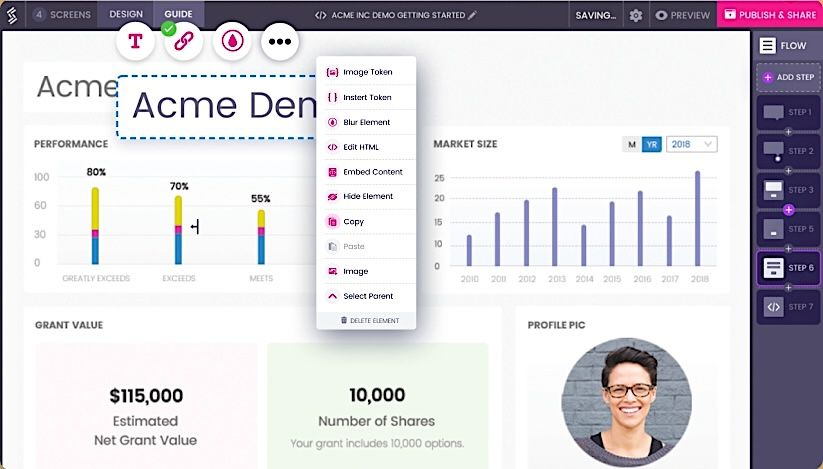
**Storylane** is a product demo builder for your go-to-market and revenue-generating team. It enables you to capture your product's interface and customize it with interactive elements like tooltips and hotspots, making demos more engaging and informative for prospects. Additionally, Storylane provides demo performance analytics to monitor viewer engagement and optimize your demos for better results.
**Best for:** Revenue teams seeking a user-friendly, no-code product demo solution.
**Price:** Four tiers - Free, Starter ($40/monthly), Growth ($100/monthly), and Enterprise (custom pricing).
**Review:** _“We make almost daily use of Storylane to help with our demonstrations and support material.”_
### **4. Navattic**
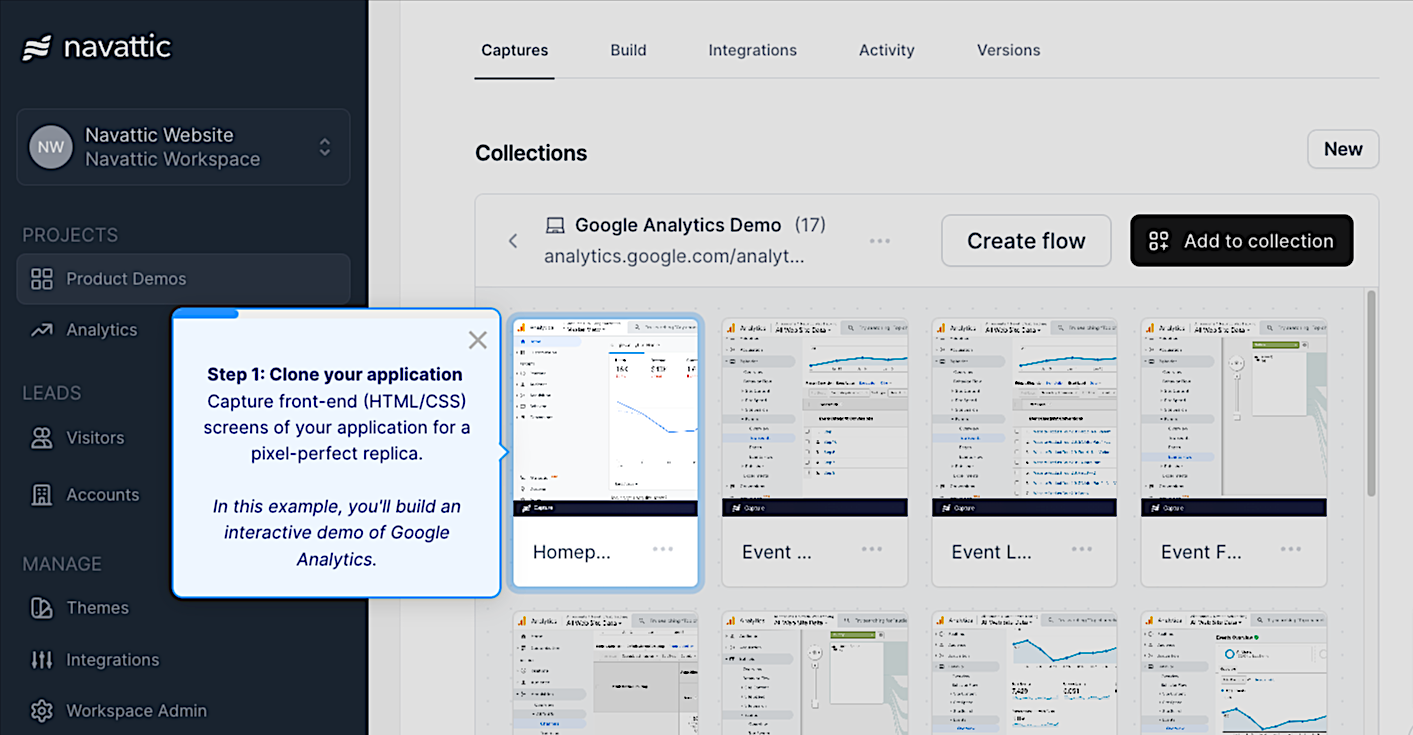
**Navattic** enables the creation of interactive product demos that mirror your live application, creating pixel-perfect copies of demo environments without engineering. The flow builder transforms apps into interactive stories by allowing text, elements, and image edits. Product demos can be shared via email or embedded on websites, enhancing prospect engagement and [lead generation](https://www.oktopost.com/blog/components-every-lead-generation-landing-page-must-have/).
**Best for:** Product-led growth teams needing realistic demos for various applications.
**Price:** Three levels - Base ($400/monthly), Growth ($1000/monthly), and Enterprise (custom pricing).
[**Review:**](https://www.g2.com/products/navattic/reviews) _“While Navattic offers powerful features for creating demos, there is room for enhancement in user interface customization options and integration capabilities.”_
### **5. Demoboost**
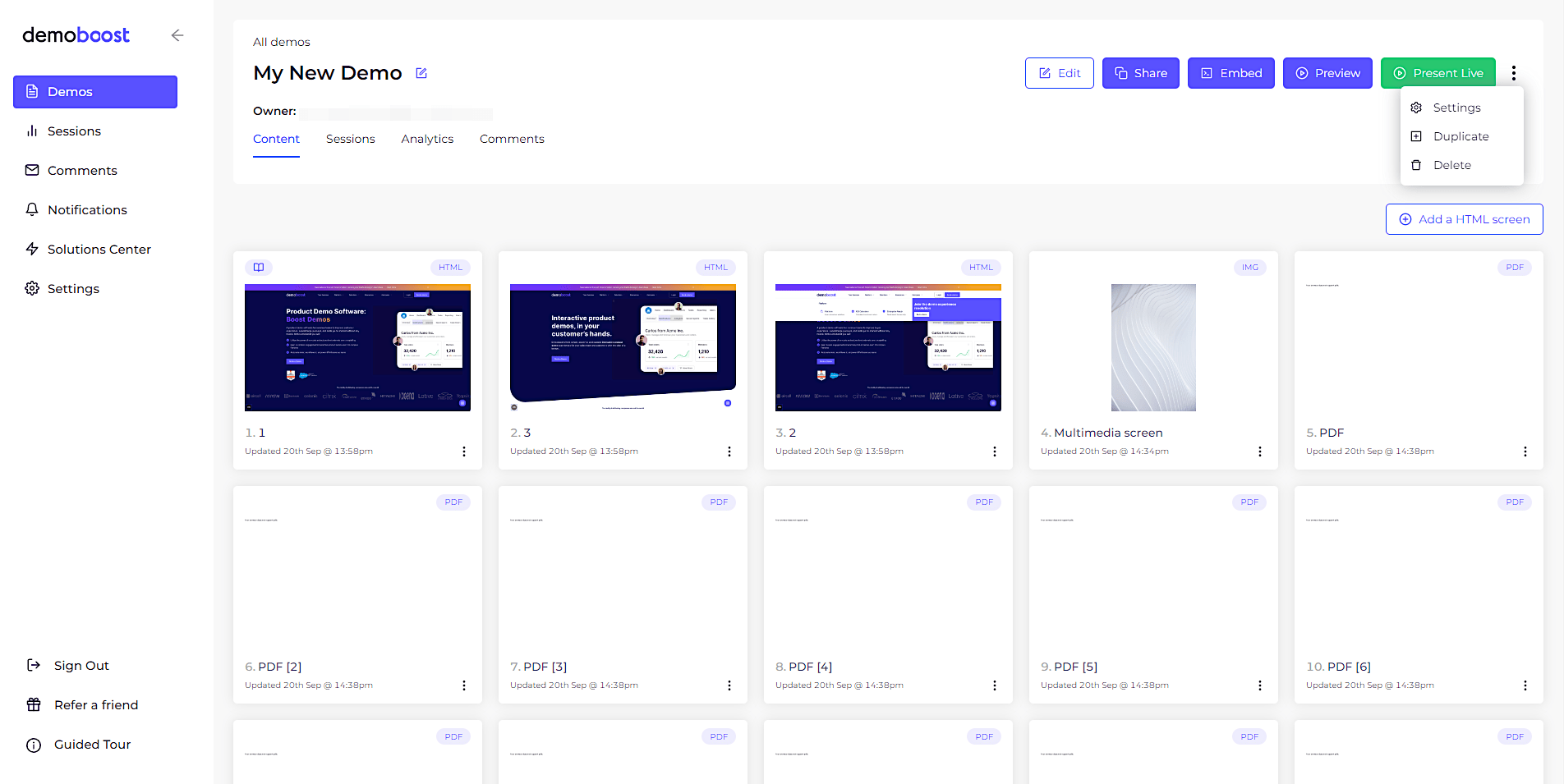
**Demoboost** allows you to create a centralized library of interactive demos that can be easily shared with prospects on-demand. The platform offers many customization options to personalize the content and track engagement metrics for insights into prospect behavior. Demoboost also integrates with various CRMs and sales enablement tools.
**Best for:** Sales teams for SaaS organizations that need a holistic, centralized demo solution.
**Price:** By inquiry
**Review:** _“While the tool itself is maybe not yet the most robust, the team behind it is extremely helpful when it comes to support and consulting on the proper implementation.”_
###
**6. Coast**
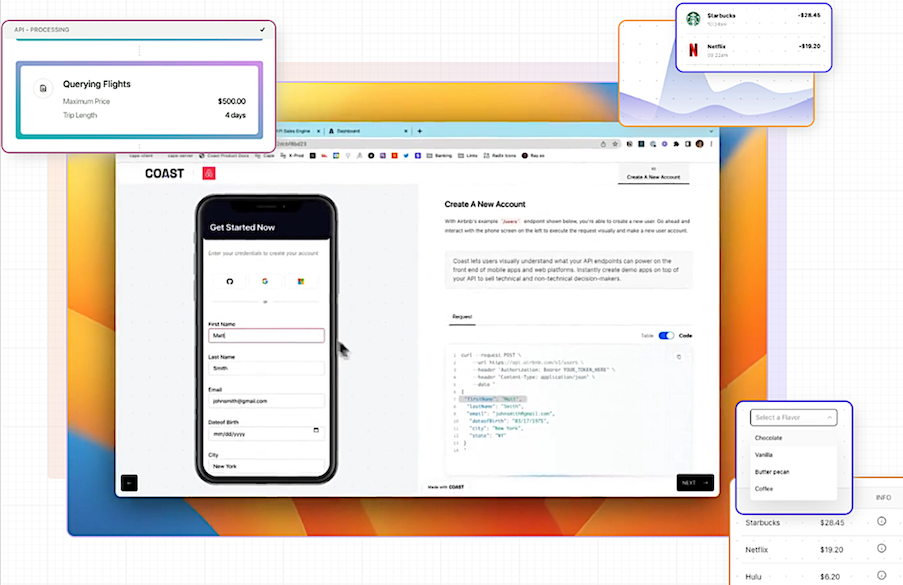
**Coast** helps you to create live, interactive demos that showcase your product's backend and frontend simultaneously. This is particularly useful for API products or those without a traditional user interface. Each demo environment is unique to each lead, providing a personalized experience and the ability to save changes for later reference.
**Best for:** Companies with API-first products.
**Price:** Upon request
**Review:** _“Any API seller will gain an immediate advantage by using Coast.”_
###
**7. Omedym**
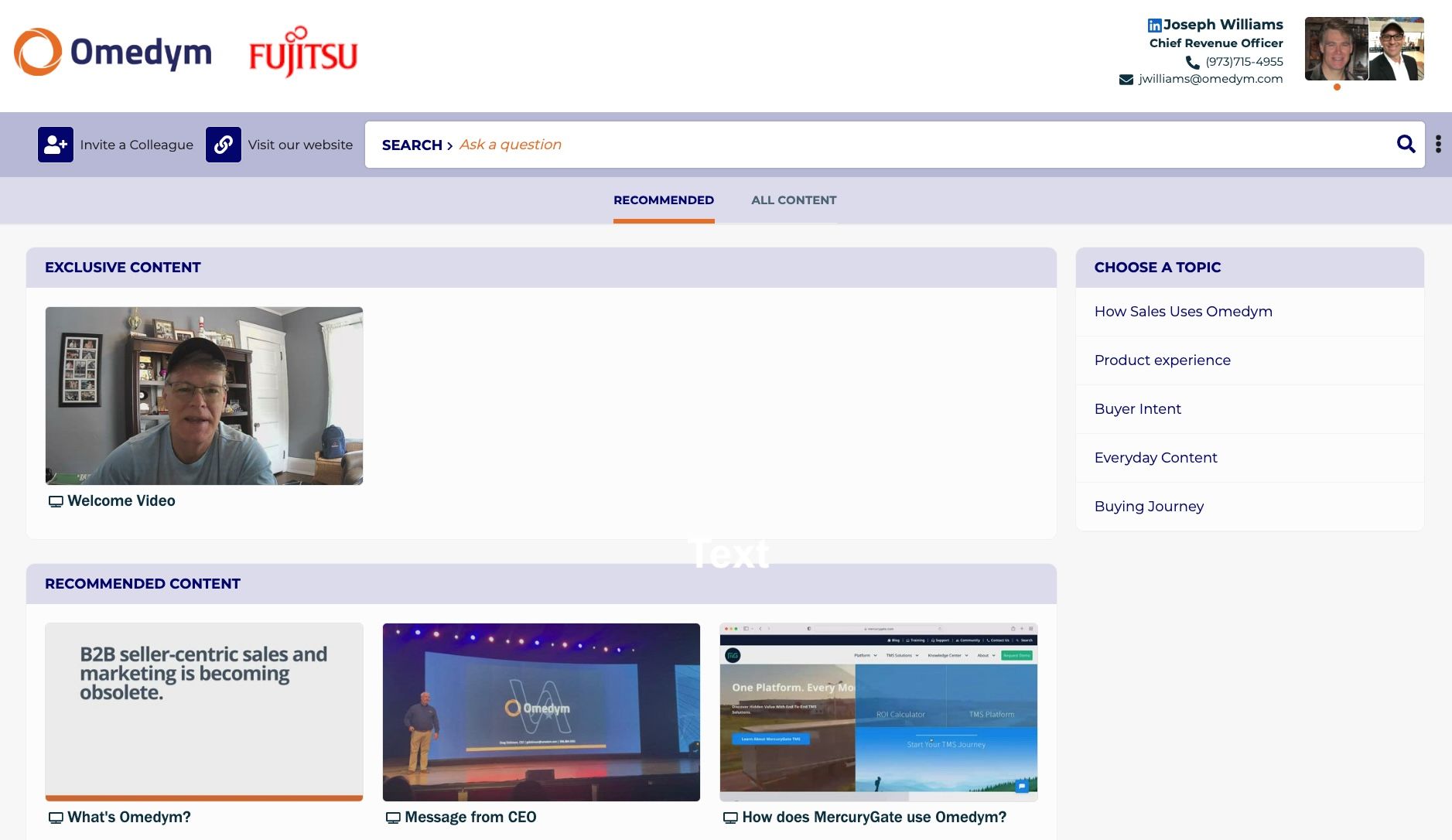
**Omedym** transforms your existing content into an interactive demo experience by indexing every word in your videos and PDFs, making them fully searchable. This allows prospects to self-educate and explore your product in a way that's relevant to their specific needs. Omedym also provides detailed analytics and insights into buyer interest and behavior.
**Best for:** Companies with a wealth of existing content looking to create a self-service, buyer-centric demo experience.
**Price:** Private Digital Sales Room at $100/monthly, or Website Digital Sales Room at $500/monthly.
**Review:** _“A client-facing portal takes only minutes to set up, and you get incredibly useful insights such as which pages your prospects are looking at, and for how long.”_
### **8. Reprise**
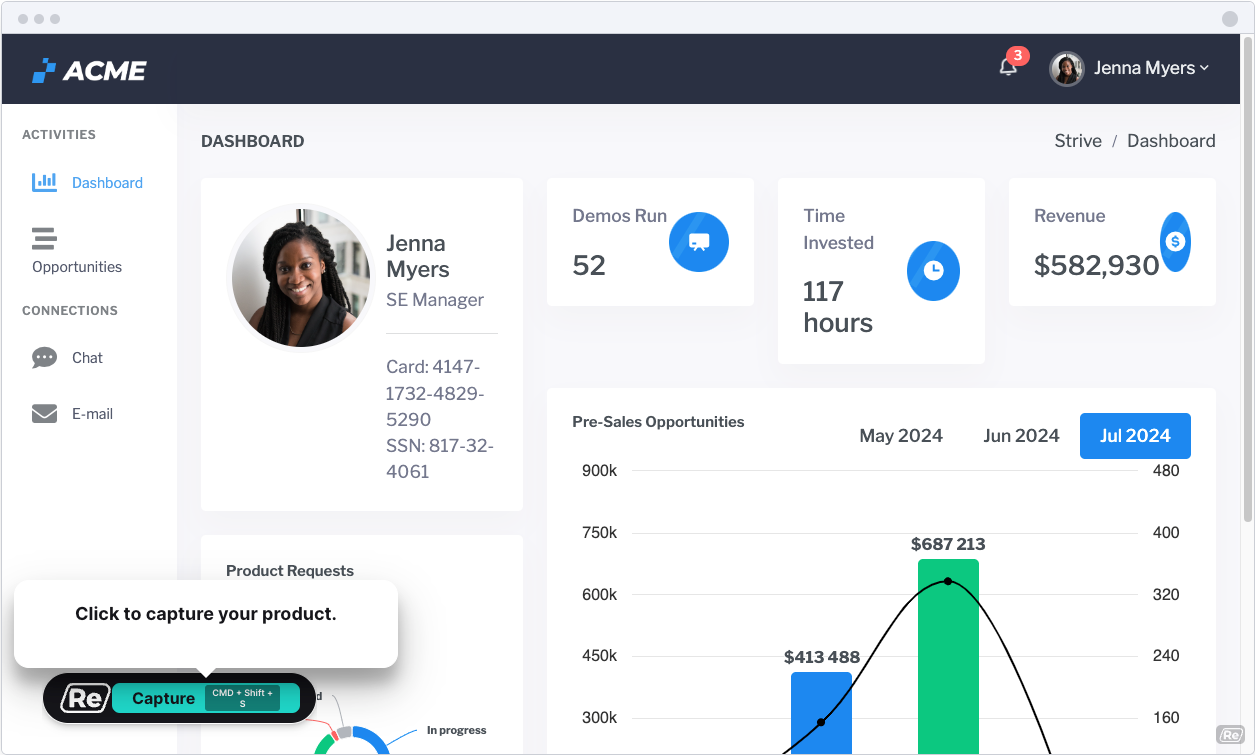
**Reprise** provides sales teams with tools to create and deliver interactive product demos that reset after each use, ensuring a fresh experience for every prospect. Its flexible sharing options make it easy to incorporate demos into various stages of the buyer journey. Reprise offers features like guided tours, branching scenarios, and sandbox environments.
**Best for:** Demo creation for enterprise sales and marketing team.
**Price:** By inquiry
**Review:**_“Reprise has taken a very active role in creating a space (where) we, the customers, can connect, learn from each other, and provide feedback to Reprise.”_
### **9. Saleo**
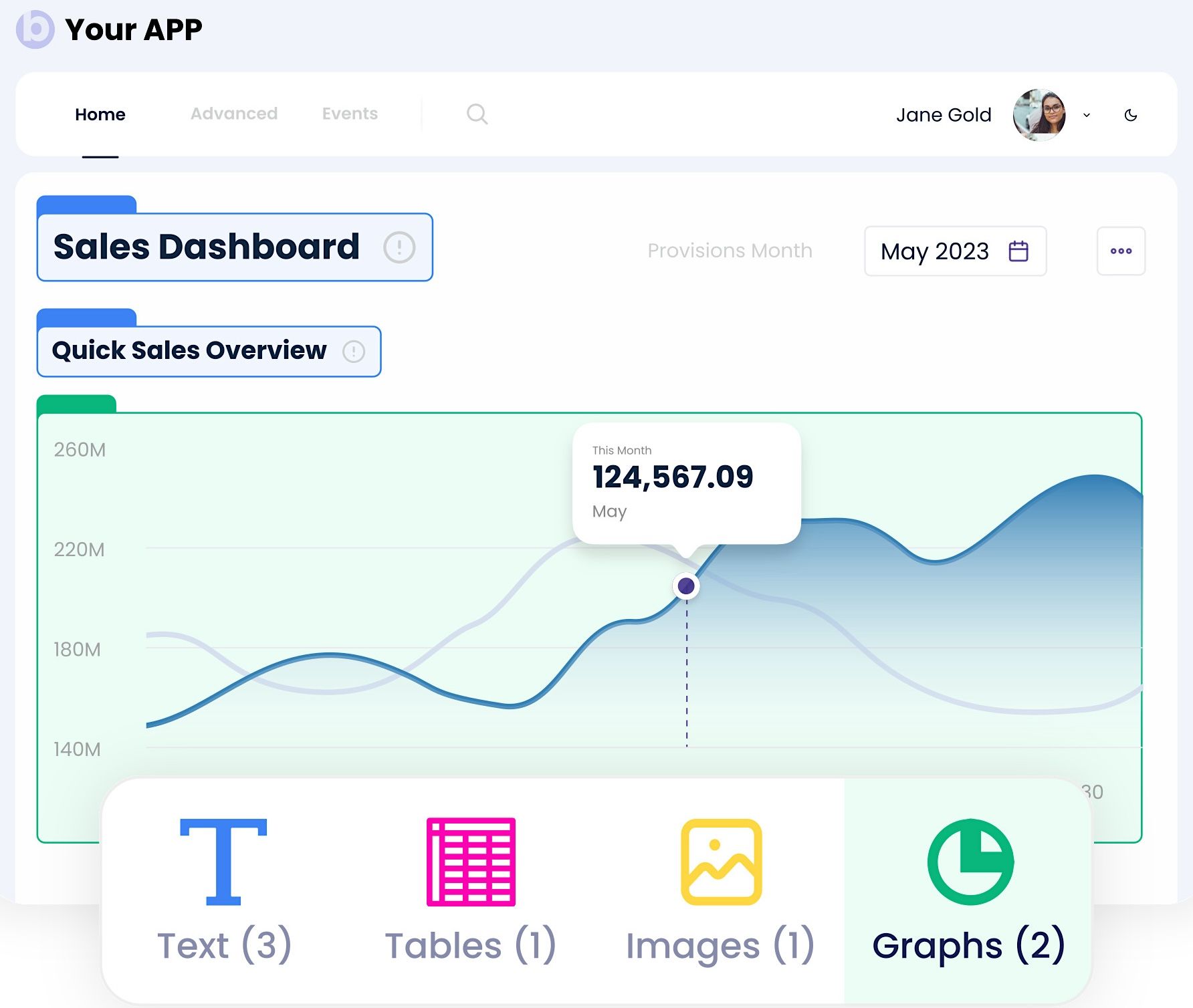
**Saleo** specializes in transforming your existing product into live, data-complete, and relevant demo environments. Its no-code AI modeling engine allows for complete control over every aspect of the software, from graphs and tables to workflows and images. Saleo also offers seamless integration with [popular CRM platforms](https://mvpgrow.com/hubspot-vs-salesforce-for-b2b/) to streamline your sales workflow.
**Best for:** Live demo automation
**Price:** By request
**Review:** _“There isn't a whole lot to dislike, but given the company is still young there are a few features that would take it to the next level - specifically offline demo capabilities.”_
###
**10. Walnut**
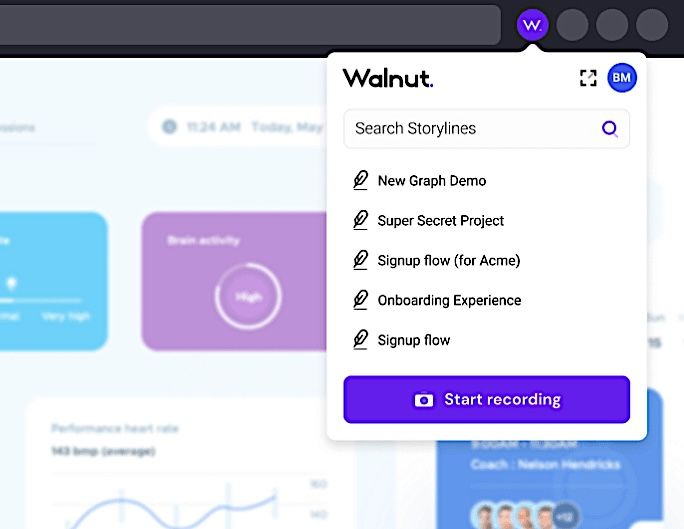
**Walnut's** demo automation software creates personalized, interactive product demos that adapt to each prospect's specific needs and interests. Its intuitive editor helps with easy customization, and its integration with popular sales tools streamlines your workflow. Walnut also offers robust analytics and A/B testing capabilities to optimize your demos.
**Best for:** Integrating easily with a diverse tech stack
**Price:** 3 tiers - Lite ($9200/annually), Pro ($20,000/annually), and Enterprise (custom pricing), plus add-ons.
**Review:** _“Integration is a breeze and (the) learning curve and training only make that easier.”_
## **Be Demo Ready with Demostack**
The evolving landscape of B2B sales demands a personalized, self-directed buyer journey. Demo automation software has become a critical tool for streamlining sales processes, enhancing the buyer experience, and, ultimately, closing more deals.
Demostack empowers teams to create compelling personalized demos that resonate with their target audience, drive engagement, and accelerate the sales cycle. Among the many options available, Demostack stands out with its intuitive interface, robust customization options, and powerful analytics— making it an invaluable asset for sales enablement teams.
**[Contact us](https://www.demostack.com/) to experience the power of Demostack and discover how our innovative platform can elevate your sales performance.**
## Article: Unleash Demostack with our HubSpot integration
Source: https://www.demostack.com/post/unleash-demostack-with-our-hubspot-integration
Demostack’s [new integration with HubSpot](https://www.demostack.com/platform/integration/hubspot) provides unprecedented visibility into prospective buyers. You can send leads from embedded product tours directly into your Marketing Hub, gather new buyer engagement data, and prioritize the deals that really matter. So your entire go-to-market team can function like a well-oiled machine.
In this article, we’ll show you how the integration works and discuss some of the reasons it is invaluable to teams using HubSpot.
## Capture demand and top up your pipeline
The Demostack-HubSpot integration [allows you to capture demand](https://www.demostack.com/use-cases/marketing) from your website, blog posts, landing pages, and social media posts and push the data into your Marketing Hub.
Create a [product tour](https://www.demostack.com/platform/products/tours) to show the feature you’d like to highlight, and embed the tour in any piece of content. Then gate it behind a simple form so you can capture the contact details of whoever is interested. When the lead hits HubSpot, your sales team can follow up in real time just like they would with any other leads. Better yet, they’ll know how high the intent of the lead is and which features interest the team most.
This integration takes the technical headache out of the equation. That is to say that instead of manually importing leads using a spreadsheet, you can simply add the tour to your website from HubSpot and watch the leads flow in.
Everything else will sync automatically. You can just set it and forget it. No stress needed.
## Extract buyer engagement data effortlessly
Any data you collect from product tours will automatically become a Hubspot contact. So, you can make sure that the sales and [marketing team](https://www.demostack.com/use-cases/marketing) will see which features the lead has viewed, whether there are additional key decision-makers who weren’t on the initial call and who they are, and even when people left the product tour.
With this added buyer engagement data, your sales team will have far more leverage going into a conversation. They can start a demo by highlighting a preferred feature or explaining a complicated workflow that might have caused confusion. Or, they could request that certain team members join the call to accelerate the process.
Unlike marketers, who can measure everything from time on page and scroll rate to clicks and conversions, sales teams have far less data. There may be limited publicly available information about a company, especially if it’s small or privately owned, and the information that is available might be out-of-date. So it’s often very difficult for sales teams to identify a prospect’s specific needs and even harder to personalize their approach.
Even when a marketing team does a great job of tracking user journeys, sales teams typically need a discovery call before a demo call just to collect the basic information they need to craft a compelling pitch.
Now though, sales teams can analyze activity on the product tours and sandboxes to gather crucial insights before ever even logging into Zoom.
## Qualify, Prioritize. Forecast. (Repeat)
When you’re lucky enough to have a robust marketing funnel, prioritization can be tricky. Take on too many leads and you’ll quickly overwhelm your sales teams. But, qualify too strictly, and you may risk rejecting great opportunities.
Many teams opt for the former.
As a result, demand for presales has surged, not only in the demo but [throughout the buyer lifecycle. ](https://www.presalescollective.com/content/the-undeniable-shift-in-presales-surging-demand)As B2B technology has become increasingly complex, so has the sales cycle. Presales professionals serve as buyer coaches and stay engaged long past the point the deal initially closes.
The Demostack-HubSpot integration can relieve some of that burden.
When you leverage Demostack’s products to qualify prospects, both your SEs and your sales reps can spend more time focusing on what really matters–selling.
For example, if multiple team members are active in a sandbox, including members of leadership, you’ll know that the team is probably ready to discuss a deal seriously and mobilize quickly.
Better yet, since everything will be synced in HubSpot, you won’t have to ever switch platforms or remember to manually import data. And, with more data on buyer intent, it will be far easier to accurately forecast your quarterly revenue.
##
## Final thoughts
An integration between Demostack and HubSpot means that your presales operations can be perfectly seamless. All of the buyer engagement data you collect from product tours, sandboxes, and demos will flow effortlessly into Hubspot.
So, everyone in your go-to-market team can gain greater visibility into the viability of any given deal. And, it will be easier than ever to keep everyone on the same page.
## Article: Unlock new possibilities with Demostack’s Salesforce integration
Source: https://www.demostack.com/post/unlock-possibilities-with-demostacks-salesforce-integration
Demostack’s new integration with [Salesforce](https://www.salesforce.com/) helps you translate raw demo data into real business value more effectively than ever before.
In this article, we’ll show some information you can pull from Demostack into Salesforce. Then we'll explain how you can interpret that data and upgrade your processes in real-time. So, you can squeeze every bit of value out of Demostack and level up your demo operations.
### Fast-track your way to the perfect pitch
Our new [Salesforce integration](https://www.demostack.com/platform/integration/salesforce) lets you pull demo, tour, and sandbox data from Demostack directly into your CRM. When you can see all your CRM data coupled with new demo data in one place, you’ll quickly learn what’s working and what’s not working in your demos and your demo process. Imagine if you could find out how many demos it takes to increase your win rate or at which part of the sales cycle your demos are most effective. Or, if you have customized demo templates, consider how helpful it would be to understand which templates are the most effective to close a deal.
### Create more A+ players
With this integration, you can not only determine what a great demo process looks like but also WHO gives the best demos. You will also be able to see who your A+ players are and who aren’t, so you can enable those B and C players to be better.
With all of this added visibility, management will be able to optimize the demo process more efficiently than ever before.
### Allocating presales work effectively
With Demostack and Salesforce, you'll be able to actively allocate your presales resources more appropriately.
Today, many customers customize different demo templates for various scenarios. When you create different demo templates for every persona, company size, industry, and pain point, you can slice and dice your data from every angle.
Discover, for example, which industry needs the fewest SE resources to get to a win. If you learn that selling to Finance companies takes fewer resources than selling to Health companies, and both get you the same payoff, you should prioritize selling to finance companies. And, you can analyze in real-time if your SE resources are, in fact, being allocated appropriately.
### Import crucial insights from a tour or sandbox leave-behind
With our [sandbox](https://www.demostack.com/platform/features/sandbox) leave-behind, you can uncover crucial details about prospects throughout the sales cycle, and now you can import that data into Salesforce. You’ll see how serious your champions are, and if they do share it, you will reveal who the other key players are. Plus, you’ll see which features each stakeholder cares about.
By putting this data into Salesforce, your team can set up workflows to help accelerate deals. For example, with automatic email or Slack notifications, your team will know when a prospect is HOT. The same goes for product Tours.
### Final Thoughts
Ultimately, this new update helps you turn crucial insights into business value. More than just a method for overcoming tool fatigue, this integration is the key to telling better stories.
It’s time to streamline demo operations and drive outsized returns for your organization. Let us know how you plan to get value from the Demostack and Salesforce integration.
## Article: PII Shield: Demostack's latest tool makes masking sensitive data quick and effortless
Source: https://www.demostack.com/post/pii-shield-demostacks-makes-masking-data-quick-and-effortless
Get the product into your customer’s hands faster. Deliver an immersive, tailored demo experience. Personalize as much of your demo as possible.
These are the driving factors to architect the story you want to tell through your demo and enable the buyer to make a decision in your favor. In all three pointers, you’ll find a common theme: personalization is king.
Sales teams understand that but adopt varying approaches to personalization; the most common being using realistic data. At its core, this is an effective approach, but it’s when they unknowingly include personally identifiable information (PII) that problems start.
**Spoiler Alert:** Having PII in demo stories can lead to severe ramifications and catastrophic fines.
##
## What is PII?
Personally identifiable information, or PII, is any confidential information someone could use on its own or with other information to identify, contact, or locate individuals with or without consent. Common examples of PII include:
- Name
- Email
- Address
- Phone number
- Social Security number
- IBAN
- Credit card information
PII is often unknowingly left behind in a digital environment (in this case, your sales demo). As it's sensitive information, you need to take active measures to protect or “mask” it. In other words, figure out a way to deliver personalized demos in the current privacy-forward landscape.
##
## Why having PII in your sales demo is not good
Why all the fuss about not having PII in your sales demo? To stay compliant and be professional.
Organizations must be in compliance with consumer privacy regulations like HIPAA, GDPR, CCPA, and other privacy mandates that require certain information, like the PII of their employees, customers, and third-party vendors to be protected.
It’s a legal obligation that extends to sales assets, even the sales demo.
If you don’t take this seriously, you’ll find yourself paying seriously hefty fines. We’re talking 4% of your annual global revenue, sometimes even millions.
Besides legal reasons, PII in demo stories is also unprofessional.
Picture this: you're demoing out of production, and showing your own sensitive data. For instance, you're showcasing your CRM and accidentally show the prospect you're presenting to as an active opportunity in your pipeline with a value attached of how much you think the deal is worth.
Unfortunately, your prospect grew uncomfortable seeing that and ends the conversation.
Therefore, it's just safer to avoid having PII in your sales demo.
##
## How do organizations deal with PII in their demo process today
The lack of awareness isn’t an issue. Many companies understand the importance of avoiding PII in the demo process, but how they respond to it varies.
Some SDRs and AEs ignore the problem and continue showing PII data from the production instance, hoping it won’t come back to bite them. Others build demo instances themselves and try adding their own dummy data.
The problem with using dummy data is it can get outdated quickly, feels disconnected from the prospect, making it harder to build and maintain the complete product.
There are also sales teams investing in a robust data platform that masks data for every environment and database. While this helps the company comply with the HIPAA, GDPR, and CCPA regulations, it isn’t practical because of the (very) steep price tag.
“_So does this mean everything is doomed and there is nothing I can do about it?_”
Of course not. There is one solid solution that allows you to produce PII-free sales demos at scale _and_ eliminates the need to invest in an additional robust data platform: **Demostack’s PII Shield.**
## How PII Shield by Demostack helps streamline compliance for sales demos
At Demostack, we prioritize empowering AEs, SEs, and marketers to showcase product in the best light without a hassle. Our PII Shield supports this initiative by helping companies with sensitive data in their products.
At its core, PII Shield automates PII removal by scouring through your data to identify and mask any sensitive information. Use it to replace real data with the data you need to tell the story you want to tell at scale, without any manual effort.
**No [demo experience platform](https://www.demostack.com/post/demo-experience-platform) other than Demostack has the capabilities to mask PII data at such scale.**
Our PII Shield uses a data masking technique called substitution to help you tell a better story. It lets you:
- Mask PII with asterisks
- Mask PII with fake data
Unlike expensive data platform products, Demostack’s onboarding to mask PII is quick and seamless. It lasts less than a week—sometimes less than a day—to help you get the product in your prospects' hands faster.
The entire process is done quickly and without hassle, so you can focus on more important tasks, like actually delivering a world-class sales presentation.
What’s more, Demostack is GDPR and HIPAA compliant, and has earned an unqualified SOC 2 certification from PWC, so you can rest easy knowing the highest precautions are already taken to protect your organization's and your clients’ data.
## How Demostack PII Shield works
PII Shield sounds like magic. So how does it actually work?
To begin with, you must identify what PII format types you want to replace and with what data you want to replace them with. To reiterate, you do not need to identify each PII instance, just the PII format type. The tool will automatically identify your PII requests and then add the layer of rules to mask the sensitive data and streamline compliance.
For example, you can use PII Shield to find all the phone numbers in your demo instance and substitute them with a variety of area codes or from one specific area code.
Once the substitution process is complete, neither your prospects nor your employees can see the PII in your sales demo, even when creating a new clone.
##
## Present PII-free sales demos with Demostack’s PII Shield
It's true that [personalization helps you win more deals](https://www.demostack.com/post/5-ways-to-win-more-deals-with-personalized-demos), but this ambition shouldn’t be at the cost of non-compliance.
With Demostack’s PII Shield, you can automate maintaining data integrity for both external use (prospects) and internal use (employees). Personalize your demo stories at scale to deliver optimal demo experiences without the hassle.
So go ahead, take the easy way out—and still win at it.
## Article: Make dummy data smart
Source: https://www.demostack.com/post/demostack-unveils-ai-data-generator-for-effortless-and-scalable-customized-demos
**SAN FRANCISCO, Dec. 6, 2023**—Demostack, the only place for all things demo, unveiled its [AI Data Generator](https://www.demostack.com/platform/features/ai-data-generator) today. This is a significant advancement for demo managers, enabling the creation of customized demos effortlessly and at scale. Now, customer-facing teams can deliver professionally tailored demos on every call to drive sales faster down the funnel and win more deals.
## Customize Demos at Scale with Demostack’s AI Data Generator
With generative AI embedded into Demostack, demo managers can quickly tailor demos to specific segments, personas, and industries. The AI Data Generator populates new products with realistic data, replaces personally identifiable information (PII), and replaces dummy data with smart data.
## Customized Demos Win Deals
Leading Customer Success and Product Experience Platform, Gainsight is using Demostack’s AI Data Generator to scale even more custom demos. [David Greene, Sr. Solutions Manager at Gainsight](https://www.linkedin.com/in/davidmgreenestl/), commented, “Our experience with Demostack-powered demos has already led to an 8% increase in win rates. The AI Data Generator will enable us to continue this upward trajectory by producing more customized demos at scale.”
## Top Use Cases of AI Data Generator:
1. **Scrub PII:** Ensure customer data protection without burdening product or R&D teams.
2. **Make Dummy Data SMART:** Generating context-specific data for every demo scenario.
3. **Fill Demos with Data:** Add data to empty, stale, or outdated demo environments.
## An Enabler to Expand into New Markets
When expanding to international markets, new industries, launching new products, or going upmarket, the demo must reflect the new prospect.
- Sell internationally with local phone numbers, names and addresses
- Break into new verticals with new product content and terminology
- Sell upmarket by intelligently replacing smaller numbers with larger numbers
## Reflecting the Customer in Every Demo
Jonathan Friedman, co-founder and CEO of Demostack, emphasizes the importance of relatability in demos. “A perfect demo acts as a mirror, reflecting the customer in the product. Our GenAI-driven editing features enable our customers to craft perfect demos for every customer type. In a highly competitive environment, Demostack ensures that demos are professional, predictable, and relevant,” said Friedman.
**About Demostack**
Demostack is your Demo HQ - the command center for your entire demo operation. We help SaaS go-to-market teams take control of the demo and deliver tailored product stories at every deal stage. Create custom demo assets in minutes, showcase product in the best light, and measure how your demos are impacting deals - all from one place.
## Article: Demostack receives SOC 2 Type II attestation with highest security standards
Source: https://www.demostack.com/post/demostack-receives-soc-2-type-2-compilance
We are proud to announce that we have acquired SOC 2 Type II compliance in addition to SOC 2 Type I. Not only do we prove compliance using the highest security and confidentiality standards, but we also turned to PwC to run our assessment because of their decades of experience and commitment to excellence.
This added level of security is, first and foremost, a testament to the priority we place on serving our customers and the degree to which we’ll go to [protect their data](https://www.demostack.com/privacy).
## What is SOC 2 Type II compliance?
SOC 2 compliance is a set of standards established by the [Association of International Certified Public Accountants (AICPA)](https://www.aicpa.org/home) for informational security. The certification covers five general principles: security, availability, processing integrity, confidentiality, and privacy.
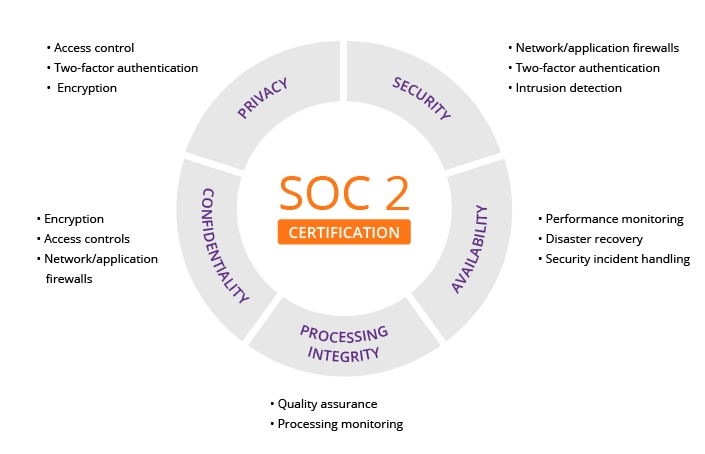
Adding Type II to Type I requires that internal controls not only acknowledge certain security standards, but also fully adhere to them day-in and day-out. So essentially, Type I certifies that an organization efficiently designed and implemented operational infrastructure in a theoretical sense. Type II confirms that said infrastructure is, indeed, functioning properly in practice as well as in theory over the course of at least six months.
## Why did we choose PwC?
PwC is one of the big four accounting firms in the United States. Renowned for their commitment to excellence, [PwC is an easy choice](https://www.pwc.com/) for any SaaS firm dedicated to going above and beyond to protect their customers from any potential breach or cyber attack.
We wanted to show the world that when it comes to safety, we never sacrifice quality for expediency. Regardless of how much time or effort it requires, we are committed to securing our technology from any incoming malicious attacks and mitigating any potential risk or unauthorized changes.
## Why is it important for Demostack?
Data privacy is at the heart of our entire operation.
That is to say that we intentionally built our product so that SaaS companies could efficiently mask the personally identifying information (PII in their demos). That way, anyone can run an authentic product demo without intentionally or unintentionally revealing sensitive customer, employee, or third-party vendor data.
Whether a business is selling marketing software or financial services, it’s easy for an AE running several demos a day to mistakenly reveal anything from customer email addresses to credit card information while sharing his screen on a Zoom call.
We created Demostack to make it easy for organizations to provide relevant, accurate demos without having to worry about data privacy. Our Demo HQ, which includes our [PII shield, is designed](https://www.demostack.com/post/pii-shield-demostacks-makes-masking-data-quick-and-effortless) to help you conceal personal data as easily as possible, so you can focus on what you do best–selling your product.
SOC 2 Type II compliance shows to the world that we really do take security seriously, and we’re willing to talk the talk and walk the walk. If we’re going to tell our customers how to protect their PII, we should be able to put our money where our mouth is and prove that we are judging ourselves against that same benchmark.
## Why SOC 2 Type II now?
Our fourth hire, [David Williamson](https://www.linkedin.com/in/davidkwilliamson/), Head of Governance, Risk, and Compliance, was an industry veteran, so security was a top concern of ours from the very beginning. However, now we’re formally acknowledging those efforts for the sake of our growing customer base.
Now that Demostack is starting to work with Fortune 500 companies, what may have once been formalities are now barriers to entry.
Even though we are relatively young, our solution is in high demand, and if we’re going to service some of the most esteemed institutions in the world, we have to hold ourselves accountable to their standards.
##
Where will we go from here now that we have SOC 2?
We’ve shown our investors, partners, and suppliers that we will go to great lengths to ensure privacy and confidentiality for our customers. After all, not only are we SOC 2 Type II compliant, but we are also [HIPAA and GDPR compliant](https://www.demostack.com/trust-center).
While we will never stop in our efforts to deliver more and more quality, with these certifications in place so early on in our business journey, we can now turn our attention to bringing Demo HQ, our full-stack demo solution, to as many organizations as we can.
## Article: Demostack raises $34 million Series B\!
Source: https://www.demostack.com/post/demostack-raises-34-million-series-b
We’re excited we’ve closed our Series B with $34 million, bringing our total funding to over $50 million!
We are incredibly thankful to all our new and returning investors. This round was led by none other than Tiger Global Management with participation from Bessemer Venture Partners, Amiti Ventures, [GTMfund](https://www.gtmfund.com/), Operator Collective, and StepStone.
Founded two years ago, our team set out to create something truly special, something businesses had needed for decades… The ability to create tailored product demos for every live sales call in minutes.
Demostack’s unique technology allows our users to spin up a fully functioning demo environment in minutes, that can be edited with a point and click. This perfect product clone is used to craft a product story that resonates with each specific buyer.
Compelling product stories are a significant competitive advantage, enabling revenue teams to deliver world-class product demos at scale -- better engaging prospective customers, shortening sales cycles and increasing win rates.
As our Co-Founder and CEO Jonathan Friedman says:
> The recent investment further positions us to become the market leader of demo experience solutions for the industry and allows us to continue to invest in R&D, innovation, and global growth… It is now more important than ever before to deliver a great product demo, and the reason is two-fold: remote selling is here to stay, and buyers expect a seamless, personalized buying experience. We built Demostack to help sellers adapt to this market shift.
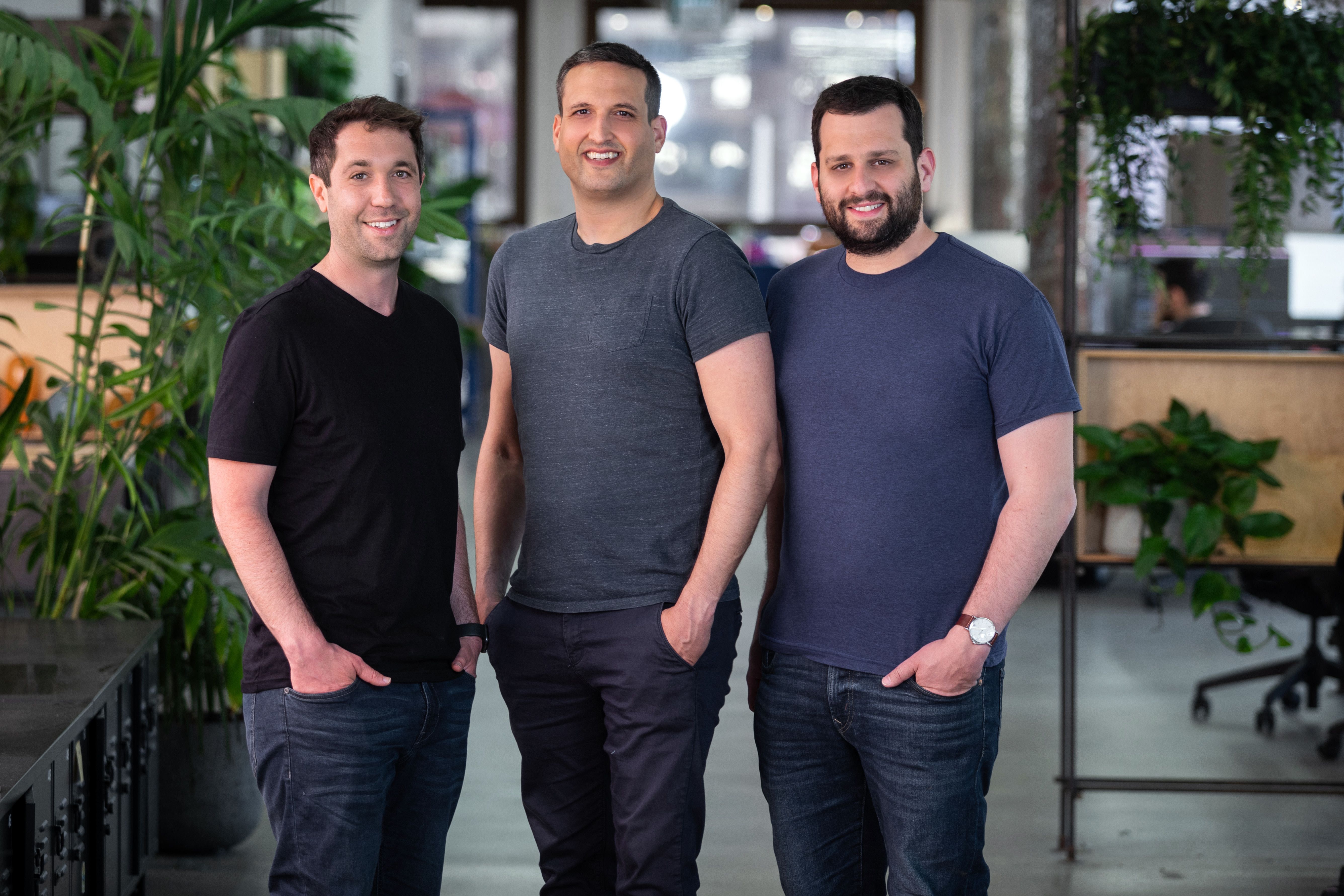
Caption: Demostack Founders, CTO Aaron Hakim, CEO Jonathan Friedman, and CPO Gilad Avidan
BlueVoyant, an internal and external cyber defense platform, and one of our newest customers is already seeing an impact. “We used Demostack for a multi-million dollar RFP and it allowed us to showcase the value of our product with a much stronger story in the demo," said Bryan Rowland, director of solutions architecture, BlueVoyant. "That was all the ROI we needed in one call."
With our new funding, we will continue to grow our global footprint, with additional R&D resources, sales, and marketing across the U.S. and Europe, Middle East and Africa (EMEA).
We will also continue to position ourselves as the category leader of demo experience solutions for midmarket and enterprise organizations.
Want to hear more about Demostack? Here's what some of our investors have to say...
### **John Curtius, Partner at Tiger Global:**
> Before Demostack was created, sales teams would have to work with their engineering team to add and manipulate data in their demo environment, often requiring weeks of work and greatly limiting their ability to showcase their product's value with the prospect... Demostack has changed the game for software sales, and we are glad to be a part of it.
### **Adam Fisher, Partner, Bessemer Venture Partners:**
> We are excited to continue to invest based on the success that Demostack has already experienced this past year... We expect that sales teams will soon only need to bring two things to a meeting -- a slide deck and a Demostack product demo.
### **Amit Bendov, Co-Founder and CEO, Gong**
> The demo is arguably the most important part of the deal cycle, but until now sales organizations have been stuck with the status quo of unstable, lackluster demos. The innovation behind Demostack makes it possible to showcase compelling demos on every call, creating a snowball effect on revenue and win rates. Demostack will soon become a household name in the sales tech stack.
## Article: Demostack is a leader on the G2 Presales Grid Report
Source: https://www.demostack.com/post/demostack-is-a-leader-on-g2
G2 is the largest and most trusted software marketplace where millions of people go to make smarter buying decisions based on authentic peer reviews.
The G2 Grid report is a visual depiction of G2 scores based on real-time customer feedback aggregated from online sources and social networks.
Being a leader on the Grid confirms that our customers are not only satisfied with our demo experience platform, but they love using it to solve their demo challenges. We’d like to say a massive thank you to our customers that took the time to share their stellar reviews on G2.
### What is the presales category on G2?
According to G2, “[Presales software](https://www.demostack.com/post/pre-sales-tools-to-make-your-life-easier) helps presales professionals such as sales engineers, solutions architects, and solution consultants engage with prospective customers and demonstrate a product's capabilities, as well as better manage their activities”.
### Not all presales products are equal
Not every product in the presales category has the same use case. For example, Vivun helps streamline communications crossteam, Tolstoy is a video platform, and Demostack empowers SEs to customize demos and ultimately [replace your demo environment](https://www.demostack.com/post/your-demo-environment-build-or-buy).
### How did Demostack become a presales leader?
It’s not surprising that we’ve become a presales leader on the G2 Grid, with customers satisfaction attributes like:
93% – Quality of support.
96% – Ease of doing business with.
85% – Ease of setup.
94% – Meets requirements.
95% – Ease of use.
90% – Ease of admin
And these numbers are significantly higher than those of our peers.
### What makes our customers happy according to G2?
The reviews on G2 reveal why our customers love Demostack. Here are five benefits our users have discussed publicly via G2 reviews:
**Replace our demo environment** – No need for R&D and Product to build and maintain a demo environment. SEs have the independence to clone and customize themselves.
**Showcase our product perfectly every time** – Easy to show value to buyers with tailored customizable demos that can be built in minutes.
**Multiple demo templates for every use case** – After SEs build templates, they can trust AEs to deliver micro demos for buyers’ specific use cases. This in turn saves SEs from joining unqualified meetings.
**No-code [cloning](https://www.demostack.com/platform/features/cloner) process that captures everything –** The simplicity of capturing every element of your product with a few simple clicks enables non-technical reps to prepare a customized demo on the fly.
**Amazing customer service and support** – We, at Demostack, hired the best CSMs and CS any company could ask for. Customer reviews on G2 seem to agree.
### Voice of the customer
Don’t take our word for it. Here are five customer testimonial snippets we identified from combing our recent reviews:
1. “The cloning process is unparalleled. Within 10-15 minutes we can clone our entire environment and we can also update it with incremental changes. Once cloned, we can edit our demo in many ways and with little work.” Yoni F, Solutions Director
2. “Innovative cloning process that is simply the best and outperforms any other platform on the market. Capturing every single element of your entire environment with ease!” Bryan C. Manager, Partner Success
3. “Stable application environment with the ability to create multiple use cases… Relationship management and customer advocacy are very strong.” Mike W, Solution Consulting Director
4. “Demostack makes it easy to create scenarios that model real-life product uses.” Adam G, Product Evangelist
5. “Demostack has helped us improve how we showcase our product and make the value easy to demonstrate.” Anonymous
Interested in seeing all the Demostack reviews on G2? You can find them here.
## Article: Demostack: A new frontier with Overlay
Source: https://www.demostack.com/post/demostack-a-new-frontier-with-overlay
We are continuing our mission to architect the next generation of product storytelling.
Today, we’re introducing a suite of new features and updated capabilities that allow admins and editors to mask their production environment with an Overlay of edits.
## How does it work?
Plug your URL in Demostack, add an overlay of edits, and save it as a template. No code or cloning needed.
Sounds simple? It is.
If you have used [Google Chrome's Inspect Element tools](https://zapier.com/blog/inspect-element-tutorial/), the output is similar - except with Demostack, you can save edits and reuse those product story templates over and over again.
## Demostack extending its tech
With Demostack, there are now _multiple_ ways to build a demo for the live sales use case.
Until today, our unparalleled cloning capabilities fueled our [early success.](https://www.demostack.com/post/gloat-unlocks-demo-environment-potential-with-demostack) When you clone, you create an independent demo environment that can be edited with no code.
Now with today’s release, you can also add an Overlay of edits on top of your production environment.
## New use cases
[Cloning](https://www.demostack.com/platform/features/cloner) allows SEs to create a reliable, independent demo environment for their team to demo off. It helps make SE ensure that demos are consistent and do not contain any surprises. But because the environment is not connected to the app’s backend, it has some limitations. That’s where today’s release comes in.
With Overlay, now you can:
- Show real-time data
- Show the latest product updates
- Show your chatbot
- Show search functionality
- Manage persistent sessions (eg. Shopping carts)
### Demo HQ
With Demostack, you have your demo assets, tools, and analytics in one place.
- Enable buyers to self-educate with guided product walk-throughs
- Mask your existing environment with a story that resonates on every live demo
- Scale your demo operation with an independent demo environment built for showcasing & sharing
With Demostack, you can scale your demo operation and win more deals faster. No wonder Demostack is the only demo solution that’s a [Leader on G2](https://www.demostack.com/post/demostack-is-a-leader-on-g2).
## Article: 12 Questions to Ask a Presales Engineer in a Job Interview
Source: https://www.demostack.com/post/12-questions-to-ask-a-presales-engineer-in-a-job-interview-
B2B buyers today expect much more than a one-size-fits-all sales pitch. They come to the table with extensive research, higher expectations, and a demand for proof. They want to see the solution in action, understand its technical fit, and confirm that it delivers real value before making a decision. That's where presales engineers come in. These professionals translate complex products into compelling solutions by showing exactly how they meet prospects' needs.
Innovative companies know the value of strong presales capabilities. A recent study found that these businesses regularly achieve above-average new business win rates of 40-50% and 80–90% for renewal business. These figures demonstrate how technical validation has become a make-or-break moment in B2B sales—because, without it, deals stall or fall apart. Presales engineers promote positive outcomes by delivering the insights and demonstrations buyers need to move forward with confidence.
For companies navigating longer sales cycles and tougher competition, hiring the right presales engineers is essential to sustainable success. The right presales team can be the difference between a prospect walking away or signing on the dotted line. Here's how to ensure you find the best ones for your organization.
## **What Are Presales Engineers, and Why You Need to Hire the Right Ones**
Presales engineers operate at the intersection of sales and technical expertise. Supported by [presales software tools](https://www.demostack.com/post/top-8-presales-software-solutions-for-2025), **they collaborate with account executives and sales teams to help prospects understand how a product solves their specific pain points.**
Unlike traditional sales representatives, presales engineers **dig into the technical aspects of a solution.** They provide custom product demos, address complicated customer questions, and make sure the solution aligns with a prospect's needs and challenges.
They are prevalent in industries where technical validation is crucial in the buying process, like B2B SaaS, cybersecurity, fintech, and enterprise technology.
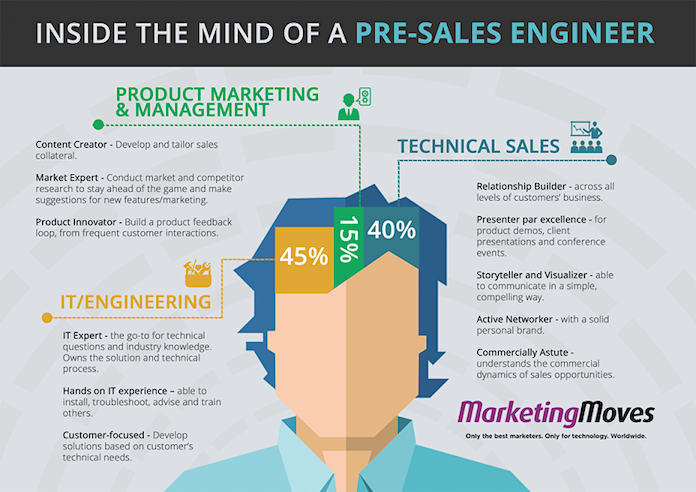
Caption: MarketingMoves
### **The Importance of Hiring the Right Presales Engineer**
Hiring the right presales engineer is critical to closing high-value deals. They **act as the technical backbone of the sales process** by translating product features into real-world benefits and demonstrating how a product meets the buyer's needs. **When a presales engineer effectively displays a product's value, prospects gain confidence in purchasing it, which helps deals progress faster.**
But a bad hire can have the opposite effect. A presales engineer who lacks the necessary technical depth, communication skills, or adaptability can prolong the sales cycle—and cause promising deals to fall apart.
That's why assessing presales engineer candidates must go beyond technical expertise. Asking the right interview questions helps to evaluate problem-solving skills, communication abilities, and cultural fit. The goal is to hire someone who strengthens the sales team and the customer experience.
## **What Are the Benefits of Presales Engineers?**
Competent presales engineers offer many benefits to an organization, including:
### **Shorter Sales Cycles**
Presales engineers who address technical questions promptly, provide the proper [solution-focused demos](https://www.demostack.com/post/solution-selling-the-essential-sales-guide), and customize products to meet a prospect's needs reduce uncertainty in the sales process. This removes decision-making roadblocks and shortens the sales cycle.
### **Higher Win Rates and Deal Sizes**
When prospects thoroughly understand how a product addresses their challenges, they're more inclined to convert. A great presales engineer increases conversions and drives larger deal sizes by providing the technical clarity that stakeholders need to justify their purchase.
### **Increased Customer Confidence**
Buyers need to trust that your solution will work in their environment. Presales engineers boost their confidence by showcasing real-world applications, helping mitigate potential risks, and facilitating a seamless technical evaluation by the prospect.
### **More Efficient Sales Teams**
Entrusting presales engineers with in-depth technical discussions allows sales reps to concentrate on strategic planning and building relationships. This [alignment with sales](https://www.demostack.com/post/aligning-sales-and-presales-to-deliver-winning-demos) creates a more efficient division of labor that helps the team work smarter and close more deals.
### **Increased Consistency in Product Messaging**
One of the many things that can derail a deal is misaligned messaging. When presales engineers deliver clear, precise, and consistent explanations of a product's capabilities to prospects, it prevents confusion and reinforces the solution's value proposition.
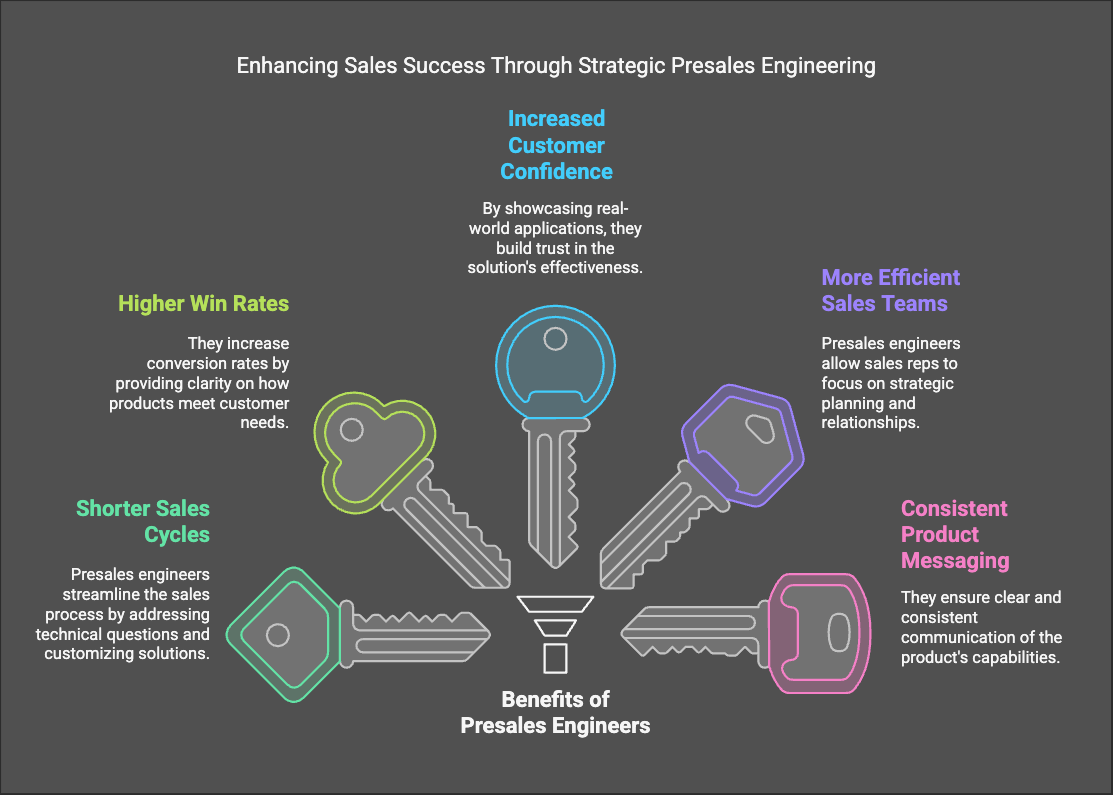
## **12 Key Questions to Ask a Presales Engineer in a Job Interview**
Here are twelve essential questions to ask when hiring a presales engineer for your team and what to look for in their responses:
**Technical and Product Knowledge Questions**
### **1. Can you walk us through a time when you explained a complex technical concept to a non-technical audience?**
Presales engineers must be able to bridge the gap between a product's technical complexity and business value. **The right candidate will describe a scenario where they successfully broke down a difficult concept**—like material informatics software, for example—and made it understandable.
Good responses to this question should include a clear approach (such as using analogies, visual aids, or business use cases) and demonstrate patience, adaptability, and the ability to gauge the prospect's comprehension in real-time.
### **2. How do you typically prepare for a product demo?**
A presales engineer's preparation process directly impacts the success of their demos. **A great candidate will go beyond feature explanations and talk about researching the prospect's** challenges, customizing the demo flow to reflect them, and anticipating objections.
They should emphasize aligning the demo with stakeholder priorities and pain points to create a compelling, relevant demo. Potentially impactful candidates will understand how to balance efficiency with customization by using a demo platform like Demostack, which allows teams to automate and personalize demos with ease.
### **3. What strategies do you use to handle technical objections during a sales call?**
**A savvy presales engineer sees objections as golden opportunities to reinforce your product's value.** The right candidate's answer to this query should include identifying the genuine concern behind the objection, providing a clear response, and reframing challenges as a chance to show off exactly how the product resolves them.
Bonus points if they can describe a time when they turned an objection into a pivotal moment in the sales cycle.
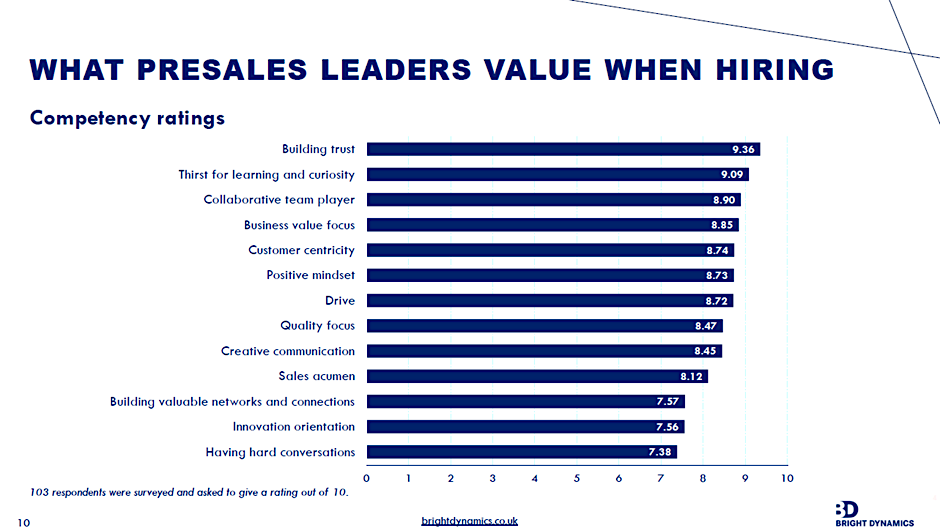
Caption: Bright Dynamics
**Sales and Customer Engagement Questions**
### **4. How do you tailor demos for different buyer personas?**
Presales engineers interact with technical stakeholders, executive decision-makers, and end users—and each has different concerns. **A favorable answer will include strategies for adjusting the depth of technical detail to focus on ROI for executives, integrations for IT teams, and workflows for end users.**
Candidates who prioritize audience-specific messaging and adapting demos in real-time are standouts. It's even better if they use platforms like Demostack that can create reusable, persona-specific demo environments to deliver targeted presentations without rebuilding demos from scratch.
### **5. Can you give an example of a deal where your demo significantly influenced the buying decision?**
This question separates the presenters from the presales engineers. Viable candidates should discuss how they structured a demo around the prospect's pain points, how they addressed concerns, and what the outcome was.
**What you're looking for here are presales engineers that drive purchase decisions.** Responses that show an understanding of buyer psychology, objection handling, and demo storytelling should push candidates to the front of the line.
### **6. What’s your approach to collaborating with account executives and the broader sales team?**
Collaboration is crucial for presales engineers, so **a great answer to this question will include regular alignment with sales, participation in strategy calls, and proactively supporting sales goals.**
Look for candidates who see their role as a partner to sales rather than a reactive resource. Also, look for someone who understands the importance of sharing demo performance insights (like those provided by Demostack) and data-backed feedback to help the sales team refine their outreach and follow-ups.
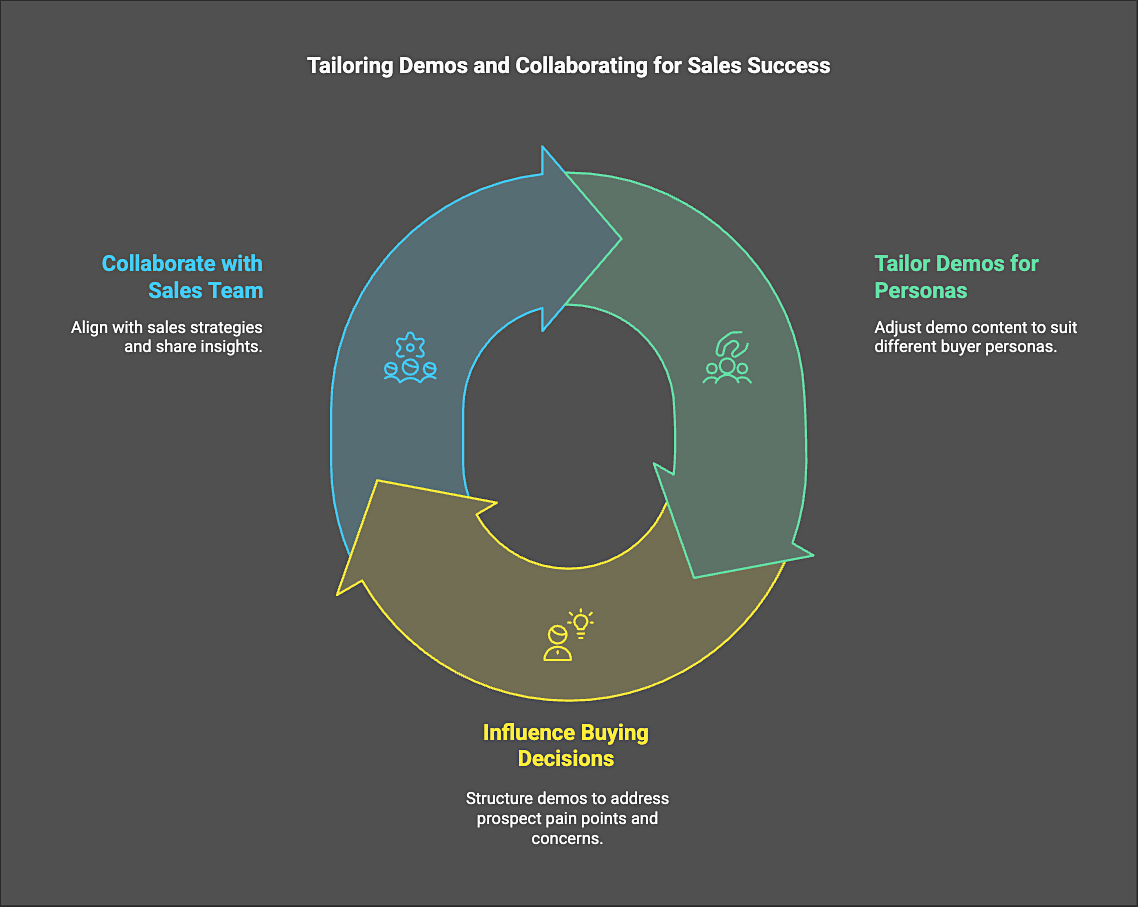
**Problem-Solving and Adaptability Questions**
### **7. Describe a time when a demo went wrong. How did you handle it?**
Unfortunately, no demo is foolproof because technical issues can happen at any time. The ideal response to this will include how they diagnosed the issue, what steps they took to recover, and what they learned from the experience.
**A problem-solving mindset and the ability to think on their feet are key traits to look for.** Bonus points if the candidate describes how they remained calm, adapted quickly, and, most importantly, kept the conversation focused on the value of the solution.
### **8. How do you stay updated on industry trends and evolving customer needs?**
A great presales engineer doesn't just understand their product—they know the market. The best responses will mention reading industry reports, engaging in peer communities, attending webinars, and collaborating with product teams.
**Candidates who prioritize continuous learning and a growth mindset will be able to continuously refine their approach to stay ahead of always-shifting buyer expectations.**
### **9. What role do analytics and post-demo feedback play in refining your approach?**
**The best presales engineer candidates will highlight how they collect post-demo feedback, analyze what worked (and what didn't), and how they make iterative improvements to optimize them based on the numbers, the prospect's role, and their pain points.**
It's also a positive if they mention tracking engagement, reviewing common objections, and adjusting the demo messaging to improve outcomes—and if they promote using a platform like Demostack's that provides detailed analytics so presales teams can make data-driven demo strategy adjustments.
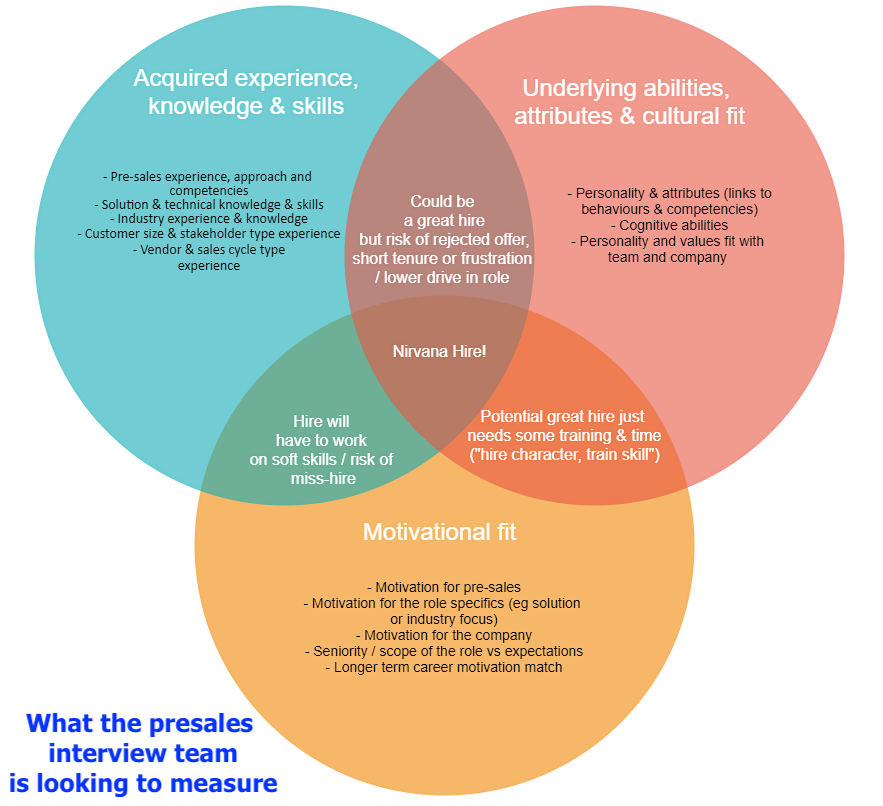
Caption: LinkedIn
**Cultural Fit and Growth Questions**
### **10. Why do you want to work for our company?**
It's the oldest job interview question—and arguably the most essential one. A candidate's answer reveals how much they've researched the company and understand its mission.
Look for in-depth responses that include details about your company's product, presales team structure, or market positioning. **Strong candidates will express alignment with the company's goals and a satisfying reason for wanting to contribute,** as opposed to generic enthusiasm for "a new challenge."
### **11. What excites you most about the presales engineer role?**
This question helps gauge long-term motivation. Candidates should be excited about problem-solving, engaging with customers, and shaping buying decisions. Look for authentic passion around breaking down technical concepts or improving how prospects experience the product.
**Those with backgrounds that include sales, tech acumen (including demo automation platforms), industry knowledge, and appropriate certifications should shine while answering this query.**
### **12. Where do you see the future of presales and product demos evolving?**
Presales is rapidly evolving as AI-driven demos, interactive self-guided experiences, and automation play an ever-larger role in the buyer journey. An excellent candidate will acknowledge these trends and discuss how they plan to adapt to emerging technologies and changing buyer expectations.
**Candidates who recognize the importance of interactive and scalable demo environments, along with self-serve and data-driven selling,** will be better positioned to thrive long-term in your organization.
## **Increase Win Rates with the Right Presales Engineer and Demostack**
A great presales engineer shapes how prospects experience your product. The right hire will anticipate objections, tailor demos to different stakeholders, and ensure that prospects clearly understand the value of your solution. These 12 interview questions provide a structured way to evaluate a candidate's ability so you can build a presales team that shortens sales cycles and increases win rates.
Demostack provides presales engineers with the tools to create engaging, interactive demos tailored to each buyer's needs. The platform simplifies demo setup, so your team can concentrate on showing your product's value, solving the prospect's pain points, and personalizing demo experiences based on job function.
With easy customization for every stage of the sales funnel and actionable insights, presales engineers using Demostack can produce impactful demos that enhance every sales engagement.
**[Try Demostack today](https://www.demostack.com/win-more-deals-lp) to experience how it upgrades your presales strategy.**
## Article: Battle Cards: 7 Essential Cards for Specific Objections
Source: https://www.demostack.com/post/battle-cards
Objection handling is one of the most common challenges in B2B sales. When a prospect questions a feature gap in your product or raises concerns about how your solution solves their pain points, sales teams are expected to respond quickly and clearly. These situations come up often, and how they’re handled can be the difference between the deal stalling or making a sale. But what if your sales team had a strategic cheat sheet that enabled quick, confident responses?
That’s where battle cards give sales and presales teams an advantage. A battle card is a practical resource used to guide objection handling during live sales conversations. They help teams respond with clear, accurate information when it matters most. It’s no surprise that 63% of competitive intelligence leaders now provide battle cards to their sales teams, and 71% of companies using them have seen win rates improve.
Battle cards support different parts of the sales process, from competitive positioning to persona targeting. When built around specific objections, they give sales teams a way to respond that keeps deals moving. They can even inform how your solution is presented in a demo by helping teams reinforce the right message at the right moment. Let’s take a closer look at battle cards and how aligning cards to buyer friction points leads to increased sales.
## **What Are Battle Cards, and Why Do They Matter?**
**Battle cards are internal reference tools used by sales and presales teams to address objections and respond to competitor claims during high-stakes conversations.** They’re designed to give teams quick access to the positioning and technical details needed to support live selling.
**Most are structured as visual aids with single-page layouts using bullet points, brief text sections, and at-a-glance content like feature comparisons or customer proof points.** Many teams now embed battle cards into CRMs or communication platforms so they’re available where the work happens.
### **Who Uses Battle Cards and How?**
**Sales and presales teams use battle cards to respond clearly when questions come up about product capabilities or competitor messaging. For example:**
- **[Presales Enablement](https://www.demostack.com/post/what-is-presales-enablement) Teams** maintain and distribute battle cards, and ensure they reflect current objections and messaging.
- **Sales Engineers** use them to answer technical questions and support product comparisons.
- **Account Executives** use battle cards to prep for calls and respond clearly when objections come up mid-conversation.
- **Channel Partners** use them to stay aligned on product positioning in external conversations.
### **Why Battle Cards Matter**
In complex B2B sales, teams are expected to respond to friction as it happens, often without time to reset the conversation. When common objections aren’t handled clearly, important details can get lost or misrepresented. **Battle cards help teams prepare for the specific points that tend to slow down deals. They anchor messaging in actual buyer concerns and help teams keep the conversation going.**
## **5 Key Benefits of Battle Cards**
**Battle cards offer many benefits to the presales and sales motions, including:**
1. **Faster Ramp for New Reps -** Battle cards give new team members a clear starting point. They explain core messaging and cover the objections reps are most likely to face early on.
2. **Consistent Competitive Messaging Across Teams -** With shared language in place, sales and presales teams are less likely to contradict each other or dilute the product story in competitive conversations.
3. **Increased Confidence in Live Selling Moments -** Quick access to validated responses helps teams stay focused during calls and avoid second-guessing their answers.
4. **Stronger Differentiation Against Competitors -** Battle cards make it easier for teams to highlight what sets the product apart, especially when a competitor is already in the deal or brought up by the buyer.
5. **More Effective, Targeted Demos -** Teams can use likely objections or vertical-specific friction points to shape what they show in the demo, making the experience more relevant to the buyer.
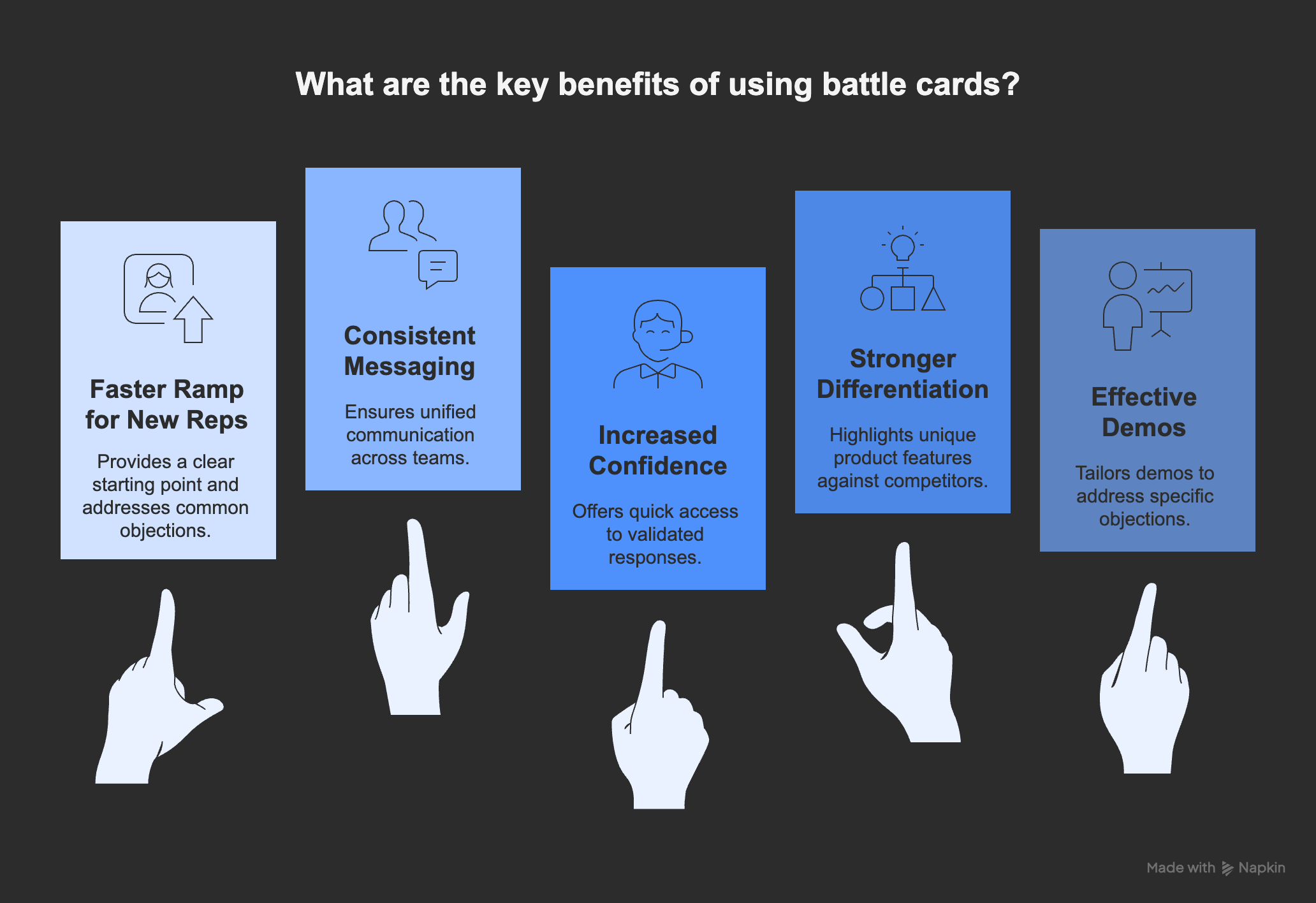
## **7 Types of Battle Cards**
1. **Objection Handling Cards** equip sales and presales teams to respond clearly when questions about risk, timing, or implementation come up during live conversations.
2. **Competitor Comparison Cards** provide a direct view of strengths and weaknesses across solutions. They are helpful when buyers mention alternatives or ask how products compare.
3. **Feature/Benefit Highlight Cards** focus on the capabilities that are most relevant to a prospect’s use case and help reinforce value during calls or demo prep.
4. **Industry or Use Case Cards** offer messaging and proof points tailored to specific verticals such as healthcare, cybersecurity, or [industrial water treatment](https://wint.ai/blog/8-methods-of-industrial-water-treatment/).
5. **Pricing & Value Justification Cards** support conversations where cost is a concern by framing pricing in terms of business impact or efficiency.
6. **Persona/Stakeholder Cards** align messaging to the role of a specific decision-maker, such as a VP of Sales or a CTO.
**Product FAQ / Roadmap Cards** support late-stage sales conversations where buyers are evaluating the product’s technical fit and future direction. These cards cover topics like feature availability, roadmap plans, security standards, and integration requirements.
## **7 Essential Battle Cards for Specific Objections**
**Objection-based battle cards are some of the most valuable assets a sales team can use. They’re built around real moments of buyer hesitation, when questions or concerns can delay decisions and cause deals to lose momentum.** When these cards reflect the objections teams hear most often, they give sales and presales teams a direct way to resolve concerns and close deals faster.
**Here are seven common objections and how your sales team can use battle cards to overcome them:**
### **1. “We’re already using [Competitor].”**
This objection doesn’t always reflect satisfaction. It often means the buyer is comfortable with what they have, and is unsure why switching is worth the effort. **This battle card helps teams reset that baseline by equipping them with language and proof that shows where your solution creates more value.**
**The card for this objection typically includes:**
- A side-by-side comparison of key features or capabilities
- Clear reasons why customers switch and what improvements they saw
- Straightforward answers to common claims made by the competitor
- Suggested ways to shift the conversation from features to measurable business results
- Examples or quotes from customers who replaced the competitor successfully
Sales and presales teams use this battle card early in the conversation to move past what the buyer already knows and focus on what they could gain by making a change.
### **2. “It’s too expensive.”**
This common objection usually means the buyer hasn’t connected the cost of the product to the value it delivers. In many cases, the sales conversation shifts to budget too early, before the buyer understands what the solution actually solves. **This battle card helps sales teams redirect that conversation back to your solution’s business impact.**
**The card for this objection typically includes:**
- Language to explain the solution’s business value in plain terms
- Examples that connect pricing to saved time, improved team output, or reduced operational overhead
- Comparisons that show how doing nothing or using another tool can cost more over time
- Customer examples that show how similar teams got internal buy-in after seeing results
The battle card for this objection refocuses the conversation for sales and presales teams on outcomes rather than price tags. It helps buyers understand what they’re paying for and most importantly, what they stand to gain from your product.
### **3. “We’re not ready for this yet.”**
**Even when the buyer recognizes a need, this objection often surfaces due to hesitation about timing.** It might even come up immediately, as the response to a discovery call question. **Buyers may feel they don’t have the internal bandwidth to evaluate or implement something new at this time.** A battle card helps sales and presales teams reframe that hesitation as a missed opportunity.
**The card for this objection typically includes:**
- Messaging that ties the solution to problems the buyer is already experiencing
- Examples of companies that started small and saw quick wins
- Responses to common concerns about internal priorities or capacity
- Suggested next steps that show how progress can begin without a full rollout
- Language that introduces urgency without creating pressure
Sales and presales teams use this battle card when buyers hesitate to engage. It gives them a way to keep the conversation grounded in current pain and shows that waiting could mean letting those problems persist longer than necessary.
### **4. “We don’t have time for a demo or POC.”**
**This objection is frequently voiced when the buyer is interested but assumes the evaluation will take too much time or effort.** In their mind, it sounds like a big project, and they’re too busy to deal with it. **This battle card helps presales teams lower that resistance by offering faster, simpler ways to try the product.**
**The card for this objection typically includes:**
- Options for fast, low-effort evaluations such as sandbox access or guided product tours
- Recorded walkthroughs or short demos tailored to the buyer’s use case
- Clear expectations around time, level of effort, and who needs to be involved
- Examples of how other teams evaluated the product quickly and with minimal disruption
Presales teams use this battle card to help buyers move forward without making a significant time commitment. It makes the evaluation feel achievable and helps keep the deal moving.
### **5. “It’s too complex to implement.”**
**This objection usually stems from negative rollout experiences in the past, or a lack of visibility into what implementation actually involves.** Buyers hear “new platform” and picture a long, complicated process that eats up internal resources. **In this case, a battle card helps presales teams reset those expectations by showing how onboarding actually works.**
**The card for this objection typically includes:**
- A plain-language summary of the onboarding process
- A list of which tasks are handled by the vendor versus the buyer
- Estimated timeframes and the number of people typically involved
- Examples of teams with limited resources who still saw fast implementation
- A [product demonstration](https://www.demostack.com/post/product-demonstration-a-b2b-sellers-guide) that shows what onboarding looks like and how setup actually works
- Answers to common questions about integrations or setup steps
The purpose of this battle card is to enable presales teams to remove uncertainty from the process and give the buyer a clearer picture of what to expect. It replaces assumptions with specifics and helps prevent fear of complexity from impeding a deal.
### **6. “How secure is your platform?”**
Protecting company data and ensuring vendor compliance are the motivations behind this buyer objection, which usually comes from legal, IT, or procurement teams. **Even when the buyer is ready to move forward, unanswered security questions can raise red flags and trigger detailed reviews that delay a purchase. A battle card helps your presales team to respond with clear, accurate answers before that happens.**
**The card for this objection typically includes:**
- Standard responses about certifications and how the platform handles customer data
- A summary of what SaaS security measures are in place and how they’re enforced
- Answers to common technical questions that come up during evaluations
- References to documentation or security review materials used in past deals
- Examples of companies with similar requirements that approved the platform
This battle card helps presales teams control the conversation and assure buyers that your solution is safe, regulated, and trustworthy—and keeps the legal and security teams away from the bargaining table.
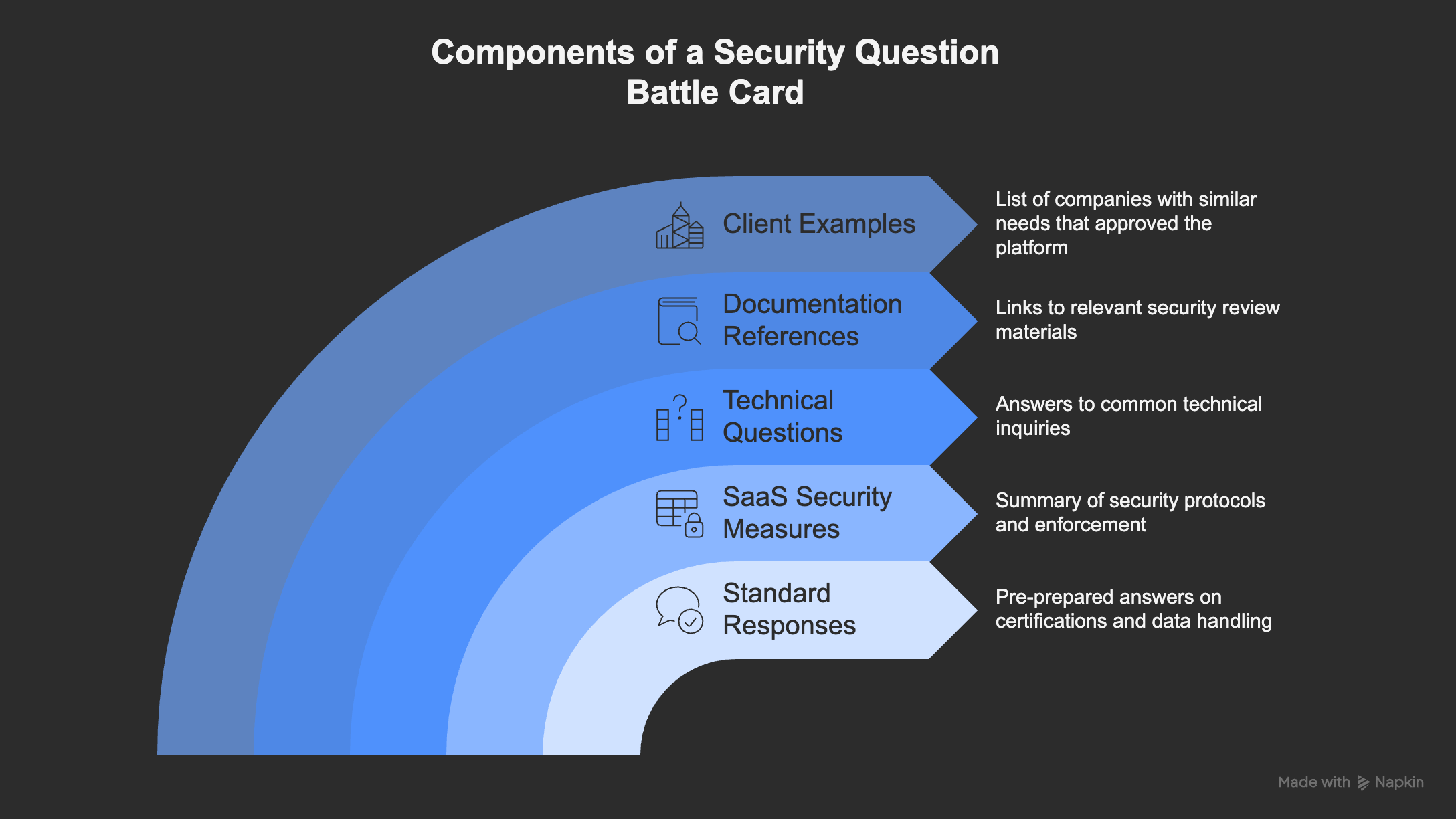
### **7. “We’ve tried this before, and it didn’t work.”**
**Buyers who previously purchased software to solve the same problem but didn’t see the results they expected often voice this objection.** Maybe their rollout was never fully completed, or the product didn’t match their needs. Now, even if the need still exists, the buyer is hesitant to try again. **To address their hesitation, sales teams can use this battle card to show what’s different this time and why your solution is more likely to succeed.**
**The card for this objection typically includes:**
- Examples of customers who had similar doubts and saw better outcomes
- Language explaining what has changed since the buyer last tried solving this problem
- Guidance for responding to concerns about previous vendor limitations or rollout issues
- Questions that help define what a successful outcome would look like now
- Messaging that helps the buyer see this as a new opportunity, not a repeat of past mistakes
Sales teams leverage this battle card to reframe the buyer’s past experiences and open a path forward. It gives a buyer the confidence to reconsider the solution with better information and more realistic expectations.
## **How Battle Cards Improve Sales Demos**
**Battle cards and [sales demos](https://www.demostack.com/post/sales-demo-examples-that-inspire) serve different functions, but when used together, they make each other more effective.** A well-crafted battle card doesn’t just help a team respond to questions in the moment. It can also shape the structure of a demo by highlighting which concerns are likely to come up and what the best proof points are to address them.
**For example, if a battle card flags “integration complexity” as a common objection in the healthcare vertical, a demo can be designed that shows exactly how the product handles those requirements.** With Demostack’s platform, teams can quickly create a custom demo environment using Cloner and use Playbooks or overlays to guide conversations around common objections inside the demo itself. That alignment helps teams deliver a narrative that addresses concerns before they are voiced.

**The benefit runs both ways. When a sales engineer sees that a particular part of the demo consistently prompts questions, they can work with enablement to update or expand the relevant battle card.** The messaging becomes tighter, the card becomes more useful, and the next demo becomes more effective. **This feedback loop keeps both tools grounded in real conversations and focused on winning deals.**
## **Turn Your Battle Cards Into Winning Demo Strategy**
**Battle cards are one of the most effective tools for overcoming objections in complex B2B sales.** They help sales and presales teams prepare for the tough questions, align messaging across roles, and keep deals moving forward. **But to truly shift a buyer’s perception of your solution, that narrative has to be reinforced during the demo, which is where decisions start to take shape.**
**That’s where Demostack delivers a significant advantage.** The demo platform is built for sales and presales teams, and lets you create consistent, ready-to-go demo environments tailored to any buyer conversation. You can highlight key features, demonstrate workflows, or walk through objection-specific use cases—all without relying on engineering. Teams can easily control the entire product story and keep it aligned with the objection coverage in their battle cards.
**[Try a demo](https://www.demostack.com/win-more-deals-lp) of Demostack to see how it helps you turn your best battle cards into even better demos.**
## Article: Top 10 Best Sales Enablement Software
Source: https://www.demostack.com/post/top-10-best-sales-enablement-software
Sales cycles in 2024 are vastly different from what they were a decade ago. The rise of remote working, the shift to data-driven decision-making, and buyer expectations for a personalized buying experience are all driving the demand for sales enablement software.
Sales enablement software aims to empower sales teams with all the tools they need to navigate these challenges, close deals faster, and drive revenue growth by streamlining the sales process. In this environment, it's no wonder that the global sales enablement platform market size is forecasted to exceed $12 billion by 2030.
Before we introduce our list of the top ten sales enablement software tools in 2024, let's quickly define what sales enablement software is, why you need it, and what to look out for when choosing the solutions to empower your sales teams.
## **What is sales enablement software?**
Sales enablement software is a broad category of platforms and tools that leverage technology to enhance the efficiency and effectiveness of an organization's sales processes. Sales enablement software aims to bridge the gap between marketing, sales, and customer success, often by employing data and automation throughout the deal cycle from lead generation to deal closure.
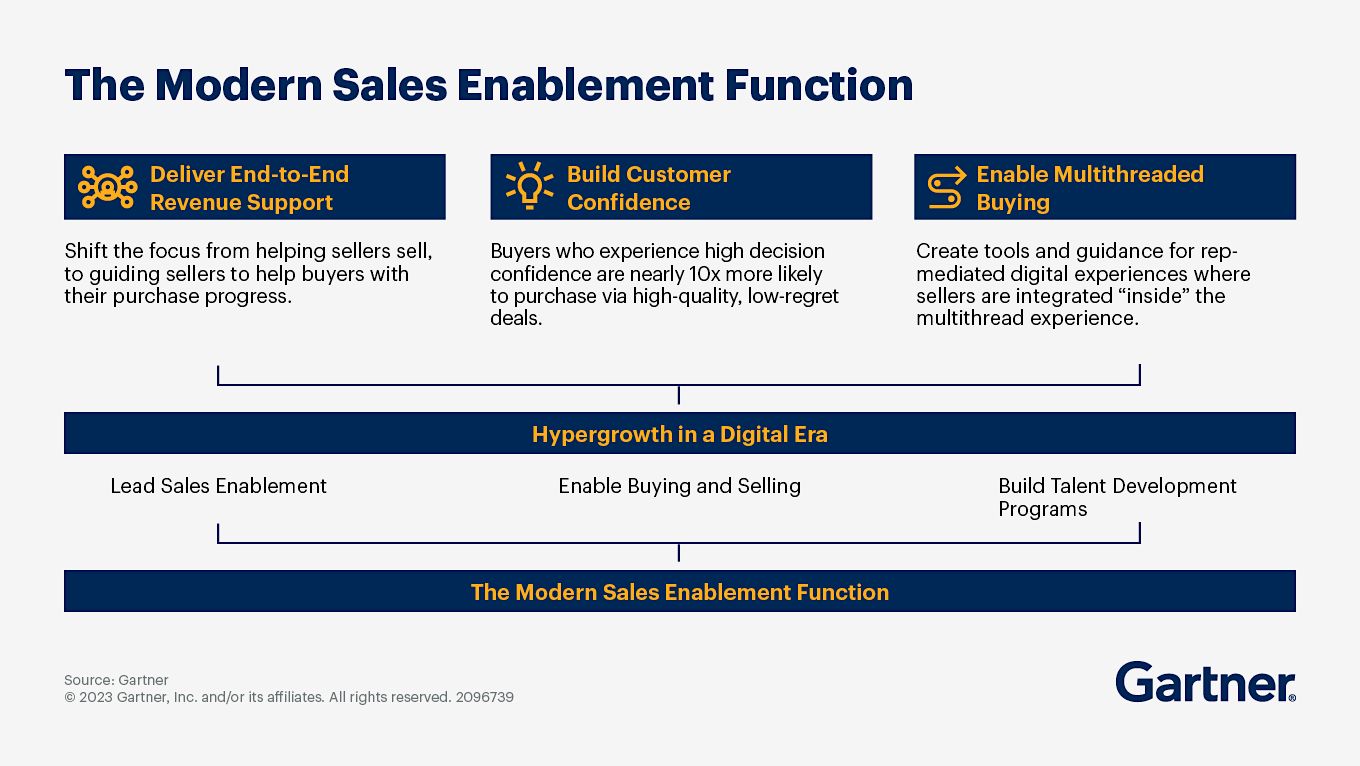
In essence, the role of sales enablement software is to make the job of sales teams easier. While there are many types of sales enablement software available to improve sales performance and revenue growth, the one thing all sales enablement tools have in common is that they are specifically designed to save time and streamline sales.
## **Types of Sales Enablement Software**
Software categories considered as sales enablement tools or platform features include:
- Buyer and sales engagement
- [Sales demo experience software](https://www.demostack.com/post/demostack-is-revolutionizing-sales-enablement-for-demos)
- Conversation intelligence
- CRM (Customer Relationship Management)
- Sales content management
- Intelligence and analytics
- Training and coaching
## **5 Benefits of Sales Enablement Software**
1. **Increased Productivity -** Sales enablement software allows salespeople to focus on what they do best: sell. With easy access to all needed information and automated processes to save time and effort, your sales teams can spend their time closing deals.
2. **Improved Performance -** Salespeople are better at their jobs when armed with the right sales enablement tools to optimize their work through a data-driven approach. This leads to an overall increase in close rates and quota attainment.
3. **Better Customer Experience -** Sales enablement software also benefits your potential customers and existing clients by creating a seamless, personalized experience for each interaction and contact in the sales process. In turn, this promotes brand loyalty and customer satisfaction.
4. **Greater Alignment Between Sales and Marketing -** Sales enablement tools ensure that sales, marketing, and customer experience teams can collaborate more cohesively, share resources, and deliver a consistent and meaningful consumer experience.
5. **More Business Growth -** Sales enablement tools empower sales teams to maximize their potential to promote and close deals, driving business growth and revenue stability.
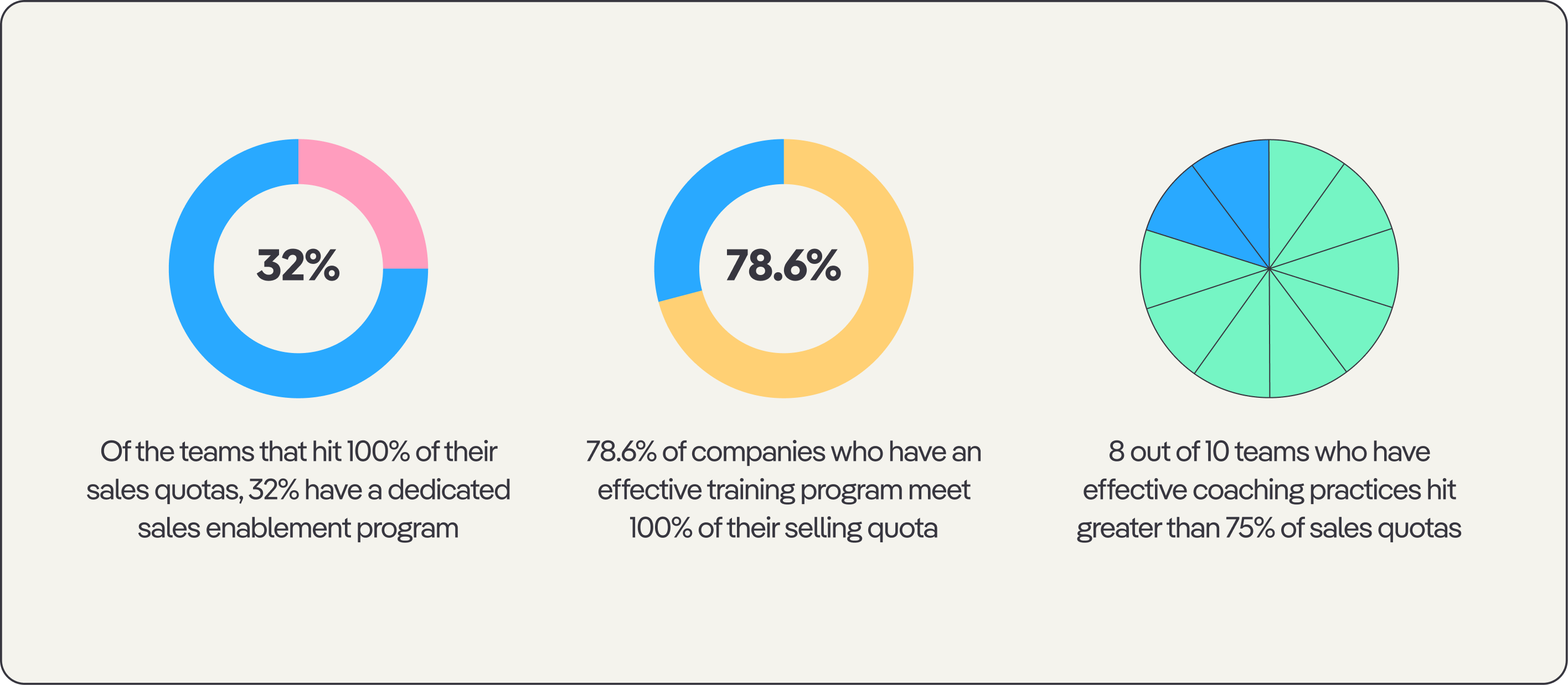
Caption: Sales Enablement
## **Key Features to Look for in Sales Enablement Software**
Even though sales enablement software encompasses a versatile range of tools and platforms, there are a few features and capabilities that you should prioritize when choosing a tool to empower your sales teams.
### **Intuitive Interface**
Opt for solutions offering a user-friendly interface designed to serve the needs and goals of your sales reps.
### **Workflow Automation**
Automation features let you offload repetitive and manual tasks to machines and are especially effective when they let sales reps build and customize them using no-code interfaces.
### **Sales Stack Integration**
Your sales enablement software should integrate seamlessly with existing systems and tools to ensure data consistency, streamline workflows, and save your reps from having to enter data in multiple interfaces.
### **Analytics**
Without monitoring and measuring performance KPIs, it's hard to make actionable decisions. Analytics help sales team leads understand how and where optimization can increase performance.
### **Security**
Since many sales enablement software tools process sensitive data, it's important to choose solutions that employ robust security measures to safeguard data like confidential sales strategies, client PIIs, and financial information.
## **Top 10 Best Sales Enablement Software Tools**
**Sales Engagement**
### **1. Salesloft**
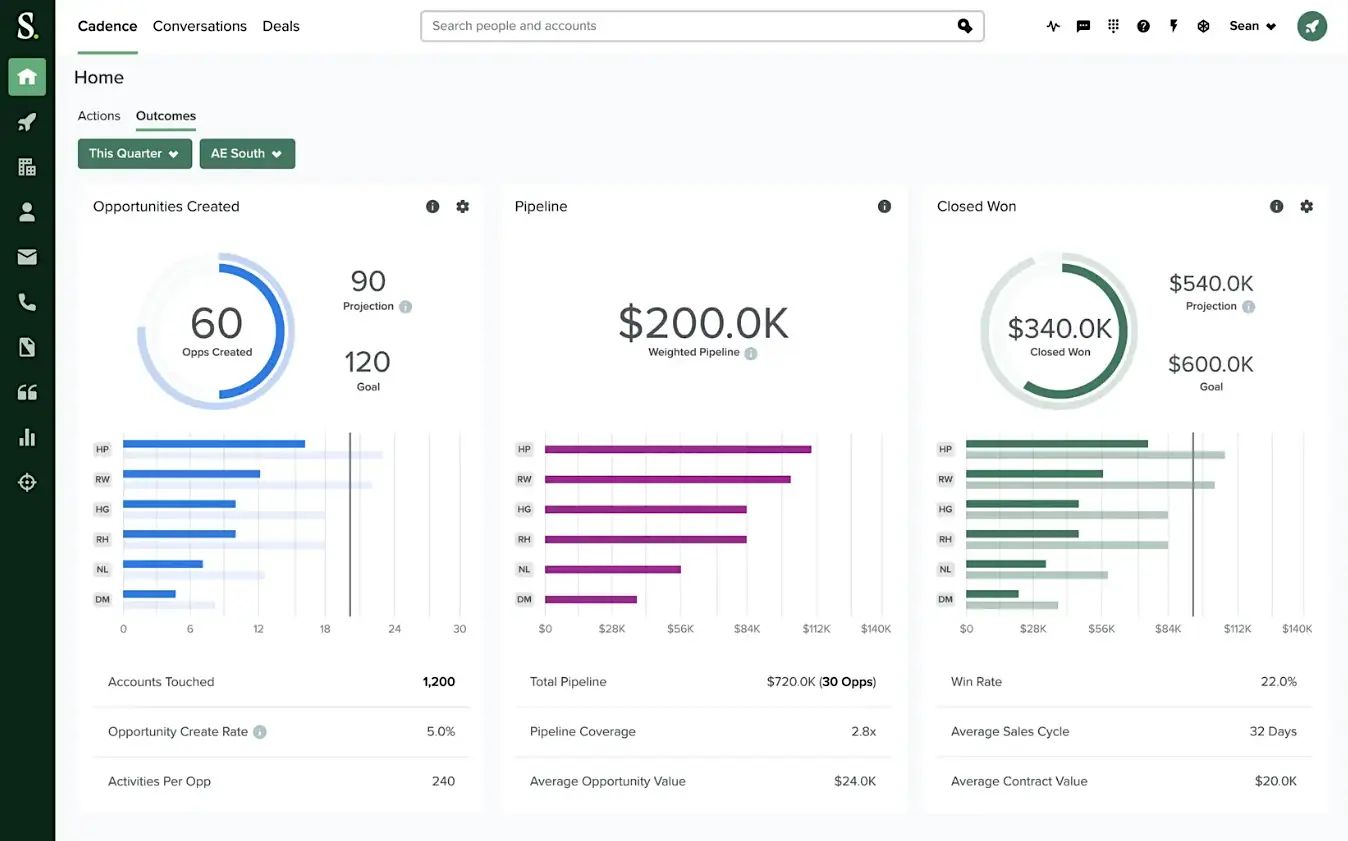
Caption: Salesloft
**SalesLoft** is a revenue orchestration platform that employs AI and machine learning to provide robust forecasting abilities. It also integrates smoothly with major CRM systems and other business applications. The software features tools that combine automation, analytics, and sales training to enhance your overall sales enablement strategy measurably.
**Best for:** Growing sales teams
**Pricing:** By inquiry
**Review:** _“Salesloft has allowed our team to effectively reach out to leads while keeping track of activities. The analytics are helpful to view which activities and messaging lead to the greatest successes and help us plan for future reachout.”_
**Sales Demo Experience**
### **2. [Demostack](https://www.demostack.com/)**
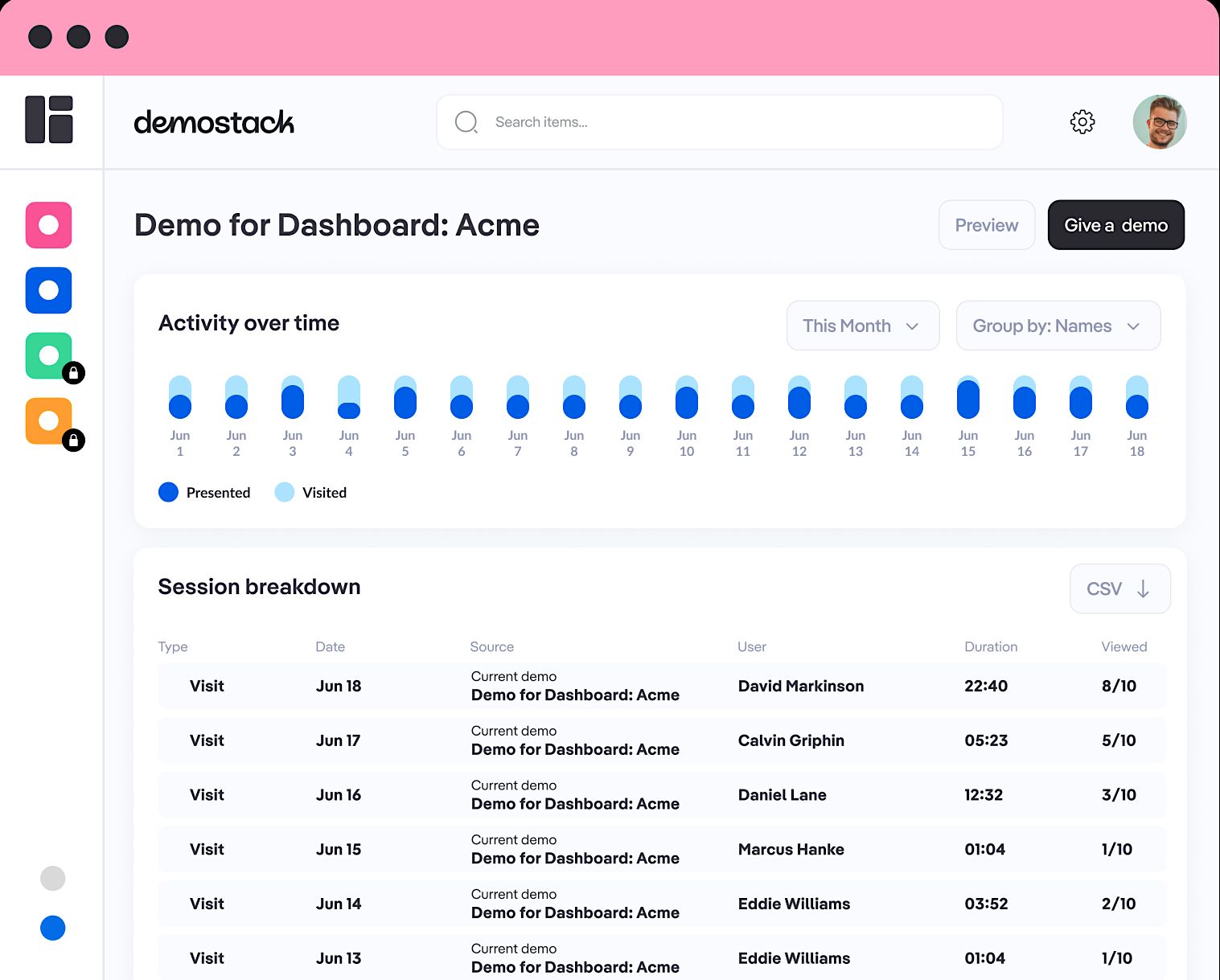
Caption: Demostack
**Demostack** revolutionizes sales demos by transforming them into interactive experiences. It empowers sales teams to create [personalized, guided demos](https://www.demostack.com/post/8-essential-steps-to-master-outbound-sales-in-2024--demostack) tailored to each prospect's specific needs. This results in more engaging and impactful conversations, leading to faster conversions and closed deals.
The platform offers a range of features, including customizable demo templates, real-time analytics for tracking prospect engagement, and integration with popular CRM platforms. These capabilities enable sales teams to streamline their demo processes, gather valuable insights into prospect behavior, and ultimately drive revenue growth through effective product demonstrations.
**Best for:** B2B sales teams, particularly in the SaaS space, who are looking to enhance their demo processes and deliver more impactful product demos. It is especially valuable for organizations with complex products or services that require personalized explanations and interactive experiences to effectively communicate their value proposition.
**Pricing:** Custom quotes are available, with annual pricing starting at $55,000.
**Review:** _“Demostack helps to spin up a demo environment. Code is not necessary for this. SaaS revenue teams get help from Demostack to become empowered to share product stories that connect, accelerate revenue growth, drive conversation forward.”_
**Conversation Intelligence**
### **3. Dooly**
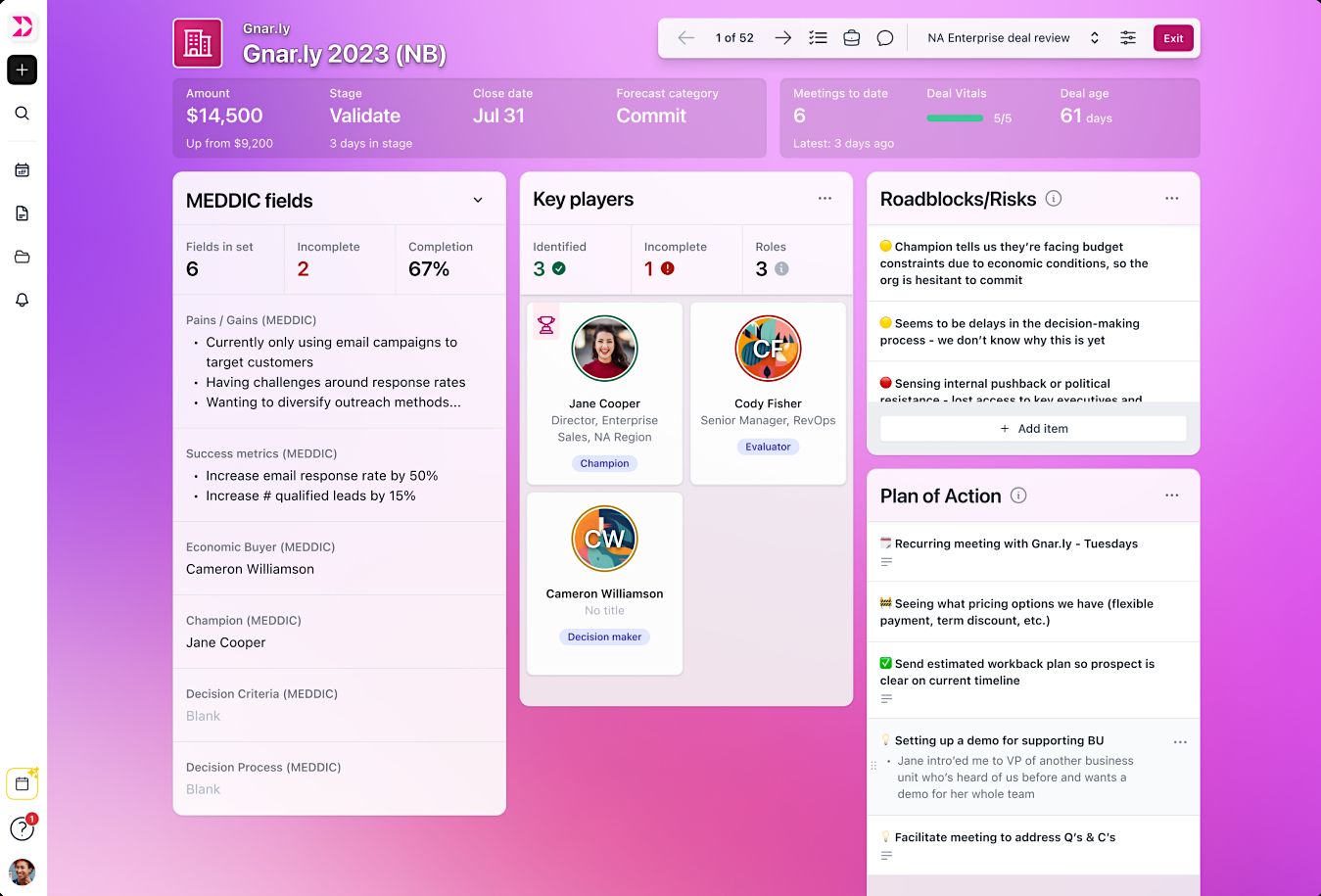
Caption: Dooly
**Dooly's** AI-powered solution empowers teams to centralize sales content, track rep activity, and measure engagement. A key feature is conversation intelligence, which analyzes recordings of sales and discovery calls to identify sales trends, coaching opportunities, and key talking points to provide a data-driven approach that helps reps improve their communication skills. In addition, the Playbooks feature offers a centralized sales content management system that expedites responses to buyer questions.
**Best for:** Small sales teams using SalesForce.
**Pricing:** Three plans are available - Free, Growth (from $30 per user/month), and Premier (from $65 per user/month).
**Review:** _“Dooly makes it super easy to instantly update Salesforce fields for multiple accounts at once in as few clicks as possible. The ease of use has actually translated to more detailed notes and more success on deals.”_
**CRM**
### **4. HubSpot Sales Hub**
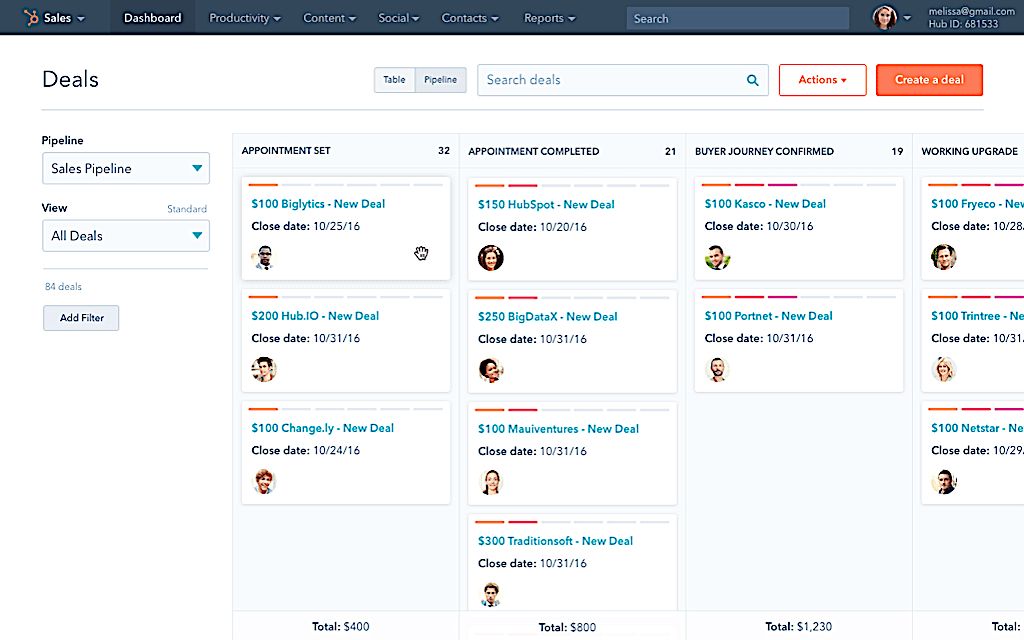
Caption: Hubspot Sales Hub
**HubSpot Sales Hub** is a one-stop software solution for most of the marketing and sales enablement needs of SMBs, with CRM at the heart of its offering. In addition to email and prospect tracking, call and meeting scheduling, and analytics to streamline the process, the robust and user-friendly platform offers extensive integration and customization options.
**Best for:** Integrating sales and marketing
**Pricing:** Four plans are available - Free, Starter (from $20 per user/month), Professional (from $100 per user/month), and Enterprise (from $150 per user/month).
**Review:** _“It's a great way to automate processes in our lead-to-customer journey. Hubspot can make your life easier with the task assignment and the automated processes you can program.”_
### **5. Salesforce Sales Cloud**
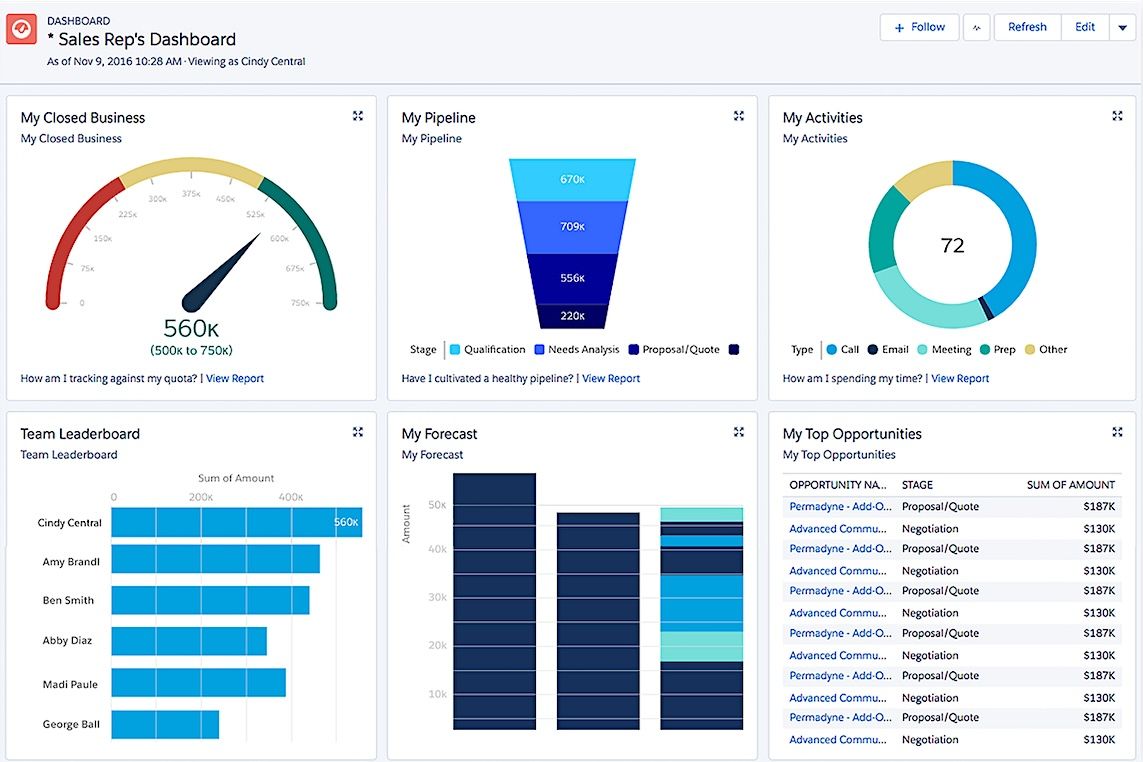
Caption: Salesforce Sales Hub
**Salesforce Enablement** is a feature of the popular Salesforce CRM platform. It's expandable, robust, and known to most salespeople. The software features include sales team coaching, performance insights, templates, and other tools and integrations to centralize customer relationships and sales cycle management.
**Best for:** Enterprises with large sales departments
**Pricing:** A variety of plans are available, starting with a base rate for the CRM and additional costs per feature required.
**Review:** _“The ability to connect seamlessly with various other tools and platforms makes it a versatile solution for managing customer relationships and sales processes.”_
**Sales Content Management**
### **6. Seismic**
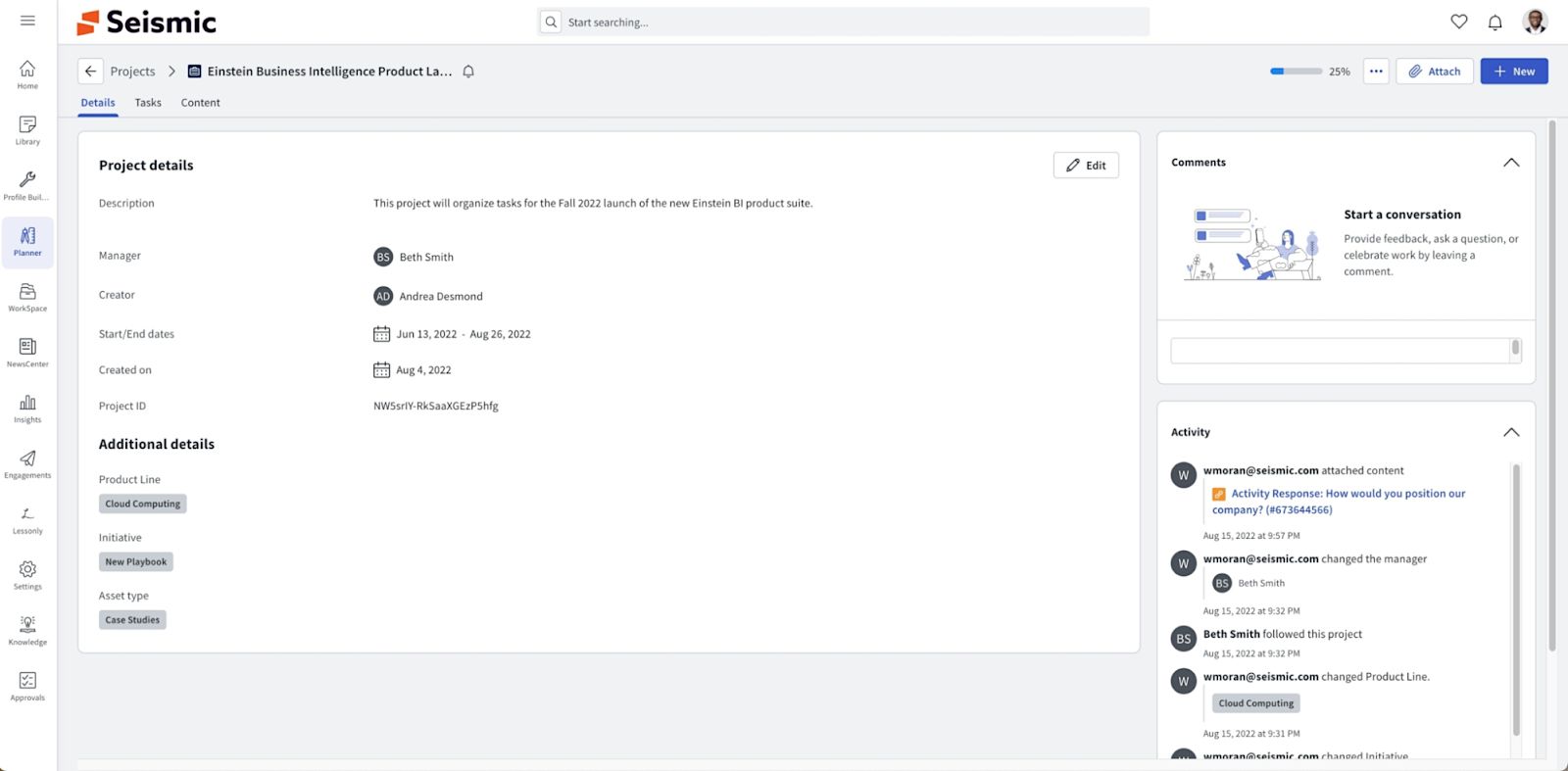
Caption: Seismic
**Seismic Enablement Cloud** is a comprehensive content management platform. Key features include a centralized content hub, personalized learning paths, data-driven insights to optimize sales performance, and tools to streamline onboarding and training. The platform allows sales reps to easily access the most relevant content, improving engagement with buyers and driving sales effectiveness.
**Best for**: Large organizations that need extensive sales content management
**Pricing:** Upon request
**Review:** _“Seismic makes it super easy for your Sales team to find and share content and to see how it's resonating, and for Marketing to track what content is adding value.”_
### **7. Highspot**
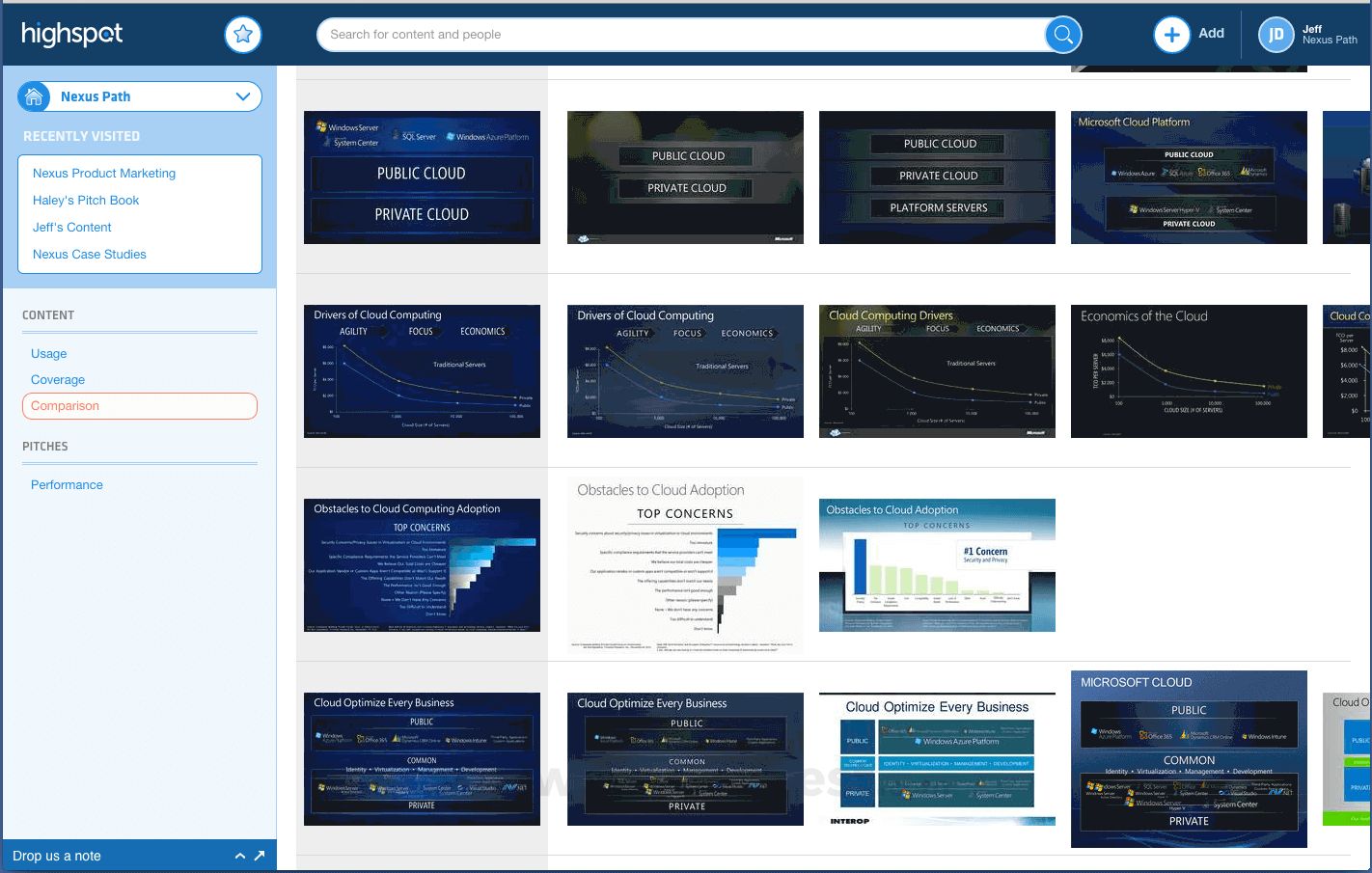
Caption: Highspot
**Highspot** has a unique focus on sales training, coaching, and content-based customer relations management. It leverages AI to optimize and contextualize content for every step of the sales cycle. Highspot also boasts rich analytics on sales content performance and buyer engagement to help refine your sales enablement strategy.
**Best for:** Enterprises looking to experiment with AI in sales content management
**Pricing:** By inquiry
**Review:** _“Highspot is easy to use and is a quick way to send high quality educational and promotional content to my customers and colleagues.”_
### **8. Showpad**
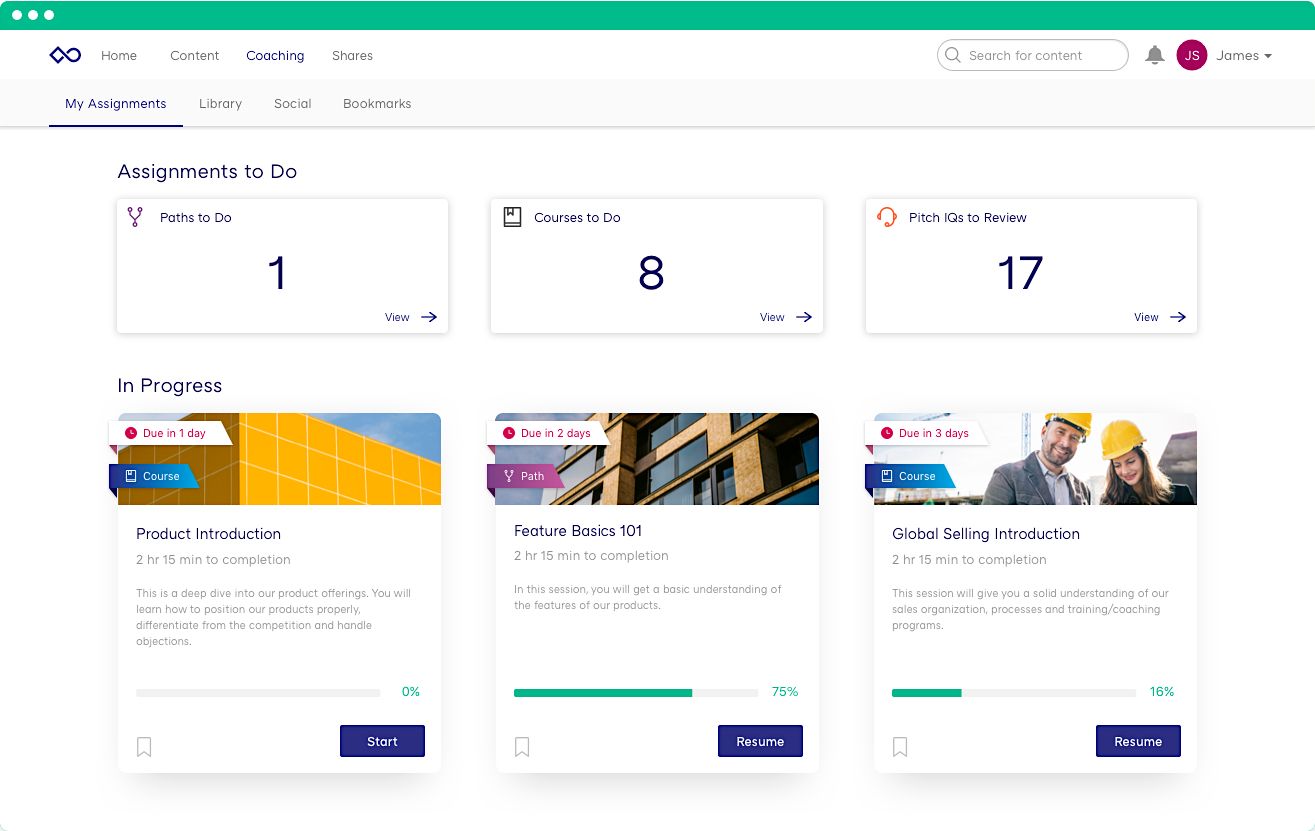
Caption: Showpad
**Showpad Content** is a content management tool focused on content distribution flexibility and customization. Its main advantage is its ability to integrate with your CMS or DAM of choice. It also offers real-time collaboration on sales content, bridging the gaps between sales enablement teams and content marketing departments.
**Best for:** Sales teams at large businesses that need to present and share content in varied environments.
**Pricing:** By request
**Review:** _“From an enablement and onboarding perspective, this platform is quite comprehensive while being user-friendly for your day-to-day account executive to do their job successfully.”_
**Sales Intelligence**
### **9. Demandbase**
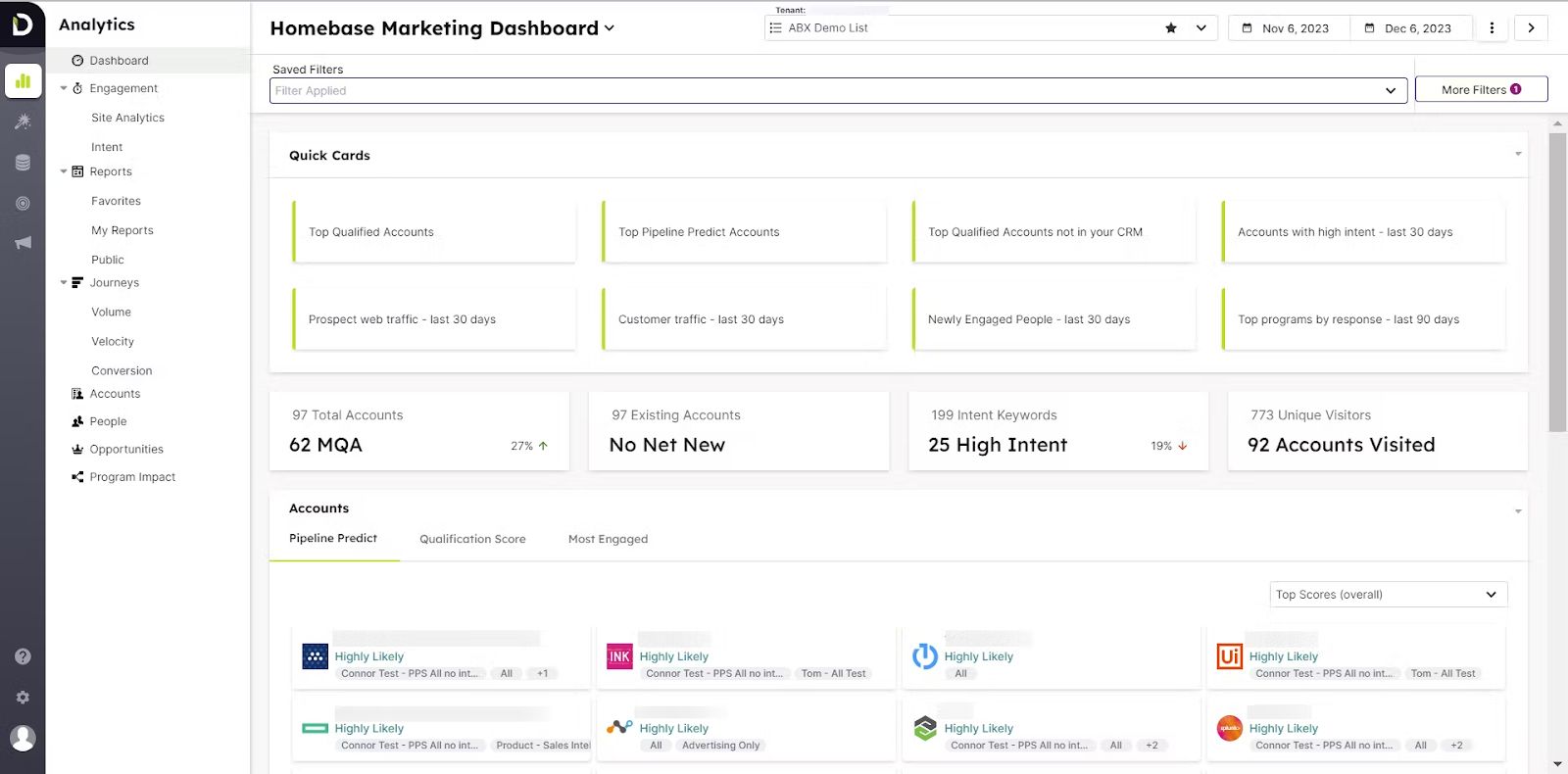
Caption: Demandbase
**Demandbase One** is a GTM and ABM platform that employs AI, social listening, and lead engagement monitoring to enrich account data. It combines information from internal and external sources to provide comprehensive account intelligence throughout the sales cycle.
**Best for:** Complex and lengthy sales cycles involving multiple stakeholders and online prospect interactions.
**Pricing:** By inquiry
**Review:** _“Demandbase has moved our ABM capabilities to the next level. This platform has so much to offer for those with the capability to manage it.”_
**Sales Readiness and Coaching**
### **10. Mindtickle**
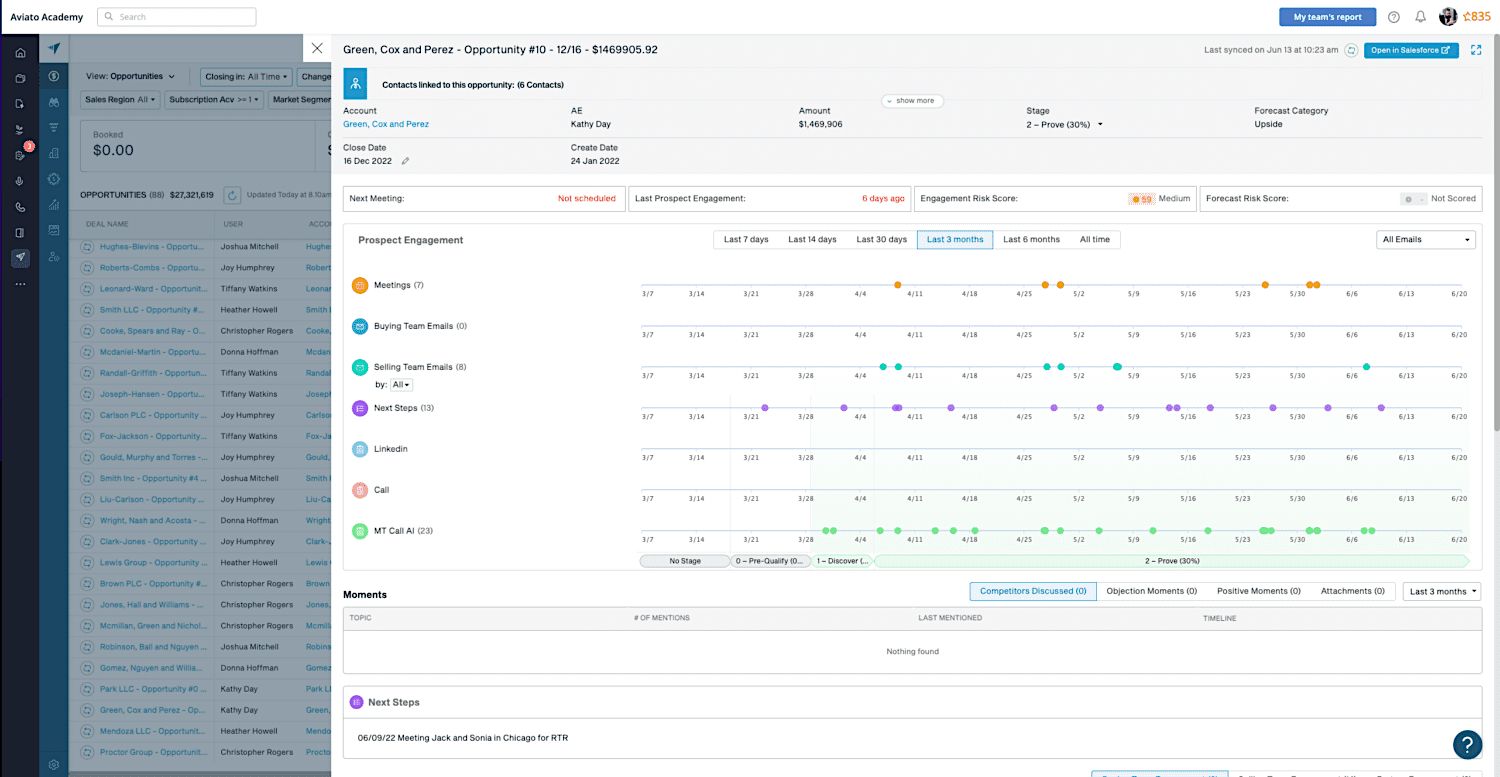
Caption: Mindtickle
**Mindtickle** is a comprehensive sales enablement solution for enterprises that prioritize sales training and readiness. It provides reps with training based on sales behaviors across the sales stack. The solution offers robust tools for onboarding, skill developments, and continuous learning with extensive automation capabilities.
**Best for:** Large business with complex products that requires continuous learning for sales enablement.
**Pricing:** Upon request
**Review:** _“Bring conversation intelligence with data-driven readiness!”_
## **Demostack: Sales Enablement Software that Wins**
The modern sales landscape demands a multi-faceted approach to sales enablement. It's no longer sufficient to rely on traditional methods; instead, a combination of tools and strategies is essential to empower sales teams and drive revenue growth. Personalized product demos are a pivotal element in this new paradigm and help deliver more wins to your sales team.
Demostack is a powerful tool that empowers sales teams to create tailored demos that resonate with each prospect. With features like customizable templates, real-time analytics, and seamless CRM integrations, Demostack streamlines the demo process to optimize sales performance. Its data-driven insights enhance sales effectiveness by identifying areas for improvement and optimization.
**Sign up for a free demo today to discover how Demostack can revolutionize your sales enablement strategy.**
## Article: How to Maximize Discovery Call Success: 12 Essential Tips
Source: https://www.demostack.com/post/how-to-maximize-discovery-call-success-12-essential-tips
A B2B prospect has shown interest in your product or service, so what should you do? Throw an office party? Call in the CEO? Panic? Nope—it’s time to set up a discovery call. The discovery call is one of the most critical conversations you will have with your prospects, setting the scene for a positive partnership.
Engaging prospects through a call helps you define goals and get buy-in as early as possible. For most companies, the conversion rate from discovery calls to sales is about 10-30%, with 15% of organizations seeing a rate above 30%.
Sometimes, this conversion success is not one-and-done—discovery is a process, not a single event, and the discovery call is the catalyst that gets the wheels turning.
## **What is a discovery call, and why is it so important?**
**A discovery call is your first conversation with a prospect after they show interest in your business.** The call is an opportunity to better understand your prospect’s current situation, business goals, and pain points.
The goal of the discovery call is to determine whether the prospect is a good fit for your business and vice versa. If all goes well, each call should end with a qualified lead that can be passed to sales.
## **What’s the difference between a discovery call and a sales call?**
The clue is in the name—a discovery call gathers information about the prospect’s organizations and needs. It isn’t the space to pitch your product or service, which is what happens on a [sales call](https://www.demostack.com/post/what-discovery-questions-should-you-ask-on-a-sales-call). Instead, a discovery call is a space to focus on the prospect’s pain points. It is usually shorter than a sales call and can take only 15-30 minutes.
## **What are the benefits of discovery calls?**
Discovery calls offer many critical benefits, including:
- **Establishing Trust and Credibility -** The discovery call is a perfect opportunity to develop a foundation of trust by demonstrating your expertise and consideration for the prospect.
- **Building Stronger Relationships -** Use the call to show your prospects that you understand and recognize their pain points and goals, proving that you have their best interests at heart.
- **Finding More High-Value Leads -** This call is the ideal time to qualify leads, gauge the prospect’s intent and interest, and determine whether they are suitable customers for you.
- **Overcoming Obstacles:** Now that you’ve got the prospect on the phone, it becomes an opportunity to overcome any roadblocks or concerns the prospect has. Sales enablement tools like a [personalized demo](https://www.demostack.com/post/the-demo-efficiency-frontier-when-should-a-demo-be-shown-on-the-first-call) are the ultimate sidekicks for positive persuasion.
- **Gain Valuable Insights -** You can get to know your prospects’ pain points and business challenges on a deeper level that no desk-based research would uncover.
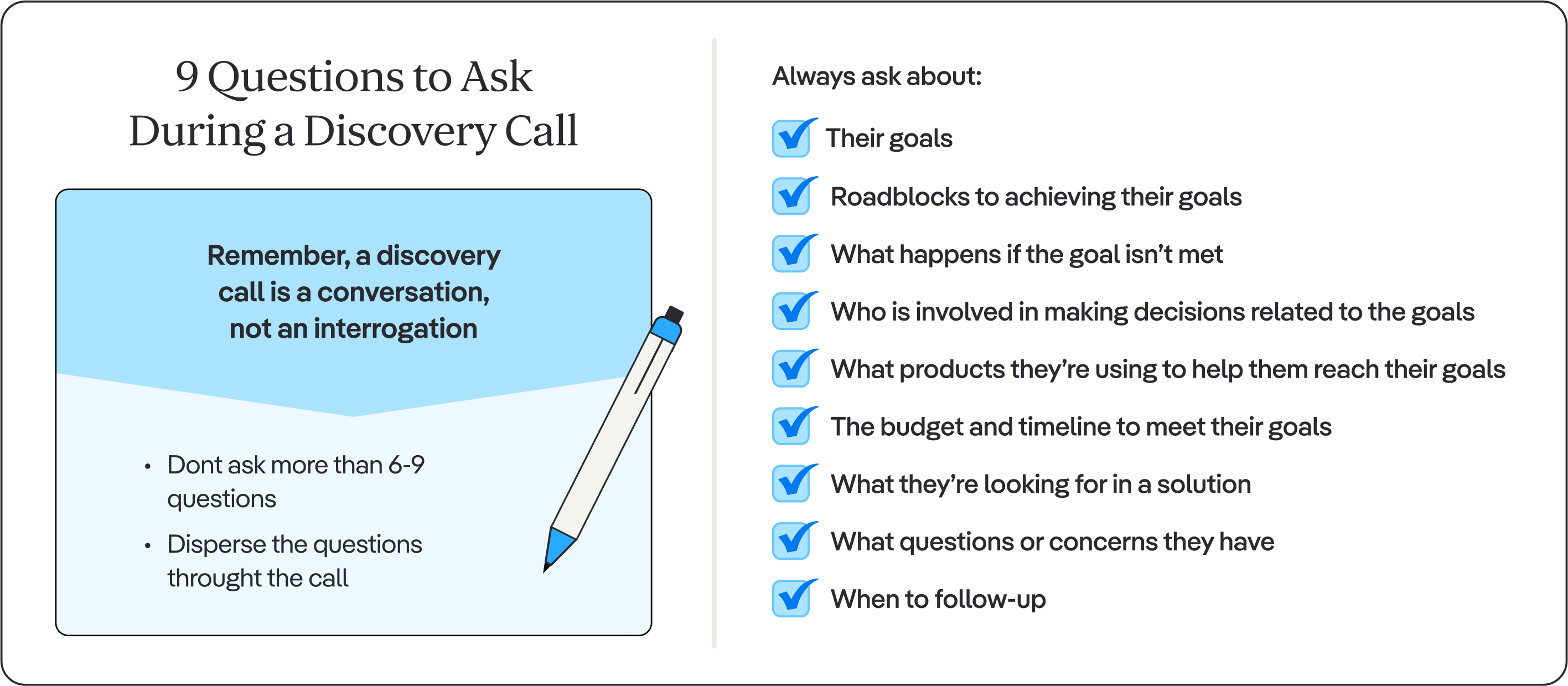
## **12 Essential Tips to Maximize Discovery Call Success**
### **1. Pre-Call Preparation is Essential**
You know the old saying: Fail to prepare, prepare to fail. Before the discovery call, invest time researching the company and the relevant decision-makers. You can use your research to prepare questions and show prospects that you already have a foundational understanding of their requirements and pain points. This info will come in handy if you decide to prepare a demo.
Typically, sales reps prepare and ask about [10- 25 questions](https://www.demostack.com/post/the-discovery-phase-questions-every-sales-rep-should-ask). Some good places to begin your research include:
- The ‘About us’ page on the company’s website.
- The company’s LinkedIn page.
- The prospect’s LinkedIn page.
- Recent company news, such as investment rounds.
### **2. Start with a Strong Opening**
You only have seven seconds to make a good first impression, so the initial moments can set the tone for the rest of the discovery call. Build a rapport by demonstrating enthusiasm and highlighting the value of the discovery call for shared understanding and relationship building.
Although the discovery call isn’t the time to pitch your product (the longest sales rep monologue should last about 2 minutes and 43 seconds), you can still provide a strong (and brief) opening statement summarizing:
- Who you are and your role.
- What your company does.
- The goal and agenda of the call.
- Small talk with the client. Even a simple ‘How is your day going?’ can start things on the right foot.
### **3. Active Listening is Crucial**
Preparing a list of great questions before the discovery call is essential, but it doesn’t need to be set in stone. The golden advice for discovery calls is to practice active listening and adapt to the tone and direction of the conversation – then, you can provide a reply that is aligned with their needs.
Active listening means demonstrating attentiveness to the speaker using techniques like body language and affirmation. Repeating and clarifying their comments helps you prove to the prospects that you understand their business and requirements and, most importantly, that you are listening to them. If you engage with them, they will engage with you.
### **4. Ask the Right Questions to Uncover Needs**
The last thing your prospects want is to feel like they’re in an interrogation session. Rather than probing as much as possible, ensure you ask high-value and open-ended questions that encourage the prospect to give a detailed answer.
Example questions could be:
- Tell me about your company’s operational, organizational, and financial goals.
- What problems are you looking to solve with X?
- What is your team’s current process for X?
- How urgent is this requirement?
- Can you describe your ideal solution for X?
- What would a successful outcome look like for this project?
As you uncover their business needs, note which critical pain points you can address at the demo stage.
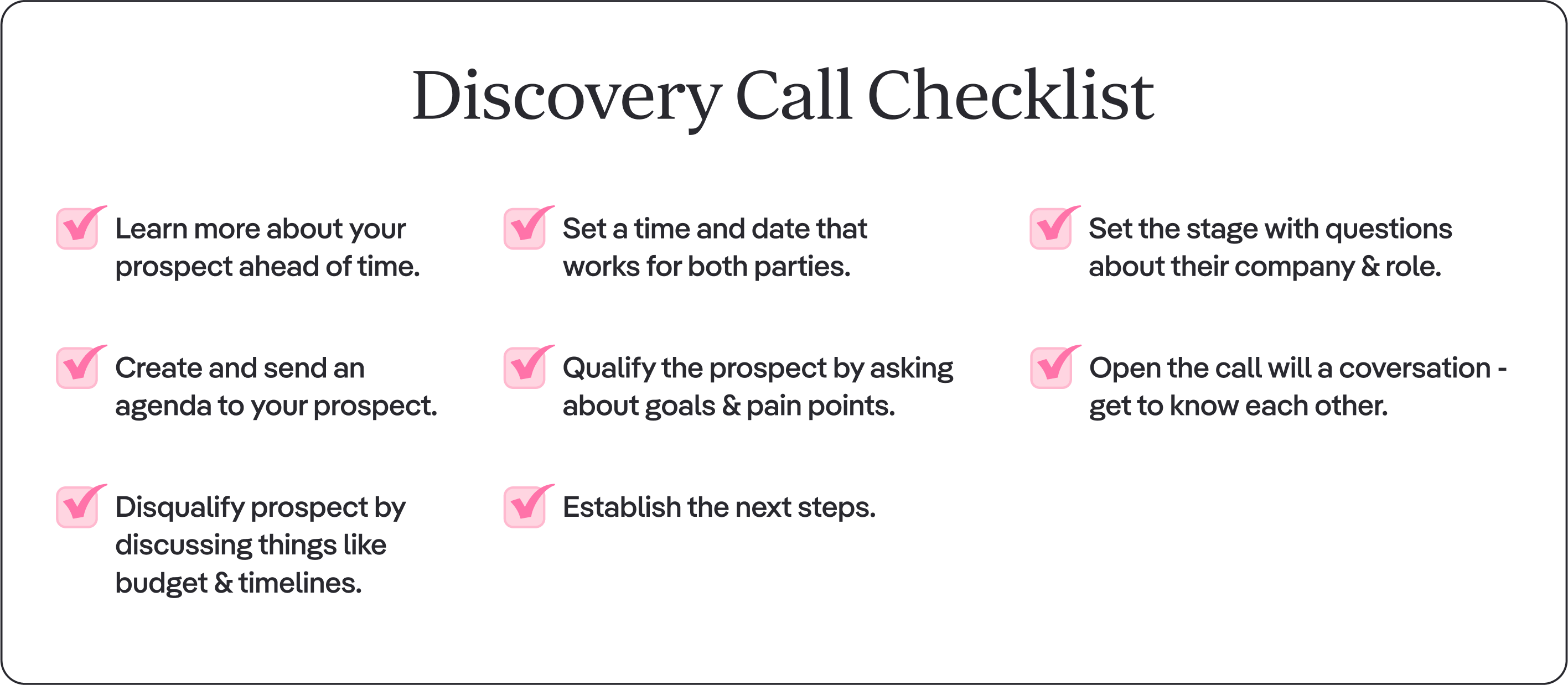
### **5. Position Your Solution as the Answer (But Don't Pitch!)**
After using your pre-prepared questions to uncover the company’s short- and long-term goals, use this information to your advantage and introduce relevant benefits and use cases of your product or service.
It’s a fine line between pitching and chatting. Rather than diving into the hard sell, you can try the ‘feel-felt-found’ objection technique:
- **Feel:** Empathize with the prospect’s concern.
- **Felt:** Use a case study or testimonial to highlight how other customers felt the same way.
- **Found:** Explain how other customers found what they wanted using your product or service.
Judging by the prospect’s level of interest at the end of the call, you can offer them a demo. Although the discovery call is all about the prospect, you still need to shine a spotlight on your product to garner their interest, and a demo is an effective and engaging way to do this.
You should ideally strive to demo your solution at every pipeline meeting, and the discovery call is no different. For example, an adaptable solution like Demostack can generate easy-to-use display demos for every use case, including one tailored for a discovery call
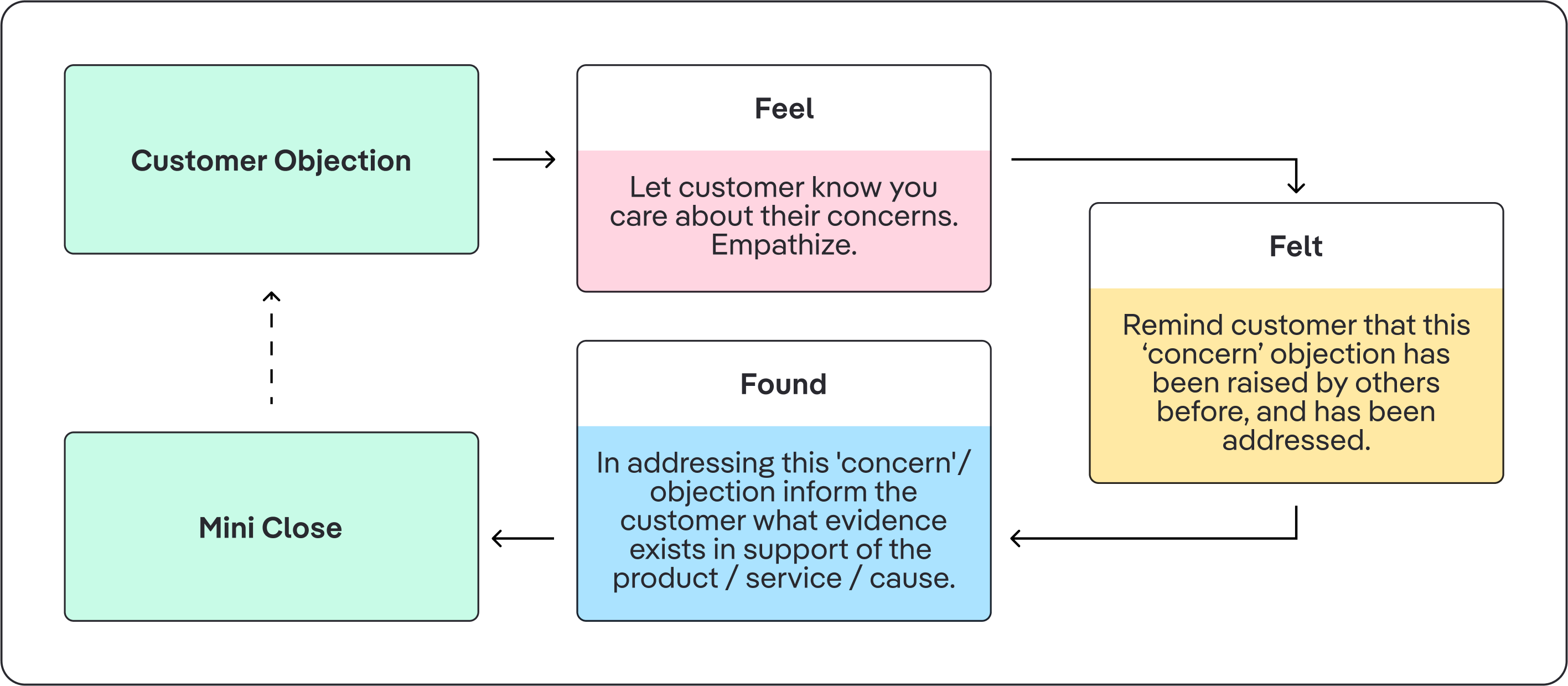
### **6. Handle Objections with Confidence**
Discovery calls can get tricky, and the prospect may throw a few curveballs your way. If so, take the time to acknowledge their concerns and highlight proof points of your product or service.
A personalized product demo, use cases, and customer stories can bolster your response and reassure prospects, and empathetic language like ‘Many of our customers initially felt the same way’ can keep the conversation personal.
### **7. Confirm Their Business Challenges**
During discovery calls, one of the best practices is to take notes and document the information you gather, which you can share with sales enablement, sales engineering, and marketing colleagues.
Don’t be afraid to ask prospects to confirm or further explain the features or goals of their company’s product or service. Asking for more information encourages them to dig deeper and provide more detail about their business challenges.
You can also use your meeting notes to customize the demo further. For example, some prospects may want to see ROI, usability, or integration capabilities.
### **8. Identify Their Decision Criteria**
You haven't yet sealed the deal, even if the call was successful. At this stage, you can ask about the company's decision-making process, such as:
- Who is involved?
- Who makes the final call?
- Are there any upcoming or unforeseen challenges, such as an upcoming budget review?
- What are their timelines?
This detail helps you advise your sales team colleagues about which stakeholders to engage and which sign-off processes to prioritize.
### **9. Set Clear Expectations for the Next Steps**
You can set clear next steps at the end of the call, including action points, task ownership, and timelines. Document this information for easy referencing. Lastly, don’t forget to secure their commitment. It’s unlikely that you will get a firm ‘yes’ on the discovery call, but you can move them further down the sales funnel by inviting them to watch a demo or book another call.
### **10. CRM Updates**
You’ll gather tons of information on the discovery call, but it’s what you do with this information that matters. Following the call, you can fill your CRM with the unstructured data. Rather than leaving quick notes, create mandatory fields such as moving a contact or company from the discovery phase to ‘qualified pipeline’ or ‘closed lost.’ This best practice helps you structure the data and see its total value.
### **11. Leverage Technology**
Technology can help you deliver a streamlined experience with your prospect, even during the initial discovery stages. Simple automation additions like recording and transcribing can help improve communication, and CRM tools bring your marketing, sales, and customer service requirements together in one place.
Don’t forget where the demo slots into the picture. For example, you can integrate Demostack with your CRM to seamlessly track demo engagement and personalize follow-up actions.
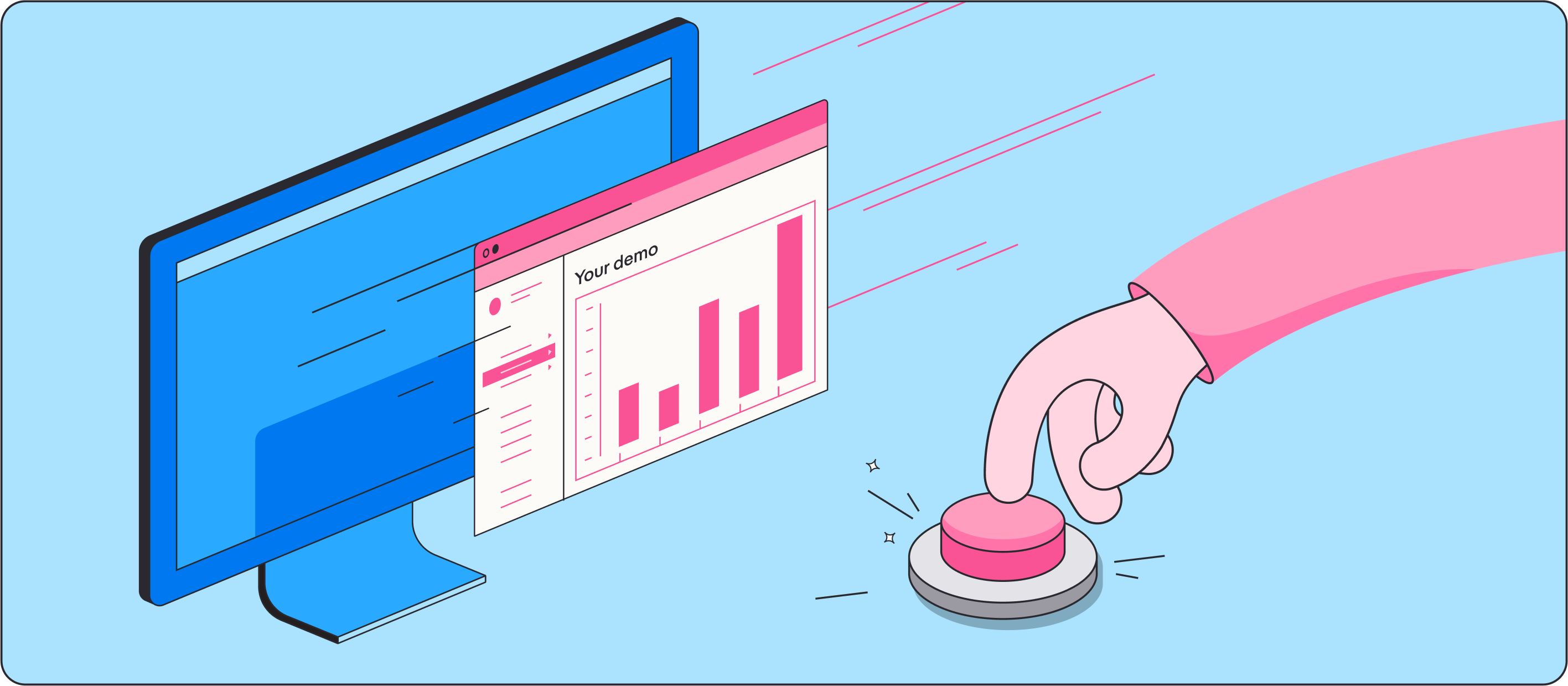
### **12. Continuously Improve**
‘Never stop learning’ is an awesome attitude to have. After the call, re-watch the recording (or listen to the transcript) to analyze your approach. Your colleagues can provide constructive feedback to help you level up in the next discovery call.
Continuous improvement also applies to your product demos. By choosing a tool with built-in analytics features, you can track engagement, identify your prospect’s areas of interest, and measure the demo’s impact – all this info helps you better prepare for next time.
## **Be Demo-ready During the Discovery Call**
Since discovery calls are short, the emphasis should be on gathering valuable insights, not on the volume of information. Likewise, from your prospect’s perspective, they want to see you provide quality proof points about your product or service, and a demo is the best way to do so.
Demostack is a powerful sales enablement and demo automation platform that delivers personalized, interactive, and data-driven demos to your prospects. It automates the demo creation and delivery processes, enabling you to focus on the quality of the discovery call. With Demostack, you can showcase the value of your product or service and provide prospects with hands-on product experience.
**Want to see Demostack in action? Take it for a spin by [booking a demo](https://www.demostack.com/).**
## Article: Top 10 Sales Performance Management Software
Source: https://www.demostack.com/post/top-10-sales-performance-management-software
Sales leaders are under pressure to drive predictable growth in increasingly complex and competitive markets. But most organizations struggle because they are using reactive, fragmented systems that cause sales execution to break down and deal progress to stall. What's missing is a unified approach to managing how sales teams operate, communicate value, and how sales performance impacts revenue outcomes.
Last year, 84% of sales reps did not meet their quota. That level of underperformance shows that it's high time for sales teams to adopt more structured, data-driven approaches, even when it comes to demos. The solution is to employ Sales Performance Management (SPM) software, designed to monitor sales progress, determine and recognize success, and proactively respond to processes and employees that need improvement.
The market for this software is booming, with an estimated 2025 market size of approximately $3.19 billion that's growing at a CAGR of 16.3% through 2030. As demand grows for various types of SPM platforms that integrate automation, planning, execution, and optimization, selecting the right solution has become a strategic priority. Let's take a closer look at the top ten sales performance management software tools and how to choose the right ones for your team.
## **What Is Sales Performance Management Software?**
**Sales performance management (SPM) is the process whereby sales leaders track and improve the effectiveness of their teams.** In a B2B environment, this includes setting performance expectations, measuring progress, and making adjustments that help sales teams stay on target.
**Sales performance management software brings this process into a digital environment. These platforms are designed to support core activities such as planning, tracking, and evaluating performance over time.** They help organizations manage sales performance more consistently, especially as teams grow and sales operations become more complex.
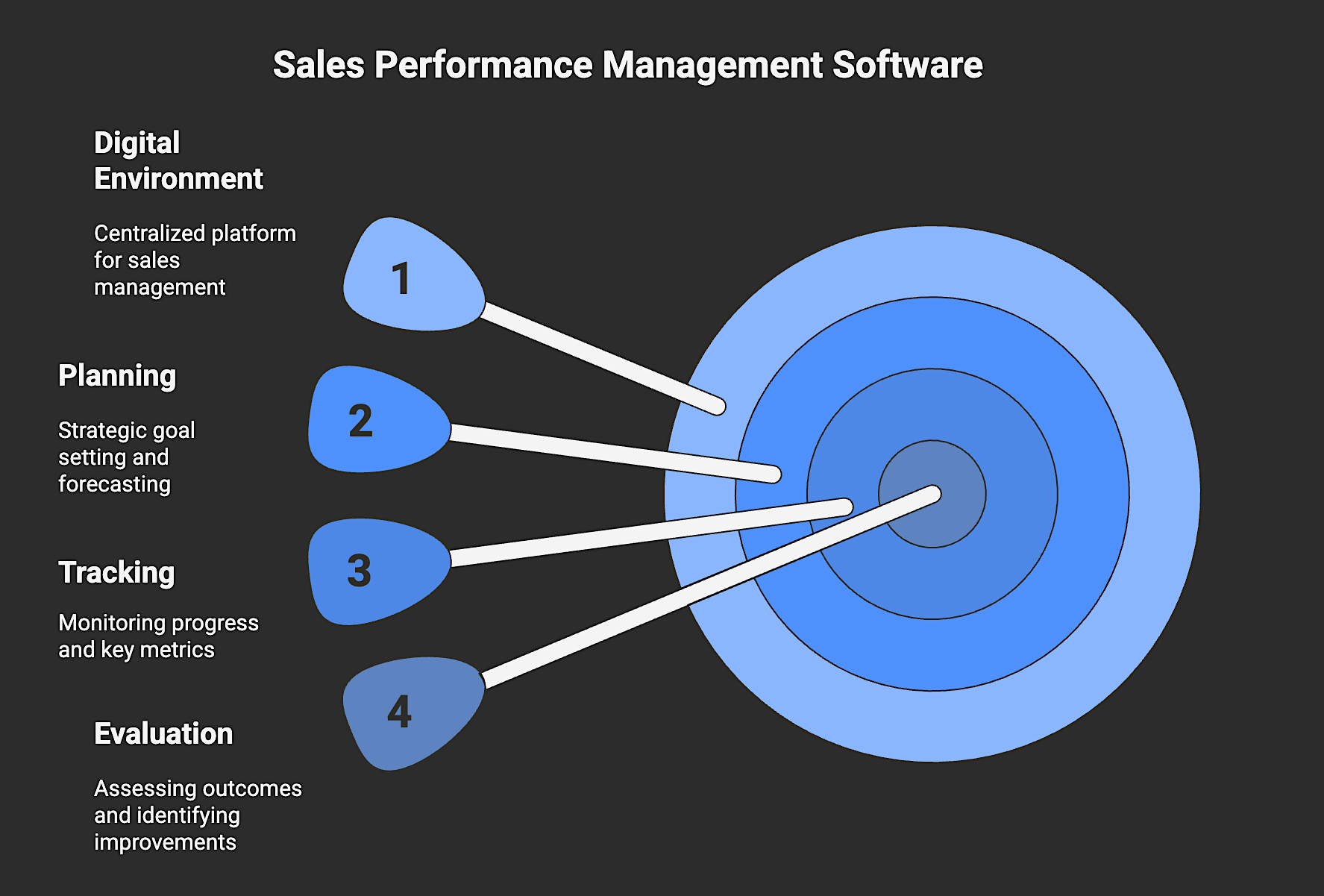
SPM software is becoming more important as companies move away from static reporting and reactive interventions. Sales performance can't be improved if it isn't being monitored in real-time or tied to execution on the ground.
Historically, most SPM software has focused on planning and measurement. Today, more companies are recognizing that sales performance also depends on how well teams present the product and engage buyers to move deals forward. Newer tools are emerging that focus on enhancing sales performance by directly improving the execution of sales functions, such as delivering targeted [product demonstrations](https://www.demostack.com/post/product-demonstration-a-b2b-sellers-guide) that engage buyers and advance deals.
## **What Are the Main Types of Sales Performance Management Software?**
SPM Software is a category that includes multiple capabilities designed to improve the performance of your sales team. **The primary types include:**
- **Sales Performance Analytics and Reporting Software** monitors sales metrics and performance outcomes, like the number of meetings booked or deals won, for each sales rep and across the team.
- **Sales Enablement Platforms** equip sales teams with the tools to execute effectively in live selling scenarios by presenting the product clearly and consistently. They can include tools like [battle cards](https://www.demostack.com/post/battle-cards), sales decks, and interactive demo environments.
- **Pipeline Management Tools** help teams track active deals and manage pipeline health.
- **Sales Forecasting Software** predicts future revenue based on pipeline data and historical trends, helping leadership project the business's direction and determine if additional sales resources are needed.
**Revenue Intelligence Platforms** analyze the activities of both the sales team and buyers, such as sales calls and meetings, to uncover insights that drive conversions.
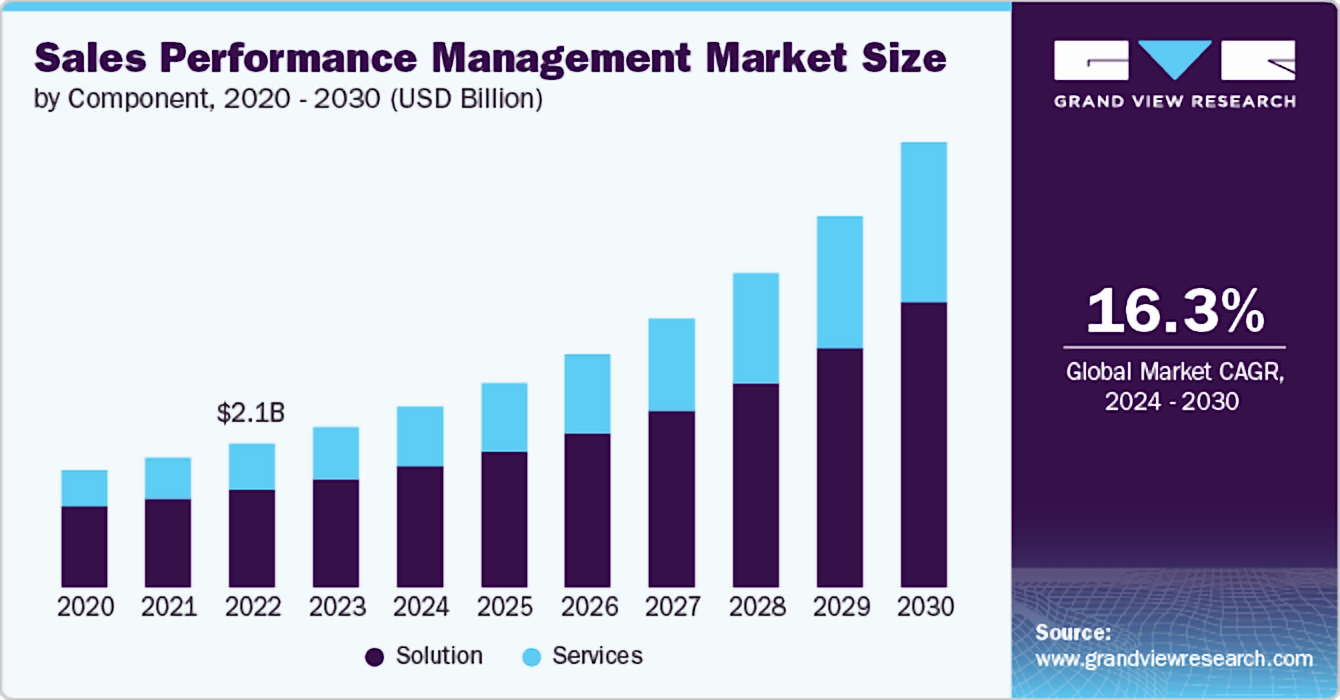
- **Sales Training and Coaching Software** helps the sales team upskill through onboarding programs and professional development.
- **Incentive Compensation Management Tools** automate commission tracking and compensation rules. These systems reduce errors, simplify plan administration, and help sellers stay focused on the right objectives.
- **Quota and Territory Management Software** assigns and adjusts sales targets and coverage areas across teams.
- **Gamification and Motivation Platforms** use recognition, scorecards, and performance tracking to drive increased engagement by the sales team. They reinforce key behaviors and boost energy during longer sales cycles.
- **Goal and OKR Management Tools** enable the tracking and alignment of team and individual sales goals, keeping everyone on target.
## **5 Benefits of Sales Performance Management Software**
**SPM software offers many benefits, such as:**
### **1. Improved Sales Execution**
SPM tools provide real-time guidance, standardized workflows, and automated coaching prompts that help sales reps follow best practices consistently, leading to higher win rates and shorter sales cycles.
### **2. Faster, More Accurate Forecasting**
Automated data collection and advanced analytics enable sales leaders to generate reliable revenue predictions quickly, reducing manual effort while improving forecast accuracy through better pipeline visibility.
### **3. Aligned Incentives and Behavior**
The software directly connects compensation plans to performance metrics and strategic goals, ensuring that sales teams focus on activities that drive the most valuable outcomes for the business.
### **4. Greater Visibility and Accountability**
Centralized dashboards and reporting provide managers with clear insight into individual and team performance, making it easier to identify coaching opportunities and hold team members accountable for their results.
### **5. Scalable Sales Processes**
Standardized workflows and automated tools, such as interactive demos, enable organizations to maintain consistent sales methodologies as they expand. This way, they can onboard new team members faster while preserving institutional knowledge and best practices.
## **Key Features of Sales Performance Management Software**
**When choosing sales performance management tools for your organization, look for these key features:**
- **Alignment with your sales structure –** Accommodates compensation models, territory assignments, and role hierarchies without requiring changes to your organizational structure.
- **Automation of manual processes –** Replaces spreadsheets and manual workflows with automated tracking and plan management to reduce errors and overhead.
- **Real-time visibility into performance and pipeline data –** Provides immediate access to performance metrics so teams can respond faster and stay aligned.
- **Ease of use and user adoption –** Supports use by sellers, managers, and admins without the need for technical training or support.
**Integration with your tech stack –** Maintains accurate, up-to-date data across CRM and other systems without duplicate entry or manual updates.
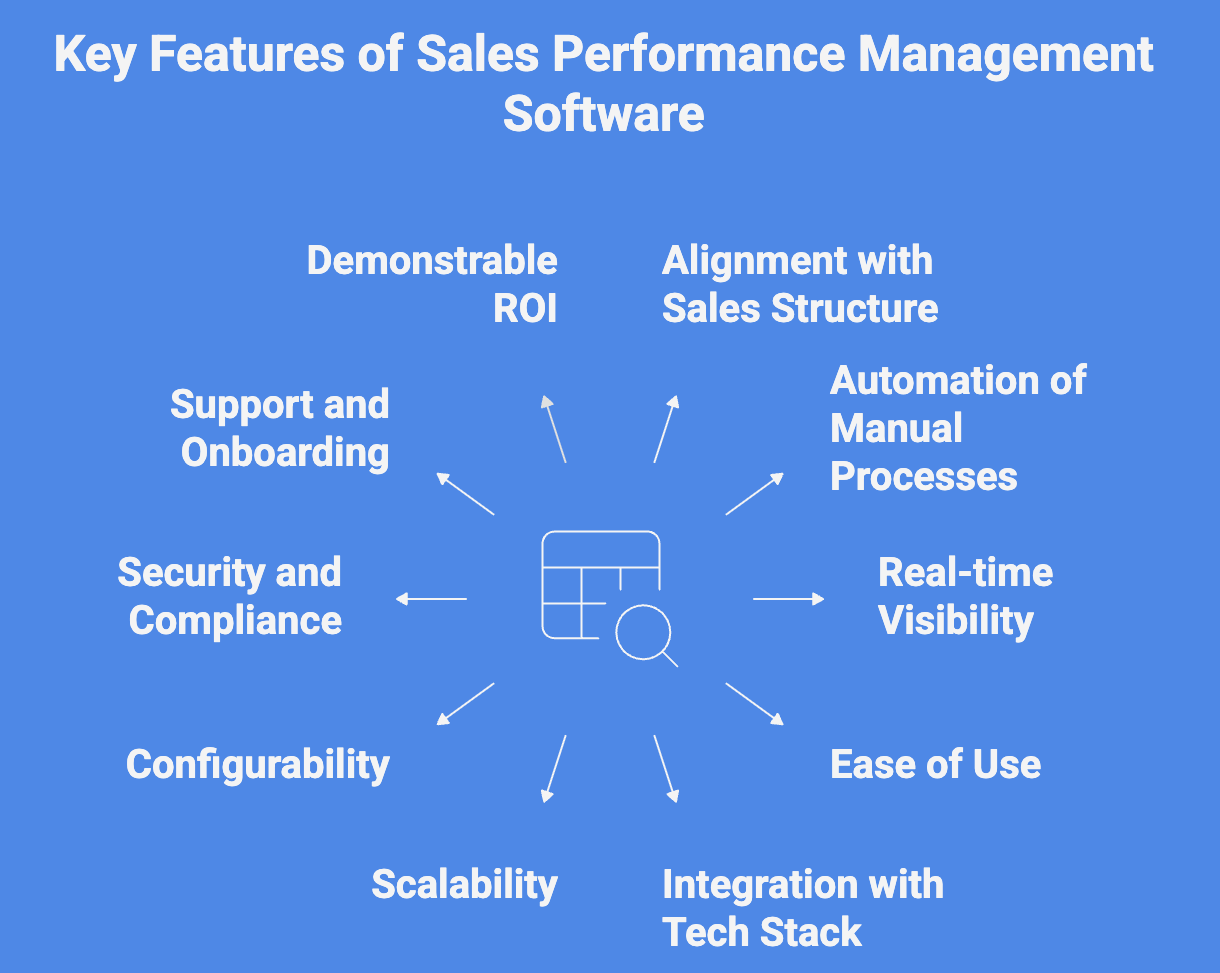
- **Scalability –** Supports additional users, product lines, and sales regions without requiring changes to core workflows or processes.
- **Configurability –** Allows non-technical users to modify workflows, dashboards, and compensation plans without developer support.
- **Security and compliance –** Protects sensitive sales and employee data in line with industry and data regulatory standards like [ISO 27001](https://www.jit.io/resources/security-standards/iso-27001-checklist).
- **Support and onboarding resources –** Includes training programs and launch support that help teams realize value quickly.
- **Demonstrable ROI –** Delivers measurable gains in sales efficiency or revenue performance tied to business goals.
## **Top 10 Sales Performance Management Software by Category**
### **1. Best for Sales Performance Analytics & Reporting: InsightSquared**
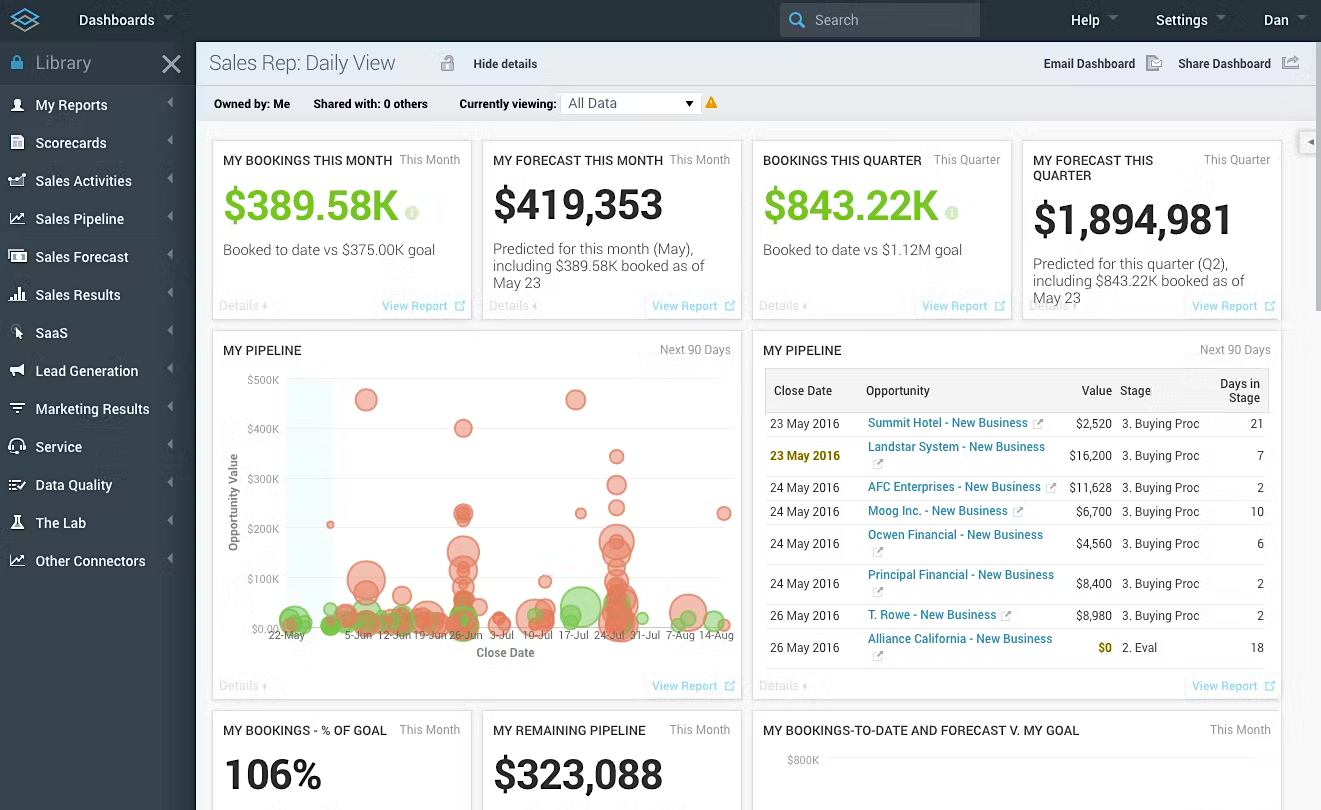
**InsightSquared delivers real-time sales analytics by combining CRM data with activity tracking, providing teams with a comprehensive view of their performance.** It includes pre-built reports and interactive dashboards that surface trends in pipeline health, deal velocity, and forecast accuracy. Sales leaders use it to spot performance gaps, improve forecast confidence, and make faster, data-backed decisions.
**Review:** _“I like the intuitive nature of the reporting and dashboards. It makes board prep easy and internal reporting a breeze.”_
**2. Best for Sales Enablement: [Demostack](https://www.demostack.com/)**
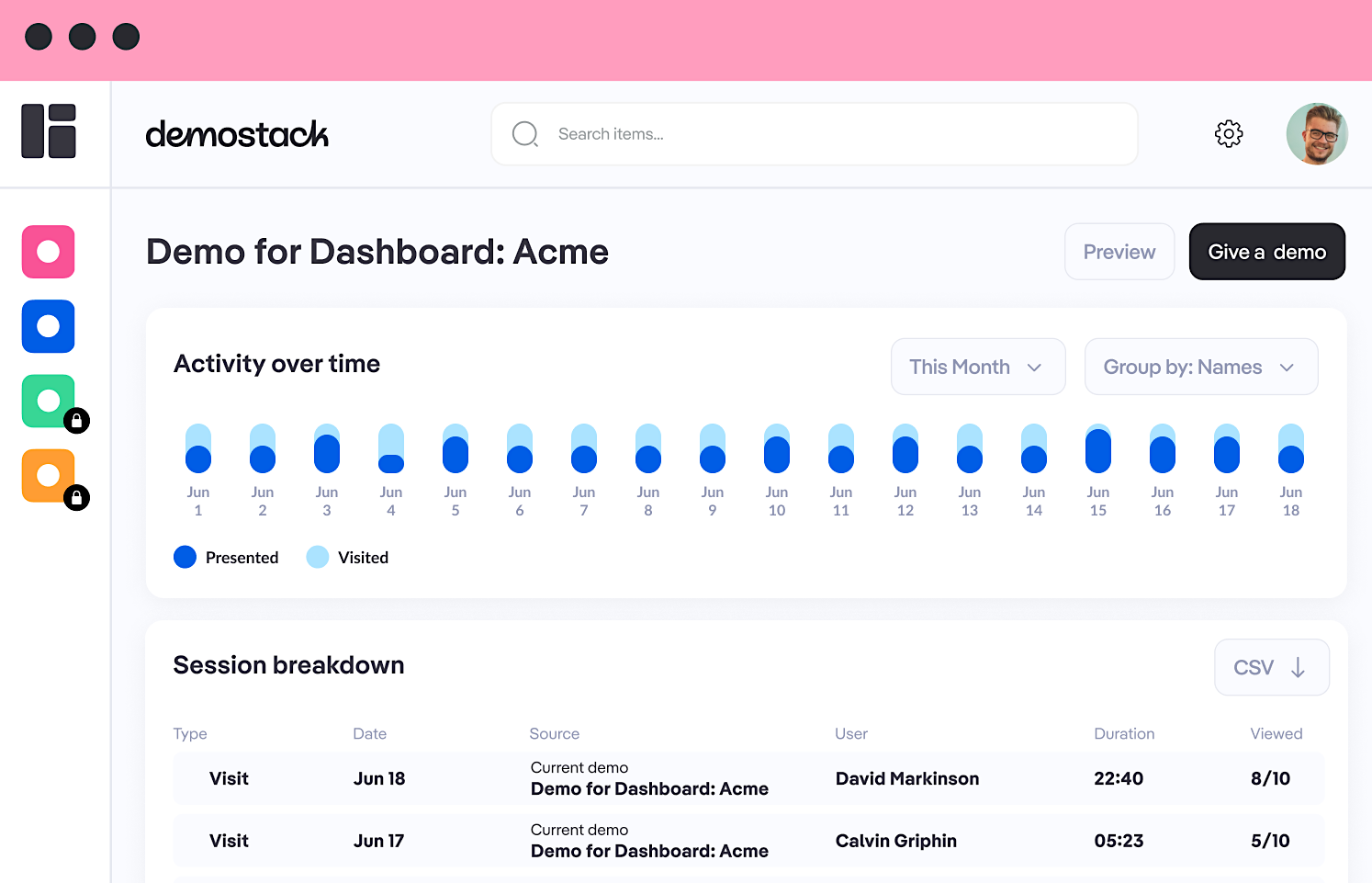
**Demostack is the [demo software solution](https://www.demostack.com/post/demo-software-solutions-for-2025) that helps sales and presales teams close deals faster by letting them show the best versions of their product for every use case without relying on engineering.** It creates robust, secure clones of live product demos, enabling consistent, tailored demos that drive faster sales cycles, increase deal volume, and move qualified opportunities through the pipeline.
Sales enablement teams use Demostack to give AEs the ability to deliver customizable demos independently. Product tours and demo sandboxes help prospects explore features on their own time, while analytics reveal what resonates most, enabling teams to fine-tune messaging and focus on buyers who are ready to act.
**Review:** _“Demostack has been the perfect solution. We can have a custom demo prepped in minutes instead of hours. The ‘Tour’ function is also critical for helping our champions sell when we're not in the room.”_
### **3. Best for Pipeline Management: Pipedrive**
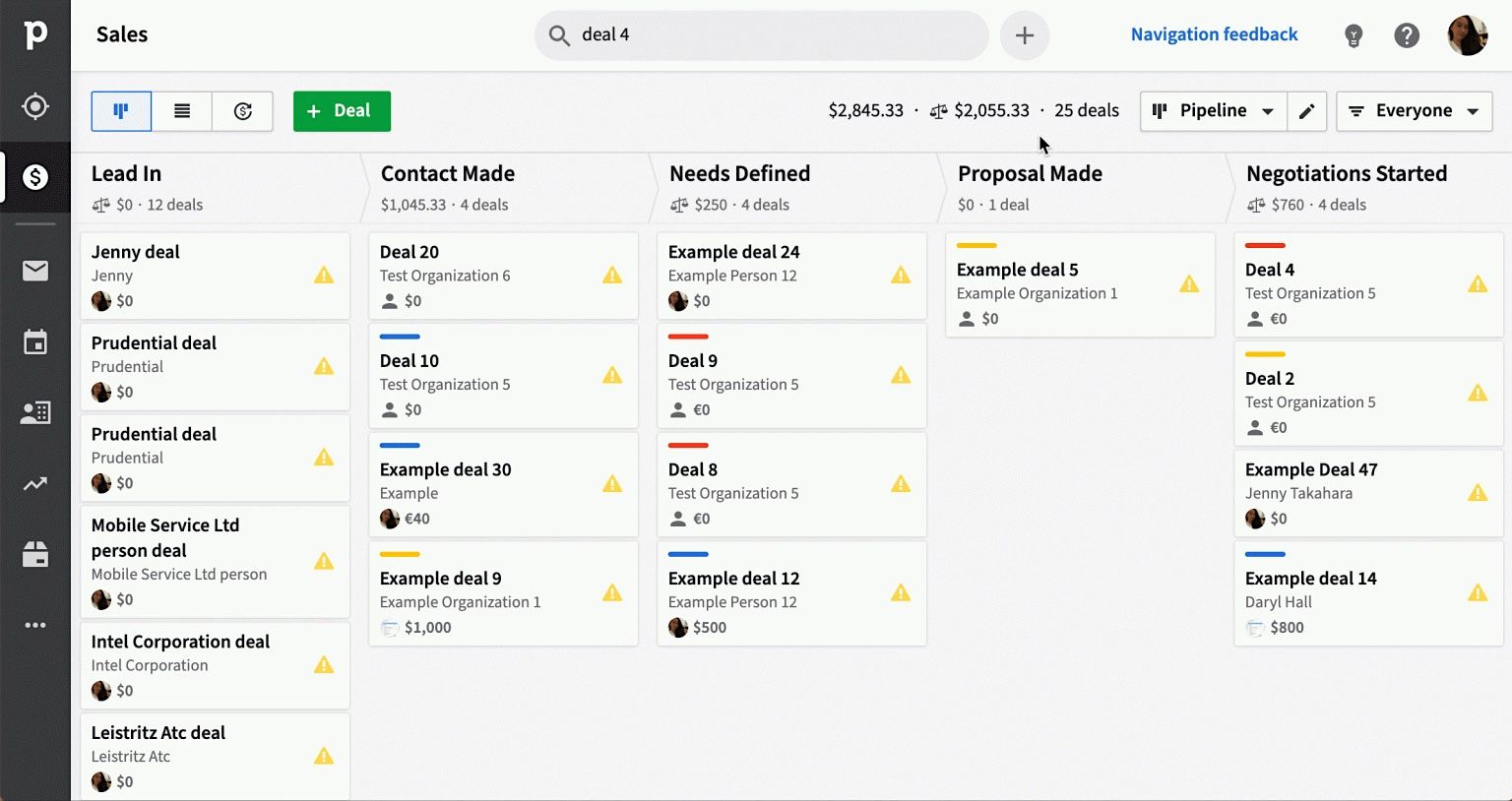
**Pipedrive provides sales teams with a visual way to track deals as they progress through each stage of the sales process.** Pipeline stages can be customized to reflect your actual workflow, and deals are updated through drag-and-drop actions. Each deal contains relevant context, including activity history and next steps. Teams can also set automated triggers that send alerts or assign follow-ups when deals stop moving forward.
**Review:** _“Being able to create our own pipeline stages and add custom fields has made all the difference in tailoring it to fit our workflow. It’s become the core of how we manage and grow our business.”_
### **4. Best for Sales Forecasting: Clari**
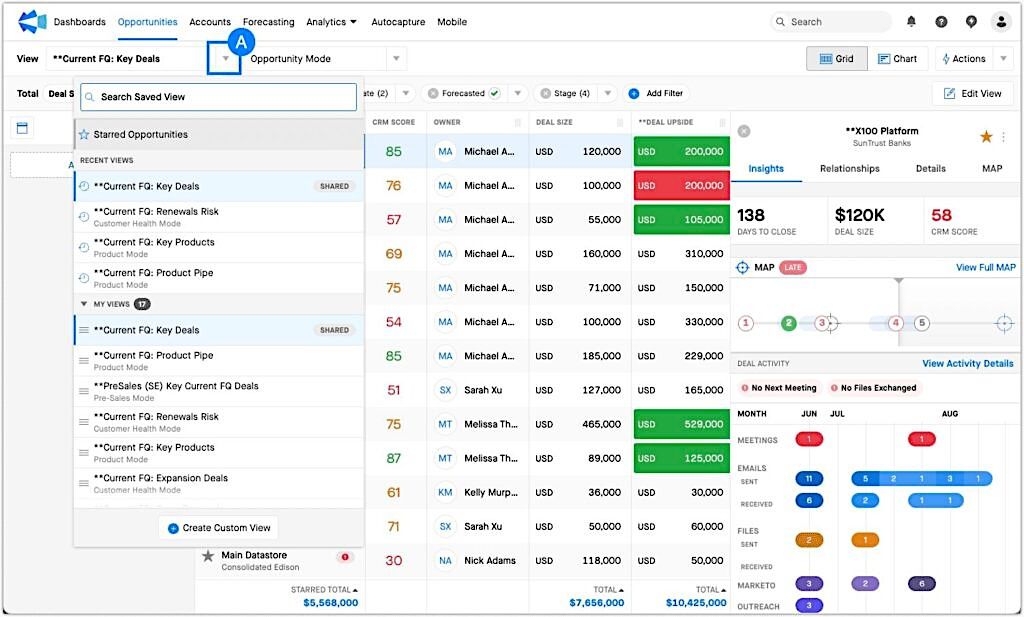
**Clari provides AI-driven revenue context, including predictive deal scoring and forecasting.** Its AI sales forecasting tool enables accurate forecasts across every segment and model. It provides real-time sales analytics with visualizations and insights into deal flow and pipeline health. The platform consolidates information from CRMs like Hubspot and Salesforce, email, calendar, and other systems into a single analytics hub to improve forecast accuracy.
**Review:** _“Clari is a great tool because it simplifies forecasting and makes it so much easier to get accurate insights.”_
### **5. Best for Revenue Intelligence: Gong**
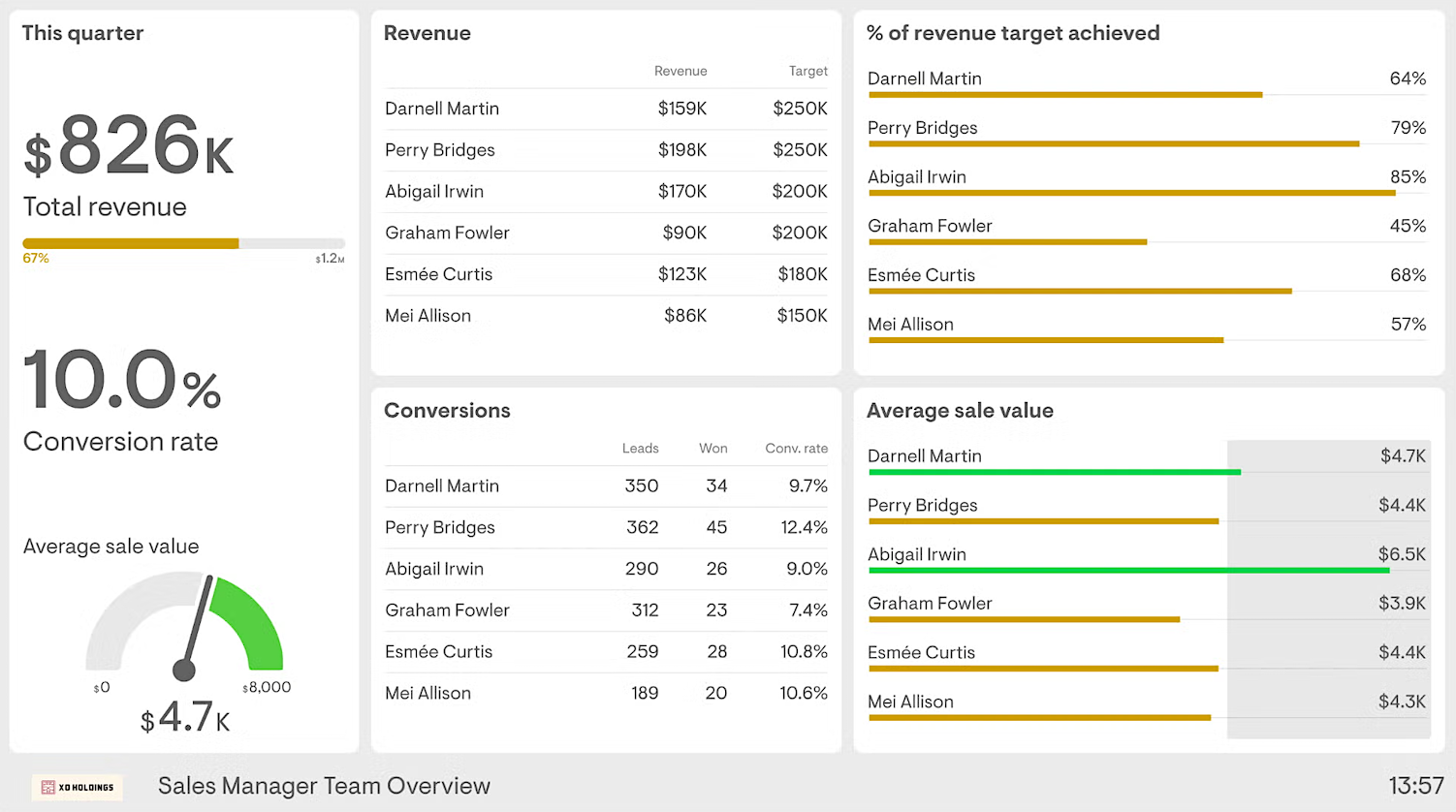
**Gong uncovers revenue intelligence that improves sales performance by connecting day-to-day selling behavior to revenue outcomes.** It automatically captures calls, emails, and meetings, then uses AI to flag risks, highlight coaching opportunities, and show how deals are progressing. Sales leaders rely on Gong to understand team execution and guide conversations that drive results.
**Review:** _“Gong has completely transformed how I approach sales calls. Being able to revisit recordings, track keywords, and see engagement insights has made it easier to coach myself and improve.”_
### **6. Best for Sales Training & Coaching: Mindtickle**
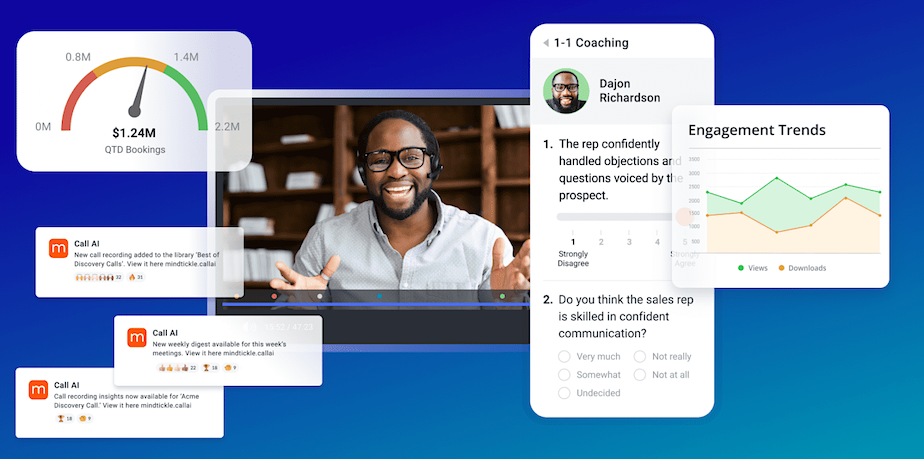
**Mindtickle offers a unified training and coaching platform designed to improve seller readiness and skills.** It identifies individual and team skill gaps and then delivers personalized coaching, either through AI or manager-led sessions, to close them. Sales leaders use features like role-based profiles, call scoring, and guided prompts to deliver targeted feedback in context. A readiness index tracks skills alongside performance metrics such as quota attainment, helping leaders measure the impact of training programs.
**Review:** _“We needed an LMS that can support both our Sales and Operations team, with continual assessments and coaching to help close any gaps in training and provide a consistent experience for our customers. MindTickle has been able to help us achieve that objective.”_
### **7. Best for Incentive Compensation Management: CaptivateIQ**
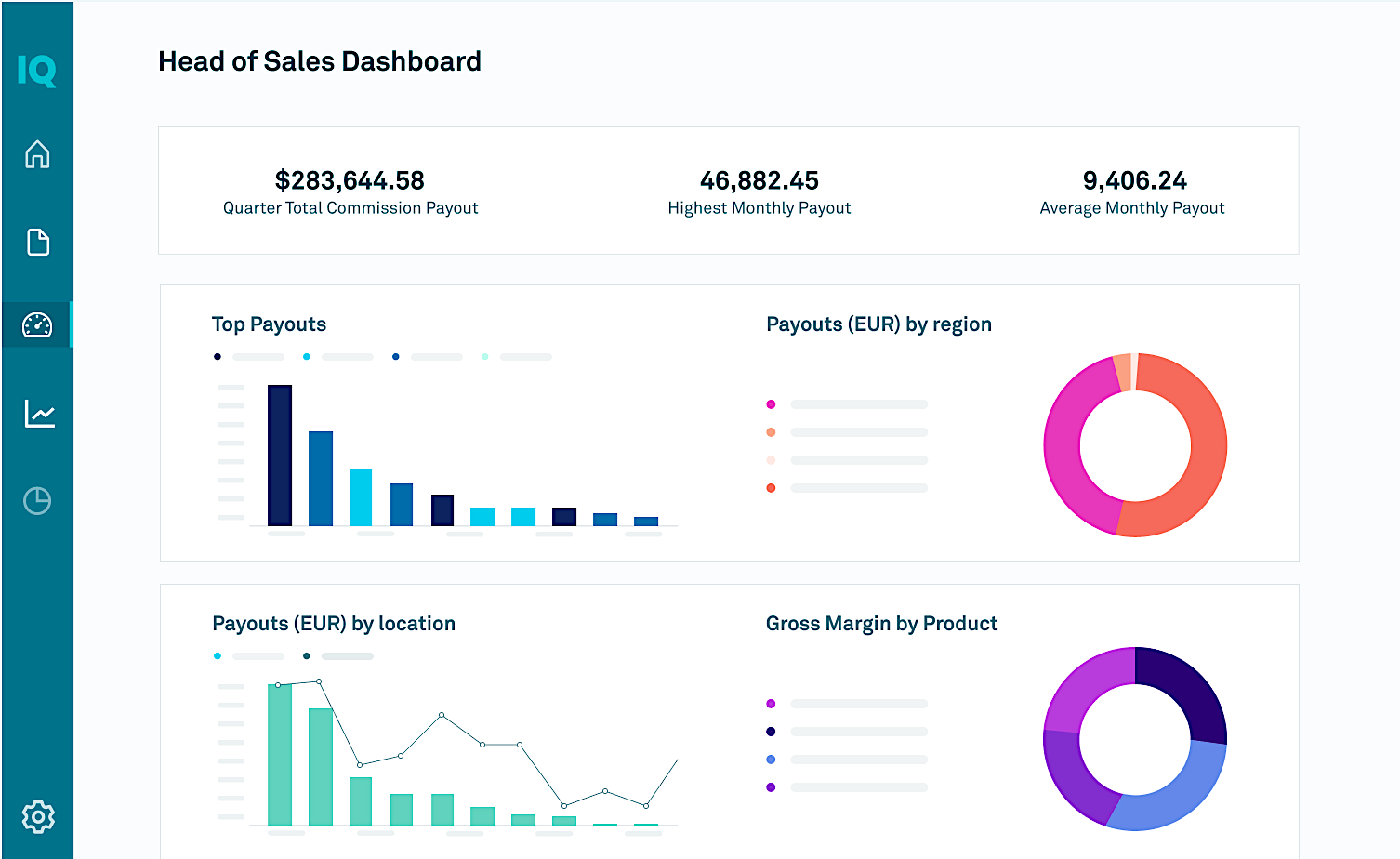
**CaptivateIQ automates commission calculations and plan modeling to ensure payouts are accurate and aligned with company goals.** The platform includes real-time earnings dashboards for sales team members and approval workflows for finance and sales leadership. Sales leaders can create and adjust commission plans using an intuitive, no-code interface that also enables automating commission workflows. Real-time dashboards provide transparency on earnings and incentives, helping reps understand how their performance drives revenue.
**Review:** _“Captivate IQ makes processing large quantities of sales commission payments very simple and quick.”_
### **8. Best for Quota & Territory Management: Xactly AlignStar**
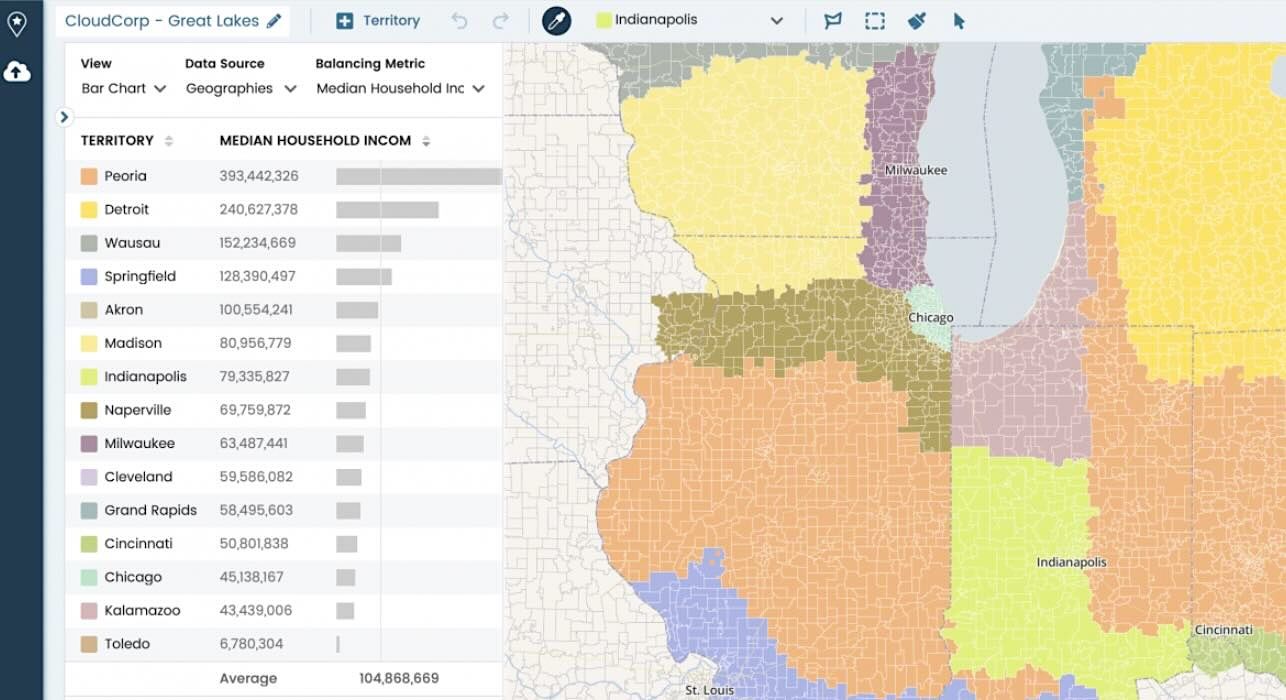
**Xactly AlignStar is an AI-powered platform that helps sales leaders plan and manage quota and territory assignments with greater precision.** It supports multiple territory models, including geographic and account-based, and allows teams to test and adjust plans before rollout. Built-in tools help identify coverage gaps and balance workload across reps and regions. Leaders can model changes, preview impact, and align targets to available market potential.
**Review:** _“With AlignStar, I can formulate, rethink, and even introduce new markets. AlignStar allows me to adjust the balance of work that each zip code carries.”_
### **9. Best for Gamification & Motivation: Ambition**
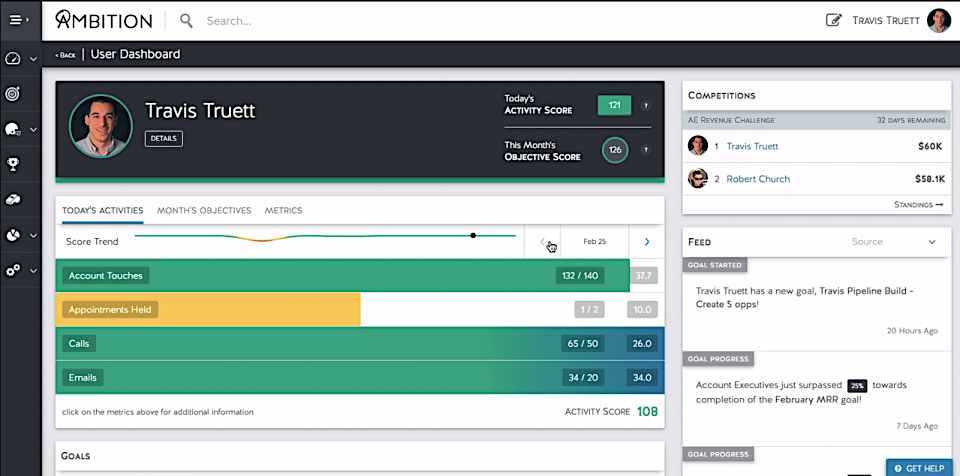
**Ambition delivers real-time scorecards and leaderboards that create metrics and rankings for individuals and teams.** Users can set up performance challenges based on calls, demos, or closed deals, and trigger automated alerts when goals are reached. The platform includes live TV-style broadcasts and badges to recognize top performers and milestones. By tying motivation to tracked metrics, Ambition helps sales leaders reinforce performance standards and drive consistent activity across the team.
**Review:** _“We introduced Ambition to our team and saw a few immediate benefits: easy-to-create contests, increased metrics transparency (for motivation and management purposes), increased competition, and an additional venue to drive process adoption.”_
### **10. Best for Goal & OKR Management: WorkBoard**
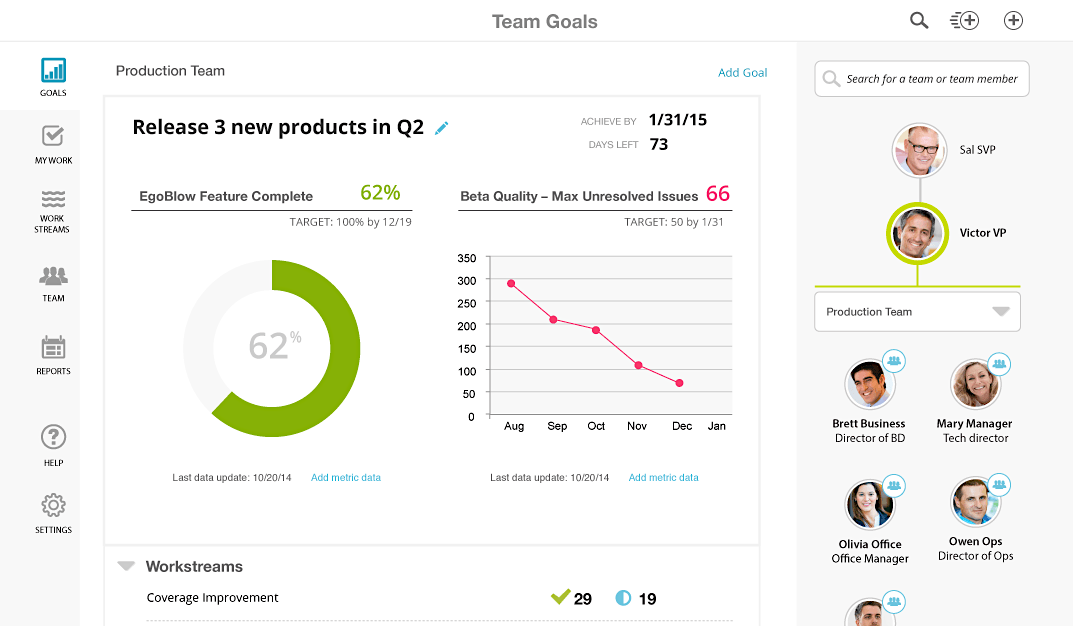
**WorkBoard is an enterprise-grade OKR (Objectives and Key Results) platform that uses AI to help teams set, align, and track strategic goals.** Managers can define objectives, map key results, and use AI-generated action and validation plans tied to measurable outcomes to guide execution. The platform gives sales leaders deep insights into goal progress and accountability. WorkBoard links sales metrics to OKRs and tracks alignment across teams to drive sales performance.
**Review:** _“Having WorkBoard implemented across our entire organisation has meant everyone is reporting their progress in one place; this gives global visibility of what teams are achieving…reinforcing the 'common goal' mentality.”_
## **Drive Sales Performance by Focusing on Execution**
Sales performance improves when leaders have visibility into how teams operate and where execution breaks down. **The right sales performance management software connects day-to-day activity with outcomes that matter, enabling teams to act sooner and stay aligned around what drives revenue.**
**Demostack supports sales enablement by making it easier to scale consistent demo experiences across teams.** It enables AEs to deliver customized demos quickly and independently, while freeing SEs to focus on strategic opportunities. Sales leaders use it to reinforce messaging, improve execution quality, and track buyer engagement with demo analytics—all without relying on engineering. **[Try a demo today](https://www.demostack.com/win-more-deals-lp) and see how Demostack helps your team execute with confidence.**
## Article: Customer\-Led Growth: Definition, Examples, and Best Practices
Source: https://www.demostack.com/post/customer-led-growth
It’s time to toss out your traditional sales playbook. One-size-fits-all, feature-heavy product demos and marketing materials are no longer enough to engage modern buyers. Customer-led growth (CLG) strategies that prioritize listening to your customers are bridging the gap between technical buyers and the B2B SaaS companies selling complex products.
80% of customers say the experience that a company provides is just as important as its products, showing that trust depends on more than features alone. Customer-led growth helps you understand how buyers actually think and talk about their problems, so you can engage them in a way that feels clear and relevant. It’s a smarter way to go-to-market when the old playbook no longer works.
The CLG approach helps companies rethink how they position value and communicate it across every touchpoint. It’s especially useful for teams navigating complex sales cycles, where understanding customer context can make or break a deal. Let’s take a closer look at what customer-led growth really is and how to put it into practice.
## **What Is Customer-Led Growth?**
**Customer-led growth (CLG) is a go-to-market strategy that focuses on deepening your understanding of existing customers’ needs and pain points.** It puts your ideal customer’s voice at the center of your marketing and sales efforts, from demo delivery to content messaging and [sales enablement training](https://www.demostack.com/post/sales-enablement-training-7-must-have-modules).
**Creating a customer-led growth strategy involves:**
- **Investing in structured feedback loops:** Conduct in-depth customer interviews, review customer support transcripts, and analyze closed deals.
- **Reviewing your findings:** Analyze the insights to unearth how customers actually describe their needs, evaluate value, and make decisions.
- **Applying your insights:** Put CLG strategies into action by tailoring everything from sales pitches to product demonstrations to the customer’s perspective.
**B2B SaaS companies, especially those with complex or configurable products, harness CLG to build trust throughout multi-stakeholder buying journeys.** If your product requires a technical explanation that addresses diverse pain points across an organization, CLG offers an effective framework.
**Teams will use insights gained from customer feedback to inform sales plays, such as demo narratives.** This context helps you tailor the demos and messaging to real-world customer needs, boosting credibility and relevance earlier in the buying journey.
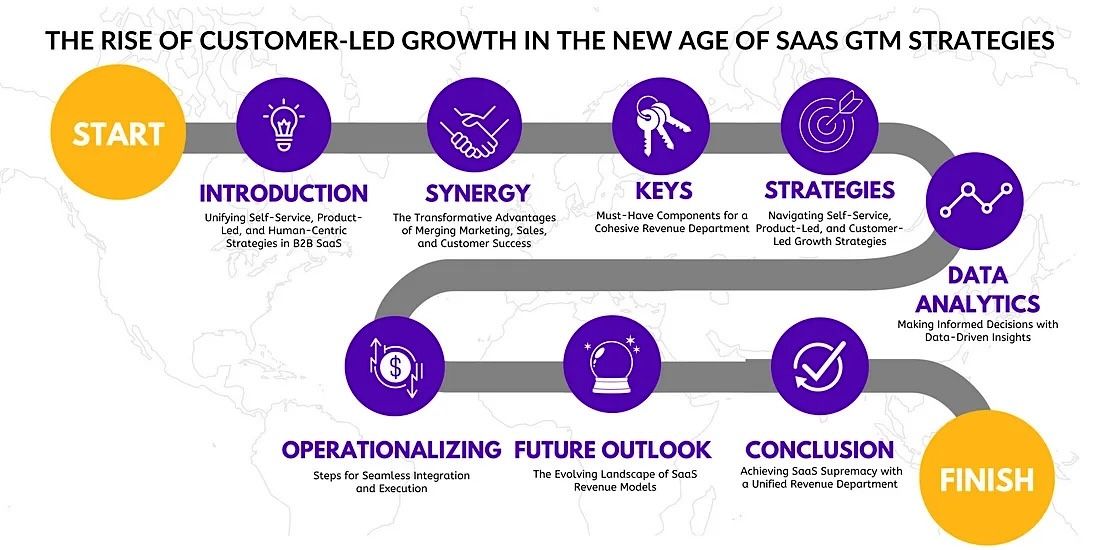
Caption: RiteGTM
## **Why Customer-Led Growth Matters for B2B SaaS Companies**
### **Traditional Models Fall Short for Complex Sales**
Any SaaS company knows that traditional sales-led growth (SLG) or product-led growth (PLG) initiatives fall short when it comes to engaging technical buyers. These buyers evaluate complex products for a diverse range of use cases within their organization.
To add to the complexity, multiple stakeholders want to throw in their two cents. **PLG and SLG are anchored on promoting product value in generic pitches and one-size-fits-all demos, but customers in the B2B SaaS space demand real-world relevance.**
### **CLG Aligns Messaging with Buyer Reality**
**Customer-led growth encourages sales reps to learn how actual customers articulate their problems and the value they want from your solution, helping you pinpoint the relevance to their industry and unique challenges.** After all, buyers don’t want to hear you waffle on about the product. They want you to provide compelling and consistent stories showcasing why your product is right for their use cases and workflows.
By grounding enablement materials and demo content in the customer’s language, CLG helps reduce message inconsistency across GTM teams. It also shortens ramp time for new sellers by giving them more accurate, field-tested narratives from which to work.
### **It Delivers Clarity in High-Stakes, Demo-Heavy Cycles**
Demo-heavy sales motions for industries like cybersecurity and healthcare require sensitivity and clarity when your teams discuss factors like technical capabilities. These are high-stakes, high-scrutiny environments where misplaced messaging can derail a deal. In these scenarios, you’ll likely turn to more comprehensive demo formats like proof-of-concept walkthroughs and tailored narratives for each role.
**Customer-led growth makes these demos more relevant and context-aware. It gives sellers a structured way to build trust earlier in the process, especially when different personas have different priorities.** CLG also empowers sales teams to speak more confidently and cohesively across the funnel, using a shared understanding of what buyers actually care about.
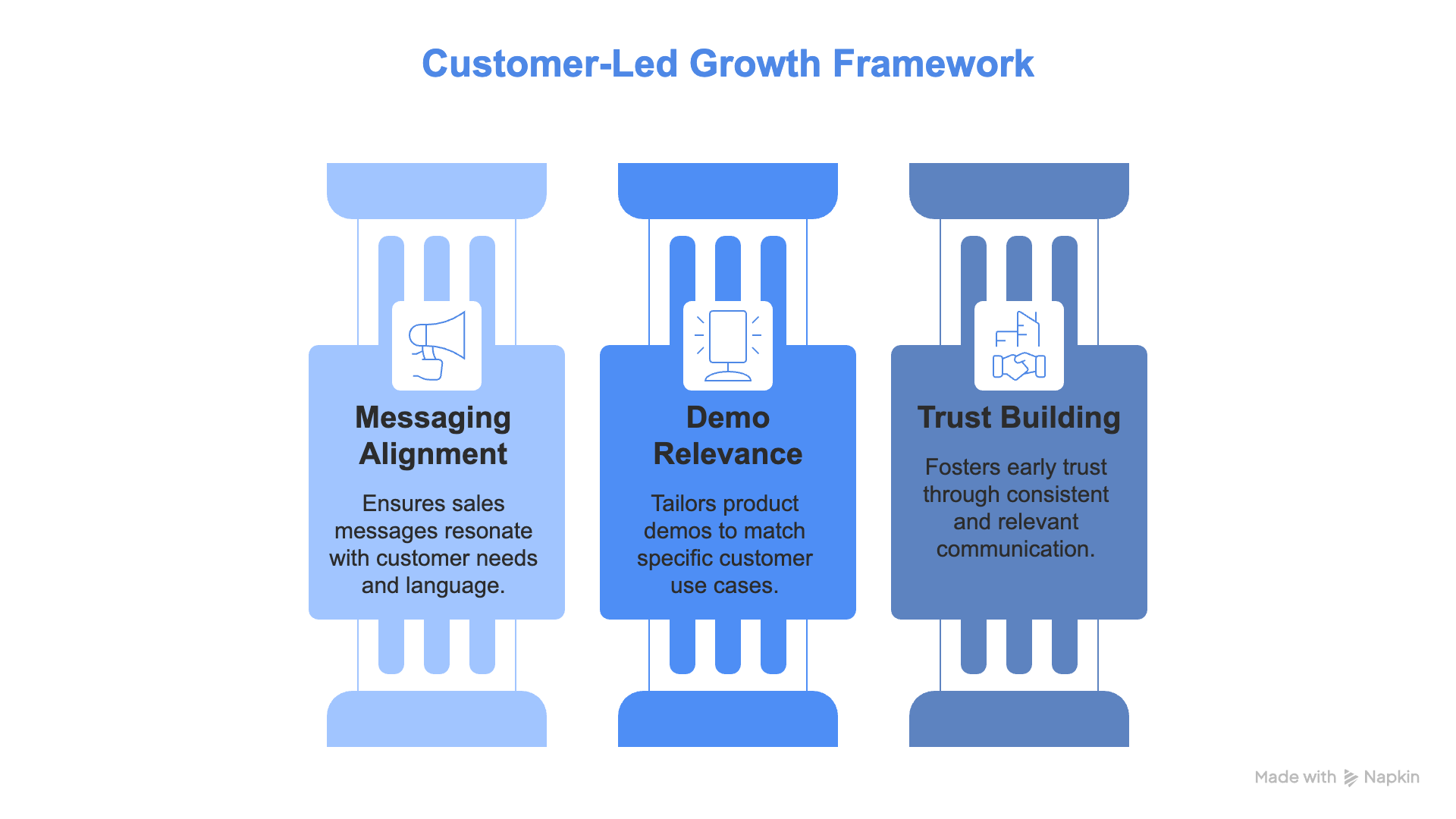
## **9 Best Practices for Customer-Led Growth**
**To implement customer-led growth that improves sales performance and buyer engagement, B2B SaaS teams can use the following tactics and examples to operationalize CLG across their go-to-market efforts:**
### **1. Identify and analyze your best-fit customers**
The most valuable data is already at your fingertips. **Use account-level data to pinpoint loyal customers with strong retention and deep product engagement. They’ll form the research pool, which is your ideal customer persona (ICP).**
**At this point, you can conduct in-depth interviews with these top buyers and ask:**
- What were their initial pain points?
- Which features do they like best?
- What specific business outcomes do they achieve with your product?
- How do they evaluate solutions, and who drives the final decision?
- How would their internal teams describe your product’s value?
This work helps sales, marketing, and enablement teams stay focused on the right segments. It also guides how you shape messaging and demos so that your best-fit customers influence what gets shown and said during the sales process.
### **2. Use customer input to refine messaging and positioning**
What would your customers say about their pain points? Nope, not what _you think_ they’d say—getting this information from the horse’s mouth is essential for a successful customer-led growth strategy. **Based on the customer feedback you’ve gathered, identify the raw language customers use to:**
- Describe their problems.
- Articulate their needs.
- Explain the value they get from your product.
**When your sales and marketing language mirrors how buyers talk about their problems and goals, it instantly improves relevance and credibility—the pillars of customer trust. It helps inform how your reps talk in live conversations, how they frame demo flows, and how they handle objections.** The more your team sounds like the buyer, the easier it is to build trust.
**Shared messaging also reduces inconsistency across teams.** Whether it’s a campaign, a cold call, or a sales demo, buyers hear the same story in language that makes sense to them.
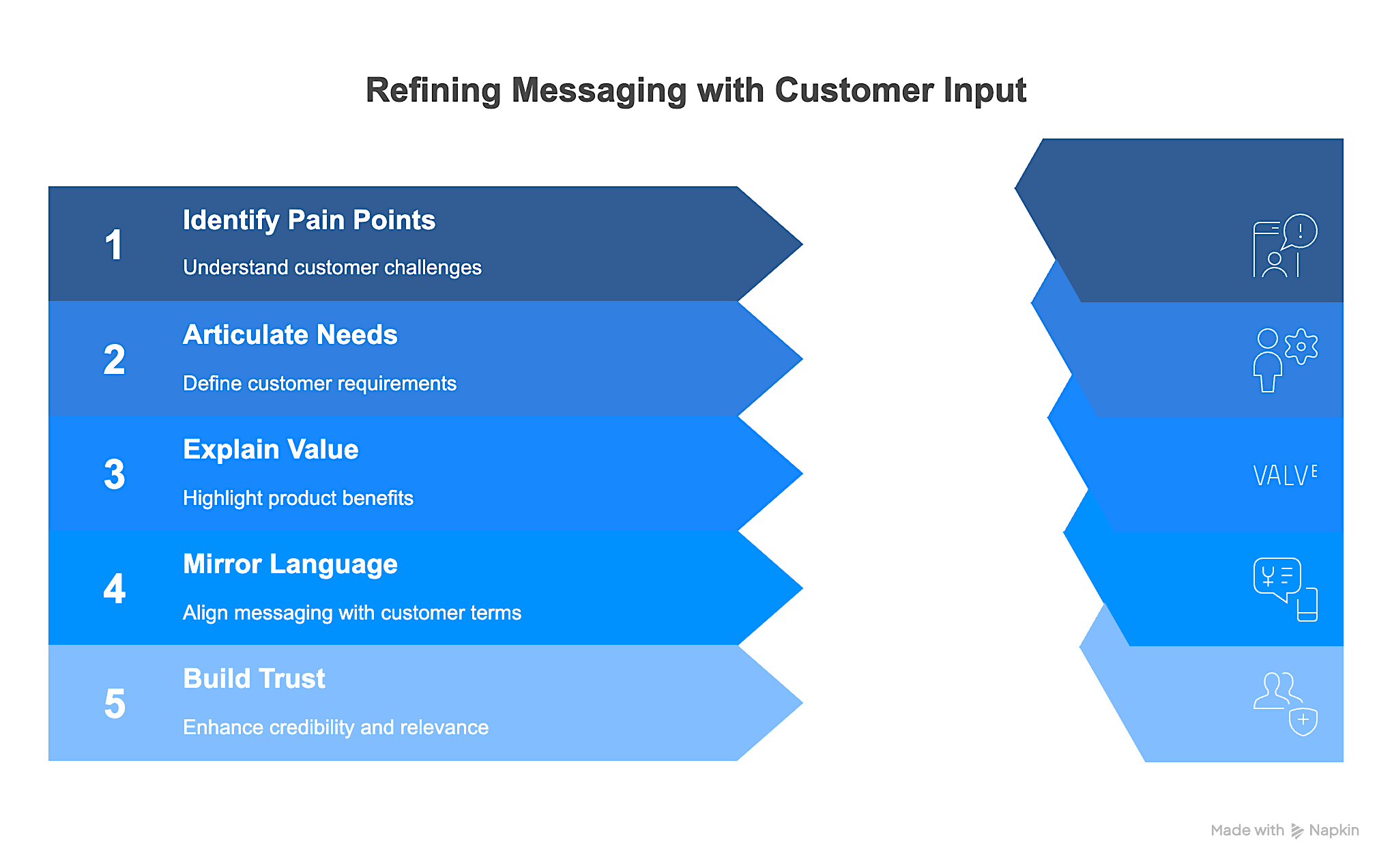
#### **Example in Action**
A sales rep at a materials informatics SaaS vendor notices in recorded calls that prospects describe their current onboarding process as _“a headache for new hires.”_ Using this intel, the sales enablement team creates a new internal training messaging emphasizing how their solution provides a _“unified and seamless onboarding experience for new employees.”_ The result is that they addressed the pain point with a customer-sourced phrase.
### **3. Center demo content around use cases, not product tours**
**Applying a customer-led growth strategy to demos means rebuilding demo flows to revolve around specific customer needs and business scenarios, not your products’ general capabilities.** Use-case-centric demos help buyers visualize immediate value and relevance much faster, which speeds up their decision-making.
**Follow these guidelines:**
1. **Create modular demo components** focused on different industries, roles, pain points, use cases, or workflows.
2. **Map the demo components to different buyer personas** that you’ve already developed based on your ICP. This step ensures each key stakeholder receives a demo story relevant to their pain points and use case.
**This approach becomes much easier to execute when teams have tools that allow them to customize demo content without relying on technical support.** It also makes the strategy scalable. This way, you’re not building a new demo from scratch every time. Instead, you’re assembling the right components based on what the buyer actually cares about.
It’s important to note that your demo components aren’t built in a vacuum. They’re informed by the same CLG research you’re doing elsewhere: customer interviews, win/loss analysis, and feedback from the field all feed directly into what those flows should look like.
#### **Example in Action**
Let’s say you are a company in FinTech marketing and selling financial planning software to SMBs. Usually, you’d launch into a general overview of your budgeting features at the start of the product demo. However, CLG strategies have revealed that your ICP struggles with cash flow predictability. Therefore, you can begin the demo by showcasing exactly how the software generates accurate cash flow projections based on historical data and scenario planning.
### **4. Enable sales teams to personalize demos without engineering**
Even simple demo personalization (e.g., the prospect’s name) can be complicated without the right tools. The bigger problem is that demos are often the only part of the sales process that is not wholly owned by go-to-market teams. AEs and SEs end up waiting on engineering or product teams to make small changes, which delays deals and limits how relevant the demo can be for different audiences.
The ability to personalize demos on the fly dramatically reduces that friction. **The most impactful personalization goes beyond surface-level tweaks and reflects the buyer’s pain points, industry, or persona.** But doing that without adding more work for engineering requires a better way.
#### **Example in Action: Demo Personalization the Easy Way**
**The secret is to use a demo experience platform. Demostack gives your sales and presales teams the ability to deliver customizable demos without relying on engineering help.** It puts ownership and control of the demo experience directly in your team’s hands.
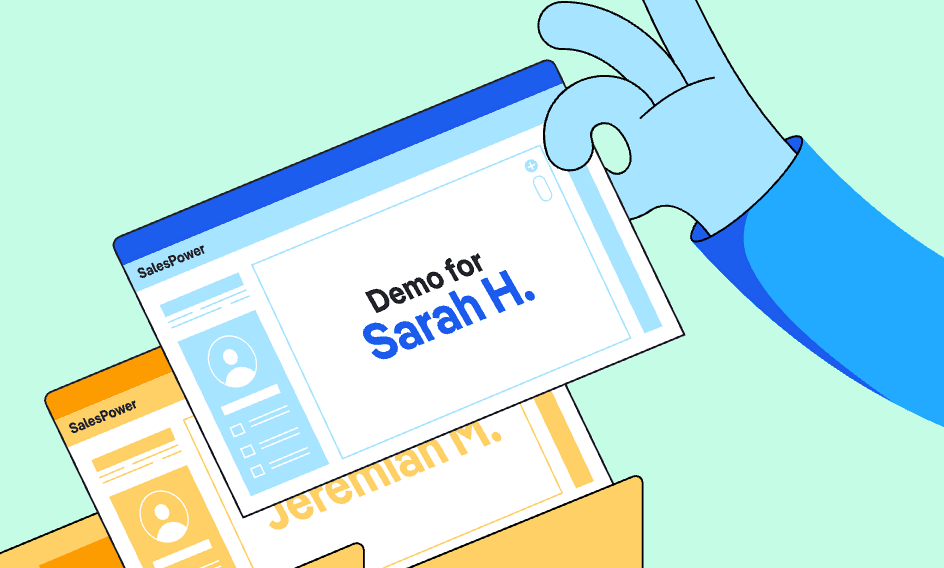
In this example, Demostack works by creating robust, secure clones of live product demos, making even the most complex solutions easy to showcase. It leverages AI to rapidly tailor demos with relevant data at scale, ensuring sales teams can address specific buyer needs without technical bottlenecks.
### **5. Use demo feedback and analytics to improve GTM execution**
What if you could gain additional customer-led growth insights from the demos themselves? **The best demo experience platforms track how buyers interact with self-guided demos—what they click, how long they stay on certain screens, and which features draw attention.**
**Analyzing demo engagement reveals what prospects care about and where they might be getting stuck.** It’s not just about improving demo flows. These insights can highlight gaps in enablement or point to objections that need to be addressed earlier in the process.
#### **Example in Action: Get data-driven insights from your demo platform**
**A [demo software solution](https://www.demostack.com/post/demo-software-solutions-for-2025) with in-platform analytics can connect demo activity to CRM data, giving you a clear view of how specific interactions impact sales outcomes.** This kind of feedback helps teams refine their strategy based on real buyer behavior and continuously improve how they engage prospects.
### **6. Align sales, marketing, and customer success on customer outcomes**
**All GTM functions (sales, marketing, and customer success) must be on the same page about buyers’ business and value goals.** It’s the secret to providing and describing value throughout the entire customer lifecycle, from initial marketing awareness to sales touchpoints like demos.
After all, demos shouldn’t just sell features. They’re a tool to support real business outcomes and post-sale value realization. When teams align around what success looks like for the customer, the demo becomes a way to highlight progress toward those goals, not just product capability.
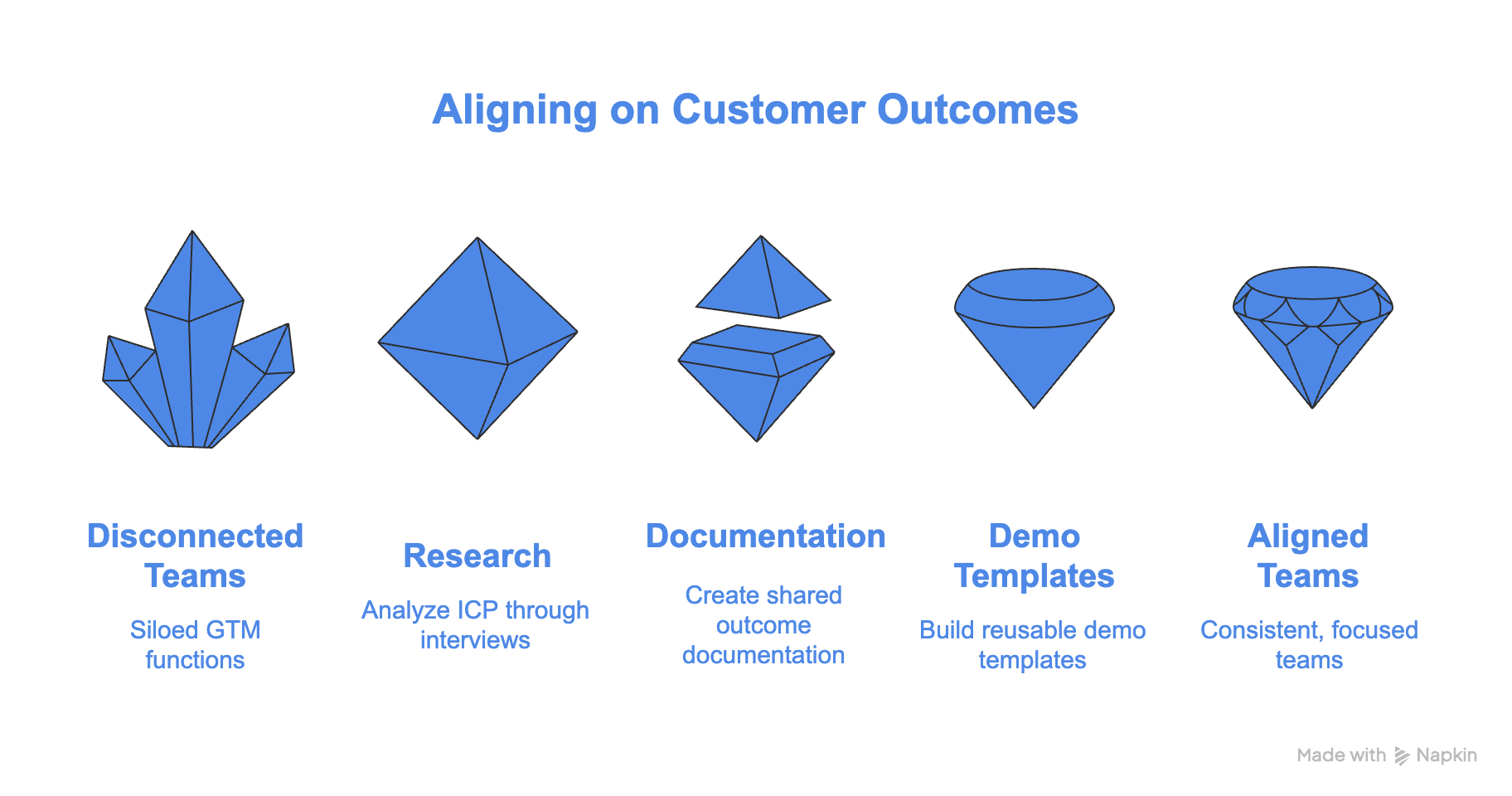
**Use your ICP analysis to bring together leaders from sales, marketing, and customer success and create shared documentation outlining the top business goals or critical workflows your product helps customers achieve.**
Aligning around these outcomes helps close the gap between what’s promised presale and what’s delivered after the deal closes. They can also be built into reusable demo templates and onboarding flows, helping teams stay consistent and focused at every stage.
### **7. Create demo-adjacent assets that reinforce the buyer narrative**
Even the best demos shouldn’t exist in silos. **Creating supplementary materials that align with the specific use cases and value demonstrated during a [sales demo](https://www.demostack.com/post/sales-demo-examples-that-inspire) is critical for gaining buy-in, reducing the risk of miscommunication, and ensuring your value proposition rings true long after the demo has ended.**
**These materials could include:**
- **Tailored recap decks** that reuse screenshots and data points from the demo.
- **Customized ROI calculators** to highlight post-sale value and outcomes.
- **Personalized one-pagers** that echo the language used in the demo to discuss the buyer’s unique use cases.
**These assets work best when they use actual customer phrasing and content from the demo.** They give internal champions something accurate and relevant to share with other stakeholders, especially in multi-person buying groups where the rep isn’t always in the room.
**Using an advanced demo experience platform also makes it easier to reuse visuals, wording, and workflows from the original demo**, so follow-up content stays consistent and easy to produce.
### **8. Use buyer objections and deal loss insights to refine enablement**
“Why did you lose the deal?” is the million-dollar question. **Negative feedback is just as valuable for customer-led growth as positive reflections.** **Understanding genuine customer concerns and complaints about the sales process helps you:**
- **Centralize win/loss notes** for all sales reps
- **Identify recurring objections** and messaging points that consistently fall flat
- **Use these patterns** to create or update comprehensive objection-handling playbooks
- **Revise the demo flow** to address common misunderstandings or objections proactively
Objections reveal where expectations and execution are out of sync. Using that feedback to update sales enablement content helps teams prepare for common concerns and respond with more confidence and clarity in future deals.
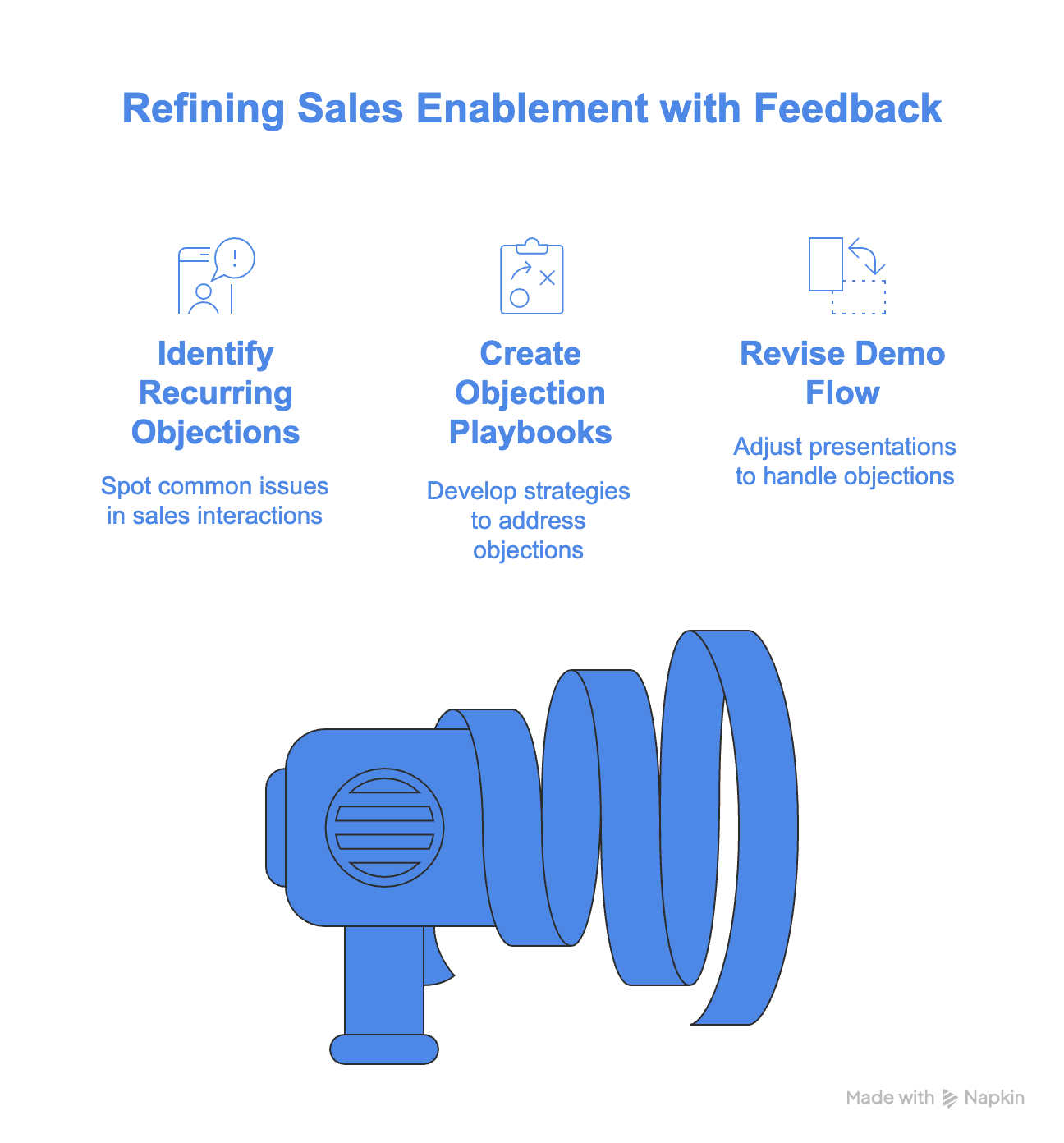
### **9. Continuously update ICPs and demo flows based on data**
Your ideal customer personas (ICPs) are not set in stone—neither are your demo flows. **Market conditions, buyer behavior, and product changes all affect how your team should position value.**
**Treat both ICPs and demos as living assets that evolve with what you’re learning from the field.** Use data from support transcripts, post-sale conversations, demo analytics, and win/loss analysis to keep your materials aligned with what buyers care about most.
#### **Example in Action**
A customer success team supporting a compliance platform for financial institutions notices a rise in questions about new AI regulations. After reviewing support transcripts, they identify a recurring need: prospects want to understand how the product helps them show that their risk models meet transparency and audit requirements. The team shares this insight with sales, who update their demo flows to focus on how the platform supports regulatory compliance.
## **Put Demo Control in the Hands of GTM With Demostack**
**Customer-led growth enables SaaS companies to connect with modern buyers by grounding go-to-market strategy in real customer behavior and feedback.** When sales, marketing, and customer success teams understand how buyers describe their problems and what they expect from a solution, it becomes easier to deliver messaging and demos that are relevant from the first touch.
**Demostack gives GTM teams full control over the demo experience.** Teams can create customized, live demo environments without relying on engineering and tailor each one to specific personas, use cases, or industries. The result is a consistent, scalable, and high-impact demo experience that reflects what buyers actually want to see.
**[Book a demo](https://www.demostack.com/win-more-deals-lp) with Demostack to see how it helps you turn customer insight into sales conversations that close.**
## Article: What is Presales Enablement, and How to Get it Right
Source: https://www.demostack.com/post/what-is-presales-enablement
B2B presales teams are busier than ever—and not always in the right ways. Many teams find that demo requests are piling up as technical validation becomes a non-negotiable part of the buying process. More volume, however, doesn't always mean better outcomes. Without a clear strategy in place, presales ends up reacting to this demand instead of guiding it—and that creates friction across the sales cycle.
Research shows that Solutions Engineers (SEs) are now delivering 40% more demos weekly year over year—yet 30 to 50% of those demos are unqualified. The increased volume shows a growing demand for technical validation but also highlights a lack of processes to prioritize demo requests. To scale effectively, companies need structured presales systems that help manage demand, improve demo readiness, and support a more strategic use of SE resources.
Presales enablement offers teams a better path forward. It provides the structure and support they need to keep up with growing deal complexity. When presales teams have the right tools and systems, they add real momentum to the sales cycle and create more consistent, confident buyer experiences.
## **What Is Presales Enablement?**
**Presales enablement equips technical sales teams with the tools, systems, content, and training they need to operate effectively across the sales cycle.** It ensures they're not starting from scratch every time a buyer needs to evaluate the product. **Instead, it standardizes how presales teams run demos, deliver technical proof, and handle product-level questions with confidence.**
While it's often grouped with sales enablement, the focus is fundamentally different. Sales enablement helps AEs deliver the pitch. **Presales enablement supports everything that happens when the conversation shifts to product depth—when buyers need to see how it works, ask the [presales engineer](https://www.demostack.com/post/12-questions-to-ask-a-presales-engineer-in-a-job-interview-) tough questions, or confirm that the proverbial shoe fits.**
**Presales is often the turning point in complex software sales. It's where buyers assess solutions to determine:**
- **Does it suit our needs and solve our pain points?**
- **Does it work within our business and technical environment?**
- **Do its features and benefits justify the investment?**
Without a strong presales enablement strategy, teams waste time creating materials and responding to ad hoc requests. With effective systems, they can operate more efficiently and directly contribute to revenue growth.
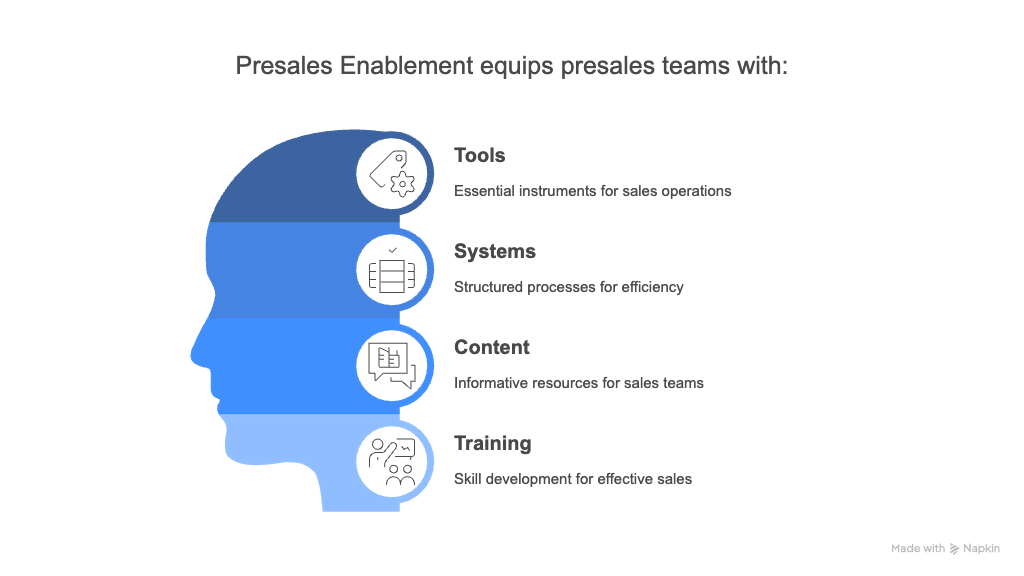
## **Benefits of Presales Enablement**
**Presales enablement provides many benefits, including:**
- **Increases Technical Win Rates -** With better preparation, presales teams can clearly demonstrate how the product meets buyer needs, which leads to more confident technical approvals.
- **Shortens Sales Cycles -** Standardized demo workflows and technical templates make it easier to respond quickly to requests, which reduces delays and keeps deals moving forward.
- **Boosts Presales Team Efficiency -** Reusable demos, content libraries, and [automation tools](https://yaballe.com/automated-dropshipping-tips-examples-and-best-practices/) reduce prep time and minimize repetitive work so presales can support more opportunities without overextending the team.
- **Improves Sales and Presales Alignment -** Shared demo assets and clearly defined processes improves [sales and presales alignment](https://www.demostack.com/post/aligning-sales-and-presales-to-deliver-winning-demos) during handoffs, which reduces confusion and creates a more consistent buyer experience.
**Enables Measurement and Coaching -** Tracking how demos and evaluations perform gives leaders a clear view of what's working and what's not—whether at the individual level or across the entire presales process. That visibility opens the door to continuous improvement over time.
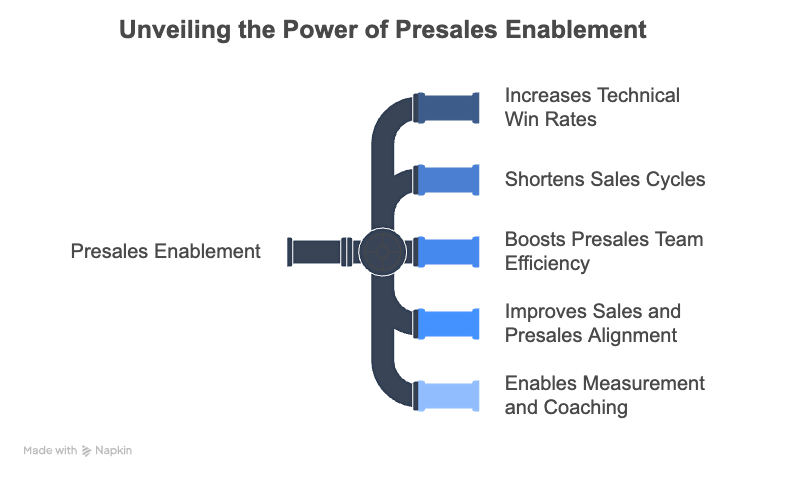
## **6 Core Components of a Strong Presales Enablement Strategy**
**Building a robust presales enablement strategy includes these foundational components:**
### **1. Demo Infrastructure**
**Demo infrastructure supports every technical touchpoint in the sales cycle. This includes stable environments, customizable workspaces, sandbox access, and automation tools that reduce manual setup.** Buyer-facing experiences—like self-guided tours or click-through demos—also play a growing role in qualifying interest before an SE is involved.
**Using a platform like Demostack is key to building this foundation. It helps presales teams deliver polished, consistent demos in multiple formats without pulling in engineering or having to recreate assets from scratch.**
### **2. Presales Content Library**
**Centralized content makes it easier for presales teams to deliver the right message at the right time. These assets include technical decks, product briefs, competitive responses, RFP templates, evaluation frameworks, and a demo library.** A robust library also supports personalization by including clear guidance on how to adjust demos or materials based on buyer role, industry, or use case.
### **3. Sales Collaboration Tools**
**Alignment between sales and presales teams starts with sharing systems. Playbooks, qualification frameworks, and structured feedback channels keep both teams aligned from discovery through close.** These tools help eliminate disconnects and keep the focus on the buyer experience.
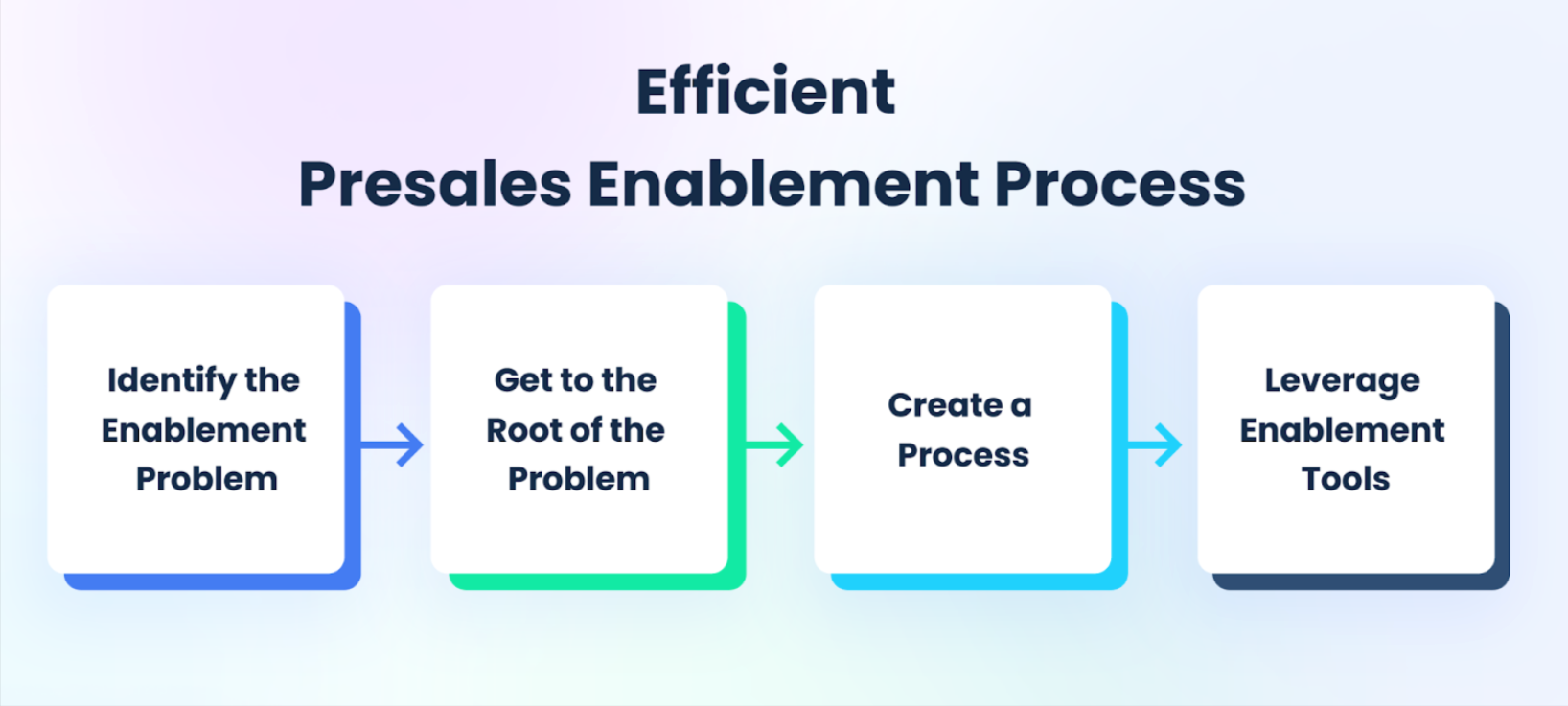
Caption: PreSkale
### **4. Knowledge Management**
**As an organization's presales team grows, critical information can become more challenging to access and reuse. A dedicated knowledge management system is crucial for capturing technical answers, past configurations, successful demo flows, and common objections.** This invaluable resource helps teams move faster and avoid duplication. It also preserves institutional knowledge that might otherwise be lost, deal to deal.
### **5. Training and Coaching**
**Effective presales enablement includes skill development. Onboarding programs help new team members ramp up quickly, while scenario-based practice and demo certifications provide experienced SEs with room to improve.** Ongoing coaching helps your team stay sharp as products evolve, and buyer expectations shift.
### **6. Performance Metrics and Insights**
Operational visibility helps teams improve and scale. **Tracking demo volume, time-to-demo, win rates, and engagement data gives presales leaders a focused picture of what's working. These insights support better coaching, smarter resource planning, and more strategic decision-making.**

### **5 Steps to Get Presales Enablement Right**
**Building an effective presales enablement strategy takes structure and the right systems to support your technical team's growing role in the sales cycle. Here's how to put a scalable program in place—and set it up for long-term impact:**
### **1. Start with Cross-Functional Alignment**
**Before investing in tools or content, get your sales and presales aligned on how they work together. Start the process with clear definitions of roles and responsibilities across the sales cycle, from discovery and qualification through demo delivery and technical validation.**
**Agree on shared KPIs, such as technical win rates or time-to-demo, and make sure both teams understand how their work connects.** Involve revenue leaders, sales enablement, and presales managers in these conversations to set expectations early—and avoid misalignment later.
### **2. Operationalize Demo Workflows**
Consistency is key when it comes to demo delivery. **Define standard demo formats for different use cases, such as first-call overviews, deep dives, or POCs. Automate as much of the prep as possible using advanced demo platforms that replicate environments, populate sample data, or streamline setup tasks.** Finally, equip your team for success with a library of ready-to-use demos that are easy to access and update.

### **3. Document and Scale What Works**
Every team has top performers and repeatable wins, but too often, that knowledge lives in slide decks, Slack threads, or individual inboxes. **Create a central space to capture what's working: demo scripts that resonate, technical validation responses, objection-handling techniques, and templates for POCs or evaluations. Make it easy for your team members to contribute and update content, and build processes that reward reuse instead of constantly reinventing the wheel.**
### **4. Invest in Continuous Training**
Great presales teams aren't built through one-time onboarding. They need training that's ongoing, practical, and closely tied to actual deal scenarios. **Your team's training should include mock demos, peer reviews, shadowing opportunities, and regular refreshers as your product evolves. Tie coaching back to observed performance—such as how SEs handle complex objections or run discovery-driven demos—and give teams space to practice before they're under pressure.**
### **5. Leverage the Right Technology**
**Technology is a critical layer in any presales enablement strategy—but only if it's solving the right problems. Start by mapping where your team's time is being lost:** Are SEs manually setting up environments? Searching for demo assets? Struggling to deliver consistent experiences?
**Look for gaps that create friction across the presales motion. Then, prioritize [presales tools](https://www.demostack.com/post/top-8-presales-software-solutions-for-2025) that remove blocks, reduce manual work, and help the team support more opportunities with less effort.**
This is especially true in complex, high-stakes industries like fintech, where buyer trust hinges on technical validation and where support from experienced fintech marketing agencies can complement presales efforts behind the scenes.
**From there, build a tech stack that supports how your team actually works. It should include**:
- **A platform for demo creation and delivery**
- **A centralized system for managing demo-ready content, technical documents, and supporting materials**
- **Basic analytics** that show how your presales activity influences the pipeline.
Keep the stack lean but purposeful—every tool should give time back to the team or help leadership make smarter decisions. **Choosing tools like Demostack that bring multiple needs together in a single platform makes it easier to scale presales without sacrificing quality or speed.**
## **Build a Revenue-driving Presales Engine**
**Presales now plays a central role in how complex software is evaluated and sold. Buyers want to see how the product works, understand how it fits into their environment, and decide whether it can solve the problems they care about.** **Presales enablement gives your technical teams the tools and structure to meet those expectations with confidence.** It turns demo delivery, technical validation, and product conversations into a repeatable engine that wins more deals faster.
**Demostack plays a key role in making that shift possible. It allows presales teams to create and update demos without engineering support, tailor product flows for different use cases, and track how prospects engage with demos in both live and async formats.** The platform also supports sandbox-style evaluations through fully interactive demo environments without requiring live product infrastructure, which gives buyers a more engaging hands-on experience. **With Demostack, teams can show your solution's value more effectively and deliver high-impact demos at scale.**
**To start building a presales engine that drives revenue, [book a Demostack demo](https://www.demostack.com/win-more-deals-lp) today.**
## Article: Selling transportation logistics software? Your demo could be costing you deals\.
Source: https://www.demostack.com/post/selling-transportation-logistics-software-your-demo-could-be-costing-you-deals
Transportation and logistics software is built for efficiency, automation, and real-time data. But when it comes to selling it? That’s another story.
Your buyers don’t just want features—they need proof. Real data. Seamless TMS and telematics integrations. Confidence that your platform actually works in their day-to-day operations.
So where do the problems start?
Live demos are risky. They can expose sensitive data, break down at the worst possible moment, or fail to adequately show that your product integrations work. Instead of building confidence, they slow down deals and create doubt. Your prospects don’t have time for that—and neither does your GTM team.
So, how do you fix this? Let’s break it down.
## **Your Integration Demo Fails**
Imagine this: You’re on a demo call with a major freight carrier. They’ve told you upfront—TMS integration is a dealbreaker. You sales people confidently click through the workflow, ready to prove it works.
Then—error message.
Most T&L solutions rely on complex integrations with:
- TMS—Routing, dispatch, and load planning
- Telematics & IoT—GPS tracking, vehicle diagnostics, driver safety monitoring
- ERP & Finance Systems—Billing, invoicing, and procurement
Live demos depend on real-time connections, making them fragile and unpredictable. A single API failure, slow sync, or missing data can kill confidence—and the deal.
✅ Our suggested fix : A pre-configured, integration-ready demo environment that proves compatibility without relying on unstable live connections.
## **Your Live Software Product Demo Hiccups**
Imagine this: Halfway through a demo with a 3PL, everything is going smoothly—until you click on a key feature. Loading… still loading… then nothing.
When this happens, you risk losing credibility. And the prospect starts to wonder: _If the demo isn’t working now on this sales call, how will it perform when we are live? Am I willing to take that risk?_
The challenge with live demos:
- Broken workflows—Outdated data or system errors interrupt key user flows.
- Glitches & downtime—Unstable environments make your product look unreliable.
- Inconsistent experiences—Your sales team struggles to replicate the same polished story every time.
✅ **Our suggested fix:** A cloned demo environment that performs exactly like your live product but removes live system dependencies—so every demo runs smoothly, every time.
## **SE Backlog is Causing Delays**
Imagine this: You just wrapped a strong discovery call with a fleet operator who’s ready to see the product. They want a demo—tomorrow.
But there’s a hitch. Your SEs have very limited bandwidth (or you are behind on headcount) and can’t customize a demo for days.
How this causes issues:
- Longer sales cycles – Deals stall when GTM teams can’t run demos without expert support.
- Missed momentum – Buyer urgency fades when low SE bandwidth causes delays.
- Overloaded SEs – SEs get stretched thin, burn out, leave, and additionally the velocity in your sales cycle slows down.
✅ **Our suggested fix:** Give your AEs foolproof, ready-to-go demo environments with built-in guardrails—so they can confidently deliver tailored demos without waiting on SEs or engineering.
## **Their Prospect Wants to Try Before They Buy**
Imagine this: You’ve delivered a solid demo. Now the prospect wants to try it out for themselves with sales.
Uh oh! You don’t have a quick or safe way to share the environment. You could create a POC, but that typically takes weeks to scope and set up.
The problem with traditional demos:
- No safe way to share – Prospects can’t explore your product or test workflows on their own.
- Internal buy-in stalls – Champions can’t share the demo with other stakeholders in their org.
- POCs are costly and slow – Setting one up takes time, resources, and coordination.
✅ **Our suggested fix:** Deliver an interactive sandbox demo that gives buyers hands-on access—without the overhead of a POC. Let them click through guided key workflows, explore on their own time, and loop in others to build internal buy-in faster.
## **How Top T&L Tech Companies Are Solving This Problem Today**
To stay ahead of competition, many transportation and logistics software companies are supplementing their live demos with purpose-built environments that tell a strong product story—without the technical baggage and typical complications that slow down sales cycles.
With Demostack customers in this space, they’re removing roadblocks from their demo process—no more broken environments, missed moments, or waiting on overworked SEs. It gives their GTM teams the ability to deliver consistent, tailored demos that show real value from the very first call.
**No More Broken Demos**
Cloned demo environments look and feel like your real product—but they don’t rely on live systems, fake data, or APIs. That means no exposed PII, no crashes, and no awkward surprises during a live call with your prospect or any sort of live presentation.
### **AEs Can Run with It**
Sellers don’t have to wait for SEs or engineers to step in. With customizable demo templates built with guardrails in place, they can confidently show key workflows and integrations—tailored to the buyer, from the very first call.
### **Buyers Can Click Around**
Prospects get a hands-on sandbox where they can explore the product after the demo. It’s a simple, effective way to keep momentum going without having to spin up a full POC.
### **Show Integrations That Just Work**
TMS, telematics, ERP—buyers need to see that your platform fits into their world. With Demostack, you can show integrations in action without waiting on engineering to make it happen.
Demostack helps T&L companies demo with confidence - reducing risk, increasing speed, and improving conversion rates. Want to see how it can help you?? [Talk to us](https://www.demostack.com/win-more-deals-lp), we are here to help!
## Article: Why Your AEs Ramp Too Slowly—and How to Fix It
Source: https://www.demostack.com/post/why-your-aes-ramp-too-slowlyand-how-to-fix-it
You hire a sales rep. You’re both ready to go and get logos through the door. But then you hit a roadblock. The ramp time is slower than it should be—and if you don’t do something about it, you’ll keep losing out on revenue.
For most SaaS companies, getting new sellers fully ramped is a long game.
The excuses are predictable:_“Our product is too complex.”“It just takes time to learn how the product works.”“We let SEs handle the demo.”_
But let’s be real: if it takes more than 6 months for a seller to confidently show your product, explain how it solves real problems, and tailor the story to different buyers—something is broken. And that’s not ramp. That’s runway. And it’s burning fast.
The real gap here isn’t knowledge. It’s not motivation. It’s product fluency. If your sellers still don’t have it 6 months into the job, the problem most likely isn’t them. It’s how you’re enabling them..
It’s time to rethink how you onboard, train, and certify new reps.
## **What’s Really Slowing Sellers Down**
Your reps might know the pitch. They’ve seen the decks. They’ve even sat in on live demos. But when it’s time for them to explain how the product actually works, they turn right to the SE. And to be fair, that’s often what the SE expects – for the AE to be the intro to the call.
Here’s why:
1. **They don’t get hands-on.** Watching demos doesn’t build fluency. If reps don’t have a safe, guided environment to explore the product on their own, they’ll never internalize how it works—or how to talk about it. Without space to play, break things, and practice, learning stays surface-level.
2. **Enablement stays surface-level.** Sales training often covers messaging and value props—but skips over how the product delivers that value. And when enablement lacks the tools to go deeper, reps are left guessing what buttons to push or what stories to tell.
3. **They learn to rely on someone else.** If every interaction with the product requires an SE, a sandbox request, or an engineer’s help, reps never build confidence—or trust with the prospective buyer. That’s not enablement. That’s a handoff. And it reinforces a culture of “someone else will show it.”
4. **The product environment isn’t built for learning.** Reps might get access to the product, but most environments aren’t designed to teach. They’re cluttered, unstructured, and way too complicated to show what the product can do. Without a clear path to explore key workflows, reps end up guessing instead of learning.
## **The Crawl–Walk–Run Approach to Product Fluency**
The fastest-ramping sales teams don’t just hand reps a pitch deck and hope for the best. They take a structured, hands-on approach to product enablement. When you break product enablement down to three stages, **Crawl–Walk–Run**, reps learn faster when they can explore, practice, and apply what they’re learning in the product itself.
**Crawl: Introduce the story**
Early on, reps need a way to understand the product’s purpose, the personas it serves, and the value behind each key feature—without dwelling on login screens and home dashboards. The goal at this stage is orientation, not depth.
This is where **interactive product tours** or guided demos are very useful. They walk reps through specific workflows (like onboarding a user or completing a task) in a linear, controlled path—no clicking around required. Combined with narrated demo videos or walkthroughs from top sellers, they give new reps the context they need to start connecting the dots.
## **Walk: Learn by doing**
Once reps know the what and the why, they need to get their hands on the how. But instead of dumping them into a cluttered environment that may lack the latest features, the best teams give them access to **sandboxed demo environments**—safe, pre-sequenced versions of the product designed for learning.
This is where product fluency starts to take root. Reps explore key flows at their own pace. They practice showing features, click through common user paths, and rehearse talking points without fear of breaking something—or going off-script.
## **Run: Apply and certify**
With product context and hands-on experience under their belt, reps are ready to apply what they’ve learned. Here, the demo environment shifts from a practice tool to a proving ground. You’re not looking for perfection—you’re building confidence and repeatability.
This might look like:
- Recording a sample demo using a sandbox
- Personalizing a use-case walkthrough with dummy data
- Walking through a realistic product scenario in a mock call
- Getting certified on core flows
## **Case Study: How Motive Turned Demo Enablement on Its Head**
Most of Motive’s sellers couldn’t confidently demo the product on their own. They leaned heavily on SEs, spent hours prepping examples, and lacked a consistent, repeatable way to tell the product story. To fix that, Motive rebuilt demo enablement from the ground up.
First, they created a safe, standalone demo environment that replicated their live platform—no PII, no backend issues, and no surprises. Reps could explore workflows, rehearse talk tracks, and build confidence without needing engineering support or hours of prep.
Next, they rolled out a Crawl–Walk–Run certification track. Every new seller completed a progression of guided tours, sandbox walkthroughs, and personalized demo recordings—all within their first 30 days.
And to keep it engaging? They introduced a “Beat the Boss” challenge, where reps competed in a March Madness-style bracket to deliver the best demo—including a showdown with their CEO.
The impact:
- **+15%** lift in trial conversions
- **+10%** improvement in win rates
- A team of sellers who could confidently show product—without waiting on SEs
“To be honest, when this was first assigned, I was a bit apprehensive. But the preparation really helped me gain a much deeper understanding of the product. It also gave me valuable insights on how to pitch the product more effectively and smoothly—and helped me get more familiar with the demo click path.”— _Enterprise AE at Motive_
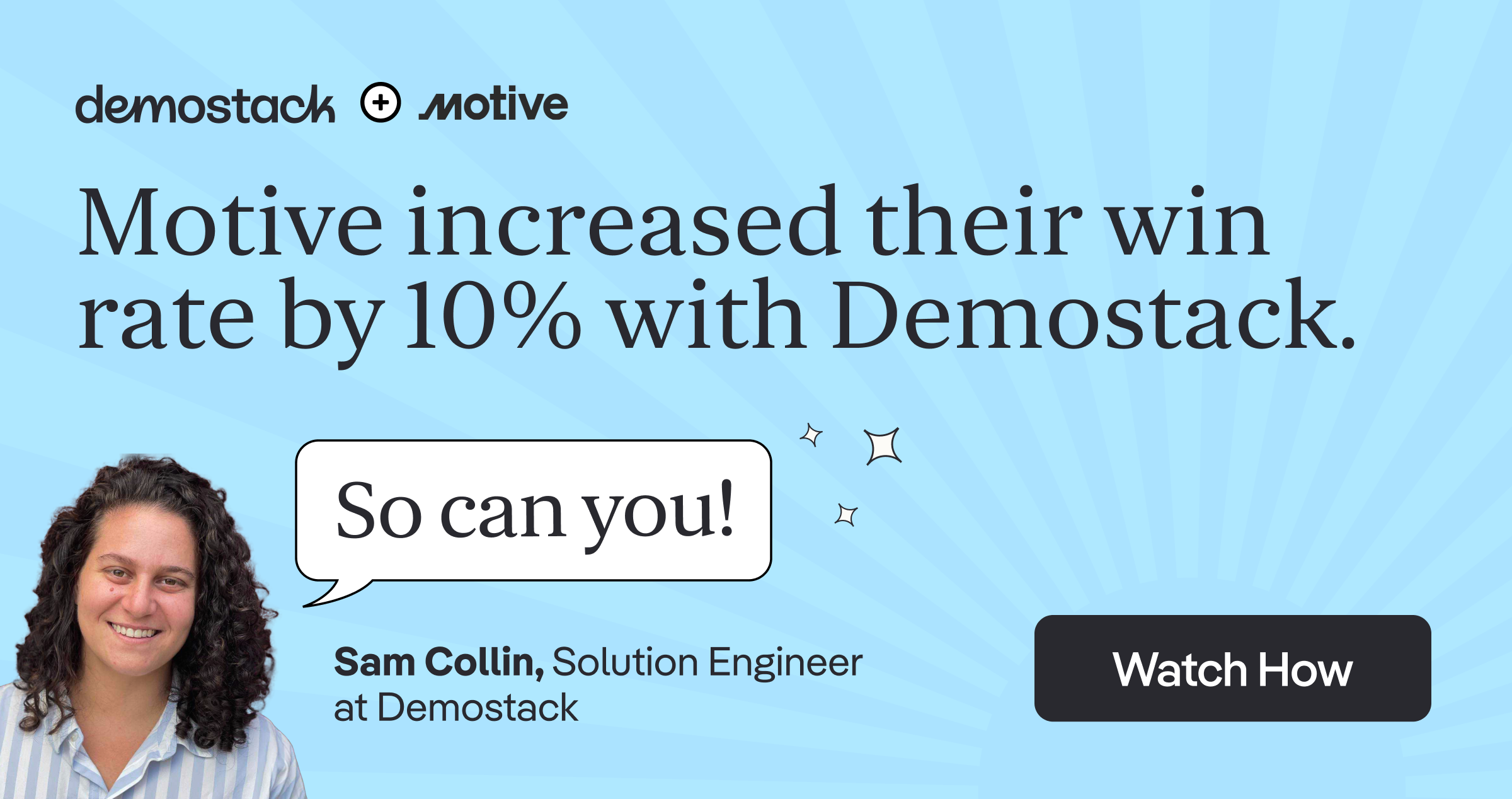
Link: https://www.demostack.com/webinar/mastering-the-art-of-demos-with-motive
## **Final Takeaway: Software Product Demos Aren’t Just for Buyers**
Most teams treat demos only as sales tools. But the best teams also use them for something very powerful: training.
Product tours, sandboxes, and demo environments aren’t just for live calls—they’re how you teach reps what the product _actually_ does, how it solves problems, and how to tell that story with confidence.
Because if your sellers can’t explore the product safely, practice the narrative, and build fluency on their own… they’re not enabled. They’re just waiting for someone else to show it.
Link: https://www.demostack.com/guide/how-to-build-cybersecurity-buyer-trust-with-product-demos
## Article: Solution Selling: The Essential Sales Guide
Source: https://www.demostack.com/post/solution-selling-the-essential-sales-guide
## **Solution Selling: The Essential Sales Guide**
Problem-solving is at the core of every business decision. Whether your prospects need to optimize an internal process, cover gaps in the user journey, or improve a product feature, they will show interest in a new product or service only when and if it fills an existing gap.
As a salesperson, the premise sounds simple: showcase how your product fills this gap. But the reality isn't quite as straightforward. In a study of B2B buyers by Gartner, 77% say their latest purchase was either "difficult" or "very complex." As a result, 75% now prefer a rep-free sales experience.
**Solution selling can make your sales journey smoother and more positive. By shifting the spotlight from what you have to offer to what your prospects have to gain, you make every interaction more meaningful and relevant.**
## **What Does Solution Selling Mean, Exactly?**
The solution selling sales methodology focuses on your prospects' needs and pain points. It involves positioning your sales approach so you're not just selling a generic product with various use cases and benefits (and hoping one is relevant to your prospect) but instead offering a clear vision of how the product solves a specific problem. The focus shifts from what you're selling to how it can help your prospect.
**The key to the [solution selling methodology](https://www.demostack.com/post/the-8-components-of-the-solution-selling-methodology) is a deep understanding of your prospect's needs, followed by tailored guidance and recommendations on how your solution (or even a feature within your broader offering) can help fulfill them.**
B2B teams are busy; they don't have time to hear generic claims about how you're the best in the market or sift through a laundry list of irrelevant features. A solution-selling approach can make your sales interactions more effective and engaging by pinpointing where and explaining how your product adds value.
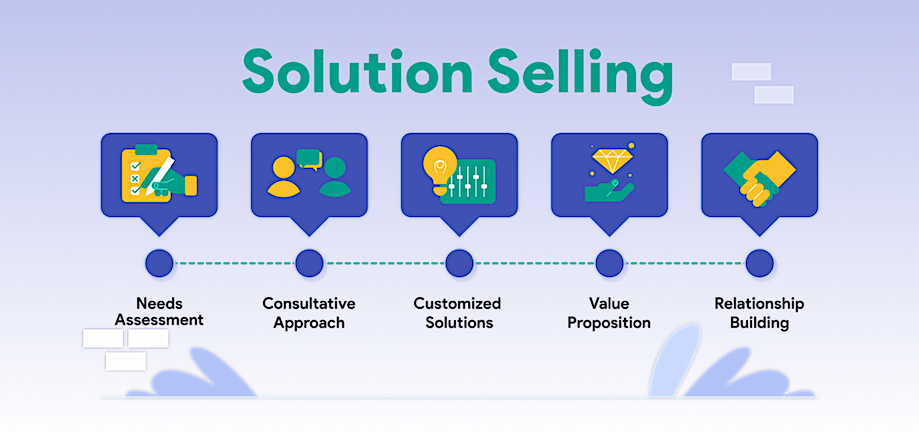
Caption: Streak
## **When to Use Solution Selling**
There are certain types of customers and instances where solution selling works best and when it doesn’t:
### **Prospects Aware of Their Problem**
Firstly, it's best if your prospect is already aware of their problem and is either actively seeking a solution or open to exploring new avenues to fix it.
### **Unique Needs That Off-the-Shelf Solutions Can't Address**
This sales methodology is useful if your prospect has a unique need that off-the-shelf solutions can't address.
Suppose you're selling software for commercial property management, and your prospect is concerned with weather-related risks. With a solution-selling approach, you can demonstrate how your platform can be customized to include real-time weather data or automated response triggers—directly addressing their needs and setting yourself apart from competitors.
### **Highly Complex Products with Varied Features**
Solution selling is also suitable for highly complex products that offer a varied range of features.
**Imagine you are selling an end-to-end cybersecurity solution with advanced threat detection, endpoint protection, and data encryption features. However, your prospect is primarily concerned with data security. By focusing on your data encryption capabilities, you can effectively demonstrate your value without overwhelming the prospect with unnecessary details.**
### **When Solution Selling May Not Work**
However, solution selling doesn't work well in all scenarios. For example, if companies aren't aware of their needs, have conflicting priorities, or there is a misalignment between departments, you may struggle to define a specific problem to solve.
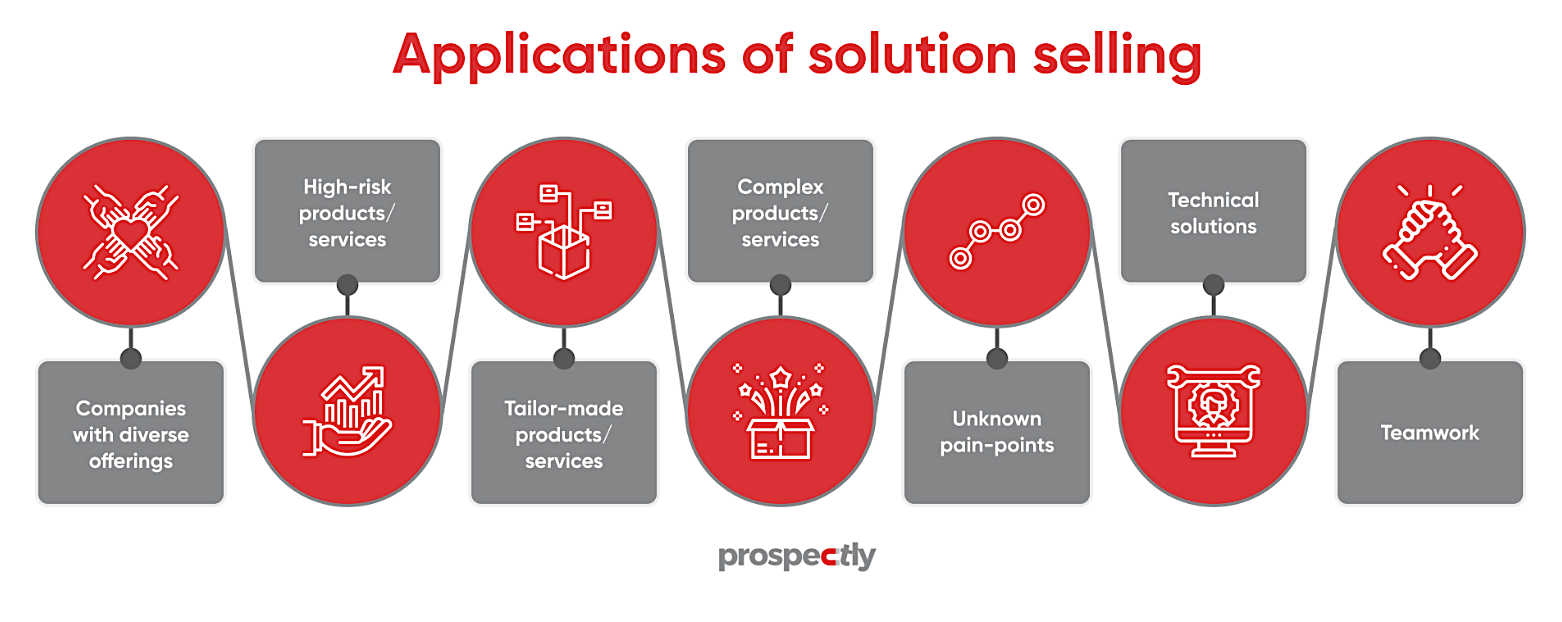
Caption: Prospectly
## **What Are the Pros and Cons of Solution Selling?**
[Innovative sales methodologies](https://www.demostack.com/post/7-innovative-sales-methodologies-that-move-the-needle) don't work in every situation or for every prospect. Therefore, it's essential to consider where solution selling may fall short and where it provides the most value. Here are the most common pros and cons of this methodology:
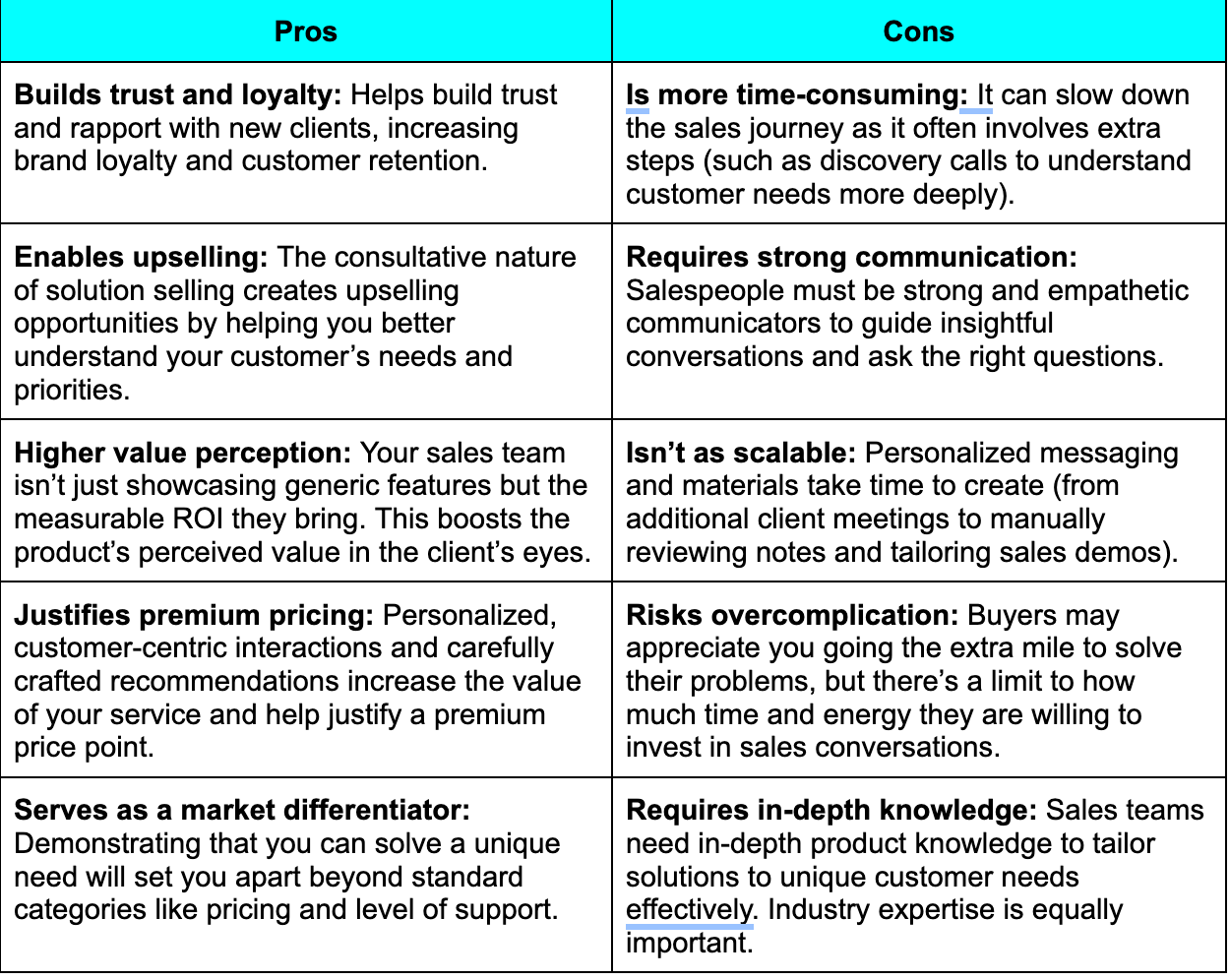
## **7 Steps to Effective Solution Selling**
### **1. Do Your Research**
The first few interactions with your prospect are crucial for establishing credibility and showing that you care. Before proceeding further in the sales process, research the company, who you may speak with, and recent industry trends that could impact the company's operations or business goals.
**While you will likely have various opportunities to ask questions about the prospect and their needs at later stages, first impressions matter, and you must show expertise from the get-go.**
### **2. Build Rapport and Trust**
Great salespeople need more than excellent communication skills—they need the ability to empathize and connect with people on a deeper level. To build a deeper rapport and trust with your prospects, approach them with a friendly tone and show interest in learning more about their role, priorities, needs, and goals.
**Avoid starting conversations with a sales pitch or boasting about your product on inopportune occasions. Solution selling is all about building strong client relationships and delivering value beyond a product, so your interactions should be human-centered.**
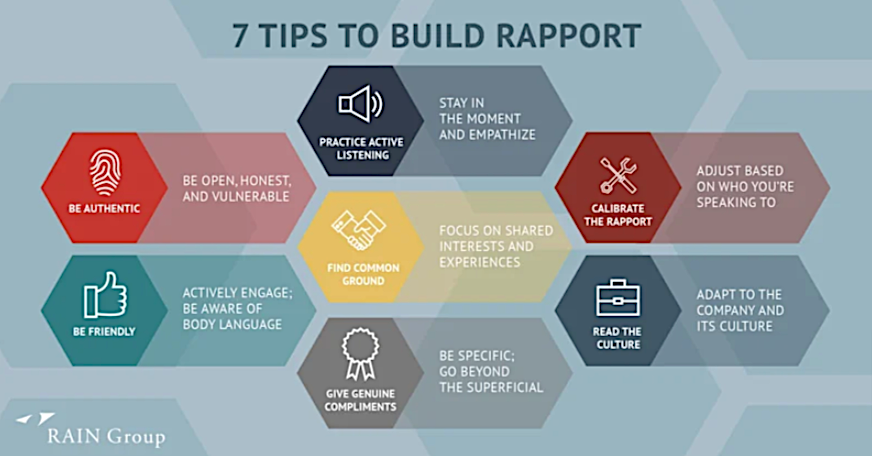
Caption: Rain Group
### **3. Ask Insightful Questions**
Don't fall into the trap of asking for timelines and budgets before understanding what your prospect is trying to achieve. Book a meeting with your prospect to discuss current challenges and goals, and start with open-ended discovery questions that can reveal their pain points and desired outcomes.
For example, you may want to ask:
- **What are your biggest challenges as a business?**
- **How is this particular challenge affecting day-to-day operations?**
- **How are you dealing with it right now?**
- **What would be the key limitations and constraints to be aware of?**
- **How do you envision the ideal solution to this challenge?**
- **What experience do you hope to offer users with this solution?**
- **How would you measure the success of this solution?**
### **4. Identify and Confirm the Problem**
At this stage, you can gather with your team, revisit meeting notes and key communications, and identify your prospect's main challenge. You can also map out any barriers your client has faced when tackling this challenge, especially if your product helps break them.
**Before spending more time and effort developing personalized materials, confirm with the prospect that your assumptions are accurate and that you are heading in the right direction. Ensuring mutual understanding will help avoid friction in future meetings and prevent planting any seeds of doubt in your prospect's mind.**
### **5. Present a Tailored Solution**
Now is the time to let your expert product knowledge shine. Present a tailored solution, showcasing the features and customization capabilities relevant to your prospect's problem. To make your pitch more engaging, [create a demo video](https://www.demostack.com/post/how-to-create-a-software-demo-video-in-7-simple-steps) or deliver a live demo that illustrates, step by step, how your product addresses their unique needs.
**Demostack can help you significantly speed up this process and, importantly, improve the quality of your demos. With Demostack, you can quickly personalize demos with new images, text, and even charts and data so that all information is relevant to your prospect's background, needs, and goals.**
After the demo, consider sharing other case studies or marketing materials. For example, you could share a webinar tutorial you recently conducted in partnership with a client or a successful client story on your website.
### **6. Quantify the Value**
You are selling a vision, but executives care about numbers, too. That's why you must remind them of the value your product adds. So, what exactly is in it for them? It could be a 20% ROI in upselling and new sales opportunities, time savings, and team efficiency, or the potential to reach an entirely new market.
**The key is to focus on the impacts your prospect cares about the most. Using Demostack for your interactive and personalized demos, you can get real-time engagement analytics showing what features and messaging resonated with your prospect the most. This is invaluable information to build a strong case for your product.**
### **7. Follow Up Strategically**
B2B sales cycles are notoriously long, so your salespeople are likely used to waiting for responses. But staying silent isn't a strategy. Keep communication alive by reaching out to your prospect at a reasonable frequency. While it isn't a magic formula, the **3x3x3 method** (following up three times, with three days between each follow-up and using three different channels) is widely used.
**Beyond the frequency of communications, you should review the quality and relevance of every interaction, such as your product demos. You can leverage Demostack's demo analytics to tailor your follow-ups to be as effective as possible, addressing any concerns and building trust in your product.**
Lastly, ensure your efforts are aligned with your marketing team so they can tailor their email marketing campaigns to convey the right message at the right time.
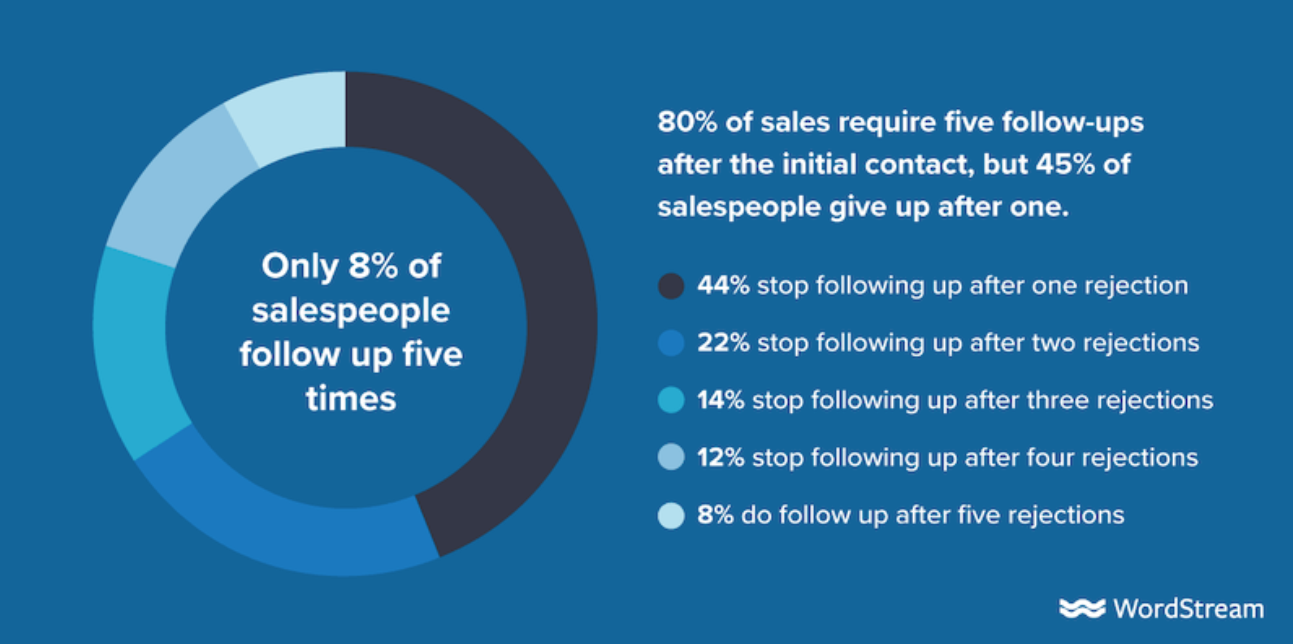
Caption: WordStream
## **Show, Don’t Tell: How Sales Demos Help Seal The Deal**
B2B buyers aren't interested in what you offer unless it benefits them and solves their problems. That's why solution selling is as effective now as in 1975 when it was first introduced. Successful solution selling requires both in-depth product knowledge and the right sales tools.
A robust sales enablement platform like Demostack helps you bring the solution you're selling to life with interactive and personalized demos. Your sales teams can embed prospect details like company name, revenue, and pain points to spin up fresh, personalized demos in seconds.
Plus, you can provide a customized sandbox environment that features your most relevant capabilities so your prospect can try them out. Instead of having your engineering team waste precious time altering these environments, the platform lets your sales team do this easily and quickly for every new prospect.
**[Book a demo today](https://www.demostack.com) to see how Demostack helps you focus on what really matters to your customers—and seal the deal faster.**
## Article: Top 8 Presales Software Solutions for 2025
Source: https://www.demostack.com/post/top-8-presales-software-solutions-for-2025
When selling B2B software, the presales process is critical in bridging the gap between complex products and prospective buyers. But today, presales engineers face increasing demands. Delivering high-impact demos, managing technical complexities, and meeting tight deadlines—often with limited resources—are just the start.
Add in the pressure to stand out in a competitive market, and it's easy to see how common challenges like time-consuming prep, inconsistent demo quality, and lack of collaboration tools can quickly become roadblocks. Fortunately, presales teams have help from presales software solutions.
These tools directly address the pain points presales teams face by streamlining workflows, automating repetitive tasks, and enabling tailored, consistent buyer interactions—all while freeing up time to focus on value-driven engagements. It's no surprise that the presales software market is growing rapidly, with industry reports forecasting a significant expansion from $94 Billion in 2023 to $179.24 Billion by 2031.
Whether you're looking to improve efficiency, boost collaboration, or deliver flawless demos, these tools can make an immediate impact. Let's take a closer look at the top eight presales software solutions for 2025.
## **What Are Presales Software Solutions?**
**Presales software solutions are tools designed to support presales engineers—the technical experts responsible for connecting a company's product to its prospective buyers. These professionals create customized product demos, answer technical questions, and help prospects understand how a solution meets their specific needs.**
The presales process is critical to building clarity, trust, and confidence during key moments in the sales journey. It's a challenging role. Presales engineers must manage tight deadlines, complex product configurations, and high expectations from both prospects and sales teams. Without the right software tools, ensuring demo consistency, personalizing presentations, and collaborating with other teams can feel like an uphill battle.
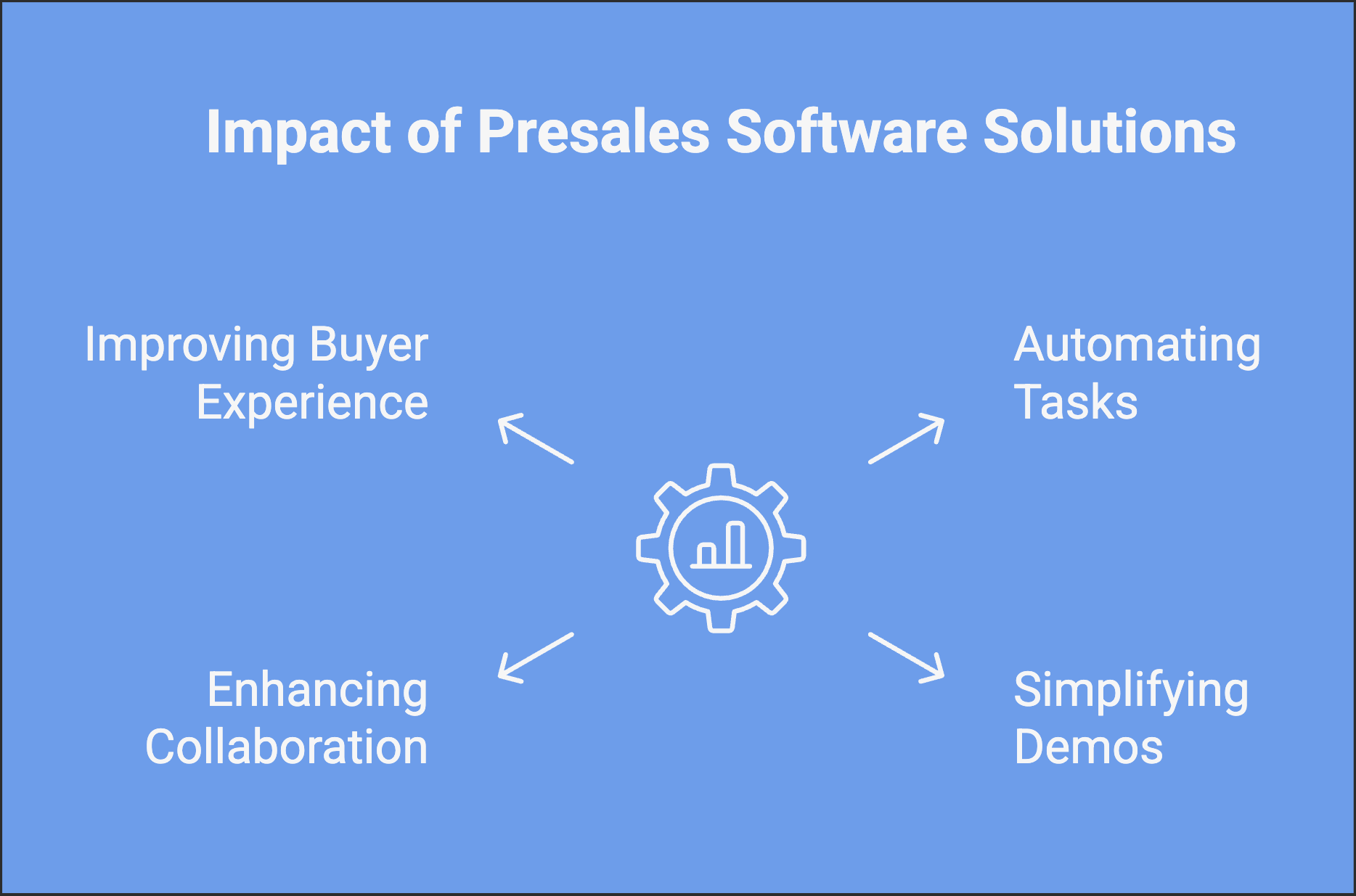
**Presales software tools change the game by automating repetitive tasks, simplifying demo preparation, and [aligning team collaboration](https://www.demostack.com/post/aligning-sales-and-presales-to-deliver-winning-demos) to give presales engineers more time to focus on delivering meaningful, impactful interactions.**
Features like customizable demos, guided tours, and analytics help create seamless, high-quality buyer experiences while reducing the strain on busy teams. These solutions are essential for presales professionals who need to meet the demands of today's B2B sales environment.
## **Types of Presales Software Solutions**
Presales software solutions come in several types, with each designed to address specific aspects of the presales process:
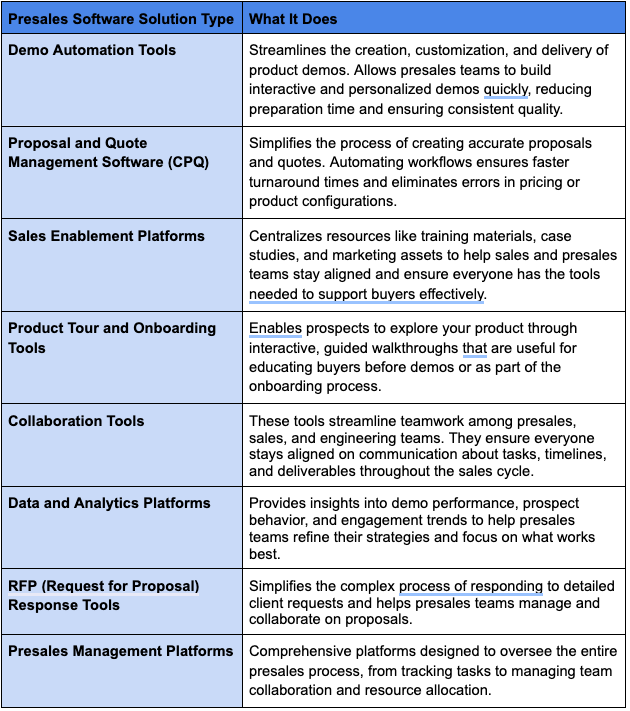
## **Benefits of Presales Software Solutions**
Presales software solutions solve key challenges across the entire presales process, including:
- **Saves Time Across Tasks -** Automation tools streamline repetitive activities like proposal and demo preparation, which allows teams to focus on strategic problem-solving and prospect engagement.
- **Improves Solution Accuracy -** Tools like CPQ software reduce errors and delays by ensuring that quotes, configurations, and proposals are precise and tailored to each prospect's requirements.
- **Enhances Collaboration -** Centralized tools enable teams to stay aligned and work efficiently throughout the [sales process](https://www.demostack.com/post/sales-process-flowchart-7-steps-to-an-airtight-pipeline) by improving communication and resource sharing.
- **Boosts Buyer Understanding -** From demos to interactive product tours, presales tools provide engaging, personalized experiences that help prospects see how solutions meet their unique needs.
- **Comprehensive Analytics -** Many types of presales software—including demo automation and proposal tools—include analytics that helps teams analyze buyer behavior, measure engagement, and refine their strategies.
## **Key Features of Presales Software Solutions**
Here are the key features to look for when choosing presales software solutions for your team:
### **Automation Capabilities**
Automation features should handle repetitive tasks such as demo environment setup, proposal creation, and RFP responses. These features save time, ensure accuracy, and reduce the need for manual intervention, which allows presales engineers to focus on higher-value activities.
### **Customization Options**
Effective presales software allows you to customize demos, proposals, and [product tours](https://www.demostack.com/post/6-product-tour-examples-that-boost-usage) to meet the unique requirements of individual prospects. Customization ensures that your deliverables are relevant, resonate with the buyer's needs, and highlight the product's value in a way that boilerplate presentations cannot.
### **Seamless Collaboration Tools**
Presales engineers often work across teams, so any presales software solutions must support easy collaboration with sales, engineering, and marketing. Features like centralized resource sharing, task tracking, and real-time updates ensure smoother workflows and increased interdepartmental alignment.
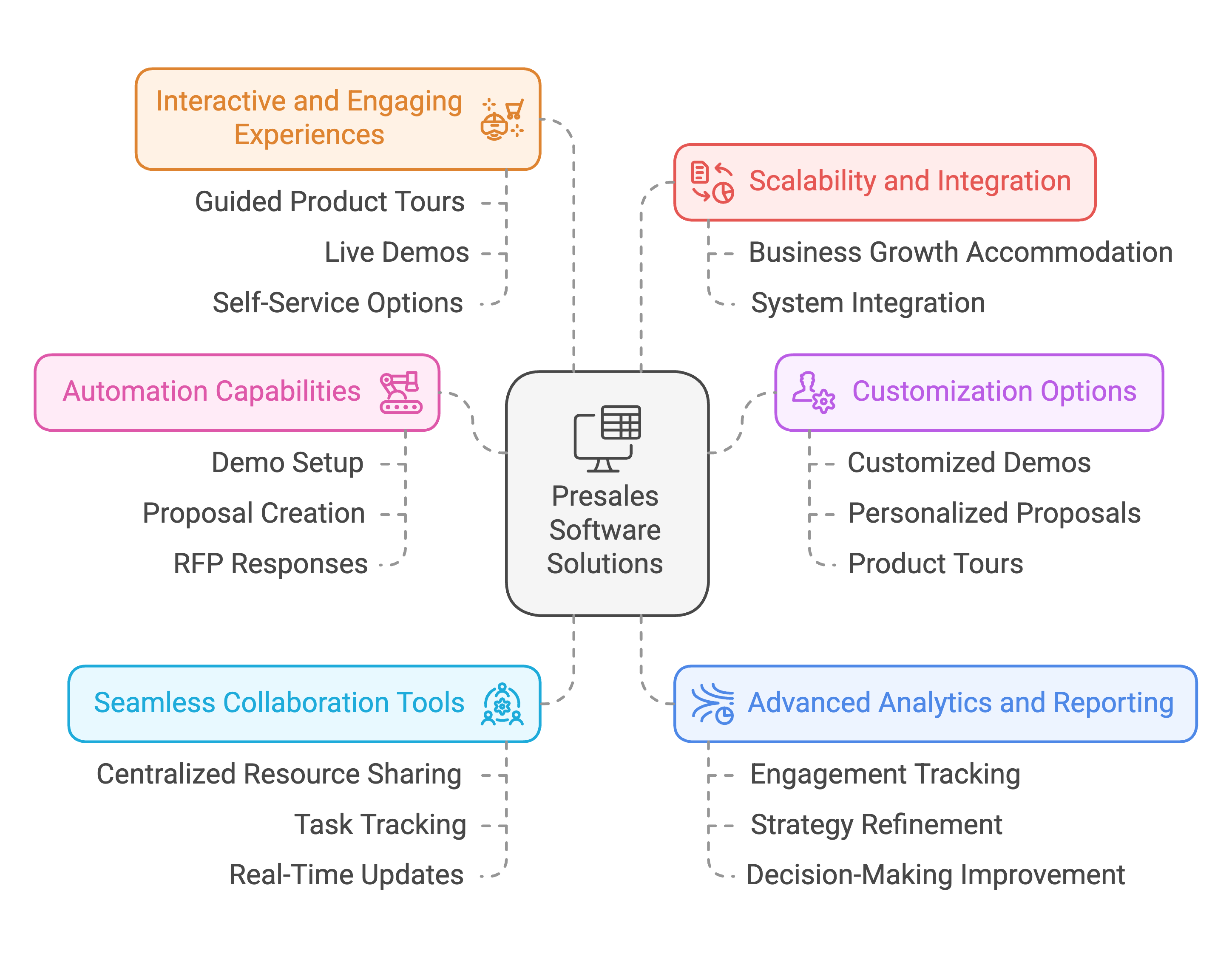
### **Advanced Analytics and Reporting**
Robust analytics capabilities should track engagement with demos, proposals, and other deliverables. These insights help teams identify what resonates with buyers, refine strategies, and improve decision-making. Integration with your CRM ensures a more comprehensive view of the sales process.
### **Scalability and Integration**
Presales software should be scalable to accommodate business growth and evolving needs. It must integrate seamlessly with existing systems, such as CRMs or CPQ tools, to avoid disruptions and maintain consistency across workflows.
### **Interactive and Engaging Experiences**
Features like guided product tours, live demos, and self-service options provide interactive experiences that capture buyer attention, allow prospects to explore the product at their own pace, and get a better understanding of its key features and benefits.
## **Top 8 Presales Software Solutions**
##### **Demo Automation Tools**
### **1. [Demostack](https://www.demostack.com/)**
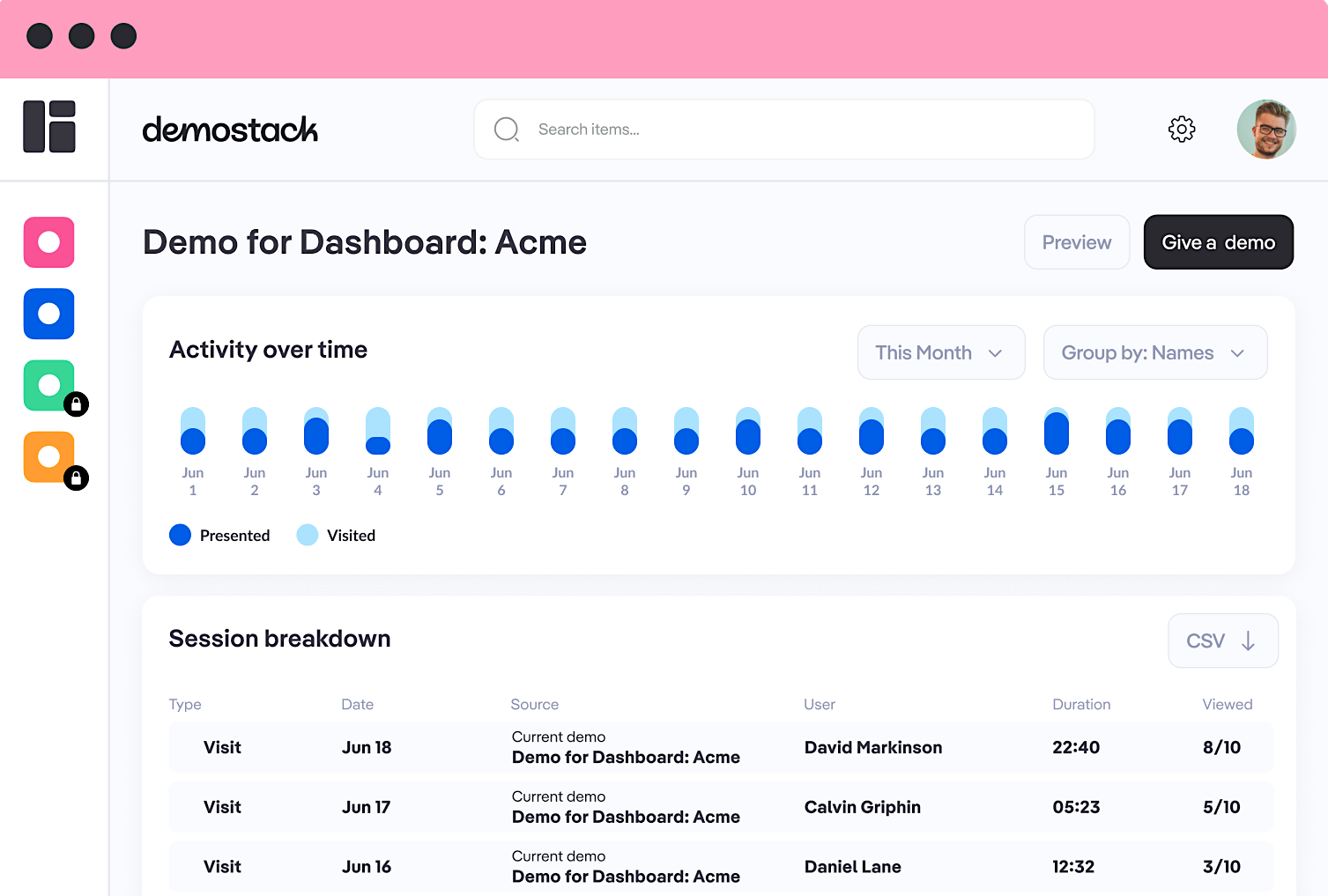
**Demostack** simplifies demo creation and delivery by empowering presales engineers to build tailored, interactive demos without relying on engineering resources. Its platform enables demo customization to suit specific buyer needs. You can even share product sandboxes that send real-time alerts when buyers interact with them to keep the conversation going after the initial call ends.
Demostack also boasts in-depth analytics that provide insights into buyer engagement. The platform's guided tours and seamless CRM integrations streamline workflows, while its AI-powered personalization helps demos reflect your prospect's real-world scenarios. Demostack saves time, ensures demo consistency, and enhances buyer experiences at every stage of the sales process.
**Best for:** Creating personalized, data-driven demos efficiently and without needing technical knowledge.
**Price:** Contact Demostack for a custom quote. A free demo is available.
**Review:** _“In the end, you get a demo experience that is almost the same as the original environment, and for me, that's why Demostack are the winners.”_
##### **Proposal and Quote Management Software (CPQ)**
### **2. Salesforce CPQ**
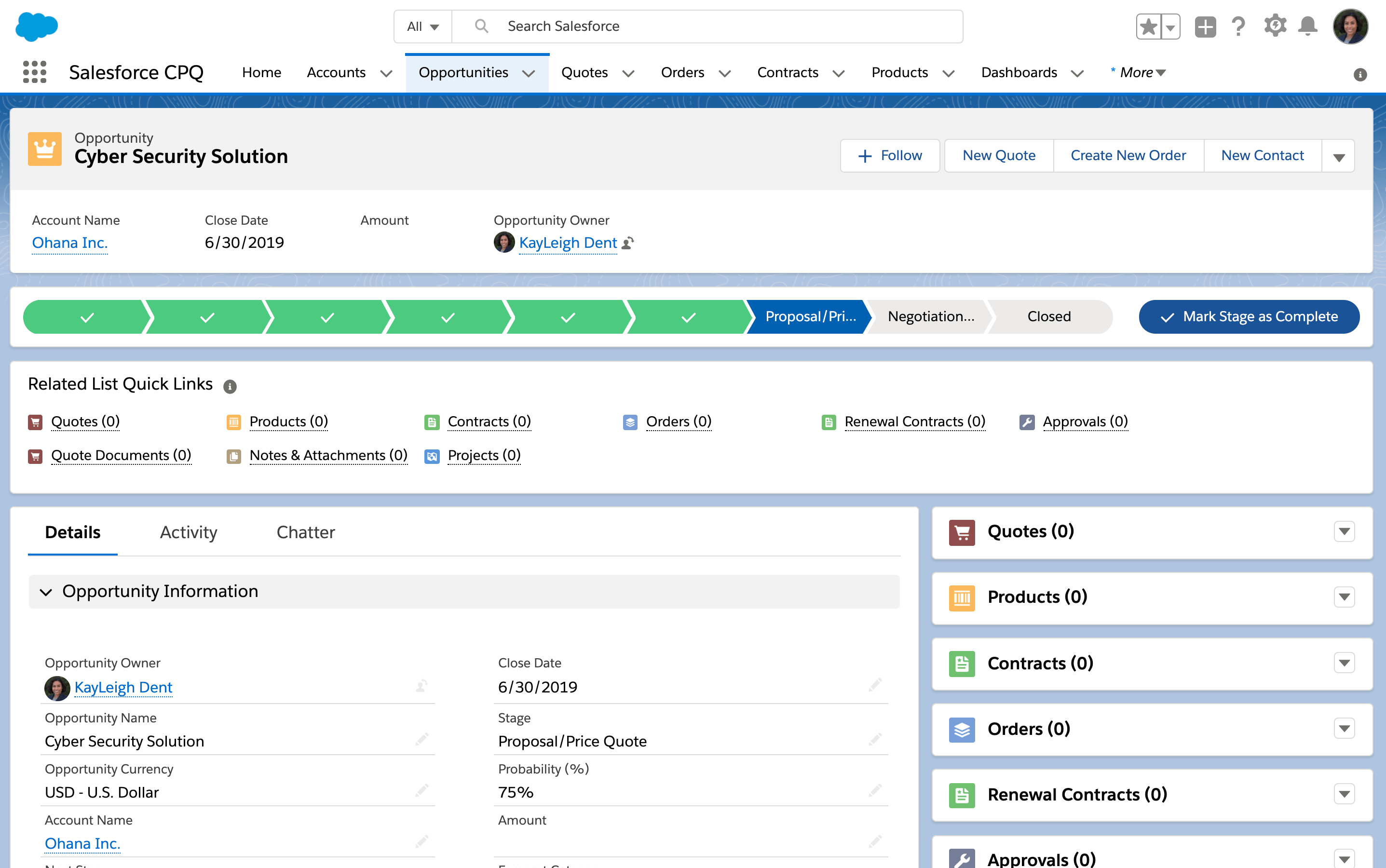
**Review:** _“It’s really streamlined the quoting process for us massively and being able to do custom things for our industry that we couldn’t do before.”_
### **Sales Enablement Platforms**
### **3. Seismic**
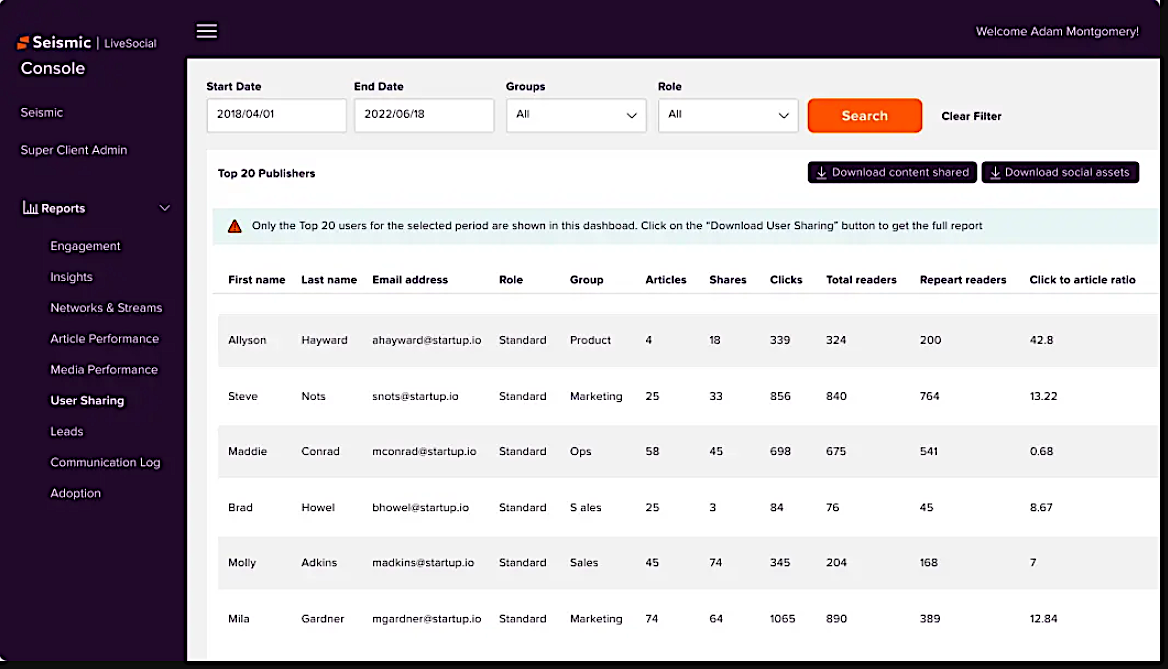
**Seismic** is a comprehensive sales enablement platform that equips presales engineers with the tools and content needed to deliver impactful buyer experiences. It centralizes resources like case studies, product collateral, and training materials so teams have instant access to what they need. Seismic's automation capabilities streamline content personalization, and it also has content analytics that reveal how various assets are performing.
**Best for:** Teams that need to manage large content libraries while delivering tailored materials and tracking buyer engagement.
**Price:** By request
**Review:** _“Ease of platform functionality lets us build specific hubs for the sales teams on topics they are most interested in and streamline where the teams are finding the latest and greatest information.”_
#####
##### **Product Tour and Onboarding Tools**
### **4. UserGuiding**
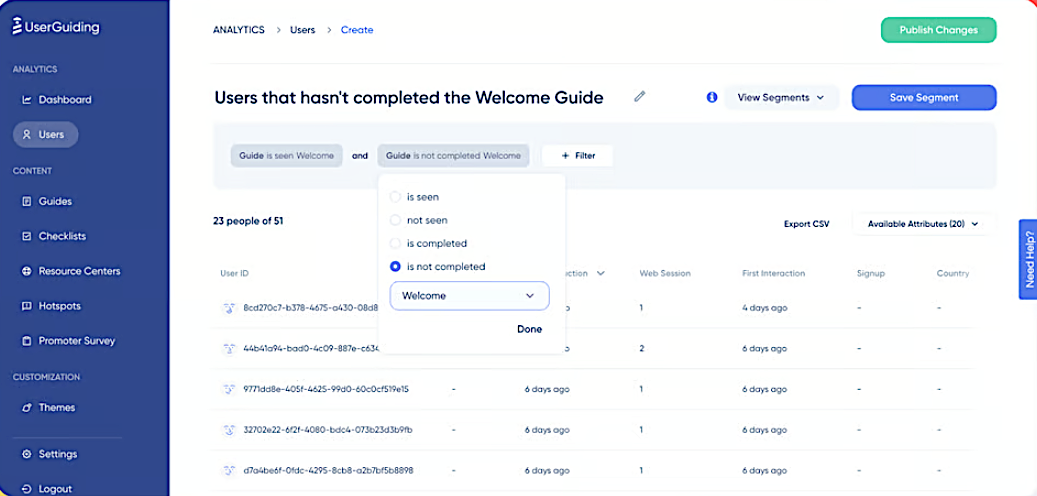
**UserGuiding's** platform enables quick customization of onboarding flows, tutorials, and walkthroughs to suit different prospects and use cases. It enables presales teams to create interactive, guided experiences that showcase product capabilities and address buyer needs. Presales engineers can quickly implement self-service experiences (with minimal support) that improve user adoption and help prospects make informed decisions.
**Best for:** A flexible tool to craft engaging, interactive buyer experiences and improve understanding of complex products.
**Price:** Three tiers - Basic at $69/month, Professional at $199/month, and custom pricing for Corporate.
**Review:** _“UserGuiding supports my customers, in a friendly way, (about) how they can work smart(er) with our application.”_
##### **Collaboration Tools**
### **5. Slack**
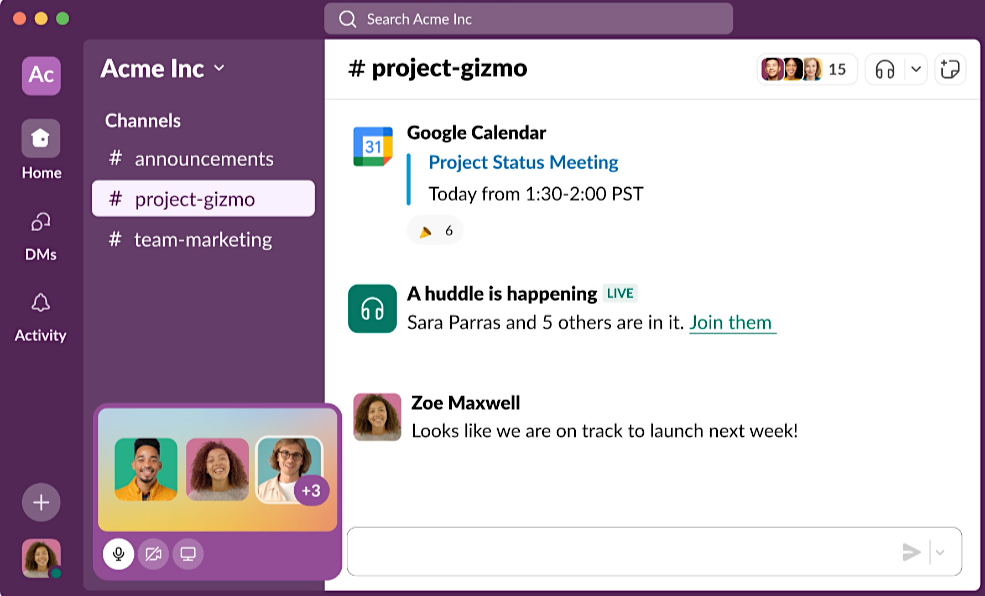
**Slack** is a versatile collaboration tool that connects presales teams with sales, engineering, and marketing through real-time messaging, file sharing, and integration with key platforms like CRMs. Its customizable channels allow teams to organize client or project discussions, so key information is easy to access. Slack’s integrations with tools like Google Drive and Zoom enhance team efficiency with better overall communication and access to shared workspaces.
**Best for:** A centralized platform for organized, real-time communication and seamless collaboration across departments.
**Price:** Four tiers - Free, Pro at $8.75/month, Business+ at $15/month, or custom pricing for Enterprise Grid.
**Review:** _“Slack really facilitates communication with both internal and external stakeholders.”_
##### **Data and Analytics Platforms**
### **6. Chorus.ai**
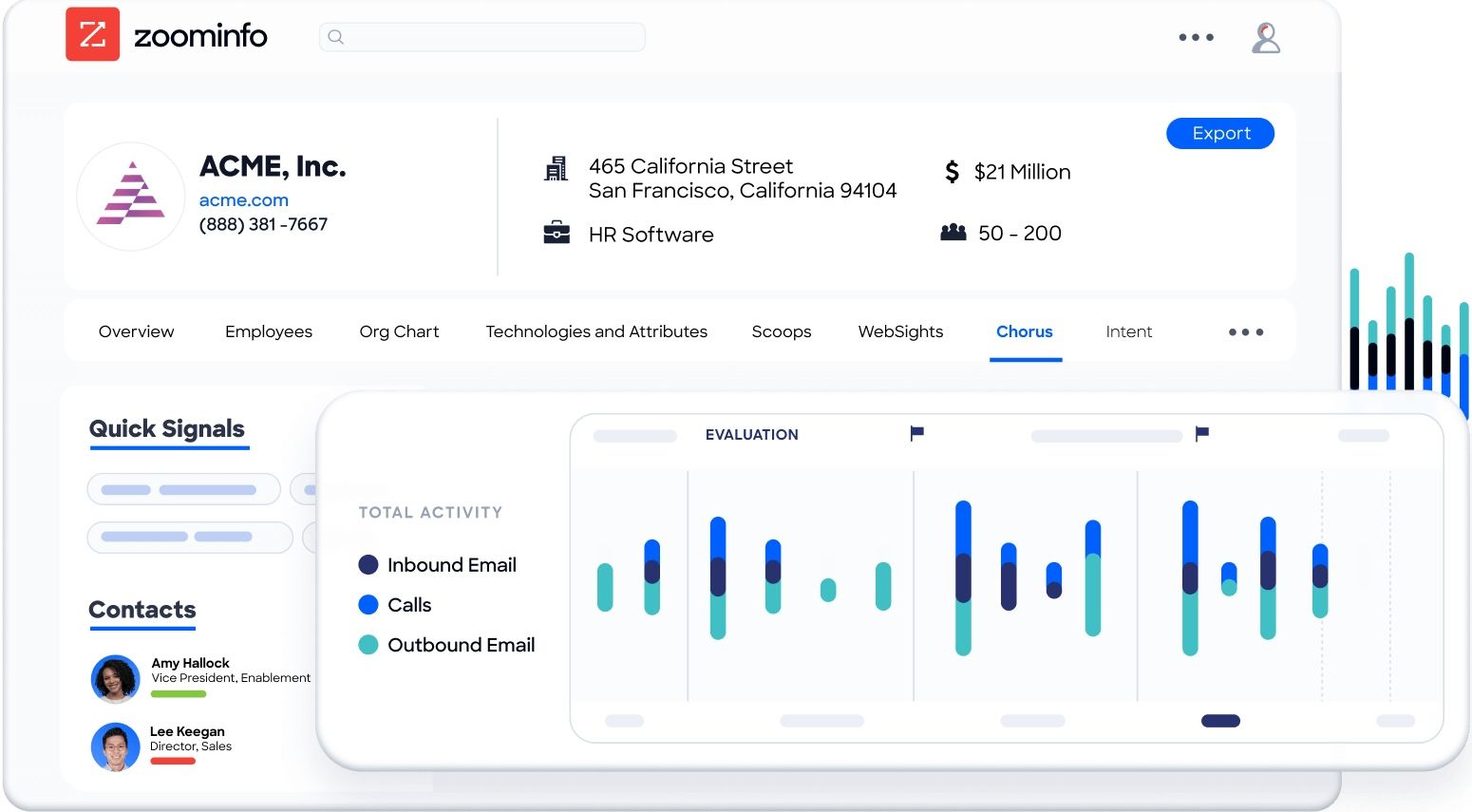
**Chorus.ai** from ZoomInfo is an AI-powered conversation intelligence platform that captures and analyzes sales interactions like calls and meetings to provide actionable insights for presales teams. Through recording and transcribing interactions, it identifies key topics, tracks sentiment, and uncovers trends in buyer engagement. Its AI-driven analytics help presales engineers understand customer needs, refine messaging, and align their strategies with the broader sales team.
**Best for:** Leveraging conversation intelligence and analytics to enhance customer interactions and drive strategic alignment.
**Price:** By inquiry
**Review:** _“We’re getting more data on how we can improve our product and improve our processes across the board.”_
##### **RFP (Request for Proposal) Response Tools**
### **7. Loopio**
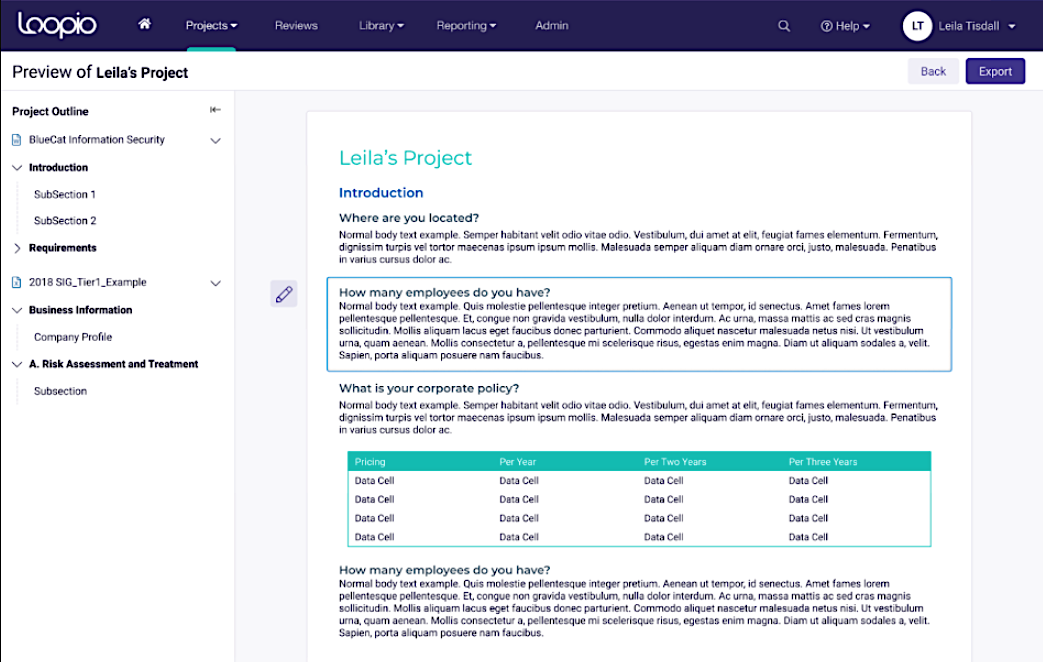
**Loopio** transforms how presales teams handle RFPs by simplifying the response process. Its intuitive platform centralizes content management so you can quickly access approved answers and customize them for specific proposals. Dynamic templates and proposal automation software automatically pull the best content into each document, while also streamlining task assignments and progress tracking to deliver professional responses that reduce errors and increase win rates.
**Best for:** A streamlined, collaborative solution for managing and delivering high-quality RFP responses.
**Price:** Custom quotes are available for four tiers, from Essentials to Enterprise.
**Review:** _“Loopio's content library has been the most efficient manner to keep track of our huge catalog of responses.”_
**Presales Management Platforms**
### **8. Homerun**
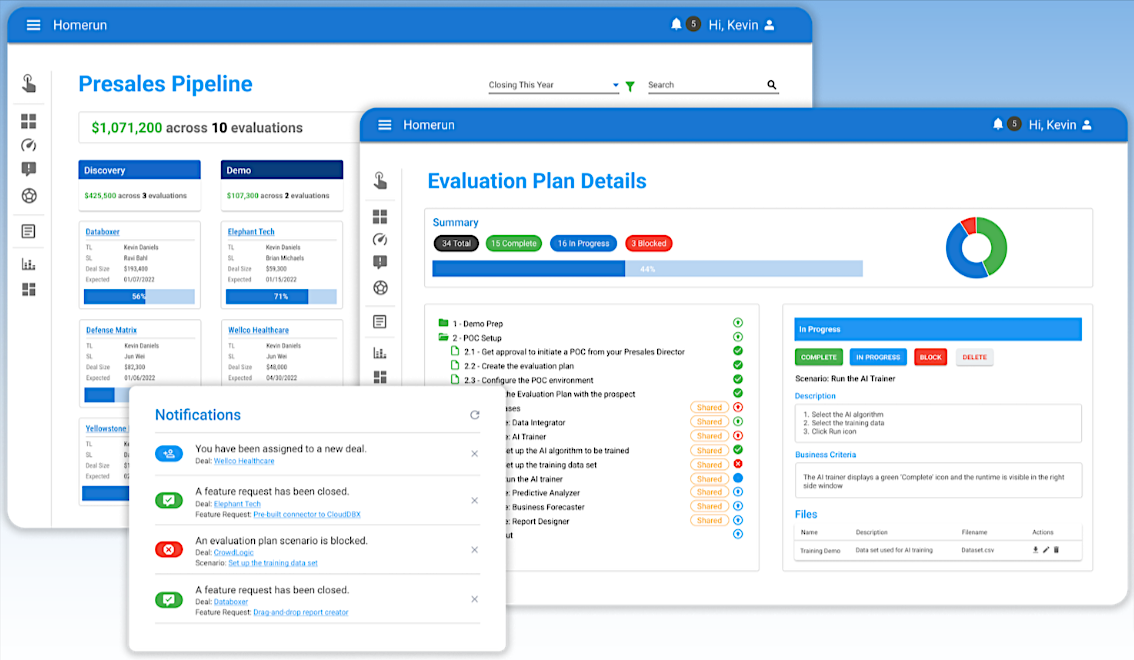
A dedicated presales management platform that helps teams organize, track, and optimize their workflows, **Homerun** scores with features like resource allocation, pipeline visibility, and task management. It keeps teams aligned and efficient with collaboration tools that enhance communication between sales and presales, while its reporting capabilities provide deep insights into team performance and opportunities for improvement.
**Best for:** Presales teams looking to streamline operations, improve workflow visibility, and enhance collaboration with sales.
**Price:** By request
**Review:** _“What Homerun Presales does is consolidate all of the information that is important to presales engineers as well as presales leaders into a single, easy-to-implement, integrate, and use a single pane of glass.”_
## **Build a Stronger Presales Strategy with Demostack**
Presales teams face unique challenges, but the right tools can make a significant difference. Leveraging presales software solutions helps teams streamline processes, deliver personalized demos, and provide meaningful buyer experiences that drive sales. A thoughtful, multi-pronged approach ensures your team stays efficient, consistent, and impactful throughout the process.
Demostack's solution is purpose-built for presales teams. It simplifies demo creation and customization to deliver tailored, polished presentations while offering actionable analytics so you can adjust your presales strategy to be more effective. With its seamless integrations and time-saving features, Demostack helps you overcome common presales obstacles and win more deals.
**[Get a demo of Demostack](https://www.demostack.com/) to start building a stronger presales strategy today.**
## Article: What is Sales Velocity, and 8 Ways to Improve Time to Close
Source: https://www.demostack.com/post/what-is-sales-velocity-and-8-ways-to-improve-time-to-close-
No matter the size of your business, increasing sales revenue is always a priority. For B2B products and services, revenue growth can be particularly challenging due to traditionally long sales cycles, which can significantly impact an organization's financial health.
In fact, in 2023, nearly half of B2B sales leaders reported longer sales cycles, a trend that contributed to 91% of sales teams in the US and UK missing their quotas in the first quarter of the year. This highlights the importance of not just closing deals but doing so more efficiently.
To tackle these challenges, B2B sales leaders rely on key metrics like sales velocity, which measures how quickly deals move through your pipeline. Sales velocity is directly tied to time to close. By optimizing sales velocity, you can identify and eliminate bottlenecks in your sales process—and speed up your entire sales cycle.
Here are eight actionable ways to accelerate sales velocity and improve your time to close.
## **What is Sales Velocity and How to Calculate It**
Sales velocity, sometimes called pipeline velocity, is a metric that indicates how quickly your leads progress through your sales funnel. Sales velocity measures the rate at which sales cycles come to completion based on four key metrics: number of opportunities, average deal size/value, win/close rate percentage, and the average length of your sales cycle.
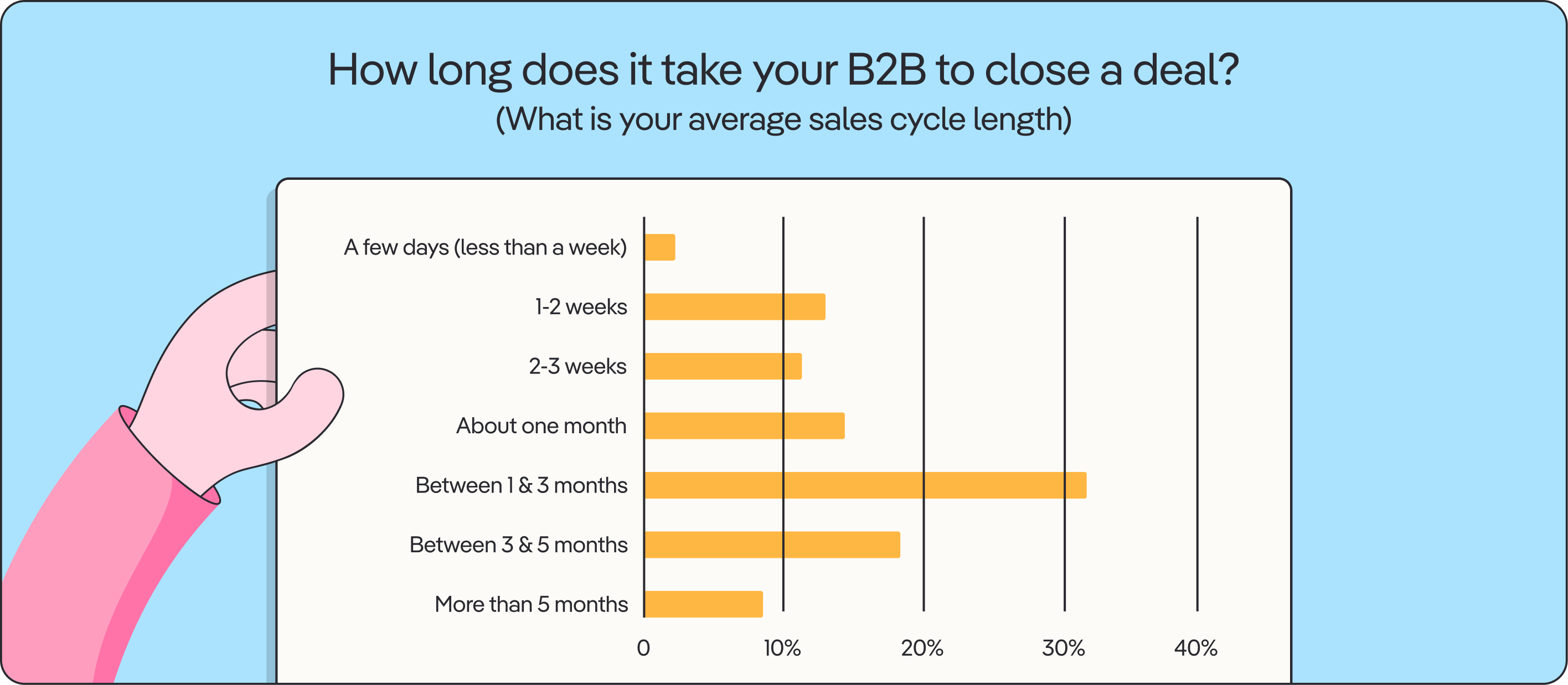
### **The Number of Opportunities in Your Pipeline**
The first variable in the sales velocity calculation is the number of valid sales opportunities you have in your pipeline at the time of measurement.
Your sales pipeline should always be filled with high-quality, sales-qualified leads (SQLs). A pipeline cluttered with low-quality leads that are unlikely to convert can negatively impact your revenue.
One effective way to ensure you’re filling your pipeline with the right opportunities is through thorough [discovery calls](https://www.demostack.com/post/how-to-maximize-discovery-call-success-12-essential-tips). These initial conversations help qualify leads by uncovering their specific needs and challenges, ensuring that only those with genuine potential move forward in the sales process.
### **Average Deal Size / Value (or CLV)**
The average deal size or value is the average sum of revenues you have generated from new clients over a period prior to the time of measurement.
To calculate your average deal value, divide the sum of your generated revenue by the number of deals closed over a specific period. For example, if your sales efforts in a quarter resulted in revenues valued at $100,000 via 50 deals closed, then your average deal value would be $2,000. ($100,000/50 = $2,000).
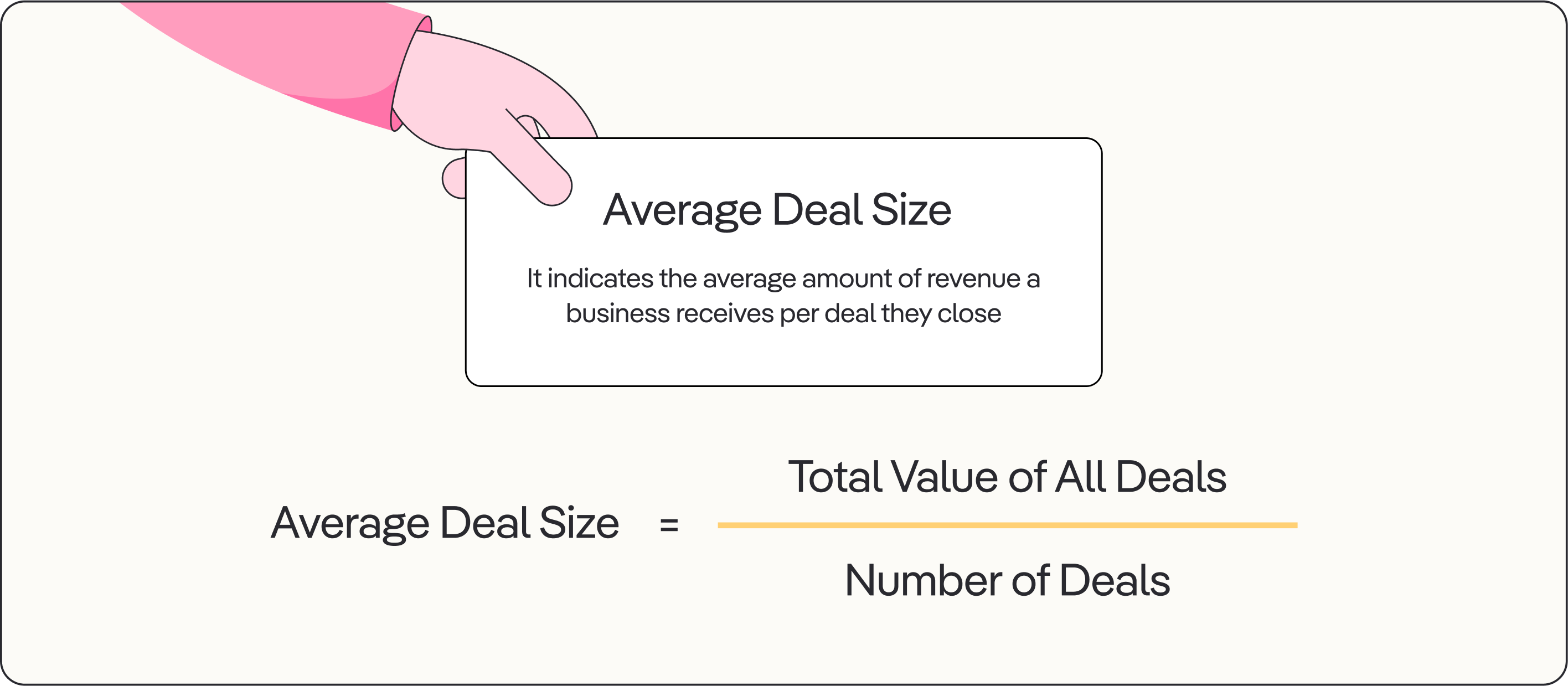
For subscription-based products and services (like SaaS), you can use the average customer lifetime value (CLV) instead of the average deal value variable when calculating your sales velocity.
Since CLV accounts for long-term and recurring revenues to your business, it can be a better indication of the total contribution of every closed deal to the revenues of a subscription-based product or service throughout the ongoing relationship with the customer.
### **Win Rate Percentage**
Your average win rate or conversion rate is a measurement of your sales teams' ability to successfully convert SQLs into paying customers. To calculate your average win rate, simply divide the total amount of deals won by the total amount of opportunities.
Next, calculate your win rate percentage with this formula:
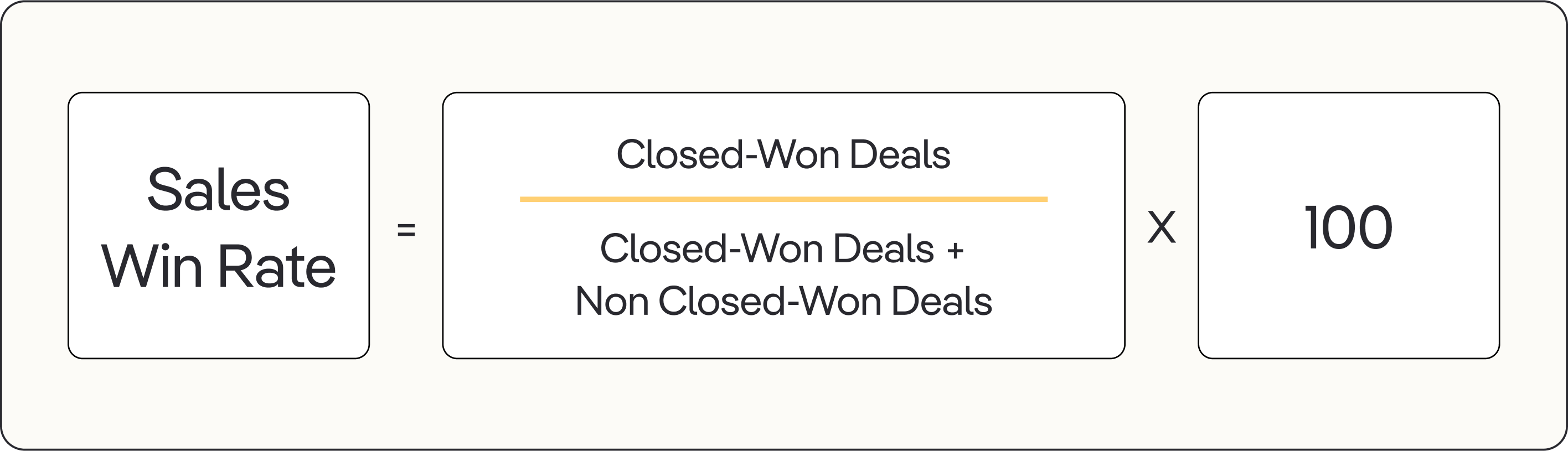
### **The Average Length of Your Sales Cycle**
The last variable in the sales velocity formula is the one you never want to see grow. Also called pipeline length, the average length of your sales cycle is a measurement of the time taken to convert a qualified lead into a paying customer. This variable must account for the entirety of the prospect journey and, with B2B sales, can take months to complete.
To calculate your average sales cycle length, sum up the number of days it took to close each sale in the period measured. Then, divide that sum by the number of closed deals in that same period.
The formula for calculating sales cycle length is:
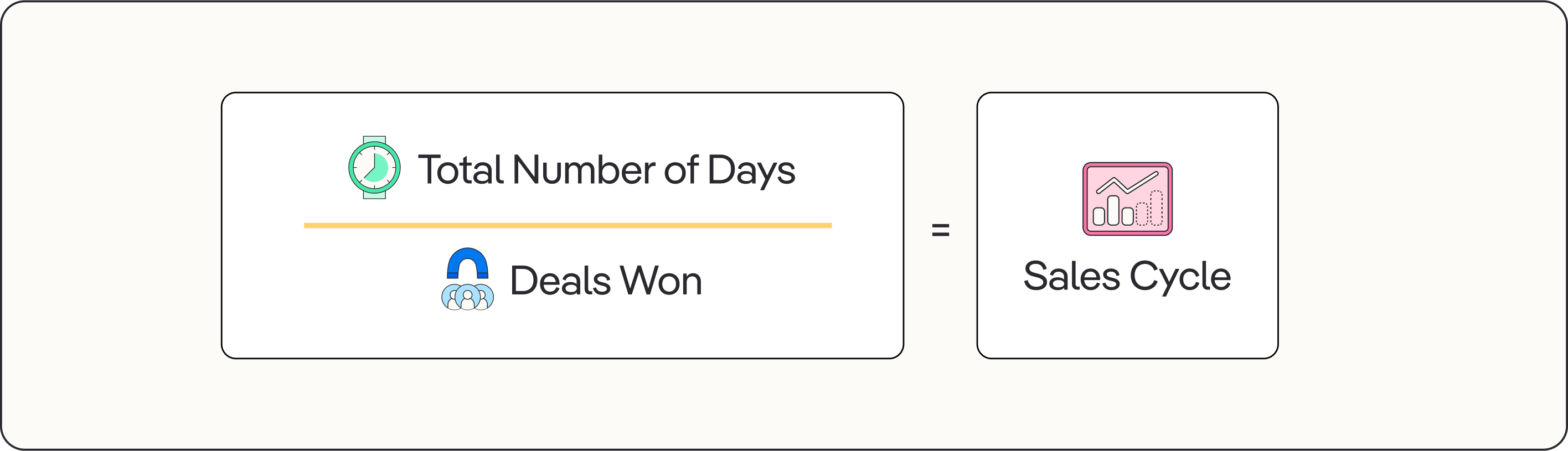
It's worth noting that most of these numbers should be available in your CRM platform.
### **How is Sales Velocity Calculated?**
To calculate your sales velocity, multiply the number of opportunities by the average deal value and win rate, then divide the result by the average length of your sales cycle. [It's worth noting that most of these numbers should be available in your CRM platform.
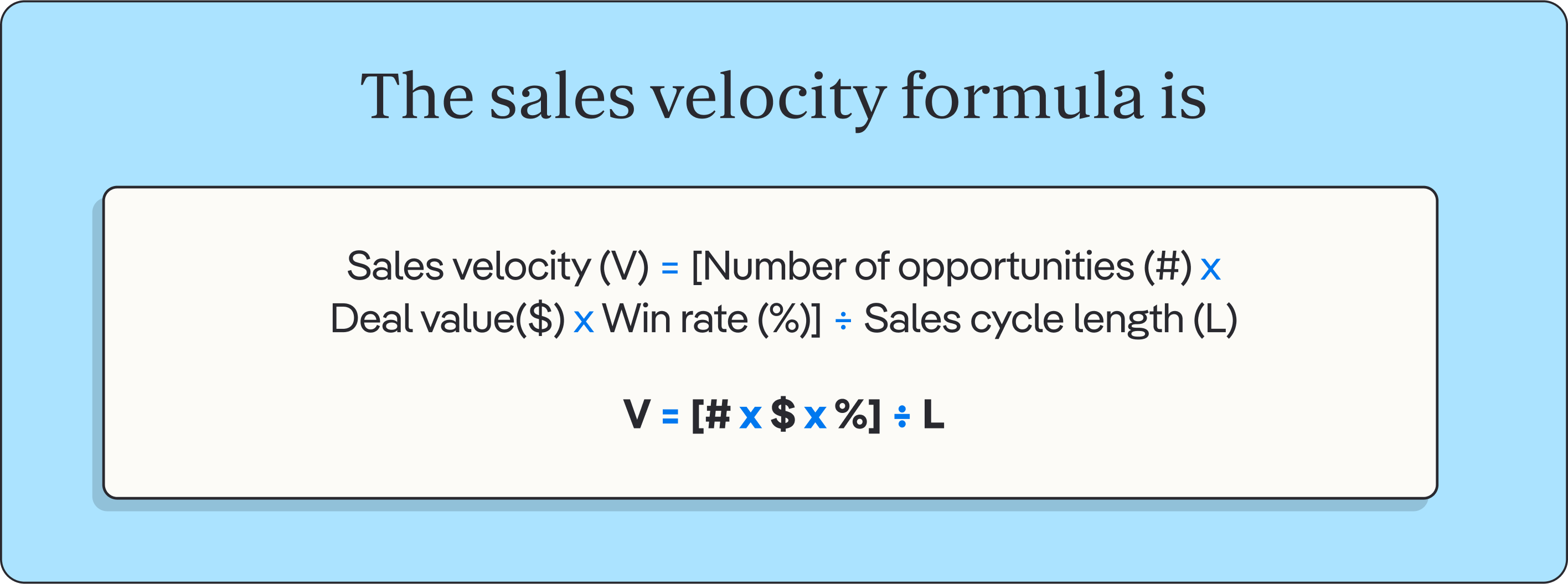
Now that we’ve got all the sales velocity math sorted, let’s pivot to eight actionable strategies to increase it.
## **8 Ways to Improve Sales Velocity and Accelerate Time to Close**
Sales velocity is a lot more than just a metric to quantify the rate at which your sales efforts bear fruit. It is also a strategic tool for finding the bottlenecks and issues that slow your sales cycle. This means tweaking and optimizing each of the variables in the equation, with the sorest spot for B2B sales cycles—the cycle length—as the focal point.
### **1. Optimize Lead Qualification**
The quality of the leads in your pipeline is often reflected in your sales velocity rates. This is especially true when the number of opportunities is high and the win rate exceptionally low. To remedy this, review and revamp your lead qualification processes and declutter your sales pipeline.
Strategies and tactics to improve the quality of the opportunities in your pipeline include:
- **Employ algorithmic or AI-enhanced lead scoring techniques** to rank leads based on behaviors that indicate intent.
- **Review and optimize your target audience and buyer persona definitions.** Make sure your value proposition and messages are relevant to their needs and pains.
- **Implement lead nurturing** (and leverage automation to do so effectively) to keep warm prospects engaged with your sales process.
- **Focus your lead generation efforts** on sources proven to deliver high-quality and high-value leads.
### **2. Enhance Sales Training and Enablement**
To successfully close deals and turn prospects into happy customers, your sales teams need the skills, tools, and in-depth understanding of your product and the buyer. Here's how to do it:
- **Start by getting feedback from your reps to understand their needs and knowledge gaps.** Next, you can apply one or more of the following:
- **Create a proactive coaching plan** to enhance and improve the performance of your teams, rather than a responsive plan that provides training and tools only when performance drops.
- **Measure sales reps' individual and group performance** in a repeatable and scalable process with pre-set KPIs.
- **Collaborate with marketing and development teams** to provide your sales team with a comprehensive but accessible sales knowledge base with FAQs, brochures, and other sales material and resources consolidated in one place.
- **With SaaS products, you can use demo platforms like Demostack** to let your sales team 'play' with a realistic demo of your product to understand it better and explain its value.
- **Equip your teams with sales enablement tools that automate tasks** and let reps focus on what they do best—move deals toward closing.
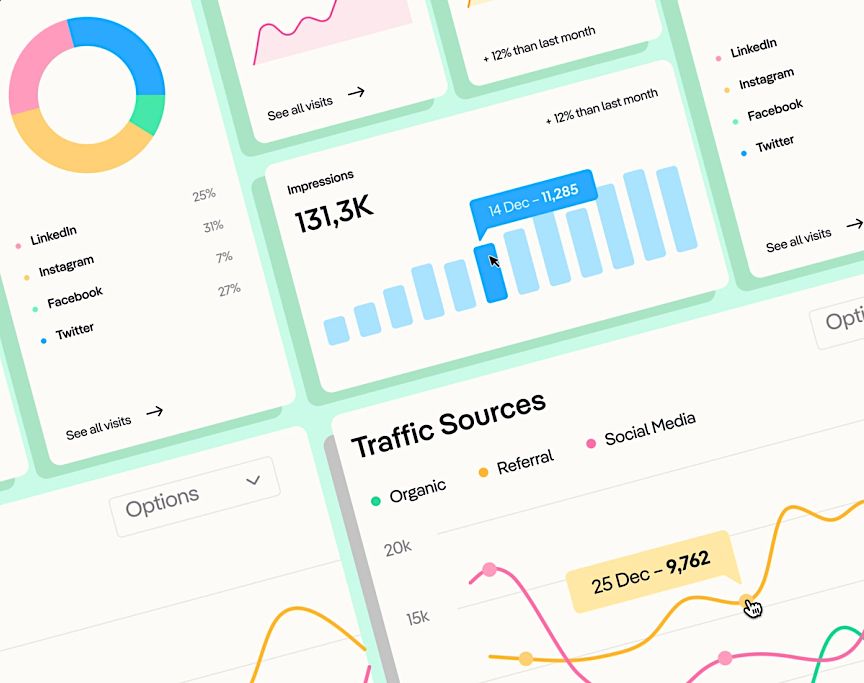
### **3. Implement Effective CRM Strategies**
Your CRM is the primary tool your sales reps use throughout their sales cycles. Most modern CRM tools offer many features and capabilities aimed at accelerating sales cycles and uncovering bottlenecks in your pipeline. Take advantage of them by:
- Organizing, maintaining, and enriching the lead data in your CRM systems to pinpoint high-value opportunities.
- Aiming for collaboration with a CRM implementation that promotes communication and information sharing between teams and team members.
- Connecting your CRM to your [sales enablement tools](https://www.demostack.com/post/top-10-best-sales-enablement-software) to enrich prospect data and centralize sales and marketing activities in one platform.
### **4. Leverage Sales Automation Tools**
Sales automation tools encompass a wide range of software solutions designed to streamline and optimize your sales process by eliminating the time your salespeople spend on repetitive, mundane tasks.
Implementing sales automation makes tasks like lead nurturing, scheduling, and responding to prospects become faster and more efficient. For example, you can use [demo automation](https://www.demostack.com/post/top-10-demo-automation-software-for-2024) to instantly create and deliver personalized, interactive product demonstrations tailored to each prospect's needs. This not only enhances the quality of your sales interactions but also significantly reduces the time your team spends preparing demos, allowing them to focus on closing deals.
### **5. Improve Sales and Marketing Alignment**
The role of marketing is to make sales a breeze and reduce the role of sales teams in the process to a negotiation and customization dialogue. With that in mind, it's vital that you continuously align sales and marketing operations, and invest in improving communication and collaboration between the teams.
- Collaboratively determine the best sources and characteristics for high-quality leads and, if needed, revisit your buyer persona definitions and targeting.
- Develop materials and resources according to sales representatives' requirements and feedback across the stages of the sales cycle, ensuring they can instantly access relevant information when they need it.
### **6. Personalize Sales Presentations and Demos**
Customization and personalization in B2B sales cycles have become an expected part of the process. Your prospects don't want to flip through lengthy solution pages or slide decks to understand how a specific feature in your SaaS solution provides value to their business.
Instead, try using personalized demos—a proven tool for increasing sales velocity.
With Demostack's ability to quickly create and share personalized demos, you can deliver a demo experience that directly resonates with your prospect's pain points and needs.
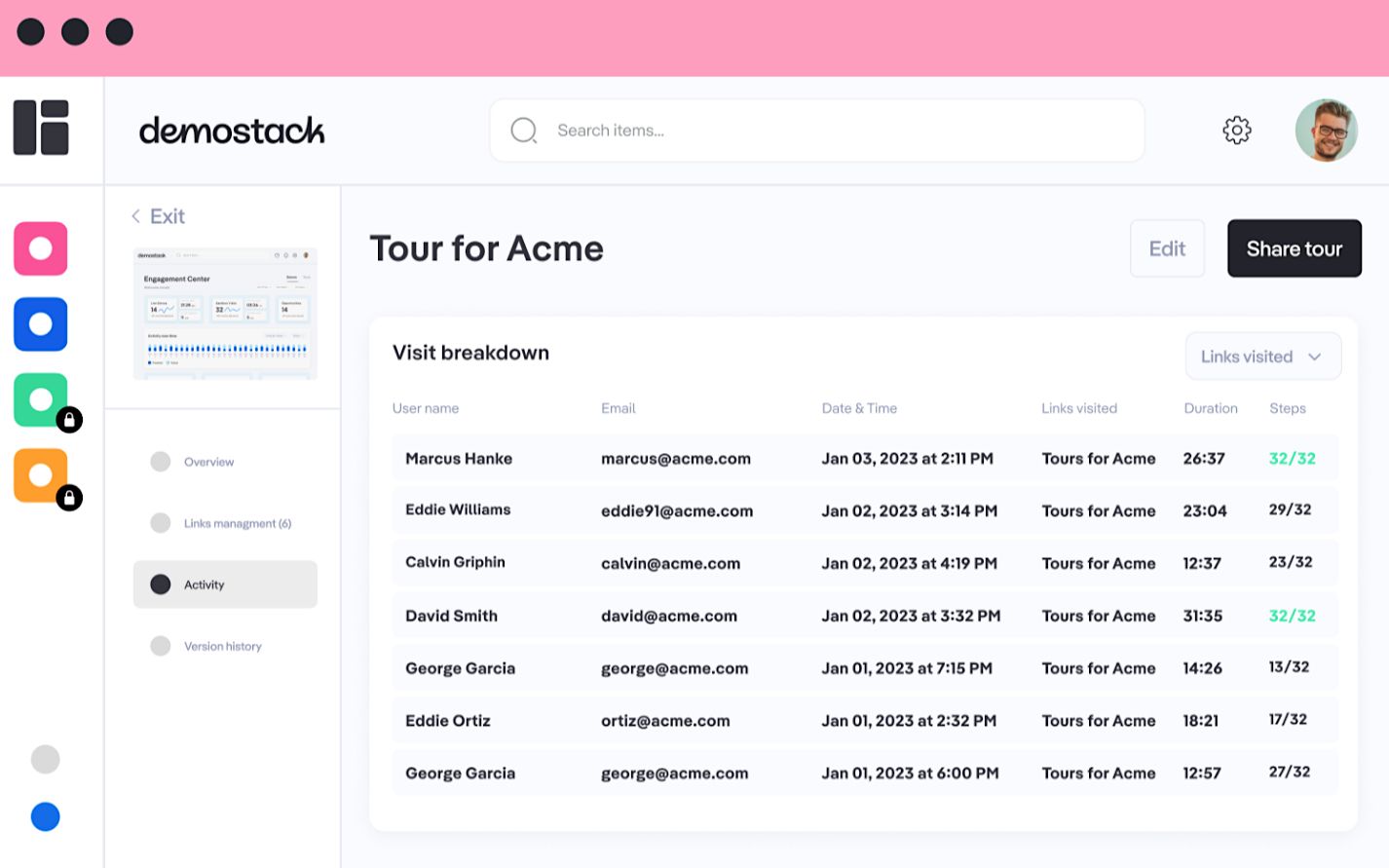
### **7.Optimize Follow-Up Processes**
Up to 80% of all sales require at least five follow up touchpoints to close a deal. At the same time, just under half of all sales reps give up after only one follow up attempt—leaving money on the proverbial table. The best way to look at follow up processes is as relationship nurturing.
To follow up more effectively:
- **Set concrete timelines** for automatic and manual follow-up activities.
- **Log all follow-ups and attempts in your CRM**, along with relevant contact notes.
- **Create templates for common scenarios in follow-up processes** like quote requests, certifications, and other deliverables that are appropriate to your industry.
### **8. Leverage Data-Driven Insights**
Finally, it's essential to have comprehensive, data-driven visibility into your sales pipeline. This entails setting and monitoring critical metrics and then applying data analytics to pinpoint the bottlenecks in your pipeline.
In addition to sales velocity, you should monitor and analyze metrics like step-based conversion rates, win/rate losses by campaign, and any other KPIs that are relevant to your business.
## **Reduce Your Time to Close with Demostack**
Sales velocity is a crucial metric in B2B sales, demanding continuous attention and optimization. By focusing on improving this metric and leveraging effective sales enablement tools, you can benchmark performance, forecast future revenue, and, most importantly, reduce Time to Close. As a result, deals move through your pipeline faster, accelerating growth and improving overall efficiency.
Hands-on product demonstrations are often crucial to shortening lengthy sales cycles, reducing time-to-close, and accelerating sales velocity. With Demostack, your sales reps don't need to wait for engineering to make a demo environment available. Instead, you can use automation to create interactive, customized, and data-driven demonstrations of your SaaS products and their features.
**[Contact Demostack](https://www.demostack.com/) to discover just how easy it is to deliver no-code, on-demand demos for your sales teams.**
## Article: How Qualtrics Enabled Their AEs to Demo and Accelerate Sales
Source: https://www.demostack.com/post/enable-aes-to-demo-and-accelerate-sales-
Discover how Qualtrics transformed their sales process by empowering their Account Executives (AEs) to create personalized, scalable demos in minutes using Demostack's advanced demo automation software. In this webinar, you'll see how Qualtrics overcame the bottlenecks of customized demos, shortened sales cycles, boosted AE confidence, and increased conversion rates. Watch now to learn the secrets behind their remarkable success!
## Article: Overcoming Challenges in Keeping Demos Fresh: Effective Solutions
Source: https://www.demostack.com/post/Maintaining-Software-Demos
Keeping your product demos up-to-date and relevant is crucial. Sam Collin, a seasoned Solutions Engineer at Demostack, recently shared insights and best practices on maintaining and improving demo environments . Here’s a deep dive into my key takeaways from speaking with her.
## The Only Thing Constant is Change
Sam likens maintaining a demo environment to gardening, where different sections require varying types of maintenance at different times.
## The Importance of Fresh Demos
Product demos are essential tools for sales teams, providing potential clients with a tangible understanding of your software’s capabilities. However, as products evolve, demos need constant updates to reflect the latest features. Outdated demos can lead to several challenges:
- **Revenue Leakage**: Failing to showcase the latest features can result in missed sales opportunities.
- **Extended Sales Cycles**: Inability to demonstrate new functionalities can slow down the sales process.
- **Increased Maintenance Load**: Sales teams may spend more time maintaining demos instead of focusing on live calls.
## Challenges in Maintaining Demos
Maintaining an up-to-date demo environment is akin to tending a garden – it requires continuous care and attention. Some of the main challenges include:
- **Constant Updates**: Keeping the demo environment aligned with ongoing product updates.
- **Data Relevance**: Ensuring that new features have the necessary data for impactful demos.
- **Dependence on R&D**: Relying on R&D teams for updates can delay the process, as they prioritize production environments.
## Effective Solutions to Demo Challenges
Addressing these challenges requires a suite of tools designed to streamline the creation, management, and presentation of software demos. Here are some effective solutions:
- **Demo Builder**: Allows users to create and customize demos, add relevant data, and block certain interactions to keep demos focused.
- **Demo Library**: Organizes and stores demo assets for easy access and sharing.
- **Desktop App:** Provides a clean, distraction-free environment for presenting demos.
- **Demo Analytics:** Tracks demo usage and ties it to revenue outcomes, helping measure effectiveness.
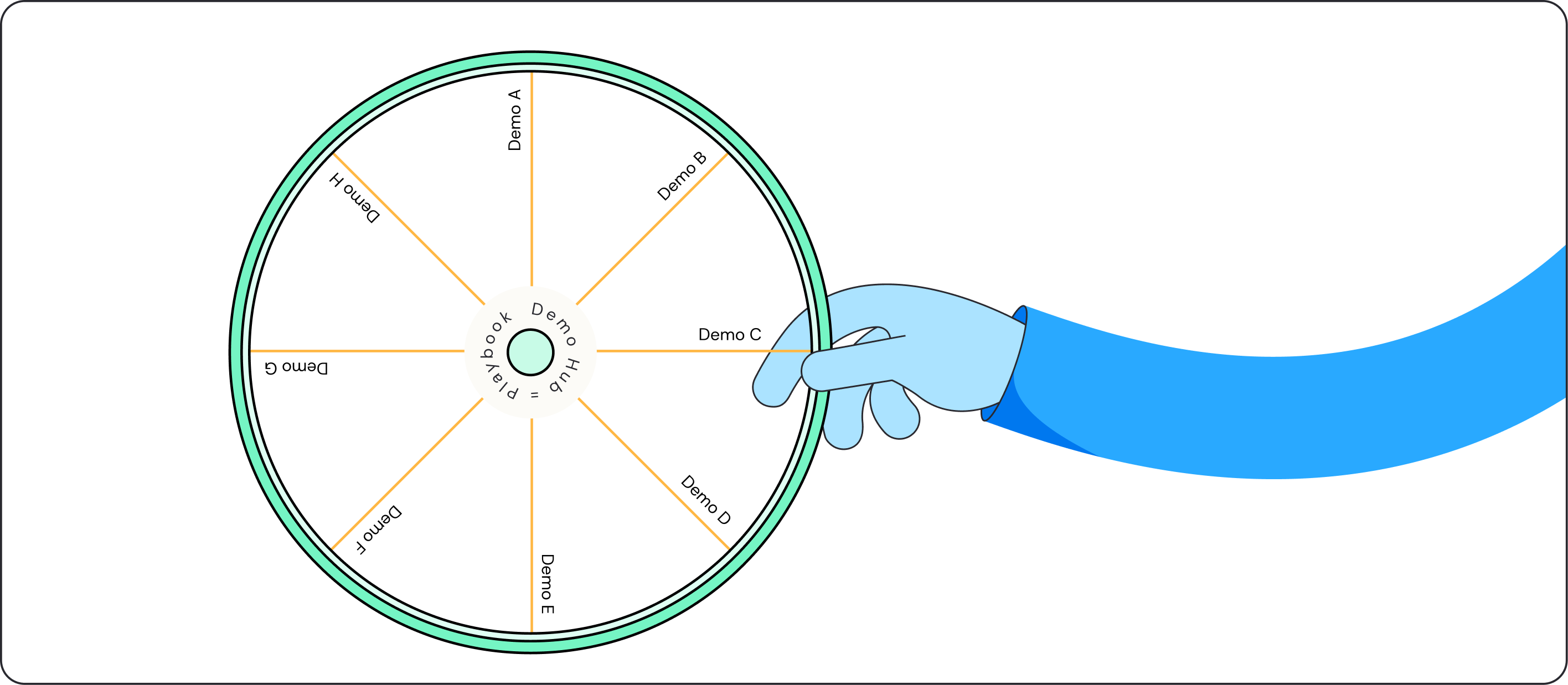
## Spoke-hubs and Modules
A key strategy with updating new product releases with Demostack is the hub and spoke model for organizing demo environments. The "hub" refers to a centralized playbook that contains all the necessary assets for demos. Each "spoke" represents individual demo modules, such as different product features or use cases. This modular approach allows for efficient updates and maintenance. When a new feature is released, a new module (spoke) can be created and easily integrated into the playbook (hub) without overhauling the entire demo environment. This structure ensures that different sections of the demo can be updated independently, streamlining the process and keeping demos fresh and relevant.
## Practical Demonstration: Building a New Demo
Here are 3 steps to create a new demo module for a new feature using a comprehensive demo management tool like Demostack. This process involves:
1. **Cloning the Demo**: Recording a deep network-level version of the demo.
2. **Customization**: Adding variables and customer-specific data to personalize the demo.
3. **Guidance and Enablement**: Embedding guidance notes within the demo to assist sales teams in presenting new features effectively.
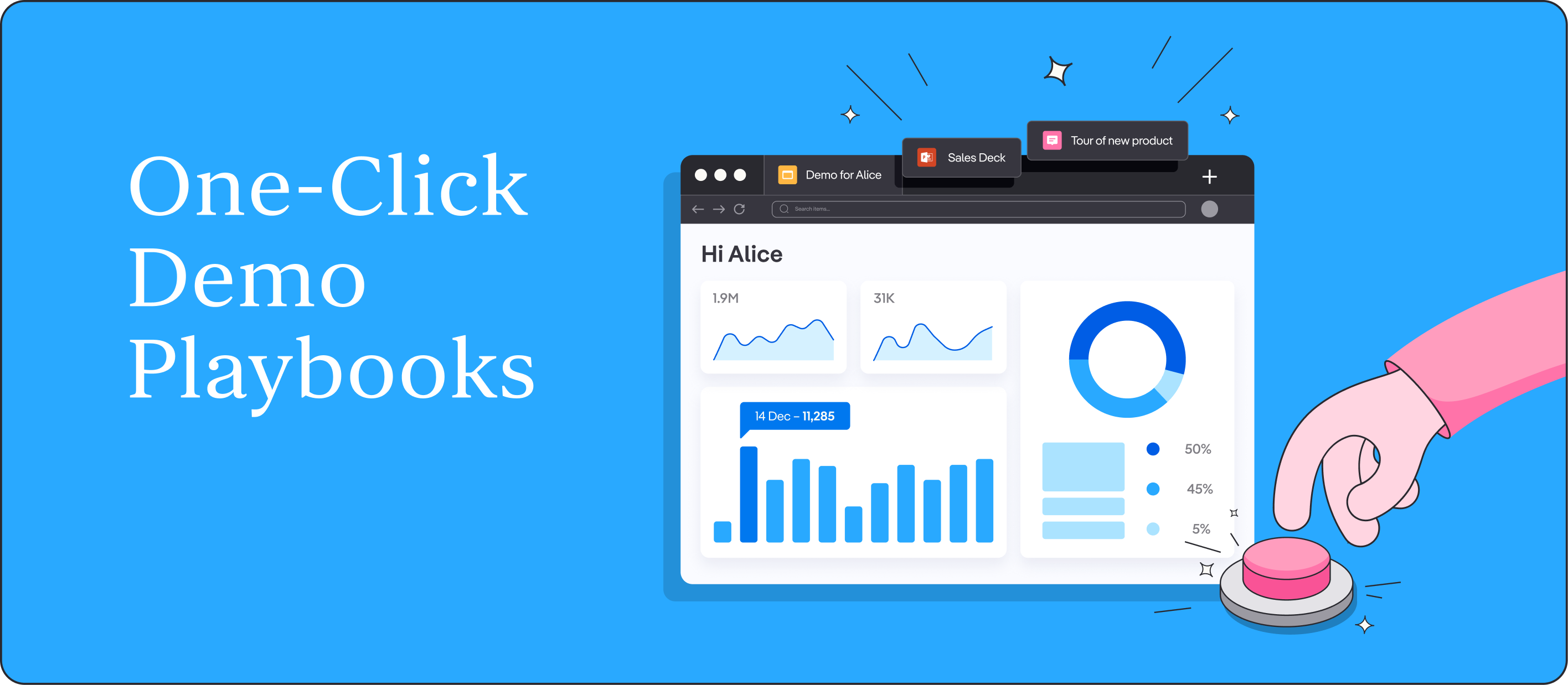
## Presenter Experience
A seamless and efficient presenter experience is crucial for delivering impactful demos:
- **Seamless Integration**: Presenters can access the latest demos through a single link, ensuring consistency.
- **Personalization**: Easy customization options for tailoring demos to specific clients.
- **One-click Playbooks**: Presenters can quickly switch between different demo modules during a presentation.
## Flexibility with Live Demos
For those unexpected questions or unique client needs, overlay demos provide real-time updates and flexibility, allowing experienced presenters to demonstrate features on the fly.
## The Power of Scalable Demo Management
Controlling the demo environment and narrative is vital for moving fast and delivering consistent, impactful demos. A comprehensive demo management tool empowers sales teams to manage their demo environments independently, without relying on R&D, and ensures that every demo is as relevant and engaging as possible.
By leveraging these solutions, your sales team can deliver up-to-date, personalized demos with ease, enhancing your software's appeal and driving business success.
## Article: How to Maintain Demo Consistency Across Channel Sales
Source: https://www.demostack.com/post/how-to-maintain-demo-consistency-across-channel-sales
Channel sales can be a big win for B2B SaaS companies looking to grow. However, there's a tricky part: making sure all your sales partners are on the same page when it comes to demonstrating and talking about your product. When messages get mixed up, it can lead to confusion among customers and shake their confidence in your brand. This makes it harder for your sales partners to seal the deal.
The key is finding a way to create demos that are easy to use and can be slightly customized by your partners with little to no support from sales engineers–all while keeping the core message about your product consistent. In this article, we’ll help you tackle the challenge of message consistency head-on, turning it into a strength for your business. Later on, we'll explore how tools like Demostack can be instrumental in achieving this.
Ready to hear more about how to make channel sales work in your organization? Let’s dive in!
### **The Importance of Messaging Consistency in Channel Sales**
When you sell through partners, especially with complex software products, making sure your demos and messages are the same across the board is critical.
If your demos or product messaging changes depending on who's talking, it can confuse customers and make them doubt your brand. Plus, when all your partners use the same story and show the product in the same way, it sticks in customers' minds better in the long run.
This consistency also makes training your partners easier. After all, if there's one standard way to show and talk about your product, partners can quickly learn how to do it right.
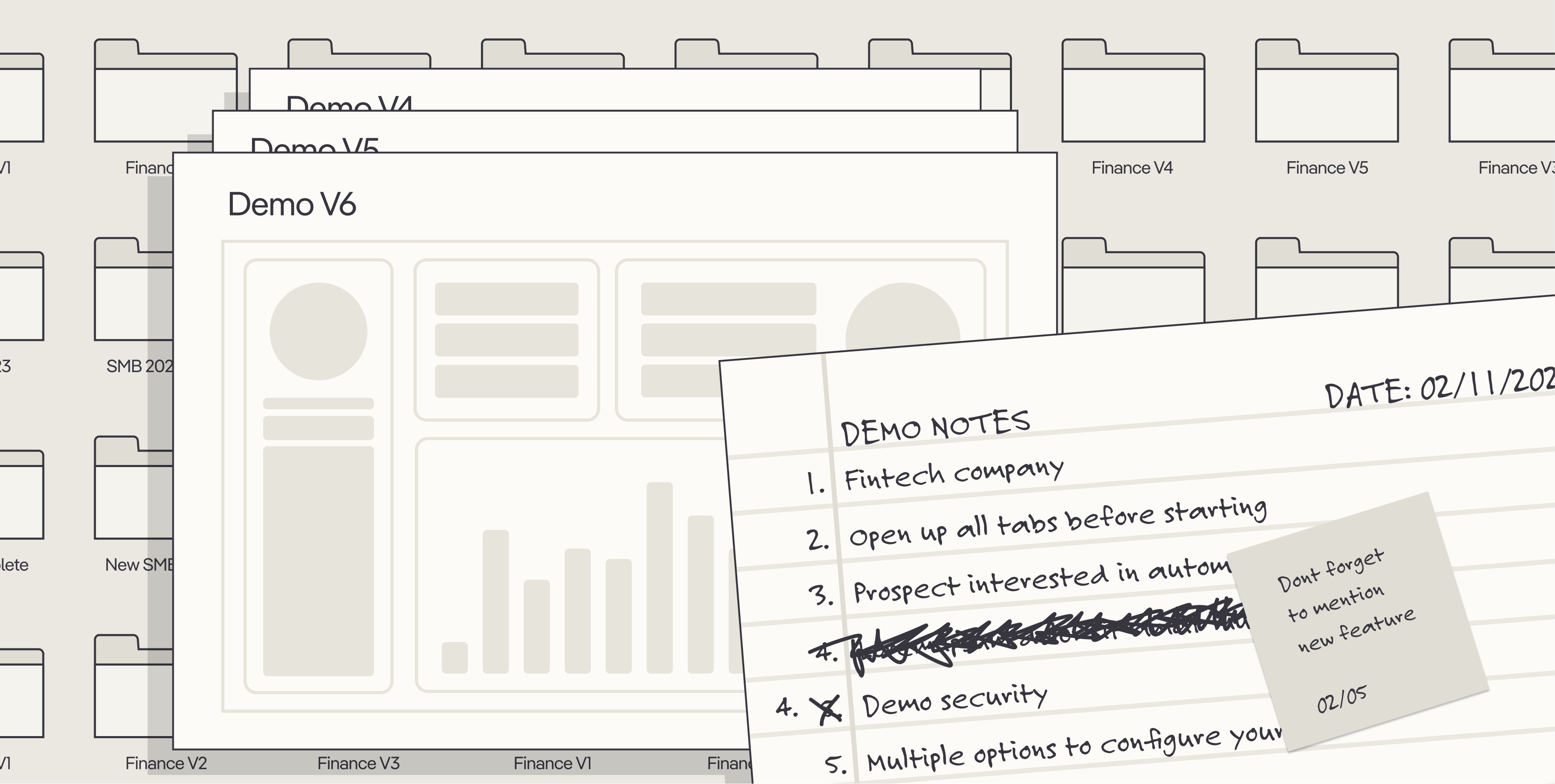
## **Challenges in Maintaining Consistency Across Channel Sales Partners**
Keeping messaging consistent isn’t always easy. Here are some common problems SaaS companies face in keeping things consistent across channel sales:
1. **Different Styles:** Working with many partners means dealing with many ways of doing things. It's like that game of "telephone" where the message gets mixed up as it goes along. It's super important that all partners get and share the same main message correctly.
2. **Quick Product Changes:** In the software world, we're always updating and improving your products. This is great for staying ahead, but it's a challenge to keep all your partners in the loop. It's like trying to hit a moving target and making sure everyone is aiming right.
3. **Different Partner Backgrounds:** Partners come from all sorts of places and have different skills. This diversity is usually good, but it can make it hard to keep presentations of your product consistent.
4. **Communication Gaps:** Good communication is what keeps your partner network strong. But sometimes, messages get lost because of different time zones, languages, or just too much info to share. This can cause a delay where not everyone has the latest updates, messing up the consistency of your messages.
5. **Different Audiences:** Each partner might be talking to a totally different group of customers, each with their own needs. While it's important to tailor messages to fit these needs, it's also key not to stray too far from your main message.
To tackle these problems, you need to use smart tools that help you update information in real-time, train your partners well, and keep your communication clear and consistent. By facing these challenges head-on, you can make sure your network of partners works like a well-oiled machine, accurately and effectively sharing what your product is all about.
### **How to Implement a Strong Channel Sales Strategy**
As presales pros stepping into channel sales, your job isn't just knowing your products inside out. You also need to make sure your sales partners can talk about your products as effectively as you do. Moving to channel sales is a big change and needs careful planning to keep things consistent, engaging, and successful.
To do this right, you need to give your partners all they need to succeed—from teaching them about what your product does to making sure the demos they use are just as good as yours.
Here's a table that breaks down the key parts of setting up a channel sales strategy. It covers the challenges you might run into, what tools you should use to solve them, and the benefits you can expect.
|
**Aspect**
|
**Challenge**
|
**Solution**
|
**Benefit**
|
|
Partner Education
|
Ensuring partners understand product functionalities quickly
|
Interactive product tours and demo sandboxes
|
Partners are well-equipped to showcase the product effectively and consistently
|
|
Demo Consistency
|
Variations in demos due to uncoordinated modifications or tests
|
Controlled demo environments that mirror the company's latest updates
|
Unified presentation of the product across all partners
|
|
Sales Conversion
|
Need to craft a resonating story that increases win rates and shortens sales cycles
|
Demos tailored to specific narratives
|
Improved win rates and more efficient sales cycles
|
|
Customization
|
Tailoring demo content to specific buyer personas, use cases, or industry verticals
|
Easy customization of demo content to align with various buyer needs
|
Relevant and engaging product stories, enhancing buyer interest and engagement
|
|
Demo Creation and Maintenance
|
The effort required in setting up and maintaining up-to-date demos
|
Simplified demo setup processes, with minimal effort to keep demos current
|
Streamlined demo management, freeing up resources for strategic initiatives
|
|
Personalized Demonstrations
|
Delivering demos that address the specific concerns and interests of each prospect
|
A live product demo with a light layer of edits to conceal PII.
|
Enhanced buyer experience and engagement, leading to higher interest and potential conversion
|
|
Buyer Exploration and Engagement
|
Allowing buyers to explore the product at their own pace, contributing to their decision-making process
|
A sandbox environments for buyers to experiment with the product independently
|
Empowered decision-making by buyers, with a hands-on understanding of the product's capabilities
|
### **How Demostack Can Help You Maintain Demo Consistency Across Channel Sales**
For in-house presales teams eyeing the leap to channel sales, Demostack is here to bridge the gap by helping you craft demos that are both standard and adaptable. This means your [partners](https://www.demostack.com/use-cases/partnerships) can keep the core message consistent but still personalize it for their specific audience.
What's even better? Updating demos across the board is hassle-free with Demostack. A tweak in your product or a shift in your messaging can be rolled out to all partner demos swiftly, ensuring everyone's on the same page. With Demostack, scaling to channel sales doesn't mean losing control over your product's story—it means enhancing it, ensuring every demo is as effective as if you were giving it yourself.

### **Benefits of Using Demostack for Channel Sales**
Demostack offers a suite of tools designed to empower partners and ensure message uniformity:
1. **Streamlined Partner Education:** With Demostack’s interactive product tours and demo sandboxes, partners can quickly learn how to use the software. So, they're equipped to showcase the product effectively and consistently.
2. **Controlled Demo Environments:** Demostack provides a consistent demo environment with clear guardrails, eliminating the risk of uncoordinated modifications or tests.
3. **Increased Win Rates:** Crafting a story that resonates and equipping partners with tools for compelling demos can significantly increase win rates and shorten sales cycles, ensuring the go-to-market message is not just consistent but also effective.
4. **Customized Product Stories:** The platform's ease of customization allows tailoring demo content to fit specific buyer personas, use cases, or industry verticals, maintaining consistency in the product story while making it relevant and engaging.
5. **Effortless Demo Setup:** Demostack simplifies demo creation, requiring no R&D effort and making it as easy as copying and pasting a URL, ensuring all partners use an up-to-date and consistent demo setup.
6. **Personalized Demonstrations:** Partners can deliver live demos tailored to each call, ensuring the go-to-market message is consistently personalized and impactful.
7. **Sandbox Environments:** Providing resellers with [sandbox](https://www.demostack.com/platform/features/sandbox) environments for buyers allows them to explore at their own pace. This drives home those same messaging points even long after the call has finished.
### **How Hunters Helped Streamline Demo Operations Across Channel Sales**
Faced with an unpredictable homegrown demo environment, [the Hunters team](https://www.hunters.security/.com/customer/hunters) Because of dependencies, data in the demo environment took too much time to update making the product story look outdated. That’s why strategic partners and sellers needed a contained demo environment for showcasing, especially during trade show seasons.
[Demostack revolutionized Hunters' sales process](https://www.demostack.com/customer/hunters) by providing a stable, secure, and easily updatable demo environment. "I was sold on Demostack within the first 20 minutes," Buchanan noted, emphasizing the immediate relief from the constant struggle to maintain an up-to-date demo environment. This shift allowed Hunters to deliver compelling demos consistently, a crucial factor in shortening their sales cycle.
Buchanan enthusiastically recommends Demostack, highlighting its significant return on investment. "There's a huge ROI on the time saved on setup and maintenance with Demostack," he mentioned, pointing to the ease of providing strategic partners with a reliable demo environment and the ability to leave buyers with a lasting impression through sandbox environments. Demostack not only streamlined Hunters' demo process but also reinforced the company's reputation for innovation and reliability in the SOC space.
### **Final Thoughts on Channel Sales**
Channel sales can be a great way to expand. However, that growth can’t come at the expense of inconsistent messaging and scattered demo operations.
That’s why Demostack is so helpful. Sales engineers can easily clone the product and use the clone as a demo environment. Since it’s just a clone, there’s no risk a partner will accidentally break something. However, because clones can be customized to suit a specific persona, industry, or use-case, it will be easier to keep partners aligned with the main message.
Ultimately, with careful training and the right tools, your channel sales will prove to be a huge asset to your organization, expanding your reach and maximizing your productivity.
## Article: How to overcome the demo bottleneck
Source: https://www.demostack.com/post/demo-bottleneck
Hi, everybody, and welcome to Demo HQ Day. This is the third time that we're doing an event like this. And the wonderful thing about this event is not only that we can bring together some of the top people in our industry and hear your ideas bouncing off each other, but also that we can see how we're thinking about demos as evolving and maturing over time.
And over the past couple of years, we've been seeing a major trend. Which was that we're moving from scaling conversation to an efficiency conversation. How can we do more with less resources? And we're expected to get the same or even better results with much less resources.
How can we accomplish something like that? And how does it relate to demos? When we started talking about demos and efficiency with our friends at different companies, we discovered something very important, which we call the demo bottleneck. So what is a demo bottleneck? The demo bottleneck is what we call it when.
You have to do a demo to move a deal forward.
You, of course, absolutely need to do it. It could be to build trust or answer questions or even for discovery and your seller wants to schedule a demo call, but for whatever reason they're blocked. Either it takes too much time to prepare a demo or schedule a presales engineer or maybe the demo itself just doesn't do, it can't do what you want it to do and we're getting into a situation where we have a lot of sellers waiting in line for presales or even sometimes for R&D to get demos ready and deliver them.
And it might be that the demo environment is too cumbersome, it's too slow. Maybe, your presales team is overworked. I know that's pretty common these days. Usually it's a combination of those two things. So let's get started learning about it and dealing with it.
And to do that I'm going to ask you to imagine today that you're a CRO. Even if you're not, and I'm definitely not a CRO. But even if you're not I think I, we could argue that you need to sometimes to think like one. So you can help your company reach your goals. So if we're a CRO what is our job in the simplest terms?
I would say get more revenue. And so how do we go about doing something like that? So we look at, let's look at our sales funnel. This is like a simplified version of, I'm sure that all of you guys have something like this. And each deal goes through a series of stages and each stage takes some time and then the deal either goes to the next stage or gets closed, lost or disqualified or so every stage takes a certain amount of time and it converts to the next stage at a certain rate.
If we're a CRO what we do is we go through each stage and we try to make it faster. And we try to make it convert more. So we come up with ideas and then we do them. We measure them and then we iterate, we do it again. And of course it's hard to do this without tools. And so there's a bunch of tools that I'm sure you're familiar with.
And each one of those tools, you can think about it like. It helps us optimize a certain part of the process. Okay, so now that we have this framework, let's get back to the demo. Where does the demo fit into this? Where does the demo show up in this funnel? And it turns out that, usually it's somewhere here.
Either you do it in marketing or at the beginning of the sales process or deep within, or even a POC is a sort of a demo. Usually you have even more than one. And let's try to think of the demo from the CRO's perspective. So number one, it's something that we have to do. To be honest, if I'm a CRO, I'd rather skip it. Why not close the deal without the hassle of doing a demo?
It's complicated. It requires a lot of people, a lot of resources, it slows everything down, but can we close the deal without it? Probably not. So we have to do it. And number two it's something that we don't as sales really control who controls a demo, who prepares it. It's usually Presales and the product is built by our R&D and product and it has certain limitations.
These aren't like our people, it's not people in our organization and it's not clear what we can do to really change the demo or improve the operation around it too much. So somewhere in the deal, the buyer is sitting through a call with one of our reps. Probably there's an SE there also and is getting a demo and again, probably more than one. And, we've spoken to hundreds of different companies about their demo. Rarely, if ever do we hear, Oh, the demo is just great. It's super fast. We can show everything. Everything is great. Move on. Usually when we talk to people about the demo, you hear some pretty common complaints.
So the first one is that SEs, it takes a long time to prepare a demo, like hours, sometimes days and that, it brings your customer acquisition cost way up. You have to have a team of presales all day long. What they're doing is they're preparing demos again and again, just doing that stuff.
Not even doing what SEs are best at, which is. Creating that technical alignment around the deal and understanding the needs and doing technical discovery and all of that [00:05:00] stuff. All the preparing demos. That's something that really brings the cost up. And then, the other thing is that if it takes hours to prepare a demo then, it could take weeks to schedule a demo.
It could take, you want to schedule a demo, a seller wants to do it tomorrow, but now you can't, it takes 10 days. And, time kills all deals, it lowers your velocity. During those 10 days, somebody loses budget, somebody gets fired, who knows what's gonna happen. And the third thing is, that's pretty common, is that we have a demo environment, but the data there, the content there is either stale, all the dates are old, or the content is irrelevant.
We know that Boeing wants to see a certain something in the demo, we, the demo, we just can't do it, or we can't do it in time. And that, Leads to low conversion and low conversion. That's deep in the funnel. So it's an expensive low conversion, right? Because we already spent so much time and money on this deal.
And now we're showing the second or the third demo after months of working on this deal. And now they're not engaged with the demo because it's just not, it doesn't have the stuff that we needed to have. And the bottom line here is, it's low efficiency. We're losing deals.
We're losing revenue and it's taking us an awful lot of time just by doing manual work by some pretty expensive and overworked people. So how are we going to solve this? If I'm a CRO, what do I do to solve this? I would think okay, so who's in charge of the demo? It's our presales engineers.
Let's go to the head of presales and ask them. Let's ask them, how can we make it so that we can schedule a demo a day after the intro call? And they'll say it takes six hours to prepare it. So no, get in line. Or you can ask, I don't know. Walgreens really needs to see how we use the reports feature or whatever, because that's their pain point.
But for some reason, we just can't make the demo do that. Maybe it can't just, it can't be set up in time. So then your seller is stuck, dealing with it, showing whatever they can or selling around it. What if competition can show it? Walgreens is probably looking at a lot of vendors.
If they can show it and you can't. Maybe that's like the thing that tips the scale in their favor. Or, let's make it super simple. Can we even measure how much time it takes to schedule a demo? Does it take three days? Does it take 10 days? Is it actually a problem or how often, does a presales person even need to be in one?
It's very difficult to measure these things. And the answer to these questions in our experience is typically one of two things. And, at least traditionally, it's one of two things. The first answer is just, let's just get more presales people. This would be the answer in 2021, in 2022 even.
Let's get more presales, hire them and train them. And then the line is shorter because you just have a bunch of people that are doing this all day long. But, in 2024, is that happening? Can I go to my CEO and ask for, And more presales people just so we can do demos faster.
Probably not. And then the other thing is, oh, we want to make the demo better. Great. Let's go to who builds the product and R&D. Let's go to them and ask them to prioritize it. And is R&D going [00:08:00] to prioritize like demo automation? I know our R&D is super busy building features and supporting customers.
So you're like not really. Sales is left alone here and to fend for themselves. And why is that? Why can't we build a product that's easy to demo? Think about your product for your company. Why isn't it easier to demo it? And why that's, it's not, we don't think it's a problem that's going to get better.
And the reason it's not getting better is because when you have your product, you have your product roadmap kind of pulling it aside. That's what the company is working on and the product roadmap. You're adding functionality, you want it to work well, you want it to be secure, you want the data to be accurate, and that's like sometimes it's not only different from the demo roadmap, like for the demo, you don't want it to be secure, you want every everybody to be able to access it and see it, you don't need like accurate data, you just want it to show like a sales spike every time or one, one deal of each type, just idealize data.
And you don't want it to be functional. You don't want to send a hundred reps to a functional product demo where they can click on something and maybe it does something destructive. You want it to be non functional. You want it to be safe. And those things are even diametrically opposed from each other.
Never mind that there's no time to work on the demo stuff. It's sometimes just the opposite of where the product is going. And the weight of transforming the product into something that's a workable demo. It's usually on presales who again, are already overworked. So if product and R&D aren't going to solve it for us, they might for a bit but over time, the gap is going to grow again.
So what do we do and what do we do in 2024? To solve this demo bottleneck. So let's talk about that today. And the good news is that you're not alone. This is a problem that basically every B2B SaaS company at least is facing and is dealing with all the time. And especially You know when presales teams are even more stressed out in this market it's something that's pretty common.
So let's talk about the sessions today. In the first session Laura, Todd, and Brent are going to explore how CROs and Presales can [work together to tackle the demo bottleneck](https://www.demostack.com/post/show-me-product) in 2024. And we're going to hear some really interesting insights from them. I'm really excited about that session then the second panel focusing on [using demos to advance deals](https://www.demostack.com/post/interactive-demos-between-calls) how to explore, innovative approaches like product tours and sandbox demos with insights from sales and Presales leaders.
Some of these guys are working with download stacks. Some of them are not. It's going to be a really interesting kind of a deep dive kind of conversation that's going to be really interesting. And then, finally, Jonathan, my co-founder and CEO of Demostack, is going to address [the demo landscape that's really shifting](https://www.demostack.com/post/demo-tech-sales-transformation) and the push for showing product earlier buyers want to see the product super early.
How do we show the product early in the sales cycle? Really interesting today. Really interesting stuff.
## Article: Use data\-driven sales demos as deal\-clinching tools
Source: https://www.demostack.com/post/sales-demos
Sales demos are more than just presentations; they are the key to unlocking successful deals.
At Demostack, we firmly believe in the power of a well-crafted sales demo. That’s why our motto is "demos win deals." A compelling sales demo can dramatically boost your chances of sealing a deal while a poorly executed one can undermine even the most promising sales conversations. Unfortunately, despite their important role in closing deals, sales demos are often not given the attention they deserve.
Excellently managed sales demos are not just tools for presentation; they are strategic instruments that can earn you a place at the decision-making table. Recognizing this, it becomes clear that mastering the art of sales demos is not just an option, but a necessity for any organization aiming for success in today's competitive market.
That’s why today I’ll explain what elements are crucial to preparing, running, and improving demos that impress prospects and close deals.
## Unleashing potential with data-driven sales demos
Demostack is committed to helping everyone craft better product demos by leveraging analytics. A [data-driven approach](https://www.demostack.com/guide/data-driven-demos) is quite a paradigm shift in the demo landscape, but by incorporating real-time data into their demo operations, sales teams can have far more control over their win rate.
In other words, teams can harness these insights to refine their sales strategies. So, they can make smarter, data-backed decisions about which features to show and how to tell their story, ultimately driving outsized returns across the entire sales process.
## Diverse sales demo types: Pre-call, in-call, and post-call explained
At Demostack, we categorize sales demos into three types: pre-call, in-call, and post-call, each with unique characteristics and requirements. This variety adds layers of complexity, making it challenging for companies to know where to start with their demo strategies.
Pre-call demos: These are the [product teasers](https://www.demostack.com/platform/products/tours), the appetizers of our demo world. They set the stage, pique interest, and prepare prospects for what’s to come. They are crucial in building anticipation and laying the groundwork for a successful sales call.
In-call demos: This is where the magic happens. In-call demos are the main event, customized to dazzle during the actual sales call. They're dynamic, interactive, and focused on showcasing the product in real time, responding to live feedback, and addressing specific customer needs.
Post-call demos: The follow-through is as important as the pitch. Post-call demos or [sandboxes](https://www.demostack.com/platform/features/sandbox) are designed to reinforce the message, answer lingering questions, and provide a tangible reminder of the product’s value. They keep the conversation going and maintain engagement after the call.
Navigating these three types of sales demos can be complex. Each requires a different strategy and approach to ensure that you communicate the right information at the right time.
Now, let’s break that down even further to understand the process that brings these sales demos to life.
## Streamlining sales demo operations: From creation to execution
Running a good sales demo operation in a company involves several important steps, and it's not just about showing the product. First, there's making the sales demo materials, like presentations or videos. These aren't just simple slides; they're special tools made to grab the audience's attention and show off what's great about your product.
Next up is making sure your team knows how to use these materials the right way. This part is about teaching everyone how to use these sales demos to connect with customers effectively. It's all about having a consistent and strategic way to show your product to people.
Lastly, you have to analyze performance. This means checking if the demos are successful and figuring out what can be better next time. You need to tune into the details and see how they fit into the bigger picture of what customers want and what's happening in the market.
This whole process shows that running sales demos is more than just a one-time thing–it’s powered by a [GTM machine](https://www.demostack.com/post/transforming-demos-into-a-gtm-machine). It's a continuous effort that needs to keep up with changes in what customers expect and the market trends. It's a key part of how a business can succeed in showing off and selling its products.
## How Demostack is transforming demo management
It's clear that managing sales demos well is critical to the success of a company’s go-to-market strategy, but it's not easy. That's where Demostack makes a big difference.
At Demostack, we created something special–the Demo HQ app. This app changes the game in demo management by simplifying the creation and management of demos. By providing a standardized platform for sales demos, we aim to transform them from a mere sales step into a critical component of the revenue generation process.
## Article: How to use demo frameworks to sell more
Source: https://www.demostack.com/post/demo-framework
The point of a demo, of course, is to sell.
But, what drives those deals exactly? Well, we sat down with Chris Orlob, CEO at pclub.io and ex-Gong employee, and Jamal Reimer, Founder of Mega Deal Secrets to see what they had to say about it.
For them, demos that make an impact have a reliable demo framework, compelling stories, and the right amount of prep work.
Ready to hear more? Let’s dive in!
## Building a solid demo framework from stories to solutions
If you want to [transform your demos from an afterthought to a GTM engine](https://www.demostack.com/post/transforming-demos-into-a-gtm-machine), there's a simple yet powerful framework Jamal uses to set up the audience in the right way: start with a story, then outline the strategy, delve into the tactics, and finally, present customer stories as social proof.
This framework does more than just guide the presentation; it sets the stage for a narrative that your potential buyers can see themselves in. Beginning with a story, you captivate attention and establish a connection. This isn’t just about showing features; it's about weaving a narrative that places your product as the hero in your user’s story.
The strategy segment is where you align your offering with their business goals, showing a clear path to success. When you discuss tactics, you’re delving into the “how” – how your solution can be implemented in their specific environment.
And nothing is more convincing than concluding with real customer stories. These stories serve as social proof, providing concrete examples of your product solving real-world problems. It’s about showing, not just telling, the value you bring to the table.
This is the demo framework Jamal uses to show that you understand not just what they need, but also why they need it, and how it will impact their business in a positive and measurable way.
Then, if you want to take it to the next level, if you’re talking to a senior executive, you can add a summary slide in between the story and strategy section. Here, you articulate a very concise version of your customer’s problems as well, if not better, than they can. This not only shows them you’re listening to them, but it also assures them that you can, in fact, solve the problem.
In his own words, Chris explains, “The money is only in the demo when you have teed it up with a very intimate understanding of what your customer is going through. That is not a check-the-box activity. That is a through line that you repeat through the sales cycle that continues to draw them back to the assumingly painful problem that you’re solving for them.”
Now let’s explore what good storytelling is all about.
## Every success starts with a story
Jamal goes on to discuss the different kinds of [stories](https://www.demostack.com/post/give-better-product-demos-with-storytelling) to lay the foundation for your demo framework. “Here's what we heard from your team” can be powerful. In this story, you’re effectively echoing their own words back to them, showing you've done your homework and understand their specific challenges. This tactic builds trust right from the start, as it demonstrates you're not just there to sell but also to solve a problem.
You can share your own experiences with the problem you're solving as well, making it more relatable. In that case, you’re connecting through shared challenges. This approach brings authenticity to your presentation, transforming it from a generic pitch to a relatable story.
Jamal’s third story type is your origin story. Your origin story is a narrative about overcoming challenges and leveraging the drive to innovate. That can be deeply inspiring to a potential customer.
Chris brings up the book [_Expert Secrets_](https://expertsecrets.com) by Russell Brunson as an example. Brunson highlights the power of storytelling in teaching, which is very relevant to demos. He explains that it’s about using stories as a vehicle for conveying value, not just facts. Through storytelling, you're not just talking at your audience; you're engaging with them, which makes your demo memorable and impactful.
## Stay within the scope of your software
Whatever story you choose, it’s vital to stick within the scope of what your solution can actually solve, continues Jamal.
When you reframe the sales meeting as a strategic business discussion, your solution is “a linchpin, not the Holy Grail” Chris quips. It’s a critical piece in the puzzle, but not the only one. Your goal is to make the solution an integral part of a larger narrative encompassing the customer’s needs, the market they operate in, and their specific challenges.
That’s how you demonstrate that you’re not just another vendor. You’re a partner who’s invested in their success.
So, how do we do all of that?
## Preparation makes perfect
Prep is key for a great demo.
Jamal and Chris discussed how you should [scale your preparation to the size of the deal](https://www.demostack.com/post/the-many-flavors-of-demos-p2). For smaller deals, you can get away with preparing slight personal touches here and there. Larger, more qualified deals naturally demand more attention and detail. For these enterprise sales, the quality of your insights and the precision of your solution’s alignment with their goals are crucial.
Treat your accounts like an investment portfolio. Each account, like an asset, requires a different strategy and level of involvement. If there's not enough background knowledge on customer pain points, don’t hesitate to reschedule or augment the discovery process. For significant deals, investing in preparation can make the difference between winning or losing a contract.
## Create compelling, value-driven conversations with demo frameworks
Remember, great demos are more than presentations. They’re the heart of your go-to-market strategy. That’s why you need a solid demo framework to help you not only highlight the features of your product but also to showcase its role in driving success.
The art of the demo lies in the ability to resonate, connect, and convince. It's where your understanding of the customer's needs, your product's capabilities, and your storytelling skills come together to create a moment of clarity and conviction.
Done right, a well-crafted demo isn't just a part of the sales process; it becomes a critical, defining factor in driving more sales.
## Article: Buyer Enablement Explained \- Your Questions Answered
Source: https://www.demostack.com/post/what-is-buyer-enablement
In today’s fast-paced B2B landscape, buyer enablement has become the cornerstone of a successful sales strategy, focusing on empowering buyers with the necessary tools and information to streamline their purchasing journey.
Dive into our guide to understand the essentials of buyer enablement, its significance, and strategies for implementing it effectively in your sales process.
## What is buyer enablement?
Buyer enablement is providing helpful information and tools that facilitate the purchase process for B2B customers. The goal is to make it easy to buy your product, both during the first purchase and later renewals.
B2B selling has traditionally been about [sales enablement](https://www.demostack.com/use-cases/sales), which is different from buyer enablement.
- Sales enablement strategies focus on streamlining the sales process for sellers.
- Buyer enablement focuses on the buying journey. It's all about providing buyers with information that is easy to process and assessment tools that are shareable with other stakeholders, so they can make informed purchase decisions about products and services.
Being too seller-focused means ignoring the only person who can close the deal — **the buyer**.
## What is the buyer’s journey?
The B2B buying journey is the process buyers go through to make a purchase. The journey is complex and often involves multiple people from different departments. According to DemandGen, 59% of B2B buying groups have more than three internal stakeholders. These buying teams have internal tasks to complete and need to reach a consensus before making a purchase decision.
An ever-expanding list of options further complicates this process as new technologies, products, and suppliers enter the market. B2B buyers get stuck in a loop, performing all internal tasks simultaneously and revisiting them multiple times during the journey.
Buyer enablement helps these teams complete their internal tasks, overcome roadblocks, and present a strong case for your product or service to their company executives.
## B2B buyer enablement: why is it important?
Research by [Gartner](https://www.gartner.com/en/documents/3811564) shows that B2B buyers spend only 17% of their time engaging with sales representatives. Since that number includes all vendors under consideration, an individual supplier might only get 5% to 6% of their total time. Instead, B2B buyers spend most of their time on research and information gathering, both online and offline.
The data shows buyers no longer rely exclusively on sales representatives for information. However, sales reps can still add value by presenting relevant buyer enablement tools and content throughout the journey. These materials can also be effective in nudging the buyer towards your solution over a competitor’s.
Buyer enablement also means facilitating your champion, allowing them to pitch your product or service to other decision-makers in your absence. This relationship can be symbiotic — with the champion providing insight into what content is most likely to persuade the buying group and the sales rep organizing and curating all relevant material for them.
## The two types of buyer enablement
Buyer enablement can be divided into two categories:
- ### Prescriptive advice
Salespersons should offer buyers research-based content recommendations and helpful information on best practices. These recommendations can be case studies, whitepapers, or webinars.
- ### Practical support
Practical support includes all buyer enablement tools that help buyers complete tasks in the buying process. These resources include return on investment (ROI) calculators, checklists, or even [leave-behind sandboxes](https://www.demostack.com/post/the-demo-leave-behind-your-secret-to-buyer-enablement) that let all the stakeholders in the buying process demo the product.
_Watch our [webinar](https://www.demostack.com/webinar/adapting-to-the-new-buyer-journey) with Skaled to learn more about adapting to the modern buyer journey._
## 4 best practices for an effective buyer enablement strategy
The B2B buyer enablement methodology is based on sales teams assisting buying groups through all stages of their non-linear journey. Here are 4 best practices to keep in mind:
- ### Create buyer enablement content
On average, B2B buyers engage with 3-5 content pieces before engaging a salesperson, according to [DemandGen](http://e61c88871f1fbaa6388d-c1e3bb10b0333d7ff7aa972d61f8c669.r29.cf1.rackcdn.com/DGR_DG121_SURV_ContentPref_March_2020_Final.pdf). Unfortunately, most B2B sales content focuses on lead generation and prospect nurturing instead of buyer enablement.
Buyer enablement content can come in different forms, including data analysis tools and [product demos](https://www.demostack.com/post/why-interactive-product-demos-win-deals) that highlight relevant features of your solution. Identify which content will be most beneficial for your buyer and enable them to make an informed decision.
- ### Understand the B2B buyer's pain points
A crucial step in this sales process is to help the buying group identify and understand the problem they are trying to solve. After an in-depth [discovery phase](https://www.demostack.com/post/the-discovery-phase-questions-every-sales-rep-should-ask) and looking at the business context, provide buyers with a framework for challenge assessment and high-quality resources that give them a holistic view of the problem.
- ### Make buying tasks easier
Instead of a product-focused sales pitch, help the buyers complete internal tasks by providing educational material that is easily shareable with other stakeholders. Remember to back up your information with research data and facts as well. These resources help to boost the buyer’s confidence and your chances of closing the deal.
To build better customer relationships, keep multiple communication channels open with buyers and offer days and times you’re available for meetings.
- ### Improve collaboration between sales and marketing teams
Sales teams need to align with their counterparts in marketing to help them understand the buyer’s journey. A sales representative can identify friction points, communicate them to marketing, and collaborate on creating content such as case studies, product comparisons, and industry benchmarks.
## Demostack: Leverage demos to better enable your B2B buyers
The modern B2B buyer comes well-informed with high expectations as they enter the sales process. Research by McKinsey found that a personalized B2B buying experience leads to a 15%-30% increase in revenue and retention improvement.
Use [Demostack's demo experience platform](https://www.demostack.com/product) to create **tailored** demo sandboxes that buyers can share internally and gain an advantage over your competitors. Simply clone your product into a controlled demo environment and enable buyers to experience it for themselves through interactive self-guided tours.
_Get a demo today._
## FAQs:
### What are the three stages of the B2B buyer's journey?
The three stages in a buyer’s journey are:
- **Awareness:** Buyers realize they have a problem that needs to be solved.
- **Consideration:** After the problem has been identified, buyers begin to explore solutions.
- **Purchase:** It's the final step in the buying process. Buyers may also opt for free trials during this stage.
### How does buyer enablement help sales teams?
Buyer enablement shares the burden of providing value to the customer with other departments within the organization. Marketing, for example, takes the responsibility of creating buyer enablement content. Sales teams should ideally be only the delivery system for consistent quality-assured content and information to the buyer.
## Article: An introduction to tailored demos
Source: https://www.demostack.com/post/introduction-to-tailored-demos
> Product-led growth strategy is floundering. There, we said it. Too many salespeople are using it, and the sales cycle isn't moving fast enough. There's excessive bloat that hinders all movement down the funnel. This doesn't mean that product-led growth is ancient history. On the contrary, it just needs an update.
First and foremost, you need a smarter approach and innovative tools to be more versatile and move faster.
And the best way to do that? **Tailored Demos**.
## What is a tailored demo?
As it stands, demos come too late in the process.
You:
- Start with a discovery call
- Learn what the prospect wants
- Set up a follow-up call
- Then position your product based on the limited information you have about their use case.
Call. Talk. Negotiate. Repeat.
Problem is, much of the first demo call addresses common features, with the prospect’s specific questions being saved to the very end.
> _Let me check, and we’ll take that off-line._
Sound familiar?
Tailored demos are designed to challenge this status quo.
They’re a visual product story template that leverages your product to facilitate productive discussions with prospects, customers, and partners.
They **allow the client to see and understand your product better**—make it more tangible—to enable quality conversations as early as possible.
## Why you need tailored demos for your business
According to the product-led growth strategy, your product is your main vehicle to acquire, activate, and retain customers.
Prospects will go to your website, sign up for a free trial, and test-drive the features. Meanwhile, you keep your fingers crossed, hoping they'll upgrade to the paid version.
On the other hand, we have revenue operations and enablement that tries to align, enable, and hold accountable revenue teams (Marketing, Sales, [Customer Success](https://www.demostack.com/use-cases/customer-success), and Partnerships) to accelerate revenue growth.
While both are fantastic market strategies, there's one major problem: when prospects click on the 'Book a Demo' CTA on your website, they want to _see the product_.
Yes, prospects want to know more. But it's the solution they're interested in and what it can do for them. Naturally, when you delay this, your prospect loses interest—they may even get annoyed and drop your product altogether.
Moreover, simply talking about the product and claiming it solves problems isn't enough. You have to show your product in action to form an emotional connection that sticks and encourages conversion.Tailored demos make this achievable. They **focus and facilitate conversions** by giving prospective and current customers and partners visuals and values to move them forward and accelerate deals.
## Demo-Driven revenue acceleration strategy is the future
Tailored demos are a part of the **demo-driven revenue acceleration strategy**, where you offer customized product demos to lead discovery, build authentic connections, and make your product value more tangible across the customer lifecycle.
Interestingly, this strategy is a combination of product-led growth and revenue operations. Remember, we mentioned you need an updated approach to drive sales cycles? Demo-led revenue acceleration is exactly that and more.
Here, you **present your product as the best possible solution to solve pain points** as early as possible. This way, you can generate genuine excitement to carry the conversation forward.
Think about it: your product is your best asset, so why not leverage it to make sales and boost revenue?
Besides, prospects today have tons of resources at their disposal. Demoing early gives them unique information that they otherwise cannot find by doing a Google search.
Let's not forget that even your customers want the product at the forefront. It's like killing multiple birds with one stone!
## When should you use tailored demos?
Tailored demos are personalized micro-demo and discovery demo templates that can be the **facilitator of discovery and enabler of revenue** across the customer lifecycle.
Wondering what we're talking about? Stay with us, and we'll explain in a bit.
### Micro-Demos help create a before and after situation
**Micro-demos** are visual product tours that show off your products solving specific problems important to customers. These aren't the typical 30-minute generic product demos customers expect.
Instead, they aim to **give value in the form of product and get value in the form of insights**.
As previously established, the best customer experience you can provide on the call is through your product. But to facilitate the discussion, you have to know how to leverage it correctly—something that micro-demos make possible.
These demos create a menu of high-level problems your product solves. Suppose you're on an introductory call with a prospect, where they mention a common pain point.
Thanks to micro-demos, you'll already have a visual template ready that shows your product solving it.
What better way to sell your product, right?
**Micro-demos create an effective 'Before and After' situation** that helps you win your prospect’s trust and facilitate productive conversations.
Of course, you don't need to display all the problems your solution solves—just the common ones your target customers usually face to take the conversation forward.
Your aim is to give prospects some value while simultaneously elevating your product. So after identifying the problem that's obviously painful for them, you can dive in deeper on that specific menu item and pull up that specific visual story.
The direct benefit? It'll **make the discovery phase much more tangible** for the prospect. They'll understand your product better, creating trust and authenticity between you and them.
With micro-demos, you gather insights earlier and facilitate more effective sales.
By showing prospects tangible evidence your product solves common problems early, you save the big questions for the full demo, allowing it to remain focused on the questions specific to that prospect’s use case.
### Tailored demos facilitate discovery
Using micro-demos gives you a decent amount of discovery, including identifying your prospect's persona and the core problem. Your next step is to use the insights you got when doing a micro-demo and make your product demos as tailored as possible.
Tailored product demos are what we call **discovery demos**, which enable you to have more relevant conversations with your client. These demos help you uncover what's needed from your product to win the deal.
The whole point of discovery demos is to facilitate discussions—and not to launch into a full product story. You combine discovery and demo and leverage them to work in your favor.
When you ask prospects and current customers and partners relevant questions based on your collected insights, it gives them the impression that you actually care about solving their problems. This will help you **deliver an experience that's completely different from the demos of your rivals**.
Demoing also kills the need for any presentations and sets the stage for you to partner with prospects to discover how they can gain the most value with your product.
Moreover, you can do as many discovery demos as you want to ensure the demo is exactly tailored to your prospect’s requirements.
Every time you carry out a discovery call, you can have the insights from the last call visually shown in the demo, which will **make your product more specific as per the use case**.
This will allow customers to _finally_ see your solution can genuinely help them and that it's worth giving it a shot. Think of the whole process as a funnel, where you start broad and then narrow it down to make the demo more tailored as you progress.
## How can you leverage tailored demos
Let's take a look at how you can leverage tailored demos to make your Marketing, Business Development, Sales, Partnerships, and Customer Success teams more efficient and effective.
**- Marketing** can use demo templates to drive leads via public demos and deliver crucial insights to sales.
**- Sales Development** can do better lead qualifications and deliver more insights to AEs. They can use micro-demos on outreach campaigns, live chats, and first calls to create value-based visuals.
**- Account Executives** can build credible connections with prospects and understand what it takes to seal the deal.
**- Pre-Sales Engineers** will have more time to focus on developing effective PoC strategies and on accelerating deals.
**- Channel Sellers and Partners** can use tailored demos to speed up their deals, whether it's to create a new partnership or sell it to a third party.
**- Customer Success** can visualize what success looks like on an upgraded plan. This will help them uncover growth and upsell opportunities as well as train new customers.
As you can see, controlled micro-demo and discovery demo templates enable revenue teams to boost revenue significantly. They can be a real game-changer to take your business to the next level.
## A Concept That Gives Way to Progressive Demoing
Tailored demos allow you to use your best asset—your product—early on in the sales cycle to build trust and facilitate authentic conversations.
Yes, you can use public demos and screenshots, but that tangible element would still be missing.
These demos add that value, which not only generates excitement but also lets you get granular to provide your customer with the best possible user experience and initiate collaborative selling.
[Demostack](https://www.demostack.com/) lets you create a custom demo environment that looks and feels exactly like your product.
Use it to test out new strategies and solve any key problems in your demo ops to facilitate progressive demoing—all the while having a lot more control over your demos and insights over moving deals forward.
## Resource: The D\.E\.M\.O Framework webinar
Source: https://www.demostack.com/webinar/demo-framework
## Demostack MCP: Integrate, without making it a project
Your AI tool can now answer questions like "which demo converts best" or "which SE showed what" straight from your Demostack data.
## Resource: Trust, AI and the Sales Engineer
Source: https://www.demostack.com/webinar/trust-ai-and-the-sales-engineer

How AI is transforming discovery, demos, and technical prep without replacing human connection

Key insights from 38 global SE leaders on the future of technical sales

What the “Future Sales Engineer” must master to thrive in an automated, digital-first world
## Demostack MCP: Integrate, without making it a project
Your AI tool can now answer questions like "which demo converts best" or "which SE showed what" straight from your Demostack data.
## Resource: Demostack Builder Agent & Demo Partner in action
Source: https://www.demostack.com/webinar/demostack-builder-agent-and-demo-partner

Builder Agent
How to infuse an expert narrative into a full-fidelity simulation through natural language - generating realistic, use-case-specific data without engineering or live-tenant constraints.

Demo Partner
How an enablement agent guides practitioners through the product, embeds step-by-step guidance, and speaks on your behalf when you can't be in the room - so partners and sellers stay consistent.

Demostack MCP
How to surface who's using your demos, who's proficient, and who's certified - generating insight dashboards that don't exist natively in the platform, simply by asking.
## Resource: The D\.E\.M\.O Framework
Source: https://www.demostack.com/guide/demo-frame-work
## Demostack MCP: Integrate, without making it a project
Your AI tool can now answer questions like "which demo converts best" or "which SE showed what" straight from your Demostack data.
## Resource: Turning POCs into Revenue
Source: https://www.demostack.com/webinar/turning-pocs-into-sales-revenue
## Resource: Aligning Sales & Presales for Winning Demos
Source: https://www.demostack.com/webinar/aligning-sales--presales-for-winning-demos

Reduce unqualified demo requests by aligning more effectively with sales.

Identify key customer insights needed to deliver successful, tailored demos.

Make your demos purpose-driven to advance opportunities more effectively.
## Demostack MCP: Integrate, without making it a project
Your AI tool can now answer questions like "which demo converts best" or "which SE showed what" straight from your Demostack data.
## Resource: From Conflict to Collaboration: Resolving SE/Sales Misalignment
Source: https://www.demostack.com/webinar/ae-se-alignment-enterprise-demos

Resource & Workload Conflicts
Why AEs feel under-resourced and SEs feel over-extended - and how to move from “time is scarce” to “collaboration is the real resource.”

Role & Identity Conflicts
The clash between strategic SE aspirations and “demo-only” expectations - and how Social Styles can bridge differences in how each role communicates value.

Communication & Expectation Conflicts
Where misalignment begins (feature promises, corrections in front of customers, unclear hand-offs) - and how to fix it with shared processes and explicit pre-call alignment.
## Demostack MCP: Integrate, without making it a project
Your AI tool can now answer questions like "which demo converts best" or "which SE showed what" straight from your Demostack data.
## Resource: How to Build a Sales Demo Program That Scales
Source: https://www.demostack.com/guide/how-to-build-a-sales-demo-program
## Demostack MCP: Integrate, without making it a project
Your AI tool can now answer questions like "which demo converts best" or "which SE showed what" straight from your Demostack data.
## Resource: A POC costs $35K to $70K to run\. Six out of ten end in no decision\. Three operators broke down why, and what the winners are doing differently\.
Source: https://www.demostack.com/webinar/turning-pocs-into-revenue
## Resource: Demostack Builder Agent and Demo Partner in action \(Demo Day\)
Source: https://www.demostack.com/webinar/demostack-builder-agent-and-demo-partner-in-action-demo-day-
## Resource: From Conflict to Collaboration: Resolving SE/Sales Misalignment
Source: https://www.demostack.com/webinar/sales-engineering-alignment-enterprise-deals

Resource & Workload Conflicts
Why AEs feel under-resourced and SEs feel over-extended — and how to move from “time is scarce” to “collaboration is the real resource.”

Role & Identity Conflicts
The clash between strategic SE aspirations and “demo-only” expectations - and how Social Styles can bridge differences in how each role communicates value.

Communication & Expectation Conflicts
Where misalignment begins (feature promises, corrections in front of customers, unclear hand-offs) - and how to fix it with shared processes and explicit pre-call alignment.
## Demostack MCP: Integrate, without making it a project
Your AI tool can now answer questions like "which demo converts best" or "which SE showed what" straight from your Demostack data.
## Resource: Trust, AI and the Sales Engineer
Source: https://www.demostack.com/webinar/trust-ai

How AI is transforming discovery, demos, and technical prep without replacing human connection

Key insights from 38 global SE leaders on the future of technical sales

What the “Future Sales Engineer” must master to thrive in an automated, digital-first world
## Demostack MCP: Integrate, without making it a project
Your AI tool can now answer questions like "which demo converts best" or "which SE showed what" straight from your Demostack data.
## Resource: The D\.E\.M\.O Framework webinar
Source: https://www.demostack.com/webinar/demo-framework-webinar

Reduce unqualified demo requests by aligning more effectively with sales.

Identify key customer insights needed to deliver successful, tailored demos.

Make your demos purpose-driven to advance opportunities more effectively.
## Demostack MCP: Integrate, without making it a project
Your AI tool can now answer questions like "which demo converts best" or "which SE showed what" straight from your Demostack data.
## Resource:
Source: https://www.demostack.com/webinar/scaling-enterprise-demos
## Demostack MCP: Integrate, without making it a project
Your AI tool can now answer questions like "which demo converts best" or "which SE showed what" straight from your Demostack data.
## Resource: Scaling Enterprise Demos: How Synack Replaced Their Demo Environment
Source: https://www.demostack.com/webinar/scaling-enterprise-demos-how-synack-replaced-their-demo-environment

Why Synack reimagined their demo strategy-
and what triggered the change

How they cut demo build time from 100+ hours to under 10

How modular demos improved lead conversion, sales self-sufficiency, and conference reliability

Best practices for enabling non-technical users to deliver tailored demos
## Demostack MCP: Integrate, without making it a project
Your AI tool can now answer questions like "which demo converts best" or "which SE showed what" straight from your Demostack data.
## Resource: How to build Cybersecurity Buyer Trust With Product Demos
Source: https://www.demostack.com/guide/how-to-build-cybersecurity-buyer-trust-with-product-demos
## Demostack MCP: Integrate, without making it a project
Your AI tool can now answer questions like "which demo converts best" or "which SE showed what" straight from your Demostack data.
## Resource: Mastering the art of Demos with Motive
Source: https://www.demostack.com/webinar/mastering-demos-with-motive

Creating a Seamless Demo Experience:
Communicate value effectively and
engage potential clients from the first interaction.

Strategies to Simplify Complex Demos:
Make information accessible and
impactful for your prospects.

Aligning Goals:
Understand the importance of synchronizing operational, business,
and sales objectives within your demo strategy.

Encouraging Field Team Participation:
Discover best practices for fostering
demo involvement from field teams without overwhelming them.

Leveraging Real-Time Data:
Learn how to use real-life examples to showcase
your product's capabilities and benefits.
## Demostack MCP: Integrate, without making it a project
Your AI tool can now answer questions like "which demo converts best" or "which SE showed what" straight from your Demostack data.
## Resource: Mastering the art of Demos with Motive
Source: https://www.demostack.com/webinar/mastering-the-art-of-demos-with-motive

Creating a Seamless Demo Experience:
Communicate value effectively and
engage potential clients from the first interaction.

Strategies to Simplify Complex Demos:
Make information accessible and
impactful for your prospects.

Aligning Goals:
Understand the importance of synchronizing
operational, business, and sales objectives
within your demo strategy.

Encouraging Field Team Participation:
Discover best practices for fostering
demo involvement from field teams without overwhelming them.

Leveraging Real-Time Data:
Learn how to use real-life examples to showcase
your product's capabilities and benefits.
## Demostack MCP: Integrate, without making it a project
Your AI tool can now answer questions like "which demo converts best" or "which SE showed what" straight from your Demostack data.
## Resource: Behind the Deals: 3 REAL Stories on Going from Broken Cycle to Fixed
Source: https://www.demostack.com/webinar/behind-the-deals-going-from-broken-cycle-to-fixed

Real-world examples of diagnosing and fixing broken sales cycles

Expert strategies to boost sales performance

Actionable insights to refine your sales process
## Resource: Behind the Deals: 3 REAL Stories on Going from Broken Cycle to Fixed
Source: https://www.demostack.com/webinar/behind-the-deals-3-real-stories-on-going-from-broken-cycle-to-fixed
## Demostack MCP: Integrate, without making it a project
Your AI tool can now answer questions like "which demo converts best" or "which SE showed what" straight from your Demostack data.
## Resource: Aligning Sales and Presales for Winning Demos
Source: https://www.demostack.com/webinar/aligning-sales-and-presales-for-winning-demos
## Demostack MCP: Integrate, without making it a project
Your AI tool can now answer questions like "which demo converts best" or "which SE showed what" straight from your Demostack data.
## Resource: Fix Your Demos: How to crush demos
Source: https://www.demostack.com/webinar/fix-your-demos-how-to-crush-demos-in-2022-and-beyond

Setting the foundation for a win
Learn what you need to create a successful demo.

Demo do's and don'ts
The three things that kill demos (and how to fix them).

Controlling the narrative
How to tell product stories that close deals.
## Demostack MCP: Integrate, without making it a project
Your AI tool can now answer questions like "which demo converts best" or "which SE showed what" straight from your Demostack data.
## Resource: Watch: Fix Your Demos: How to crush demos
Source: https://www.demostack.com/webinar/watch-fix-your-demos-how-to-crush-demos-in-2022-and-beyond

Setting the foundation for a win
Learn what you need to create a successful demo.

Demo do's and don'ts
The three things that kill demos (and how to fix them).

Controlling the narrative
How to tell product stories that close deals.
## Demostack MCP: Integrate, without making it a project
Your AI tool can now answer questions like "which demo converts best" or "which SE showed what" straight from your Demostack data.
## Resource: Watch: How Qualtrics Enabled Their AEs to Demo and Accelerate Sales
Source: https://www.demostack.com/webinar/watch-how-qualtrics-enabled-their-aes-to-demo-and-accelerate-sales

How to enable 2,000+ team members on new demos

How to empower AEs to to demo, without needing technical support.

How Qualtrics generated 85 unique opportunities using Demostack
## Demostack MCP: Integrate, without making it a project
Your AI tool can now answer questions like "which demo converts best" or "which SE showed what" straight from your Demostack data.
## Resource: How to create the connection: Crafting the right story to accelerate demo to deal
Source: https://www.demostack.com/webinar/how-to-create-the-connection-crafting-the-right-story-to-accelerate-demo-to-deal

Crafting a story with your demo in mind
Learn how to wrap a story around your demo

Discovery creates an opportunity for connection
How great discovery leads to better understanding of what is important to your audience and how to connect with them.

Leverage metaphors, analogies, and similes
How and when to use stories to support pain points, solutions, and expertise
## Demostack MCP: Integrate, without making it a project
Your AI tool can now answer questions like "which demo converts best" or "which SE showed what" straight from your Demostack data.
## Resource: The B2B buyer's guide to demo automation
Source: https://www.demostack.com/the-b2b-buyers-guide-to-demo-automation

How close is the demo to your live product?
Fidelity is everything. You want the demo experience to be just like the real thing.

Can you keep your demo up-to-date with your product?
With new product releases coming out all the time, you shouldn't have to demo old tech.

Can it replace the need for a trial?
Get product into the customer's hands faster with a sandbox that shows your value.
## Demostack MCP: Integrate, without making it a project
Your AI tool can now answer questions like "which demo converts best" or "which SE showed what" straight from your Demostack data.
## Resource: How to shorten your sales cycle with a demo experience platform
Source: https://www.demostack.com/how-to-shorten-your-sales-cycle-with-a-demo-experience-platform

How to shorten your sales cycle length today
Both non-technical and technical methods of reducing your sales cycle that your sales and revenue teams can use today

Sales acceleration
How a demo experience platform reduces your time-to-demo and increases selling capabilities to decrease your time-to-revenue

How to win more revenue with customization
How a demo experience platform helps you win more revenue with increased customization and the ability to scale
## Demostack MCP: Integrate, without making it a project
Your AI tool can now answer questions like "which demo converts best" or "which SE showed what" straight from your Demostack data.
## Resource: Data Driven Demos: How to win more deals with demo data
Source: https://www.demostack.com/data-driven-demos

The Black Box Unveiled
Gain unprecedented insights into your sales process by tapping into the oft-ignored realm of demo data, turning your product demonstrations into powerful, data-driven sales tools.

Holistic View, Focused Impact
Discover the unique, actionable data points each go-to-market team should be considering, enabling a more cohesive, effective demo strategy that maximizes your sales outcomes.

From Guesswork to Guidance
Learn how to navigate the sea of demo data, spot inefficiencies, recognize patterns, and ultimately, drive sales growth based on solid, reliable insights instead of mere estimations.
## Demostack MCP: Integrate, without making it a project
Your AI tool can now answer questions like "which demo converts best" or "which SE showed what" straight from your Demostack data.
## Resource: The Demo Operation Playbook
Source: https://www.demostack.com/the-demo-operation-playbook

Ready-to-use, tailored demo assets
Your sales organization should have a demo gallery to pull from on the spot with assets that fit their audience and deal stage. Learn which assets are best used where, and how to tailor them.
How your presales and sales engineering teams help you win deals

Enablement
Most companies are underutilizing their GTM team as product storytellers, and this is a missed opportunity. We'll cover how to level them up to demo with confidence, so your SCs don't need to spend valuable time on every demo request.
How RevOps and sales engineering leaders can empower and enable their presales teams

Demo data
When done right, demo data should be a new source for sales insights, opening what has, until now, been a black box. We'll cover what questions your demo data should answer, and how to leverage those insights to create a more efficient sales motion.
All of the top tools that your presales team needs to succeed
## Demostack MCP: Integrate, without making it a project
Your AI tool can now answer questions like "which demo converts best" or "which SE showed what" straight from your Demostack data.
## Resource: Demystifying the Demo Landscape
Source: https://www.demostack.com/demystifying-the-demo-landscape

Demo solution use cases
When evaluating a demo solution, always start with what problem you’re trying to solve. We’ll break down the 3 main use cases and how they inform the technology you need.

Demo technology
There’s no one-size-fits-all in terms of demo tech. We’ll clarify how each method works and what demo assets you can create with each type of technology.

Who plays where
We’ll demystify which solution providers offer each type of demo tech, so you can cut through the noise and find a tool that actually solves your needs.
## Demostack MCP: Integrate, without making it a project
Your AI tool can now answer questions like "which demo converts best" or "which SE showed what" straight from your Demostack data.
## Resource: Demo\-driven revenue acceleration
Source: https://www.demostack.com/webinar/demo-driven-revenue-acceleration

Micro-demos
Discover insights, build connection, and tailor deal-winning solutions faster

Discovery demos
Leverage demos to facilitate engagement, drive discovery, and gain buy-in

Tailored demos
Accelerate deals with prospective and current customers and partners
## Demostack MCP: Integrate, without making it a project
Your AI tool can now answer questions like "which demo converts best" or "which SE showed what" straight from your Demostack data.
## Resource: Bridging the gap between PLG and enterprise sales
Source: https://www.demostack.com/webinar/bridging-the-gap-between-plg-and-enterprise-sales

What is PLG
What is PLG and how you can benefit

How to apply PLG to enterprise sales
Utilize PLG with a complex sales motion

How to give better demos
Give better demos, faster to capitalize on demand
## Demostack MCP: Integrate, without making it a project
Your AI tool can now answer questions like "which demo converts best" or "which SE showed what" straight from your Demostack data.
## Resource: Out with the old, in with the new: RevOps redux
Source: https://www.demostack.com/webinar/revops-redux

What initiatives to measure
Ensure you're utilizing your current tech stack to its highest potential

How to take stock of your tech stack
Do you have what you need to succeed, or are there important updates to be made?

What's in store for 2022
Learn what experts from PX, The Revenue Architect Podcast, Senzing, WalkMe, and Smart Selling Tools are planning
## Demostack MCP: Integrate, without making it a project
Your AI tool can now answer questions like "which demo converts best" or "which SE showed what" straight from your Demostack data.
## Resource: Adapting to the new buyer journey in 2022
Source: https://www.demostack.com/webinar/adapting-to-the-new-buyer-journey

Shifts in buyer behavior
The changes that have occurred in buying habits

What buyers now expect from sellers
Buyers have the leverage, and here's what they want

How to use storytelling
How organizations can use storytelling to capture and engage
## Demostack MCP: Integrate, without making it a project
Your AI tool can now answer questions like "which demo converts best" or "which SE showed what" straight from your Demostack data.
## Resource: How to accelerate revenue with better product storytelling
Source: https://www.demostack.com/webinar/how-to-accelerate-revenue-with-better-product-storytelling

How to think about product storytelling
What's your prospect's perspective, and what angles should you take to uncover their pain

How to tailor your demo
Personalize each experience by speaking to where the prospect is today

The power of showing product sooner
Highlight the solutions that solve their immediate problems today
## Demostack MCP: Integrate, without making it a project
Your AI tool can now answer questions like "which demo converts best" or "which SE showed what" straight from your Demostack data.
## Resource: How to overcome demo anxiety
Source: https://www.demostack.com/webinar/how-to-overcome-demo-anxiety

Ask better questions
Get all the answers you need during discovery

Tailor the demo
Customize your product demo for exactly who's on the call

Own the room
Radiate confidence and trust - fake it 'til you make it
## Demostack MCP: Integrate, without making it a project
Your AI tool can now answer questions like "which demo converts best" or "which SE showed what" straight from your Demostack data.
## Resource: How to give demos that don't suck
Source: https://www.demostack.com/webinar/how-to-give-a-demo-that-doesnt-suck

Solve a single problem
Focus your efforts on your prospect's specific needs

Ask open questions
Let the conversation flow organically instead of forcing it

Show product sooner
Give your prospects a way to "play" with the product sooner rather than later
## Demostack MCP: Integrate, without making it a project
Your AI tool can now answer questions like "which demo converts best" or "which SE showed what" straight from your Demostack data.
## Resource: How to enable sales with better product demos
Source: https://www.demostack.com/webinar/how-to-enable-sales-with-better-product-demos

Why the demo is the most critical part of the sales process
How the demo impacts more than just the initial sale

How to maximize the value of every demo
Learn to create custom, personalized demos that provide buyers with maximum relevance

Remove the "imagine if" conversation
Stop asking your prospects to imagine your product and instead demonstrate real value
## Demostack MCP: Integrate, without making it a project
Your AI tool can now answer questions like "which demo converts best" or "which SE showed what" straight from your Demostack data.
## Resource: Watch: How to create the connection: Crafting the right story to accelerate demo to deal
Source: https://www.demostack.com/webinar/watch-how-to-create-the-connection-crafting-the-right-story-to-accelerate-demo-to-deal

Crafting a story with your demo in mind
Learn how to wrap a story around your demo

Discovery creates an opportunity for connection
How great discovery leads to better understanding of what is important to your audience and how to connect with them.

Leverage metaphors, analogies, and similes
How and when to use stories to support pain points, solutions, and expertise
## Demostack MCP: Integrate, without making it a project
Your AI tool can now answer questions like "which demo converts best" or "which SE showed what" straight from your Demostack data.
## Resource: Watch: Bridging the gap between Enterprise and PLG
Source: https://www.demostack.com/webinar/watch-bridging-the-gap-between-enterprise-and-plg

What is PLG
Use effective demos to close deals faster and win more sales

Prevent demo glitches
Get tips from the experts on how to avoid your worst demo nightmares

The art and science of great demos
Discover how to tailor and scale your product demos to get the best end result
## Demostack MCP: Integrate, without making it a project
Your AI tool can now answer questions like "which demo converts best" or "which SE showed what" straight from your Demostack data.
## Resource: Watch: Adapting to the new buyer journey in 2022
Source: https://www.demostack.com/webinar/adapting-to-the-new-buyer-journey-video

Shifts in buyer behavior
The changes that have occurred in buying habits

What buyers now expect from sellers
Buyers have the leverage, and here's what they want

How to use storytelling
How organizations can use storytelling to capture and engage
## Demostack MCP: Integrate, without making it a project
Your AI tool can now answer questions like "which demo converts best" or "which SE showed what" straight from your Demostack data.
## Resource: Watch: Demo\-driven revenue acceleration
Source: https://www.demostack.com/webinar/demo-driven-revenue-acceleration-video

Micro-demos
Discover insights, build connection, and tailor deal-winning solutions faster

Discovery demos
Leverage demos to facilitate engagement, drive discovery, and gain buy-in

Tailored demos
Accelerate deals with prospective and current customers and partners
## Demostack MCP: Integrate, without making it a project
Your AI tool can now answer questions like "which demo converts best" or "which SE showed what" straight from your Demostack data.
## Resource: Watch: Out with the old, in with the new: RevOps redux
Source: https://www.demostack.com/webinar/revops-redux-video

What initiatives to measure
Ensure you're utilizing your current tech stack to its highest potential

How to take stock of your tech stack
Do you have what you need to succeed, or are there important updates to be made?

What's in store for 2022
Learn what experts from PX, The Revenue Architect Podcast, Senzing, WalkMe, and Smart Selling Tools are planning
## Demostack MCP: Integrate, without making it a project
Your AI tool can now answer questions like "which demo converts best" or "which SE showed what" straight from your Demostack data.
## Resource: Demo: Your path to more revenue
Source: https://www.demostack.com/webinar/demo-your-path-to-more-revenue

Shorten the sales cycle
Use effective demos to close deals faster and win more sales

Prevent demo glitches
Get tips from the experts on how to avoid your worst demo nightmares

The art and science of great demos
Discover how to tailor and scale your product demos to get the best end result
## Demostack MCP: Integrate, without making it a project
Your AI tool can now answer questions like "which demo converts best" or "which SE showed what" straight from your Demostack data.
## Resource: Watch: How to overcome demo anxiety
Source: https://www.demostack.com/webinar/how-to-overcome-demo-anxiety-video

Ask better questions
Get all the answers you need during discovery

Tailor the demo
Customize your product demo for exactly who's on the call

Own the room
Radiate confidence and trust - fake it 'til you make it
## Demostack MCP: Integrate, without making it a project
Your AI tool can now answer questions like "which demo converts best" or "which SE showed what" straight from your Demostack data.
## Resource: Watch: How to accelerate revenue with better product storytelling
Source: https://www.demostack.com/webinar/how-to-accelerate-revenue-with-better-product-storytelling-video

How to think about product storytelling
What's your prospect's perspective, and what angles should you take to uncover their pain

How to tailor your demo
Personalize each experience by speaking to where the prospect is today

The power of showing product sooner
Highlight the solutions that solve their immediate problems today
## Demostack MCP: Integrate, without making it a project
Your AI tool can now answer questions like "which demo converts best" or "which SE showed what" straight from your Demostack data.
## Resource: Watch: How to enable sales with better product demos
Source: https://www.demostack.com/webinar/how-to-enable-sales-with-better-product-demos-video

Why the demo is the most critical part of the sales process
How the demo impacts more than just the initial sale

How to maximize the value of every demo
Learn to create custom, personalized demos that provide buyers with maximum relevance

Remove the "imagine if" conversation
Stop asking your prospects to imagine your product and instead demonstrate real value
## Demostack MCP: Integrate, without making it a project
Your AI tool can now answer questions like "which demo converts best" or "which SE showed what" straight from your Demostack data.
## Resource: Watch: Demo, your path to more revenue
Source: https://www.demostack.com/webinar/demo-your-path-to-more-revenue-video

Shorten the sales cycle
Use effective demos to close deals faster and win more sales

Prevent demo glitches
Get tips from the experts on how to avoid your worst demo nightmares

The art and science of great demos
Discover how to tailor and scale your product demos to get the best end result
## Demostack MCP: Integrate, without making it a project
Your AI tool can now answer questions like "which demo converts best" or "which SE showed what" straight from your Demostack data.
## Customer Story: Amplitude scales their demo operation with a Demostack environment
Source: https://www.demostack.com/customer/amplitude
## At a Glance
- Customer: Amplitude
- Champions: Meghan Noel, Vice President of Global Presales, and Haley Cen, Demo Engineering Manager
- Industry: Product Analytics
- Headquarters: San Francisco, California
- Employees: 800+
## Challenge
- Stretched Solution Consulting (SC) resources due to over-reliant Account Executives (AE) on the SC team for product demos
- Complex data sets for each tailored demo took up to 2-4 weeks
- A demo environment for each new product rollout took up to 80-100 engineering hours to create
- High demand for new demos due to aggressive product innovation roadmaps
- Providing access and training to the field on how to show the product was labor intensive
- Sales reps “fear of the demo” or reluctance to learn to showcase the product in 1st conversations
## Demostack Value
- Amplitude has scaled demo activities by enabling more people to show their product in a tailored way each time
- AEs can handle first-call demos with confidence without relying on SCs
- Shortened the time to make a custom demo from a few weeks to a few minutes
- Can now customize text, charts, and data directly through Demostack rather than creating custom datasets
- AEs and SCs can now share a Sandbox link to build deal momentum after live demos
## About Amplitude
Amplitude is a leading digital analytics platform. More than 1,900 customers, including Atlassian, Chick-fil-A, Marks & Spencer, NBCUniversal, Shopify, and Under Armour rely on Amplitude to gain self-service visibility into the entire customer journey. When teams understand how people are using their product, they can deliver better product experiences. With Amplitude, teams can understand what product features are working, where users are getting stuck, and what actions lead to the right outcomes. Nothing is more critical to driving revenue growth. Amplitude is the best-in-class analytics solution for product, data, and marketing teams, ranked #1 in multiple categories in G2’s 2022 Fall Report. Learn how to optimize your digital products and business at amplitude.com.
## Before Demostack
Amplitude had demo environments they had built but giving access and training to the field was extremely labor-intensive.
Creating a demo that conveyed the product value and competitive differentiation in-house was incredibly difficult because it required complex, custom data sets.
Not being able to scale the demo created challenges with scaling the business and an over-reliance on the PreSales team.
With a massive pipeline of product innovation happening, Amplitude needed a better way to support their demo team because each new product release required up to 80-100 hours to stand up a new demo environment.
## The solution
With Demostack, Amplitude has scaled their demo operation.
“Demostack has been the key and a game changer around our ability to scale and focus on the right things,” said Meghan Noel, VP of Global Presales at Amplitude.
They’re enabling sellers with easy-to-use demos so the Solutions Consulting team can focus their time and expertise where it is most valuable.
With product innovation happening at rapid speed, they’re able to spin up a demo in no time for a new release, allowing them to bring new products to market faster.
Finally, the data set bottleneck was also solved with Demostack. Instead of spending 80-100 hours building complex data sets for a new demo, the Amplitude team is now able to edit charts and data in a few minutes to craft a story that truly showcases the value of the analytics their platform delivers.
## Customer Story: How Synack Scaled Their Demo Process with Demostack
Source: https://www.demostack.com/customer/Synack
## **The Challenge**
Let’s face it: demoing a cybersecurity product is no small feat. Synack had to speak to a wide range of personas—from security analysts to CISOs—each looking for something different. Their old demo setup relied on a staging environment and automated scripts to populate fake data, but it had some serious drawbacks:
**Too Complex**
A single static demo couldn’t meet the needs of all their varied audiences.
**Time Drain**
Keeping the environment up and running took up to 20% of a solution engineer’s week.
**Risky Business**
Demos would sometimes break during key meetings.
##
**The Solution**
Synack wanted a demo experience that was flexible, scalable, and secure. With Demostack, they got just that:
**Custom Demos for Every Persona**
No more one-size-fits-all. Now, demos are modular and tailored to each prospect.
**Secure Sandboxes**
High-fidelity clones of their platform eliminate concerns about sensitive data or system outages.
**Anyone Can Demo**
AEs, CS, and even marketing can now spin up demos on their own—no technical help required.
**Reliable and Repeatable**
Demos just work, even in mission-critical moments.
**Rolling It Out**
Synack didn’t just plug in Demostack and hope for the best.
They revamped their approach to demos:
- Built a modular demo library mapped to personas and use cases
- Used deep links to give reps instant access to the right demo, every time
- Freed up their engineers to focus on actual product development
## Demostack Impact
The results speak for themselves:
**Shorter Demos**
What used to take an hour now takes 10-15 minutes—without sacrificing impact.
**Empowered Teams**
More people can run demos, and fewer bottlenecks mean faster sales motion.
**Higher Conversions**
Personalized, snappy demos keep prospects engaged and move them along faster.
**Cost Savings**
They cut the hidden costs of demo maintenance (which added up to more than a full-time salary!)
## **Key Takeaways**
Tailored, modular demos resonate better with prospects. - Empowering go-to-market teams with self-serve demos reduces engineering lift. - Predictable, secure demo environments build trust in the sales process. - Modern demo platforms like Demostack help companies scale smarter, not harder.
##
About Synack
Synack’s Penetration Testing as a Service platform manages customers’ attack surfaces by discovering new assets, pentesting for critical vulnerabilities and gaining visibility into the root causes of security risks. Synack is committed to making the world more secure by harnessing a talented, vetted community of security researchers to deliver continuous penetration testing and vulnerability management, with actionable results.
## Customer Story: This pharmacy\-tech platform added a simulation layer for sales\. The result: a 4x boost in efficiency
Source: https://www.demostack.com/customer/how-a-pharmacy-tech-platform-added-a-simulation-to-make-drug-cost-savings-tangible
## Challenge
- An internal, hardcoded demo portal that couldn’t keep pace with a fast-moving pharmacy landscape, forcing engineering tickets and an 18-month backlog for changes.
- Difficulty building data environments that felt credible while avoiding exposure of PHI (Protected Health Information).
- Long sales cycles caused by slow, brittle demos that couldn’t quickly reflect market shifts like new biosimilars, generics, or pricing changes, leaving sales reps without an up-to-date story to present to prospects.
## Solution
- RxSS adopted Demostack’s product simulation layer to clone its pharmacy benefit navigation portal, enabling simulated environments that represent benefit plan data without exposing PHI.
- The business team (Clinical Pharmacy, Product, UX) was empowered to edit drug names, prices, and savings stories on demand using Demostack’s editing capabilities.
- The adoption of Demostack eliminated an 18-month engineering backlog with a workflow that lets the team spin up a market-relevant, sales-ready demo for prospect presentations in days, not years.
RxSS (Rx Savings Solutions) is a pharmacy benefit navigation platform whose mission is to surface savings opportunities related to prescription medications across the United States. The company brings plan benefit and formulary transparency to self-funded employers, fully insured health plans, and Medicare plans. RxSS keeps members inside their existing benefits, maximizing the dollars employers are already spending. The immediate RxSS team consists of around 300 employees and is supported by a 10–12-person sales team that works through major HR-benefits consultants. By combining its cloud-based adjudication platform with real-time savings alerts and a concierge team of pharmacy technicians, RxSS attacks prescription drug spend, one of the most frequent and visible cost drivers in U.S. healthcare, at the moment a claim is filled, surfacing lower-cost equivalents that treat the same condition so members and plans can make informed choices.
## Escaping the 18-month engineering queue
Before Demostack, the RxSS sales team relied on an internal, hardcoded demo portal that mirrored a slice of production. Every time the pharmacy market shifted, a new generic launched, a biosimilar entered the market, a payer changed its formulary, the team needed a programmatic change to keep the demo credible. Those requests went into the engineering queue and could wait up to 18 months for delivery, an unacceptable gap given how quickly drug pricing moves.
By moving the demo environments into Demostack, RxSS lifted the burden of demo maintenance off of engineering and put it in the hands of the people who actually know the savings stories: clinical pharmacists, product, and UX. What used to be a long-running ticket is now a same-week update, and engineers went back to working on core platform functionality rather than demo upkeep.
_“We were stuck in an 18-month engineering queue just to keep the demo current. With Demostack, the people who actually know the savings stories own the experience.” Keith Gaetano, Director of Pharmacy, RxSS_
Collaborating with Demostack made more financial sense than continuing the internal work, a clear ROI for moving the demo experience externally.
## A 4x lift in sales enablement efficiency
The most tangible business impact has been on the sales enablement process itself. The previous workflow involved spending three to four hours per request, logging a Jira ticket, waiting for engineering, reworking the data months later, and sitting with an engineer to validate it. Today, a full pricing check takes about an hour the first time and roughly five minutes for follow-up edits, freeing the team to tell any story they need on demand.
The net result is 4x increase in sales enablement efficiency, helped along by smarter find-and-replace and AI-assisted overwrites that make editing faster.
## Simulating product environments to tell market-relevant savings stories
RxSS sells into HR benefits and total rewards buyers whose primary questions are about plan spend and member experience. To answer them credibly, the sales team has to show, not tell, walking through specific savings opportunities like therapeutic alternatives, dose-form changes, generic substitutions, and FDA-authorized generic clones. The underlying adjudication engine evaluates roughly 70,000 savings suggestions, so the simulated demo has to make that complexity feel tangible.
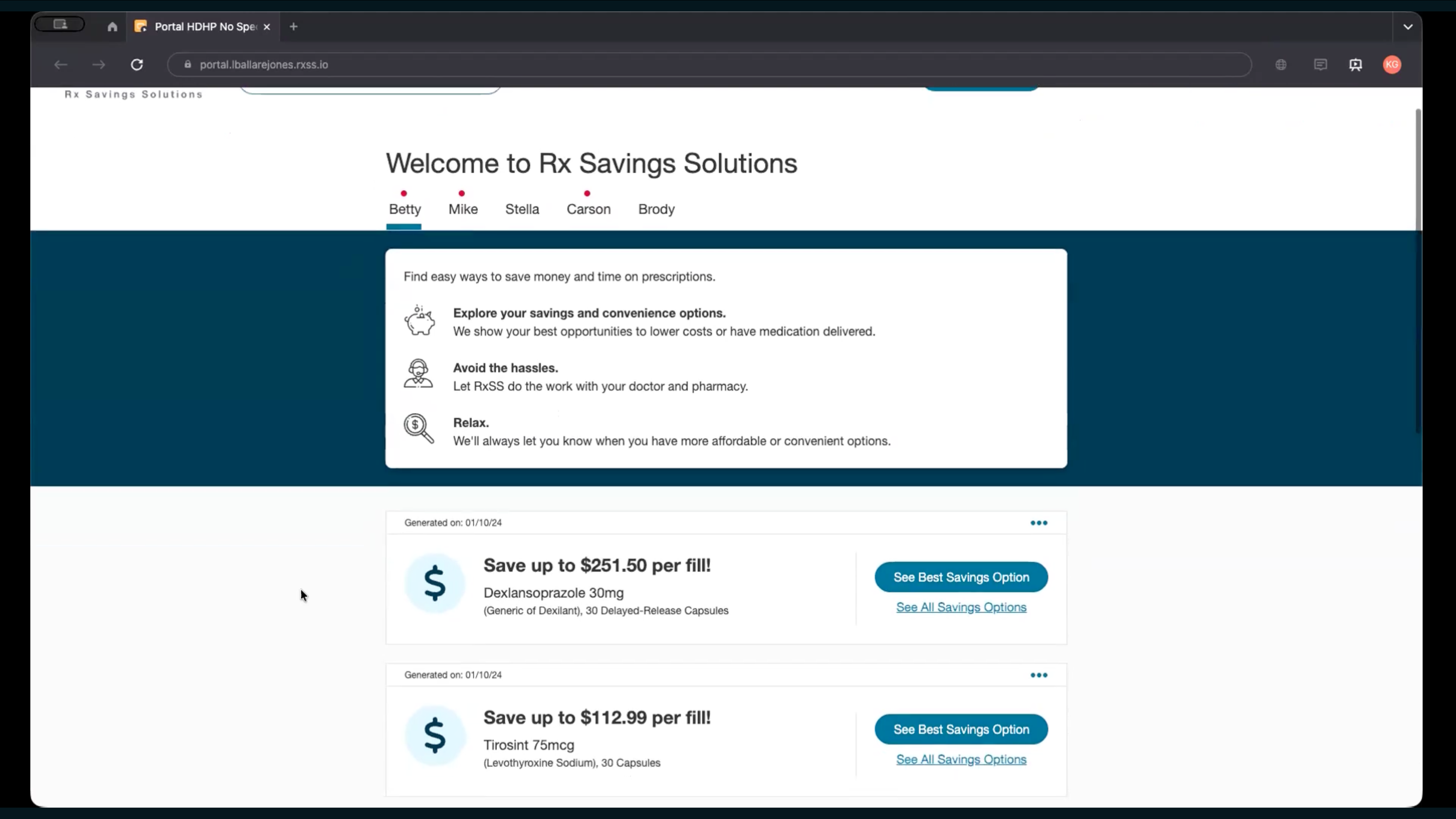
Caption: Image: An RxSS demo, simulated by Demostack. Presented in every sales call
With Demostack, the team clones and fully simulates the product environment whenever a new feature ships or a new clinical story emerges. Sales reps especially benefit from being able to spin up a fresh savings story around a hot drug within hours, instead of waiting months for it to be reflected in the internal portal.
## Keeping PHI out of the sales motion
Pharmacy benefit data is unusually sensitive. RxSS wanted demos that were completely free of PHI, so using internal patient data in market-facing conversations was never an option. The underlying systems didn't help: they were clunky, prone to crashing, and unable to surface a realistic patient on a specific drug with meaningful out-of-pocket spending. The problem compounded late in the plan year, when most members had already hit their out-of-pocket maximums. The savings stories RxSS most needed to tell no longer existed in live claims data.
Demostack solves both problems at once. RxSS now builds curated demo snapshots showing a specific cost on a specific drug at a specific point in time, with full control over which drugs appear. That means the team can tailor the demo for any audience and, critically, remove competitor products before sales calls with pharmaceutical manufacturers. The simulated data is detailed enough to be persuasive, but controlled enough to be safe.
_“Before Demostack, building a credible demo was painful and slow. Now we build ‘golden nuggets'",_ Keith Gaetano, Director of Pharmacy, RxSS.
## The human touch behind the tech
While Demostack makes day-to-day demo work fast and self-serve, the more complex builds are where the team's partnership shines. Through a shared sandbox, Demostack's Customer Success and Solutions Engineering teams work directly with RxSS to shape sophisticated demos, often ahead of major customer presentations. Keith calls it "awesome customer service" paired with the right functionality, the combination that makes the platform usable at the pace pharmacy benefits demand.
## Staying ahead as competition intensifies
RxSS is a category leader. But as the landscape becomes more crowded, the team knows that giving the market an actual product experience is critical. "The pharmacy benefit navigation category looks very different today than it did three years ago," said Keith. RxSS used to walk into RFPs as one of only two providers being evaluated. Now the typical deal involves three or more competitors pitching the same buyer, which stretches sales cycles and raises the bar on every demo.
RxSS is leaning on Demostack to win in that competitive environment. When the next big inflection point hits the market, whether biosimilars, GLP-1s, a new generic, or a pricing shift, RxSS can stand up a credible, market-relevant savings story in days instead of months. The ability to keep the portal feeling current and to spin up tailored stories on demand turns Demostack into a competitive weapon. In a market where buyers are comparing more vendors more carefully, Demostack is how RxSS makes sure its differentiation actually lands in the room.
## Customer Story: Hunters replaces demo environment with Demostack and shortens sales cycle
Source: https://www.demostack.com/customer/hunters
### Challenge
- Extended sales cycles, mostly due to the POC stage
- Resource-heavy POCs
- Increased FinOps cost on spinning up POC environments
- Homegrown demo environment
- Strategic partners need for a controlled demo environment
### Demostack Value
- **50% reduction in many sales cycles:** By creating a new POC motion only made possible with Demostack’s demo Sandbox tech, customers can get a look and feel for Hunter’s product without doing a full POC that needs integrations set up
- **Optimized FinOps cost:** With unlimited Demostack Sandboxes at their disposal, Hunters don't need to connect to their prospect’s cloud environments leading to significant savings
- **Predictable and secure demo environment:** Presales, sales, and partners now don’t need to depend on R&D or product to update their demo environment, rather presales can manage it themselves
- **Optimized use of presales resources:** Instead of spendings weeks setting up a POC, Hunter’s sales engineers can focus on demos and moving the POC forward.
- **Improved prospect prioritization:** Sandbox analytics gives Hunters insight into how serious a customer is and what should be covered in every meeting
### Before Demostack
Hunters, a leader in SOC cybersecurity platforms, faced a common industry challenge: extended sales cycles due to the necessity of a Proof of Concept (POC). Traditional POCs, crucial for validating the effectiveness of cybersecurity solutions, often involved lengthy setups, integration complexities, costly setup, and significant resource allocation. This process not only slowed down sales momentum but also introduced risks and uncertainties into the sales pipeline.
### The Solution
**A new POC motion (Express POC):**
With Demostack, Hunters can send a Sandbox leave-behind to prospects avoiding the need to manually set up a custom POC. By effectively addressing the challenges of traditional POCs, Hunters not only accelerated their sales cycles but also improved resource efficiency, reduced costs, and significantly enhanced the customer evaluation experience. Now Hunters can deliver immediate value without prospects needing to wait any time.
**Monthly FinOps savings**
Companies don’t even realize the amount of money they are spending on spinning up POC and demo environments. With unlimited Demostack Sandboxes at their disposal, Hunters can avoid paying large cloud fees for every prospect.
**Presales demo environment autonomy**
The dependency on R&D or product teams for demo environment updates has been eliminated.
Presales can leverage Demostack and own the demo environment themselves. This makes everyone happier.
**Partners have a dependable demo environment**
Channel sales partners now have a secure and predictable demo where they can confidently showcase Hunter’s product in the first call.
##
About Hunters
Hunters’ SOC platform empowers security teams to automatically identify and respond to incidents that matter across their entire attack surface. Through built-in detection engineering, data correlation, and automatic investigation, they help teams overcome volume, complexity, and false positives. Hunters mitigates real threats faster and more reliably than SIEMs, ultimately reducing customers' overall security risk.
## Customer Story: Gloat unlocks its demo environment potential with Demostack
Source: https://www.demostack.com/customer/gloat
## Challenge
- Live production environment not easily configurable to showcase the range of the product
- Homegrown demo environment was unpredictable and had too many bugs, particularly in showing newly released functionality
- Homegrown demo environment required significant R&D and technical resources, making it impossible to customize demos at scale
- Demos couldn’t easily be customized
- Challenging to share a stable, customized sandbox with prospects after sales calls
## Demostack value
- Gloat’s solution consulting (SC) team now owns the demo environment without reliance on technical teams
- Gloat SCs can customize every demo for each use case and persona
- Gloat’s product marketers create customized demos for analysts, and events, and can now enable confidently
- SCs and AEs can share a trial-like Sandbox environment after a call
## About Gloat
Gloat is an industry-leading Workforce Agility Platform that enables businesses to move like a startup and deliver like an enterprise. Bringing together the world's first AI-powered Talent Marketplace with rich, dynamic Workforce Intelligence, the Gloat platform empowers businesses to develop and deploy their talent, while continuously understanding and adapting their workforce to changing needs. With Gloat, businesses are ready to navigate change at speed, retain critical skill sets, and design a future-proof workforce.
## Before Demostack
Gloat’s demo environment needed support from the product and R&D team. Without full-time support, code ownership, and an actual product owner, the demo environment was filled with bugs and outdated features.
Furthermore, the sales and solution consultant (SC) teams couldn't customize each demo instance. Thus, nearly all demos were generic and not tailored to the prospect. This lack of customization made it difficult for Gloat’s sales team to show the real value of their product. In addition, it was difficult for the product marketing team to prepare for enablement, analyst briefings, and events.
Lastly, Gloat, had no way of showing off its incredible product to its prospects outside of a demo. Since Gloat’s Artificial Intelligence (AI) machine needs a magnitude of data to run, Gloat could not offer a trial. So, Gloat relied heavily on its Solution Consultants (SC) to show off the demo environment during live calls.
## The solution
Demostack has given Gloat’s SC team more autonomy over their demo environment. The sales team is happy, and so are the technical teams. Yoni, the SE and SC team lead, has customized multiple demo templates for many use cases. Each SC can further personalize its demo instance using variables. Plus, SCs and AEs can now share a trial-like Sandbox environment after calls, so prospects can interact with the product and see the potential.
_“With an accurate demo, we now move from helping our buyers imagine how the product looks, to helping our buyers imagine the impact that it's going to have on their organization.”_
And, Noelle can now enable the sales teams with confidence and easily personalize demos for analyst briefings and events.
Demostack has become the Demo HQ for Gloat.
## Choosing Demostack over competitors
Like many technology companies, the Gloat team was unaware of a technology solution available solving for their demo environment pain points. Multiple cross-organization task forces could only solve the issues if they had unlimited resources.
Yoni Friedman, VP of Sales Engineering & Solution Consulting tried solving Gloat’s demo issues in-house but finally sought an external solution. Yoni and his team tested a few demo experience platforms, but only Demostack could clone Gloat's entire environment within minutes--Yoni needed 40+ hours to do that exact thing with a competing product.
_“Getting our product in front of buyers early in the deal in a customized way, tailored to their use cases and to their problems, has allowed us to close more business quicker.”_
## Customer Story: BlueVoyant leverages Demostack for multi\-million dollar RFP
Source: https://www.demostack.com/customer/bluevoyant-leverages-demostack-for-multi-million-dollar-rfp
## Challenge
- BlueVoyant wanted to better showcase its products and services so customers better understood its value. Three different demo environments were used in the sales process, making the demo environment complicated.
- Sales Engineers (SEs) required on every call.
## Demostack value
- Demostack clones the full experience of what’s shown in the live demo, and allows reps to have their own demo environments, better showcasing BlueVoyant’s products and services.
- Demostack’s ease of use and ability to clone in minutes allows AEs to demo on introductory or discovery calls, so SEs can focus on larger or later stage deals.
## About BlueVoyant
BlueVoyant is an internal and external cyber defense platform that defends business ecosystems against today’s threats by utilizing large, real-time datasets with industry-leading analytics, and technologies. The company’s threat intelligence data detects and quickly responds to cybersecurity risks using intuitive automations to mitigate threats against your attack surface effectively and efficiently.
## Before Demostack
- BlueVoyant was using three different in-house demo environments to manage different aspects of their demo experience, which was difficult to manage
- SEs were required on every call due to this complexity
- BlueVoyant was looking to better showcase the value it brings to customers with its demos
BlueVoyant wanted to improve its demo environment to showcase its advanced technology, data, and analytics in the best light.
## Requirements
- Reduce demo complexity so SEs were no longer needed on every call
- Better showcase BlueVoyant’s value proposition in the demo
- Deliver consistent, repeatable, winning demos
- Reduce the cost of demo upkeep
- Demo environment solution for third-party sellers
To solve this, BlueVoyant identified several key criteria. The team needed a way to demo that was simple enough that any Account Executive could do it without the help of a Sales Engineer. The company also wanted a way to white-label their demo environment for their partners.
Naturally, the solution had to deliver consistent, repeatable demos without any surprise changes and provide access control to prevent surprises.
**_“We were looking for something that was straightforward and easy for our Account Executives and Salespeople to login and show customers without the help of a Sales Engineer,”_** said Bryan Rowland, director of solutions architecture at BlueVoyant.
## Why Demostack
- Execute high quality live demos consistently
- Effective solution with the ease of use
- Ability to update in minutes with zero extraneous work
- Individual demo instances for each user
After comparing and doing proof of concept (PoC) for multiple solutions, including video recording and screenshot-based platforms, BlueVoyant chose Demostack for its ability to clone the full product experience in minutes, plus, how easy it was to edit and make updates.
**_“Demostack is apples to oranges to other demo solutions. What I love about it is that I can log in, grab everything we need, make an update, and demo in minutes, which really sets it apart. In comparison, other solutions require a ton of overhead and maintenance work, since you have to manually link screenshots together to create a demo asset. With Demostack, I can clone the entire experience in seconds,”_** Rowland said.
## Results
- BlueVoyant used Demostack for a multi-million dollar request for proposal (RFP) to better tell the story of its products and services, and showcase elements they otherwise wouldn’t have been able to demo
- AEs can handle intro demo calls without the need for SEs thanks to a much simpler demo environment
- Demostack is the go-to platform for showcasing what BlueVoyant’s products and services can do
- Resources required to manage demo environments were reduced, allowing BlueVoyant to scale faster
Now, BlueVoyant’s sellers can effortlessly run introductory calls without an SE, thanks to Demostack’s ease of use and consistent demos. Those SEs can instead focus on more strategic and later stage deals to ensure their time is spent on the most valuable activities.
Even in a short period of time, Demostack is already adding value to the BlueVoyant team.
**_“We used Demostack for a multi-million dollar RFP and it allowed us to showcase the value of our product with a much stronger story in the demo. That was all the ROI we needed in one call,”_** said Rowland. **_“I would absolutely recommend Demostack to others in software sales. Having a product like Demostack is a game-changer for anyone doing live demos.”_**
## Customer Story: Gainsight increases their win rate by 25%
Source: https://www.demostack.com/customer/gainsight
## Challenge
- **Creating custom demos:** The complex nature of demo customization was a hurdle for Gainsight's sales team, affecting the sales cycle's length and efficiency.
- **Long demo response time**: A previous Service Level Agreement (SLA) of 48 hours for custom demo preparation delayed initial sales conversations, risking the loss of prospect interest and lengthening the sales cycle
- **Cohesive story for multiple products:** The need to integrate multiple products, recently acquired, into a cohesive demo emphasized the importance of an efficient and versatile demo solution
## Demostack Value
- **Increased their win rate by 25**% when using customized demos versus standard demos
- **Faster sales cycles:** Can cut 3 out of 5 demo calls by customizing the first demo and showing the prospect their use case as early as possible
- Significantly **reduced its demo response time**, from 48 hours to an hour, keeping sales momentum strong
- The platform has allowed Gainsight to efficiently integrate and showcase its broad product suite
- Easier to maintain multiple product demo environments
## Choosing Demostack over competitors
Demostack was not the first demo automation software Gainsight bought and onboarded. But the other venture-backed software was too burdensome to manage. It was confusing for admins and took too much time to set up a demo environment.
When the first demo environment was set up, Gainsight's sales team could not veer off the preplanned click-path, limiting sales from answering questions or showing a true technical demo.
In addition, Gainisight could not piece together multiple products together, preventing sales from telling one unified story.
## Before Demostack
**Prospect is waiting days for a demo**
Before Demostack, Gainsight faced significant challenges that impacted its sales cycle and deal closure rates. The process of customizing demos, crucial for winning deals, resulted in prospects waiting days for a personalized demonstration. This delay not only gave competitors an advantage but sometimes led to lost deals altogether.
**Multi-product modules hard to manage and demo**
Gainsight's strategy of expanding its product suite through acquisitions added complexity to demo presentations. Sales teams had to juggle multiple logins and keep numerous tabs open, each product requiring its own demo instance and separate customization.
This setup was not only cumbersome but also prone to distractions and unprofessional moments during presentations, such as unintended pop-up notifications.
## After Demostack
**Gainsight winning more deals**
After implementing Demostack, Gainsight experienced a transformational change in its sales strategy and outcomes. The ability to quickly customize demos meant that prospects could immediately see the value tailored specifically to their needs, significantly reducing the need for multiple demos. This streamlined approach not only accelerated the sales process but also increased the win rate for Gainsight in a highly competitive market where every advantage counts.
**Demo templates at sales fingertips**
Another reason the sales motion is faster is that sales and presales have custom demos at their fingertips. With a demo library, every sales person can select the right demo already tailored to their prospect’s use case. This is especially important for the commercial sales team, who often face prospects expecting a demo early in the sales cycle.
**Complex demos made simple**
With Demo Playbooks, Gainsight's sales team can handle complex, multi-product demonstrations with ease. Sales can easily customize multiple products and launch a multi-product demo in one-click. Sales teams no longer need to log into multiple platforms or manage numerous tabs in preparation for a call.
Demostack's ease of use ensures management that demos are more likely to match the buyers' expectations every time.
## About Gainsight
Gainsight, the world’s leading Customer Success platform, helps businesses drive efficient growth by unifying the post-sales customer journey. Its innovative set of customer success, customer education, product experience, and community management products are used by companies of all sizes and industries, including nearly 200 publicly traded organizations.
## Glossary: POC \(Proof of Concept\)
Source: https://www.demostack.com/glossary/poc-proof-of-concept
## What is a POC (Proof of Concept)?
A demonstration or project that aims to validate the feasibility and practicality of a concept or idea. POCs are typically used in the early stages of product development to showcase key functionalities and assess whether the proposed solution can meet specific requirements or solve a problem effectively.
## Glossary: Demo Vignette
Source: https://www.demostack.com/glossary/demo-vignette
## What is a Demo Vignette?
A brief, focused demonstration highlighting a specific aspect or feature of a product. Demo vignettes are concise and tailored to address particular interests or concerns of the audience, providing targeted insights into the product's functionality.
## Glossary: Interactive Demo
Source: https://www.demostack.com/glossary/interactive-demo
## What is an Interactive Demo?
A dynamic demonstration that allows users to actively engage with a product or service. Interactive demos often feature hands-on experiences, enabling users to explore features, simulate usage, and gain a better understanding of the product's capabilities.
## Glossary: Running a POV
Source: https://www.demostack.com/glossary/running-a-pov
## Why Should a SaaS Company Run a POV?
Running a Proof of Value (POV) is a valuable strategy for SaaS companies for several reasons. By implementing a POV, SaaS companies can:
### Demonstrating Product Value to Potential Customers
Running a POV allows SaaS companies to showcase the value and capabilities of their product to potential customers. By providing a hands-on experience, users can see firsthand how the software can solve their specific pain points and meet their unique needs. This tangible demonstration helps prospects understand the potential benefits of the product and increases their confidence in its effectiveness.
### Building Trust and Credibility with Prospects
A POV helps establish trust and credibility with prospects by enabling them to experience the product before making a purchasing decision. By giving potential customers an opportunity to interact with the software and validate its performance, SaaS companies can eliminate skepticism and build confidence in their offerings. This transparency and willingness to let prospects test drive the product fosters trust in the company and its ability to deliver on its promises.
### Identifying and Addressing Specific Customer Challenges and Needs
During a POV, SaaS companies gain valuable insights into the specific challenges and needs of their potential customers. By analyzing user interactions and feedback, companies can identify pain points, understand user preferences, and gather relevant data to enhance the product and tailor it to the needs of their target audience. This information is crucial for refining the product and aligning it with customer expectations, maximizing its value proposition.
### Differentiating from Competitors
Running a POV sets SaaS companies apart from their competitors by offering a highly personalized and interactive experience. While competitors may rely on traditional sales demos or marketing collateral, a POV allows users to engage directly with the product and evaluate its performance in real-world scenarios. This hands-on approach demonstrates the uniqueness and superiority of the SaaS company's offerings, making it more compelling and memorable for potential customers.
### Increasing the Chances of Closing the Deal
One of the primary objectives of running a POV is to increase the chances of closing the deal. By immersing potential customers in a tailored and interactive experience, SaaS companies can effectively address their needs, solve their pain points, and present a compelling case for why their product is the best solution. This personalized and immersive approach significantly enhances the probability of converting leads into paying customers and accelerating the sales cycle.
In conclusion, running a Proof of Value is a strategic approach that provides numerous benefits for SaaS companies. It enables them to showcase product value, build trust and credibility, identify customer challenges, differentiate from competitors, and increase the likelihood of closing deals. By leveraging the power of a POV, SaaS companies can enhance their sales and marketing efforts, drive customer engagement, and ultimately drive revenue growth.
## How to Plan and Prepare for a POV
Planning and preparing for a Proof of Value (POV) is crucial to ensure its success and maximize the chances of converting the prospect into a paying customer. Here are some key steps to follow when planning and preparing for a POV:
### 1. Understanding the Customer's Goals and Pain Points
Before starting a POV, it is important to thoroughly understand the customer's goals and pain points. What are they trying to achieve with the software? What are their specific challenges or pain points that they hope the solution will address? By gaining this understanding, you can tailor the POV experience to focus on the aspects of your software that are most relevant to the customer's needs.
### 2. Defining Clear Success Criteria for the POV
It is essential to define clear success criteria for the POV to measure its effectiveness. Success criteria should be measurable and aligned with the customer's goals. For example, if the customer's goal is to increase sales by a certain percentage, success criteria could include achieving a specific revenue target during the POV period. Defining these criteria upfront helps set expectations and provides a benchmark for evaluating the results of the POV.
### 3. Setting Realistic Expectations for the Customer
It is crucial to set realistic expectations for the customer regarding what the POV can achieve. Make sure to communicate the limitations and scope of the POV, as well as what it can realistically demonstrate. This helps prevent any misunderstandings or disappointment on the customer's end and ensures that they have a clear understanding of what to expect from the POV.
### 4. Collaborating with the Customer to Determine the Scope and Timeline of the POV
Collaboration with the customer is essential when determining the scope and timeline of the POV. Work closely with the customer to understand their availability, priorities, and any constraints that may impact the POV. This collaboration ensures that the POV is tailored to the customer's needs and aligns with their schedule, increasing the chances of a successful outcome.
### 5. Aligning Internal Resources and Support for the POV
Ensure that the necessary internal resources and support are available and aligned for the POV. This may include technical experts, customer success managers, or other team members who will be involved in the POV process. By ensuring proper support and resources, you can address any potential issues or challenges that may arise during the POV and provide the customer with a smooth and seamless experience.
By following these steps and thoroughly planning and preparing for a POV, you can maximize its effectiveness and increase the chances of converting the prospect into a satisfied customer.
## Best Practices for Running a Successful Proof of Value (POV)
When it comes to running a successful Proof of Value (POV), there are certain best practices that can greatly enhance the overall experience and increase the chances of turning the POV into a successful sale. Let's explore some of these best practices in detail:
### Customizing the POV to the customer's specific needs
One of the key factors in running a successful POV is tailoring it to the specific needs and requirements of the customer. Every customer is unique, with varying pain points and objectives. By taking the time to understand the customer's business goals and challenges, you can customize the POV experience to align with their specific needs.
To effectively customize the POV, it's important to gather detailed information about the customer's pain points, desired outcomes, and any specific use cases they would like to explore. This information will help you design a POV that addresses their specific requirements, making it more relevant and impactful.
### Providing hands-on training and support during the POV
During the POV, it's crucial to provide hands-on training and support to the customer. This ensures they have the necessary guidance to effectively navigate and utilize the features and functionalities of your solution.
To provide effective training and support, consider offering interactive demos, video tutorials, user guides, and live assistance. By empowering the customer with the knowledge and skills they need to fully utilize your solution, you increase their confidence and overall satisfaction with the POV.
### Regularly communicating with the customer to ensure their needs are met
Continuous communication with the customer throughout the POV is essential to keep them engaged and address any concerns or questions they may have. Regular check-ins allow you to gauge their level of satisfaction, identify any potential roadblocks, and make necessary adjustments to ensure their needs are being met.
Consider scheduling regular meetings or calls to discuss the progress of the POV, gather feedback, and address any issues or challenges that arise. By maintaining open lines of communication, you can build trust and strengthen your relationship with the customer.
### Collecting and analyzing data to measure the success of the POV
To objectively evaluate the success of the POV, it's important to collect and analyze relevant data. This data could include metrics such as usage statistics, conversion rates, cost savings, or any other key performance indicators (KPIs) that align with the customer's goals.
By tracking and analyzing this data, you can measure the impact of your solution during the POV and provide concrete evidence of its value. This data-driven approach not only helps you assess the success of the POV but also enables you to make data-backed recommendations and insights to the customer.
### Documenting the results and preparing a compelling ROI analysis
Lastly, it's crucial to document the results of the POV and prepare a compelling return on investment (ROI) analysis. This documentation serves as a powerful tool to showcase the value and effectiveness of your solution to the customer.
In the ROI analysis, highlight the quantifiable benefits and cost savings that the customer can expect to achieve by using your solution. This analysis should be based on the data collected during the POV, as well as any industry benchmarks or case studies that support your claims.
By documenting and presenting a compelling ROI analysis, you provide the customer with a clear understanding of the potential benefits they can derive from investing in your solution, reinforcing their decision to move forward with the purchase.
In conclusion, by following these best practices for running a successful POV, you can maximize the chances of converting the POV into a successful sale. Customizing the POV, providing hands-on training and support, regularly communicating with the customer, collecting and analyzing data, and preparing a compelling ROI analysis are key steps in ensuring a positive and impactful POV experience.
## Common Challenges and How to Overcome Them
### Lack of Alignment between Sales, Pre-Sales, and Delivery Teams
One of the common challenges in the SaaS sales cycle is the lack of alignment between the sales, pre-sales, and delivery teams. When these teams are not on the same page, it can lead to confusion, miscommunication, and ultimately hinder the progress of the sales demo.
To overcome this challenge, it is important to establish effective communication channels and regular meetings among the teams. This ensures that everyone understands the goals and objectives of the sales demo and can work together towards achieving them. Additionally, providing clear guidelines and documentation about the roles and responsibilities of each team can help align them and promote collaboration.
### Unclear Objectives and Success Criteria for the Proof of Value (POV)
Another challenge that may arise in the SaaS sales cycle is having unclear objectives and success criteria for the Proof of Value (POV). The POV is a critical stage in the sales process where the customer evaluates the software solution and determines its value.
To overcome this challenge, it is essential to have a thorough understanding of the customer's needs and requirements. By conducting a detailed discovery process, the sales team can gather the necessary information to define clear objectives and success criteria for the POV. It is important to involve the customer in this process to ensure their expectations are aligned with the goals of the POV.
### Difficulty in Accessing Customer Data or Systems for the POV
Accessing customer data or systems can be a challenge during the POV stage of the SaaS sales cycle. This can hinder the ability to showcase the full capabilities of the software solution and demonstrate its value to the customer.
To overcome this challenge, it is crucial to establish a strong relationship with the customer's IT or technical team. By working closely with them, the sales and pre-sales teams can address any data or system access issues early on and find suitable solutions. It may involve providing secure access mechanisms or using simulated or anonymized data for the POV.
### Managing Customer Expectations during the POV
Managing customer expectations is always important, but it becomes particularly challenging during the POV stage of the SaaS sales cycle. Customers may have high expectations and specific requirements that need to be met for them to consider the software solution as a viable option.
To overcome this challenge, it is important to set realistic expectations from the beginning. Clearly communicate what the POV can and cannot achieve, and ensure that the customer understands the limitations and scope of the evaluation. Regularly communicate updates and progress to manage expectations effectively and address any concerns or issues promptly.
### Dealing with Unexpected Issues or Roadblocks during the POV
Even with proper planning and preparation, unexpected issues or roadblocks can arise during the POV stage of the SaaS sales cycle. These can include technical glitches, compatibility issues, or unforeseen constraints that impact the smooth execution of the POV.
To overcome this challenge, it is important to have contingency plans in place. Anticipate potential issues and devise alternative approaches or workarounds to keep the POV on track. It is also important to have a dedicated support team available to quickly address any issues that may arise during the POV and minimize their impact on the overall evaluation process.
By addressing and overcoming these common challenges in the SaaS sales cycle, sales teams can ensure a smoother and more successful sales demo experience for both themselves and their customers.
## Glossary: Tell Show Tell
Source: https://www.demostack.com/glossary/tell-show-tell
## What is the Tell Show Tell technique?
A presentation technique that involves explaining a concept or feature (Tell), demonstrating it in action (Show), and then summarizing or reinforcing key points (Tell). This approach enhances understanding by combining verbal explanation with visual demonstration.
## Glossary: Sales Forecasting
Source: https://www.demostack.com/glossary/sales-forecasting
## Why is Sales Forecasting Necessary?
Sales forecasting is a critical process for businesses of all sizes and industries. It plays a vital role in various aspects of the sales cycle and provides valuable insights and information that drive decision-making and strategic planning. Let's explore the importance of sales forecasting in more detail:
### 1. Helps in Setting Sales Targets and Goals
Sales forecasting acts as a foundation for setting sales targets and goals. By analyzing historical data, market trends, and customer behavior, businesses can make informed projections of future sales performance. These forecasts enable organizations to establish realistic and achievable sales targets, which in turn can motivate sales teams and guide their efforts.
### 2. Guides Resource Allocation and Budgeting Decisions
Accurate sales forecasting is essential for effective resource allocation and budgeting decisions. By estimating future sales volumes, businesses can determine the amount of resources, such as personnel, technology, and marketing, required to meet projected demand. This helps optimize resource allocation and avoid over or underinvesting in various departments or areas within the organization.
### 3. Facilitates Effective Inventory Management and Production Planning
Sales forecasting also plays a crucial role in inventory management and production planning. By predicting future sales volumes, businesses can anticipate demand fluctuations and adjust their inventory levels accordingly. This prevents stockouts or excess inventory, leading to improved customer satisfaction and cost savings. Additionally, accurate sales forecasts help optimize production planning by aligning production schedules with anticipated demand.
### 4. Assists in Identifying Potential Sales Opportunities and Risks
Sales forecasting enables businesses to identify potential sales opportunities and risks. By analyzing market trends, customer behavior, and competitor activities, organizations can anticipate changes in the market and identify areas of growth. This allows businesses to proactively pursue new opportunities and develop strategies to mitigate potential risks, such as market saturation or economic downturns.
### 5. Supports Decision-Making and Strategic Planning
Sales forecasting provides valuable information for decision-making and strategic planning. By understanding expected sales performance, businesses can make informed decisions regarding product development, pricing strategies, market expansion, and sales and marketing initiatives. Sales forecasts serve as a basis for evaluating the feasibility and profitability of various business strategies, enabling organizations to make sound, data-driven decisions.
In conclusion, sales forecasting is essential for businesses as it helps in setting sales targets, guides resource allocation and budgeting decisions, facilitates effective inventory management and production planning, assists in identifying potential sales opportunities and risks, and supports decision-making and strategic planning. By leveraging accurate sales forecasts, organizations can enhance their sales performance, optimize operations, and achieve long-term success.
## III. Types of Sales Forecasting
Sales forecasting is an essential component of strategic planning for businesses. It involves estimating future sales performance based on historical data, market trends, and other relevant factors. There are two main types of sales forecasting methods: qualitative and quantitative.
### A. Qualitative Sales Forecasting Methods
Qualitative sales forecasting methods rely on expert opinion, judgment, and market research to predict future sales. These methods are subjective and involve gathering insights from experienced individuals or customers to make informed forecasts. Here are some common qualitative sales forecasting methods:
#### a. Expert Opinion and Judgment
Expert opinion and judgment involve seeking input from industry experts or individuals with deep knowledge and experience in the market. These experts use their insights and intuition to make educated estimations about future sales. This method is particularly useful when there is limited data or when market conditions are uncertain.
#### b. Market Research and Surveys
Market research and surveys collect data from customers, prospects, and industry sources to understand consumer preferences, buying behavior, and market dynamics. This information helps in determining potential demand and sales patterns. Surveys can be conducted through online questionnaires, face-to-face interviews, or focus groups.
#### c. Delphi Technique
The Delphi technique is a structured method of gathering multiple expert opinions to reach a consensus on sales forecasts. It involves a series of questionnaires where experts provide their forecasts anonymously. These responses are then compiled and shared with the experts again for further refinement until a consensus is reached. This method is useful when forecasting in complex and uncertain environments.
### B. Quantitative Sales Forecasting Methods
Quantitative sales forecasting methods rely on historical data and mathematical models to predict future sales. These methods are objective and involve analyzing numerical patterns and trends. Here are some common quantitative sales forecasting methods:
#### a. Time Series Analysis
Time series analysis examines historical sales data to identify recurring patterns and trends. It involves measuring quantitative variables like sales volume, revenue, or units sold over a defined period. This data is then used to forecast future sales using statistical models and algorithms.
#### b. Regression Analysis
Regression analysis is a statistical technique that examines the relationship between dependent and independent variables. In sales forecasting, it helps identify how changes in factors like advertising expenditure, pricing, or economic indicators impact sales. By analyzing historical data, regression models can be used to predict future sales based on these variables.
#### c. Seasonal Forecasting
Seasonal forecasting focuses on capturing periodic fluctuations in sales due to seasonal variations. This method acknowledges that sales may vary throughout the year due to factors such as holidays, weather, or cultural events. Historical sales data is used to identify seasonal patterns, which are then applied to forecast future sales during specific time periods.
#### d. Trend Analysis
Trend analysis examines how sales have been changing over time to identify upward or downward trends. It involves plotting historical sales data on a graph and fitting a trend line to visualize the overall direction of sales. This trend line can then be extended to forecast future sales based on the observed patterns.
By using a combination of qualitative and quantitative sales forecasting methods, businesses can gain valuable insights into future sales performance. These forecasts aid in strategic decision-making, resource planning, and setting realistic sales targets.
## Steps in the Sales Forecasting Process
Sales forecasting is a critical component of the sales cycle that helps businesses plan and set realistic targets for future sales. By analyzing historical data, market trends, and customer behavior, organizations can make informed decisions about their sales strategies and resource allocation. Here are the key steps involved in the sales forecasting process:
### Data Collection and Analysis
1. **Gathering Historical Sales Data**: The first step in the sales forecasting process is to collect and organize historical sales data. This can include information on past sales volumes, revenue, customer demographics, and any other relevant data points. By analyzing this data, businesses can identify patterns, trends, and seasonal variations that can inform future projections.
2. **Analyzing Market Trends and Customer Behavior**: To accurately forecast sales, it is essential to consider market trends and customer behavior. This involves analyzing industry reports, market research data, and customer feedback to gain insights into factors that may impact sales. By understanding customer preferences, market dynamics, and competitive forces, organizations can make more accurate sales projections.
### Choosing the Appropriate Forecasting Method
1. **Considering the Nature of the Product or Service**: Different products and services may require different forecasting methods. For example, sales of seasonal products may require a seasonal forecasting model, while sales of long-term investments may require a trend analysis approach. It is important to consider the unique characteristics and demands of the product or service when selecting a forecasting method.
2. **Evaluating the Available Data and Resources**: The availability and quality of data can impact the choice of forecasting method. Organizations must evaluate the data they have on hand, as well as the resources and expertise available to perform the analysis. This evaluation ensures that the selected forecasting method is both feasible and reliable.
### Developing the Forecast
1. **Applying the Chosen Forecasting Method**: Once the forecasting method has been selected, it is time to apply it to the available data. This typically involves using statistical models, time-series analysis, or other quantitative techniques to generate sales projections. The chosen method should be applied consistently and systematically to ensure accuracy and reliability.
2. **Calculating Future Sales Projections**: Using the selected forecasting method, future sales projections can be calculated. This involves forecasting sales for a specific time period, such as a month, quarter, or year. The projections should take into account factors such as market conditions, customer behavior, and any other relevant variables identified during the analysis process.
### Monitoring and Revising the Forecast
1. **Comparing the Forecasted Results with Actual Outcomes**: Once the forecasted sales period has passed, it is important to compare the projected sales with the actual outcomes. This allows organizations to assess the accuracy of their forecast and identify any gaps or discrepancies. Understanding the reasons for any deviations between the forecasted and actual results can help refine future forecasts.
2. **Adjusting the Forecast Based on New Information or Changing Market Conditions**: Sales forecasts are not set in stone and should be continuously monitored and revised based on new information or changing market conditions. This can include factors such as shifts in customer preferences, changes in competitive landscape, or unforeseen events that may impact sales. Regularly updating the forecast ensures its relevance and helps organizations adapt their sales strategies accordingly.
By following these steps in the sales forecasting process, businesses can make informed decisions, set realistic sales targets, and allocate resources more effectively. This contributes to a more efficient and proactive sales cycle, ultimately driving business growth and success
## Best Practices for Sales Forecasting
Sales forecasting is an essential part of the SaaS sales cycle that allows businesses to make informed decisions and plan for the future. By accurately predicting sales results, companies can allocate resources effectively, set realistic goals, and identify potential areas for improvement. Here are some best practices to consider when it comes to sales forecasting:
### Regularly update and review the forecast
To ensure the accuracy of your sales forecast, it is crucial to regularly update and review it. Market conditions and customer behavior can change rapidly, so it's essential to revisit your forecast on a regular basis. This will help you stay agile and respond quickly to any shifts or trends in the market. Additionally, incorporating new data and adjusting your projections as needed will provide a more realistic view of your sales performance.
### Collaborate with different departments
Sales forecasting shouldn't be done in isolation. By seeking input from various departments, such as sales, marketing, and finance, you can gain valuable insights and perspectives that will improve the accuracy of your forecast. Sales teams can provide on-the-ground knowledge and insights into customer behavior, while marketing teams can contribute market research and campaign data. Finance teams can provide a broader financial context and help align your forecast with the company's overall goals.
### Use a combination of forecasting methods
To enhance the accuracy of your sales forecast, it's recommended to use a combination of forecasting methods. Qualitative methods, such as expert opinions or market surveys, can provide valuable insights into customer preferences and market trends. Quantitative methods, such as historical data analysis and statistical models, can help you identify trends and patterns in your sales data. By combining both qualitative and quantitative approaches, you can generate more accurate predictions and reduce the risk of bias or errors.
### Consider external factors and market conditions
Sales forecasting should not solely rely on internal data and historical trends. It's essential to consider external factors and market conditions that may influence your sales. Analyzing the impact of economic trends, industry changes, or regulatory developments can help you identify potential risks and opportunities. Additionally, monitoring your competitors and their market share can provide insights into your competitive positioning and market dynamics.
By following these best practices, businesses can improve the accuracy of their sales forecasting and make more informed decisions. Regularly updating and reviewing the forecast, collaborating with different departments, using a combination of forecasting methods, and considering external factors will help businesses navigate the complexities of the sales cycle and drive revenue growth.
## Glossary: Micro Demo
Source: https://www.demostack.com/glossary/micro-demo
## Why Should You Use a Micro Demo?
A micro demo is a shortened version of a product demonstration that focuses on showcasing key features and value quickly. This condensed format offers several benefits that make it a valuable tool in the SaaS sales cycle.
### Benefits of Using a Micro Demo:
1. **Increased engagement and interest from prospects:** A micro demo captivates prospects by delivering a concise and impactful overview of the product. By highlighting key features and demonstrating immediate value, it captures the attention of potential customers, making them more likely to stay engaged throughout the demo.
2. **Ability to showcase key features and value quickly:** Traditional product demos can be time-consuming and overwhelming. In contrast, a micro demo presents the most important features and functionalities in a short amount of time, allowing prospects to quickly understand the product's value proposition. This condensed approach ensures that prospects see the most relevant aspects, increasing their understanding and interest in the product.
3. **Efficient use of time for both the seller and the prospect:** The shorter duration of a micro demo makes it well-suited for busy prospects and sales reps with limited time. It allows the seller to deliver a compelling demonstration without taking up too much of the prospect's schedule. Additionally, from the seller's perspective, conducting micro demos enables them to fit more demos into their schedule, leading to increased efficiency and productivity.
4. **Flexible and adaptable to different sales scenarios:** Micro demos can be easily tailored to address specific pain points and unique needs of different prospects. This versatility allows sellers to customize their pitch and focus on the aspects of the product that are most relevant to each individual prospect. By showcasing the specific value and benefits that resonate with the prospect, a micro demo increases the chances of converting leads into customers.
5. **Supports the virtual selling environment**: In today's digital landscape, virtual selling has become the norm. Micro demos are particularly effective in the virtual space as they can easily be delivered remotely via screen sharing or pre-recorded videos. This flexibility makes it convenient for both the seller and the prospect to conduct and experience the demo from anywhere, eliminating the need for in-person interactions.
Overall, the use of micro demos in the sales cycle offers numerous advantages. It increases engagement and interest from prospects, allows for a focused presentation of key features and value, efficiently utilizes time, adapts to different sales scenarios, and fits seamlessly into the virtual selling environment. Incorporating micro demos into your sales strategy can help accelerate the sales process and lead to more successful outcomes.
## How to Prepare for a Micro demo
Preparing for a micro demo involves several important steps that will help you deliver a tailored and effective presentation to your audience. By understanding your audience, identifying key pain points, and creating a compelling script, you can ensure your demo resonates with your prospects and increases your chances of winning the deal.
### Understanding Your Audience and Tailoring the Demo to Their Needs
Before diving into your demo preparation, it is crucial to have a deep understanding of your audience. Take the time to research and gather information about their industry, role, pain points, and goals. This knowledge will allow you to tailor your demo specifically to their needs, making it more relevant and impactful.
Here are a few key considerations when understanding your audience and tailoring your demo:
1. **Industry-specific language:** Speak the language of your audience to establish credibility and demonstrate an understanding of their challenges and goals.
2. **Focus on pain points:** Identify the pain points your audience is experiencing and highlight how your product can solve those pain points. Frame your demo around addressing these specific challenges.
3. **Customize the demo flow:** Adapt the flow of your demo to align with your audience's specific needs and priorities. Provide relevant examples and use cases that resonate with their industry or role.
4. **Highlight unique value propositions:** Showcase the unique features and benefits of your product that directly address your audience's pain points and differentiate you from your competitors.
### Identifying the Key Pain Points Your Product Solves
To make your micro demo truly impactful, it is essential to identify and focus on the key pain points that your product can solve for your prospects. By addressing their pain points directly, you can demonstrate the value and relevance of your solution.
Follow these steps to identify the key pain points your product solves:
1. **Research and analyze:** Conduct thorough market research and customer interviews to understand the common pain points in your target market. Look for patterns and recurring challenges.
2. **Prioritize pain points:** Rank the identified pain points based on their significance and prevalence in your target audience. Focus on the pain points that are most critical and can be effectively addressed by your product.
3. **Align with your product's strengths:** Evaluate how your product's features, capabilities, and unique value propositions align with the identified pain points. Highlight the specific ways your product can alleviate these challenges.
4. **Quantify the impact:** Whenever possible, quantify the impact that your product can have on addressing each pain point. Use metrics, case studies, and testimonials to provide concrete evidence of your solution's effectiveness.
### Creating a Concise and Compelling Script for the Demo
A well-crafted script is vital for delivering a smooth and persuasive micro demo. It ensures that your presentation stays focused, coherent, and highlights the most important aspects of your product. By following a clear script, you can effectively communicate your message and capture your audience's attention.
Consider the following tips when creating your demo script:
1. **Structural organization:** Divide your demo into logical sections, starting with a strong introduction that grabs attention, followed by a clear presentation of features, and ending with a powerful conclusion that reinforces key takeaways.
2. **Clear messaging:** Craft concise and clear messaging for each section of your demo. Use simple language and avoid jargon to ensure your audience easily understands the value and benefits of your product.
3. **Engaging storytelling:** Weave a compelling narrative throughout your demo, using stories, examples, and testimonials to highlight the real-world impact of your product. This helps to engage your audience and create an emotional connection.
4. **Demonstration flow:** Plan the flow of your demo to showcase key features, benefits, and use cases in a logical sequence. Make sure to allocate sufficient time for each section and avoid overwhelming your audience with too much information.
By following these preparation guidelines, you can maximize the impact of your micro demo and increase your chances of successfully closing deals. Remember to continually refine and improve your approach based on audience feedback and market insights to stay ahead of the competition.
## Tips for conducting a successful Micro demo
Conducting a successful micro demo requires careful planning and execution. Here are some tips to help you make the most out of your micro demo:
### Keeping the demo focused and concise
1. **Clearly define your objectives:** Before starting the micro demo, identify the specific goals you want to achieve. Whether it's showcasing a particular feature or addressing a specific pain point, having clear objectives will help you stay focused throughout the demo.
2. **Stick to the key messages:** Keep your messaging concise and on point. Avoid going into unnecessary details that may distract your audience from the main purpose of the demo. Highlight the key benefits and value propositions that align with your audience's needs.
3. **Structure the demo flow:** Plan the flow of your demo in a logical sequence that guides your audience through the most important aspects of your product. Use a storyboard or demo script to ensure a smooth and organized presentation.
4. **Time management:** Micro demos are meant to be short and time-efficient. Be mindful of time constraints and make sure you cover the essential points within the allocated time. Avoid rushing through the demo or going over time, as both can negatively impact the audience's experience.
### Using visually appealing and interactive elements
1. **Use high-quality visuals:** Incorporate visually appealing elements such as graphics, images, or videos to enhance the overall presentation. Choose visuals that are clear, easy to understand, and align with your brand identity.
2. **Demonstrate interactivity:** Showcase how your product works by actively involving your audience in the demo. Allow them to interact with the product through guided exercises or simulations. This not only makes the demo more engaging but also helps in understanding the product's functionality.
3. **Highlight key features:** Instead of overwhelming your audience with a laundry list of features, focus on demonstrating the most impactful and unique features of your product. Highlighting these features will help showcase the value your product brings to the table.
### Addressing questions and objections effectively
1. **Encourage audience participation:** During the micro demo, encourage your audience to ask questions or provide feedback. Actively listen to their concerns and address them promptly. This will not only help create a more interactive experience but also build trust and credibility with your audience.
2. **Prepare for common objections:** Anticipate potential objections that your audience may have and come prepared with persuasive responses. Address objections with robust explanations, case studies, or testimonials that highlight the benefits and success stories of your product.
3. **Adapt to audience needs:** Pay attention to the specific needs and pain points of your audience and tailor your demo accordingly. Show how your product can address their challenges and provide practical solutions. Personalizing the demo experience will enhance its effectiveness.
Remember, a successful micro demo is not just about showcasing your product. It is also about creating a personalized and engaging experience that resonates with your audience. By following these tips and adapting them to your unique context, you can increase your chances of winning over prospects and closing deals more effectively.
## Best Practices for Following Up After a Micro Demo
After conducting a Micro demo, it is essential to follow up effectively to maintain momentum and continue nurturing the prospect's interest. This section will outline three best practices for following up after a Micro demo.
### 1. Sharing additional resources and information with prospects
One of the key objectives of a Micro demo is to provide prospects with a brief and focused overview of your product or service. However, it is crucial to remember that a Micro demo is just the beginning of the sales cycle. To maintain engagement and help prospects make an informed purchase decision, it is essential to share additional resources and information with them.
By providing relevant whitepapers, case studies, product brochures, or video tutorials, you enable prospects to delve deeper into your offering and understand its value proposition.
These resources can address specific pain points or demonstrate how your solution has benefited similar clients in the past. Sharing such materials showcases your expertise and ensures prospects have access to comprehensive information to aid their decision-making process.
### 2. Ensuring timely and personalized follow-up communication
Timely follow-up communication after a Micro demo is vital to maintain engagement and keep the prospect interested. Make it a priority to follow up within 24 to 48 hours after the demo to capitalize on the momentum generated during the session. This promptness demonstrates your commitment and professionalism.
When following up, personalize the communication based on the prospect's specific needs and pain points discussed during the demo.
Reference specific features or use cases that align with their requirements to reinforce the relevance and value of your offering. Address any questions or concerns raised during the demo and provide clarification or additional details as needed.
Using a personalized approach helps establish rapport and builds trust with the prospect. It shows that you understand their unique challenges and are invested in finding a tailored solution for their business.
### 3. Tracking and measuring the impact of the Micro demo on the sales process
To evaluate the effectiveness of your Micro demo and make data-driven improvements, it is crucial to track and measure its impact on the sales process.
Doing so allows you to assess how well the demo is converting prospects into qualified leads or moving them further along the sales funnel.
Implementing a robust tracking system allows you to monitor key metrics such as conversion rates, lead engagement, or deal velocity.
By tracking these metrics, you can identify areas of improvement in your Micro demo strategy and make data-backed decisions to optimize future demos.
Consider leveraging customer relationship management (CRM) software or analytics tools to automate the tracking process. These tools can provide valuable insights into prospect behavior, enable effective lead nurturing, and help you refine your overall sales strategy.
Following these best practices for following up after a Micro demo will enhance the effectiveness of your sales cycle.
By sharing additional resources, ensuring timely and personalized follow-up communication, and tracking the impact of the demo, you can nurture prospects more effectively and increase conversion rates.
## Glossary: Sales Demo Personalization
Source: https://www.demostack.com/glossary/sales-demo-personalization
## Why is Sales Demo Personalization Crucial in the SaaS Industry?
In the highly competitive SaaS (Software as a Service) industry, sales demo personalization plays a crucial role in gaining a competitive edge and driving conversions. By tailoring demos to meet the specific needs and pain points of potential customers, SaaS companies can effectively showcase the value their products provide and build trust and credibility with prospects. Let's explore why sales demo personalization is so essential in the SaaS industry.
### 1. Differentiation in a Competitive Market
The SaaS market is crowded with numerous companies offering similar products and functionalities. To stand out from the competition, SaaS companies need to differentiate themselves and highlight what sets them apart. Sales demo personalization allows companies to showcase how their product can specifically address the unique pain points and challenges of potential customers. By personalizing the demo to demonstrate how the product aligns with the prospect's specific requirements, SaaS companies can differentiate their offering and leave a lasting impression.
### 2. Addressing Specific Pain Points
One of the key advantages of sales demo personalization is its ability to address the specific pain points of potential customers. Every business has unique challenges that they are looking to solve with a SaaS solution. By understanding and incorporating these pain points into the demo, SaaS companies can show how their product can directly alleviate those pain points. This tailored approach resonates with prospects, as it demonstrates that the SaaS company understands their needs and has a solution to their specific challenges.
### 3. Building Trust and Credibility
Sales demo personalization plays a vital role in building trust and credibility with prospects. When prospects see that the sales team is taking the time to understand their specific pain points and customize the demo accordingly, it instills confidence in the SaaS company's ability to deliver value. Personalized demos create a sense of empathy and reliability, fostering trust in the prospect's mind. Trust is a crucial factor in the decision-making process, as potential customers want to partner with companies they feel confident in.
In conclusion, sales demo personalization is crucial in the SaaS industry due to the highly competitive market and the need for differentiation. Personalized demos address the specific pain points of potential customers, showcasing how the SaaS product can effectively solve their challenges. Moreover, this personalization builds trust and credibility with prospects, increasing the likelihood of conversion. SaaS companies that prioritize sales demo personalization are well-positioned to succeed in the industry by offering a tailored and impactful demo experience.
## How to Gather Information for Effective Sales Demo Personalization?
In order to personalize a sales demo and make it truly effective, it's crucial to gather relevant information about potential customers. This section will explore strategies for conducting thorough research, utilizing CRM data and other sources to collect valuable insights, as well as the importance of actively listening to customer needs during pre-sales interactions.
### Strategies for Conducting Thorough Research on Potential Customers
1. **Utilize online resources**: Conduct a comprehensive search of the company's website, blog, social media profiles, and any other online presence. Look for information on their products, services, recent news or announcements, customer testimonials, and any pain points or challenges they may be facing. This can provide valuable insights into their business objectives and priorities.
2. **Explore industry publications**: Read industry publications, news articles, and research reports related to the customer's industry. This can help you understand the market trends, challenges, and opportunities they are likely to be facing. It also demonstrates your knowledge of their industry, which can build rapport and credibility during the sales demo.
3. **Leverage professional networks**: Reach out to your existing professional network to see if anyone has connections or insights into the potential customer. LinkedIn and other professional networking platforms can be valuable resources for finding individuals who are familiar with the company or industry. Engaging with these connections can help you gather additional information and perspectives.
### Utilizing CRM Data, Customer Surveys, and Other Sources to Collect Valuable Insights
1. **Leverage CRM data**: Utilize customer relationship management (CRM) software to track and analyze customer interactions, preferences, and buying behaviors. This data can provide valuable insights into their past purchases, preferred communication channels, and areas of interest. By analyzing this data, you can tailor the sales demo to highlight features and benefits that align with their specific needs and preferences.
2. **Conduct customer surveys**: Develop and administer customer surveys to collect feedback and insights directly from customers. Surveys can help you gather information on their pain points, desired outcomes, and preferences. This information can be used to personalize the sales demo and address their specific needs and concerns.
3. **Engage with sales and customer success teams**: Collaborate with colleagues in sales and customer success teams to gather insights they have learned from previous interactions with the customer. Sales representatives and customer success managers often have valuable knowledge about the customer's goals, challenges, and preferences. This information can provide additional context for personalizing the sales demo.
### The Importance of Actively Listening to Customer Needs During Pre-Sales Interactions
1. **Ask open-ended questions**: During pre-sales interactions, ask open-ended questions that encourage the customer to share their needs, challenges, and goals. This allows you to gather specific information that can be used to tailor the sales demo to their unique requirements.
2. **Take note of pain points and objections**: Actively listen to the customer's pain points and objections. These insights can guide you in addressing their concerns during the sales demo and showcasing how your product or service can solve their specific challenges.
3. **Adapt the sales demo in real-time**: As you receive feedback and insights from the customer during the sales demo, adapt and adjust your presentation to better address their needs and concerns. This demonstrates your responsiveness and commitment to meeting their requirements.
By following these strategies and actively listening to customer needs, you can gather the necessary information to personalize your sales demo effectively. This personalized approach increases the chances of resonating with potential customers and ultimately closing the deal.
## Tips for Tailoring Sales Demos to Meet Individual Prospect Needs
When it comes to sales demos, one size does not fit all. Tailoring your demo to meet the individual needs of each prospect is crucial for success. Here are some tips to help you customize your sales demos effectively:
### 1. Customizing the Demo Agenda
To address specific pain points and goals, it's important to customize the demo agenda for each prospect. This means understanding their unique challenges and objectives before the demo. By doing so, you can highlight the features and benefits of your product that are most relevant to their needs.
Consider the following steps to tailor your demo agenda:
- Research: Gather information about the prospect's industry, company size, and specific pain points. This will help you understand their challenges and how your product can solve them.
- Prioritize: Identify the most important pain points and goals for the prospect. Focus on showcasing how your product can address these specific needs.
- Personalize: Create a demo agenda that highlights the features and benefits of your product that directly address the prospect's pain points and goals.
By customizing your agenda, you can ensure that the prospect sees the value and relevance of your product to their specific situation.
### 2. Adapting the Language and Terminology
Another important aspect of tailoring sales demos is adapting the language and terminology used in the demo to resonate with the target audience. Speak their language and use terms that they are familiar with. Avoid technical jargon that may confuse or alienate the prospect.
Consider these tips for adapting your language:
- Research: Gain an understanding of the prospect's industry and level of technical knowledge. This will help you gauge the appropriate level of technicality for your demo.
- Simplify: Break down complex concepts into easy-to-understand terms. Use analogies or real-life examples to illustrate your points.
- Align: Use the prospect's terminology and language when describing their pain points and goals. This will help create a connection and show that you understand their specific needs.
By adapting the language and terminology, you can ensure that the prospect understands the value proposition of your product and feels comfortable engaging with your demo.
### 3. Incorporating Relevant Case Studies, Testimonials, and Success Stories
To showcase the real-life benefits of your product, it's important to incorporate relevant case studies, testimonials, and success stories into your sales demos. This helps prospects see how your product has helped companies similar to theirs and builds trust in your solution.
Consider the following approaches when incorporating these elements:
- Research: Find case studies, testimonials, and success stories that are relevant to the prospect's industry or pain points. This will make them more relatable and compelling.
- Highlight Benefits: Focus on the outcomes and benefits achieved by other customers using your product. Use specific metrics or results to illustrate the value your product can deliver.
- Use Visuals: Incorporate visuals, such as charts or graphs, to present data and demonstrate the impact of your product on the success of other companies.
By incorporating relevant case studies, testimonials, and success stories, you can provide social proof and build credibility with your prospects.
In conclusion, tailoring sales demos to meet individual prospect needs is essential for success. By customizing the demo agenda, adapting the language and terminology, and incorporating relevant case studies, testimonials, and success stories, you can create a compelling and personalized demo experience that resonates with your prospects and increases your chances of closing the deal.
## Leveraging technology to personalize sales demos at scale
Personalization has become a crucial factor in the success of sales demos. It enables sales teams to create a tailored and engaging experience for each prospect, leading to higher conversion rates and accelerated revenue. With advancements in technology, sales enablement tools have emerged as powerful solutions to automate and personalize demo experiences at scale.
### Exploring the role of sales enablement tools in automating and personalizing demo experiences
Sales enablement tools play a pivotal role in automating and personalizing demo experiences. These tools provide sales teams with the functionality to customize and tailor their demos to suit the specific needs and pain points of each prospect.
By utilizing sales enablement tools, sales teams can:
1. Capture prospect data: Sales enablement tools can integrate with Customer Relationship Management (CRM) systems or other lead management platforms to capture and analyze prospect data. This data can include demographic information, browsing behavior, and prior interactions with the company.
2. Segment prospects: Once the necessary data is captured, sales enablement tools allow sales teams to segment prospects based on various criteria such as industry, job title, or previous engagement with the company. This segmentation enables more targeted and personalized demos.
3. Customize demo content: Sales enablement tools provide the capability to easily customize demo content based on prospect segmentation. This customization can include dynamic content, such as personalized product walkthroughs or simulations, that address specific pain points or showcase relevant features.
4. Automate demo scheduling: Sales enablement tools often include features that allow prospects to schedule demos directly from a company's website or landing page. This automation eliminates the need for manual scheduling, saving time for both sales teams and prospects.
### Discussing the use of interactive elements, such as personalized product walkthroughs or simulations
One effective way to personalize sales demos is by incorporating interactive elements into the presentation. These interactive elements can be tailored to the prospect's specific needs and provide a more engaging and immersive demo experience.
Some examples of interactive elements that can be used include:
- Personalized product walkthroughs: Sales teams can create customized product walkthroughs that highlight features and functionalities that are most relevant to the prospect. This ensures that the demo aligns with the prospect's specific pain points and requirements.
- Simulations: Simulations allow prospects to experience the product or service in a virtual environment. This interactive element can help them understand how the product works and how it can solve their unique challenges. Simulations can be particularly effective for complex or technical solutions.
By incorporating these interactive elements, sales demos become more engaging and tailored to the prospect's individual needs, increasing the chances of conversion.
### Integrating personalization into post-demo follow-ups and nurturing strategies
Personalization shouldn't stop once the demo is over. It is equally important to continue personalizing the post-demo follow-ups and nurturing strategies to maintain engagement and move prospects through the sales funnel.
Sales teams can leverage technology to:
- Send personalized follow-up emails: Following a demo, sales enablement tools can automate the sending of personalized follow-up emails based on the prospect's interests and actions during the demo. This ensures that prospects receive relevant information and feel that their specific needs are being addressed.
- Provide targeted content: Sales enablement tools can track prospect engagement and provide targeted content based on their interests and preferences. This can include case studies, testimonials, or additional resources that align with the prospect's needs.
- Nurture leads with personalized workflows: Automated workflows can be created within sales enablement tools to nurture leads based on their stage in the buyer's journey. These workflows can be personalized to deliver the right content at the right time, helping to move prospects closer to conversion.
By integrating personalization into post-demo follow-ups and nurturing strategies, sales teams can continue to build relationships and drive prospects towards making a purchasing decision.
In conclusion, leveraging technology to personalize sales demos at scale is essential for modern sales teams. Sales enablement tools enable automation and personalization by capturing prospect data, segmenting prospects, customizing demo content, and automating demo scheduling. Additionally, incorporating interactive elements into the demo and personalizing post-demo follow-ups and nurturing strategies further enhance the personalized sales experience. By embracing these technologies and strategies, sales teams can improve conversion rates and accelerate revenue.
## Glossary: Harbor Tour Demo
Source: https://www.demostack.com/glossary/harbor-tour-demo
## What is a Harbor tour Demo?
A metaphorical term for a product demonstration that takes the audience on a guided journey, similar to a harbor tour. This type of demo provides a comprehensive overview of a product's key features, emphasizing its value proposition and addressing potential pain points.
## Glossary: Demo Automation
Source: https://www.demostack.com/glossary/demo-automation
## What is Demo Automation?
The process of utilizing automated tools and scripts to conduct product demonstrations. Demo automation streamlines the presentation of key features, ensuring consistency and efficiency in showcasing a product or service to potential clients.